
 TRIAL LESSON
Piano Lessons
Music and Executive Function: What Parents Should Know About Attention, Planning and Piano
Aug
Music and Executive Function: A Parent Piano Guide
A parent’s evidence guide
Music and Executive Function: What Parents Should Know About Attention, Planning and Piano
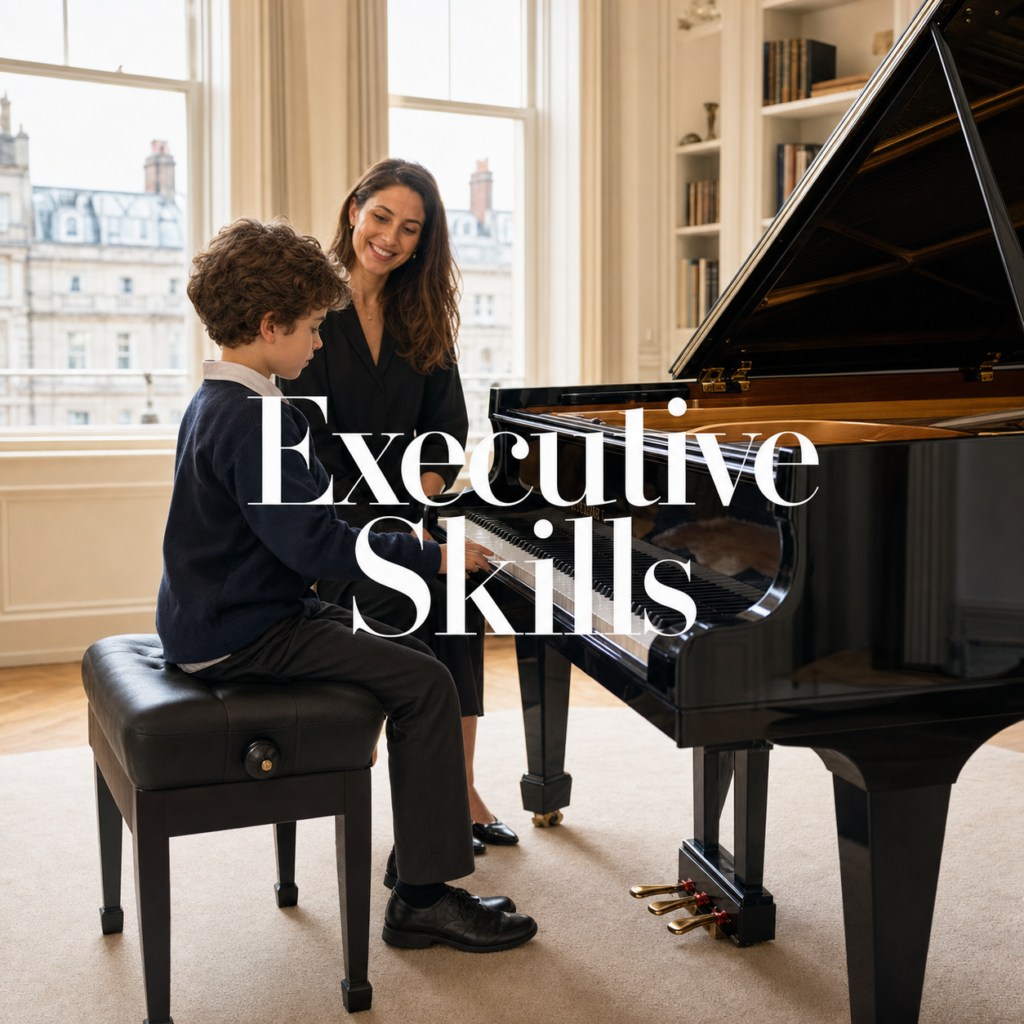
Music and executive function are connected through the small acts of remembering, waiting, adapting and listening that make purposeful learning possible. Piano study can exercise these habits, but the evidence deserves a careful reading.
The short answer: structured music learning is associated with modest improvements in several executive skills, especially inhibitory control. It is a promising form of rich learning, not a guaranteed route to higher intelligence or effortless concentration.
What executive function means in everyday family life
Executive function is a family of mental processes that helps a child act with purpose rather than simply react. Researchers commonly group it into three closely related capacities: working memory, which holds information in mind; inhibitory control, which helps a child pause or resist an automatic response; and cognitive flexibility, which allows a change of plan when a rule or situation changes.
These capacities appear in ordinary moments. A child uses working memory to follow a two-step instruction. Inhibitory control helps them wait for their turn rather than interrupt. Cognitive flexibility helps them try a different method when the first one fails. They develop over many years and are shaped by maturation, relationships, sleep, movement, play, schooling and repeated opportunities to practise self-regulation.
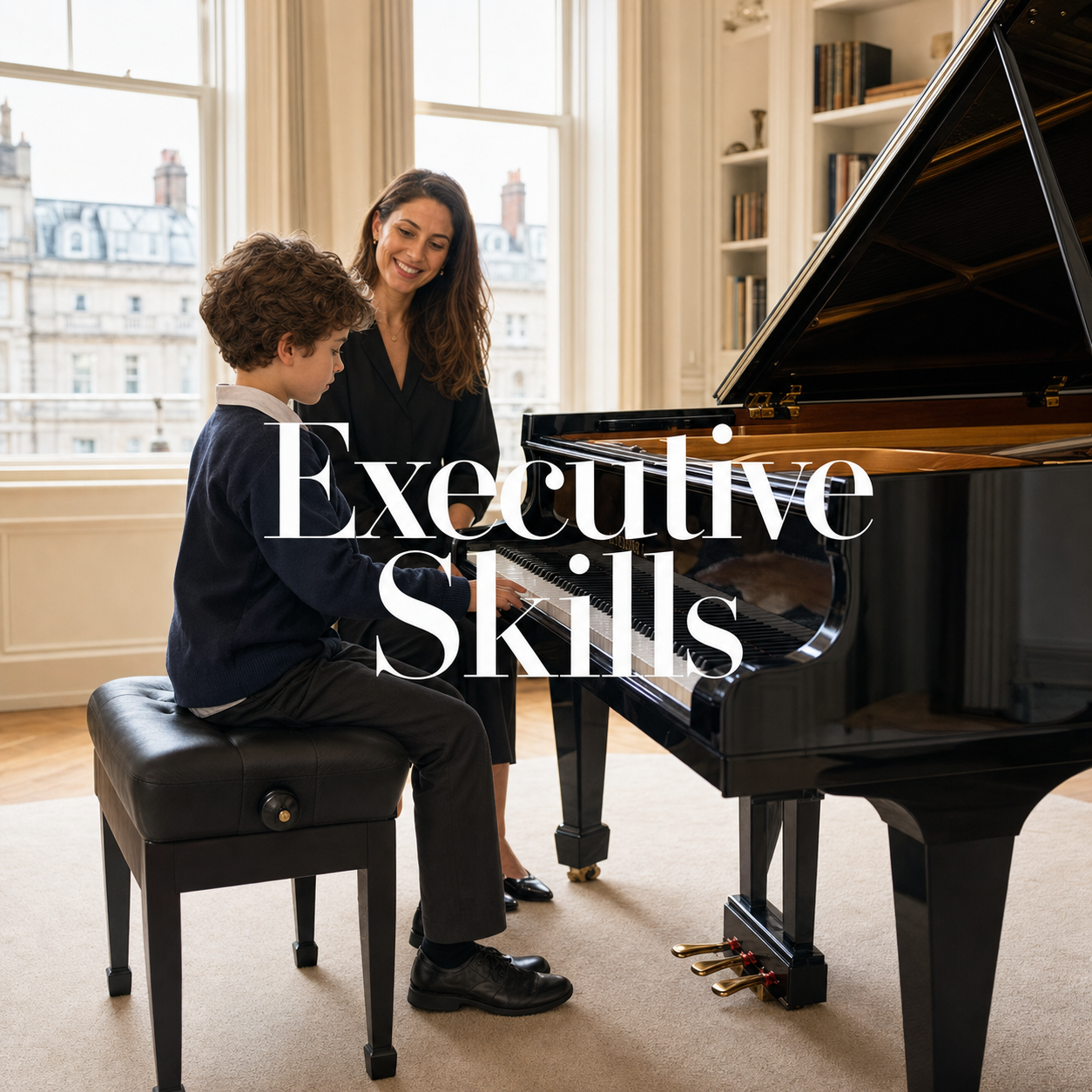
This is why a musical instrument is interesting. It gathers several demands into one meaningful activity. The pupil listens to a sound, remembers what comes next, coordinates both hands, notices an error and modifies the next attempt. The result is music, so the mental work has an immediate purpose rather than feeling like an abstract test.
For parents
Executive skills are not a verdict on a child’s ability. They fluctuate with tiredness, stress, novelty and the difficulty of the task. Look for gradual patterns, not a perfect performance on every day.
What research says about music and executive function
A 2022 systematic review examined 29 controlled studies involving children from preschool to adolescence. The authors found the most consistent evidence for improvement in inhibitory control, particularly among preschool children. Results for working memory and cognitive flexibility were less uniform, and several large trials found little or no advantage over active comparison groups. That mixed pattern matters: enthusiasm should sit beside methodological caution.
A newer systematic review and meta-analysis, published in 2025, brought together ten studies of children aged three to six. It reported small-to-moderate pooled effects for inhibitory control, working memory and cognitive flexibility. The authors also noted differences in programme content, duration, frequency and research quality. Their subgroup findings can help researchers design future studies, but they should not be converted into a rigid home-practice prescription.
A broader 2025 three-level meta-analysis of 46 studies and 3,530 participants also found a modest overall association between musical training and executive function. Taken together, the direction is encouraging. Yet studies use different musical activities, teachers, control groups and assessment tasks. Families should therefore hear “music may support these skills” rather than “music will make every child more organised”.
“The strongest reason to study piano is still musical: to hear more deeply, express an idea and acquire a craft. Cognitive benefits are welcome companions, not the sole destination.”
Three executive skills the piano naturally recruits
1. Hold
Working memory: keep a rhythm, fingering, dynamic or teacher instruction active long enough to use it.
2. Pause
Inhibitory control: wait for the pulse, stop at the requested point and resist rushing after a mistake.
3. Switch
Cognitive flexibility: change articulation, hand, tempo or strategy when the music asks for something new.
Piano is especially clear because these processes can be heard. If the pulse moves too early, the pause was not sustained. If the pattern disappears halfway through, working memory was overloaded. If a pupil repeats the same unsuccessful attempt, they may need help finding a new route rather than more insistence.
What supportive piano teaching looks like
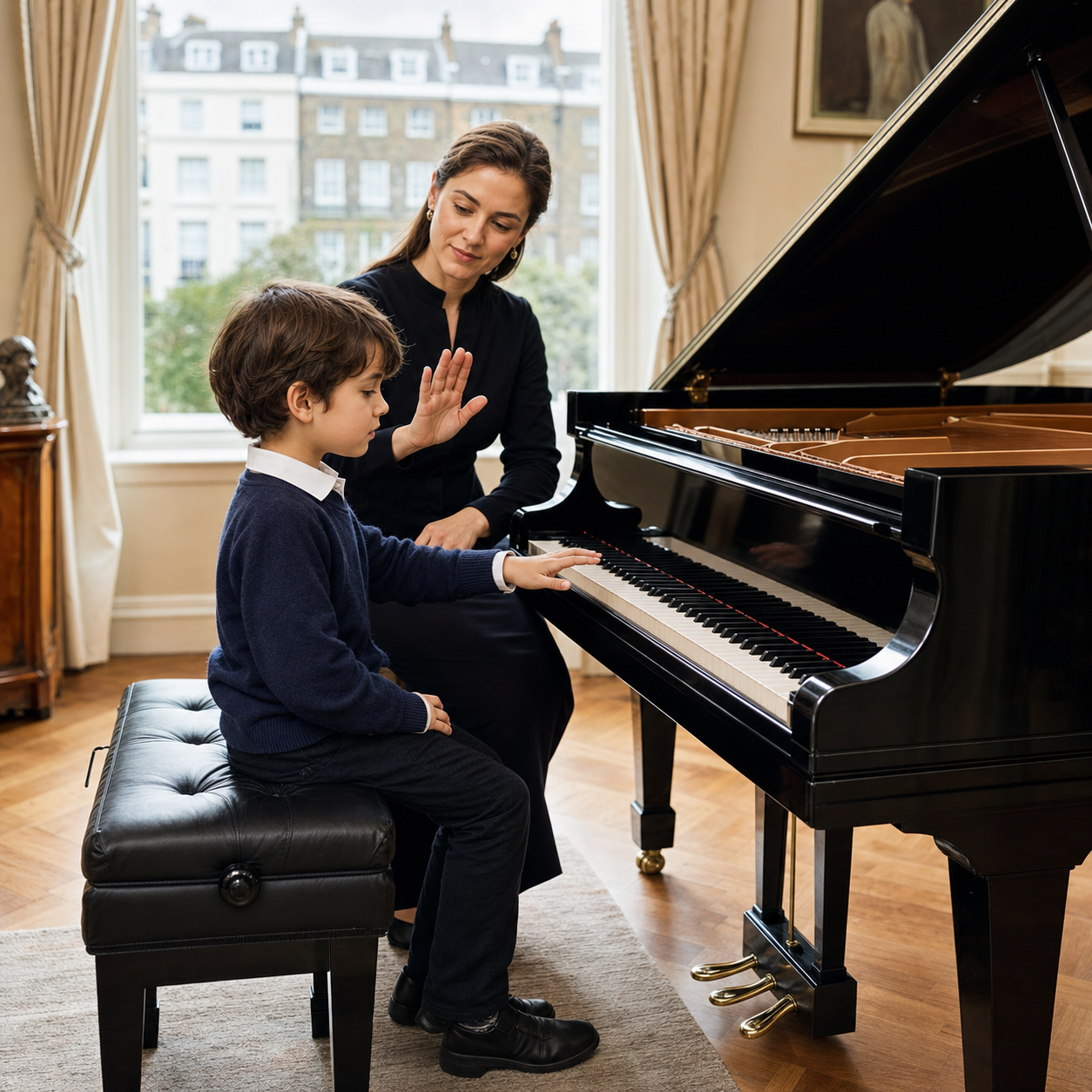
Executive demand must be matched to the child. A skilled teacher makes the next step visible without removing all thought. For one pupil, that might mean isolating two notes and asking for a deliberate pause. For another, it might mean playing a four-bar phrase from memory, then changing only the articulation. The task should be sufficiently challenging to require attention, but sufficiently achievable to preserve curiosity.
This is one reason structured piano lessons for children can help. A teacher can notice whether the obstacle is musical understanding, motor coordination, memory load, reading, confidence or simply fatigue. The response then becomes precise rather than punitive.
| When a child… | The demand may be… | A helpful musical response |
|---|---|---|
| forgets the second instruction | too much working-memory load | give one cue, then add the next |
| rushes immediately after an error | inhibition under pressure | breathe, count one silent bar, restart |
| repeats an unhelpful method | difficulty switching approach | change one variable: hand, rhythm or tempo |
| loses focus in a long session | fatigue, not defiance | finish one small goal and stop well |
A calm home routine that exercises planning
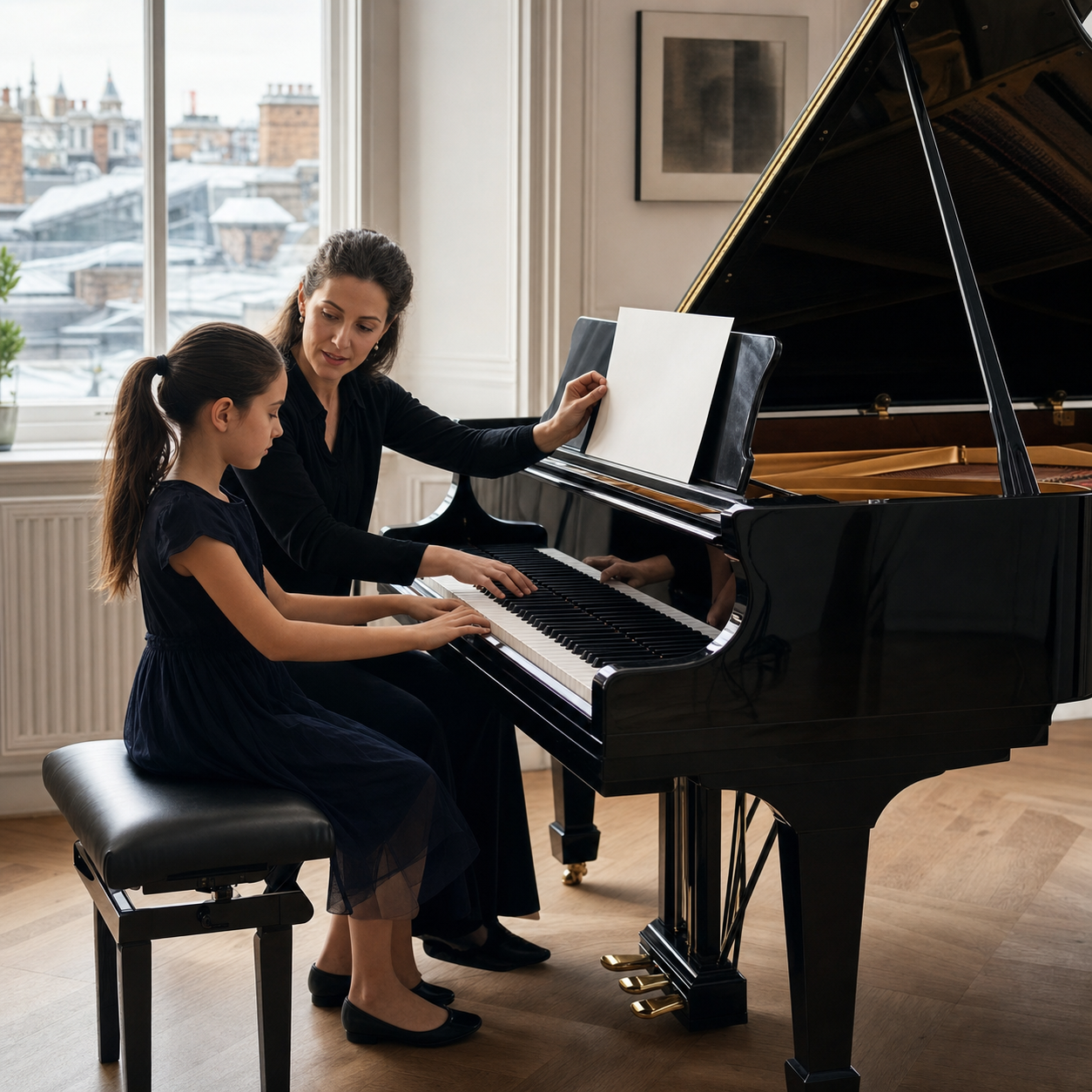
Home practice does not need to resemble a laboratory programme. Its value lies in a predictable sequence, a clear musical goal and a warm relationship. For a young beginner, fifteen focused minutes may be more useful than a prolonged negotiation. Older or more experienced pupils can work longer, but quality remains more revealing than the clock.
The five-part practice path
- Choose: name one small outcome, such as an even opening phrase.
- Recall: ask the child what the teacher suggested before supplying the answer.
- Try: play a short section once with full attention.
- Compare: identify one thing that changed and one thing to adjust.
- Close: repeat the successful version, mark the achievement and stop calmly.
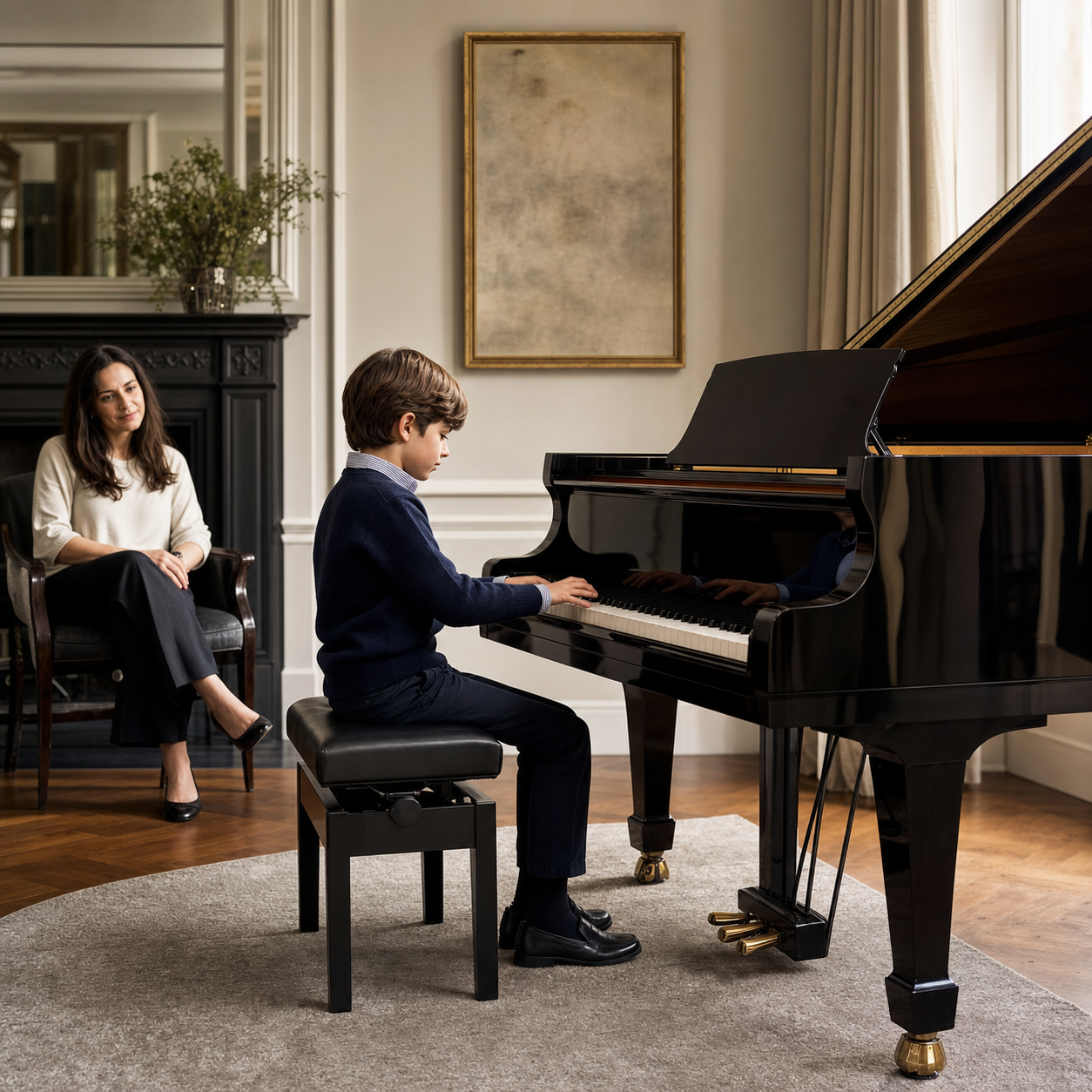
Parents can support the frame without becoming a second teacher. Questions such as “What are you listening for?” or “Which part will you try differently?” invite planning. By contrast, a stream of corrections can overload working memory and make the child dependent on external prompts. WKMT’s guide to piano practice tips for parents explores how to keep this partnership calm and sustainable.
Teacher’s note
If every practice ends in conflict, reduce the number of decisions. Agree the time, choose a single goal and let the teacher decide the technical method at the next lesson.
Progress parents can notice without turning practice into a test
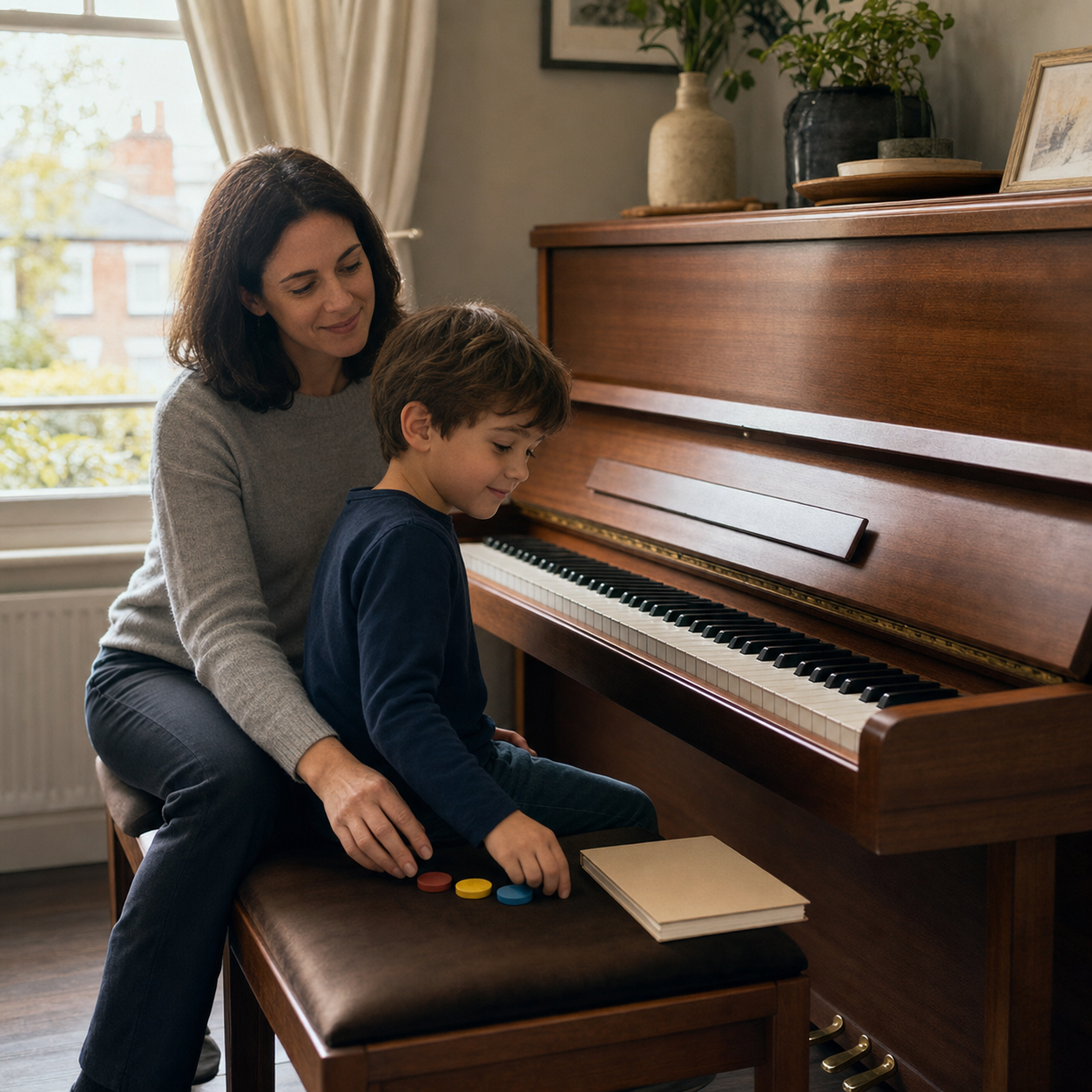
The most useful signs are musical and behavioural rather than numerical. A child may begin to start with less prompting, remember the purpose of a repetition or stop after an error instead of racing on. They may accept a slower tempo, describe what went wrong more precisely or choose a different practice method. None of these appears in a straight line. A difficult school day can temporarily hide skills that are developing well.
Keep observations light. One sentence at the end of practice is enough: “You paused and found another way.” This names the process without attaching a fixed label to the child. Avoid comparing siblings or promising that musical study will raise school marks. When motivation is low, reconnect the task to sound: choose a phrase the pupil enjoys, listen to its shape and make one audible improvement.
A balanced measure
Ask whether the child is becoming a more independent listener, not whether every practice is frictionless. Musical independence grows through well-supported decisions.
Common parent questions
Does piano improve concentration?
Piano repeatedly requires focused listening and coordinated action, and research suggests music training may support aspects of executive control. It cannot guarantee broad concentration gains in every setting. The clearest immediate progress is usually attention within the musical task itself.
Is more practice always better?
No. A short, purposeful session can demand more useful attention than a long session shaped by fatigue and conflict. Match the task to the child’s stage, maintain good technique and end after a clear success when possible.
Should a parent correct every mistake?
Usually not. Select one goal and allow the child time to hear, remember and adjust. If the same problem persists, note it for the teacher. Constant correction can crowd the very planning and self-monitoring that practice should gradually develop.
Keep expectations musical and humane
No instrument can promise a universal transfer into grades, behaviour or general intelligence. Children differ, and improvements on a research task do not automatically appear in every classroom or family situation. Music should not replace appropriate educational, developmental or clinical support when a child needs it.
What piano can offer is a beautifully structured place to practise attention. The child hears cause and effect, works towards a phrase, tolerates a small difficulty and experiences improvement. Over time, those moments can strengthen confidence in effort as well as musicianship. Related WKMT articles on music education in early childhood and music and language development place that growth within a broader picture of play, listening and communication.
Give attention a musical purpose
Thoughtful children’s piano teaching can turn remembering, pausing and adapting into meaningful musical habits, paced for the individual pupil.
Sources on Music and Executive Function: A Parent Piano Guide
Evidence and institutional guidance
- Effects of music training in executive function performance in children: a systematic review, Frontiers in Psychology,
- Effects of music training on executive functions in preschool children aged 3–6 years: systematic review and meta-analysis, Frontiers in Psychology
- Boosting executive function in children aged 3–12 through musical training: a three-level meta-analysis, Frontiers in Psychology
- The association between music training and executive function in 6–7-year-old children, Frontiers in Education
- Cognitive enrichment through art: a randomised controlled trial of music or visual arts group practice
- Enhancing and practising executive function skills with children, Center on the Developing Child at Harvard University.