
 TRIAL LESSON
Piano Lessons
Music Language Development: How Listening, Rhythm and Piano Support Young Children
Jul
Music Language Development in London
A parent’s guide to sound, speech and first piano steps
Music Language Development: How Listening, Rhythm and Piano Support Young Children
Music language development begins long before a child reads a note. Songs, pauses, repeated rhythms and shared listening can make communication feel playful, predictable and deeply human.
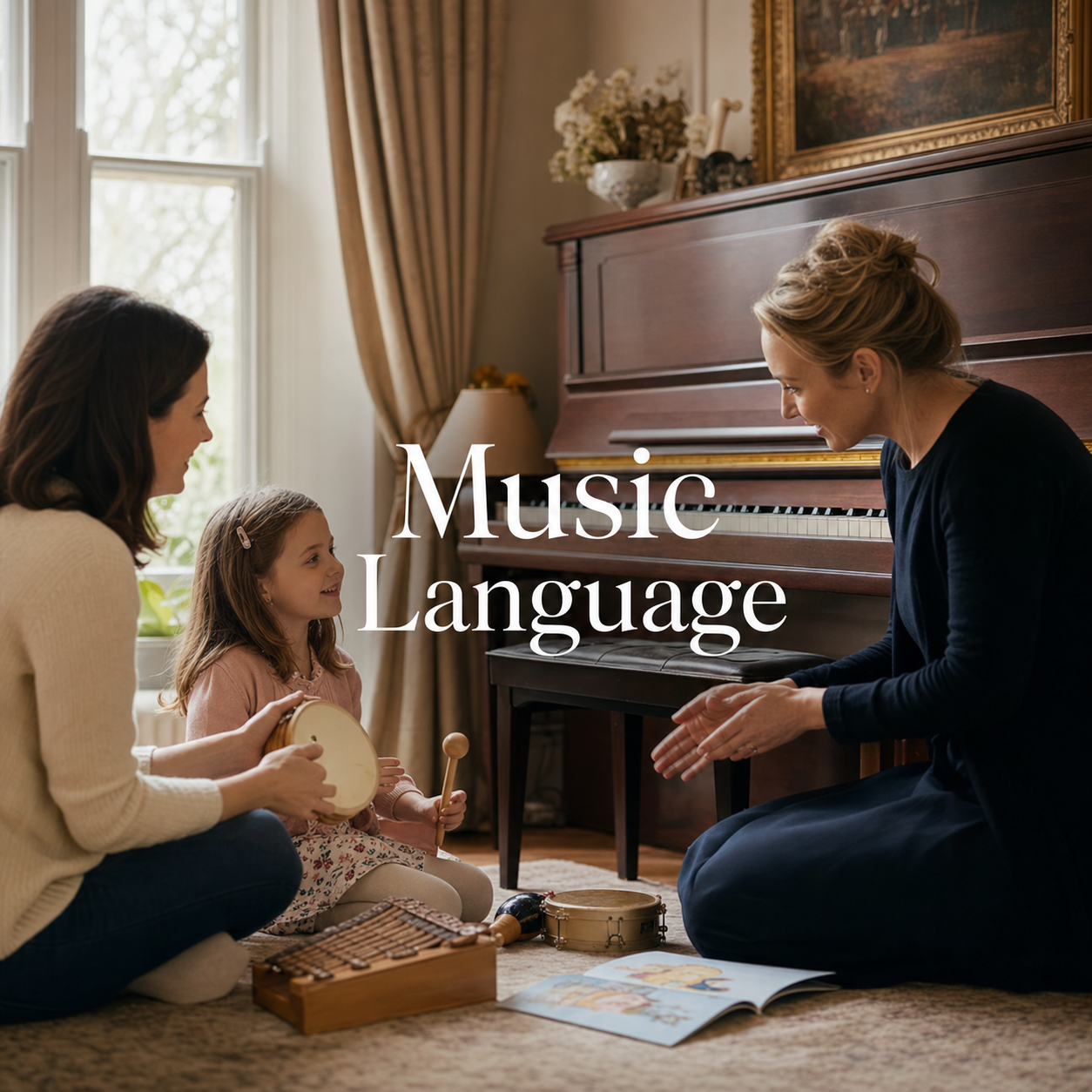
A child hears the rise and fall of a familiar voice, waits through a tiny pause, then answers with a sound, gesture or smile. That exchange already contains many of the materials shared by music and language: timing, pitch, pattern, memory, attention and turn-taking. Music does not replace conversation, stories or specialist support. It can, however, give families an inviting way to practise the habits that make communication possible.
The most useful approach is neither a formal “brain-training” programme nor constant background music. It is active and relational: sing directly to your child, leave space for a response, copy their sounds, clap a pattern together, and let a short piano phrase become a question that they can answer. Research links children’s musical sensitivity and home musical engagement with aspects of vocabulary, gesture, grammar and phonological awareness, while also warning that association is not the same as guaranteed cause and effect.1
For parents
Keep the aim modest and observable. Look for more attentive listening, happier turn-taking, clearer copying and greater confidence in making sounds. A musical activity is valuable when it opens communication, not when it pressures a child to perform.
What music and language share
Speech is patterned sound. English organises syllables around stresses; questions and emotions are carried partly by pitch; conversation depends on knowing when to enter and when to wait. Music makes these features unusually clear. A steady beat creates expectation. A rhyme highlights similar endings. A melody stretches the contour of a phrase. Call-and-response turns listening into participation.
A 2023 review of twelve studies found consistent associations between musical abilities and language abilities in children. Rhythm and melody were linked with measures including grammar, phonological awareness and comprehension, while informal singing and music-making at home also appeared relevant.1 A UCL study of 64 infants aged 8.5 to 18 months found that the home musical environment predicted gesture development; among infants under twelve months, parental singing and the broader musical environment also predicted word comprehension.2 These are encouraging findings, but they should be read as evidence for a promising relationship rather than a promise that music lessons will produce a particular language outcome.
Musical play can also be welcoming in multilingual homes. Parents do not need to abandon the language in which they sing, joke and respond most naturally. A familiar song in one language, a rhyme in another and a wordless sound game can all belong to the same family repertoire. The NHS advises parents to speak to a child in whichever language feels comfortable and notes that growing up with more than one language can be an advantage.6 Music offers a shared frame without asking the child to choose between parts of their identity.
“The musical gift is not a perfect imitation. It is the feeling that a child’s sound has been heard and deserves an answer.”
A simple pathway from sound play to the piano
Children do not need to move through musical experiences at identical ages. Development is uneven, and temperament matters. The pathway below is therefore a set of possibilities, not a test.
The listen–answer pathway
| Stage | Musical exchange | Communication habit |
|---|---|---|
| Baby and young toddler | Face-to-face songs, bouncing pulse, copying babble | Shared attention and anticipation |
| Toddler | Action rhymes, stop-and-go games, sound choices | Turn-taking and sound discrimination |
| Pre-school child | Clapping names, inventing verses, high-and-low piano sounds | Syllable awareness and expressive choice |
| Young beginner | Short echo phrases, singing before playing, musical storytelling | Listening memory, sequence and confident response |
Five musical exchanges to try at home
Choose one activity and repeat it for several days before adding another. Repetition lets a child predict the shape of the game, while small variations invite flexible attention. Keep the television and radio off during the exchange so your voice, the child’s reply and the musical sound remain easy to distinguish.
- Sing and leave the last word open. Pause before the final word of a familiar song. Accept a sound, gesture or glance as an answer; do not rush to fill the gap.
- Clap the rhythm of names. Say family names naturally, then clap their syllables. Compare long and short names without turning the game into a correction exercise.
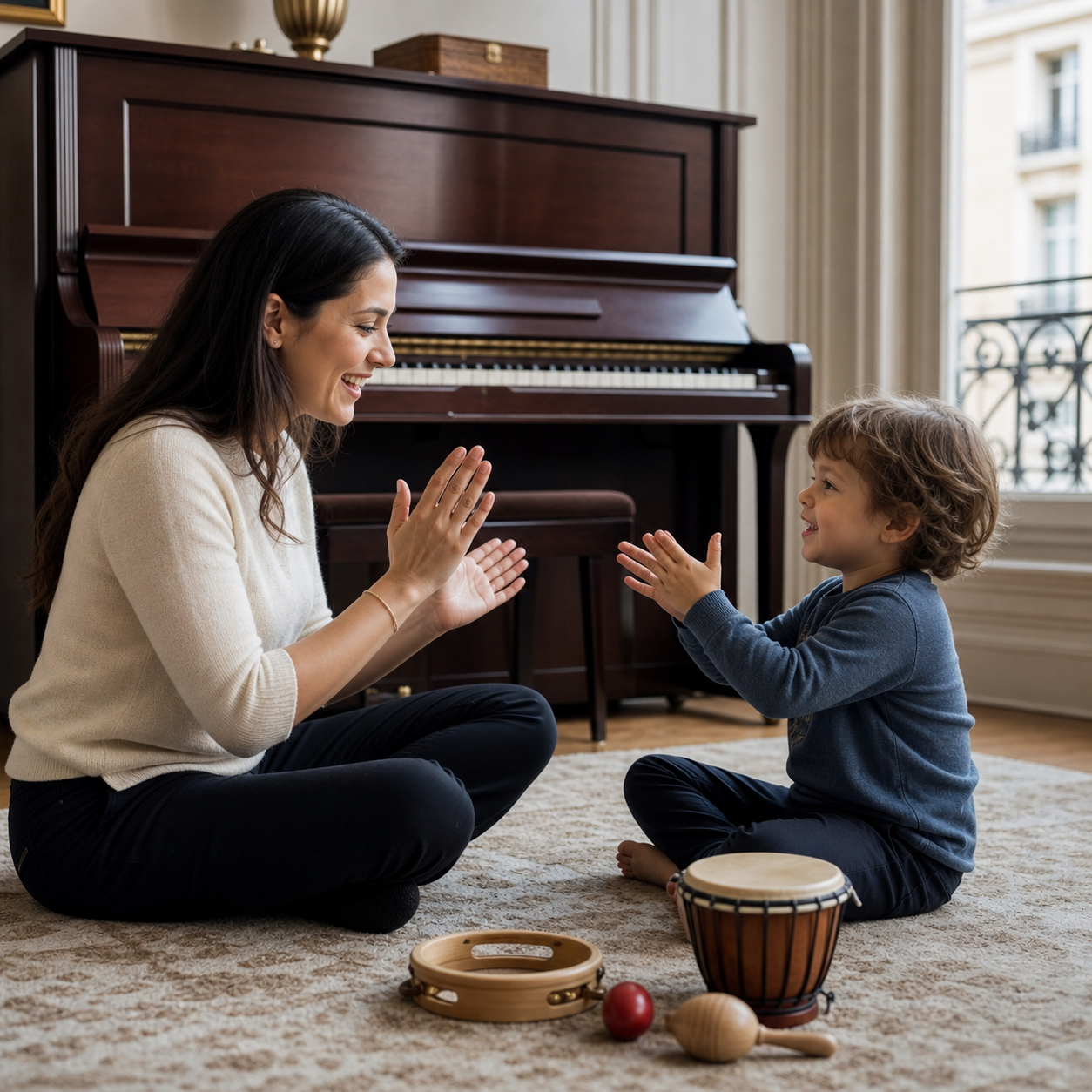
- Play a sound conversation. Use a drum, saucepan or two safe piano notes. Offer a very short pattern, then wait. Copy the child’s reply before introducing a variation.
- Give a song a new verse. Replace one noun or action in a well-known song. The Department for Education recommends playful song-word changes as a way to encourage listening, confidence and new vocabulary.3
- Turn a picture into sound. Choose one image in a book and ask, “What might this sound like?” A low note might be an elephant; a light repeated note might be rain. Follow the child’s invention.
Practice insight
Three engaged minutes are more useful than twenty distracted ones. Finish while the exchange still feels enjoyable, and repeat the same game on another day. Familiarity frees a child to listen more deeply and contribute more boldly.
How piano lessons can support music language development
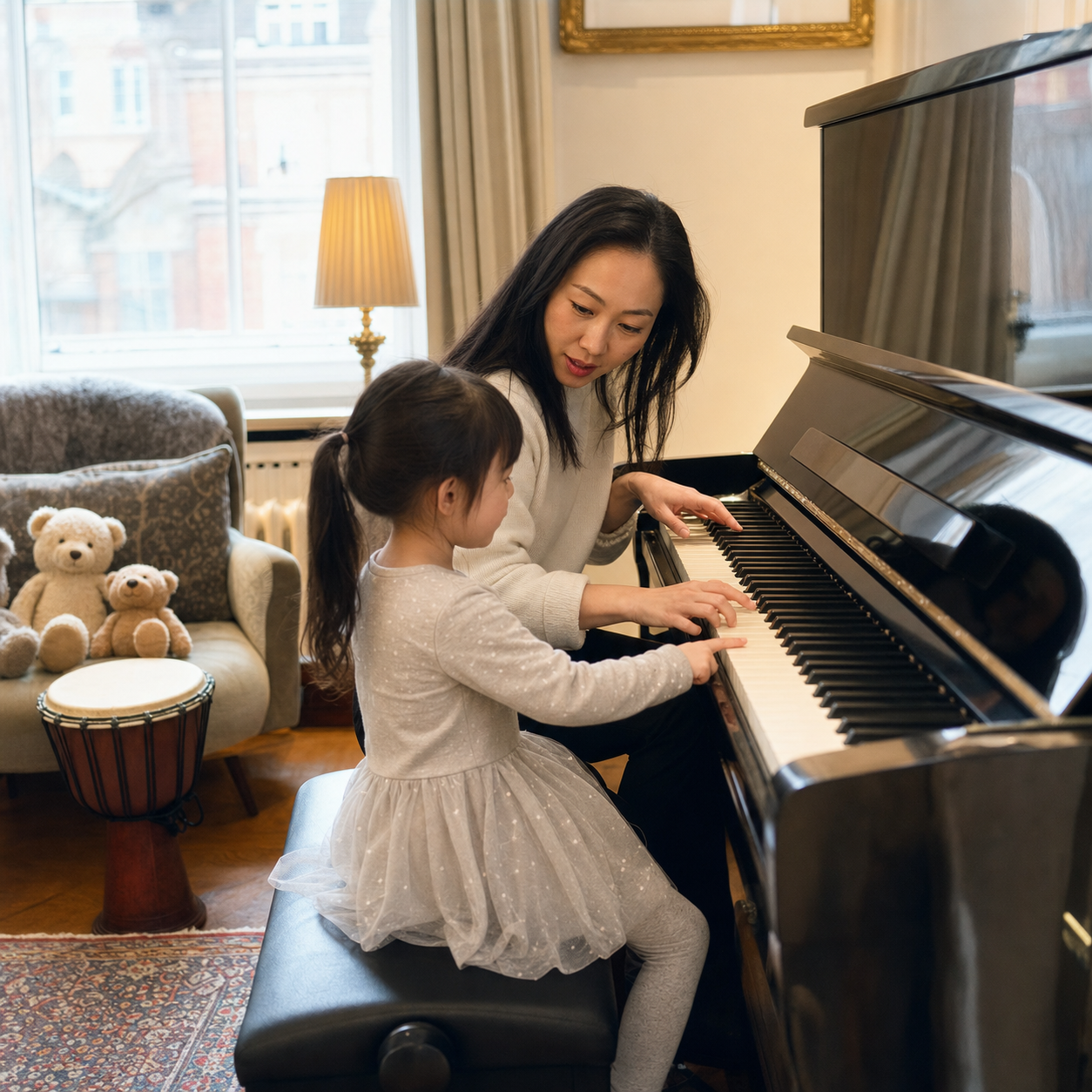
Piano study adds a valuable feature to musical play: a visible, stable map of sound. Higher and lower notes have clear positions. A short pattern can be heard, seen, remembered and reproduced. A sensitive teacher can turn this into genuine dialogue by singing phrases, using simple imagery, waiting for the pupil’s response and adjusting the task to the child’s attention.
For a young beginner, a good lesson may include copying two notes, describing a musical contrast, walking a pulse, choosing an ending for a phrase and playing a tiny story. These activities strengthen musicianship first. Their language value lies in the same habits: noticing detail, holding an idea in mind, sequencing events, interpreting tone and answering another person.
The distinction matters. Piano tuition is education, not speech and language therapy. It should never be sold as treatment, and parents should not delay professional advice because a child enjoys music. Recent reviews of rhythm-based interventions report promising results for phonological awareness and reading fluency, but also substantial methodological limits and a need for stronger long-term evidence.4
Choosing the right moment and teacher
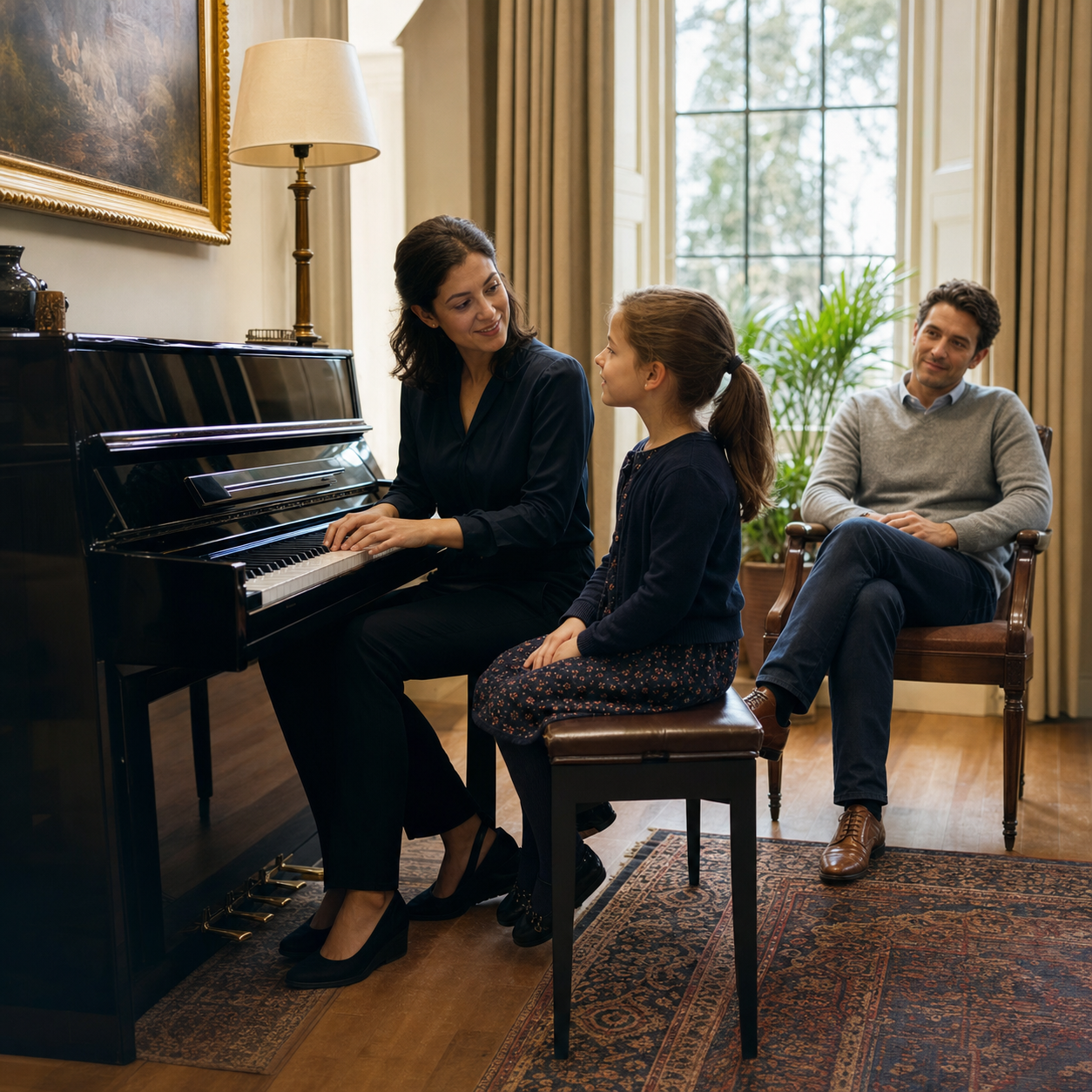
Readiness is less about a birthday than about participation. A child may be ready for first piano steps when they can share attention for a few minutes, imitate a simple action, enjoy repeating a short pattern, tolerate gentle guidance and show curiosity about the keyboard. They do not need to read words, know letter names or sit perfectly still.
Look for a teacher who speaks clearly without over-talking, demonstrates before explaining, welcomes the parent appropriately, uses singing and movement, and can change pace without losing the musical goal. Ask how lessons are adapted for young beginners and how home practice is introduced. Our guide to recognising a child’s musical curiosity can help parents notice readiness without labelling talent too early, while the early-childhood music pathway gives broader context from listening and play to first piano steps.
Teacher’s note
The strongest early lesson may look deceptively simple. If a child listens to a two-note phrase, answers it with intention and wants to do it again, the foundations of musical thought are already being built.
When music is not enough
Children develop at different rates, and one missed milestone does not provide a diagnosis. Even so, persistent concerns deserve attention. Evelina London advises seeking guidance when, for example, a one-year-old is not responding to familiar voices or babbling, a two-year-old is not attempting words, or an older pre-school child has marked difficulty understanding language, forming sentences or joining conversation.5 The NHS recommends speaking to a GP or health visitor if you are worried; families may also be able to contact local speech and language therapy services directly.6
Continue singing and musical play if the child enjoys them, but treat them as a supportive relationship, not an assessment or cure. A qualified speech and language therapist is the appropriate professional for specific communication concerns.
A thoughtful next step for London families
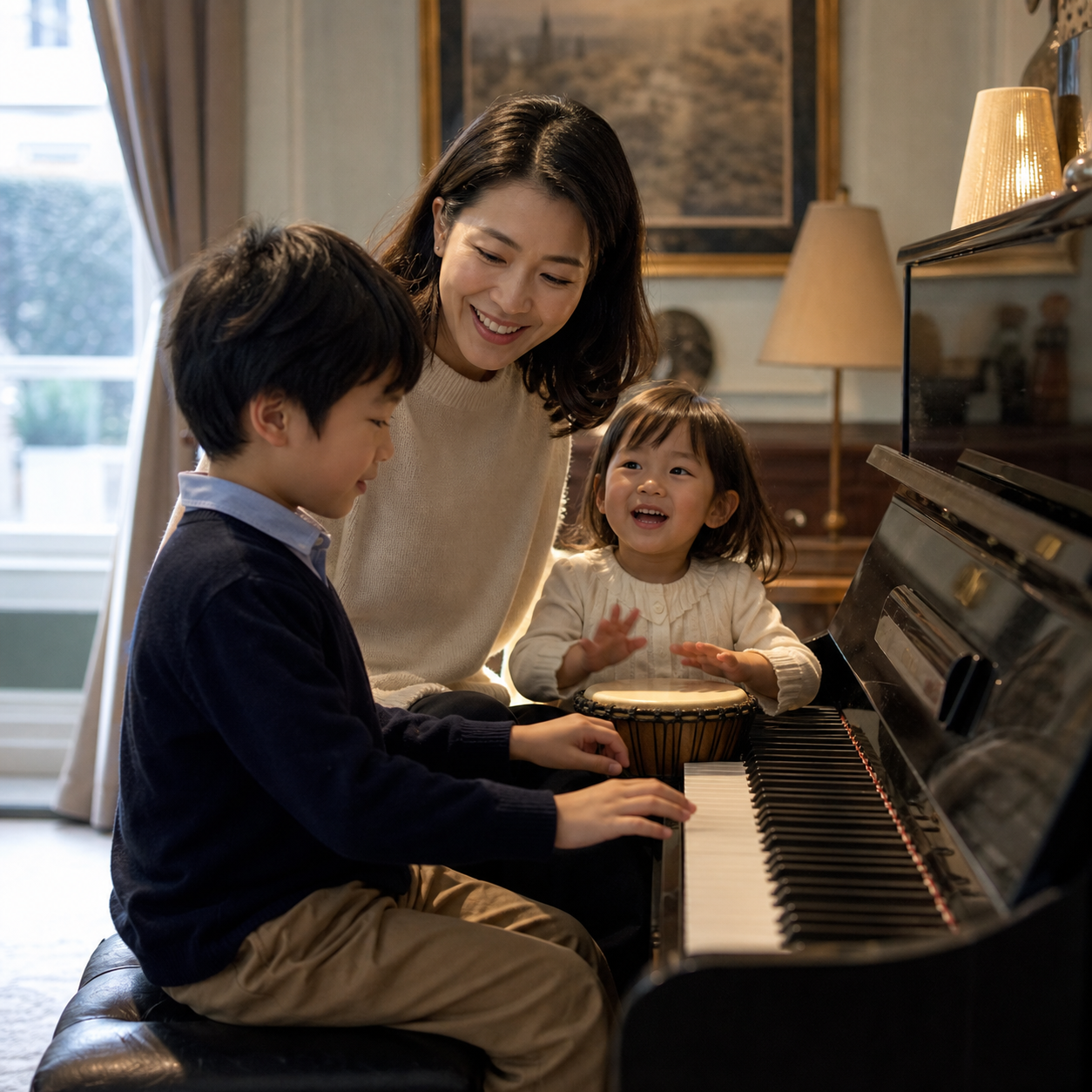
For most families, music language development grows through ordinary moments of close attention rather than elaborate equipment. For those considering structured study, WKMT’s piano lessons for children in London provide a natural next step from playful listening to individual musical learning. The aim is not to accelerate a child through material, but to match teaching, repertoire and practice expectations to the pupil in front of us. WKMT’s wider London piano teaching community supports families across different ages and stages.
Begin with a musical conversation
If your child is curious about sound and ready to share a short, focused activity, a carefully paced lesson can turn that curiosity into listening, confidence and expressive playing.
Questions parents often ask
Does listening to music improve a child’s language?
Passive listening alone is unlikely to be the most useful route. Evidence is more persuasive around active engagement: parental singing, shared rhythm, movement, imitation and musical turn-taking. These activities sit alongside conversation and reading, not in place of them.
Should we start piano before a child can read?
Often, yes. A young child can learn through listening, singing, movement, pattern and imitation. The deciding factors are interest, shared attention and the teacher’s ability to work appropriately with an early beginner.
Can piano lessons help a child with a language delay?
Music can offer an enjoyable setting for listening and expression, but piano lessons are not clinical treatment. Seek assessment from a GP, health visitor or speech and language therapist when development causes concern, and let musical activity remain a positive complement.
Sources and further reading on Music Language Development
- Frontiers in Psychology / PubMed Central, The Association between Music and Language in Children: A State-of-the-Art Review
- UCL Institute of Education, The impact of the home musical environment on infants’ language development
- Department for Education, Listening and understanding: songs to encourage sound and word play
- BMC Psychology / PubMed, The efficacy of rhythmic training for enhancing language and reading skills in children
- Evelina London Children’s Healthcare, When to be concerned about your child’s speech and language development
- NHS, Help your baby learn to talk .
- Royal College of Music Research Online, Music in early education and care settings for communication and language support