
 TRIAL LESSON
Uncategorized
Is My Child Musical? A Parent’s Guide to Listening, Curiosity and Piano Readiness
Jul
Is My Child Musical? Parent Guide to Musical Signs
A parent’s listening guide
Is My Child Musical? A Parent’s Guide to Listening, Curiosity and Piano Readiness
Musicality is rarely one dazzling trick. It is more often a pattern of attention, pleasure, imitation, imagination and persistence that becomes clearer when a child has room to explore.
If you have found yourself asking, “is my child musical?”, begin by putting aside the idea of a single test. A child may sing accurately yet dislike performing. Another may sing roughly but hold a steady pulse, invent patterns at the piano, remember tiny details in a piece, or become absorbed in the character of a sound. These are different expressions of musical engagement, not a ladder with one correct top rung.
Recent research on children’s musicality describes it as a profile rather than a fixed gift. Perception, musical production, and enthusiasm or motivation can develop at different rates. Everyday singing, dancing, listening and musical games also shape what parents are able to notice. The sensible question is therefore not “does my child possess talent?” but “what musical behaviours appear repeatedly, and what environment helps them grow?”
What does “musical” mean in childhood?
In adult conversation, the word can sound like a verdict. In childhood, it is better understood as a changing combination of abilities and dispositions. A useful framework considers three broad areas:
The three areas influence one another. A child may perceive far more than they can yet reproduce. Singing and rhythmic coordination mature gradually, while confidence can change dramatically with the setting. One awkward performance tells you very little; repeated behaviour across weeks tells you much more.
Seven signs worth noticing
None of these signs proves exceptional ability, and a child need not display all of them. Look for patterns that arise voluntarily and recur in different contexts.
- They notice sound details. They may comment that an instrument sounds bright, dark, gentle or “like footsteps”, or recognise when a familiar song changes.
- They find or maintain a pulse. Clapping, walking, bouncing or tapping in time can reveal rhythmic attention. Young children will not always remain perfectly synchronised.
- They remember musical fragments. A child may recall an opening, a rhythm, a bass pattern or the order of contrasting sections after only a few hearings.
- They imitate and transform. Copying a phrase is useful; changing its ending, rhythm or mood shows imaginative ownership.
- They respond physically or emotionally. Movement, stillness, laughter, suspense and requests to hear a passage again can all show close engagement.
- They organise sound. Repeating a pattern, making a beginning and ending, or choosing contrasting high and low sounds suggests an emerging sense of structure.
- They return without being pushed. Repetition driven by interest is particularly valuable. A child who revisits the keyboard, song or rhythm is beginning to build a relationship with music.
“Musical promise is often heard first as a child’s wish to listen again.”
Ability, motivation and opportunity are different things
Parents naturally notice what a child can do today, but musical development also depends on what they want to do and what they have had the opportunity to practise. A child surrounded by singing may reproduce melodies earlier than one who has heard little live singing. A child with access to a keyboard may look more “naturally” inventive simply because the instrument is familiar. Neither comparison tells us where either child may be after a year of thoughtful teaching.
Motivation is equally easy to misread. Some children throw themselves into every new activity and then move on quickly. Others approach slowly, watch for several weeks and become deeply committed once they feel secure. Musical enthusiasm may appear as loud excitement, but it may also appear as private humming, careful listening, collecting favourite recordings or repeating one tiny passage until it feels right.
Opportunity should be rich but not relentless. Hearing varied music, singing together, attending an age-appropriate concert and having supervised access to an instrument can broaden a child’s experience. Filling every afternoon with coached musical tasks can have the opposite effect, making music feel like another performance demand. Curiosity needs some unmeasured space.
This is why comparisons between siblings are especially unhelpful. One child may have quick aural memory; another may possess stronger physical coordination or a more patient approach to detail. A teacher’s work is to identify the route through which each learner can enter the music, then gradually strengthen the less developed areas.
What parents can test at home without turning it into a test
Choose brief, playful exchanges. Harvard’s “serve and return” model describes the value of noticing a child’s focus and responding to it. The same principle works beautifully in music: offer a sound, wait, notice the response, and build on what the child contributes.
Minute 1–2: Echo. Tap a two- or three-beat pattern and invite a reply. Let the child invent the next pattern.
Minute 3–4: Contrast. Play or sing something high, low, fast, slow, loud or quiet. Ask what changed, without demanding technical words.
Minute 5–6: Memory. Repeat one short pattern after a pause. Notice whether the child recognises or anticipates it.
Minute 7–8: Imagination. Ask for music for a sleepy bear, a small bird or a storm. Listen for deliberate choices.
Minute 9–10: Choice. Offer two activities and see which the child wants to repeat. Preference and persistence matter.
Do this occasionally, not as a daily examination. Record observations in plain language: “kept the pulse during the chorus”, “noticed the tune was higher”, “invented three endings”. Avoid labels such as gifted, unmusical, lazy or tone-deaf. They make development sound settled when it is still moving.
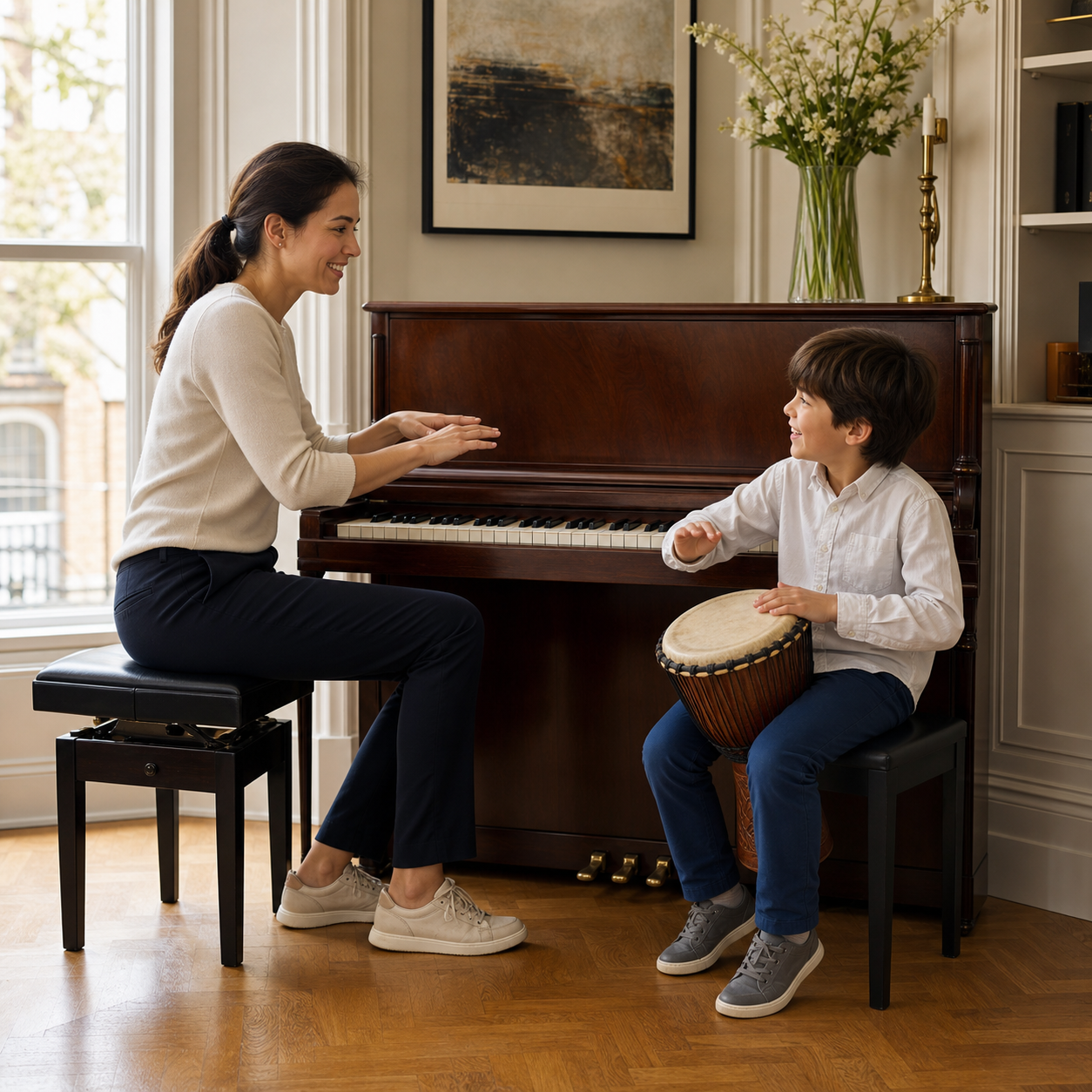
Musical signs and what they may mean
| What you notice | A possible strength | A helpful next step |
|---|---|---|
| Copies rhythms readily | Pulse and auditory-motor coordination | Echo games, marching, simple accompaniments |
| Remembers tunes | Melodic memory and contour | Sing phrases back; find them by ear |
| Invents sound stories | Imagination and musical structure | Improvisation with two contrasting moods |
| Listens for long periods | Attention and emotional engagement | Compare short pieces and discuss character |
| Returns to difficult passages | Motivation and emerging practice habits | Offer one clear goal and a short success check |
What not to mistake for a lack of musicality
Some children need longer to respond in front of adults. Others dislike singing but love pattern, harmony or instrumental colour. Coordination may lag behind perception. A cautious child may be listening intensely while appearing inactive. Neurodivergent children may show engagement in ways that do not match a conventional lesson script.
Research also shows that pitch and rhythmic abilities do not all mature on the same timetable. Singing itself is a developmental skill, not a talent possessed by a chosen few. It is therefore unwise to use one missed note, one unsuccessful recital or one standardised exercise as a final judgement.
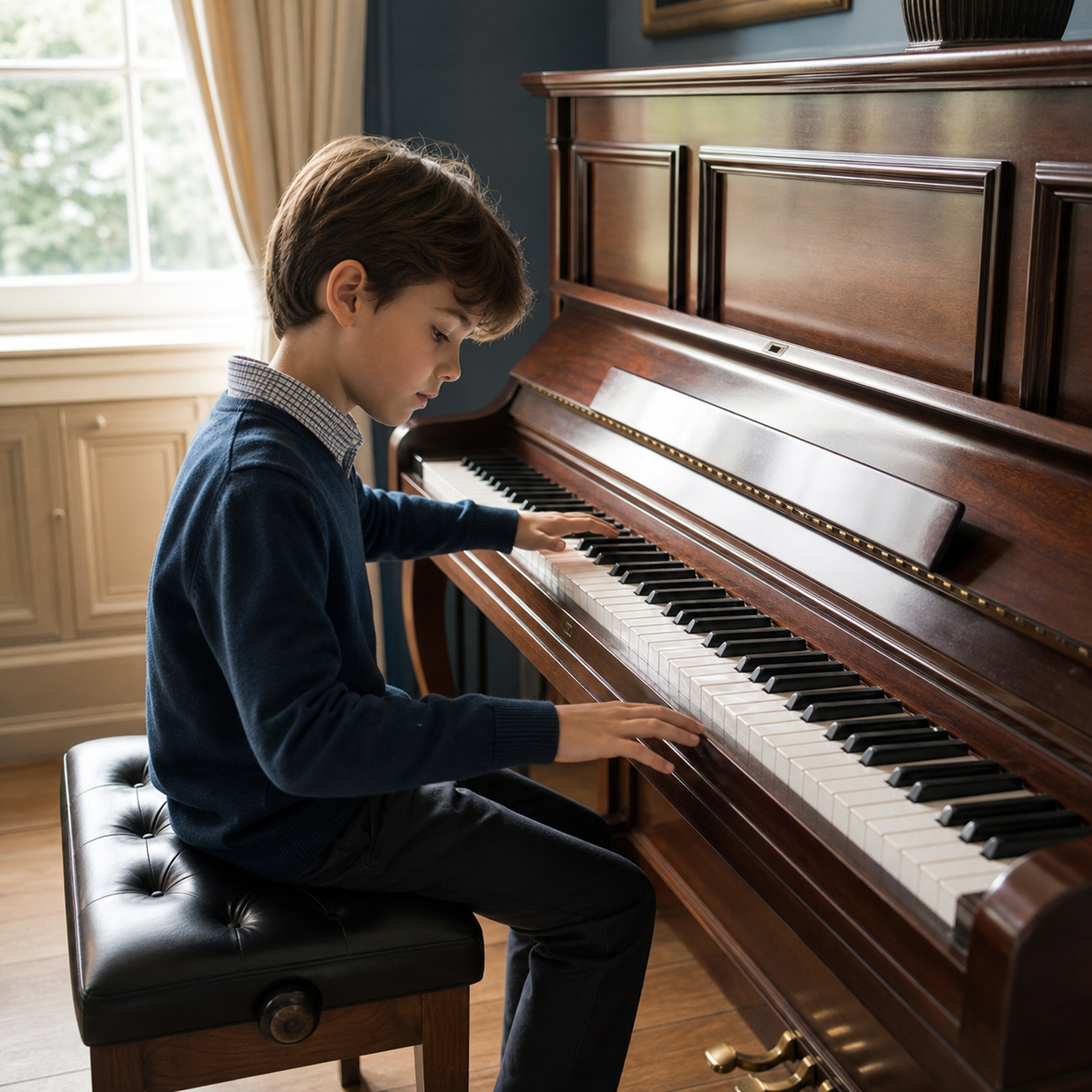
Is my child musical enough for piano lessons?
Musical readiness is not an entrance examination. A more practical set of questions is whether the child can share attention with an adult for a short period, respond to simple instructions, tolerate gentle repetition, and show some interest in sound or the instrument. Age, temperament and lesson length all matter.
For a young beginner, the first lessons should include listening, movement, singing, imitation and imaginative playing, not a rush towards notation. Parents considering structured piano lessons for children in London can look for a teacher who observes the individual child and adjusts pace, language and repertoire accordingly.
Useful related guides include WKMT’s piano practice tips for parents, its playful introduction to piano nursery rhymes, and a careful discussion of the difference between healthy development and the label piano prodigy.
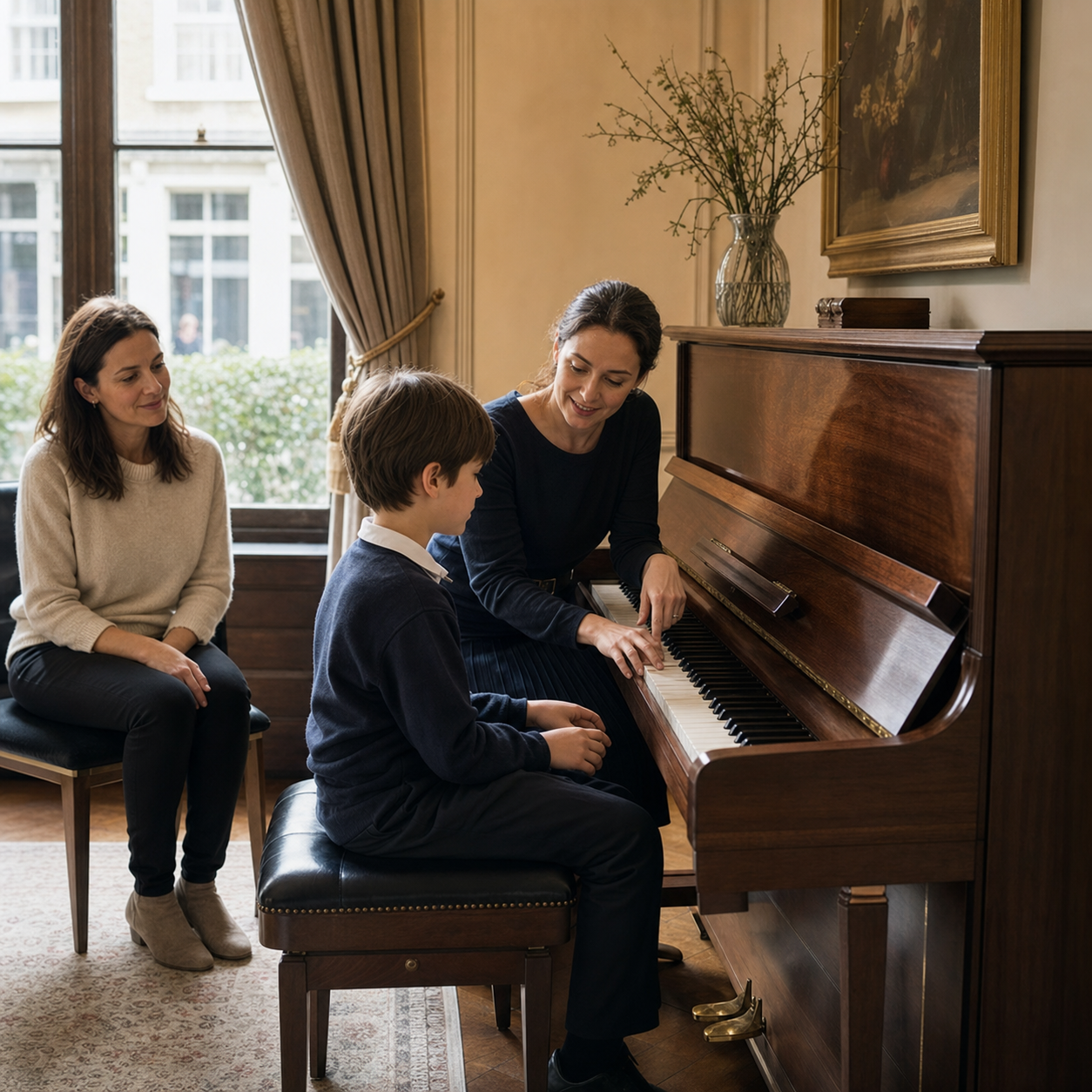
Give musical curiosity a thoughtful next step
If your child is drawn to sound, rhythm or the piano, an attentive teacher can help you understand their present strengths without rushing the process.
A calm answer to the question
If your child notices, responds, experiments or repeatedly returns to music, there is something worth nurturing. If those behaviours are not yet obvious, that does not close the door. Musical abilities develop through maturation, culture, opportunity and teaching. Offer rich listening, playful participation and a responsive adult presence; then watch what grows.
The most helpful answer to “is my child musical?” is often: let us give them a humane musical environment and find out together.
Sources on Is my child musical Guide
- Child Musicality Screening: development and initial validation, PLOS One / PubMed Central
- The development of musical skills of children over one year, Frontiers in Psychology
- Best Start in Life: the four specific areas of learning, Department for Education
- Serve and Return, Center on the Developing Child at Harvard University
- Arts Participation, Education Endowment Foundation
- Rhythm and melody tasks for school-aged children, Frontiers in Psychology