
 TRIAL LESSON
Piano Lessons
ABRSM Exams in London: Your Ultimate Guide to Success

Mar
ABRSM Exams London – Complete Guide
Mastering ABRSM Exams in London: Your Ultimate Guide to Success

“Music exams aren’t just tests—they’re milestones in your musical journey.”
🎵 Quick Navigation on ABRSM Exams London
- Understanding ABRSM Exams
- London Exam Centers & Costs
- Preparation Timeline & Strategies
- One Week Before: Final Preparations
- Exam Day Success Strategies
- After Your Exam: Results & Next Steps
- Performance Grades: The Online Option
- FAQ Section
Understanding ABRSM Exams
The Associated Board of the Royal Schools of Music (ABRSM) provides internationally recognized music qualifications that serve as important milestones in a musician’s development.
Whether you’re a beginner or advanced student, understanding the exam structure is key to your success.
What’s Being Assessed?
Each ABRSM exam evaluates four core components:
| Component | Description | Percentage |
|---|---|---|
| Pieces | Three prepared pieces from the syllabus | 30 marks each (90 total) |
| Scales & Arpeggios | Technical exercises appropriate to your grade | 21 marks |
| Sight-reading | Playing unfamiliar music at first sight | 21 marks |
| Aural Tests | Listening skills and musical perception | 18 marks |
Success Target: A passing score requires 100 out of 150 marks, with Merit at 120+ and Distinction at 130+.
London Exam Centers & Costs
Top Exam Venues in London
London offers numerous exam centers, each with different facilities and accessibility options:
- The Crowndale Centre (Camden)
- Guildhall School of Music & Drama
- Royal Academy of Music
- Trinity Laban Conservatoire
2025+ Exam Fees Breakdown
| Level | Basic Fee | Facility Fee | Total |
|---|---|---|---|
| Prep Test | £53 | £7.50-15 | £60.50-68 |
| Grades 1-3 | £68-78 | £7.50-15 | £75.50-93 |
| Grades 4-5 | £94-101 | £7.50-15 | £101.50-116 |
| Grades 6-8 | £115-137 | £7.50-15 | £122.50-152 |
Additional costs to consider:
- Accompanist fees: approximately £20 (required for most instruments except piano and guitar)
- Sheet music: £10-20 per grade
- Lesson fees for exam preparation
Money-Saving Tip: Subsidies may be available for eligible candidates receiving Free School Meals, Housing Benefit, or Council Tax Support—potentially reducing exam fees by 50%!
Preparation Timeline & Strategies for Practical ABRSM Exams
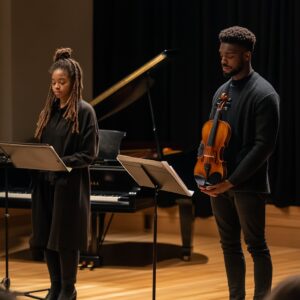
Your Countdown to Success
| Months Before | Focus Areas |
|---|---|
| 6-12 months | • Select appropriate pieces • Begin technical exercises • Start slow, focused practice |
| 3-6 months | • Increase practice frequency • Memorize scales and arpeggios • Record yourself playing |
| 1-3 months | • Complete mock exams • Refine problem areas • Practice with accompanist |
| Final month | • Full run-throughs • Sight-reading daily practice • Aural test preparation |
Mastering the Components
💪 Scale Success Strategies
Scales often make the difference between passing and distinction! Try these approaches:
- Practice with a metronome at various speeds
- Create a “scale challenge jar” – pick scales at random daily
- Record and critically analyze your scale performances
- Practice scales in different rhythmic patterns to build flexibility
🎼 Piece Perfection
Your pieces represent 60% of your total marks, so give them the attention they deserve:
- Analyze first, play second – understand the structure and musical context
- Break complex passages into small, manageable sections
- Practice at 70% speed with 100% accuracy
- Record yourself weekly to track progress and identify issues
- Focus on expression and musicality, not just correct notes
👁️ Sight-Reading Secrets
Make this challenging component more manageable with:
- Daily 5-minute sight-reading practice with new material
- “Scan and plan” technique – take 30 seconds to analyze before playing
- Focus on rhythm first, then notes
- Practice maintaining a steady pulse despite mistakes
👂 Aural Skills Development
Don’t leave this until last! Integrate into your daily practice:
- Use ABRSM’s aural training apps
- Practice with a friend taking turns giving tests
- Record melodic patterns and practice singing them back
- Identify cadences and rhythms in pieces you’re already learning
Discover exceptional piano lessons with WKMT, a leader in piano education since 2010. Available in-studio in London or online worldwide.
One Week Before: Final Preparations
The final countdown is on! Here’s your week-before checklist:
📋 Your Pre-Exam Checklist
- [ ] Confirm logistics – Exact location, time, transportation plan
- [ ] Organize materials – Examination copies of music, pencil, instrument accessories
- [ ] Practice run-through – Complete mock exam with teacher
- [ ] Maintenance check – Ensure instrument is in perfect condition
- [ ] Rest schedule – Plan adequate sleep for the week
- [ ] Outfit selection – Choose comfortable, appropriate clothing
🧠 Mental Preparation Techniques
Feeling nervous? Try these proven anxiety-management strategies:
- Visualization practice – Mentally rehearse a successful exam experience
- Positive affirmations – Replace negative thoughts with confidence-building statements
- Breathing exercises – Deep breathing to manage physical symptoms of anxiety
- Performance practice – Play for friends and family to simulate exam pressure
Exam Day Success Strategies
Before You Enter
- Arrive early – At least 30 minutes before your scheduled time
- Use warm-up rooms if available at your center
- Stay hydrated but avoid excessive caffeine
- Gentle warm-up – Focus on relaxation and familiar passages
In the Exam Room
- Make a positive first impression – Greet the examiner with confidence
- Take your time settling in – Adjust the piano stool or music stand as needed
- Tune carefully – Teachers can help with tuning for Grades 1-5
- Recover smoothly from mistakes – Keep going without stopping
Remember: Examiners want you to succeed! They’re looking for reasons to award marks, not take them away.
Common Examiner Behaviors Explained
- Silent typing – Examiners use digital devices to record comments; this doesn’t indicate negative assessment
- Stopping you during pieces – This usually means they’ve heard enough to make their assessment, not that you’re performing poorly
- Brief pauses between sections – Normal part of the assessment process, not a reflection on your performance
After Your Exam: Results & Next Steps
Digital Certificates: The New Standard
Since April 2024, ABRSM has modernized with digital certificates that include QR codes for instant verification. These digital documents offer several advantages:
- Immediate availability with your results
- Secure authentication through unique QR codes
- Environmentally friendly compared to paper certificates
- Easily shareable for educational or professional purposes
Paper Certificate Option: While digital is the new standard, you can request a traditional paper certificate for just £3.00 if you prefer the physical version for framing or traditional documentation purposes.
Understanding Your Results
Results typically include:
- Overall grade – Pass (100-119), Merit (120-129), or Distinction (130-150)
- Component marks – Individual scores for each exam section
- Examiner comments – Specific feedback on your performance
Building on Your Experience
Whatever your result, use the experience to grow:
- Analyze examiner feedback with your teacher
- Identify strengths to build upon
- Address development areas before progressing
- Celebrate your achievement regardless of the outcome!
Performance Grades: The Online Option
What Are Performance Grades?
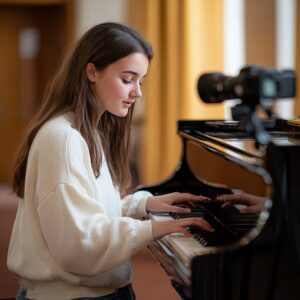
Introduced in 2020 and now a permanent fixture in ABRSM offerings, ABRSM Performance Grades provide a digital alternative to traditional face-to-face exams. These assessments focus entirely on performance skills, making them perfect for:
- Students who experience exam anxiety in traditional settings
- Those with limited access to exam centers
- Musicians seeking flexibility in exam scheduling
- Performers who want to focus solely on repertoire without technical exercises
Key Differences from Traditional Practical ABRSM Grades
| Feature | Traditional Practical Grades | Performance Grades |
|---|---|---|
| Format | In-person with examiner | Video recording submitted online |
| Pieces Required | 3 pieces | 4 pieces (including 1 free choice) |
| Technical Requirements | Scales, arpeggios, sight-reading, aural tests | None – 100% performance-based |
| Assessment Value | Pieces worth 60% of total marks | Pieces worth 100% of total marks |
| Duration | Varies by grade (typically 10-30 minutes) | One continuous video recording (no editing) |
The Four-Piece Program
For Performance Grades, you’ll prepare four pieces:
- Three pieces from the ABRSM syllabus – One from each list (A, B, and C)
- One free choice piece – At the same grade standard but selected by you
Free Choice Advantage: The free choice piece allows you to showcase your strengths and personal musical interests, potentially boosting your overall score.
Assessment Criteria
Performance Grades are assessed on four key areas:
- Pitch – Accuracy, intonation, and security of notes and rhythms
- Time – Tempo, rhythm, and pulse management
- Tone – Sound quality and instrument control
- Shape – Expression, phrasing, and artistic interpretation
Each piece receives marks out of 30, with an additional 30 marks for your overall performance, totaling 150 marks.
Recording Requirements
To ensure your Performance Grade recording meets ABRSM standards:
- Single continuous take – No editing, cuts, or multiple attempts spliced together
- Visible performer – Your face and hands/instrument must be visible throughout
- Proper introduction – State your name, instrument, grade, and piece titles
- Appropriate setting – Well-lit, quiet environment with minimal background noise
- Reasonable audio quality – Clear sound that accurately represents your playing
Submission Process
- Record your performance using a smartphone, tablet, or camera
- Upload to ABRSM’s online platform within 30 days of booking your exam
- Complete the submission form with details about your free choice piece
- Submit and wait for results – Typically available within 1-2 weeks
Tech Tip: Always do a test recording first to check sound quality, lighting, and framing before your official take.
Performance Grades Fees (2025+)
| Grade | Fee |
|---|---|
| Grades 1-3 | £65 |
| Grades 4-5 | £79 |
| Grades 6-8 | £95-120 |
Performance Grades generally cost less than traditional Practical Grades since there are no facility fees or accompanist costs (unless you choose to use an accompanist for your recording).
Frequently Asked Questions
Q: How long will I wait for results? A: With the new digital certificate system, results are typically available within 2-3 weeks after your exam.
Q: What if I’m sick on exam day? A: Contact ABRSM as soon as possible. With a doctor’s note, you may be eligible for a partial refund or exam transfer.
Q: Can I choose the order of exam components? A: Yes! Most candidates start with prepared pieces, but you can request a different order.
Q: Are ABRSM exams recorded? A: Yes, ABRSM uses an examiner app that automatically records exams for quality assurance purposes.
Q: What if I forget my music? A: Always bring original copies of your music. In emergencies, copies may be accepted with written permission from the publisher.
Q: Can I take both Practical and Performance Grade exams? A: Yes! Many students take both exam types, as they complement each other and develop different aspects of musicianship.
Q: For Performance Grades, what counts as a suitable free choice piece? A: Any piece of comparable difficulty to the grade being taken. Check ABRSM’s website for detailed parameters, or have your teacher confirm the suitability. ABRSM Exams London.
Further Resources
Citations for ABRSM Exams London
https://www.camden.gov.uk/preparing-for-music-exams
https://www.abrsm.org/en-gb/dates-and-fees/exam-dates-and-fees-latest
https://www.abrsm.org/en-gb/how-to-book/digital-exams
https://www.abrsm.org/en-gb/how-to-book/face-to-face-exams
https://www.lamda.ac.uk/lamda-exams/our-exams
https://www.trinitycollege.com/qualifications/music/grade-exams/about
https://www.abrsm.org/en-gb/dates-and-fees/local-exam-contacts
https://www.piano-composer-teacher-london.co.uk/post/why-take-abrsm-exam
London Piano Competitions – A Comprehensive Guide to London’s Prestigious Contests
Was this guide helpful? Share your own ABRSM exam experiences and tips in the comments below!
Do not miss our guide to learn how ABRSM Piano Grades can help you with school admissions in London & UK.