
 TRIAL LESSON
Piano Lessons
Homeschool Piano Curriculum: A Parent’s Guide to Structure, Progress and Confident Learning
Aug
Homeschool piano curriculum fully explained by WKMT London
WKMT London · A guide for home-educating families
Homeschool Piano Curriculum: A Parent’s Guide to Structure, Progress and Confident Learning
A useful homeschool piano curriculum is neither a pile of pieces nor a rigid school timetable. It is a balanced musical plan that helps a child listen, play, read, create and reflect, while giving parents clear signs of progress.
Families educating at home have considerable freedom in England: they do not have to follow the National Curriculum, although they remain responsible for providing a suitable education. That flexibility is an advantage in music. Piano can move at the child’s pace, connect listening with history or composition, and leave room for concentrated one-to-one work.
Freedom, however, is not the same as drift. A child can complete dozens of online lessons without developing an even pulse, a comfortable hand, attentive listening or the ability to make musical choices. The answer is a simple curriculum with recurring strands, modest weekly goals and occasional outside guidance.
For parents
Begin with breadth, then deepen. A healthy week includes playing, listening, reading and creating. It need not include every activity every day.
What should a homeschool piano curriculum contain?
The Department for Education’s music programme offers a sensible reference point even though home educators are not required to follow it. Its central musical actions are performing, listening, composing and understanding how music works. For piano study, these can become seven practical strands.
The seven-strand home piano plan
Notice pulse, character, instruments and musical shape.
Build ease, coordination, tone and healthy movement.
Connect notation, keyboard geography and inner hearing.
Learn contrasting pieces that suit the child’s stage.
Improvise, vary, compose and play by ear.
Share complete music without making every week an exam.
Name what improved and choose the next small goal.
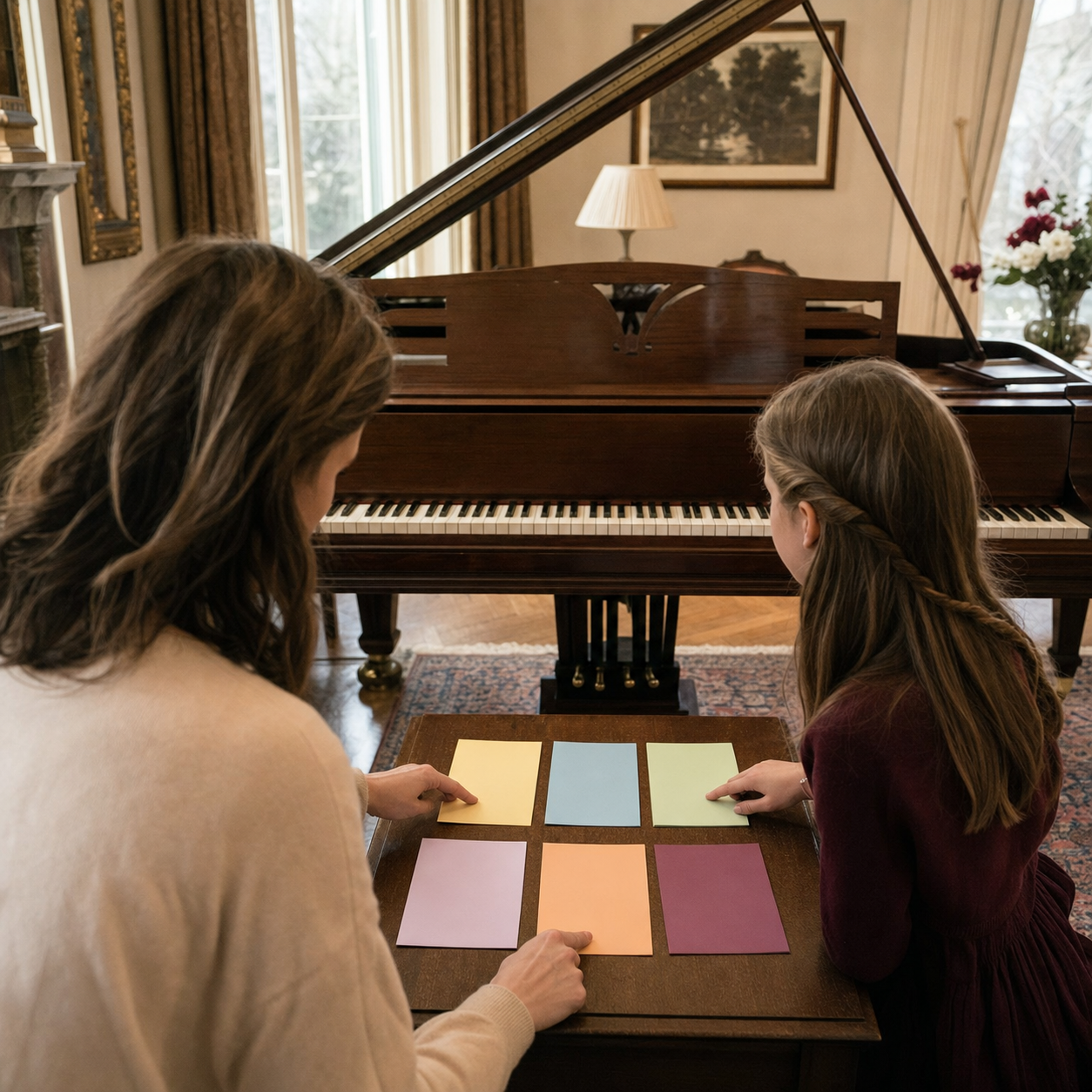
Build a week that a child can actually sustain
A curriculum is the sequence of learning; a timetable is simply where it fits. Younger beginners often learn more from short, alert encounters than from one long session. Older children can take greater ownership, but consistency still matters more than occasional marathons.
| Stage | Useful pattern | Parent’s role | Evidence of progress |
|---|---|---|---|
| New beginner | 10–15 minutes, four or five days | Sit nearby, read the task, then let the child try | Steady pulse, easy posture, remembered patterns |
| Developing player | 20–30 minutes, five days | Help divide work and ask listening questions | Independent starts, accurate reading, shaped phrases |
| Independent pupil | 30–45 minutes in focused blocks | Review weekly aims without policing every repetition | Self-correction, musical decisions, complete performances |
These are starting points, not quotas. Attention, temperament, repertoire and other commitments vary. Our guide to piano practice tips for parents gives further ways to keep help calm and specific.
Practice insight
End while concentration is still intact. A child who finishes with one clear success is more likely to return willingly tomorrow.
Choose materials by function, not by quantity
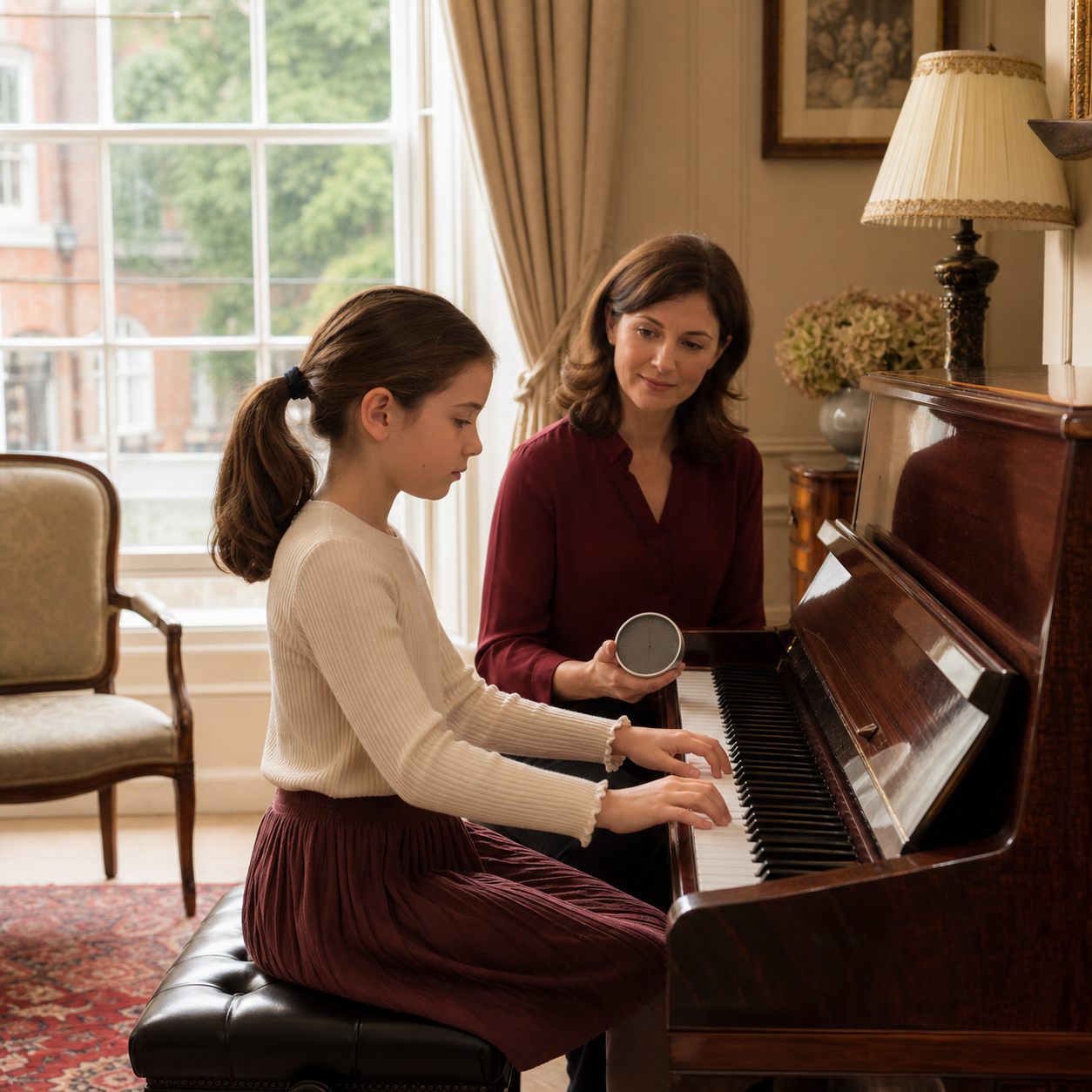
A method book can provide sequence, but it should not be asked to provide the whole musical education. Choose one principal course that moves in manageable steps, then add material only when it has a clear job. A short duet may develop pulse and listening. A familiar song may strengthen playing by ear. A contrasting piece can introduce a new articulation or character. A blank manuscript page can hold a four-bar invention without turning composition into a written examination.
Before buying a resource, ask four questions: Is the notation visually clear? Does the musical result sound satisfying at the child’s present level? Are instructions addressed to the learner rather than hidden from them? Does it leave room for a teacher or parent to adapt the pace? Large libraries often create indecision; a small, purposeful set encourages completion.
Online video can demonstrate a sound or movement, but the child should return to the instrument promptly. Watching is not practising. Pause the video, identify one task, try it from memory, then listen to the result. If a digital course rewards rapid completion, keep your own measure of progress: comfortable movement, accurate rhythm, attentive sound and increasing independence.
Resource check
One well-chosen piece, explored through listening, rhythm, technique and imagination, teaches more than five pieces hurriedly ticked off.
A sample four-week homeschool piano curriculum
Choose one achievable musical outcome for the month, such as playing a short piece fluently with a steady pulse. Keep familiar material alive while introducing only one or two new demands at once.
- Week 1 — Explore and map. Listen to the piece, clap its pulse, find recurring patterns and learn a small section. Add a playful improvisation using the same mood.
- Week 2 — Coordinate and connect. Secure fingering, rhythm and comfortable movement. Link short sections without pushing the tempo.
- Week 3 — Shape and understand. Notice phrases, balance melody and accompaniment, and discuss what gives the music its character.
- Week 4 — Share and reflect. Record or perform the piece once, celebrate what communicates, then identify one next step. Keep the occasion warm and proportionate.
“Progress is not the number of pages completed. It is the child’s growing ability to hear, decide and play with intention.”
Keep listening and creativity inside the plan
Reading music can become so visible that listening disappears. Protect time for hearing a recording, singing a phrase, copying a short rhythm, finding a tune by ear or inventing an ending. The National Curriculum’s broad aims are helpful here: children should perform, listen, compose and understand musical elements rather than merely decode notation.
Arts participation has value in its own right. The Education Endowment Foundation also reports moderate evidence of positive links with wider learning, while cautioning that context and implementation matter. For families, the practical conclusion is modest: teach music as music, observe the child carefully and avoid extravagant promises about academic transfer.
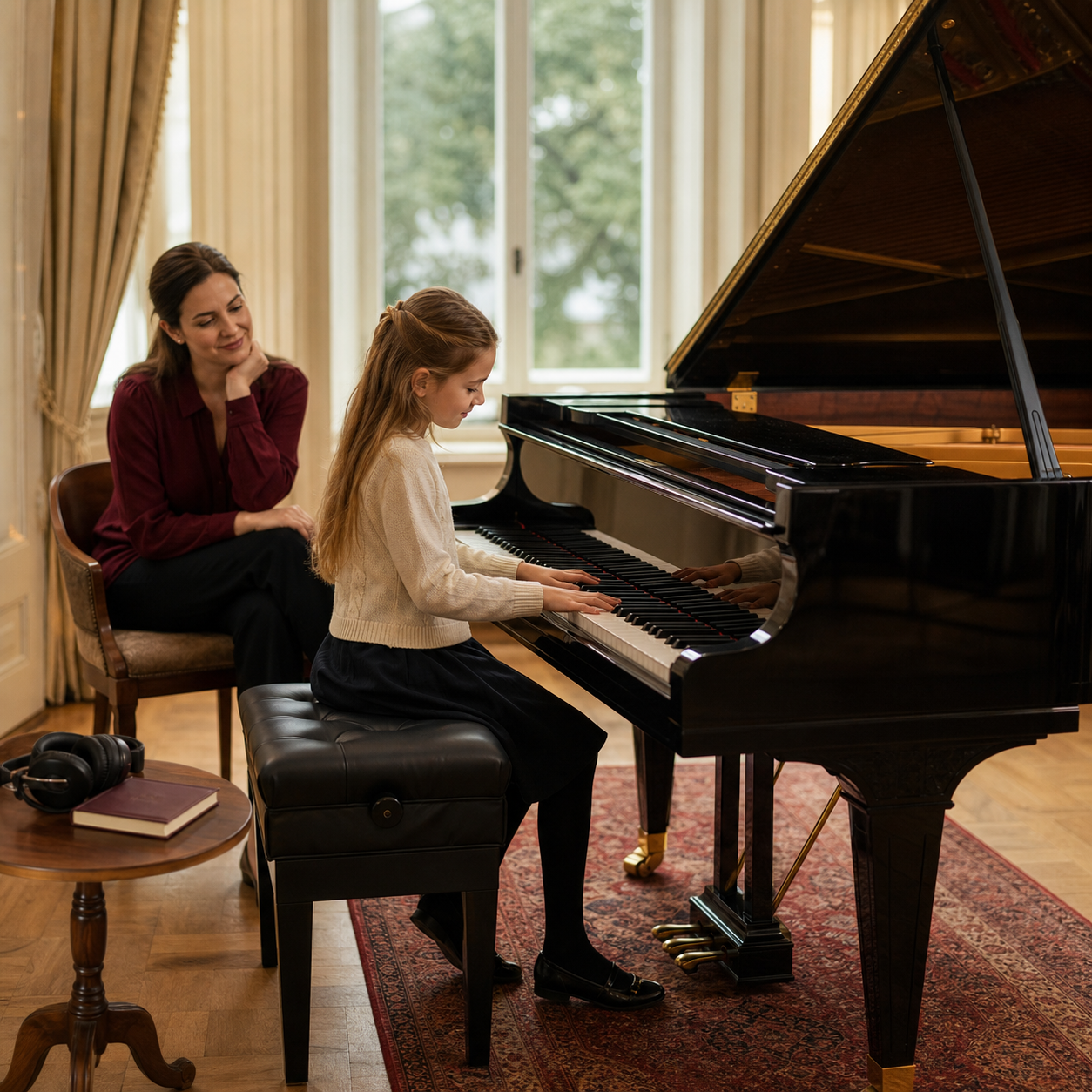
For younger pupils, our article on music education in early childhood explains how listening and play can lead naturally towards more formal study. Families with school-age learners may also find the guide to piano lessons for school children useful when comparing routines and expectations.
When should a parent bring in a piano teacher?
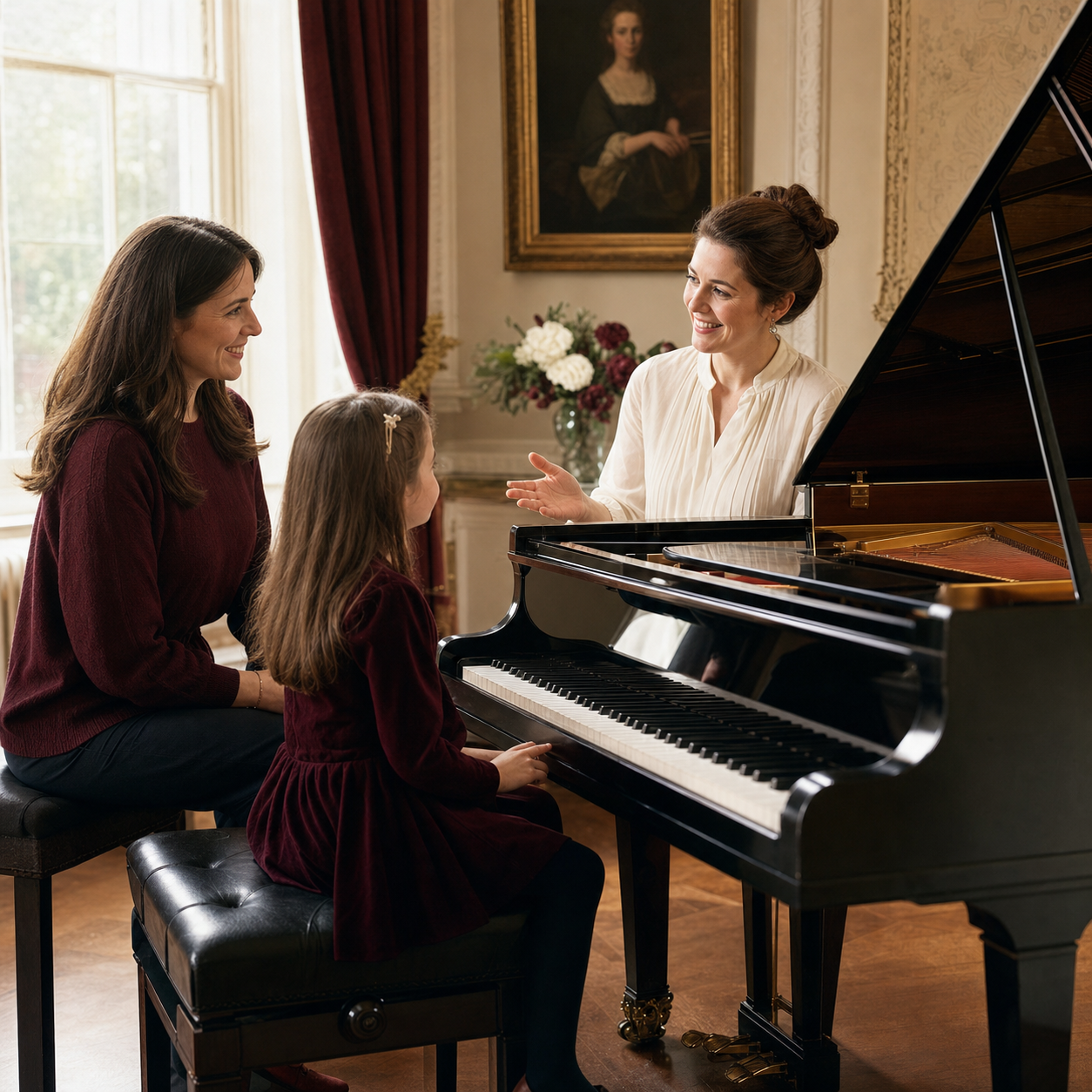
A thoughtful parent can create a rich musical environment, but some aspects of piano playing are difficult to judge from beside the instrument. Technique, tension, fingering, tonal control and repertoire sequence benefit from experienced eyes and ears. Families can complement home study with structured piano lessons for children in London. A teacher is especially useful when:
- the child repeatedly experiences discomfort or awkward movement;
- reading advances but playing remains rhythmically insecure;
- the family is unsure what repertoire should come next;
- motivation has become tied to correction or conflict;
- the child wants an exam, performance or more ambitious project;
- progress has stalled despite regular, attentive work.
Teacher’s note
A periodic lesson can be enough to correct course. A weekly lesson offers closer sequencing and feedback. The right frequency depends on the child, the parent’s musical experience and the family’s aims.
Exams are optional: use them only when they serve the child
ABRSM Practical Grades provide one recognised route, from Initial Grade to Grade 8, combining pieces with scales, sight-reading and aural work. Performance Grades place greater emphasis on a recorded programme. Either can supply milestones, but neither is a complete curriculum and neither is compulsory.
For some pupils, an exam sharpens purpose. Others flourish through family performances, recordings, composition projects or a carefully chosen repertoire list. The best checkpoint measures musicianship rather than reducing study to a sequence of certificates.
Add expert guidance to your home piano plan
WKMT’s structured piano lessons for children in London can complement home education with careful technique, appropriate repertoire and clear musical progression.
Three questions parents often ask
Do I need to play the piano myself?
No. You can organise time, listen attentively and help a child follow clear instructions. A teacher becomes more important when technical or musical questions exceed your experience.
Should I follow the National Curriculum?
Home educators in England do not have to follow it, but its music aims offer a useful breadth check. Adapt them to the child’s age, ability, interests and needs.
How often should I change the plan?
Review it every four to six weeks. Keep strands stable, change the material and adjust the balance when the child needs more challenge, consolidation or creative space.
A homeschool piano curriculum should make the next step visible without making music feel small. Keep the plan balanced, the goals humane and the listening alive. When specialist help is needed, use it early enough that confidence and physical ease remain intact.
WKMT’s wider work in classical piano study in London connects children’s learning with experienced teachers, performance opportunities and a living musical culture.
Sources on homeschool piano curriculum
- GOV.UK, Educating your child at home (checked 2 August 2026).
- Department for Education, Elective home education guidance (checked 2 August 2026).
- Department for Education, Music programmes of study (checked 2 August 2026).
- Department for Education, Teaching music in schools and Model Music Curriculum (checked 2 August 2026).
- Education Endowment Foundation, Arts participation (checked 2 August 2026).
- ABRSM, Piano qualifications and current syllabus information (checked 2 August 2026).