
 TRIAL LESSON
Piano Lessons
Does Piano Make You Smarter? What Parents Should Know About Children, Music and Learning
Aug
Does Piano Make You Smarter? A Parent Evidence Guide
A measured guide for parents
Does Piano Make You Smarter? What Parents Should Know About Children, Music and Learning
Does piano make you smarter? The honest answer is: it can strengthen particular skills used in learning, but it does not turn every child into a higher-IQ pupil. The clearest benefits are musical, attentional, auditory and motor; broader academic gains are possible, yet smaller and less certain.
The quick answer
Learning piano asks a child to listen, anticipate, read patterns, coordinate both hands, regulate movement and correct errors in real time. Those demands are genuinely valuable. Research does not, however, justify promising that lessons will automatically raise school marks or general intelligence. A better reason to learn is that musicianship itself is intellectually, emotionally and socially worthwhile.
Does piano make you smarter? What evidence can and cannot show
Some studies have reported modest improvements after music lessons. A well-known randomised experiment involving 144 six-year-olds found slightly larger IQ gains in keyboard and voice groups than in drama or no-lesson groups. Shorter experiments have also found improvements in particular verbal or executive tasks. These results matter because random assignment offers better evidence than simply comparing musicians with non-musicians.
Yet the wider picture is cautious. A large meta-analysis of experimental studies found only a small overall effect on children’s cognitive and academic skills, with weaker results in better-controlled studies. Children who take music lessons may already differ in family resources, motivation, conscientiousness or access to enrichment. Correlation is therefore not the same as causation.
For parents: ask whether a claim concerns a skill practised directly at the piano, a nearby skill such as auditory attention, or a distant outcome such as general school performance. The further the claimed transfer travels, the more careful we should be.
What the piano asks a developing brain to do
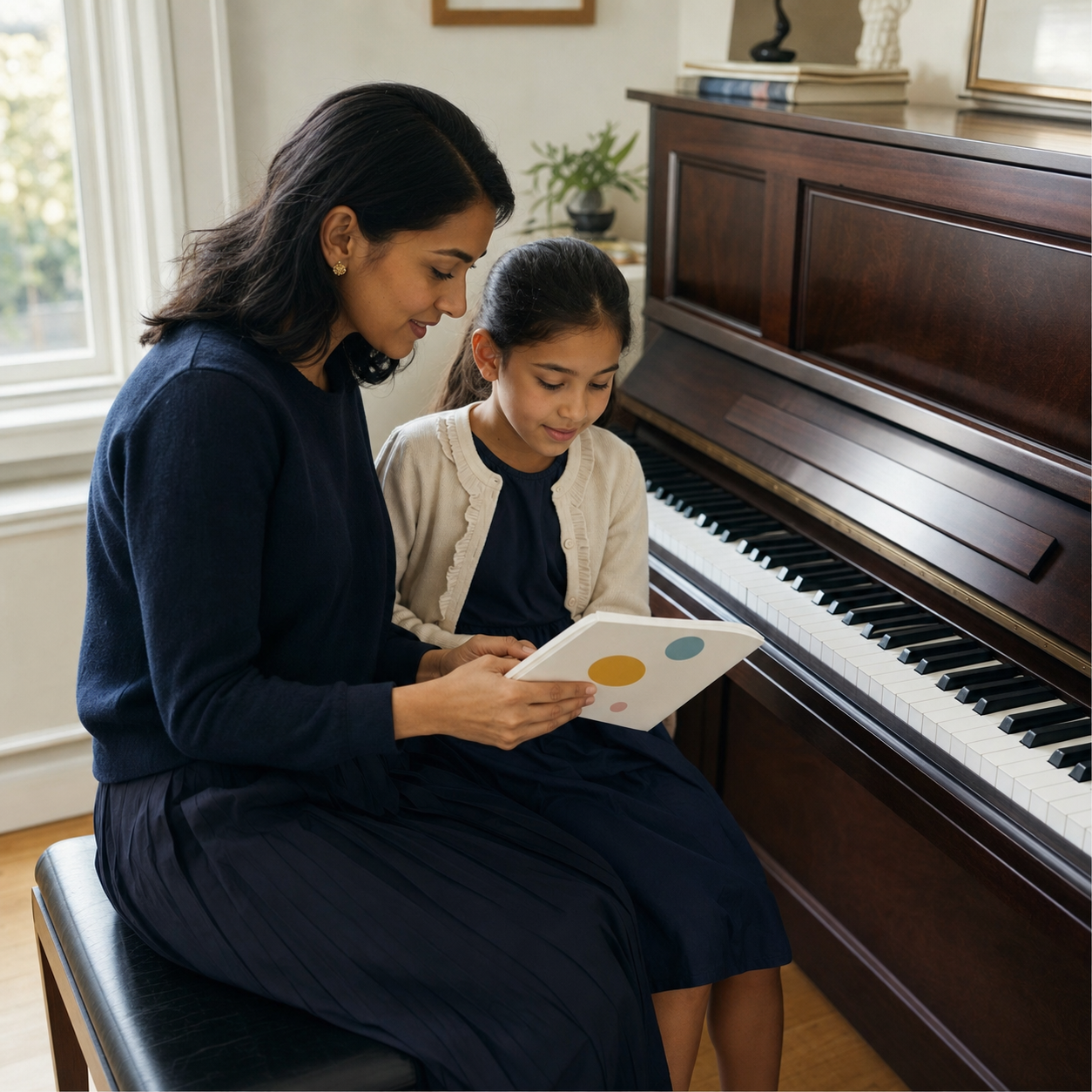
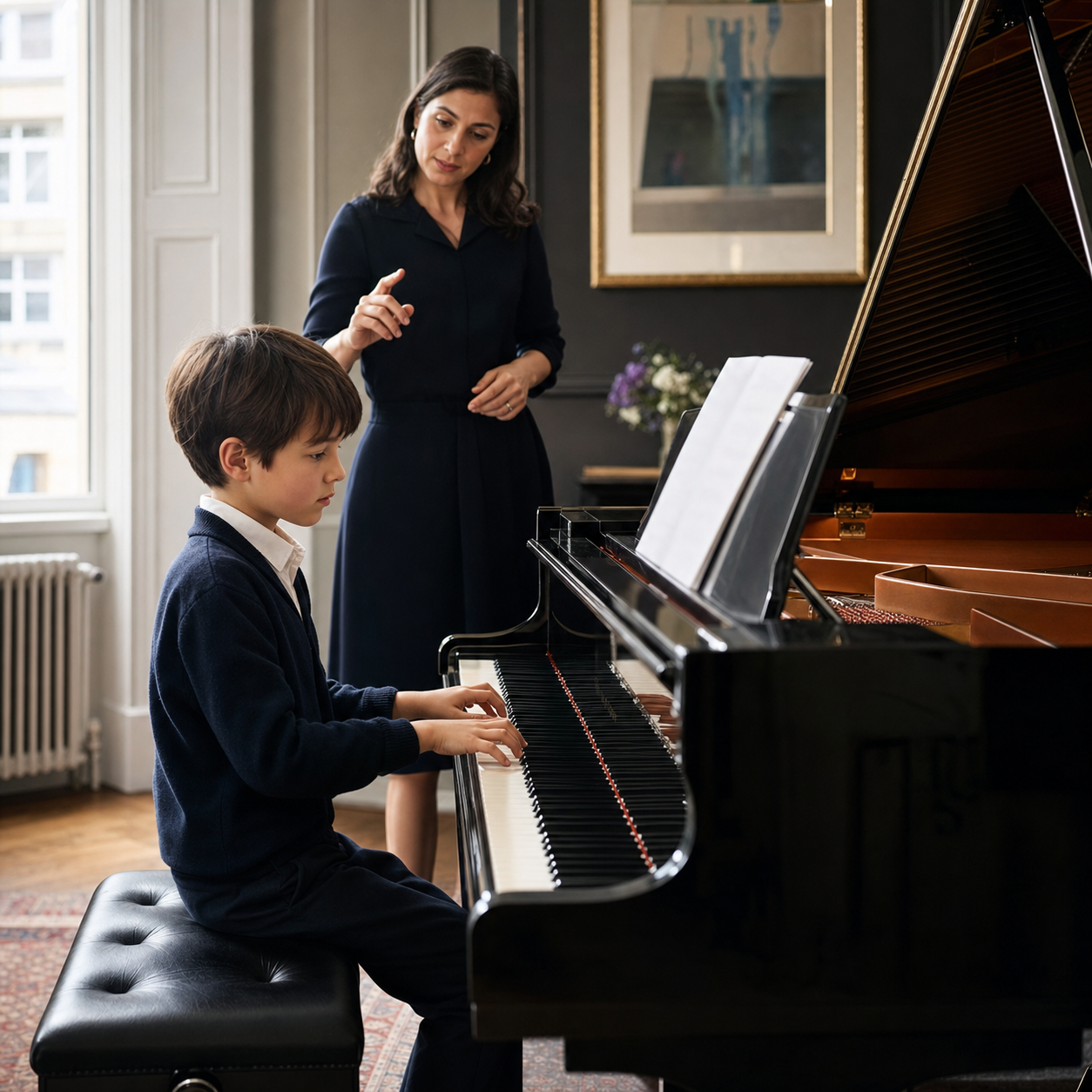
Piano playing combines several demanding processes. A young pianist converts visual patterns into planned movement, listens for the result, compares it with an inner expectation and adjusts the next attempt. Even a short phrase requires sequencing, inhibition and divided attention. Unlike passive listening, playing creates an immediate loop between perception and action.
Longitudinal brain-imaging work has associated sustained childhood music training with changes in auditory regions and white-matter pathways connecting the hemispheres. Another child study found that piano training enhanced neural responses to pitch and improved auditory word discrimination. These findings suggest that training can shape systems closely involved in hearing and sensorimotor integration. They do not prove a universal rise in intelligence.
“The most credible benefit is not a mysterious intelligence boost. It is the child learning to hear, plan, persist, evaluate and try again.”
Which benefits are realistic?
| Area | What is plausible | What not to promise |
|---|---|---|
| Attention | Practising start-stop control, error monitoring and sustained focus. | Perfect concentration in every classroom setting. |
| Memory | Remembering patterns, fingering plans, sounds and phrase sequences. | A general memory advantage for all tasks. |
| Language | Sharper pitch and timing perception may support aspects of speech processing. | Automatic improvement in reading or vocabulary. |
| School results | Habits of preparation, patience and self-correction can be useful. | Guaranteed higher marks in maths, English or exams. |
The question “does piano make you smarter?” becomes more useful when “smarter” is replaced by observable behaviours. Can your child sustain a short task for longer? Can they notice an error without collapsing in frustration? Can they remember a small sequence, hear a difference and explain what changed? These are meaningful signs of developing musical independence, even if a school report remains unchanged.
Why children’s results differ
No two pupils receive the same intervention simply because both attend a weekly piano lesson. One child may have a responsive teacher, a reliable instrument and quiet time to practise; another may be tired, overscheduled or worried about making mistakes. Lesson quality, family support, sleep, health, school experience and the child’s own temperament all affect what researchers later measure.
Selection matters too. Families who choose long-term music tuition may value education strongly or have more time and resources for extracurricular activities. Children who persist may already be especially conscientious or open to new experiences. Good studies try to control these differences, but no statistical method can make ordinary family life perfectly uniform. This is why a striking comparison between musicians and non-musicians is not automatically proof that music caused every difference.
There is also a question of what counts as success. Standardised tests capture certain abilities, but they do not fully measure an ear for colour, the courage to perform, sensitivity to another player or the satisfaction of shaping a phrase. These are not consolation prizes. They are central achievements of musical education and part of the reason piano remains valuable even when its far-transfer effects are modest.
WKMT perspective: judge lessons first by the quality of the child’s musicianship and relationship with learning. Cognitive benefits are welcome possibilities; they should never become the pressure under which music must justify itself.
What parents should expect from age, lessons and practice
There is no scientifically established age at which piano suddenly makes a child more intelligent. Younger brains are highly adaptable, but readiness still varies. A four-year-old may thrive through imitation, singing and brief keyboard exploration; an eight-year-old may manage notation and independent repetition more easily. The quality of the teaching relationship matters more than chasing a supposed cognitive window.
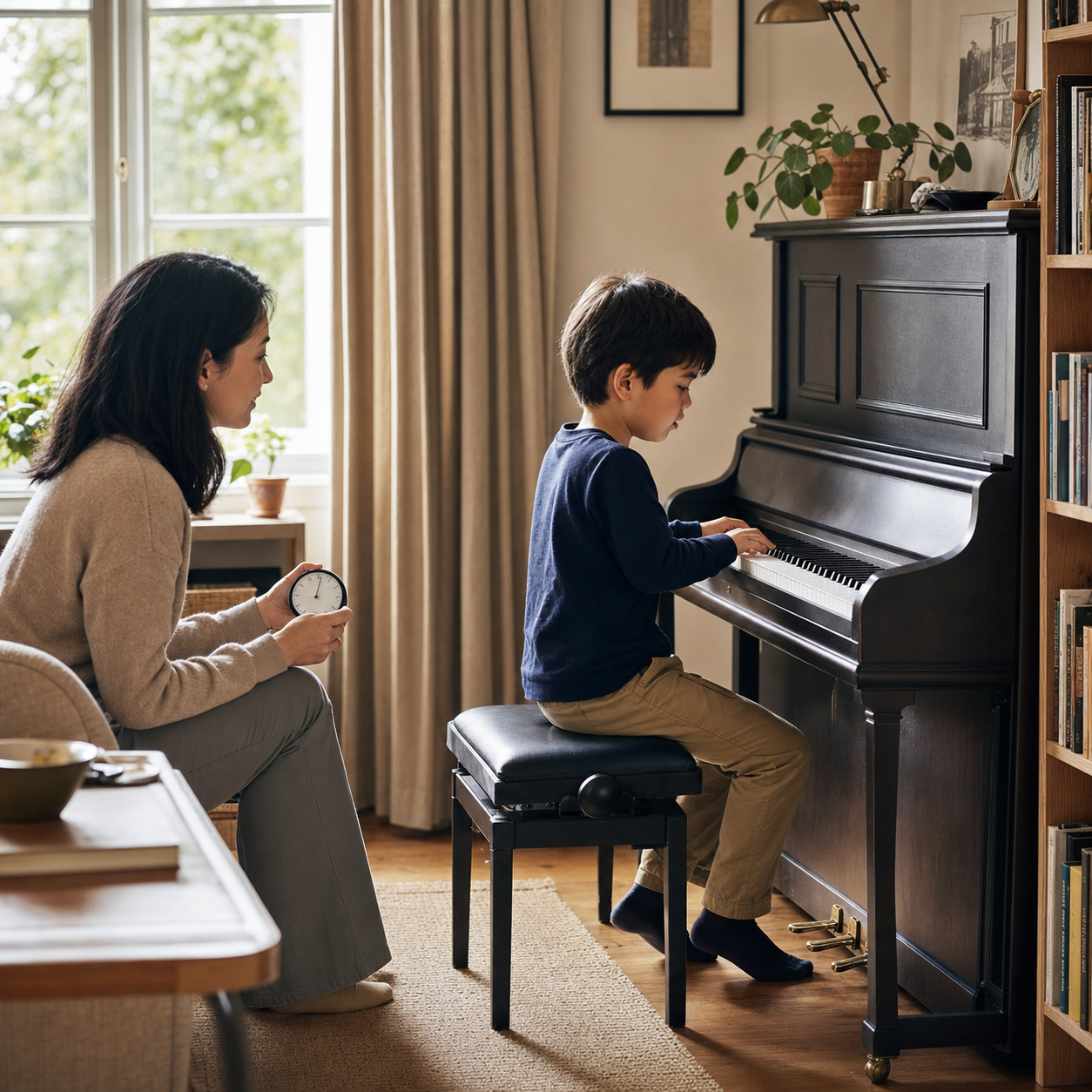
Research also does not give parents a universal “minimum dose” that guarantees wider cognitive benefits. In practical teaching, consistency is more valuable than heroic sessions. A calm routine of manageable tasks lets the child repeat the full learning cycle: attempt, listen, diagnose, adjust. Practice should finish with some appetite left for tomorrow.
A healthy home test
After practice, is the child mostly curious, capable and connected to the music? If the routine consistently produces tears, bargaining or fear of mistakes, increasing the minutes is unlikely to improve learning. Adjust the task, the pace or the adult role with the teacher.
A four-part framework for parents
Choosing lessons for a child in London
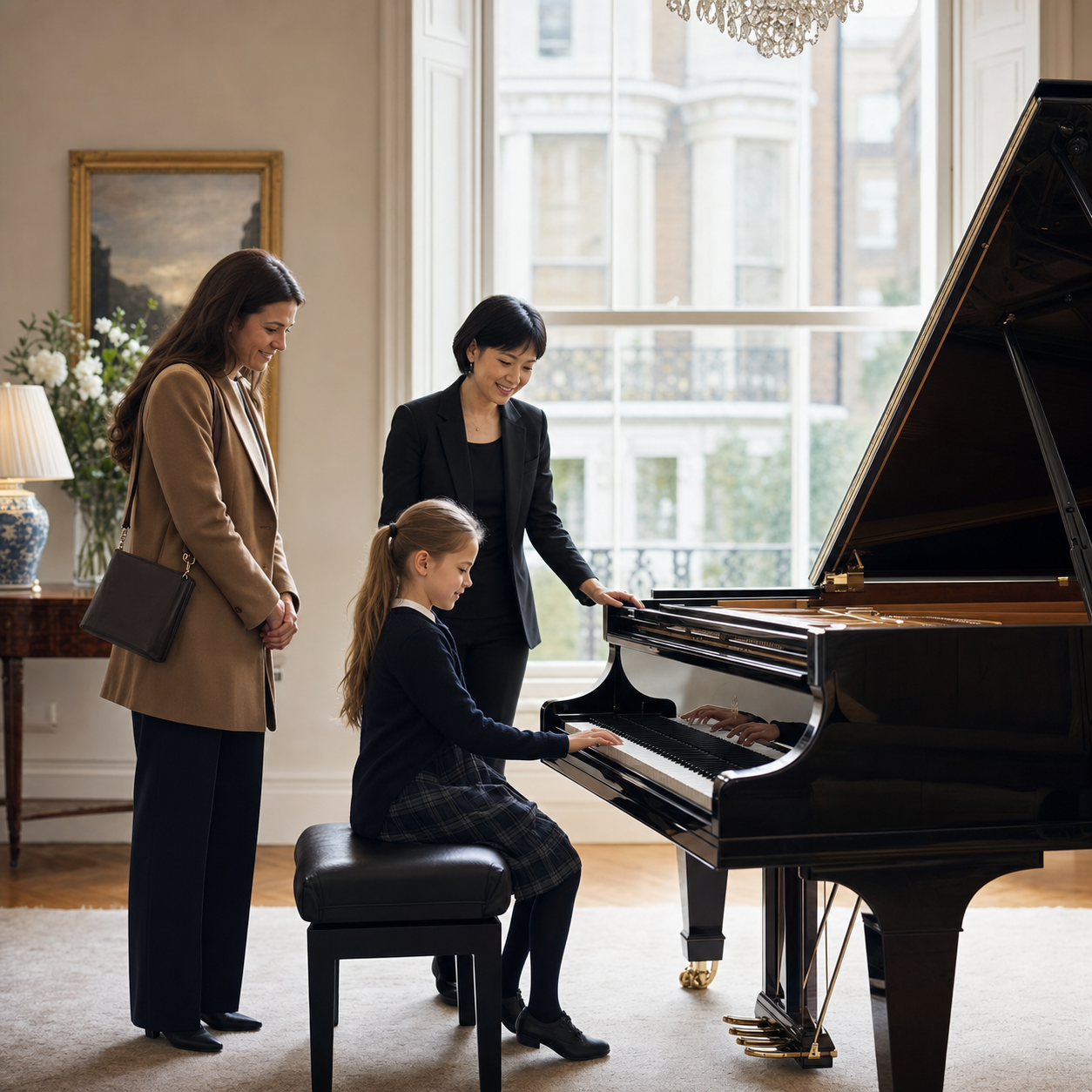
A good teacher should be able to explain what the child is learning now, how home practice should feel and how repertoire will develop over the next term. Ask how they adapt for attention span, confidence and prior experience. The strongest answer will concern musicianship and the individual child, not extravagant claims about IQ.
Parents exploring structured piano lessons for children in London can use a trial lesson to observe the fit between teacher, child and method. WKMT’s wider London piano teaching offers a classical context, while our guides to supporting practice at home and music and language development deepen the parent’s decision without replacing professional educational or clinical advice.
Let musicianship lead
If your child is curious about the piano, begin with an expert conversation rather than a promise about intelligence. A thoughtful trial lesson can reveal readiness, rapport and the right next step.
Frequently asked questions
Does piano make children better at maths?
Not reliably. Musical patterns and maths share certain forms of sequencing, but experimental research does not support promising that piano lessons will automatically raise maths attainment.
Can piano improve concentration?
Piano repeatedly exercises focused listening, inhibition and error correction. Recent reviews suggest possible benefits for aspects of executive control, but results vary and should not be treated as a diagnosis or guaranteed remedy for attention difficulties.
How long before parents notice a difference?
Musical changes can appear within weeks, while stable habits take longer. Look first for more accurate rhythm, easier coordination, better listening and a calmer response to mistakes. There is no fixed timetable for wider academic effects.
A better conclusion than “smarter”
Does piano make you smarter? It can cultivate several skills that intelligent learning uses, especially when lessons are sustained, well taught and supported without pressure. But the evidence is not a licence to market music as an IQ treatment. Piano deserves a richer case: it gives children a disciplined art through which they can listen closely, coordinate beautifully, tolerate difficulty and express something of their own.
Sources on Does piano make you smarter Guide
- Schellenberg, “Music lessons enhance IQ”, Psychological Science (2004). Last checked 1 August 2026.
- Sala and Gobet, “When the music’s over”, Educational Research Review (2017). Last checked 1 August 2026.
- Moreno et al., “Short-Term Music Training Enhances Verbal Intelligence and Executive Function” (2011). Last checked 1 August 2026.
- Habibi et al., “Childhood Music Training Induces Change in Micro and Macroscopic Brain Structure”, Cerebral Cortex (2018). Last checked 1 August 2026.
- Nan et al., “Piano training enhances the neural processing of pitch”, PNAS (2018). Last checked 1 August 2026.
- Bigand et al., randomised trial of music and visual-arts group practice (2024). Last checked 1 August 2026.
- Jamey et al., systematic review and meta-analysis of music training and inhibition control, Cognition (2024). Last checked 1 August 2026.