
 TRIAL LESSON
Piano Lessons, Uncategorized
The Hidden Pianos of London
Mar
Public Pianos in London
The Hidden Pianos of London
Musical Treasures in Unexpected Places
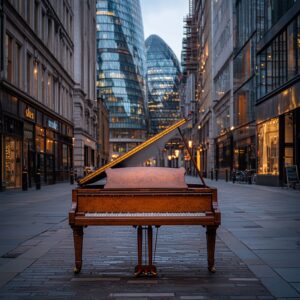
Discovering London’s Musical Street Art
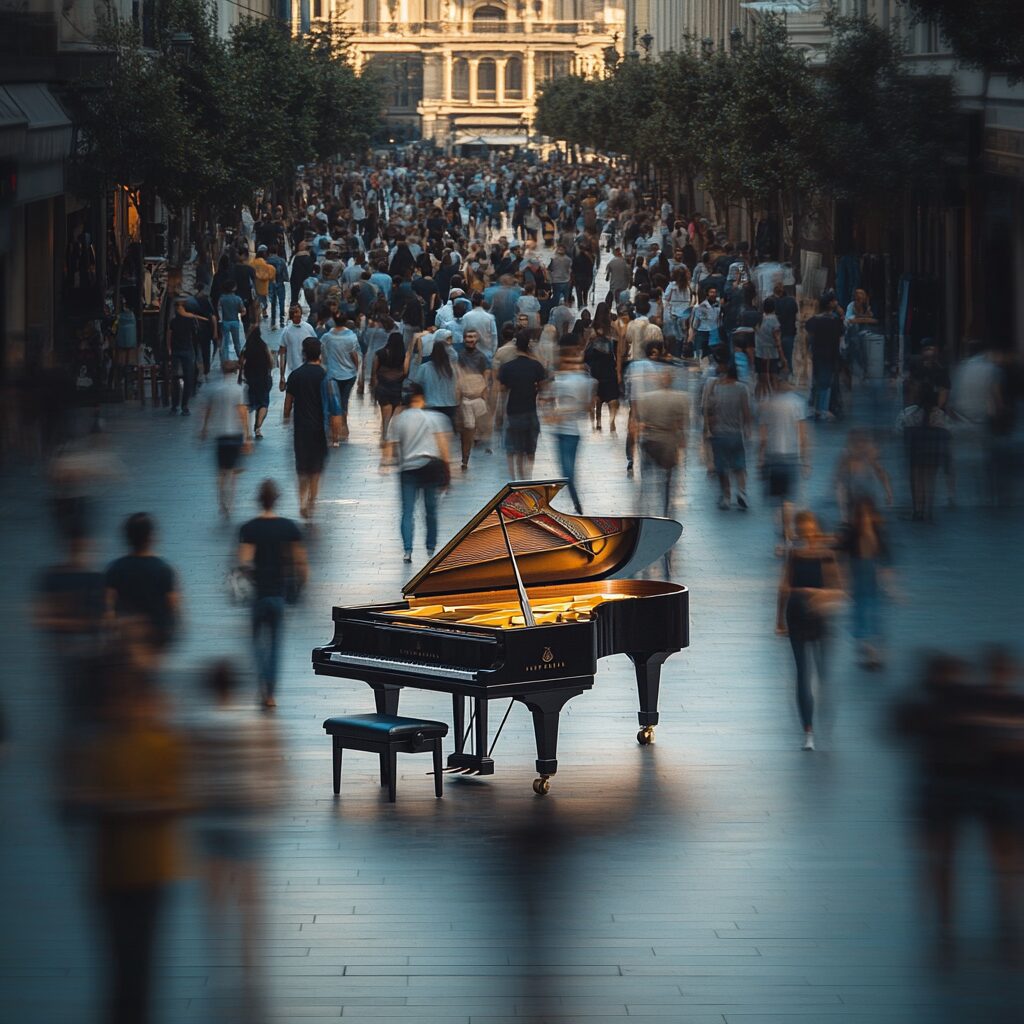
Have you ever stumbled upon a piano in the middle of a London train station? Or perhaps you’ve witnessed an impromptu concert while shopping? London’s urban landscape hides a multitude of musical treasures in the form of public pianos, offering spontaneous musical encounters for residents and visitors alike. Public pianos in London Guide.
These instruments—scattered across the metropolis in stations, shopping centers, underpasses, and public spaces—represent a unique intersection of public art, community engagement, and musical expression. From grand pianos requiring reservation to weather-beaten uprights in railway underpasses, London’s public piano scene creates a platform for musical expression while transforming ordinary spaces into venues for unexpected performances and human connection[¹].
How It All Began: The “Play Me, I’m Yours” Revolution
The phenomenon of public pianos in London traces back primarily to 2008, when British artist Luke Jerram launched his ambitious art installation “Play Me, I’m Yours.” This project, which has since become a global movement, initially brought dozens of decorated pianos to cities around the world, inviting passers-by to sit down and play[²].
In 2009, London received thirty pianos as part of this initiative, strategically placed throughout the city during the City of London Festival[²]. The following year, twenty-one street pianos appeared in public gardens, streets, and squares to celebrate the same festival[⁴].
“This isn’t about me and my creativity. The pianos act as a blank canvas for everyone else’s creativity. This is an opportunity for people to express themselves and connect with one another. You get strangers giving each other piano lessons.”
— Luke Jerram, Artist[⁴]
Origins and Artistic Vision
The “Play Me, I’m Yours” project emerged from a simple yet profound question about urban isolation. Luke Jerram, reflecting on urban anonymity, wondered: “Why don’t we know anything about our neighbours?” The project was designed as a response, intended to “provoke people, who occupy the same space, into talking to one another and engaging in their community”[²].
What began as a temporary installation evolved into a permanent feature of London’s cultural landscape, with certain pianos becoming celebrated landmarks in their own right. Most of the original fifty street pianos installed in London have disappeared over the years, but the concept has taken root, with new installations appearing and certain iconic pianos gaining fame[¹]. Public Pianos in London Complete Guide.
Sustainable Beginnings
The pianos used in the original installations were themselves narratives of renewal and sustainability. Rather than purchasing new instruments, Jerram’s project utilized pianos donated by a piano transport company—instruments that would otherwise have been destroyed[²]. These abandoned pianos were given new life, decorated colorfully by Jerram himself and local artists, and placed in public spaces with an open invitation for anyone to play.
Each piano was uniquely designed to reflect its environment; for instance, pianos near water featured nautical themes, while those in literary districts were adorned with words and book motifs[²]. After the public exhibitions concluded, the pianos were donated to local facilities, ensuring their continued contribution to community life[²].
Where to Find London’s Public Pianos
St. Pancras International Station
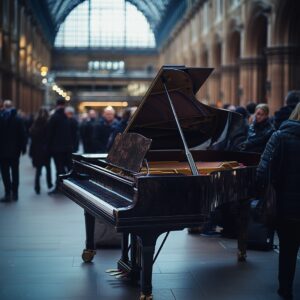
Location: Near Eurostar arrivals gate and in the main shopping arcade Claim to Fame: One piano donated by Sir Elton John in February 2016, with a personal inscription: “Enjoy this piano. It’s a gift. Love, Elton John” Notable Performers: Tom Odell, Freya Ridings, Jools Holland, Alicia Keys, John Legend, Jeff Goldblum, and Rod Stewart[³]
Herne Hill Railway Station
Location: In the underpass next to the station Known As: “The People’s Piano” Setting: Surrounded by exposed brick and adorned with bright colors Tagline: “Thanks for keeping the piano playing”[¹]
Underground Melodies: The Platform88 Initiative
London’s transportation network has embraced the public piano concept through initiatives like Yamaha’s #Platform88. This project has placed high-quality pianos in London Underground stations, creating musical oases within the city’s bustling transit system[⁵].
Notable installations include:
- Canary Wharf tube station (launched by Jools Holland)
- Tottenham Court Road station (introduced by Britain’s Got Talent winner Tokio Myers)[⁵]
Named for the 88 keys on a standard piano keyboard, this initiative represents a collaboration between Yamaha and Transport for London. The project embodies Yamaha’s global philosophy of enriching lives through music and recognizes how public pianos connect music enthusiasts, often with unexpected and magical results[⁵].
“I’m sure this beautiful instrument will provide much enjoyment for players and audiences alike. It’s amazing how many people can play the piano well and I’d encourage everyone to either have a play or just stop and listen for a while. Who knows who may spot you!”
— Jools Holland on the Platform88 initiative[⁵]
Architectural Icons with Musical Additions
Battersea Power Station Location: Turbine Hall B Setting: A Grade II*-listed former power station that once supplied electricity to Buckingham Palace and the Houses of Parliament Now: One of London’s premier shopping, dining, and leisure destinations[¹]
Westfield Stratford Piano Type: Grand piano (unlike most street pianos, which are upright models) Access: Requires advance booking Setting: One of London’s largest shopping centers with over 350 stores[¹]
London Bridge Station Unique Feature: An 1880s-style, 250-pipe organ relocated to the station’s arches by the heritage charity “Pipe Up for Pipe Organs”[¹]
Historical Installation Sites
During the original “Play Me, I’m Yours” installation, pianos appeared in diverse settings including:
- Soho Square (described as “an urban oasis” surrounded by shops and cafes)
- Carnaby Street
- British Museum forecourt
- Plaza Shopping Centre
- Millennium Bridge (with decoration featuring yachts to reflect its riverside location)[²]
While many of these original installations have disappeared, they established a precedent for placing pianos in unconventional public spaces throughout London.
Why Public Pianos Matter: Social Impact Beyond Music
Public pianos transform anonymous urban environments into spaces of potential connection and conversation. These instruments serve as powerful social catalysts, breaking down barriers between strangers and fostering community connections in one of the world’s most diverse and populous cities.
Creating “Third Places”
The pianos create what sociologists might call “third places”—locations that are neither home nor work, where community life can flourish through shared experience. The daily micro-interactions fostered by these instruments—a compliment on someone’s playing, a shared moment of appreciation for a familiar tune, an impromptu duet between strangers—contribute to a more connected urban fabric.
Luke Jerram has observed that the pianos frequently lead to unexpected social interactions: “You get strangers giving each other piano lessons,” he noted, adding that “there were two journalists who met over a piano in Sydney who recently got married”[⁴].
Democratizing Musical Performance
The inclusive nature of public pianos democratizes musical performance, removing it from exclusive concert halls and placing it in accessible public spaces. This accessibility was enhanced by thoughtful additions like the song books attached to each piano during Jerram’s original installation, which contained London-themed songs and location-specific musical selections—”songs about trains for the piano at a train station, or songs about water for the one by a bridge”[²].
Building Digital Communities
The interactive nature of these installations extends beyond physical interaction to digital community-building, as demonstrated by the “Play Me, I’m Yours” project’s website. This online platform allowed people to post event information, photos, videos, and comments about their experiences with each piano, creating a virtual community around the physical instruments[²].
The website served multiple functions:
- Enabling school children to organize outdoor performances
- Allowing professional or amateur pianists to promote their concerts or CDs
- Documenting ambitious projects like the duo who attempted a “piano marathon” of playing 24 pianos in 8 hours[²]
This digital dimension expanded the community impact of the physical pianos, creating networks of piano enthusiasts across the city and archiving ephemeral performances for posterity.
Showcasing Cultural Diversity
The cultural significance of London’s public pianos extends to their role in showcasing the city’s multicultural musical traditions. As Jerram observed: “There are plenty of hidden pianists in London, so we can really enjoy the talent and creativity they exercise in various ways”[²].
This hidden talent represents the diverse musical traditions present in London’s population, from classical European repertoire to jazz, pop, world music, and improvisational styles. Public pianos provide a democratic stage for this diversity of expression, contributing to London’s reputation as a global cultural crossroads.
Challenges & Controversies: The Realities of Public Art
Like any public art installation, London’s public pianos face numerous challenges and have occasionally become sites of controversy.
Physical Maintenance Challenges
The physical demands of outdoor or heavy-use environments present significant maintenance issues. Many of the pianos used in the original installations were already in poor condition, with Jerram noting that “some keys or pedals were not functioning”[²].
These mechanical limitations, rather than hindering enjoyment, often became conversation starters, with players remarking to each other about the instrument’s quirks[²]. Weather exposure, vandalism, and the natural deterioration that comes with frequent use in public spaces mean that maintaining these instruments requires ongoing commitment from property owners or community organizations.
Social Tensions and Public Spaces
Beyond physical maintenance, public pianos occasionally become focal points for broader social tensions. In January 2024, the St. Pancras piano donated by Elton John became the subject of a public dispute during a livestreaming session by UK YouTuber Brendan Kavanagh. The incident involved a Chinese television crew who requested that their faces be excluded from Kavanagh’s footage, citing concerns about their image rights[³].
This incident highlights how public pianos, as shared spaces of performance and recording, can become sites where contemporary issues around consent, privacy, and cultural differences play out in real time.
Approaches to Preservation
The St. Pancras piano controversy resulted in the instrument being temporarily sealed off due to station maintenance, before being relocated a short distance away[³]. This incident demonstrates both the vulnerability of public piano access and the commitment of certain locations to maintaining these popular installations.
Sustainability approaches vary across locations:
- The original model established by Jerram’s project—using donated pianos that would otherwise be destroyed—provides an environmentally conscious template[²]
- The #Platform88 initiative takes a different approach, using new, high-quality Yamaha instruments in carefully selected locations, prioritizing consistent performance quality and manufacturer support[⁵]
These contrasting approaches—recycling existing instruments versus investing in new ones specifically designed for public use—represent different solutions to the challenge of maintaining musical quality in demanding environments.
Educational Opportunities: Learning Beyond the Classroom

London’s public pianos offer significant educational opportunities that extend beyond formal music education. The democratic accessibility of these instruments provides informal learning spaces where people can:
- Experiment with music in a low-pressure environment
- Practice skills outside the home
- Receive spontaneous coaching from more experienced players
- Gain performance experience without formal recital settings
- Observe diverse playing styles and techniques
This aspect of public pianos is particularly valuable in a time when formal music education faces funding challenges in many schools. The public visibility of these instruments also normalizes musical practice and performance, potentially encouraging greater participation in music-making among Londoners of all ages.
By removing the intimidation factor of formal performance settings, public pianos create environments where musical skills can be developed and shared. This democratization of musical performance space represents a significant contribution to London’s cultural ecosystem.
The Future of London’s Public Pianos
The enduring popularity of London’s public pianos suggests a bright future for this form of urban musical intervention. New initiatives continue to emerge, building on the foundation established by pioneering projects like “Play Me, I’m Yours.”

Digital Evolution
The digital dimension of public piano culture continues to evolve, with social media amplifying the reach and impact of spontaneous performances. Videos of particularly skilled or unusual performances frequently go viral, bringing global attention to London’s public pianos and the musicians who play them. This digital afterlife extends the influence of these instruments far beyond their physical locations, creating worldwide interest in London’s public music scene.
Technological Innovations
Future innovations might include more technologically enhanced pianos that could:
- Record performances
- Offer learning guidance for beginners
- Connect digitally to other public pianos for remote duets
- Integrate with apps for educational purposes
Such technological additions could build upon the fundamental social purpose of these instruments while creating new possibilities for musical education and collaboration.
Educational Integration
Future public piano initiatives might include more structured educational components, such as:
- Scheduled workshops
- Beginner-friendly instructional materials
- Digital learning resources accessible via QR codes on the instruments
- Collaboration with local music schools and educational institutions
Such additions could enhance the educational impact of these installations while maintaining their essential character as spaces for spontaneous musical expression and community connection.
Your Turn to Play
Have you encountered one of London’s public pianos? Perhaps you’ve played one yourself or witnessed an unforgettable performance?
These instruments invite us to pause in our daily routines, to play or to listen, and to share in the universal language of music. In this capacity, London’s public pianos serve as small but significant counterforces to urban alienation, creating momentary communities around shared musical experiences.
As London continues to evolve as a global city, its public pianos stand as testaments to the power of accessible art to transform urban space and human experience. They remind us that even in the most unexpected places, London offers opportunities for creative expression and human connection—if only we take the time to seek them out.
Next time you’re passing through St. Pancras or waiting for a train at Herne Hill, why not take a moment to play a few notes or stop to listen? You never know what musical magic might unfold, and with the public pianos in London, it’s always possible.
References
- St. Pancras International Station pianos – https://stpancras.com/music
- Play Me, I’m Yours Project – https://www.streetpianos.com
- Elton John’s St. Pancras Piano – https://www.standard.co.uk/showbiz/elton-john-piano-st-pancras
- Luke Jerram’s vision and project details – https://www.lukejerram.com/playmeimyours
- Yamaha #Platform88 Initiative – https://uk.yamaha.com/en/news_events/play-me-im-yours.html