
 TRIAL LESSON
Uncategorized
Music and Emotional Development: How Piano Supports Children’s Feelings, Confidence and Self-Regulation
Aug
Music and Emotional Development Parent Guide
Music and Emotional Development: How Piano Supports Children’s Feelings, Confidence and Self-Regulation
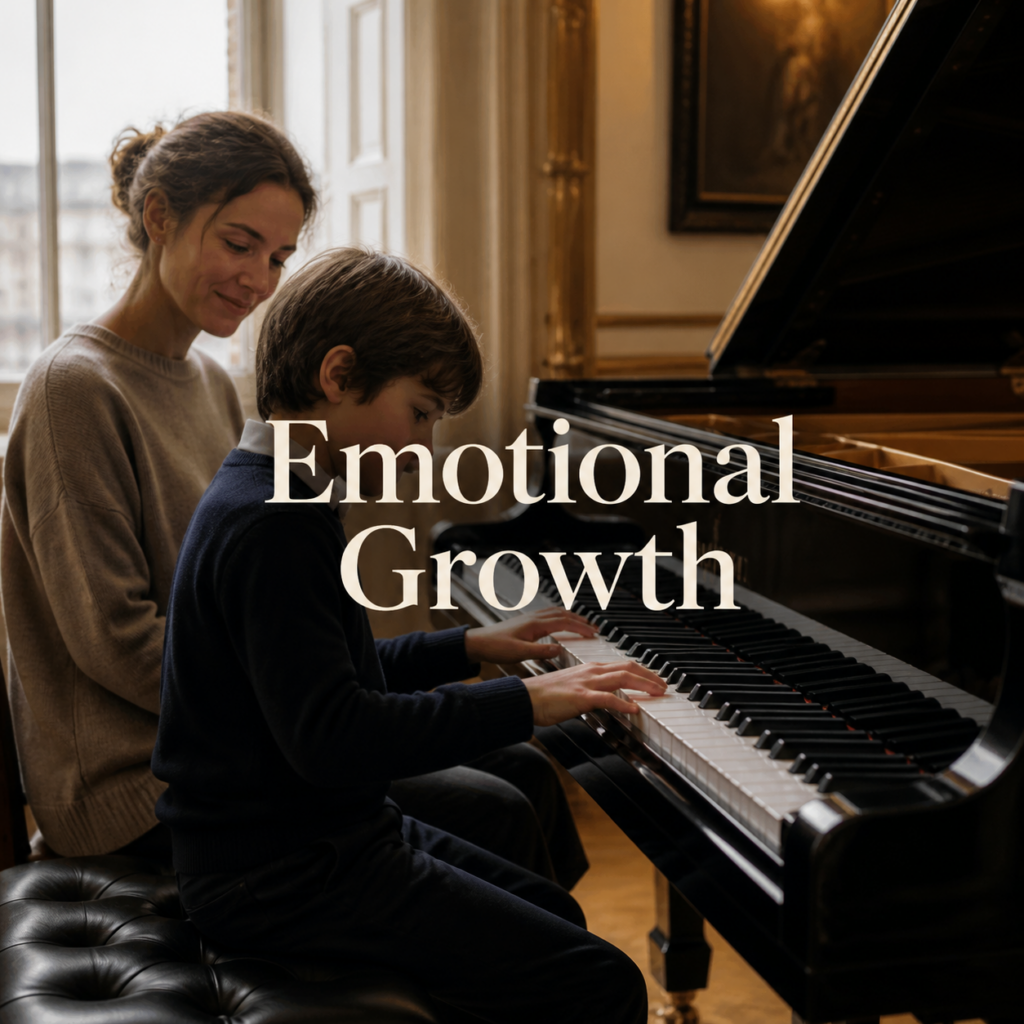
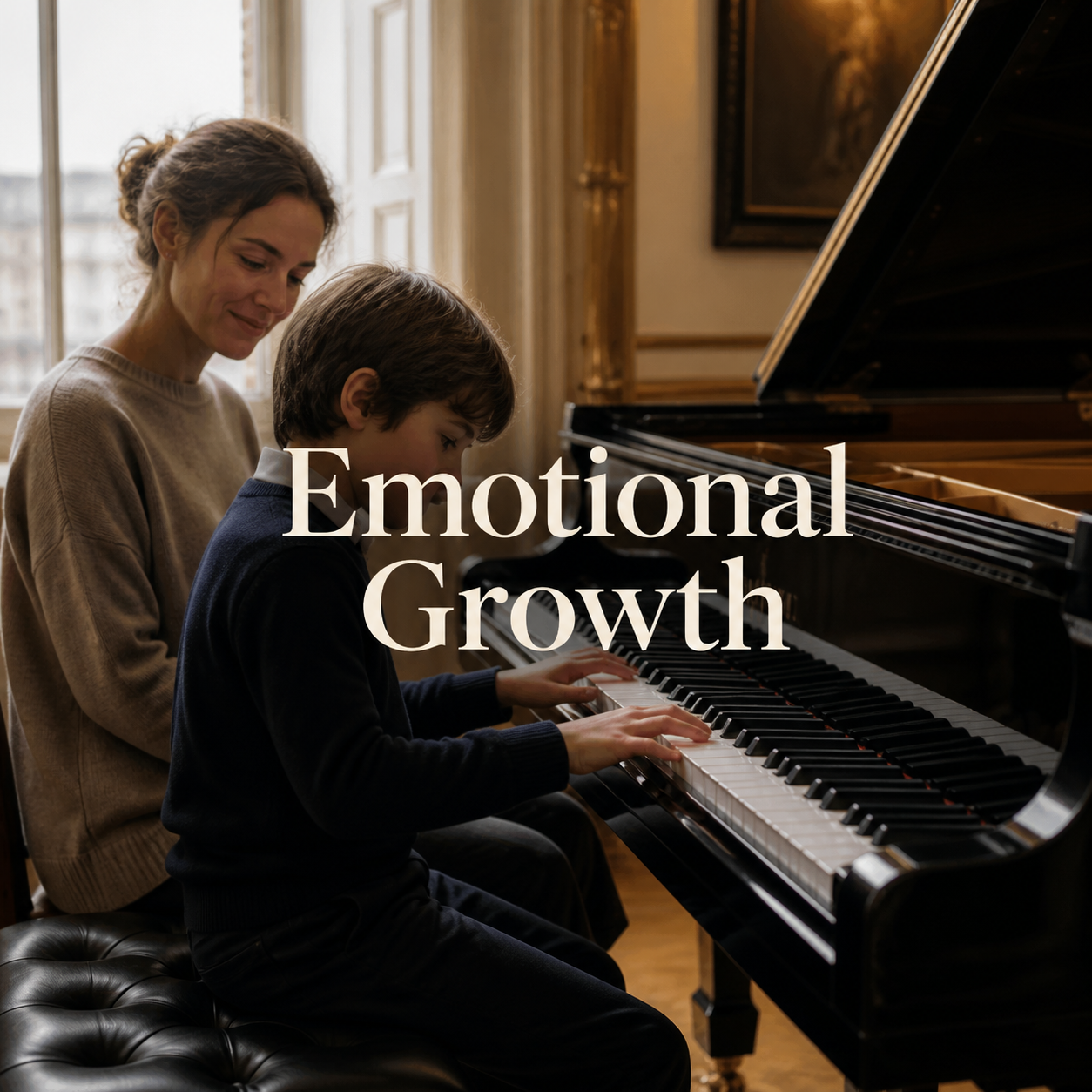
Music and emotional development can grow together when children learn to hear, name and shape expression. Piano study does not manufacture happiness or remove difficult feelings. It gives a young person a practical language for attention, effort, imagination and recovery.
The short answer for parents
Can piano help a child’s emotional development? The best answer is a careful yes. A systematic review of 26 studies involving children aged three to twelve found that educational uses of music were associated with aspects of emotional perception, expression and regulation, as well as social skills and motivation. The authors also stressed that the research was varied in method and quality, so sweeping promises are not justified [1].
That distinction is important. A piano is not a treatment, and an ordinary lesson is not therapy. What well-taught music can provide is a sequence of manageable experiences: listening closely, choosing a character, tolerating imperfection, repeating with purpose, playing with another person and eventually sharing a piece. Each experience asks a child to notice a feeling without being ruled by it.
For parents: look for greater emotional flexibility rather than constant cheerfulness. A child who can say “I am frustrated, so I will slow down and try two bars” is developing a more useful skill than one who simply avoids difficulty.
Families exploring structured piano lessons for children in London should therefore judge a lesson by its musical quality and its emotional climate. Warmth matters, but so do clarity, boundaries and meaningful standards.
Why emotional development matters in childhood
Emotional development includes recognising what one feels, finding words or symbols for it, understanding that other people may feel differently, and choosing a response that suits the situation. These abilities do not arrive together. A child may identify happiness in a melody before being able to explain disappointment after a mistake. Another may show empathy towards a friend yet struggle to settle after an exciting day.
Music offers a distinctive meeting place for these skills because it is expressive without requiring a child to disclose private experiences. A pupil can explore the difference between tender, agitated, playful and solemn sound while speaking first about the piece. That artistic distance is valuable. Feelings become material to examine and communicate, not a test of whether the child has the “right” personality.
The British national plan for music education describes musical learning as valuable in its own right and as part of a broad, enriching education [2]. This is the soundest starting point. Children deserve music because music is a substantial human art, not because every scale must deliver a secondary benefit. Emotional growth is most credible when it emerges from serious, enjoyable musical work.
What the research shows, and what it cannot prove
The research picture is encouraging but not simple. In the 2021 systematic review, studies reported benefits in areas including emotional recognition, self-expression, empathy, prosocial behaviour and aspects of regulation. Yet the interventions ranged from classroom activity to instrumental training and therapeutic programmes. Samples, measures and durations differed considerably [1]. It would be misleading to turn that body of evidence into a promise that weekly piano lessons cause a particular psychological outcome.
Research on children’s executive function is similarly mixed. A separate systematic review found promising links between music training and skills such as inhibitory control, but also identified methodological variation and the need for stronger causal evidence [3]. In practical terms, the piano asks a pupil to pause, remember a plan, coordinate actions and monitor sound. Those demands may exercise self-management, but families should not treat them as a guaranteed cognitive prescription.
A sensible parent question is therefore not “Will piano make my child emotionally stronger?” but “Does this musical environment help my child listen, attempt, reflect and recover?” That can be answered through behaviour: how a pupil approaches a new passage, responds to correction, describes a piece and works with another musician.
How piano supports music and emotional development
Piano brings together hearing, movement, memory and choice. Because a note sounds immediately, a child receives clear feedback: an intention has become an audible result. That makes several emotional processes unusually tangible.
Rhythm and regulation
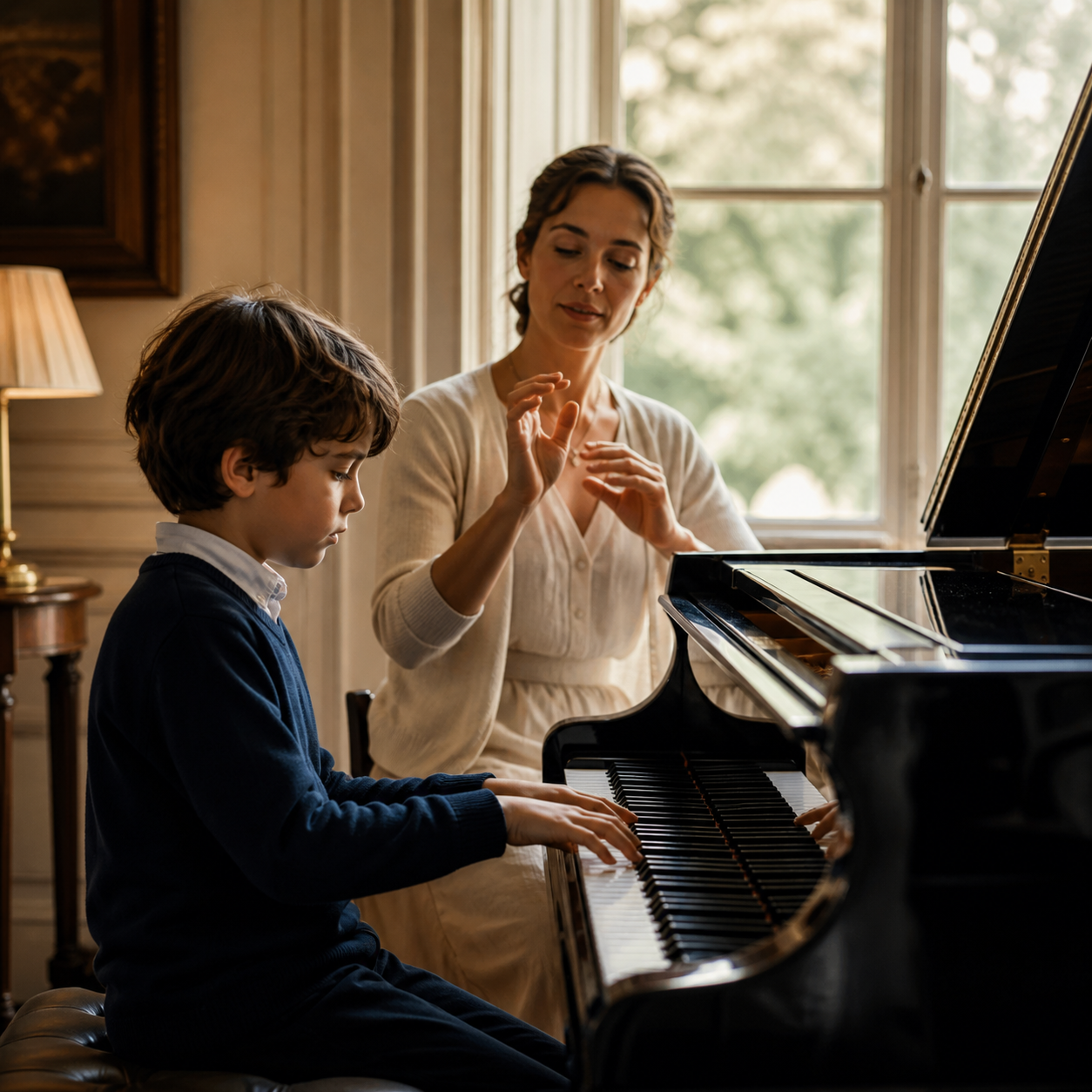
A steady pulse organises time. Clapping, walking a rhythm and playing with a teacher require a child to align action with an external pattern, a process often described as entrainment. At the keyboard, the pupil must sometimes resist the impulse to rush, wait through a rest or restart at a deliberately slower tempo. The emotional lesson is modest but powerful: excitement and frustration can be acknowledged while action remains organised.
Expression and emotional vocabulary
Music allows shades of feeling that ordinary labels can flatten. A phrase may be wistful rather than simply sad, expectant rather than simply happy. Asking “What changed when you played the second phrase more quietly?” develops emotional granularity through sound. The child learns that character depends on choices of timing, articulation, balance and tone, rather than on an instruction to “play with emotion”.
Practice, frustration and recovery
Practice is a protected encounter with something that does not work yet. In a good lesson, difficulty is reduced without being denied: one hand, a slower pulse, two beats, a silent fingering or a change of rhythm. The child experiences frustration, uses a method and hears improvement. This is self-regulation in an artistic context, not a lecture about resilience.
Shared attention and empathy
Duets and ensemble work add another layer. A pupil must leave room for another part, adjust balance and respond when a partner changes. The review literature describes music-making as a context for cooperation and social-emotional learning [1]. Even a teacher-pupil duet can make empathy audible: listening changes what one plays.
Age-by-age expectations
Children do not follow a single timetable. The following guide describes useful emphases rather than tests a pupil must pass.
| Age | Musical emphasis | Emotional skill to notice |
|---|---|---|
| 3–5 | Imitation, pulse, contrast, short musical games | Taking turns, shifting activity, naming broad characters |
| 6–8 | Clear routines, short pieces, descriptive listening | Trying again, accepting specific feedback, describing choices |
| 9–12 | Independent practice, interpretation, performance preparation | Planning, recovering from errors, communicating personal ideas |
Ages three to five. A very young child may explore loud and soft as dramatic characters, then need help moving away from the keyboard when the game ends. That transition is part of the learning. Short, playful encounters are usually more fruitful than demanding prolonged concentration.
Ages six to eight. A pupil can begin connecting feeling with musical evidence. “This sounds worried because the notes keep returning” is more valuable than guessing a teacher’s preferred answer. One small frustration may still feel enormous, so the adult’s calm reduction of the task provides a model for recovery.
Ages nine to twelve. Children often become more aware of comparison and judgement. Interpretation gives them legitimate ownership: two pupils may shape the same phrase differently while respecting the score. Preparing for a low-pressure performance can build confidence when readiness, not prestige, determines the occasion. WKMT’s related guides on music and confidence and music and executive function explore these neighbouring areas in more detail.
Choosing lessons that support healthy growth
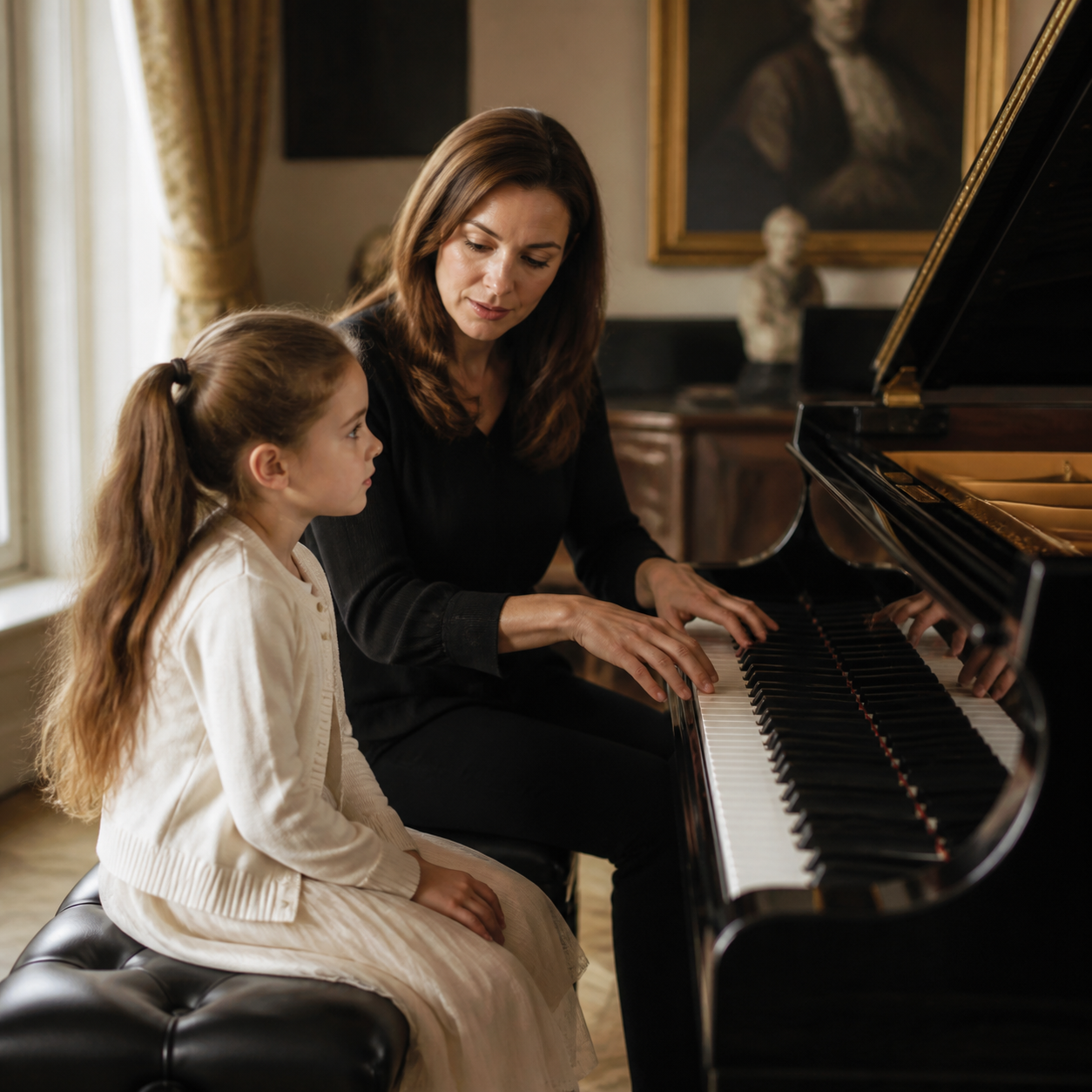
A teacher need not turn every lesson into a conversation about feelings. Emotional development is often supported indirectly through the quality of the musical exchange. Look for a teacher who can be precise without humiliating, encouraging without offering empty praise, and flexible without abandoning structure.
Teacher’s note
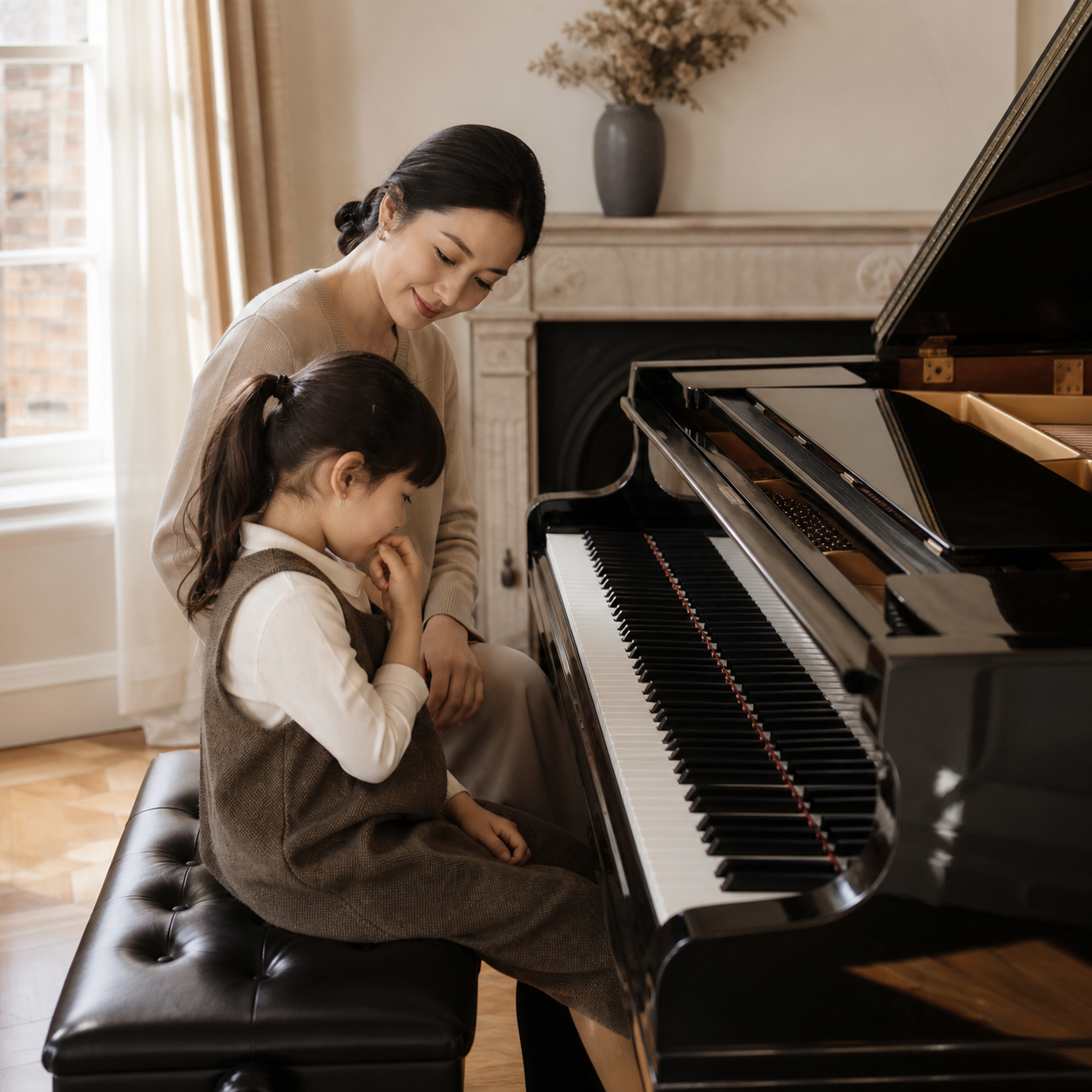
Specific feedback is emotionally safer than vague judgement. “The pulse changed in bar four; let us clap it once” gives the child something to do. “You were not concentrating” turns a musical event into a verdict about character.
Parents can reinforce this approach at home. Ask what the practice goal is, help create a quiet starting point, and allow the child to complete an achievable amount. Praise observation and method: “You noticed where the rhythm changed” or “Slowing down made that secure.” Avoid making talent the explanation for every success. Talent praise can make difficulty feel like evidence that the label was false.
Lesson structure is another useful signal. A child benefits from knowing what happens next: a greeting and musical warm-up, focused work on repertoire, one new idea, and a clear summary for home. Predictability reduces unnecessary uncertainty while leaving room for invention. The best teachers also vary the route without blurring the aim. A restless pupil might stand to tap a rhythm; a reflective pupil might compare two interpretations; a discouraged pupil might finish by revisiting something securely learned. These are musical adjustments, not rewards for avoiding the task.
Communication with parents should be equally concrete. A brief explanation of what was achieved, what needs attention and how long to practise is more helpful than a general verdict. It allows the family to support the next week without recreating the lesson at home.
Pressure also hides inside over-monitoring. A child needs adult support, especially at the beginning, but the direction of travel should be towards agency. Gradually let the pupil choose the first piece, remember one instruction or decide which two bars need attention. The broader music education benefits are most meaningful when the child remains a musician rather than becoming a project.
Education is not music therapy
Music lessons and music therapy can both involve instruments, listening and improvisation, but they have different purposes. The British Association for Music Therapy describes music therapy as a clinical intervention built around a therapeutic relationship with a qualified music therapist [4]. A piano teacher teaches music. They may create a humane, emotionally supportive environment, but they should not diagnose or claim to treat anxiety, trauma, depression or developmental conditions.
If a child’s distress is persistent, severe or affecting daily life, families should seek appropriate professional advice. A music lesson may remain a valued part of the week, yet it is not a substitute for healthcare or specialist support. This boundary protects the child and allows musical education to do its own work well.
WKMT perspective: a strong lesson can welcome the whole child without claiming to solve every difficulty. The teacher’s responsibility is excellent musical education, clear communication with families and appropriate professional boundaries.
Can piano lessons help an anxious child?
They can offer routine, expressive choice and manageable challenges, but outcomes differ. Tell the teacher what support helps, avoid forcing performance, and seek clinical guidance when anxiety is significant.
What if practice always ends in tears?
Stop the struggle and review the task with the teacher. The assignment may be too long, unclear or difficult. Shorter goals, more modelling and a predictable finishing point often change the atmosphere.
Should children play emotional pieces?
Yes, when repertoire suits their musical and developmental level. Contrasting character is valuable; adults need not demand personal disclosure. The child can discuss what the music communicates.
From private feeling to shared musicianship
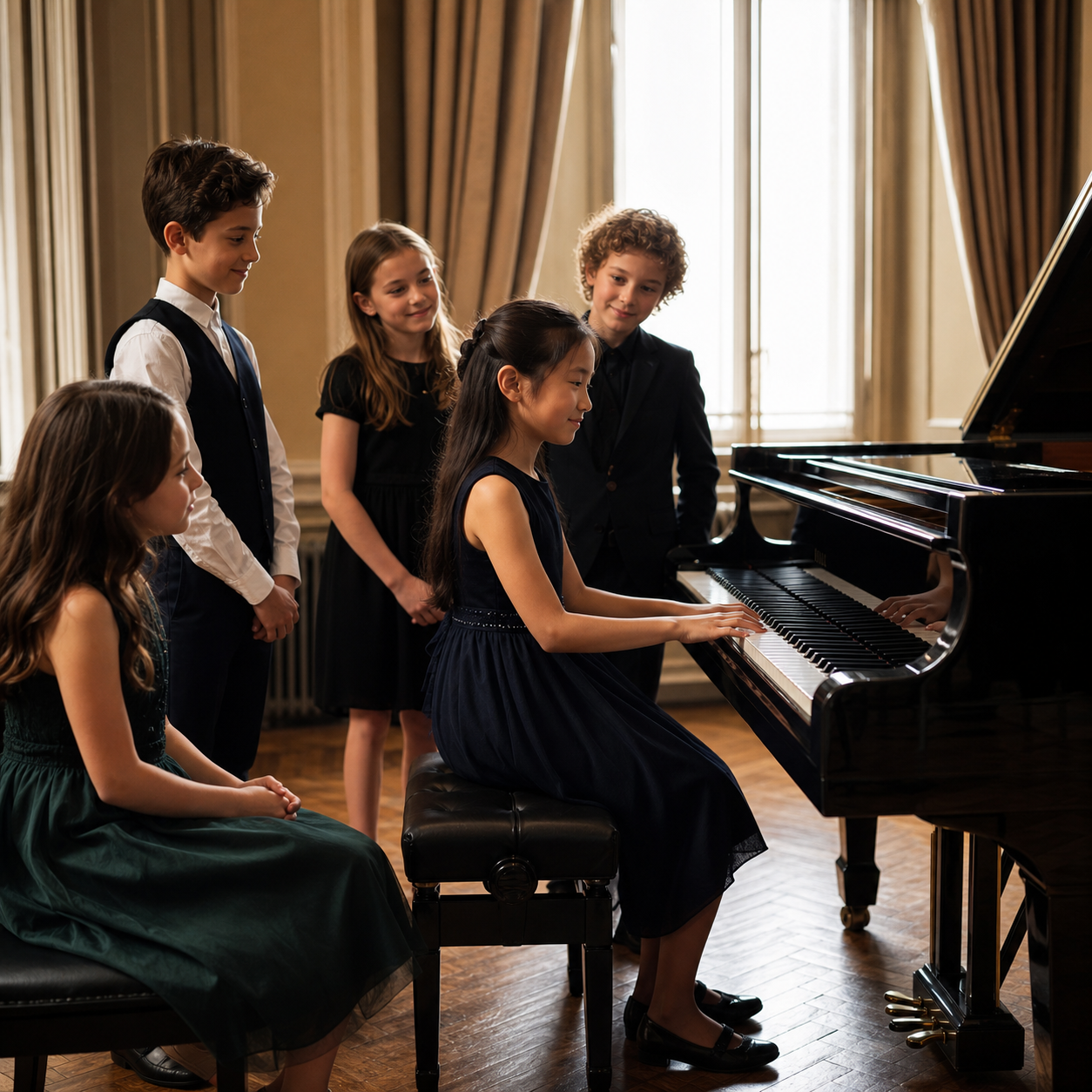
The long view of music and emotional development is not about producing a child who always appears composed. It is about building a musician who can notice, choose and communicate. The child hears a tense phrase and shapes its release; feels nervous before playing and uses preparation; becomes disappointed, then finds the next workable step; listens to another performer and responds with respect.
These are quiet accomplishments. They grow through hundreds of ordinary musical decisions, supported by adults who neither dramatise mistakes nor remove every challenge. For a wider view of WKMT’s teaching culture and classical piano study in the city, families can also visit WKMT’s London piano school.
A thoughtful first lesson begins with the child in front of us.
Explore a structured, musically serious approach for young beginners and developing pupils.
Sources on Music and emotional development
- Blasco-Magraner, J. S. et al., “Effects of the Educational Use of Music on 3- to 12-Year-Old Children’s Emotional Development: A Systematic Review”, International Journal of Environmental Research and Public Health, 2021. PMC full text.
- Department for Education and Department for Digital, Culture, Media & Sport, The Power of Music to Change Lives: A National Plan for Music Education, 2022. GOV.UK.
- Jaschke, A. C. et al., “Effects of Music Training on Executive Function Performance in Children: A Systematic Review”, 2022. PMC full text.
- British Association for Music Therapy, “What is Music Therapy?”. BAMT.
- Education Endowment Foundation, “Arts Participation”, Teaching and Learning Toolkit. EEF evidence summary.
- Habibi, A. et al., “Effects of Music Training on Inhibitory Control and Associated Neural Networks in School-Aged Children”, Frontiers in Neuroscience, 2019. Frontiers full text.