
 TRIAL LESSON
Music Theory Resoucers, Piano Lessons
Linear Analysis of Syncopation: Unveiling Hidden Rhythmic Complexity in Piano Music
Jul
Linear Analysis of Syncopation Complete Guide
Linear Analysis of Syncopation: Unveiling Hidden Rhythmic Complexity in Piano Music
Introduction: Understanding Syncopation in Theory and Practice
Syncopation is the rhythmic surprise that occurs when expected beats are displaced by unexpected accents or held notes. In simple terms, it means placing rhythmic stress where it wouldn’t normally occur, interrupting the regular pulse. This can happen by accenting a weak beat or off-beat, or by tying a note across a strong beat, so that the strong beat is not directly struck but sustained from a previous weak beat. The result is a delightful disturbance of the musical flow that catches the ear off guard. I wrote an article about the types of syncopation to understand the foundation of this topic.
In practical pianistic terms, syncopation might involve playing a note or chord slightly “after” the beat (instead of squarely on it) or holding a note through a normally accented moment, creating a tension that resolves when the expected alignment returns. Pianists often feel syncopation as a tug against the underlying pulse – you must keep the steady beat internally while executing the off-beat rhythms. This requires a solid sense of timing and sometimes independence of hands or voices, since one hand might be keeping time while the other syncopates.
Syncopation has been a feature of music for centuries (the term itself comes from Greek synkopē, meaning a cutting-away of the rhythm, and it appears across many styles – from Renaissance choral music with suspended dissonances, to African and jazz rhythms, to classical compositions. In piano music, syncopation can be understood from two perspectives: linear and vertical. Linear syncopation refers to the rhythmic events within a single melodic line or voice over time, while vertical syncopation refers to the misalignment or disjunction of rhythms between two hands or voices at a given moment. This article will explore both types in pedagogical piano repertoire from the Baroque era through the Contemporary period, showing how syncopation evolved stylistically and how it serves important teaching purposes. Guide on Linear Analysis of Syncopation.
Historical Evolution of Syncopation in Pedagogical Piano Repertoire
Syncopation is not equally prominent in all eras of piano music. In the Baroque period (17th–18th centuries), a strong regular meter was the norm, but composers did use syncopation in subtle ways. For example, J.S. Bach sometimes wrote melodies that emphasize off-beats or sustain notes across the barline. In Bach’s keyboard works – which were often intended as teaching pieces – syncopation usually appears as suspensions or tied notes that create momentary rhythmic displacement. A famous instance occurs in Bach’s Two-Part Invention No. 6 in E major, BWV 777. This invention is “a study in syncopation, contrary motion, and quirky chromaticism,” as detailed in my previous article, the very opening bar presents one voice entering on the “and” of the beat (the off-beat) with a tied note, while the other voice plays on the beat – a perfect case of linear syncopation (Also categorised as “Suspension Syncopation”) within the melody against a steady accompaniment. Bach intended his Two-Part Inventions as training pieces for developing touch and contrapuntal playing, and here he also trains the student’s rhythmic control: the right hand must accent and hold notes through the strong beats while the left hand articulates the steady pulse. Linear Analysis of Syncopation full analysis.
Here is the video that explains how the invention works with and without the syncopation to compare both versions, and how syncopation works:
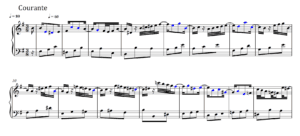
Another Baroque example is found in Bach’s dance movements; for instance, the Corrente of his Partita No. 6 in E minor features a melody that is displaced off the main beats, giving a continuous syncopated feel. These early uses of syncopation taught students to count carefully and maintain independent timing between voices, foreshadowing skills needed in more complex counterpoint.
Below we can see an extract of the piece (the beginning of the Courante) the syncopated notes are in blue on the right hand:
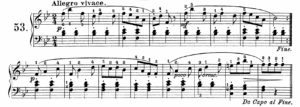
Moving into the Classical era and early Romantic era (late 18th–19th centuries), explicit syncopation was somewhat less common in elementary teaching pieces, as the focus was often on clear, on-beat rhythm and melodic simplicity. However, by the early 19th century, pedagogues like Carl Czerny recognised the need to introduce syncopated rhythms to students. Czerny included dedicated studies of syncopation in his educational opus. Notably, Czerny’s Practical Method for Beginners, Op. 599 contains Exercise No. 53, “Syncopation”, which is explicitly designed to familiarise the student with off-beat rhythms. In this short etude, one hand (or sometimes both alternately) plays notes placed on weak beats, creating a gentle syncopation while the underlying meter is played on strong beats. This exercise is effectively a primer on how to accent weak beats and count through ties. (As a contemporary listing shows, Op.599 No.53 is indeed titled “Syncopation Study”) Czerny’s inclusion of such a piece indicates that by the early 1800s, syncopation was regarded as a technical and musical skill worth teaching explicitly to beginners. It prepared pianists for more sophisticated repertoire to come.
During the Romantic era (19th century), syncopation in piano music became more prevalent in certain genres – for example, the accompaniment “oom-pah-pah” pattern of waltzes and polkas often puts an emphasis on the off-beat chords (beat 2 and 3 in a 3/4 bars) for lilt.
Composers like Chopin and Schumann sometimes used syncopated rhythms for expressive effect (Chopin’s mazurkas accent unusual beats; Schumann’s “Album für die Jugend” contains a few pieces with mild syncopations in accompaniments, for example “May, Sweet May”, “Spring Song”, “The Reapers Song”, “Roundelay”). However, much of the pedagogical literature of the mid-1800s (e.g. easy sonatinas by Clementi or Kuhlau) still adhered to straightforward rhythm. It wasn’t until late 19th and early 20th century that syncopation truly flourished in both popular music and pedagogical compositions.
The turn of the 20th century saw ragtime blaze onto the scene, bringing an exuberant style built wholly on syncopation. Ragtime’s influence on piano pedagogy was indirect but significant – it demonstrated the appeal of off-beat rhythms. In classic ragtime (Scott Joplin and others), the left hand plays a steady “boom-chuck” rhythm (bass notes on strong beats 1 and 3, chords on weak beats 2 and 4) while the right hand plays a syncopated melody that accents notes between those left-hand beats. In other words, ragtime melody lines are deliberately “ragged” or off-beat against a strict meter. This vertical form of syncopation – the two hands stressing opposite parts of the beat – became a staple of early jazz and popular piano music. Pedagogically, while rags themselves were often beyond beginners, simplified arrangements or “ragtime études” started finding their way into lesson books, teaching students to coordinate a steady left-hand rhythm with an off-beat right-hand figure. The influence of ragtime and jazz meant that by the 1920s and 30s, no well-rounded pianist could avoid learning syncopated rhythms. Contemporary educators began writing pieces that explicitly incorporate swing and syncopation to acclimate students (for instance, pieces in duple meter with ties over the bar, or bluesy off-beat accents).
“Maple Leaf Rag” is an excellent example of this:
A landmark in 20th-century pedagogical piano literature is Béla Bartók’s Mikrokosmos (1926–1939), a six-volume collection ranging from beginner to advanced levels. Bartók, a modernist composer deeply influenced by folk rhythms, included several pieces focusing on syncopation. In fact, Mikrokosmos contains three pieces titled “Syncopation” (I, II, III) at progressive difficulty levels. “Syncopation (I)” (Mikrokosmos No. 9) appears in Volume I for beginners, introducing a very simple off-beat pattern (such as a note tied over a barline or accented on an unexpected subdivision).
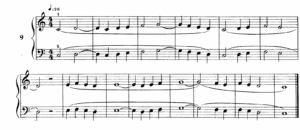
In the same book, there are also Nos. 34 and 35 to explore more.
Later, “Syncopation (II)” (No. 27)
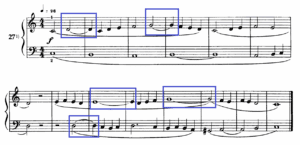
and “Syncopation (III)” (No.133)
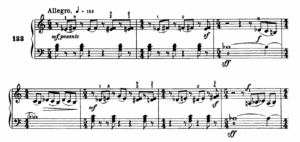
in the advanced books (Mikrokosmos Vol. 5), challenges the student with increasingly complex examples. Bartók’s approach is systematic – he first gives the illusion of syncopation by changing time signatures frequently (so the groupings feel odd, though each bar is solidly on-beat), and later he keeps a steady meter but plants accents off the grid, forcing the performer to feel the steady beat internally while playing irregular groupings. Mikrokosmos No.133 (the hardest “Syncopation” study) is particularly intriguing: its first half has constantly shifted time signatures with no notes crossing the barline, while its second half settles into a regular 4/4 meter with abundant syncopations. Bartók deliberately contrasts these two scenarios to train the student in both metric flexibility and true syncopation.– a valuable lesson about syncopation. The vertical aspect is also present in Bartók’s pedagogy: many Mikrokosmos pieces train independence by giving each hand different rhythmic patterns (for example, No. 59 “Syncopation” pits a steady pulse in one hand against off-beat accents in the other).
By the mid-20th century, other composers like Dmitri Kabalevsky and Alexander Tcherepnin also wrote children’s pieces with syncopated rhythms, reflecting the fact that contemporary music – whether folk dances, jazz, or modern classical – required these skills.
In his book “Pieces for Children, Op. 39” by Kabalevsky, some examples are No. 21 “Improvisation” in which the main motive on the right hand is a syncopation by a displacement of a quaver:
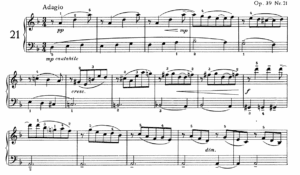
In the case of Alexander Tcherepnin, in his 10 Bagatelles (piano), Op. 5 No. 3, the accompaniment is presented always with an Off-Beat syncopation:
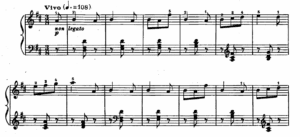
And in No. 7, the whole rhythmic pattern is displaced by a quaver beat in bars 1 to 4, with intermittent changes to on-beat patterns, giving a feeling of constant unrest:
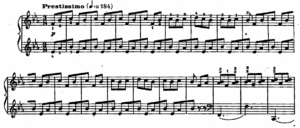
In summary, the historical trajectory shows an increasing acknowledgement of syncopation as an essential component of rhythm training. From Bach’s subtle off-beats, to Czerny’s exercises, to Bartók’s comprehensive studies, pedagogical piano literature evolved to incorporate syncopation in a structured way, mirroring its growing importance in musical styles.
Linear vs. Vertical Syncopation: Rhythmic Complexity in One Voice vs. Two
It is useful to distinguish linear syncopation and vertical syncopation when analysing piano music. Linear syncopation refers to unexpected accents or rhythms occurring within a single melodic line (one hand or voice) as it unfolds in time. In linear syncopation, it’s the melody itself that is off-beat relative to the underlying pulse. By contrast, vertical syncopation arises from the interaction of two or more parts at a given moment, usually between the left and right hands in piano music – for example, one hand plays on the beat while the other plays off the beat, creating a composite syncopated texture. Pianists often encounter vertical syncopation as a coordination challenge, whereas linear syncopation is more about phrasing and emphasis within one line.
Bach’s Invention No. 6 in E major (mentioned earlier) provides a clear example of linear syncopation. The right-hand subject is written with a syncopated rhythm, meaning its important notes frequently tie across the strong beats or land between them (Also called “Suspension Syncopation”). When you play this melody by itself, you feel the metrical accents falling in unusual spots – it has a dancing, lilting quality independent of any accompaniment. The left hand in this piece has its own subject that is more straightforward rhythmically, so together the two voices produce momentary clashes: often, the left hand will strike a note on a downbeat while the right hand is in the middle of a held note or rest, then the right hand’s next note comes after the left hand, on a normally weak part of the beat. This overlap of a steady voice with a staggered voice is the essence of Bach’s two-part syncopation. The student learning this invention must therefore keep an internal count and align the voices correctly despite their different rhythmic shapes. The benefit is a training in hearing and executing counterpoint with independent rhythms – a core Baroque skill.
The linear syncopation of the right hand teaches expressive timing (making off-beats sing) and how to project a line that isn’t rhythmically reinforced by the bass. Bach also uses suspension syncopation in his three-part Sinfonias and chorales: a note held over creates a dissonance on the beat which then resolves. From a linear perspective, the held note is the syncopation, delaying the expected change; vertically, it causes delicious tension against the other voices.
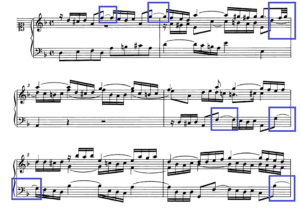
Examples of this literature can be found in Sinfonia No. 4 in D minor, in which accented last quaver on the are prolonged to the next strong beat:
On the other hand, vertical syncopation is exemplified by styles like ragtime and stride piano, as well as many 20th-century pedagogical pieces influenced by folk dances. In vertical syncopation, each hand might be perfectly regular on its own, but together they form a syncopated pattern because their attacks don’t coincide on the beats. A classic case is the ragtime “boom-chuck” pattern mentioned earlier. The left hand diligently plays bass notes on beats 1 and 3 and chords on 2 and 4 (in 4/4 time), never deviating – a very square rhythm. The right hand, however, plays melodies that often accent the “&” of the beat (the second half of each beat) or use ties that carry a note into the next beat. The overall effect is syncopated because the right hand is constantly off the left hand’s beat. For example, in Scott Joplin’s The Entertainer, you will frequently find a right-hand note struck between the left hand’s steady “om-pahs.” The two hands combined accentuate off-beats, even though individually each is simple.
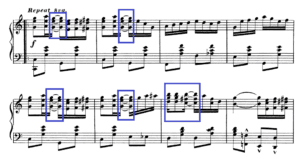
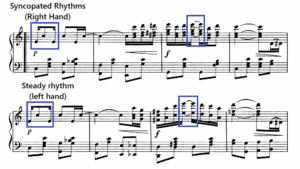
According to musicologists, ragtime is essentially “a synthesis of African syncopation and European march rhythm” – meaning one layer provides the straight march and another layer provides the syncopation. For a pianist, mastering this style is a matter of hand independence: the left hand must be almost metronomic, while the right hand is freely syncopated and “dances” around the left hand’s attacks. Many pedagogical arrangements of ragtime or “Jazz Etudes” for students isolate this concept, often by simplifying the left-hand pattern and giving an easy syncopated motif in the right hand (for instance, a right-hand note consistently tied over each downbeat). By practicing these, students learn to feel the steady beat with one hand (or foot tapping) and play off that beat with the other – a crucial step in developing coordination.
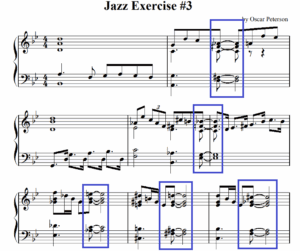
A reference of these Jazz etudes are the “Jazz Exercises” by Oscar Peterson, in which progressively guides the student to master the typical off-beat syncopations, either before or after the beat:
Differences between linear and vertical syncopation
The differences between linear and vertical syncopation sometimes blur in real music, but analysing them separately can help. In linear syncopation, one focuses on the single voice’s rhythm against an implied pulse.
We ask: is the melody accenting weak beats? Are there ties across the bar? A good teaching strategy is to have the student tap the underlying beat while singing or clapping the syncopated melody – this trains the inner metronome. In vertical syncopation, the focus is on the interaction: how do the hands interlock (or rather, avoid locking) rhythmically? Teachers often have students practice hands separately first (to solidify each hand’s rhythm), then slowly put hands together, maybe even vocalising one hand’s rhythm while playing the other. Counting aloud or using a metronome can help line up the composite rhythm correctly.
A particularly intriguing form of vertical rhythmic complexity is the polyrhythm (e.g., 2 against 3), which is not syncopation in the strict sense (since it involves different subdivisions rather than shifted accents), but it often co-occurs with syncopated music. Polyrhythms force an even higher level of independence. Czerny’s pedagogical works include examples like a simple piece in which the right hand plays in duplets and the left in triplets simultaneously – a different kind of disjunction. While not “syncopation” by definition (no accent displacement, just simultaneous contrasting rhythms), the mental skill developed is similar: maintaining two independent rhythmic frameworks at once. Many educators introduce the famous “two against three” exercise to intermediate students, which builds a foundation for both polyrhythms and complex syncopations.
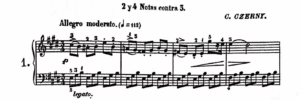
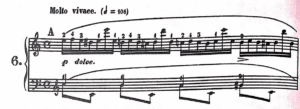
Czerny has categorised all possible polyrhythms: Nos. 1 and 2 are 2 against 3, Nos. 3, 4 and 5 are 5 against 3, No. 6 is 7 notes against 2,3 and 4. Below are some examples:
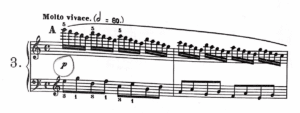
To summarise, linear syncopation in piano music trains the performer to shape a single musical line with off-beat accents, often improving expressive phrasing and rhythmic subtlety, whereas vertical syncopation trains the performer to coordinate contrasting rhythms between the hands, a key aspect of piano independence. Both are integral to advanced rhythmic mastery.
Pedagogical Purpose: What Syncopation Teaches Pianists
Incorporating syncopation into piano pedagogy is not merely about learning a special rhythm trick – it serves several core educational purposes:
- Internalising Steady Pulse: Perhaps the most important skill reinforced by syncopated passages is the ability to feel an implicit steady beat even when it’s not being explicitly played. When a student plays a syncopated rhythm, the downbeats might be silent or deemphasized; they must imagine the metronomic beat to place the off-beat notes correctly. This greatly strengthens the student’s inner timing. Teachers often note that after mastering syncopation, students have a more solid sense of beat and subdivision, since they’ve learned to count through silences and ties.
- Hand Independence and Coordination: Syncopation frequently requires one hand to do something different rhythmically from the other. Early examples like Bach’s Inventions already demand that one hand hold a note while the other moves. More modern examples, like a left-hand ostinato against a right-hand off-beat melody (à la ragtime or boogie-woogie), require true independence. Practicing these builds coordination. It’s no surprise that many “Czerny polyrhythmic etudes”aim to improve coordination – the syncopation studies in particular force the issue of hands together only at certain shared points. By conquering syncopated patterns, students gain confidence in handling any asynchronous figure (their hands learn to “agree to disagree” rhythmically, so to speak).
- Rhythmic Reading and Precision: Pedagogical syncopation also improves a student’s rhythmic reading skills. They must interpret tied notes correctly (recognising, for example, that a tied eighth across the bar line means “don’t play on beat 1, carry the previous note”). They also learn to subdivide beats meticulously (e.g., understanding where the “& of 2” lies in the bar). Syncopation studies often appear daunting in notation – lots of ties, dots, and rests – but working through them demystifies such notation. The student learns to read complex rhythms and to predict where the next downbeat will fall, even if nothing is played on that beat.
- Dynamic Emphasis & Articulation: From a musicality standpoint, syncopation teaches accentuation and balance between hands. In a syncopated melody, the off-beat notes often carry accent marks or require a natural stress to bring out the rhythmic quirk. The pianist learns to give weight to unexpected notes (often with a special arm or wrist action to lean into the off-beat) while not over-accenting the normal beats. In vertical syncopation, the student must often bring out the syncopated hand (usually the right hand melody) and keep the on-beat accompaniment lighter, or vice versa if the roles swap. This fosters control over tone and the ability to direct the listener’s ear to the rhythmic focal point. For instance, in a simple syncopated duet, the teacher might play steady chords while the student plays an off-beat melody; the student must project confidently so the rhythmic interplay is clear.
- Exposure to Stylistic Rhythms: Each era’s approach to syncopation teaches the student something stylistically unique. Baroque syncopations (like suspensions) teach about tension and release in counterpoint. Romantic-era syncopations (like in a Chopin mazurka or a Schumann piece) often teach rubato and flexibility – knowing how to play slightly “across the bar” without losing the shape. Jazz and folk syncopations teach about groove and swing – feeling a forward drive even when the rhythm is jagged. By encountering syncopation in different contexts (classical vs. ragtime vs. modern), students become more versatile and comfortable with rhythmic nuance. They also gain appreciation for how rhythm contributes to musical character: compare the elegant syncopation in a Gavotte (with its typical emphasis on beat 2) to the earthy syncopation in a Blues piece – each has a pedagogical piece somewhere (even Bartók includes a “Blues” in Mikrokosmos).
- Problem-Solving and Focus: From a psychological perspective, learning syncopated passages builds patience and concentration. Students often have to practice slowly, sometimes hands alone, and solve a puzzle of alignment. Mastering a tricky syncopation (like a tie over the bar that makes you play nothing on the downbeat but continue counting) is a small but significant victory that boosts overall confidence in tackling complex music. It is not uncommon for a teacher to use a syncopated rhythm exercise to diagnose a student’s rhythmic stability – if the student can learn it, they likely have good control; if not, it’s a clear area to work on.
Finally, focusing on syncopation fills a unique educational niche at the intersection of rhythm and music theory. It encourages students to analyze the music’s structure: they must understand where the strong beats are and why the composer is avoiding them. In essence, syncopation study combines theoretical knowledge (meter, accent patterns) with practical execution (physical timing and touch). An academic but accessible analysis of syncopation – such as breaking down a passage and marking the implied beats – can enlighten a student on how the piece is built. This integrates rhythmic understanding into the broader musical comprehension.
For instance, when a student learns Bartók’s “Syncopation” from Mikrokosmos, a teacher might ask: “How many beats are in each bar, and which beats are you not playing when you have that tied note?” Answering that involves music theory (time signature and strong/weak beats) in service of performance. In this way, syncopation exercises serve as a bridge between music theory and practice, a point which makes them especially valuable in advanced beginner and intermediate training.
Specific Examples from Pedagogical Repertoire
To ground the discussion, let’s look at a few concrete examples of syncopation in pedagogical piano pieces, along with their measure references and the skills they target:
- Bach, Two-Part Invention No. 4 in D minor, BWV 775 (bars 13–18): In the middle section of this invention, Bach writes a series of suspensions between the voices. For example, the right hand holds a note through the downbeat of m.14 while the left hand moves, creating a syncopated suspension that resolves a moment later. Here the syncopation is linear in each voice (each voice takes turns holding over the bar line) and also vertical between voices (when one is suspended, the other voice provides the moving harmony). The pedagogical focus is on polyphonic legato and timing of resolutions – the student learns to keep one hand down until the exact moment of resolution, coordinating release and attack between hands precisely. It trains a refined rhythmic control and the expressive timing of dissonance and consonance (a very Baroque skill). A clear understanding of “why does this note sound tense? – because it’s a syncopation that needs resolution on the next beat” also emerges, connecting theory (suspensions) with practice.
The example below is part of the many examples from my previous article about syncopation:
- F. Chopin Ballade No. 1 in G minor, Op. 23
Bar 36 to 43 :
During the agitato section (In 6 /4 time signature), persistent syncopation in the right hand places chords on the “&” of each beat, while the left hand continues to mark the main pulse—creating vertical syncopation. The effect is an intensification of rhythmic drive and instability.
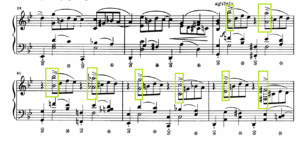
The student must learn to accent where “it’s least expected” (to quote a definition of syncopation in my previous article, and then immediately return to the underlying pulse. This builds expressive timing – pushing forward and then yielding. It also might be an introduction to “agogic” accents (accent by length) because often the tied note is effectively lengthened into the strong beat, creating emphasis by duration rather than impact.
- Béla Bartók, Mikrokosmos Volume V, Starts with No. 122 with a syncopated pattern that is repeated throughout the etude:
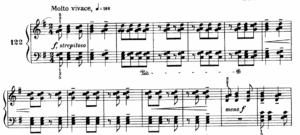
- No. 125 “Boating” (bars 1–8): This piece isn’t labeled “Syncopation,” but it features a bimodal meter: the right hand is in 6/8 and left hand in 5/8 simultaneously for several bars. This creates cross-accents and syncopated-feeling displacements when the hands come together (every few beats one hand’s accent doesn’t align with the other’s). For a student, “Boating” is a study in irregular rhythm and vertical misalignment.
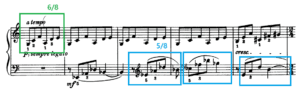
While not a simple upbeat/downbeat syncopation, it requires similar skills: keeping an independent count in each hand and listening for how the pattern realigns every so often. Bartók indicated such pieces to expand a student’s rhythmic horizons beyond common time. The pedagogical focus is on advanced coordination and the ability to feel a larger metric cycle. By mastering this, a pianist is well equipped to handle complex contemporary rhythms and to not be startled by music that doesn’t “line up” in the obvious ways.
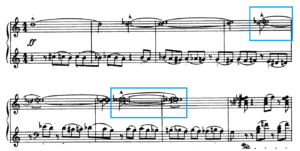
- Bartók, Mikrokosmos Vol. V, No.133 “Syncopation” (second half, approx. mm.17–24): In the second half of this challenging piece, the time signature stays in 4/4 but Bartók writes accent patterns that deliberately avoid the downbeat – e.g., a series of tied syncopations where notes fall on “& of 1”, “& of 3”, etc., with rests or ties on the strong beats. The effect is a stream of irregular accents that sound almost random, yet the student must keep the 4/4 heartbeat steady internally. Bartók basically asks the performer to demonstrate complete command over rhythm: no matter how jagged the written rhythm, the implied metronomic pulse must never waver (often teachers will have the student tap their foot or conduct lightly to ensure this). The pedagogical takeaway is absolute rhythmic security. Once a student can play such passages accurately, simpler syncopations seem easy. Furthermore, Bartók’s complex syncopation teaches analytical skills – students often end up labeling the rhythm (e.g., “this is a 3+3+2 subdivision pattern across the bar” or “accents are on 16th-note or semiquaver offsets”) which enhances their theoretical understanding of rhythm. It also inculcates modern phrasing concepts: phrases are not always aligned with bars, and a musical line can stride across barlines freely – a concept very much at home in 20th-century music.
- Modern Method Books (e.g., 21st-century jazz-influenced pieces): Many contemporary piano methods include pieces with titles like “Rocking Bass” or “Jazz Groove” for late beginners. These usually have a swing or syncopated riff in them. For example, a piece might have a left-hand that plays a steady rock rhythm (like bass on beats 1 and 3, chords on 2 and 4) and a right-hand melody that uses syncopated patterns (perhaps hitting anticipations – e.g., playing a melody note on “4&” tied into the downbeat of the next bar). The intention is to prepare students for genres like rock, pop, and jazz where backbeat and syncopation are fundamental. Pedagogically, these pieces often teach syncopated pedaling as well (lifting the pedal after the beat to accommodate the syncopation) and a relaxed, swung interpretation.
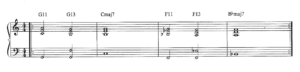
We can find some examples in the “Jazz-Blues piano” by Hal Leonard, in which a progression without rhythm is offered to be learned first:(page 16)
And immediately after, the comping pattern with syncopated rhythms:
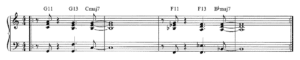
They highlight that syncopation isn’t only a classical concept but a universal musical language – one that makes music feel energised and modern. Students usually find these fun, and the motivation helps the learning of the tricky rhythms. So, adding these contemporary syncopated pieces fills that gap, ensuring a well-rounded rhythmic training.
Conclusion on Linear Analysis of Syncopation – Syncopation as a Bridge Between Rhythm and Theory in Piano Education
Syncopation, whether occurring linearly in a single melodic thread or vertically between the pianist’s two hands, unveils layers of rhythmic complexity that can transform a simple piece into something intriguing. Analysing syncopation linearly allows us to see hidden emphases and contours in melodies, while analysing it vertically reveals the interplay or “conversation” between the hands. From Bach’s inventions to Bartók’s modern miniatures, composers of pedagogical piano music have ingeniously used syncopation to both challenge and delight students.
The study of syncopation occupies a unique niche in piano pedagogy: it is at once deeply theoretical (involving understanding of meter, subdivision, and cross-rhythm) and profoundly practical (demanding precise physical timing and listening). This intersection helps students make the connection between what’s on the page and how it should sound and feel – a true holistic learning experience.
By tracing the historical and stylistic evolution, we see that each era contributed something to how we teach syncopation. Baroque gave us the concept of suspension and linear rhythmic tension, Classical pedagogues started isolating the concept for practice, Romantic and folk traditions added flavor and context to its use, and 20th-century composers like Bartók integrated it fully into the technical curriculum. Today, a piano teacher armed with this knowledge can use syncopation studies not only to teach a “rhythm trick,” but to impart broader skills: solid pulse, independence, agility in reading, and stylistic versatility.
In performance, a pianist who has mastered syncopation can bring a piece to life with subtle timing – a jazz riff swings because of confident syncopation, a Bach prelude breathes because of suspensions held just so, and a student’s rendition of a rag or a Bartók dance captivates because the rhythms groove and pulse from within. Understanding the linear and vertical dimensions of these rhythms only deepens the appreciation and execution. Thus, the linear analysis of syncopation is not an academic exercise for its own sake, but a key to unlocking hidden rhythmic complexity and, ultimately, greater musicality in piano music across all periods. Linear Analysis of Syncopation.
Sources for Linear Analysis of Syncopation
- Paterno, Gisela. Understanding Syncopation in Music: A Conversational Exploration. Piano Lessons London Blog (WKMT). 2024. – Definition and etymology of syncopationpiano-composer-teacher-london.co.uk.
- Wikipedia. Syncopation. – Technical description of syncopation as “placement of rhythmic stresses where they wouldn’t normally occur”en.wikipedia.orgen.wikipedia.org. / Linear Analysis of Syncopation Complete Guide
- Bluestine, Eric. “Bach – Invention #6 in E Major.” The Ways Children Learn Music (blog). 2024. – Commentary calling Invention No.6 “a study in syncopation, contrary motion, and quirky chromaticism.”thewayschildrenlearnmusic.wordpress.com.
- Teoria.com – Analysis of Bach Invention No.6, noting the syncopated nature of the second subject (soprano voice)teoria.com.
- Piano-Tips.com – Level 3 Lesson Book, listing Czerny Op.599 No.53 as “Syncopation Study”piano-tips.com.
- Snoman, Rick (cited on Wikipedia) – Observation on dance music and syncopation’s role in tying a track togetheren.wikipedia.org.
- Wikipedia. Ragtime. – Describes ragtime’s left-hand pattern and syncopated melody, and notes the term “ragged rhythm”en.wikipedia.org.
- Hein, Ethan. “Remixing Bartók’s Mikrokosmos No.133 – Syncopation.” Ethan Hein Blog. 2020. – Discussion of Bartók’s approach to syncopation in Mikrokosmos 133, first half vs second halfethanhein.com.
- Bartók, Béla. Mikrokosmos, Volumes I–VI. (Published 1940). – Contains pieces “Syncopation (I), (II), (III)”en.wikipedia.orgen.wikipedia.org and numerous rhythmic studies, Linear Analysis of Syncopation Guide.
- Reddit discussion – Emphasizing the importance of syncopation practice for 20th-century repertoireforums.pianoworld.com. / Linear Analysis of Syncopation Guide
- Various score references as noted in text (Bach inventions, Czerny op.599, polyrhythmic etudes, Chopin Ballade No. 1 in G minor, Op. 23, Bartók Mikrokosmos, Robert Schumann Op. 68) for specific measure examples from Petrucci Music Library. Linear Analysis of Syncopation.