
 TRIAL LESSON
Uncategorized
Queen’s Hall London: The Lost Icon of Classical Music and Piano Performance
Jul
Queen’s Hall London: The Lost Icon of Classical Music and Piano Performance
Queen’s Hall in London was once the crown jewel of the city’s classical music scene – a grand Victorian concert venue celebrated for its superb acoustics and intimate atmosphere. Opened in 1893 at Langham Place, Westminster, it quickly became the pre-eminent concert hall of Britain, synonymous with the golden age of classical music and piano performance. Here, Sir Henry Wood founded the Promenade Concerts (the BBC Proms) in 1895, and legendary musicians from around the world graced its stage. Tragically, this musical landmark met its end in 1941 when it was destroyed in the Blitz. Yet its legacy lives on. In this article, we explore the history of Queen’s Hall – from its ambitious creation and heyday to its untimely demise and lasting impact on London’s musical heritage.
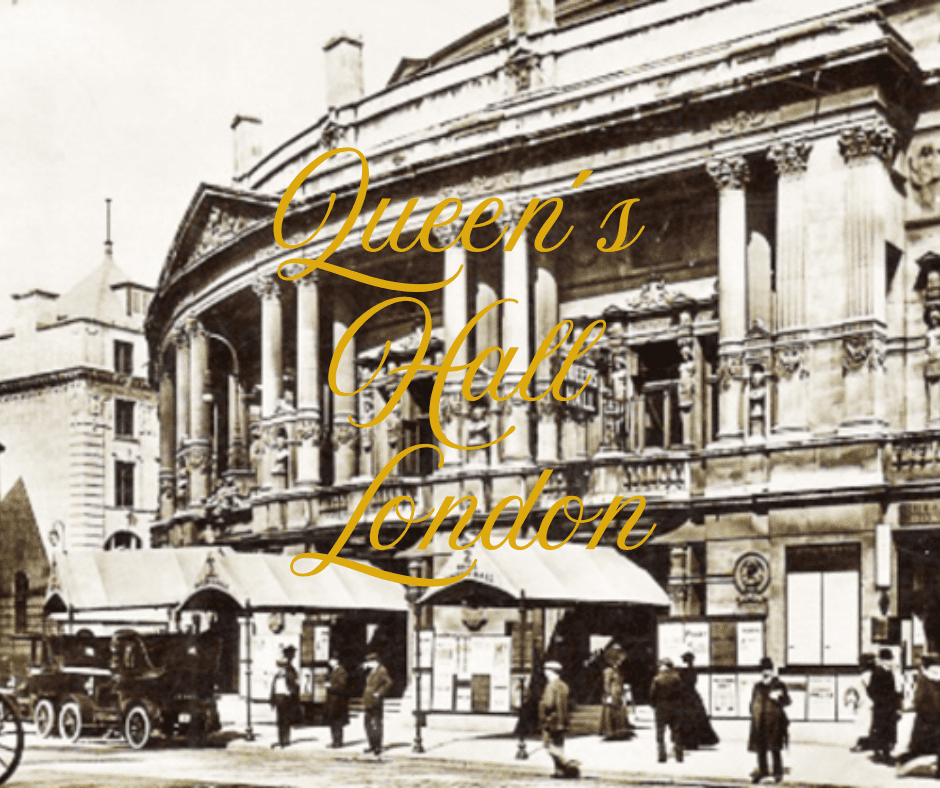
Figure: The façade of Queen’s Hall (photographed in 1894) seen from Langham Place. The building’s grand design – a curved portico with towering columns and niches holding composers’ busts – was said to be inspired by the Parthenon in Athens.
Origins and Grand Design
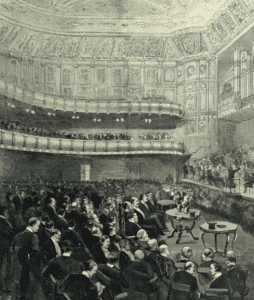
In the late 19th century, London lacked a purpose-built orchestral concert hall – major concerts were often held in multi-use venues like St James’s Hall. The idea for a new, dedicated hall was championed by entrepreneur Francis Ravenscroft, who financed the project despite having no great personal interest in music. He hired architect Thomas Edward Knightley to design a grand auditorium on a prominent triangular site at Langham Place, between All Souls Church and the Langham Hotel. The resulting Queen’s Hall, completed in 1893, featured an impressive Portland stone façade with a sweeping colonnade and classical detailing, adorned with carved busts and medallions of famous composers. Inside, the main hall was decorated in rich red and gold hues with ornate plasterwork – including a ceiling mural of cavorting cupids (later painted over for being too garish). The auditorium initially seated about 3,000 people (later reduced to roughly 2,400 after renovations to improve legroom) and included a secondary Queen’s Small Hall for more intimate recitals. From the very beginning, Queen’s Hall was envisioned as a state-of-the-art temple to music in the heart of London.
Legendary Acoustics and Atmosphere
One of Queen’s Hall’s most celebrated features was its acoustics. Knightley paid great attention to sonic design – the hall’s walls were lined with wooden panels hung on thick battens with an air gap behind them, effectively turning the auditorium into a giant resonating chamber akin to “the body of a violin”. The result was a “golden acoustic” that musicians and critics praised as unmatched by any other large hall in London. Performers noted that even the softest pianissimo could be heard clearly in the top gallery, and every nuance of sound carried beautifully throughout the space. Sir David Willcocks recalled being surprised at how “intimate” Queen’s Hall felt compared to the much larger Royal Albert Hall, yet he “wasn’t disappointed by the wonderful sound” it produced. Audience members, too, reminisced about the hall’s warm, welcoming ambience – regular prom-goers felt “part of a family” at Queen’s Hall concerts, and one old-timer fondly said, “Everybody loved Queen’s Hall… You entered it and felt at home.”. In short, the venue combined the grandeur of a big hall with the acoustical intimacy of a chamber music salon, making it a favorite of performers and audiences alike.
The Birth of the Proms at Queen’s Hall
Just two years after opening, Queen’s Hall made history by launching the first Promenade Concerts, or “Proms.” Hall manager Robert Newman envisioned a summer season of nightly concerts with affordable tickets, where audiences (many standing in the “promenade” area) could enjoy a mix of popular and serious works in a relaxed atmosphere. He enlisted a young conductor, Henry J. Wood, to lead this experiment in musical outreach. The inaugural Proms series opened in August 1895 and ran for ten weeks, during which smoking and even refreshments were allowed during concerts – a then-radical touch intended to make classical music more accessible. The very first Prom concert offered a grab-bag of 27 light classical pieces, but Newman and Wood gradually raised the artistic level, introducing more substantial repertoire as the audience grew. Their strategy succeeded: the low-priced nightly concerts cultivated a new, enthusiastic public for classical music. Within a few years, the Proms had become a beloved London institution, firmly establishing Queen’s Hall as the vibrant heart of the city’s musical life.
Golden Era: World-Class Performances and Premieres
As the 20th century dawned, Queen’s Hall entered a golden era and solidified its status as Britain’s premier music venue – “the acknowledged musical centre of the Empire,” as it was soon known. The hall regularly hosted the leading conductors, virtuosos, and orchestras of the age. International ensembles like the Berlin Philharmonic (under Wilhelm Furtwängler), the Vienna Philharmonic, and the New York Philharmonic (under Arturo Toscanini) made acclaimed appearances at Queen’s Hall. The greatest British ensembles, such as the London Symphony and later the BBC Symphony and London Philharmonic, also gave landmark concerts there. Virtuoso soloists from around the world graced its stage – renowned violinists like Joseph Joachim and Fritz Kreisler, legendary sopranos like Nellie Melba, and star pianists such as Ignacy Jan Paderewski (whom Newman paid more than any other soloist) all performed in Queen’s Hall’s heyday.
Queen’s Hall was also the scene of many important world premieres and British debuts of musical works. In 1899, Edward Elgar’s Enigma Variations received its first London performance there, and two decades later Elgar’s poignant Cello Concerto was premiered on the Queen’s Hall stage. The hall’s celebrated acoustic heard the first UK performances of Claude Debussy’s Prélude à l’après-midi d’un faune and Frederick Delius’s On Hearing the First Cuckoo in Spring. Notably, in 1901 an enthusiastic London audience at Queen’s Hall heard Sergei Rachmaninoff’s Piano Concerto No. 2 – a piece that would become one of the most beloved piano concertos – for the first time in Britain. By the 1930s, with Sir Henry Wood still at the helm of the Proms and frequent high-profile concerts, Queen’s Hall had no equal in London’s musical landscape.
It was not only “London’s premier concert-hall” but a place where musical history was being made on a regular basis.
A Venue for All: Beyond Classical Music
Though primarily a temple of music, Queen’s Hall also served as a cultural hub for various public events. Its spacious halls were often rented out for meetings, lectures, rallies and exhibitions. Notably, the hall became a popular gathering place for the women’s suffrage movement in the early 20th century – both militant and non-militant suffragist groups used Queen’s Hall for mass meetings and conventions. Emmeline Pankhurst’s Women’s Social and Political Union (WSPU) held rallies and “at home” afternoons there, and the moderate National Union of Women’s Suffrage Societies (NUWSS) convened their council meetings in the hall. In March 1918, Queen’s Hall was the venue for a grand “victory” celebration organized by the NUWSS to mark the newly-won partial enfranchisement of women.
The hall also hosted a wide variety of other events over the years. Its calendar included everything from charity bazaars and political meetings to sporting contests. In fact, Queen’s Hall even accommodated table tennis tournaments and ballroom dancing competitions in the 1930s alongside its concert schedule. In its final month of existence (spring 1941), the venue was still bustling – it saw gatherings of organizations like the British and Foreign Bible Society and the Church Missionary Society, and even hosted the annual conference of the British Legion’s women’s section, attended by Queen Elizabeth (the Queen Mother). This diverse usage reflects how Queen’s Hall functioned not just as a music hall for the elite, but as a busy public venue at the heart of London’s cultural and civic life.
Destruction in the Blitz
On the night of May 10, 1941 – during the height of the Blitz – tragedy struck Queen’s Hall. That evening, London endured one of its most destructive air raids, and a single German incendiary bomb pierced the roof of Queen’s Hall, igniting a fire in the auditorium. Two alert firewatchers on duty did manage to douse the initial flames with stirrup-pumps, but in a cruel twist the fire reignited moments later – by then, water pressure in the area had plummeted due to the widespread bombing, leaving hoses dry. With no way to contain the blaze, the great hall was soon engulfed. By dawn, Queen’s Hall was a gutted shell: the roof had collapsed, the once-sumptuous interior reduced to rubble and ashes, and the magnificent organ on stage left in charred ruins of wood and melted metal.
Poignantly, only hours before the bombing, the London Philharmonic Orchestra and Royal Choral Society had given an afternoon performance of Elgar’s The Dream of Gerontius at Queen’s Hall – a final concert that became a fateful swan song. The destruction of this beloved venue sent shockwaves through Britain’s musical community. Indeed, for many, the bomb that destroyed Queen’s Hall marked the end of an era in London’s cultural life.
“There were deeper, more elemental human tragedies on London’s worst night of the Blitz,” one account noted, “but the loss of Queen’s Hall must have stopped the hearts of music lovers around the world”
Aftermath and Enduring Legacy
In the wake of the devastation, there were impassioned efforts to resurrect what had been lost. Sir Henry Wood – whose name was practically synonymous with Queen’s Hall and the Proms – was shielded from the news at first, but when he finally learned of the destruction, his response was defiant: “We must build another Queen’s Hall,” he declared. Many in the music world echoed his sentiment and hoped the hall might be rebuilt after the war. Despite much lobbying, however, the government decided against reconstructing Queen’s Hall, and its primary musical functions were taken over by the Royal Albert Hall from 1942 onward. A fundraising campaign in the late 1940s to build a “New Queen’s Hall” fell far short of its goal; the funds that were collected were eventually used instead to convert an old church in Southwark into the Henry Wood Hall (an orchestral rehearsal venue named in honor of the Proms’ longtime conductor). The bombed-out remnants of Queen’s Hall stood ruinous for some years after 1941, but by the 1950s the site was cleared. Today, an office building called Henry Wood House occupies the location on Langham Place, marked with a green plaque that commemorates the Queen’s Hall (1893–1941) as the site of “Britain’s leading concert hall” and the original home of the Proms.
Yet, the legacy of Queen’s Hall lives on in several ways. The BBC Proms festival continues each summer at the Royal Albert Hall, where Sir Henry Wood’s bronze bust (salvaged from the Queen’s Hall rubble) presides over the concert stage – a tradition that keeps the memory of Queen’s Hall’s founder at the forefront. A number of decorative stone composer busts that once graced Queen’s Hall’s facade were rescued after the war; after decades in storage, these busts were restored and now reside in the Royal Academy of Music’s museum on Marylebone Road as tangible relics of the old hall. Musicians and acousticians still hold up Queen’s Hall as a benchmark for concert sound – its famously “perfect acoustics” have not been forgotten. In fact, many critics have lamented that London, even with its modern venues, “still lacks a concert hall” with the kind of warm, enhancing acoustic that Queen’s Hall possessed. Ultimately, Queen’s Hall London remains a cherished symbol in the history of classical music. It lives on in the hearts of those who remember that special atmosphere – a place where “you could see everything and hear everything” – and in the enduring institutions (like the Proms) that it fostered during its 48 well-tempered years of music.
References Queen´s Hall London
-
Heritage Gateway, Queen’s Hall – Historic England Research Records heritagegateway.org.uk
-
Andrew Green, “What happened to Queen’s Hall?” Classical Music Magazine (June 2017) classical-music.com
-
UCL Survey of London, “The Queen’s Hall, Langham Place” (2016) blogs.ucl.ac.uk
-
Wikipedia, “Queen’s Hall” en.wikipedia.org. (Various historical details and performer lists)
- https://www.meherbabatravels.com/location-gallery/england/queen-s-hall-london-england/