
 TRIAL LESSON
Pianists, Piano Lessons
Khatia Buniatishvili in London: Colour, Romantic Imagination and the Art of Serious Piano Listening

Aug
Khatia Buniatishvili in London
WKMT London listening guide
Khatia Buniatishvili in London: Colour, Romantic Imagination and the Art of Serious Piano Listening
Khatia Buniatishvili makes interpretation feel immediate: colour changes quickly, phrases breathe freely and a recital becomes an act of theatre. For London listeners, the reward lies in hearing how those choices reshape familiar music.

Why London listens to Khatia Buniatishvili
London has heard Buniatishvili in several distinct guises: solo virtuoso, concerto partner, chamber collaborator and curator. The Barbican’s 2024 recital placed Beethoven’s Tempest and Appassionata sonatas beside Liszt’s transcriptions of Bach and Schubert, then ended with Liszt’s own Hungarian Rhapsody No. 6. That sequence was revealing. It moved from the drama built into Beethoven’s sonata forms to Liszt’s transformation of other composers, and finally to virtuosity as theatre.[3]
The venue then made her its Artist Spotlight for the 2024-25 season. The residency opened with the Academy of St Martin in the Fields in Mozart and Haydn and concluded in June 2025 with an evening of music and words involving Nicola Benedetti, Jakub Jozef Orlinski, Axelle Saint-Cirel, Gvantsa Buniatishvili and other guests.[4][5] London therefore encountered more than a touring recitalist. It saw an artist test how personality changes across solo, orchestral and collaborative settings.
That breadth makes Buniatishvili valuable even when a listener disagrees with a tempo or climax. Her performances insist that interpretation is audible choice. The task is not automatic approval, but identifying what changed and what the change achieved.
This is why a pianist profile belongs within WKMT’s wider culture of classical piano study in London. Concert listening develops judgement. It teaches the ear to separate intensity from loudness, freedom from vagueness and stage presence from musical argument.
A career built on independence and imagination
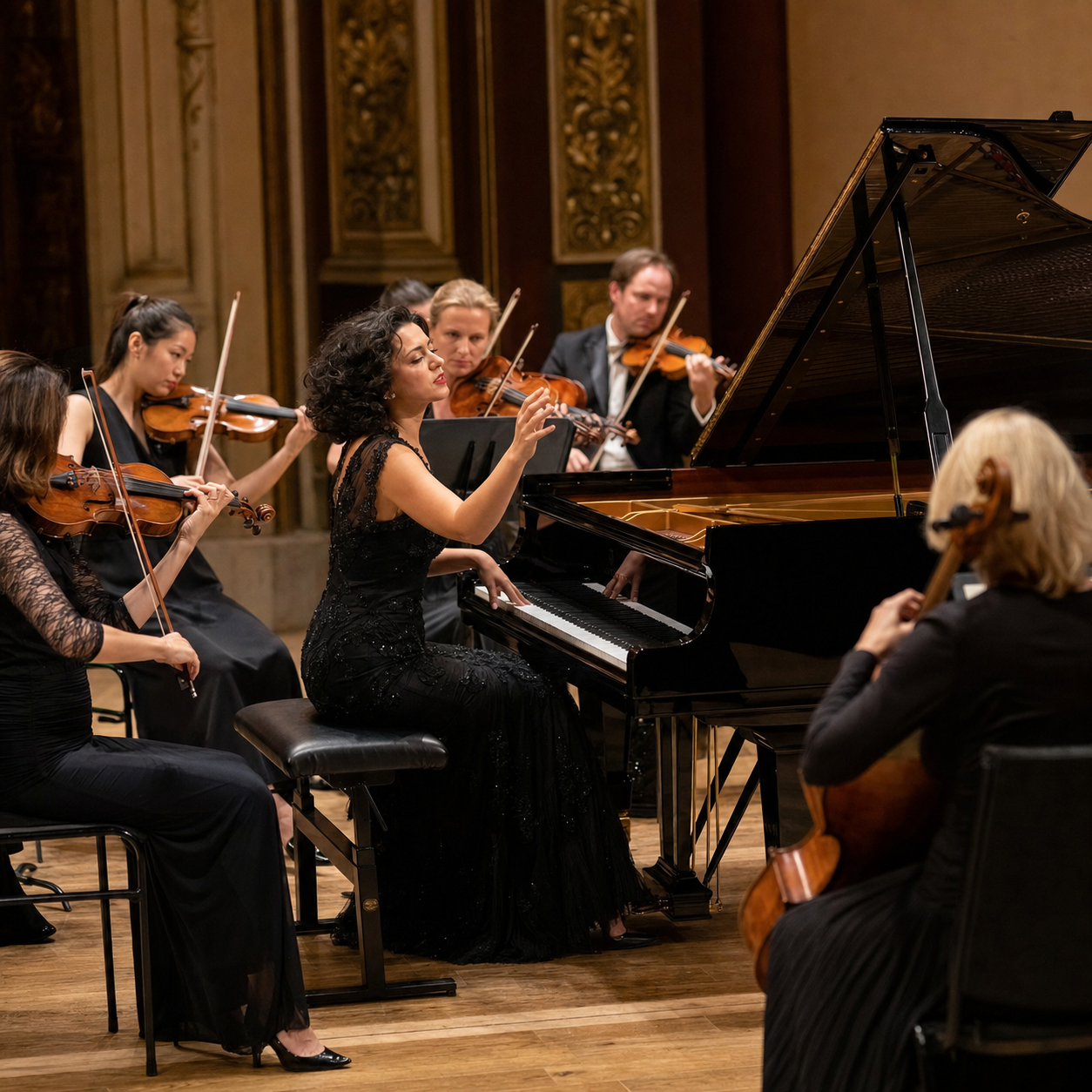
Buniatishvili’s official biography presents music as something learned within family life. Her mother introduced her to the piano, while her sister Gvantsa also became a pianist and remains a frequent collaborator.[1] Sony Classical records that she signed to the label in 2010 and released her Liszt debut the following year. Liszt was an apt declaration: his music demands command of the instrument, but it also invites a performer to invent colour, narrative and scale.
Subsequent albums resisted a single lane. Motherland assembled an intimate sequence across styles and national traditions. Kaleidoscope treated the piano as an orchestra of changing surfaces, while Labyrinth arranged short works as a psychological journey.[6]
The 2024 Mozart album marked another turn. Recorded at Air Studios in London with the Academy of St Martin in the Fields, it paired Concertos Nos. 20 and 23 and was made without a conductor. Buniatishvili directed from the piano, describing the process as one in which she had to persuade the players while preserving her own interpretation.[2][7] The point is larger than independence. A soloist who directs must make timing, rhetoric and character legible through gesture and sound.
A five-part listening map for colour and Romantic freedom
Descriptions of Buniatishvili often reach immediately for temperament, charisma or glamour. Those impressions may be genuine, but they are too broad to explain a performance. A more useful approach is to follow five audible elements and ask how they interact.
Does the principal line feel whispered, sung or projected? Notice how tone and balance make a melody seem emotionally near.
Hear how pedal, register and voicing brighten or darken a chord without changing its notes.
Rubato means flexible time. Ask whether a delay strengthens the phrase’s destination and whether lost time is later recovered.
Follow the whole rise and fall rather than isolated loud moments. A climax earns its force through preparation.
Listen after the sound. The length of a release can complete a cadence, suspend it or turn applause into interruption.
Use the map selectively. On a first hearing, allow the performance to make its total impression. On a second, choose one element and follow it through a movement. On a third, ask how that element affected structure. This prevents analysis from becoming a checklist and keeps attention on the music’s changing scale.
Romantic freedom is convincing when every liberty changes the direction of the phrase.
Liszt and Beethoven: theatre inside the score
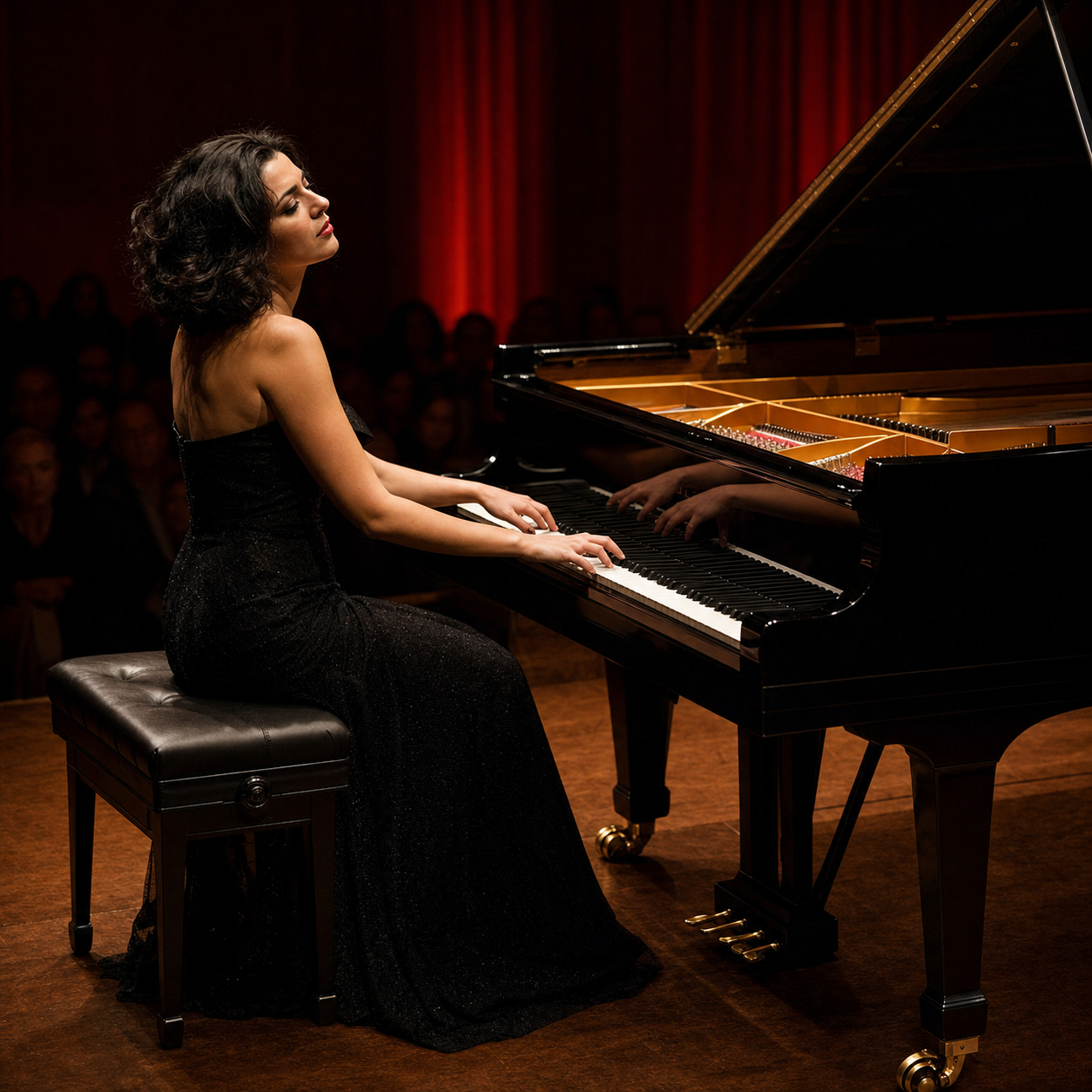
The 2024 Barbican programme offered a compact study in transformation. Liszt’s transcription of Bach’s A minor Prelude and Fugue asks the modern piano to suggest organ sonority without losing contrapuntal definition. His versions of Schubert songs transfer words and vocal breath into a single pair of hands. In Gretchen am Spinnrade, the turning accompaniment must suggest the spinning wheel while the melody carries mounting agitation. If the accompaniment becomes mere velocity, the drama flattens.
Beethoven’s Tempest and Appassionata sonatas present another kind of theatre. Their drama grows from interruption, tonal conflict and the pressure of return. Buniatishvili’s flexible pacing can make a transition feel improvised, but the listener should keep the tonal destination in view. Does a pause reveal an unstable harmony, or simply decorate it? Does a sudden acceleration release stored energy, or blur the argument?
Liszt’s Hungarian Rhapsody No. 6 then turns contrast into public spectacle: declamatory opening, dance rhythm, glittering figuration and a formidable final acceleration. The piece benefits from daring, yet speed is only one colour. Hear how repeated material changes weight and character. The finest virtuosity makes the audience understand why the final risk had to be taken.
For related context, WKMT’s articles on Chopin in London and Rachmaninoff in London explore two further Romantic traditions in which singing line, colour and public virtuosity meet.
Mozart: when colour becomes conversation
Mozart exposes a different side of Buniatishvili’s imagination because the texture leaves less room to hide. In Concertos Nos. 20 and 23, soloist and ensemble exchange ideas with almost operatic directness. The D minor Concerto, K. 466, balances public drama with inward unease; the A major Concerto, K. 488, surrounds its central slow movement with extraordinary poise. Colour must arise through articulation, voicing and dialogue rather than a continuous wash of pedal.
Directing from the keyboard sharpens those responsibilities. An orchestral answer must arrive from a shared pulse, while a solo phrase can still breathe as speech. Listen to the transition between tutti and solo: does the piano enter as a new character, continue an existing thought or contradict it? Then follow the woodwind writing. Mozart often gives personality to a phrase by changing who speaks, not by adding volume.
The conductorless recording also offers a corrective to the idea that Buniatishvili’s art is purely spontaneous. Coordination at that level depends on preparation, listening and trust. Freedom becomes collective rather than private. That is a more demanding form of imagination because every expressive impulse must remain intelligible to others.
Stagecraft, criticism and the value of disagreement
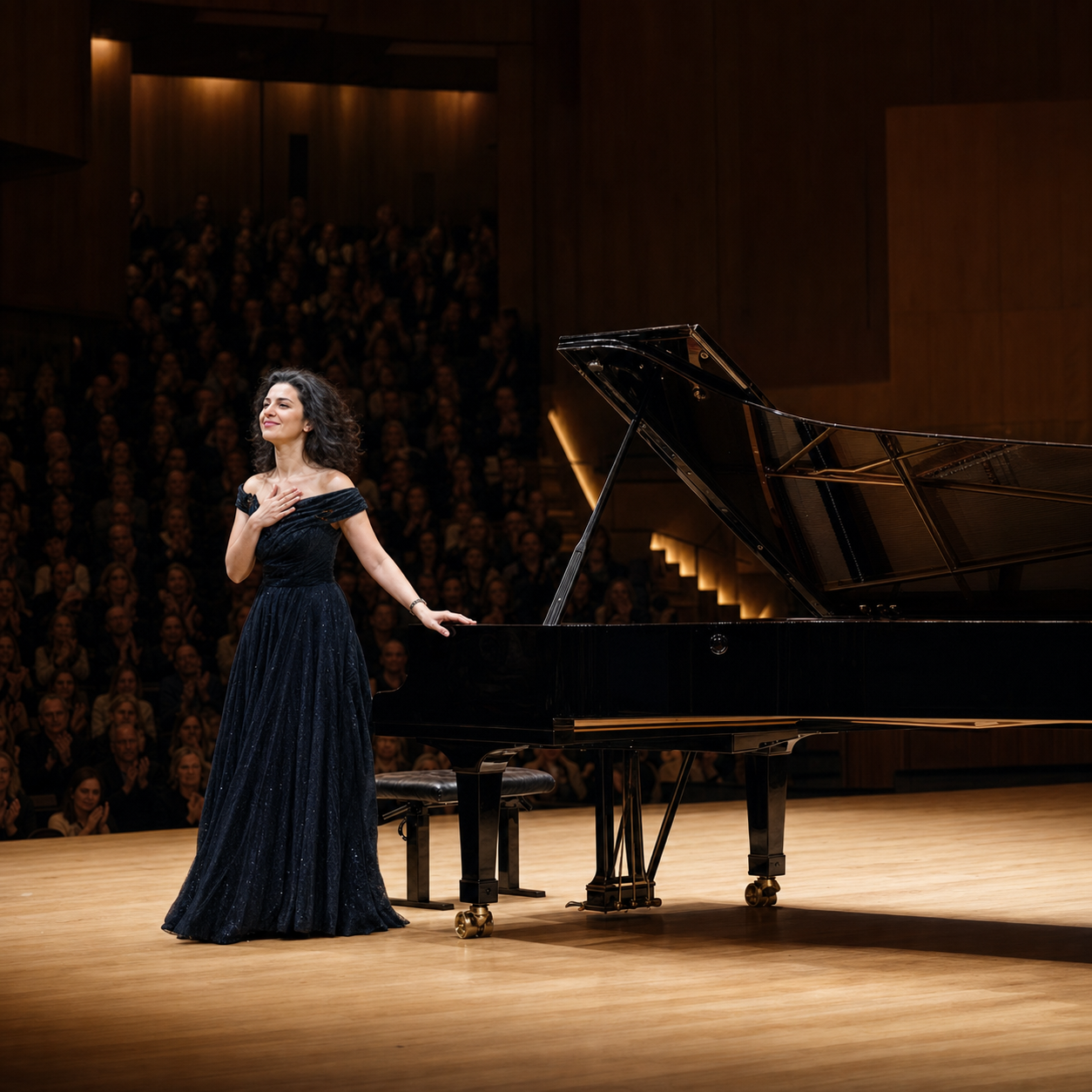
Buniatishvili’s visual presence attracts unusual attention for a classical pianist. The danger is that discussion stops there. Stagecraft can concentrate an audience before the first note, clarify the emotional scale of a programme and make silence feel charged. It can also lead listeners to mistake gesture for evidence. The best safeguard is simple: listen once without watching.
Critical reception has never been uniform. Some writers have celebrated the intensity and individuality of her Liszt; others have found certain performances impulsive or structurally loose. A sharply negative 2015 Wigmore Hall review acknowledged her formidable technique and moments of refinement while questioning the larger shape of the programme.[8] That disagreement is not an embarrassment to be edited out. It points directly to the central issue in her art: how far can expressive freedom stretch before form loses authority?
A serious listener can answer piece by piece. Compare the opening and return of a theme. Track the bass through a rubato passage. Notice whether a crescendo reveals a new harmonic level or merely increases heat. Then decide. Interpretation becomes interesting when taste is supported by audible reasons.
Four recordings and what each reveals
Buniatishvili’s catalogue is best approached through contrast. Each of these projects places a different pressure on touch, sequence and imagination.
| Recording | Released | What to hear |
|---|---|---|
| Franz Liszt | 2011 | How virtuosity, transcription and song define her early artistic identity. |
| Motherland | 2014 | How short pieces become an intimate sequence shaped by memory and belonging. |
| Labyrinth | 2020 | How changes of style and scale create a continuous psychological journey. |
| Mozart: Piano Concertos Nos. 20 & 23 | 2024 | How personal colour meets Classical proportion and conductorless ensemble dialogue. |
Begin with one complete album rather than a playlist; sequence is part of the argument. Then compare one work with a more restrained pianist. Keep the comparison precise: tempo, melodic balance, pedal clarity or treatment of a cadence. The purpose is to enlarge the choices the ear can recognise.
Hearing Khatia Buniatishvili from London
Buniatishvili’s official schedule did not list a forthcoming London performance when checked on 3 August 2026; announced dates can change, so consult the artist and venue directly before planning a visit.[9] Her recent Barbican residency nevertheless leaves a strong London trail: the 2024 Beethoven-Liszt recital, the Mozart collaboration that December and the 2025 friends finale.
Use those programmes as a listening route. Start with the Sony Mozart concertos to hear conversational balance. Move to the Liszt debut for the foundations of her Romantic identity, then hear Labyrinth for her curatorial imagination. Finish with one complete live recital when an authorised broadcast is available. Recorded sound reveals detail; a hall reveals proportion, projection and the force of silence.
WKMT’s guide to classical concerts in London provides a wider route through the city’s musical life. Arrive at any recital with one question, not ten. You may listen for how the pianist voices an inner line, how the hall changes bass resonance or how silence is held before applause. A focused question makes surprise more, not less, possible.
Bring serious listening to the keyboard
WKMT connects concert listening with the practical work of tone, voicing, phrasing and interpretation in London piano study.
What adult pianists can take into practice
The strongest lesson is not to imitate Buniatishvili’s gestures or borrow her rubato. It is to demand that every expressive choice has an audible function. Record eight bars in two versions. In the first, keep the pulse firm and the pedal economical. In the second, allow greater flexibility and colour. Listen away from the piano and ask which version makes the harmonic arrival clearer.
Adult learners often know what they feel but struggle to name what they hear. The five-part map supplies a vocabulary: melodic proximity, harmonic colour, elastic time, dynamic trajectory, release. Choose one term and make one change. This is more productive than trying to sound generally “Romantic”, because it gives the hands a defined musical intention.
For learners who want to develop that process with expert feedback, WKMT’s adult piano lessons in London provide a natural secondary route from listening into interpretation. The goal is not to become a copy of a famous pianist. It is to build an ear capable of making, testing and refining personal decisions.
Sources on Khatia Buniatishvili
- Khatia Buniatishvili artist profile and Mozart album, Sony Classical.
- Khatia Buniatishvili recital, 21 March 2024, Barbican.
- Barbican Artist Spotlight announcement, Barbican.
- Khatia Buniatishvili & Friends, Barbican.
- Khatia Buniatishvili releases, Sony Classical.
- Interview on Mozart and conductorless collaboration, Associated Press, 2024.
- Wigmore Hall review, The Guardian, 2015.
- Official concert dates, Khatia Buniatishvili.