
 TRIAL LESSON
Piano Lessons, Uncategorized
Rachmaninoff London: Where He Played, Who He Met, and Why Pianists Still Study Him Here
Feb
Rachmaninoff London Complete Guide – London music history & piano culture
Rachmaninoff in London: Concert Appearances, Critical Reception, and Where to Hear Him Today
Search “rachmaninoff london” and you quickly discover a familiar modern pattern: ticket pages, venue listings, the next big concerto night. What’s harder to find is the longer story—how Sergei Rachmaninoff first arrived as a young composer-conductor, how British critics heard him, and how London gradually made room for a musician who would become, for many listeners, the very sound of late-Romantic piano.
This chronicle sets out the main dates, halls and responses—from Queen’s Hall in 1899 to his final London appearance there in 1939—then brings the narrative up to the present with archival pointers and practical travel notes for anyone who wants to follow his footsteps through the city.
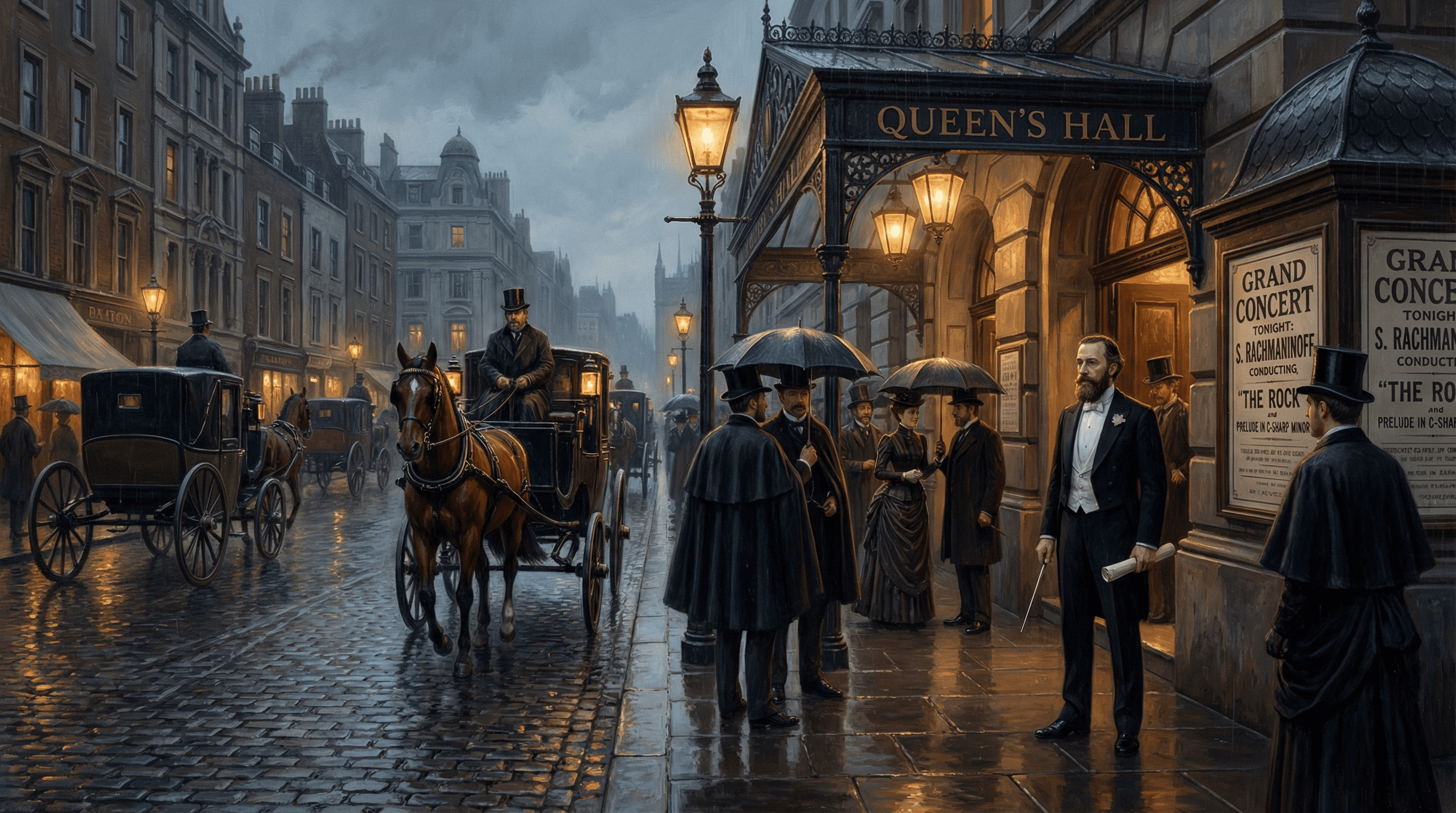
In Rachmaninoff’s London story, the venues are the chronology: Queen’s Hall for the opening and the farewell, Wigmore Hall for the recital portrait, and the Royal Albert Hall for the city’s public, ceremonial stage.
Quick facts at a glance
- First documented London appearance: 19 April 1899, Queen’s Hall (conducting The Rock; playing the Elegy and Prelude in C♯ minor).
- Key London venues: Queen’s Hall (destroyed 1941), Wigmore Hall (recitals from 1922), Royal Albert Hall (Henry Wood Jubilee, 5 October 1938).
- Notable London concerto moment: 26 May 1908, Queen’s Hall—Rachmaninoff as soloist in Piano Concerto No. 2 with the LSO under Serge Koussevitzky.
- Last London concert: 11 March 1939, Queen’s Hall.
Timeline of Rachmaninoff’s visits to London
1899: A debut at Queen’s Hall—and a divided critical verdict
Rachmaninoff’s first London appearance came on 19 April 1899 at Queen’s Hall, where he conducted his orchestral fantasia The Rock (Op. 7) and played the Elegy alongside the piece that already pursued him across Europe: the Prelude in C♯ minor. The British press noticed him at once. If the conducting drew respect, the composition did not escape rough handling; The Musical Times dismissed the work for its “small, ill-nourished themes”. London, in other words, greeted him with seriousness—just not consensus.
1908: Queen’s Hall, Piano Concerto No. 2, and a composer at the keyboard
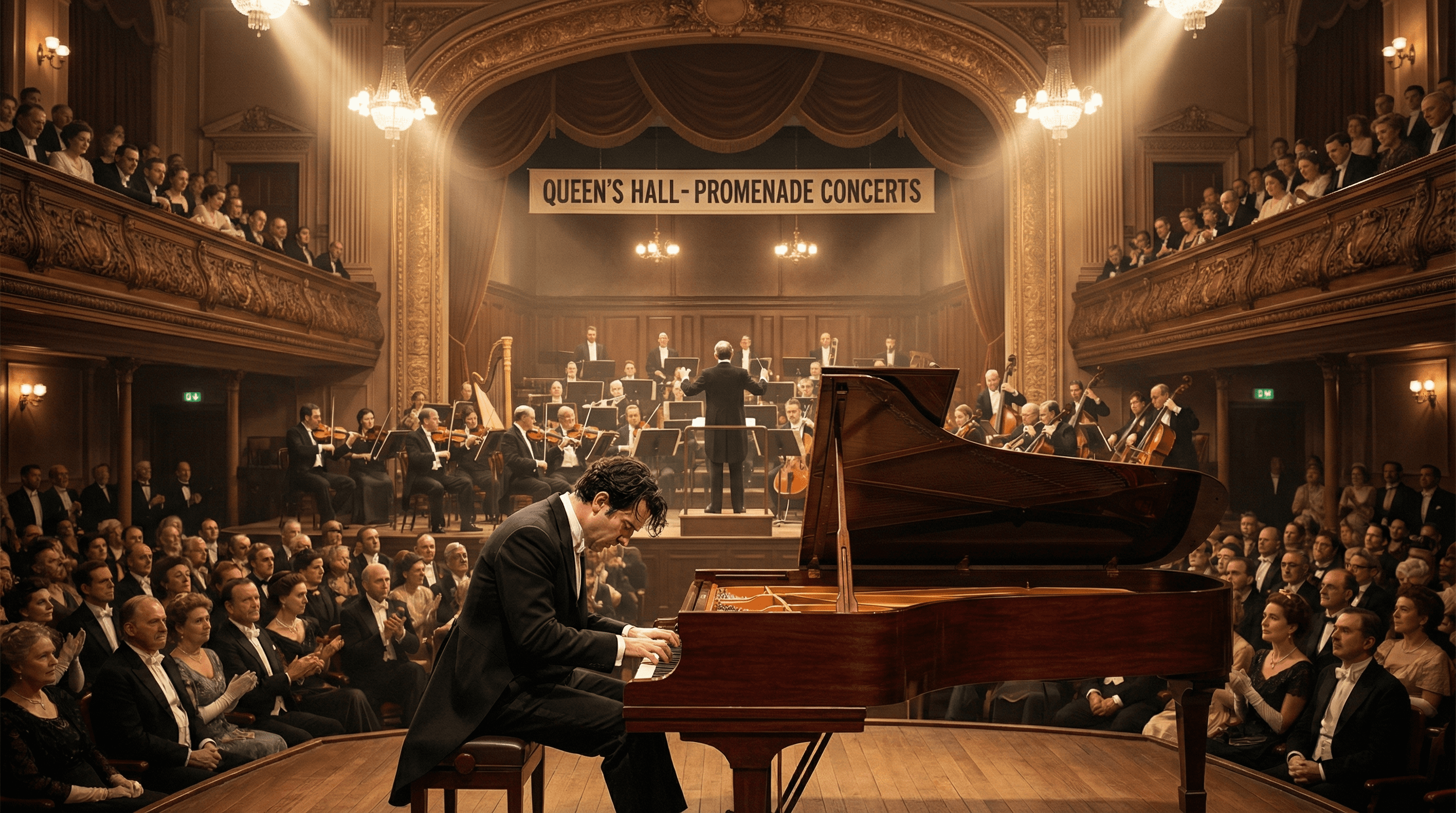
On 26 May 1908, Rachmaninoff returned to Queen’s Hall as soloist in his Piano Concerto No. 2 (Op. 18), playing with the London Symphony Orchestra under Serge Koussevitzky. The concerto had already been heard in England—its English premiere was given by Basil Sapellnikov in 1902—but the significance in 1908 was the composer’s own presence at the piano. In the Rachmaninoff London story, this is a crucial shift: from interesting visitor to recognised international figure performing a work that would eventually become a British favourite.
1922 and the mid-1920s: Post-war recitals and the Wigmore Hall connection
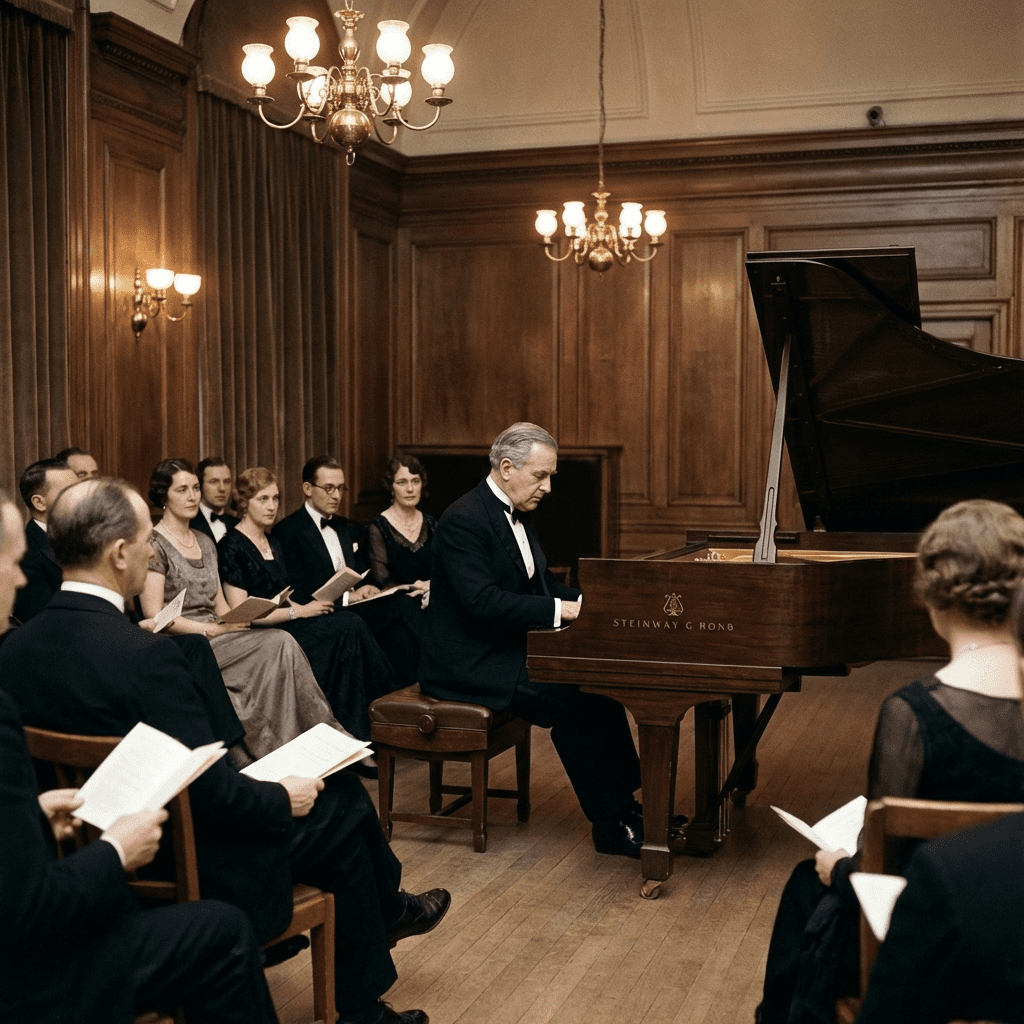
After the First World War, his London return was framed less by orchestral societies and more by the recital platform. His post-war London debut came in May 1922 with recitals at Wigmore Hall. The 1920s saw further returns as an established star, with details traceable through surviving concert programmes and hall archives. By this point, the story is no longer one of a new arrival; it is a seasoned artist bringing a recognisable repertoire—Chopin, Liszt, and his own preludes—to London audiences who came specifically to hear his pianism.
1938: Royal Albert Hall and Henry Wood’s Jubilee
On 5 October 1938, Rachmaninoff appeared at the Royal Albert Hall for Sir Henry Wood’s Jubilee concert, with Wood conducting. Rachmaninoff played Piano Concerto No. 2—an emblematic choice, both for the composer’s public identity and for the British concert tradition that Wood helped to shape. The programme survives in archival form, including a copy held by the Morgan Library.
1939: A concentrated UK tour and a final London concert at Queen’s Hall
In February and March 1939, Rachmaninoff undertook a substantial UK tour: 12 concerts in 25 days, taking in Birmingham (16 February), Liverpool, Glasgow and other cities. London remained central—Queen’s Hall hosted concerts on 18 February and, finally, 11 March 1939, which became his last performance in Britain. Soon after, he was honoured at London’s Savage Club, an echo of the social networks that often sit behind public musical life.
Major London performances and the venues that mattered
Queen’s Hall (Oxford Street): the lost centre of Rachmaninoff’s London story
Queen’s Hall was the defining address of early 20th-century concert London, and it sits at the heart of any serious “rachmaninoff london” account. It hosted his debut and his final London concert. The hall’s destruction in 1941 gives these appearances an added poignancy: the building that framed his London arc no longer exists, but the documentation—reviews, programmes, institutional records—preserves the outline.
Rachmaninoff’s Queen’s Hall programmes typically mixed his own works with the European canon. The 1899 appearance paired his conducting with solo piano items. In 1908, the emphasis fell on the Second Concerto with Koussevitzky and the LSO, placing him squarely within the most prestigious orchestral circuits in the city.
Wigmore Hall: the recital room as a public portrait
Wigmore Hall matters in this narrative because it represents a different kind of London prestige: intimate, concentrated, judgemental in the best way. Rachmaninoff’s 1922 recitals there mark his post-war London return, and the hall’s archive records events from that period onward. A recital venue also suits the way he was heard by then—not merely as a composer, but as a pianist whose programming could move between Chopin, Liszt and his own signature pieces.
Royal Albert Hall and the public ceremonial tradition
The Royal Albert Hall appearance in October 1938 placed Rachmaninoff within a public, ceremonial London moment: Sir Henry Wood’s Jubilee. If Queen’s Hall suggests the professional machinery of London’s musical societies, and Wigmore Hall the cultivated connoisseurship of the recital world, the Albert Hall suggests something broader—London hearing itself as a musical capital.
BBC Proms / Barbican: the modern afterlife of a London repertoire
Rachmaninoff’s works remain staples of modern London programming, particularly through the BBC Proms tradition and major orchestral seasons. Piano Concerto No. 2, in particular, continues to appear regularly. For today’s listener, this is the practical continuation of the historical story: the pieces he played here remain the pieces London most readily programmes.
People and institutions he met in London
London musical life is not just buildings; it is institutions and individuals with long memories. In Rachmaninoff’s case, the Philharmonic Society and the London Symphony Orchestra were key platforms, anchoring his appearances within the city’s most influential networks.
Conductors and collaborators named in connection with his London life include Sir Henry Wood—London’s central Proms figure—Albert Coates, and, importantly, Serge Koussevitzky, who led the LSO for the 1908 Queen’s Hall concerto. On the social and artistic periphery of concert life, the Savage Club’s 1939 honour places him among London’s broader cultural fraternity.
He also had friends and champions in London’s piano world. British pianist Benno Moiseiwitsch is repeatedly associated with him as a supporter and friend in the city’s musical circles, helping to explain how Rachmaninoff’s repertoire filtered into local performance culture.
Cultural impact and legacy in British musical life
The arc of Rachmaninoff’s London reception is, in miniature, the arc of his wider reputation: early scepticism about his orchestral writing, followed by a growing attachment to his piano music. In 1899, British critics could be brisk about The Rock; over time, British audiences increasingly embraced the concertos and preludes that sat more naturally within his public identity.
By the end of the period covered here, reviewers were writing in different terms—commenting on his “magic rapport with the piano” and noting the appeal of programmes that balanced canonical composers (Chopin, Schumann) with Rachmaninoff’s own pieces. His Prelude in C♯ minor had become, by many accounts, the expected encore and the unavoidable calling-card.
In the longer view, his standing in Britain is reflected not only in programming habits but in popular listening culture. A BBC poll in 2011 placed his Piano Concerto No. 2 among the UK’s most popular classical works. Whatever the early critics thought of his themes, the audience eventually made its own judgement.
Where to see and hear Rachmaninoff in London today
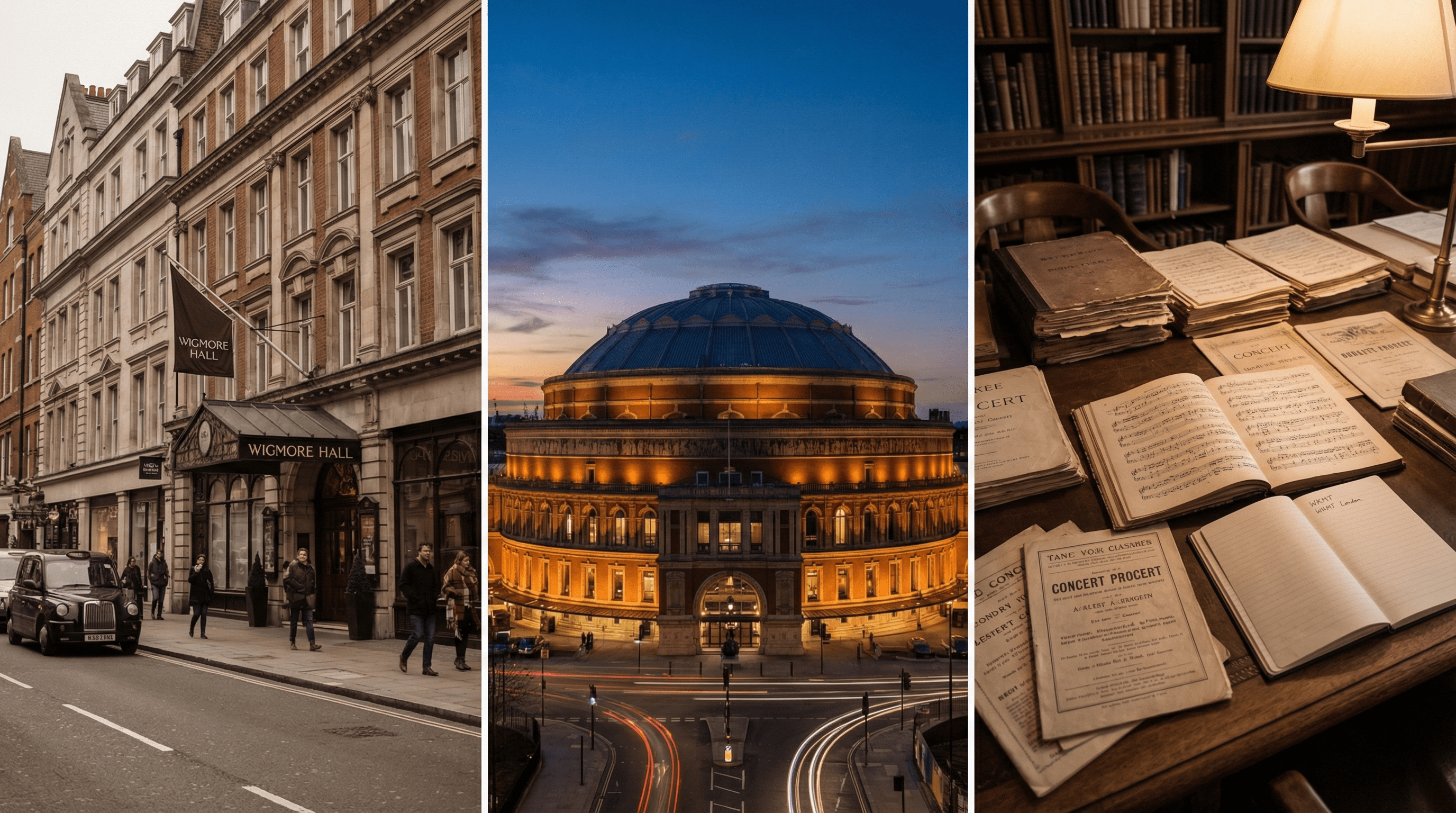
A “rachmaninoff london” itinerary is unusually walkable, even with Queen’s Hall gone. Wigmore Hall retains its recognisable character and continues to host piano recitals where Rachmaninoff sits naturally on the stand. The Royal Albert Hall remains the grand public landmark, still programming his Second Concerto often enough that you can plausibly hear the same work in the same room where he played it in 1938.
For readers interested in the documentary trail, the British Library holds relevant archival material, including publishers’ archives such as Boosey & Hawkes files and sheet music holdings noted in connection with Rachmaninoff (for example, items relating to his Cherubim Hymn). Wigmore Hall’s own archive is also a practical starting point for locating his London recital history.
If you are planning your listening rather than your research, keep an eye on major London season listings and Proms schedules. WKMT readers can also follow our own updates via the Events.
Suggested next clicks (WKMT)
Recommended recordings, modern performances, and how to follow London concerts
To reconnect with the Rachmaninoff London repertoire, begin where London audiences often begin: the Second Piano Concerto. Historical interest tends to cluster around broadcasts and documented performances connected with Henry Wood, while modern listening can be grounded in London orchestra discographies—particularly recordings involving the LSO.
For a recital perspective, look to programmes and archives associated with Wigmore Hall, including their listening resources and past live streams when available. If you prefer to follow the living concert life of the city, check listings from the Royal Albert Hall and the BBC Proms alongside major orchestra diaries.
Practical visitor guide
- Wigmore Hall: 36 Wigmore St, W1U 2BP. Useful for recital culture and archival continuity; check the hall’s visitor information online.
- Royal Albert Hall: Kensington Gore, SW7 2AP. A strong choice for large-scale concerto evenings; booking is advisable for high-demand concerts.
- British Library: 96 Euston Road, NW1 2DB. Open Mon–Thu 09:30–20:00; Reading Rooms require a free Reader Pass (check before travelling).
- Southbank / Barbican: while not part of Rachmaninoff’s historic itinerary in the material covered here, they are central to hearing his music in modern London concert life.
For those building a short musical weekend, Bloomsbury works well as a base for archival visits, while Kensington keeps you close to the Albert Hall. London’s transport makes it easy to combine both—efficient, if not always poetic.
FAQs on Rachmaninoff London Guide
- When was Rachmaninoff’s first London concert?
- 19 April 1899 at Queen’s Hall, where he conducted The Rock and played the Elegy and Prelude in C♯ minor.
- Where did Rachmaninoff play Piano Concerto No. 2 in London?
- At Queen’s Hall on 26 May 1908 with the LSO under Serge Koussevitzky, and later at the Royal Albert Hall on 5 October 1938 for Henry Wood’s Jubilee concert.
- Did Rachmaninoff give recitals in London?
- Yes. His post-war London debut came in May 1922 with recitals at Wigmore Hall, and he returned regularly during the mid-1920s.
- What was Queen’s Hall, and why is it important here?
- Queen’s Hall was a key London concert venue (destroyed in 1941). It hosted both Rachmaninoff’s debut and his final London concert on 11 March 1939.
- How did British critics receive Rachmaninoff in 1899?
- Early notices could be sharp: The Musical Times called The Rock “small, ill-nourished”, though his conducting was praised.
- What happened on Rachmaninoff’s 1939 UK tour?
- He gave 12 concerts in 25 days across the UK, including Birmingham, Liverpool, Glasgow and London, with his last British performance at Queen’s Hall on 11 March 1939.
- Where can I research Rachmaninoff materials in London today?
- The British Library is a key starting point for archival research, including publishers’ archives (such as Boosey & Hawkes) and related holdings; Wigmore Hall also maintains an archive of recital programmes.
- Where can I hear Rachmaninoff in London now?
- Major venues and series frequently programme his works, including the Royal Albert Hall and the BBC Proms; check current listings and local calendars.
Conclusion: a London story that ends in sound, not stone
Rachmaninoff’s London history is unusually clean in outline: a debut at Queen’s Hall in 1899, a defining return there in 1908, a post-war recital chapter at Wigmore Hall from 1922, a ceremonial Albert Hall appearance in 1938, and a final Queen’s Hall farewell in 1939. The buildings, the critics, and the institutions matter—but the real continuity is musical. London still hears him, perhaps more readily than it hears the arguments that once surrounded him.
If you would like regular London listening ideas and contextual guides, you can sign up to the WKMT newsletter, explore our piano lessons pages for students working on Rachmaninoff, and follow the latest updates via Events/Tickets.
Editorial note: Before publication, consult Barbican/Southbank programme archives to confirm any unsourced London events and obtain full citations for concert programmes.
Planning your own Rachmaninoff London listening?
Use this guide to map the halls, then follow current listings via Events/Tickets and deepen your repertoire context through the composer guides. If you’re learning the preludes or the Second Concerto, the piano lessons pages are the practical next step.