
 TRIAL LESSON
Music Theory Resoucers, Piano Lessons
Fermata in Music – Fermata Meaning

Feb
Fermata in Music – Analysing the Concept of Fermata
Fermata in Music – Fermata Meaning
Definition, History, and Aesthetic Uses
Definition and Symbolism of Fermata
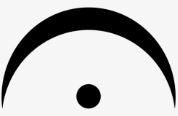
The fermata, commonly known in English as a “pause,” is a musical notation symbol (𝄐) indicating that a note, chord, or rest should be prolonged beyond its written duration. The precise length of this extension is left to the performer or conductor’s discretion, allowing for expressive flexibility. It typically appears over a note or rest and creates dramatic or rhetorical effects in musical phrasing.
The shape of the fermata is represented by an arc with a dot underneath:
Historical Origins and Terminology
The term “fermata” derives from the Italian verb fermare, meaning “to stop” and from the musical standpoint, it means “to hold.” It has been employed in Western music since at least the Renaissance, evolving in its function and interpretative implications. In German, the fermata is known as Halteton, while in French, it is referred to as point d’orgue. In English, the word “pause” is preferred. All these terms reflect its importance in shaping musical phrasing and performance.
Early Notation of the Fermata
In earlier musical notation, the fermata was not always represented in the familiar modern shape (𝄐). During the Renaissance and early Baroque periods, composers used a variety of marks to indicate sustained notes or rests. In some cases, an arc or a dot above a note indicated an intended prolongation. As notation practices were standardised in the Classical period, the modern curved arc with a dot underneath became widely accepted.
Carl Philipp Emanuel Bach, one of the many sons of Johann Sebastian Bach, contributed significantly to the understanding and interpretation of the fermata in the 18th century. Carl Philipp Emanuel Bach, in his treatise “Versuch über die wahre Art das Clavier zu spielen” in 1753. (Translated in English: “Essay on the true way to play the Keyboard”), provided guidelines on ornamentation and articulation, including the approximate duration of a fermata. He stated:
“A fermata over a note should not be played too briefly, nor excessively prolonged, but should serve as a natural extension of the musical expression. It is at the discretion of the performer to determine its length in accordance with the effect of the passage.” (Versuch über die wahre Art das Clavier zu spielen, 1753, Part II, Chapter 3)
Johann Christian Bach, another son of J.S. Bach, was known for his influence on the Classical style, also incorporated fermatas in his compositions to enhance dramatic pacing and lyrical expression. Their contributions helped formalise performance practices that influenced later composers like Haydn and Mozart. He and Mozart often played music together, and Bach even dedicated one of his symphonies to Mozart. The two remained friends until Bach died in 1782.
Types of Fermatas
Fermatas can be categorised based on their duration and expressive function:


Fermatas can be divided into two styles. Because their meanings overlap, it can be confusing for players if both styles are used in a single project.

Source:
Using Fermatas for Multiple Voices in One Staff
When writing for multiple voices on one staff, such as in choral music, fermatas must be placed carefully to ensure clarity of interpretation. Several approaches exist:
Shared Fermata: When all voices pause together, a single Fermata is placed above the staff. This is the most common approach in choral and orchestral settings where a uniform pause is required. For example:
- S. Bach Chorale “Aus meines Herzens Grunde“: Fermatas are used at key cadences to ensure all voices conclude phrases together, allowing for a sense of unity and closure to the different phrases:
Handel’s Coronation Anthems (Zadok the Priest, final chord – Bar 121): Fermatas are placed at the end of grand choral phrases to reinforce structural pauses and highlight the grandeur of the composition.
Verdi’s Requiem (Dies Irae, bars 38-39): Modern performances often adjust fermatas to heighten the dramatic effect of the text, sometimes extending them for expressive emphasis or shortening them for intensity.
Version with fermata: (01’03’’)
(Yannick Nézet-Séguin conducting Verdi’s Requiem, featuring the Met Orchestra and Chorus and soloists Ailyn Pérez, Michelle DeYoung, Matthew Polenzani, and Eric Owens.)
Without fermata: (00:57)
Independent Fermatas: If different voices sustain their notes for varying lengths, separate Fermatas may be placed above and below the staff to indicate distinct durations. This is particularly useful in polyphonic choral settings where different vocal lines require varied articulation.
Examples include:
- Bach’s Mass in B Minor (Kyrie Eleison bar 102 – 07 ’24’): The soprano II, tenor and bass lines sustain their notes differently from the lower voices, cadencing on the third beat of bar 102, requiring independent fermatas to guide phrase endings. While the rest of the voices, like the Alto, cadence in the next bar) and the soprano I cadenced in bar 101 (a bar before)

- Brahms’ Ein Deutsches Requiem (How Lovely Are Thy Dwellings, bars 157-164: Independent fermatas help shape the distinct ebb and flow of vocal lines
The upper voices (soprano and tenors) resolve slightly ahead in bar 157 of the lower voices (Alto and Basses) in bar 164, creating a layered effect:

Choral Fermatas: Conductors will often shape fermatas dynamically, cueing different voices when to release to maintain cohesion in a performance. For example:
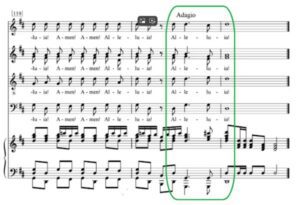
- Handel’s Messiah (Hallelujah Chorus, final chord) the adagio at the end and the fermata on the last chord provide the final grandeur gesture to the piece (3:33)

General Pause (G.P.) and Long Pause (L.P.)
The general pause or the long pause serve the same function, and are identical in function to the fermata when used over a rest or barline. The function of these pauses is to create a silence for a period of time at the discretion of the performer (or conductor with an ensemble). As indicated in the name, these are intended to be pauses of longer duration than any of the others. These marks are always shown over rests. They also interrupt the normal tempo of a composition.

Source:
General pause In a score for an ensemble piece, “G.P.” (General Pause) indicates silence for one bar or more for the entire ensemble.The marking of general pauses is relevant, as making noise should be avoided there—for instance, page turns in sheet music are avoided during general pauses, as the sound of players turning the page would be audible by the audience.
Source:
Example: Schumann Symphony No. 2, 4th Movement – Bars 272-281

Minute 33:02 in the video
Uses of the Fermata in Musical Composition
The fermata serves multiple purposes, including:
- Expressive Suspension: Extending a note or chord to heighten emotional impact.
- Cadential Emphasis: Marking the end of phrases or sections, often at cadences.
- Structural Role: Indicating a break or pause in the music, sometimes allowing performers to breathe or reset.
- Improvisatory Function: Providing space for interpretative freedom, particularly in cadenza passages.
Musical examples
Expressive Suspension
Extending a note or chord to heighten emotional impact.
Example 1: Beethoven – Piano Sonata No. 8, Op. 13 “Pathétique” (First Movement, Bar 22)
- Moment: In the re-exposition of the introduction, just before the second theme (tempo primo)
- Effect: This fermata allows the performer to linger, heightening expressivity before continuing the subordinate theme It gives a sense of breath and lyricism to the movement.
- 06:26 (in the video)
Beethoven Sonata No.8 “Pathétique” (Score) Paul Barton, FEURICH piano
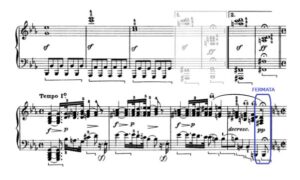
Example 2: Wagner – Tristan und Isolde, Prelude (Bar 18, on the “Tristan Chord”) minute 2 in the video
- Moment: The famous unresolved “Tristan Chord” is held under a fermata, creating a sense of expectation.
- Effect: The extended hold increases tension, amplifying the chromatic ambiguity before the phrase continues.
Richard Wagner — Tristan und Isolde (Prelude and Liebestod) — Score

Example 3: Mahler – Symphony No. 9, Fourth Movement (Bars 163-165) Minute 1:23:27 in the video
- Moment: The strings hold a sustained chord under a fermata just before the movement fades into silence.
- Effect: This fermata intensifies the tragic nature of the symphony, creating an emotionally charged moment of stillness before the final resolution.
Mahler: Symphony No. 9 (with Score)
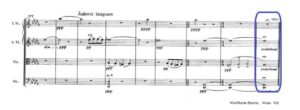
Example 4: Puccini – Nessun Dorma (Final Fermata, Bar 30-31 – 02:45 in the video)
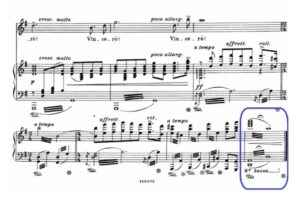
- Moment: The fermata is placed over the climactic high B♭ on the word “Vincerò” in the final phrase.
- Effect: The tenor holds this note dramatically before resolving the phrase, creating an emotionally charged moment.
- Function: The fermata serves as an expressive suspension, prolonging the climax of the aria and heightening its triumphant character.
(20) Nessun dorma Luciano Pavarotti Score – YouTube
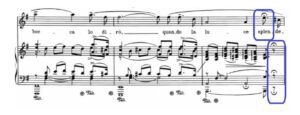
- Moment: On the word “splendero” exactly on the syllable “splen”
- Effect: The dramatic suspense created by the singer, lingering on the final notes of the cadence (1:22 in the video)
Cadential Emphasis
Marking the end of phrases or sections, often at cadences.
Example 1: Mozart – Piano Concerto No. 21, K. 467 (First Movement, Bar 396) minute 11:55 in the video
- Moment: The fermata occurs over a dominant chord just before the soloist’s entrance to the cadenza
- Effect: This fermata provides a dramatic pause, allowing the orchestral cadence to settle before introducing the piano’s cadenza

Wolfgang Amadeus Mozart – Piano Concerto No. 21 in C major, K. 467
Example 2: Wagner – Tristan und Isolde (Prelude, Final Cadence, Bars 106-107)
- Moment: The fermata appears over the final unresolved chord before the piece fades into silence.
- Effect: The fermata suspends harmonic resolution, reinforcing Wagner’s use of delayed cadences and continuous tension.
- Function: The fermata emphasizes the lack of closure, preparing for the opera’s harmonic ambiguity and leading into the next section.
Structural Role
Indicating a break or pause in the music, sometimes allowing performers to breathe or reset.
Example 1: Haydn – Symphony No. 104 “London” (First Movement, Bars 1-2)
- Moment: A fermata over a whole note in the slow introduction.
- Effect: This moment establishes grandeur and anticipation before the main Allegro begins.

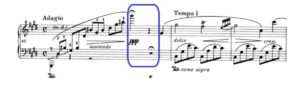
Example 2: Chopin – Nocturne in C-sharp Minor, Op. posth. (minute 2:18 in the video)
- Moment: A fermata appears over a rest, providing a moment of silence.
- Effect: This brief pause allows the phrase to breathe, reinforcing the nocturne’s introspective quality.
Chopin Nocturne Op.20 in C Sharp minor-Yundi Li
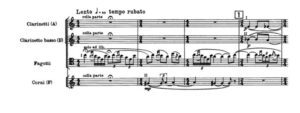
Example 3: Stravinsky – The Rite of Spring (Introduction, Bars 7-8)
- Moment: A fermata is placed over a rest just before the famous bassoon solo enters.
- Effect: This unexpected pause builds tension, making the entrance of the bassoon more striking and unsettling.
(21) Igor Stravinsky – The Rite of Spring (1913) – YouTube
Improvisatory Function
Providing space for interpretative freedom, particularly in cadenza passages.
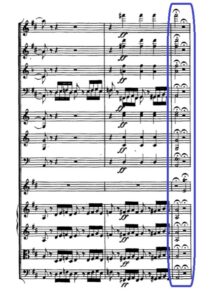
Example 1: Mozart – Piano Concerto No. 23, K. 488 (First Movement, Bar 297, Before the Cadenza) minute 9:47 in the video
- Moment: A fermata appears over a dominant chord in the orchestra, signaling the pianist’s entrance into the cadenza.
- Effect: The fermata allows the performer to decide when to begin the improvisatory cadenza, adding personal expression.
Wolfgang Amadeus Mozart – Piano Concerto No. 23 in A major, K. 488
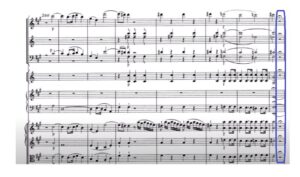
Example 2: Beethoven – Violin Concerto in D major, Op. 61 (First Movement, minute 20:34 in the video, Before the Cadenza)
- Moment: The orchestra sustains a fermata before the soloist takes over.
- Effect: The fermata creates an air of expectation, letting the performer take control of the dramatic pacing of the cadenza.
Beethoven: Violin Concerto in D major, op 61
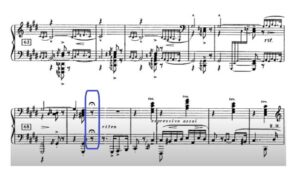
Example 3: Liszt – Hungarian Rhapsody No. 2 (Bars 69, “Lassan” Section) minute 2:27 in the video
- Moment: A fermata over a single note before the virtuosic “Friska” section.
- Effect: This fermata allows the performer to control the transition between the expressive and technical sections, highlighting the dramatic shift.
Liszt-Horowitz – Hungarian Rhapsody No. 2 (audio + sheet music)
The Medial Caesura and Its Use of Fermata
The concept of the medial caesura (MC) is particularly relevant in sonata form, where it functions as a significant rhetorical pause between the transition and the second theme. This moment, often reinforced by a fermata, serves as a structural boundary that delineates sections within a movement.
In works by composers such as Haydn, Mozart, and Beethoven, the medial caesura frequently appears in the exposition of a sonata-allegro movement, creating a marked contrast between the energetic transition and the lyrical second theme. The fermata at this juncture allows for a brief suspension of momentum before the second theme group enters, enhancing the dramatic effect of the structural division.
Caesura
The caesura is used in a similar manner to the G.P. and L.P. with the difference of typically a shorter duration of silence. Also known as the railroad tracks.
- The caesura shown by itself indicates a short silence. It is often a sudden stop in the performance with an equally sudden resumption of sound. This mark interrupts the normal tempo of a composition.
- The use of the fermata combined with a caesura indicates a much longer silence.
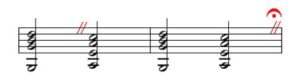
Source:
For example:
- Haydn – Symphony No. 88 in G major (First movement, Bars 30-32): A fermata over a grand pause signifies the medial caesura, creating space before the second thematic material.
Haydn: Symphony No. 88 in G major (with Score)
- Haydn Sonata Hob XVI/34 – First movement – bar 29:
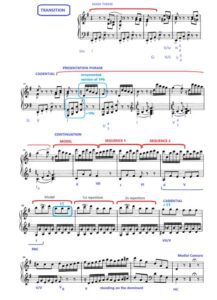
If you are interested in this piece, below is the link for a full analysis I made of the first movement:
Haydn Sonata in E Minor Hob XVI 34 – First Movement Analysis – Piano Lessons London by WKMT
- Beethoven – Piano Sonata No. 8, Op. 13 “Pathétique” (First movement, Bar 34): The fermata holds tension before the lyrical secondary theme unfolds.
Beethoven – Sonata No. 8 in C minor, Op. 13 (Pathetique), Complete with Sheet Music
A Medial Caesura, according to William Caplin’s book “Analyzing Classical Music” states:
“The theory of sonata form recently proposed by James Hepokoski and Warren Darcy gives special prominence to the textural gap—the silence—that often accompanies the very final moment of the transition. […] In their work, Hepokoski and Darcy discuss many techniques by which composers may “fill in” the gap created by the medial caesura with actual music. Here, the term is restricted to those cases where there exists a literal caesura created by a moment of silence, or else a fermata on the final sounding sonority of the transition.” (page 310)
Breath Mark – Not to get confused with Fermata
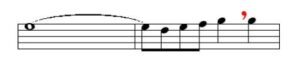
The breath mark is typically used as a pause or break in the phrasing of the composition. This means that the written note just before the breath mark is shortened slightly to allow for the short pause in the phrase. The breath mark is normally found in vocal and instrumental music, and literally directs the performer(s) to take a breath. This mark is usually not intended to interrupt the normal tempo of a composition as in the other pause directives.
Source:
Fermata in the Works of Composers Associated with London
Several composers who were born in London or spent significant time there made use of fermatas in their compositions:
- Joseph Haydn – London Symphonies (1791-1795): During his visits to London, Haydn composed a series of symphonies that prominently feature fermatas. For instance:
- Symphony No. 104 in D major “London” (First movement, Bars 1-4): A fermata in the slow introduction enhances grandeur before the Allegro begins.
- Symphony No. 101 “The Clock” (Second movement, Bars 32-34): Fermatas are used to emphasise the “ticking” rhythmic motif.
- George Frideric Handel (1685–1759): Though born in Germany, Handel lived much of his life in London, and his oratorios frequently employ fermatas to heighten dramatic effect:
- Messiah (1741, “Ev’ry Valley”): Fermatas in the recitative sections highlight rhetorical phrasing, allowing for expressive flexibility.
- Thomas Arne (1710–1778): The English composer best known for Rule, Britannia! frequently used fermatas in his theatrical works to allow the dramatic delivery of key vocal lines.
Conducting a Fermata: A Conductor’s Perspective
Conductors play a crucial role in shaping the execution of a fermata, ensuring cohesion among performers while preserving the intended musical expression. The approach to conducting a fermata varies depending on the tempo, ensemble type, and stylistic considerations. Some essential techniques include:
Defining the Length: Before rehearsal, the conductor decides whether the fermata will be brief, moderate, or extended based on the musical context. In orchestral and choral works, this decision is often communicated in advance to ensure unity.
Clear Cueing: Conductors must give a clear preparatory gesture before the fermata to indicate its presence. The preceding beat or note is often emphasized to prepare performers for the impending hold.
Sustaining the Pause: During the fermata, the conductor’s hands remain steady, often maintaining eye contact with the ensemble. In a choral setting, subtle breathing cues may help singers sustain notes for the desired length.
Ending the Fermata: The conductor signals the release either with a cutoff gesture (if the Fermata leads into silence) or with a preparatory motion to lead smoothly into the next note. In works like Beethoven’s Symphony No. 9, fermatas over rests require a clear, unified release.
Variations in Fermata Interpretation:
Orchestral Fermatas: Strings may use bow control to shape the decay, while wind and brass players rely on breath support.
Choral Fermatas: The conductor must manage staggered releases or coordinate dynamic decay.
Operatic Fermatas: Often used in recitatives, where the conductor adjusts the duration based on the singer’s dramatic intent.
Notable examples of conducted fermatas include Mahler’s Symphonies, where fermatas contribute to expansive phrasing, and Verdi’s operas, where fermatas in recitatives allow expressive liberties while remaining under conductor control.
Examples:
Orchestral Fermatas
Definition: In orchestral settings, fermatas are often sustained by the entire ensemble, but different sections employ various techniques to manage decay. Strings use bow control to shape the tapering of the sound, while wind and brass players rely on breath support to maintain resonance.
Example 1: Beethoven – Symphony No. 5 in C minor, Op. 67 (First Movement, Measure 5)
- Moment: The famous opening motif “G-G-G-E♭” ends with a fermata on the E♭ in measure 5.
- Musical Detail: The fermata is placed on a crotchet (quarter) rest, creating a dramatic silence before the phrase repeats. Strings use bow lifts to prepare for the next attack, and winds and brass allow the sound to decay naturally.
- Effect: This fermata builds suspense and reinforces the rhythmic urgency of the motif.
Beethoven: Symphony no. 5 in C minor, op.67
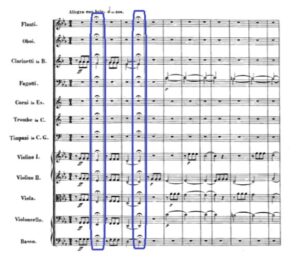
Example 2: Tchaikovsky – Symphony No. 6 in B minor, Op. 74 “Pathétique” (Fourth Movement, Measure 109)
- Moment: The final movement’s climax in measure 109 contains a fermata before a soft restatement of the theme.
- Musical Detail: Strings sustain their bow strokes while brass and winds control breath to let the sound naturally fade.
- Effect: The fermata emphasizes the tragic nature of the piece, allowing an expressive pause before the final section.
Tchaikovsky: Symphony No. 6 in B minor, Op. 74 “Pathétique” (with Score)
(38:30)

Example 3: Mahler – Symphony No. 2 “Resurrection” (Final Movement, before No. 47 piu mosso) (1:29:34)
- Moment: The grand pause near the end, just before the climactic choral entrance.
- Musical Detail: The orchestra sustains a massive chord with a fermata, with strings gradually decreasing bow pressure while winds and brass taper dynamics.
- Effect: This creates a moment of breathless anticipation before the choir enters, symbolizing the theme of resurrection.
Gustav Mahler — Symphony No. 2 in C Minor “Resurrection” — Score
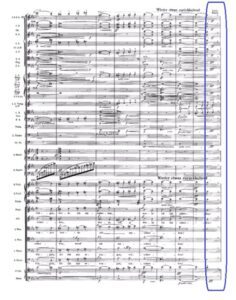
Other example from the same piece:
1:13:52 bar 448: the spacious ambience created by several fermatas between the horns and the trumpets provides the suspense before the change in tempo, to the “Quasi Allegro” in bar 455
1:14:55 In bar 459, the brasses have fermatas, while the timpani plays a tremolando in pp to silence, giving the place to the piccolo with the repeated C# (the piccolo starts this bar with a fermata giving the performer the freedom to enter with a loose time or rubato)

Choral Fermatas
Definition: Conductors often stagger releases or coordinate dynamic decay to prevent abrupt cut-offs. This is particularly relevant in large-scale choral works where different vocal parts may sustain pitches differently.
Example 1: Mahler – Symphony No. 2 “Resurrection”
1:18:00 bar 481: The multiple fermatas from bar 81 provides an ethereal moment, almost giving the feeling as time stopping:

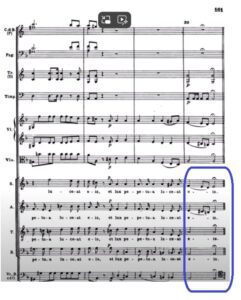
Example 2: Mozart – Requiem in D minor, K. 626
- Moment: 48:33 (Communio: Lux Aeterna)
- Musical Detail: The choir and orchestra sustain the chord with a fermata before the change of tempo to Allegro, in which the main theme of the Dies Irae appears again.
Mozart – Requiem K. 626 (Score) (Süssmayr)
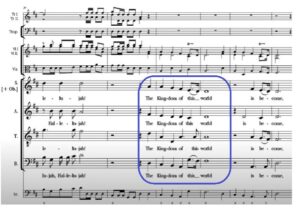
Example 3: Handel – Messiah (“Hallelujah Chorus,” 1:31)
- Moment: The phrase “The Kingdom of this World” changes tempo, slightly slower
- Musical Detail: The conductor slows down on this phrase, especially at the end
- Effect: This approach creates a beautiful contrast between the energetic beginning
Händel | Hallelujah [Chorus from “Messiah HWV 56”]
Handel – Messiah (“Hallelujah Chorus,” (3:37)
- Moment: The repeated “Hallelujah” phrases contain fermatas over cadences.
- Musical Detail: The conductor shapes the fermatas dynamically, cueing sections to release at slightly different times to allow resonance to blend.
- Effect: This approach ensures a grand, spacious choral sound that fills the hall.

Operatic Fermatas
Definition: In opera, fermatas frequently appear in recitatives, giving singers expressive freedom while allowing the conductor to shape the timing based on dramatic intent.
Example 1: Mozart – Le Nozze di Figaro, K. 492 (Recitative before “Dove sono,” Act III – 1:00)
- Moment: The fermata at the phrase “Crudel! Perché finora farmi languir così?” (Cruel one! Why have you let me languish so?)
- Musical Detail: The singer holds the fermata to emphasize emotion, while the conductor waits for the breath before proceeding.
- Effect: The fermata enhances the character’s anguish and allows for dramatic timing.
Dove Sono (Le nozze di Figaro – W.A. Mozart) Score Animation

Example 2: Verdi – La Traviata (“Amami, Alfredo,” Act II, Measure 102 – 03:28)
- Moment: Violetta holds the word “Amami” under a fermata.
- Musical Detail: The soprano sustains the note while the conductor shapes the orchestra’s soft accompaniment.
- Effect: The fermata heightens the emotional climax, emphasizing Violetta’s desperation.

(1) Maria Callas – Verdi: La Traviata: Amami Alfredo (1951) [score] – YouTube
Example 3: Puccini – Tosca (“Vissi d’arte,” Act II, Measure 34 – minute 2:20)
- Moment: The fermata on “Signor” near the phrase’s climax.
- Musical Detail: The singer can extend the phrase for dramatic impact, and the conductor allows flexibility before proceeding.
- Effect: The fermata increases emotional weight and enhances the aria’s poignancy.
“Vissi d’arte” from “Tosca” – G. Puccini – Maria Callas – Sheet music

Also, at the end, we see the written fermata on “rimuneri” (minute 2:45) (same Aria)

If you are interested to know more about it, there is a practical lesson by Leonard Stalkin (starting in minute 1’25’’):
Conclusion on Fermata
The fermata remains an essential tool in musical expression, granting both composers and performers the flexibility to shape phrasing and emotion. Whether in the symphonic grandeur of Haydn’s London Symphonies, the dramatic gestures of Handel’s oratorios, the structural clarity of Mozart’s works, the intense pauses of heavy metal, or the suspense-building moments in film scores, the fermata enriches musical narratives, demonstrating the enduring power of a simple pause in sound.