
 TRIAL LESSON
Piano Lessons
Music and Brain Development: What Parents Should Know About Piano and Growing Minds
Aug
Music and Brain Development
Music and Brain Development: What Parents Should Know About Piano and Growing Minds
The relationship between music and brain development is genuine, but it is often exaggerated. Active music-making asks a child to listen, predict, move, remember and adjust in real time. Those demands can strengthen musical skill and may support particular aspects of attention, working memory and self-control. They do not turn piano lessons into a shortcut to higher intelligence or guaranteed school results.
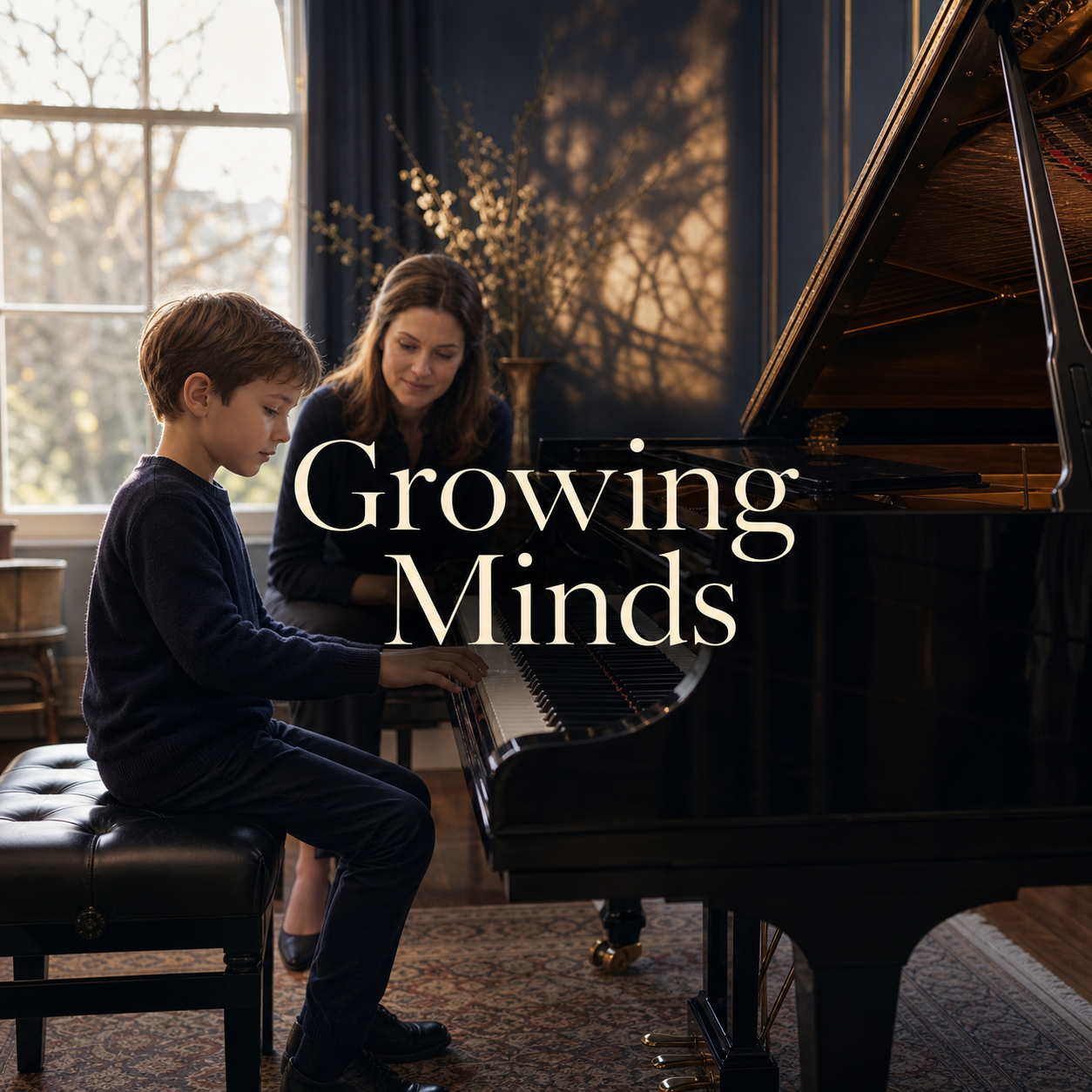
The useful question is not “Will piano make my child cleverer?” It is “Can thoughtful musical training give my child a rich, demanding and enjoyable skill to develop?” On that question, the answer is much more confidently yes.
Music and brain development: the evidence at a glance
Music recruits distributed systems rather than a single “music centre”. Listening and playing involve auditory processing, movement, timing, prediction, memory, emotion and reward. Harvard Medicine’s 2024 overview describes activity across auditory, limbic, memory and motor systems when people experience music. That wide engagement makes music neurologically interesting; it does not prove that every benefit transfers to unrelated tasks.
A 2022 systematic review of 29 records covering more than 5,400 children found evidence suggesting benefits for executive functions, most consistently inhibitory control, with smaller or less consistent findings for working memory and cognitive flexibility. A newer meta-analysis of preschool interventions reported a small-to-moderate pooled effect for inhibitory control, while also noting heterogeneity and risks of bias. These are encouraging findings, not promises for an individual child.
The counterweight matters. A rigorous 2020 multilevel meta-analysis found no reliable broad cognitive or academic transfer once study quality was controlled. In other words, learning music is valuable in itself, and any wider benefit should be treated as a possible companion rather than the reason a family must enrol.
Study design explains why headlines can disagree. A cross-sectional study compares children who already do and do not learn music, so it cannot remove every family or motivational difference. A longitudinal study follows development over time, but groups may still differ at the start. A randomised controlled trial gives stronger causal evidence, especially when the comparison group receives another engaging activity. A meta-analysis then combines several studies, although its conclusion is only as sound as the studies and outcome measures it includes.
What happens when a child plays the piano?
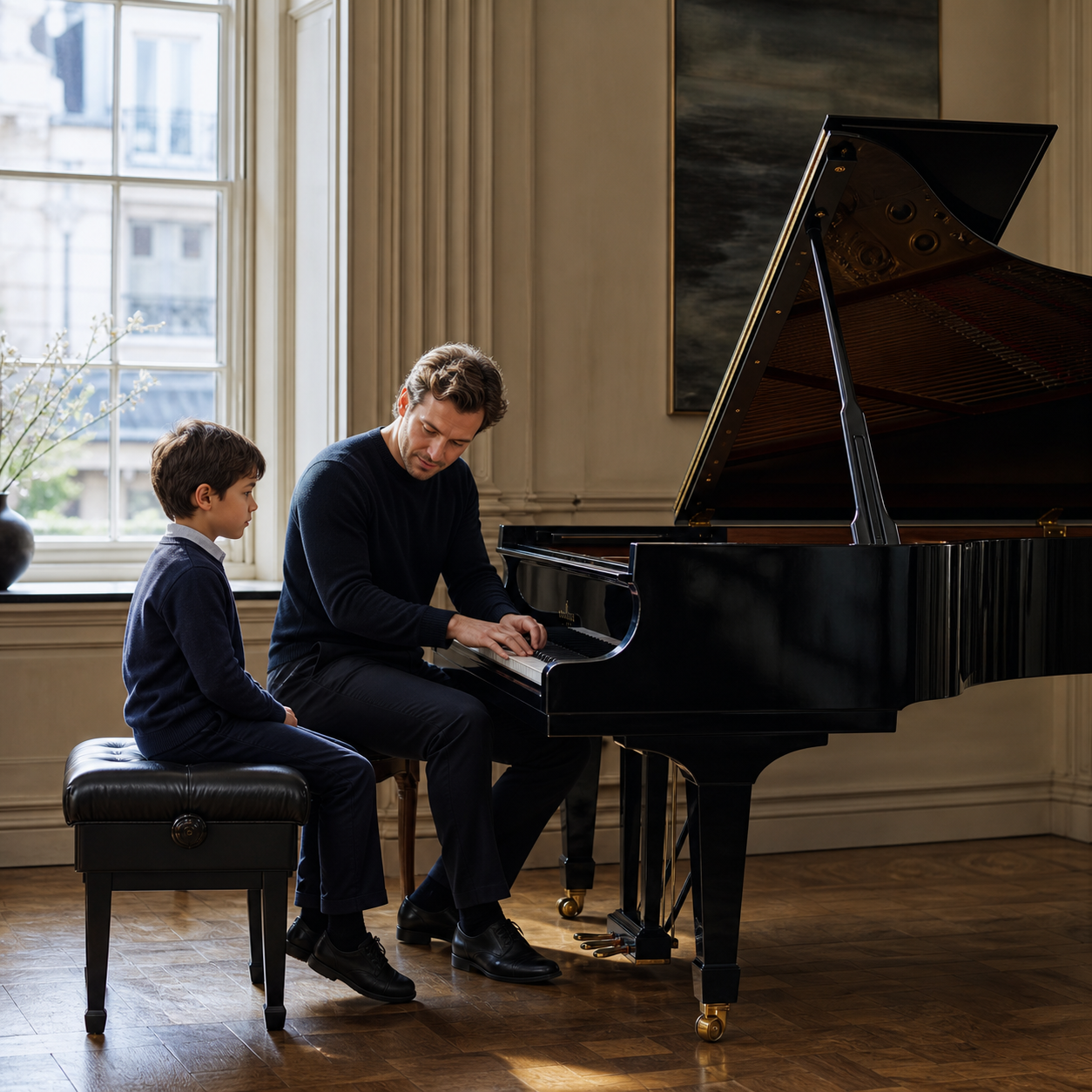
A piano lesson is a chain of predictions and corrections. The child hears a phrase, holds its shape in mind, maps sound and notation onto the keyboard, prepares a movement, listens to the result and adjusts. Even a short passage brings several systems into conversation.
Auditory attention separates melody, rhythm, articulation and tone. Motor planning sequences fingers and coordinates two hands that may be doing different things. Working memory keeps the next note, pattern or instruction available while the present one is performed. Inhibitory control helps the player pause, resist rushing and choose a deliberate response.
Neuroplasticity simply means that experience can alter how neural networks function and connect. Children’s brains are developing rapidly, but “sensitive period” does not mean “now or never”. Early experiences can be influential; later beginners can still learn deeply. A supportive start at the right moment is more useful than racing to begin before a child can attend, imitate and enjoy the process.
The developing brain needs meaningful challenge, not grand claims. Music offers challenge with sound, movement, memory and expression woven together.
Where the benefits may appear
Attention and self-control
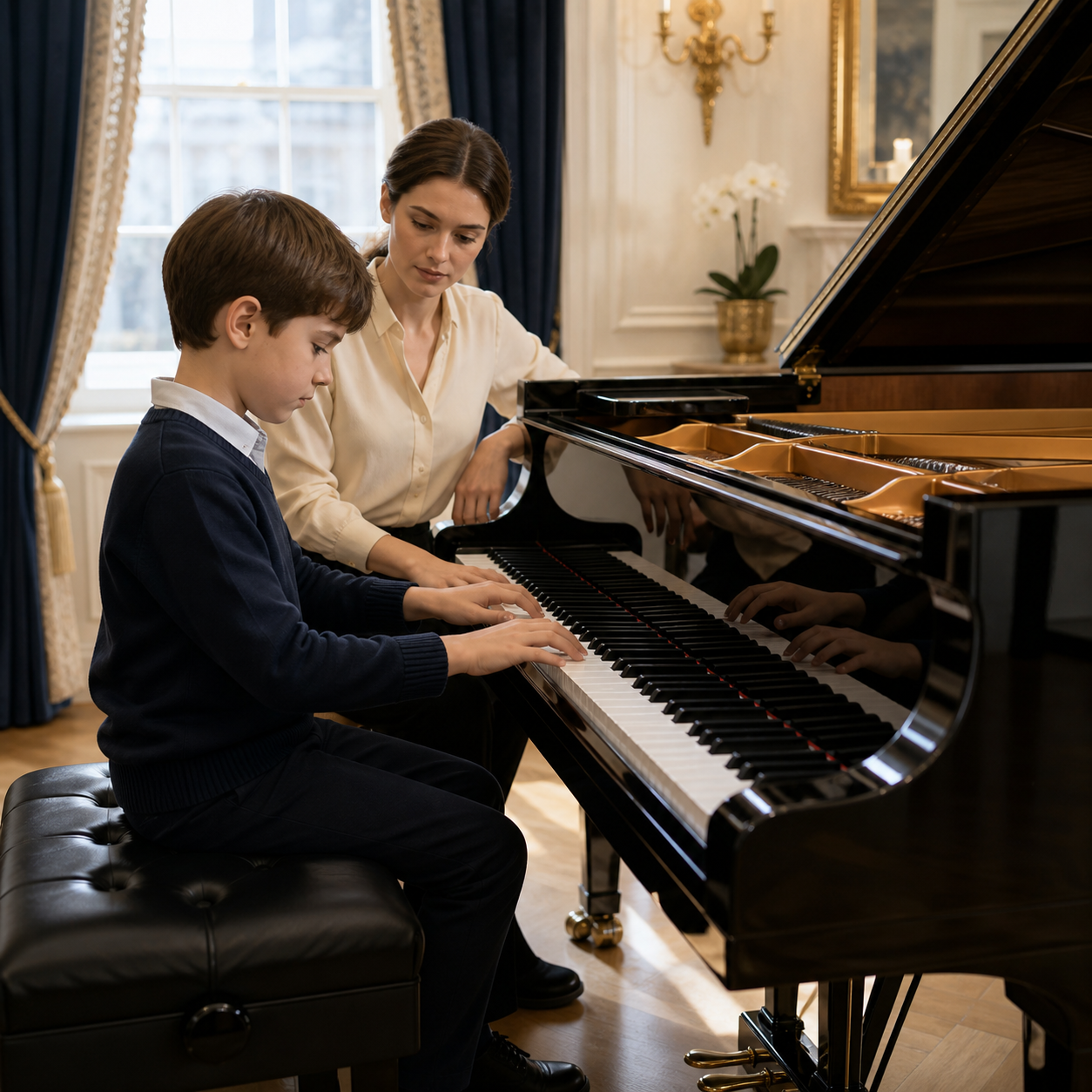
Executive functions are the processes used to direct behaviour towards a goal. Studies measure them with tasks such as Stroop, Go/No-Go, digit span and card sorting. Music training has shown its clearest wider association with inhibitory control: waiting for an entry, keeping pulse, following rests and correcting without abandoning the task all rehearse controlled response.
Language and reading-related skills
Music and speech share sensitivity to timing, pitch contour, grouping and sound contrast. A meta-analysis of literacy-related outcomes reported a small effect on phonological awareness, while broader reading outcomes were mixed. Parents should understand the distinction: musical listening may support sound discrimination, but piano tuition is not a replacement for reading instruction or specialist help.
Memory
Playing from a score involves visual, auditory and motor memory. A child remembers patterns, positions, fingering choices and musical direction. Such memory becomes increasingly organised around musical structures rather than isolated notes. Whether this reliably improves general memory outside music remains less certain.
Coordination
Piano is unusually explicit about bimanual control: two hands share a keyboard, often with different rhythms and shapes. Fine finger sequencing, posture, visual-spatial mapping and auditory feedback are practised together. The strongest expectation is therefore specific: careful tuition should improve piano-related coordination and control.
Development is rarely visible as a dramatic leap. Look for steadier pulse, longer attentive stretches, more economical movement, greater independence and a growing ability to hear and correct a mistake.
Age, readiness and the right kind of challenge
| Stage | Useful emphasis | A realistic sign of progress |
|---|---|---|
| Under 3 | Singing, movement, pulse, playful listening | Imitation and shared musical attention |
| 3–5 | Short, playful keyboard encounters with clear routine | Can copy a pattern and remain comfortably engaged |
| 5–12 | Structured lessons, reading, technique and expressive repertoire | Increasing independence and thoughtful self-correction |
| Teenagers | Ownership, repertoire choice and purposeful goals | Can plan, evaluate and sustain work with less prompting |
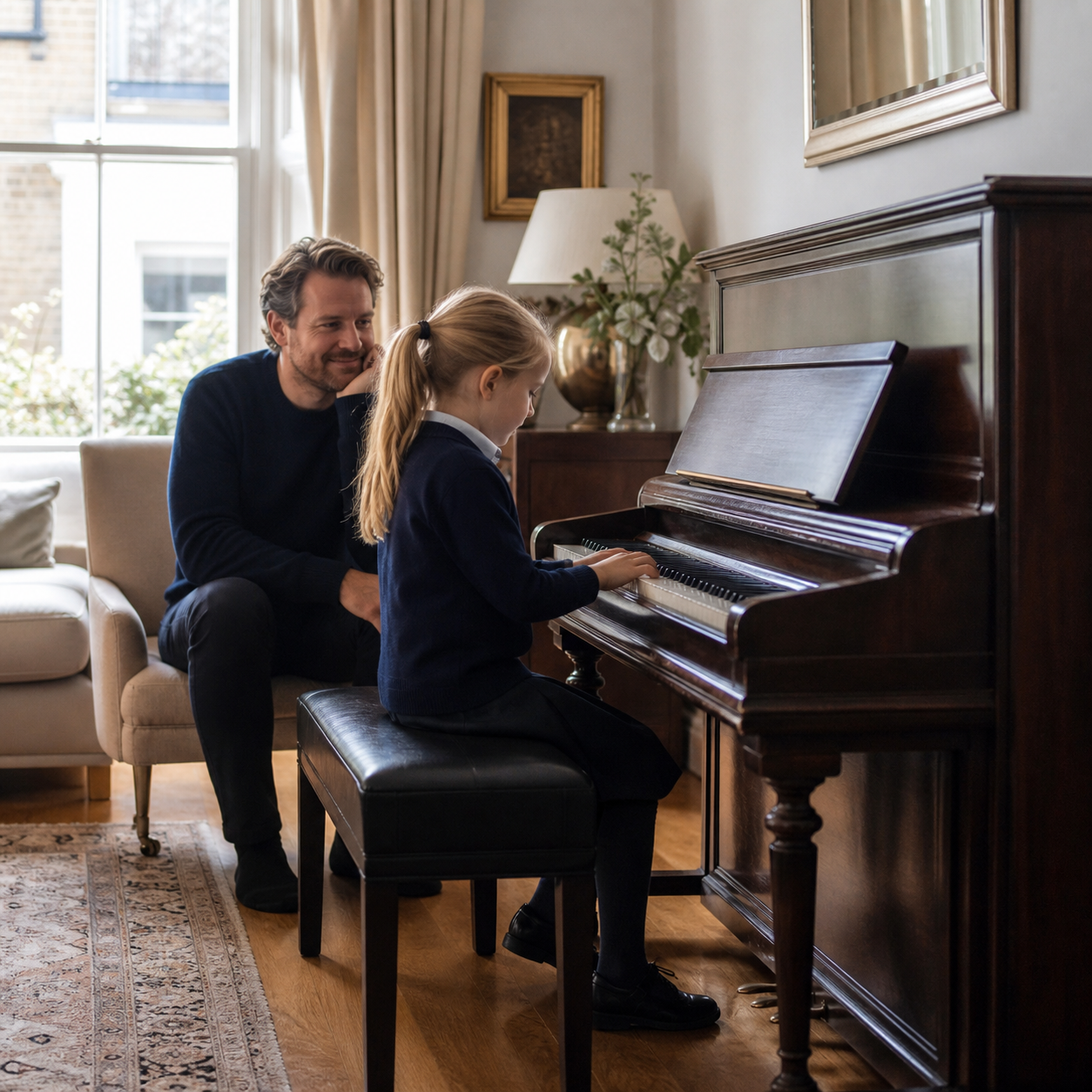
Research interventions vary enormously, from short group programmes to years of instrumental tuition. There is no scientifically guaranteed number of weekly minutes that produces a particular brain outcome. One preschool meta-analysis found stronger executive-function results in programmes lasting at least twelve weeks, meeting at least three times weekly for twenty to thirty minutes, but these were group music programmes rather than a prescription for private piano practice.
For a family, consistency should be scaled to the child. Several brief, focused encounters may be more productive than one exhausting session. Methods associated with names such as Kodály, Dalcroze or Suzuki can provide useful ideas about singing, movement, listening and imitation, yet teacher judgement and the child’s response matter more than a label.
Readiness is practical. Can the child follow a short direction, imitate a simple rhythm, tolerate gentle correction and remain curious? If so, a skilful teacher can begin from there.
Piano, group music and informal musical play
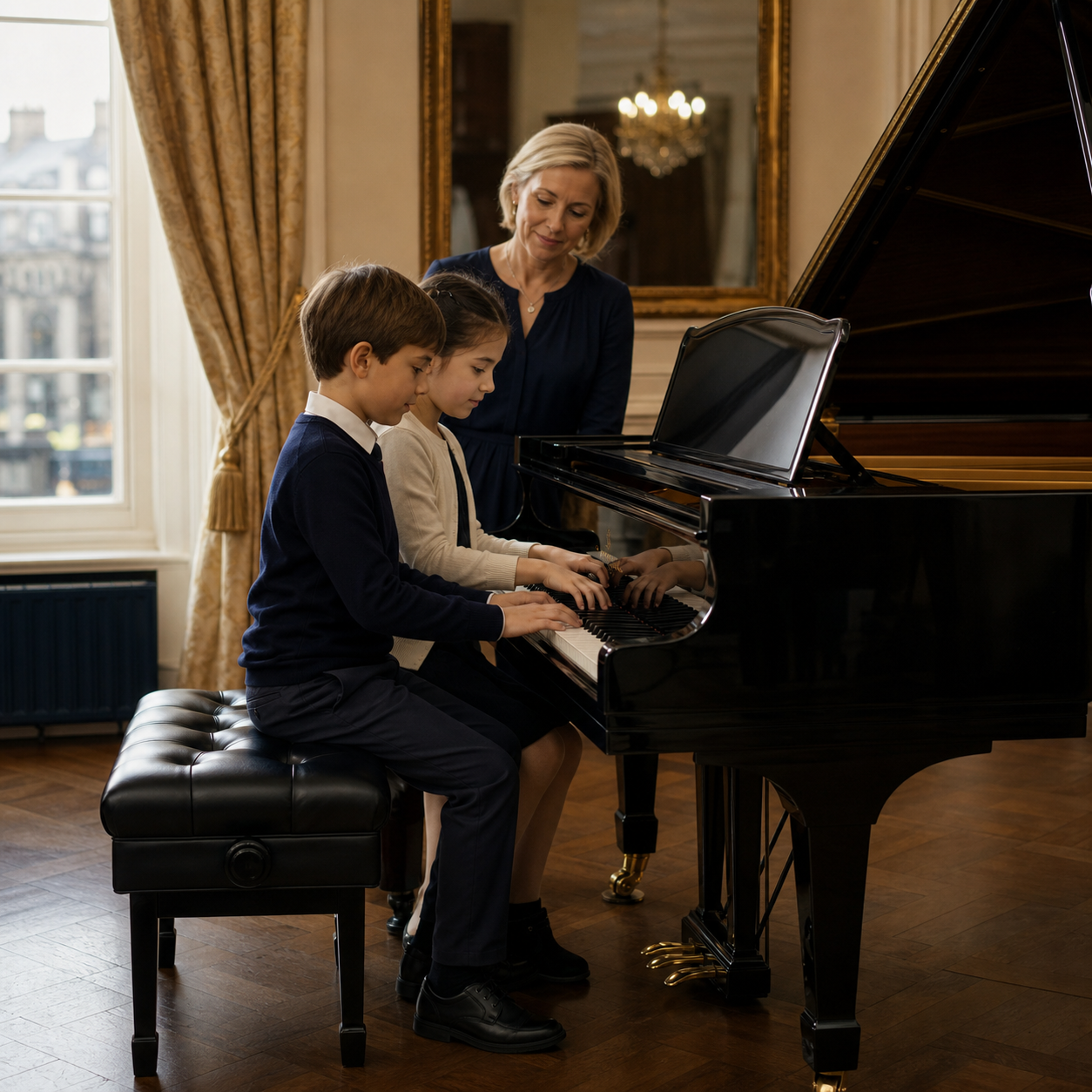
No single format owns the developmental value of music. Singing trains breath, phrase and pitch. Movement sharpens pulse and timing. Ensemble playing develops synchronisation and social attention. Informal musical play supports exploration. Piano adds a stable visual layout, immediate sound, two-hand coordination and a clear route into notation and harmony.
The best balance depends on the child. A very young beginner may need movement and singing woven into keyboard work. A school-age pupil may thrive on individual focus alongside duets, concerts or group musicianship. The National Plan for Music Education in England explicitly values singing, instrumental learning, creating music together and progression; private tuition can complement rather than replace a child’s wider musical life.
What the science cannot tell you about your child
Children who receive lessons often differ from those who do not. Family income, parental education, school provision, motivation, prior attainment and the time available for practice can influence both participation and outcomes. Random allocation and active control groups help, but music studies cannot always control every difference. Brain-imaging findings can show changed activity or structure; they cannot by themselves tell us that a child has become broadly “smarter”.
Parents should also separate music education from music therapy. A piano teacher develops musicianship. A qualified therapist uses music within defined therapeutic aims. Ordinary lessons may support confidence, emotional expression and routine, but they are not treatment for a developmental, psychological or medical condition.
Measurement also deserves caution. A better score on one working-memory task does not automatically mean better planning at school or easier organisation at home. Researchers use standardised tests because they permit comparison, but everyday development is broader and shaped by sleep, language, relationships, health, school and opportunity. Parents can value a child’s expanding musical attention without turning every improvement into proof of a neurological advantage.
The healthiest conclusion is measured: active musical learning is a complex, culturally rich activity that develops musical understanding and coordinated skill. Some cognitive processes may benefit, especially where the task overlaps with what music repeatedly asks a child to do. Broad transfer remains contested.
Choosing children’s piano lessons in London
Look for teaching that is responsive without being vague. A good teacher should be able to explain what the child is learning, why a task is appropriate and how home practice can remain manageable. Ask how listening, rhythm, reading, technique and repertoire are balanced. Notice whether the teacher adapts language and pace while still maintaining musical standards.
During an early lesson, observe the quality of attention on both sides. Does the teacher listen to the child’s sound, demonstrate clearly and allow time for an answer? Is correction specific enough to be useful, yet calm enough that the child remains willing to try again? A strong lesson alternates concentration with release. It gives the child a musical problem that is neither trivial nor overwhelming, then equips them to solve it.
Home support should follow the same principle. Help establish a predictable time, protect the piano from distraction and ask the child what the teacher requested. Avoid correcting every note from across the room. The long-term aim is independent listening: the child gradually notices what happened, compares it with an intention and chooses the next attempt.
Parents exploring structured piano study for children at WKMT can use these principles to judge readiness and fit. Related WKMT reading on music and executive function, the benefits of music education and music and emotional development gives further context. WKMT’s wider London piano teaching remains the studio’s broader point of reference.
A thoughtful start for a growing musician
If your child is curious about sound and ready for a gentle structure, explore how WKMT approaches children’s piano learning in London.
Does piano make children more intelligent?
There is no reliable evidence that piano lessons broadly raise intelligence. They build musical knowledge and specific listening, movement and practice skills; some related cognitive processes may also benefit.
Is earlier always better?
No. Early musical play is valuable, but formal lessons work best when the child can engage, imitate and respond to guidance. A well-timed start is better than a pressured one.
How soon should parents expect change?
Expect musical changes first: steadier pulse, better listening, clearer coordination and greater independence. Wider outcomes are variable and should not be used as a deadline.
Sources and further reading for Music and Brain Development: Parent Piano Guide
- Effects of music training in executive function performance in children: a systematic review, PMC.
- Effects of music training on executive functions in preschool children aged 3–6 years: systematic review and meta-analysis, PMC.
- Cognitive and academic benefits of music training with children: a multilevel meta-analysis, Memory & Cognition / PMC.
- Does music training enhance literacy skills? A meta-analysis, Frontiers in Psychology / PMC.
- How Music Resonates in the Brain, Harvard Medicine Magazine.
- The Power of Music to Change Lives: A National Plan for Music Education, Department for Education and DCMS.
- Arts participation, Education Endowment Foundation.