
 TRIAL LESSON
Piano Lessons, Uncategorized
St Martin in the Fields Concerts: A London Pianist’s Guide to Choosing the Best Programme (and Listening Like a Pro)
Mar
St Martin in the Fields Concerts Complete Guide
St Martin in the Fields Concerts: A London Pianist’s Guide to Choosing the Best Programme (and Listening Like a Pro)
St Martin in the Fields concerts aren’t one thing. You’re choosing a room, a time of day, and a style of listening—under one of London’s most recognisable roofs. If you understand those variables, you book better programmes, sit in smarter places, and leave with the kind of musical “aftertaste” that shows up in your playing.
Quick overview
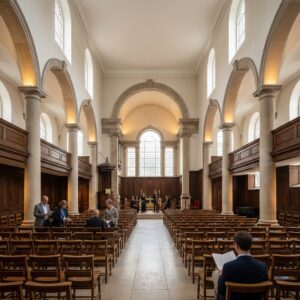
For most venues, “what’s on” is the main question. For St Martin in the Fields concerts, the better question is: what sort of listening do you want to do today? The church offers several distinct experiences—each with its own pacing, acoustic feel, and level of concentration required.
Start with three reliable decision levers:
- Format and pacing. Friday lunchtime concerts are deliberately approachable and artist-led (musicians introduce the programme). Ticketing is refreshingly clear: £10 for the concert, or £20 with a pre- or post-concert traditional fish & chips lunch in the Crypt (book in advance).
- Atmosphere. “By candlelight” options are often around an hour, usually without an interval—designed for immediacy and glow rather than a long evening’s endurance.
- Access needs (yours or your companion’s). Step-free routes, lifts to the Crypt, wheelchair spaces, and an in-church induction loop (with recommended seating rows) are clearly documented. Comfort isn’t a luxury; it determines attention span.
Why St Martin-in-the-Fields matters for pianists and concertgoers
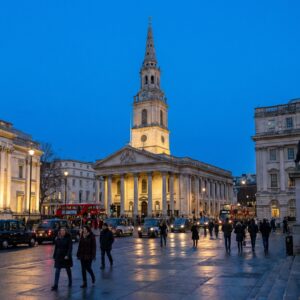
St Martin’s is not just central; it is architecturally consequential. It is Grade I listed, the present building dates to 1722–26 (James Gibbs), and it sits on Trafalgar Square—making it unusually easy to “wrap” a concert into a London day without transport friction.
Short history & cultural importance
The venue’s identity is tied to a specific institutional relationship: the Academy of St Martin in the Fields was founded by Sir Neville Marriner in 1958 and gave its first performance in its namesake church in 1959. So when you hear the Academy at St Martin’s, you’re not hearing a touring label passing through; you’re hearing an ongoing relationship with a home acoustic and a long memory.
Acoustics: the room as a collaborator
Church architecture forces you to hear structure differently. Research on historic religious buildings underlines how materials and surfaces shape reverberation and clarity—variables that change how you perceive articulation, blend, and harmonic rhythm. Put plainly: the room can “compose” alongside the composer, adding sustain where you might expect crispness, or blurring inner detail unless performers compensate.
Micro-conclusion: This venue rewards informed listening, because history, architecture, and acoustics are part of the programme.
Types of concerts you’ll actually find (and what to expect)
Think of St Martin in the Fields concerts as overlapping streams, each with its own listening posture.
Lunchtime concerts: direct, friendly, and musician-led
The Friday Lunchtime Concerts are designed to be welcoming and immediate: artists introduce what they’re playing, and programming is explicitly in partnership with City Music Foundation and Darbar Arts & Culture. The price structure is unusually transparent: £10 concert-only, or £20 with lunch in the Crypt.
Candlelight concerts: short-format, high-atmosphere
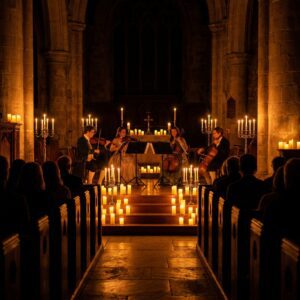
The candlelight strand is the “one-hour, no-fuss” option—often without an interval, built around recognisable pillars (Baroque classics and dependable favourites). A representative example pairs Bach and Handel concerti with Vivaldi’s Four Seasons: music that reads quickly in a resonant space and doesn’t require extensive programme-note homework to land.
The Crypt: close-up listening
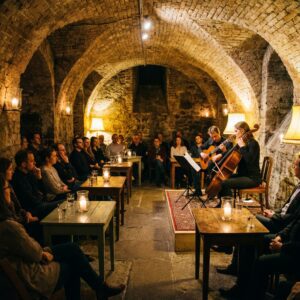
Then there’s the Crypt—both a cultural space and a listening proposition. Crypt Close-Ups are curated for intimacy, often by candlelight. The point is proximity: close enough to hear breath, bow changes, and the final chord’s decay into stone.
Micro-conclusion: Match your format to your energy: lunchtime = fresh ears, candlelight = concentrated glow, Crypt = intimacy and immediacy.
How to choose the best programme
Taste helps. A repeatable method helps more—especially if you’re a pianist trying to learn through listening.
Use this five-point checklist before you book:
- Choose the anchor work. Identify the spine of the concert: a Four Seasons, a major sonata, a choral landmark, a string serenade. If you don’t care about the anchor, don’t pretend the fillers will convert you.
- Ask what the room will do to it. Long lines (string legato, choral writing) often benefit from resonance; fast inner detail can blur. Treat acoustic fit as a deciding factor, not an afterthought.
- Scan performer roles, not just names. Is the leader directing from the violin? Is it conductor-led? That changes pacing, attack, and ensemble discipline.
- Check the running time and interval logic. One hour without an interval requires a different concentration style than a long evening with a break. Neither is “better”; they serve different ears.
- Choose your listening goal. Pick one: a technique goal (articulation, voicing, pedalling ideas), a repertoire goal (discovering what you should study), or an aesthetic goal (beauty, calm, atmosphere).
One illustrative example: if you’re eyeing a candlelight programme that includes Bach and Handel concerti plus Vivaldi’s Four Seasons, your anchor is obvious, the room is likely to favour long line and cadential weight, performer setup will shape attack and pacing, and the one-hour format gives you a clean listening “snapshot” rather than a marathon narrative.
Micro-conclusion: The “best” programme is the one whose anchor, acoustic fit, and format match your purpose for listening.
Listening like a pro at St Martin’s
To listen like a pro, act like a pro: you’re not consuming sound—you’re analysing choices. In a building like this, that means being venue-aware.
Listen for what the space does to articulation
In resonant historic buildings, clarity isn’t just speed. It’s precision of release and the discipline of ensemble consonants: breath, bow changes, cadential timing. Research on soundscapes in religious historic buildings notes how surfaces and volume shape perceived reverberation and acoustic character—directly affecting intelligibility.
Choose your seat strategically
If you want definition, sit where you receive more direct sound and fewer reflections; if you want blend, sit deeper into the wash. If you use an induction loop, St Martin’s recommends booking between rows K–V on the south (right-hand) side of the nave for the best experience.
Track musical hierarchy
Pro listeners tend to know, moment to moment: what is melody, what is bass function, what is harmonic rhythm, what is decorative. This matters especially in Baroque concerti and Vivaldi-style ritornello forms, where the “plot” is repetition with transformation.
Listening drill (60 seconds, mid-piece)
- Identify the melody carrier (who has it now?).
- Listen for the release: where does sound stop cleanly, rather than simply fade?
- Mark one cadence: how do they “arrive” together in this acoustic?
Micro-conclusion: In St Martin’s, good listening means hearing what the room adds—and how performers compensate.
Practicalities and booking tips
Be practical like a Londoner. In a central venue, comfort determines concentration—and concentration determines what you actually take home.
Timing and meals
Friday lunchtime concerts come with a genuinely useful food option: £20 includes the concert and a fish & chips lunch in the Crypt (or soup/sandwich alternative), available pre-concert (12–1pm) or post-concert (2–3pm). It must be booked in advance. If you’re coming straight from work or sightseeing, this is a sensible way to avoid rushing and to keep your energy stable for focused listening.
Accessibility and “quieter path” planning
The venue documents step-free access via a ramp on the north side; lifts connect church and Crypt, and the glass pavilion also provides access to the Crypt via stairs or lift. There are accessible toilets, four wheelchair spaces in the church for services and concerts, and an induction loop in church with recommended seating rows.
If you need a calmer route through an event—whether for neurodiversity-adjacent reasons or simple preference—treat this as your baseline: book an aisle seat, arrive early to acclimatise, and use the documented access routes so stress doesn’t steal your ears. If you need a specific accommodation, contact the venue in advance rather than gambling on the night.
Ticket pricing cues
Candlelight concerts can span multiple price bands; one programme lists bands from £9 up to £35. Plan like a musician: pay for sightlines and direct sound when detail matters (new repertoire, intricate playing); economise when it’s music you already know well.
Micro-conclusion: Your best concert nights come from logistics that protect attention: food, access, seat choice—then music.
Insider tips and curated upcoming highlights
A few habits turn St Martin in the Fields concerts from a pleasant outing into a genuine learning practice.
- Book with your hands in mind. If you’re practising British song or folk arrangements, choose programmes that feed that world. Britten arrangements and a Finzi miniature, for example, teach refinement without requiring volume.
- Alternate formats. One candlelight event plus one lunchtime recital per month is a useful pairing: atmosphere + technique.
- If you want the venue at its most intimate, go underground. Crypt Close-Ups are explicitly designed for candlelit proximity. “Get close-up” is the point.
Upcoming highlights (curated)
All dates/performers below were cross-checked against official St Martin pages and/or event listings; last checked: 2026-03-03.
- Cyrill Ibrahim (piano) — Friday lunchtime recital (6 March 2026, 1pm). If you want a pianist-led narrative arc in a short format, this is the right kind of booking—and the lunchtime structure keeps it approachable.
- Trafalgar Sinfonia: Vivaldi Four Seasons by Candlelight (23 April 2026, 7pm). A clean, high-recognition programme (Bach + Handel concerti, Vivaldi Four Seasons) in a one-hour format—ideal for practising how to hear form and cadence in a resonant space.
- Will Harmer and Friends: Golden Hour (8 May 2026, 1pm). British landscape and poetry through song/chamber writing—Britten folk arrangements, Vaughan Williams studies, and a Finzi “Ditty”. Particularly nourishing if you’re studying collaborative piano or accompaniment.
- ASMF: Sally Beamish 70th Birthday Concert with Michael Collins (11 June 2026, 7:30pm). Contemporary-classical anchor with an institutional through-line: the Academy’s historic relationship to St Martin’s remains alive in current programming.
Micro-conclusion: Use St Martin’s like a conservatoire: alternate formats, pick repertoire that feeds your practice, and treat the room as a teacher.
FAQs and a concise call to action
Do I need to be a “classical expert” to enjoy these concerts?
No. You’ll enjoy them more if you decide what you’re listening for—melody, bass, cadence, colour. That’s the difference between being impressed and being changed.
Is St Martin accessible if I have mobility or hearing needs?
Yes: documented step-free routes, lifts to the Crypt, accessible toilets, wheelchair spaces, and an induction loop with recommended seating area.
What’s the single best starter format?
A Friday lunchtime recital: short, friendly, introduced by the musician, and priced simply (with an optional lunch bundle).
If you’d like your concert-going to actively improve your musicianship, pair your St Martin bookings with focused work on listening, touch, and repertoire architecture: Piano lessons for adults in London, Scaramuzza technique coaching, Collaborative piano and accompaniment coaching, and London performance preparation. For inspiration and community, explore Student concerts and salon evenings and Concert-going for pianists: guided listening support.
Make your listening pay dividends at the piano
Bring one concert insight—articulation, cadence timing, voicing, or ensemble release—into your next practice week, and it will compound.
Sources on St Martin in the fields concerts
St Martin-in-the-Fields (official) — Lunchtime Concerts
https://www.stmartin-in-the-fields.org/lunchtime-concerts/
St Martin-in-the-Fields (official) — Candlelight Concerts
https://www.stmartin-in-the-fields.org/candlelight-concerts/
St Martin-in-the-Fields (official) — Accessibility
https://www.stmartin-in-the-fields.org/visit/visit-st-martins/accessibility/
St Martin-in-the-Fields (official) — Crypt Close-Ups
https://www.stmartin-in-the-fields.org/crypt-close-ups/
Historic England (National Heritage List for England) — Church of St Martin in the Fields (List Entry 1217661)
https://historicengland.org.uk/listing/the-list/list-entry/1217661
Academy of St Martin in the Fields (official) — Sir Neville Marriner
https://www.asmf.org/sir-neville-marriner/