
 TRIAL LESSON
Music Theory Resoucers, Piano Lessons, Scaramuzza Technique
Unlocking Your Musical Potential: The Advantages of Music Lessons in London
Oct
Learn Music in London: Personalised Piano Lessons | WKMT
Learn Music in London: Personalised Piano Lessons with WKMT
By WKMT London | Updated July 2026
Have you ever wanted to learn music in London but felt unsure where to start? At WKMT London we offer personalised, one-to-one piano tuition for children and adults, from the first lesson through to advanced repertoire and public performance. Our teachers guide each student through a comprehensive programme built around the piano, music theory, and — where the student wishes — composition. Every lesson is shaped to the individual, not delivered from a fixed script.
What sets learning music in London apart is the environment. Alongside weekly lessons, our students attend concerts, take part in student festivals, and join our concert meet-ups, immersing themselves in the city’s classical culture. This guide explains exactly what we teach, how we teach it, and why a structured, teacher-led approach produces better musicians than self-study alone.
- Personalised one-to-one piano instruction for children and adults in London
- Preparation for ABRSM and Trinity examinations, or purely for personal enjoyment
- The Scaramuzza technique and how we teach relaxed, efficient playing
- How to immerse yourself in London’s live music culture through WKMT events
- The theory, reading, and aural skills every student develops
- Our studios, beginner course, and learning resources across London
Personalised Music Instruction in London
When you learn music in London with us, the starting point is always the individual. Our one-to-one piano lessons for children and adults cover the essentials of musicianship: chord progressions, harmony, keys, and scales, along with the technical foundation of piano playing. We combine disciplined technique with genuine musical expression, so that progress is measured not only in pieces completed but in the quality of sound a student produces.
The benefit of one-to-one piano lessons
Group classes move at the pace of the room. A private lesson moves at the pace of the student. Our experienced piano teachers guide each learner through intervals, articulation, sight-reading, and interpretation, adjusting every session to what that student needs on that day. Whether you are an absolute beginner or returning to the instrument after years away, we build a strong technical foundation while nurturing the musical instinct that makes playing rewarding.
Set and achieve your musical goals
Some students want to sit graded examinations; others simply want to play the music they love, well. We support both. For those pursuing certification, we prepare candidates for ABRSM and Trinity College London examinations, the two principal UK graded systems. It is worth understanding the difference: ABRSM requires a pass at Grade 5 Theory before a student may sit Grade 6 or above in practical piano, whereas Trinity’s graded path from Initial to Grade 8 carries no such theory prerequisite. We advise each student on the route that suits their goals, and we teach the major scales, minor scales, and aural work these examinations require as a natural part of lessons rather than as a separate chore.
Classical and jazz repertoire
Our teaching centres on the classical piano tradition, from Baroque counterpoint through the Romantic repertoire that forms the heart of most students’ studies. For those drawn to it, we also teach jazz piano, including voicings, harmony, and the vocabulary of improvisation. In every case the aim is the same: to help you understand the music from the inside, so that you can interpret it rather than merely reproduce it.
Learn From London’s Piano Educators
The quality of any music education rests on the teacher. All of our tutors are DBS-checked and hold degrees in piano performance or pedagogy. They are active musicians who continue to perform and, in several cases, compose — practitioners rather than career examiners. They have taught students of every level and age, including students with additional needs, adapting each programme to the person in front of them.
Insight from experienced professionals
Our teachers bring years of performance and teaching experience to every session. We guide students through the concepts that underpin real musicianship — tempo, phrasing, voicing, harmony — and we show how those ideas apply directly at the keyboard. Because we teach one-to-one, we can ensure that each student grasps the nuances of rhythm, touch, and tone rather than being carried along by a class.
The Scaramuzza technique
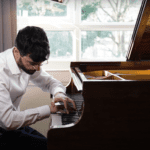
WKMT is built around the Scaramuzza technique, the pianistic method developed by Vincenzo Scaramuzza — the Argentine-Italian pedagogue who trained Martha Argerich. Its central principle is total muscular relaxation: sound is produced by the controlled use of arm weight rather than by muscular tension, which is what allows for both a powerful, singing tone and effortless-looking virtuosity. Our teaching of movement, relaxation, and reading grows directly from this approach, and it is what distinguishes our students’ playing. The short film below, from our own studio, demonstrates the finger movement at the heart of the method.
Guidance on effective practice
Progress happens between lessons, in the practice room. We teach students how to practise, not merely what to practise: how to break a difficult passage into manageable sections, how to use slow practice to secure accuracy, and how to build a daily practice routine that produces steady, measurable improvement. A well-structured twenty minutes will always outperform an hour of undirected repetition.
Relaxation is not the absence of effort — it is the efficient use of it. A tense hand fights the instrument; a relaxed one plays it. This is the foundation of everything we teach.
How a WKMT Musical Education Progresses
Learning music in London with us is not a series of disconnected lessons but a structured journey. The diagram below shows how a student typically develops, from the first trial lesson to advanced performance and, for some, composition.
Every student’s path is different; this shows the typical arc of a serious piano education at WKMT.
Immerse Yourself in London’s Music Culture
Few cities offer a richer musical life than London, and we encourage every student to take part in it. Attending live performances, meeting fellow musicians, and playing in front of an audience are not extras — they are how a student becomes a musician. Beyond weekly lessons, WKMT runs its own cultural programme of soirées, student festivals, and concert meet-ups.
Live performances and concert meet-ups
We regularly recommend concerts that align with a student’s interests or current repertoire, and we gather as a group at our concert meet-ups to attend classical performances across London together. Watching professional pianists reveals how the concepts discussed in lessons — tonality, structure, rubato — translate into living performance. These shared evenings enrich the learning process in a way no lesson alone can.
A community of fellow musicians
Learning alongside others sharpens progress. Through our regular meet-ups and soirées, students share repertoire, compare approaches to practice, and perform for one another in a supportive setting. This sense of community turns solitary practice into part of something larger, and it is one of the quiet advantages of choosing to learn music in London with an established studio rather than in isolation.
Student festivals and performance opportunities
Our student festivals give learners of every level a proper platform to perform. Preparing for a public appearance concentrates the mind and consolidates technique like nothing else, and the experience of playing for an audience builds a confidence that carries back into weekly lessons. For younger students in particular, these occasions are often the moment music becomes something they own rather than something they attend.
Develop Essential Musical Skills
A rounded musician needs more than a repertoire of pieces. Our lessons steadily build the underlying skills — theory, reading, and aural awareness — that let a student understand what they play and learn new music faster.
Understanding music theory
We teach theory not as an abstract subject but as the grammar of the music at the keyboard. Students learn how scales, key signatures, intervals, and chord construction shape the pieces they are working on, from the circle of fifths to phrase structure. For those who wish to go further, we offer dedicated composition lessons in which this theoretical grounding becomes the basis for writing original music.
Reading and aural skills
Fluent sight-reading and a trained ear are what separate a confident player from a hesitant one. We develop reading across both the treble and bass clef, and we train the ear through interval recognition, rhythmic dictation, and singing back what has been heard. These skills are essential for examinations, but their real value is everyday: they make every new piece quicker to learn and more enjoyable to play.
Build Confidence Through Regular Practice
Confidence at the piano is not a personality trait — it is the product of preparation. The students who play with assurance are almost always the ones who have practised with structure. We help every learner establish a practice routine that maximises efficiency and, just as importantly, one they can sustain.
Overcoming performance nerves
Performance anxiety is common and entirely manageable. We address it gradually, through low-pressure playing in lessons, informal performances at soirées, and the accumulated experience of our student festivals. We also teach mindful practice techniques that help students stay present and composed at the keyboard, so that nerves become something a player works with rather than against.
Composition and improvisation
For students who want to create rather than only interpret, we open the door to composition and improvisation. Understanding harmony and structure from the inside allows a pianist to shape their own ideas, whether that means improvising over a chord sequence or writing a complete piece. This creative dimension deepens musicianship and, for many adult learners who set out to learn music in London, is where the real joy of the instrument is found.
Facilities and Resources Across London
We support in-studio and online lessons with resources designed to accelerate learning: our own beginners’ course, an extensive sheet-music library, and a custom learning platform. Our studios span several London neighbourhoods, and each is a proper teaching environment rather than a hired room.
| WKMT studio | Area | Best for |
|---|---|---|
| West Kensington | Central / West London | Our principal studio; all ages and levels |
| Bermondsey | Central / South-East London | Children and adults, South-East London |
| Camberwell | South-East London | Local lessons for South London students |
| Online | Worldwide | Students beyond London, or with busy schedules |
Our own beginners’ course
We have designed a structured Piano Beginner’s Course for aspiring pianists of every age. It introduces the fundamentals — the musical alphabet, scales, chord construction, and a relaxed hand position from the very first lesson — so that new students build correct habits from the start rather than having to unlearn poor ones later. Anyone considering where to study piano in London should look closely at how beginners are taught, because those first months shape everything that follows.
Library, platform, and research
Our students have access to an extensive library of scores spanning every period and level, chosen to broaden repertoire and support sight-reading practice. Our learning platform adds recorded material, a podcast on piano learning and composition, and a research section exploring the historical and cultural context of the music — resources that complement in-person lessons and let curious students go deeper between them.
How to Start Learning Music in London
Beginning is straightforward, and the decision to learn music in London is one you can act on this week. The clearest first step is a trial lesson, which tells us both what you need and whether we are the right studio for you.
- Book a trial piano lesson at your nearest WKMT studio, or online.
- Meet your teacher and agree your goals — examinations, repertoire, or simply playing for pleasure.
- Begin weekly lessons and establish a sustainable practice routine.
- Join our concert meet-ups, soirées, and student festivals as your confidence grows.
- Progress through the repertoire at your own pace, with a plan reviewed as you develop.
Ready to learn music in London?
WKMT offers personalised piano lessons for children and adults, in our London studios and online worldwide. Book a trial lesson and start your musical journey with us.
Frequently Asked Questions About Learning Music in London
We teach one-to-one, so every lesson is built around the individual. At the trial lesson we assess a student’s level, learning style, and goals, then design a curriculum around them. This ensures steady progress whether the student is an absolute beginner or an advanced player refining their repertoire.
All of our teachers are DBS-checked and hold degrees in piano performance or pedagogy, many with postgraduate qualifications. They are active performing musicians trained in the Scaramuzza technique, which ensures a consistent, high-standard approach across the studio.
Yes. We prepare students for both ABRSM and Trinity College London graded examinations, and we advise on which path suits your goals. Note that ABRSM requires a Grade 5 Theory pass before Grade 6 practical, while Trinity’s graded path has no such prerequisite. We also teach students who prefer to learn purely for enjoyment, with no examinations at all.
We run our own programme of music soirées, student festivals, masterclasses, and concert meet-ups, connecting students with London’s classical scene. These events give learners the chance to perform, to hear professionals, and to build a community around their playing.
Yes. We teach children and adults across all levels, with dedicated pages for piano lessons for kids and adult piano lessons in London. Lessons are available in our studios and online worldwide.