
 TRIAL LESSON
Haydn Sonatas
Haydn Sonata in Eb Major HOB XVI 49 – 2nd Movement Analysis
16
Oct
Oct
Haydn Sonata HOB XVI 49 2nd Movement Complete Analysis
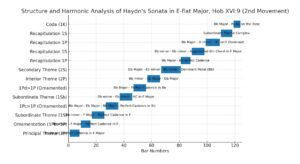 Here are the proportions of Parts I, II, and III:
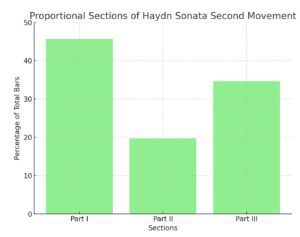 These proportions reflect the relative lengths of each part in the overall structure.
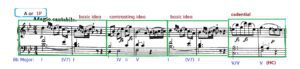
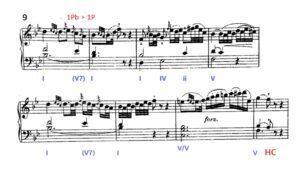
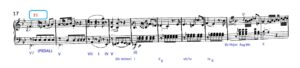

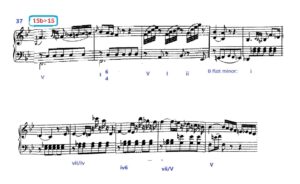
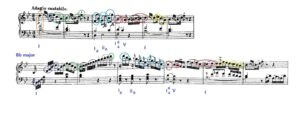
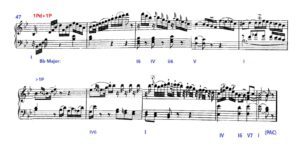 Below we see a comparison between the first exposition (Bars 1-8) and the last (Bars 47-56). In both, the harmonic progression brings the necessary consistency for both phrases, considering one Theme:
 KEY POINTS
So far, there are a few points to consider that shows that despite the fact this movement falls under the structure of a Large Ternary form, the first part has some exceptions:
Firstly, we can observe the variations in every statement of the Themes through ornamentations, seemingly behaving as variations of the Principal Theme, without being actual variations as it might be found in a proper Theme and Variations form.
Secondly, the A section of a Large Ternary form usually has three sections: ABA.
In this particular case, Haydn makes use of the repetition of the Main theme and the Subordinate theme, each time with more complex ornamentations.
KEY POINTS
So far, there are a few points to consider that shows that despite the fact this movement falls under the structure of a Large Ternary form, the first part has some exceptions:
Firstly, we can observe the variations in every statement of the Themes through ornamentations, seemingly behaving as variations of the Principal Theme, without being actual variations as it might be found in a proper Theme and Variations form.
Secondly, the A section of a Large Ternary form usually has three sections: ABA.
In this particular case, Haydn makes use of the repetition of the Main theme and the Subordinate theme, each time with more complex ornamentations.
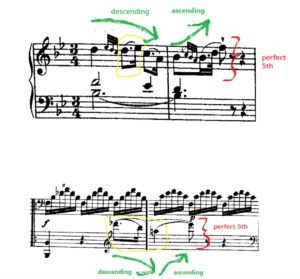 The relationship between the two motives lies in the descending and ascending melodic direction (green), the rhythm module (yellow) and the overall range on the second motive (red).
This motive modulates to several keys, making it harmonically unstable:
Starting in the parallel minor key (B flat minor), going through moving to G flat Major (Bar 62), and D flat Major (Bar 66) where he introduces the Secondary theme (2S) in D flat major, then moving to E flat minor (Bar 70), B flat minor (Bar 72), F Major (Bar 76) returns to B flat Major (Bar 78), ending with a pedal on the Dominant (Bars 79-81).to the final half cadence to return to B flat major.
The relationship between the two motives lies in the descending and ascending melodic direction (green), the rhythm module (yellow) and the overall range on the second motive (red).
This motive modulates to several keys, making it harmonically unstable:
Starting in the parallel minor key (B flat minor), going through moving to G flat Major (Bar 62), and D flat Major (Bar 66) where he introduces the Secondary theme (2S) in D flat major, then moving to E flat minor (Bar 70), B flat minor (Bar 72), F Major (Bar 76) returns to B flat Major (Bar 78), ending with a pedal on the Dominant (Bars 79-81).to the final half cadence to return to B flat major.
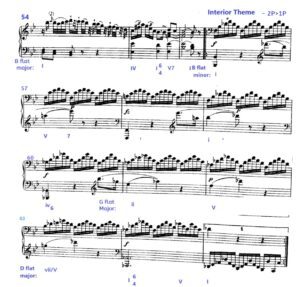 The first Theme, 2P>1P ends on a PAC in bar 66 (9 bars in total) It is stable harmonically, with the typical Tonic-Dominant relation to establish the new key in minore, B flat minor
After which a Subordinate Theme (2S) starts in D flat major in bar 67
The first Theme, 2P>1P ends on a PAC in bar 66 (9 bars in total) It is stable harmonically, with the typical Tonic-Dominant relation to establish the new key in minore, B flat minor
After which a Subordinate Theme (2S) starts in D flat major in bar 67
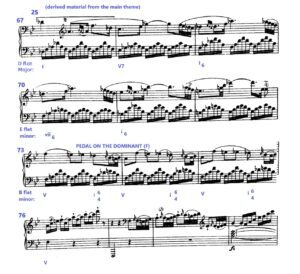 This PART II is a truncated ternary form (replacing the recapitulation for a Re-transition from bar 72 through a pedal on the dominant starting in bar 73.
2P is presented in B flat minor (minore or parallel minor mode), being the Subordinate theme of this section 2S in D flat major (Relative major of the parallel minor mode) this theme is harmonically more unstable, moving to E flat minor in bar 70; Subdominant that in here would comply a Pre-Dominant function that will lead to the pedal on the Dominant, F.
The nature of this motive is more harmonically unstable, following the convention of an interior theme or a ternary form. In this case, Haydn blends this theme into a re-transition.
This PART II is a truncated ternary form (replacing the recapitulation for a Re-transition from bar 72 through a pedal on the dominant starting in bar 73.
2P is presented in B flat minor (minore or parallel minor mode), being the Subordinate theme of this section 2S in D flat major (Relative major of the parallel minor mode) this theme is harmonically more unstable, moving to E flat minor in bar 70; Subdominant that in here would comply a Pre-Dominant function that will lead to the pedal on the Dominant, F.
The nature of this motive is more harmonically unstable, following the convention of an interior theme or a ternary form. In this case, Haydn blends this theme into a re-transition.
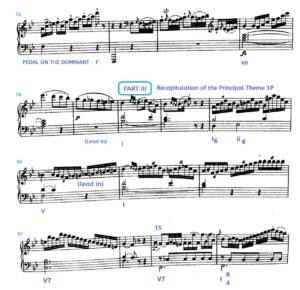
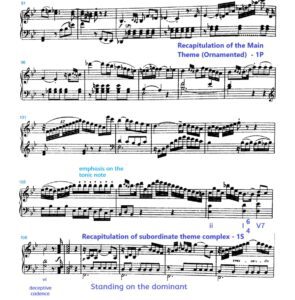
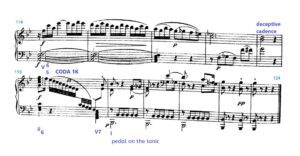
For whom is this analysis?
The analysis of the Haydn Sonata Hob XVI 49 2nd Movement is useful for anyone who would like to dive into this piece, especially performers currently studying under the Trinity or ABRSM syllabus. You can find the Complete Analysis of the First Movement here. This piece is included in the ATCL repertoire list (no. 117 on the list). Also, it is within the repertoire of the Associate Diploma (ARCT) in Piano, Performer (Page 101). Finally, for composers interested in exploring the large ternary form.SYMBOLS OF ANALYSIS
For this Analysis, we will use the symbols of analysis from the book “Guidelines to Style Analysis” by Jan LaRue. For a complete description, please refer to our website in which there is a free lesson from the Course of Analysis in which we describe the symbols and their meanings: Click here to go to the complete lesson – Symbols of AnalisisBACKGROUND on Haydn Sonata Hob XVI 49 2nd Movement
The second movement of J. Haydn’s Sonata in E-flat major, Hob. XVI:49, marked “Adagio e cantabile”, is widely regarded as one of the most expressive in his keyboard oeuvre. It provides a striking contrast to the more lively and buoyant first part, and its lyrical, almost vocal quality has prompted comparisons to operatic arias.1. Character and Structure of the Second Movement
The “Adagio e cantabile” is in B-flat major, the Dominant key relative to the E-flat major of the Allegro di Sonata creating a gentler and more introspective atmosphere. The Adagio is written in a Large ternary form (ABA) a conventional form for slow movements. According to William Caplin in his book “Analyzing Classical Form” (Page 566) […] The full-movement large ternary form is used almost exclusively in slow movements. Haydn especially cultivated the form, but a good number of large ternaries are found in the works of Mozart and Beethoven as well. […] The opening theme, characterised by its elegant melodic line and delicate ornamentation, immediately establishes a lyrical, contemplative mood. The use of ornamentation, such as trills and grace notes, lends the movement an air of refinement, yet the dynamic contrasts and occasional harmonic surprises suggest an underlying tension. The middle section, in particular, features more intense harmonic exploration, giving the movement a sense of drama and unpredictability.2. Sturm und Drang Influence
While the Sonata Hob. XVI:49 was composed after Haydn’s most direct engagement with the Sturm und Drang (Storm and Stress) movement in the 1760s and early 1770s, certain elements, especially in this “Adagio”, do reflect the emotional intensity and contrasts characteristic of Sturm und Drang. The Sturm und Drang was an aesthetic trend associated with heightened emotional expression, dynamic contrasts, and harmonic experimentation. It appeared as a reaction against the more restrained, rational qualities of early Classical music. In Haydn’s works, the Sturm und Drang style is most evident in his symphonies and string quartets from the 1760s and 1770s (for example, Symphony No. 45, the “Farewell” Symphony), which are marked by minor keys, dramatic dynamic shifts, and intense emotional expression. In the second movement of this sonata, the influence of Sturm und Drang can be seen in several ways:- Dynamic contrasts: Haydn employs significant contrasts between soft and loud dynamics, creating moments of tension and release. This technique is a hallmark of Sturm und Drang, where such contrasts were used to evoke emotional intensity.
- Harmonic instability: While it begins with a serene, lyrical theme, the middle section features more dissonant harmonies and unexpected modulations. These moments of harmonic tension disrupt the tranquillity of the opening and add an element of unpredictability, aligning with the Sturm und Drang tendency to explore emotional volatility.
- Expressive depth: Although the overall character is lyrical and graceful, there is an underlying pathos, particularly in the middle section, where the music becomes more introspective and agitated. This tension between surface elegance and deeper emotional complexity is a feature of Sturm und Drang, where composers sought to express the complexities of human emotion.
3. Lyricism and Operatic Influence
It is important to note that while the second movement exhibits some traits associated with Sturm und Drang, it is also highly lyrical, with clear influences from vocal music. Haydn’s experience with opera and vocal forms, particularly during his time at the Esterházy court, had a profound impact on his instrumental writing. The “Adagio e cantabile” has been compared to an operatic aria, with its long, flowing melodic lines and expressive nuances. The embellishments and dynamic shading further contribute to this vocal quality, lending the music a sense of expressivity that transcends mere instrumental virtuosity. This dual influence of Sturm und Drang intensity and vocal lyricism is one of the reasons why this Adagio stands out. While the emotional depth and dynamic contrasts may evoke the Sturm und Drang style, the overall mood of the movement is one of introspection and grace rather than raw emotional turmoil.4. Spiritual and Emotional Expression
The middle section is considered unique among Haydn’s tranquil second movements; in retrospect, it shows the seed of what in later years (1797) will be the Creation, his most famous Oratorio and one of his most important masterpieces. While The Creation is overtly spiritual, with its text drawn from the Book of Genesis and Milton’s Paradise Lost, there is a sense of emotional profundity and spirituality, particularly in the reflective and lyrical second movement. The serene, contemplative mood can be seen as Haydn exploring a more introspective form of expression, not dissimilar to the reverence and awe found in The Creation. In both works, Haydn demonstrates a capacity to evoke profound emotional and spiritual depth, whether through the grand depiction of the creation of the world or the intimate expressiveness of a solo keyboard work.STRUCTURE
It presents the form of a Large Ternary Form, although two editions present the form as a Theme and Variations. Convention dictates that the theme is given at the beginning of the piece under the term “Tema”, and the subsequent variations under “Var. 1, 2, 3” and so forth, not happening in most versions of this piece, except in the following editions:- Sigmund Lebert (1822-1884)
- Theodore Baker (1851-1934)
SYMBOLS OF ANALYSIS
- The Principal Theme or 1P according to the symbols of analysis of Jan LaRue; this analysis will track the different variations throughout the movement.
- The subordinate Theme will be designated as 1S
- The cadential material is 1K
- For derived material, “>” this symbol will be used. For example 1S>1P (the secondary theme derives from the principal theme)
SECTIONS BREAKDOWN – Haydn Sonata Hob XVI 49 2nd Movement
PART I (A) (Bar 1-58) – Small Ternary
- Bars 1-8: Principal Theme – 1P
- Key: Bb Major.
- Ends with a perfect cadence in the dominant key, F Major.
- Bars 9-16: Ornamentation of the Principal Theme (A) – 1Pb>1P
- Key: Begins in Bb Major and ends in F Major.
- Cadence: Perfect cadence in F Major.
- Bars 17-26: Subordinate Theme – 1S
- Standing on the Dominant
- Modulation: Moves briefly through Bb minor in Bar 21.
- Cadence: Ends with a perfect cadence in F Major (V) (Bars 25-26).
- Bars 27-36: 1Pc>1P (1P ornamented)
- Key: Begins in Bb Major.
- Modulation: Moves to Eb Major in Bar 32, returns to Bb Major in Bar 33.
- Cadence: Ends with a perfect cadence in Bb Major in bar 36.
- Bars 37-46: Subordinate Theme – 1Sb (ornamented)
- Standing on the Dominant
- Modulation: Passes through Bb minor (Bar 40) and Eb minor (Bar 42)
- End with a HC (F major)
- Bars 47-56: 1Pd>1P (most ornamented version of the Main Theme)
- Key: Begins in Bb Major.
- Cadence: Ends with a perfect cadence.
PART II (Bars 57-80) (Interior Theme or B) (Truncated Ternary Form)
- Main Interior Theme 2P (Minore) Key: Bb minor bar 57 – A section
- Modulation: Moves to Gb Major in Bar 61 and Db Major in Bar 66.
- B section – 2S (Secondary Theme) Bar 67, in Db Major.
- Further modulation: Moves to Eb minor (Bar 70), Bb minor (Bar 72)
- Pedal on the Dominant of B flat (Bar 76) to re-transition to the Recapitulation. (Bar 80)
- (It does not return to A, therefore, is considered a Truncated Ternary Form).
PART III (Return of the Main Theme A’) (Bars 81-125):
-
- Bars 81-88: Recapitulation of the Main Theme – 1P
- Key: Bb Major.
- Cadence: Ends with an imperfect cadence in Bar 88.
- Bars 89-98: 1S
- Standing on the Dominant (F7 chord)
- Modulation: Transitions to Bb minor in Bar 93, Eb minor in Bar 95.
- Cadence: Passes through F Major with the chord of the augmented 6th on the flattened second of F Major in Bar 98.
- Bars 81-88: Recapitulation of the Main Theme – 1P
- Bars 99-109 Recapitulation of the Main Theme (Ornamented) – 1P
-
-
- Deceptive cadence to G minor (Bar 108)
- Strong Half cadence on the first inversion of the F dominant chord (Bar 109)
-
- Bars 110-118 Recapitulation of subordinate theme complex – 1S
-
-
- The material of this cadence is taken from the Subordinate theme complex, 1S
-
- Bars 119-124: Coda 1K
-
- Pedal on the Tonic
Here are the proportions of Parts I, II, and III:
Breakdown:
- Part I (Bars 1-58): 58 bars
- Part II (Bars 57-81): 25 bars
- Part III (Bars 82-125): 44 bars
Total bars:
- 58+25+44=12758 + 25 + 44 = 12758+25+44=127 bars
Proportional percentages:
Part I: 45.67% Part II: 19.69% Part III: 34.65%
These proportions reflect the relative lengths of each part in the overall structure.
What is a Large Ternary Form?
Overview
According to William Caplin […] the large ternary consists of three parts. The two outer parts, both of which function as a main theme, normally have the same basic musical content, though the return of the main theme is frequently embellished. The second part—termed an interior theme —creates its most evident contrast with the main theme through modal shift, though sometimes the interior theme is set in another tonal region. […]“Analyzing Classical Form” (Page 566) Practical Considerations for Pianists For pianists, understanding this form is crucial for both interpretation and performance. Here are a few key considerations:
- Thematic Distinction: It is essential to differentiate between the principal theme and the Secondary theme, particularly in the A section; this is especially important in the repeated ornamented ones. Keeping the stress on the focal notes (structural) is crucial to a thoughtful performance.
- Repetition with Variation: While the A section recurs multiple times in PART I, avoid mechanical repetition. Instead, consider subtle variations in dynamics, phrasing, or tempo to keep the listener engaged.
- Structural Awareness: Maintain a clear sense of the overall structure throughout the performance. Understanding where you are within the form can help guide interpretive decisions and ensure the performance has coherence and direction.
FIRST PART – Bars 1-56
Exposition of the Main Theme – (1P) Bars 1-8
The main theme (1P) falls under the conventional period (a term coined by Arnold Schonberg in his book “Fundamentals of Music Composition”) which consists of 8 bars, with a main division of 2 sub-phrases divided into 4 modules of 2 bars each: Bars 1-2: Basic idea Bars 3-4: Contrasting idea (Weak cadence (HC) to divide the sub-phrase) Bars 5-6: Repetition of the basic idea Bars 7-8: Cadential idea.
Characteristics of a Period:
- Antecedent Phrase:
- The Basic Idea (Bars 1-2)
- It ends with a half cadence (HC) creating a sense of anticipation or incomplete resolution. (Bars 3-4)
- Consequent Phrase:
- The basic idea is presented again (Bars 5-6)
- Usually, it ends with a perfect authentic cadence (PAC), which provides a strong sense of closure and resolution.
- Responds to and resolves the musical idea presented in the antecedent phrase.
Structure:
- Length: Typically, both phrases are of equal length, commonly four bars each, resulting in an eight-bar period.
- Harmony: The harmonic structure often moves from the tonic to the dominant in the antecedent and returns to the tonic in the consequent.
- Melody: The melody of the consequent often mirrors or varies the melody of the antecedent, maintaining coherence while introducing some contrast.
Ornamented repetition of 1Pb>1P (Bars 9-16)
Offers the conventional addition of ornamentation to the Theme; the harmonic progressions are the same.
Subordinate Theme – 1S – Bars 17-26
The subordinate theme starts on the dominant of the main key, F dominant seventh, creating a standing on the dominant through bars 18 and 19 leading into the key of Bb minor from bar 21, returning to the main key in bar 26 through an augmented sixth chord that functions as a dominant of the dominant, resolving on F major in bar 26.
Ornamented repetition of the Main Theme 1Pc>1P – Bars 27-36:
Another variation of 1P in which the ornamentation becomes more chromatic, briefly touching E flat major in bar 32, ending on a perfect cadence in B flat major in bar 36
Ornamented Variation of the Subordinate Theme – 1Sb>1S Bars 37-46:
Starting on a Dominant, this variation derives from 1S. Haydn uses the same modal interchange briefly towards B flat minor in bars 40 to 44, returning to a cadence in B flat major again in bar 46.
Most ornamented Variation of the Main Theme 1Pd>1P Bars 47-56
This last presentation of the Man Theme is the most complex one in its ornamentation, not being easily recognisable. The challenge here is to keep the structural notes in mind when performing this passage:
Below we see a comparison between the first exposition (Bars 1-8) and the last (Bars 47-56). In both, the harmonic progression brings the necessary consistency for both phrases, considering one Theme:
KEY POINTS
So far, there are a few points to consider that shows that despite the fact this movement falls under the structure of a Large Ternary form, the first part has some exceptions:
Firstly, we can observe the variations in every statement of the Themes through ornamentations, seemingly behaving as variations of the Principal Theme, without being actual variations as it might be found in a proper Theme and Variations form.
Secondly, the A section of a Large Ternary form usually has three sections: ABA.
In this particular case, Haydn makes use of the repetition of the Main theme and the Subordinate theme, each time with more complex ornamentations.
SECOND PART Development – Interior Theme – Bars 56-80
The first section of the Development starts in B flat minor, with a melody distantly related to the first part; we will name this motive as 2P (distantly derived from the principal motive 1P):
The relationship between the two motives lies in the descending and ascending melodic direction (green), the rhythm module (yellow) and the overall range on the second motive (red).
This motive modulates to several keys, making it harmonically unstable:
Starting in the parallel minor key (B flat minor), going through moving to G flat Major (Bar 62), and D flat Major (Bar 66) where he introduces the Secondary theme (2S) in D flat major, then moving to E flat minor (Bar 70), B flat minor (Bar 72), F Major (Bar 76) returns to B flat Major (Bar 78), ending with a pedal on the Dominant (Bars 79-81).to the final half cadence to return to B flat major.
The first Theme, 2P>1P ends on a PAC in bar 66 (9 bars in total) It is stable harmonically, with the typical Tonic-Dominant relation to establish the new key in minore, B flat minor
After which a Subordinate Theme (2S) starts in D flat major in bar 67
This PART II is a truncated ternary form (replacing the recapitulation for a Re-transition from bar 72 through a pedal on the dominant starting in bar 73.
2P is presented in B flat minor (minore or parallel minor mode), being the Subordinate theme of this section 2S in D flat major (Relative major of the parallel minor mode) this theme is harmonically more unstable, moving to E flat minor in bar 70; Subdominant that in here would comply a Pre-Dominant function that will lead to the pedal on the Dominant, F.
The nature of this motive is more harmonically unstable, following the convention of an interior theme or a ternary form. In this case, Haydn blends this theme into a re-transition.
A comment from William Caplin regarding this device “ In some cases, retransition function is incorporated into a contrasting middle, if that section is the last part of the couplet (as in a truncated small ternary).”Analyzing Classical form – p. 654.
THIRD PART Recapitulation of the Main Theme (Bars 81-124)
- Bars 82-89: Principal Theme – 1P
- Bars 90-99 – 1S
- Bars 99-109 – 1Pb>1P
- Bars 110-124 Coda