
 TRIAL LESSON
Haydn Sonatas, Piano Lessons
Haydn Sonata in E Flat Major HOB XVI 49 – Third Movement Analysis
Nov
Haydn Sonata HOB XVI 49 third Movement
Haydn Sonata in E Flat Major HOB XVI 49 – Third Movement Analysis
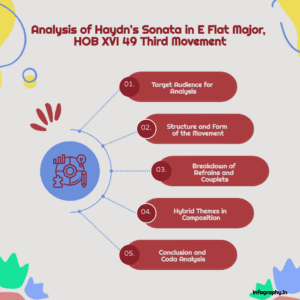
For whom is this analysis?
The analysis of the Third Movement of this Sonata is useful for anyone who would like to dive into this piece, especially performers currently studying under the Trinity or ABRSM syllabus.
This piece is included in the ATCL repertoire list (no. 117 on the list)
Also, it is within the repertoire of the Associate Diploma (ARCT) in Piano, Performer ( Page 101)
Finally, for composers interested in exploring the Rondo Form.
SYMBOLS OF ANALYSIS
For this Analysis, we will use the symbols of analysis from the book “Guidelines to Style Analysis” by Jan LaRue.
For a complete description, please refer to our website in which there is a free lesson from the Course of Analysis in which we describe the symbols and their meanings:
Click here to go to the lesson
EXAMPLES
- The Principal Theme or 1P according to the symbols of analysis of Jan LaRue; this analysis will track the different variations throughout the movement.
- The subordinate Theme will be designated as 1S
- The cadential material is 1K
- For derived material, “>” this symbol will be used. For example 1S>1P (the secondary theme derives from the principal theme)
For more information, you can go to this link
Do not miss the analysis of the first and second movements of this beautiful sonata.
STRUCTURE
This final movement has a five-part Rondo form . Caplin explains:
Consists of five principal sections: three appearances of the refrain alternate with two couplets (thus yielding an ABACA pattern). Like all rondo forms, the refrain (A) always appears in the home key, while the couplets (B, C) are set in either a contrasting key or the minore of the home key.
(Analyzing Classical Music. William Caplin. Page 642)
The minore refers to the parallel minor or a Rondo in the Major key. In this piece, The main Theme is presented on the main key of the piece, E flat major, which is the same as the first movement following the conventional procedure to return to the main key on the final piece of a Sonata. The C or Couplet 2 is presented in E flat minor, parallel minor to E flat major.
Below, we can see the chart Caplin offers in page 643 of the same book:
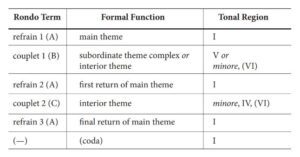
The refrain comes twice after couplet 1, offering the piece a contrasting harmony and theme, and after couplet 2, the interior theme in minor; this provides the major contrast of the piece compared to the main theme.
Conventionally, the main theme is presented in Ternary form, and this Haydn piece is no exception, as we will see in the following breakdown.
FORM BREAKDOWN
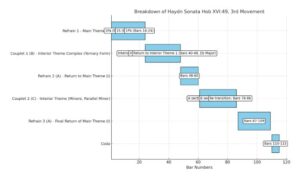
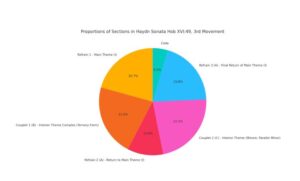
Refrain 1 – Main Theme Eb major (I)
(1Pa) (Bars 1-8)
(1S) (Bars 9-16)
(1Pb) (Bars 16-24)
Couplet 1 (B) or Interior Theme complex (Ternary form)
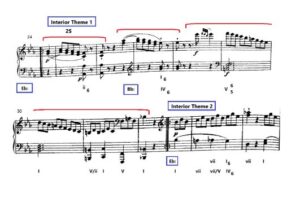
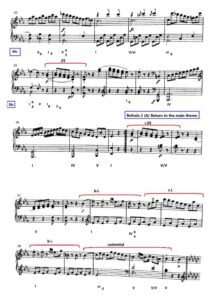
Interior Theme 1 (Bars 24-32) Bb Major (V)
Interior theme 2 (Bars 33-40) Ab Major (IV)
Return to Interior Theme 1 (Bars 40-48)- finishing on Eb major (I)
Refrain 2 (A) Return to the main theme in Eb major (I) (Bars 48-60)
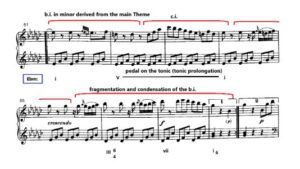
Couplet 2 (C) – Interior Theme – Minore (parallel minor) (Eb minor) (Bars 61-86)
A section: Bars 61-68
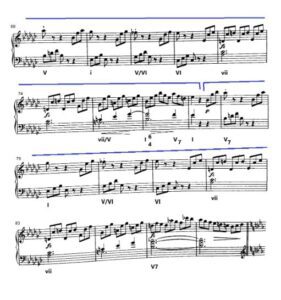
B section: Bars 69-77
Re-transition to Refrain 3 (A) Bars 78-86
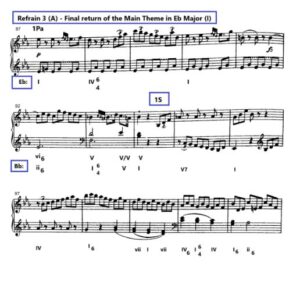
Refrain 3 (A) – Final return of the Main Theme in Eb Major (I) – (Bars 87-109)
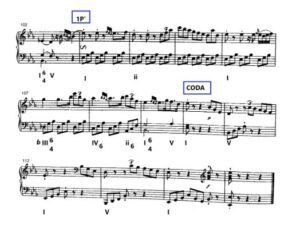
Coda – (Bars 110-115)
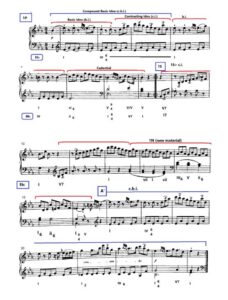
The Refrain 1 (A) or Main Theme is a Hybrid Theme, more specifically a Compound Basic Idea + a Consequent. This Theme is quite infrequent and its main characteristic is that it resembles a period (a conventional theme type) but with the difference that the contrasting idea doesn’t lead to a weak cadence (half cadence) in bar 4. Instead, we observe a prolongation progression from I to the second inversion of the IV degree and then back to the tonic degree.
Regarding the Hybrid Themes, William Caplin says:
In this hybrid type, the opening 4-bar. phrase is neither an antecedent nor a presentation, but rather a combination (hybrid) of the two, a new phrase function that bears the rather complicated term compound basic idea . This hybrid begins with a compound basic idea. Measures 5 and 6 of the theme, however, bring back the opening basic idea in the manner of a consequent phrase.This hybrid, an infrequently occurring type, strongly resembles a period . The only essential difference is the contrasting idea in mm. 3–4 of the theme does not bring a weak cadence.
(“Analyzing Classical Form”, Page 102)
The Couplet 1 or Subordinate Theme complex is in ternary form starting in bar 24 with the Interior Theme 1 starting on the dominant (Bb) the motivic material is new, segmented in two bars.
The Refrain 2 returns to the main theme through material derived from the Couplet 1 up to bar 60 in which gives place to the Couplet 2 in the parallel minor, Eb minor, changing the key signature accordingly. The Refrain or Main Theme is now presented in its minor mode and also this section has a ternary form. Haydn Sonata HOB XVI 49 third Movement.
Finally, we have the final return of the Main theme or Refrain 3 in bars 87 up to the cadence in bar 109, followed by the Coda from bar 110 until the end of the piece.
*Do not miss our Analysis of the Joseph Haydn Piano Sonata Hob XVI 34.