 TRIAL LESSON
Haydn Sonatas, Music Theory Resoucers, Piano Lessons
Haydn Sonata in E Flat Major HOB XVI 49 – First Movement Analysis
Nov
Haydn Sonata in E flat Major
Analysis of F. J. Haydn Piano Sonata in E Flat Major Hob.XVI:49 – (J. Haydn)
First Movement
For whom is this analysis?
The analysis of this Sonata is useful for anyone who would like to dive into this piece, especially performers currently studying under the Trinity or ABRSM syllabus.
This piece is included in the ATCL repertoire list (no. 117 on the list)
Also, it is within the repertoire of the Associate Diploma (ARCT) in Piano, Performer ( Page 101)
Finally, for composers interested in exploring the Allegro di Sonata form.
BACKGROUND on Haydn Sonata in E Flat Major
“Haydn wrote his sonata in E-flat major, Hob. XVI: 49 for the fortepiano. According to John Rink, it is Haydn ‘s first sonata to be specifically written for the fortepiano.” It was written for one of his noble patrons. Haydn provides some instructions for playing this piece: “Only the Adagio is quite new, and I especially recommend this movement… it is rather difficult but full of feeling.”
( John Rink, Musical Performance: A Guide to Understanding (Cambridge: Cambridge University Press, 2002)
SYMBOLS OF ANALYSIS
The terms coined by William Caplin in his book “Analyzing Classical Form” will be used for this analysis.
HISTORICAL CONTEXT of Haydn Sonata in E Flat Major
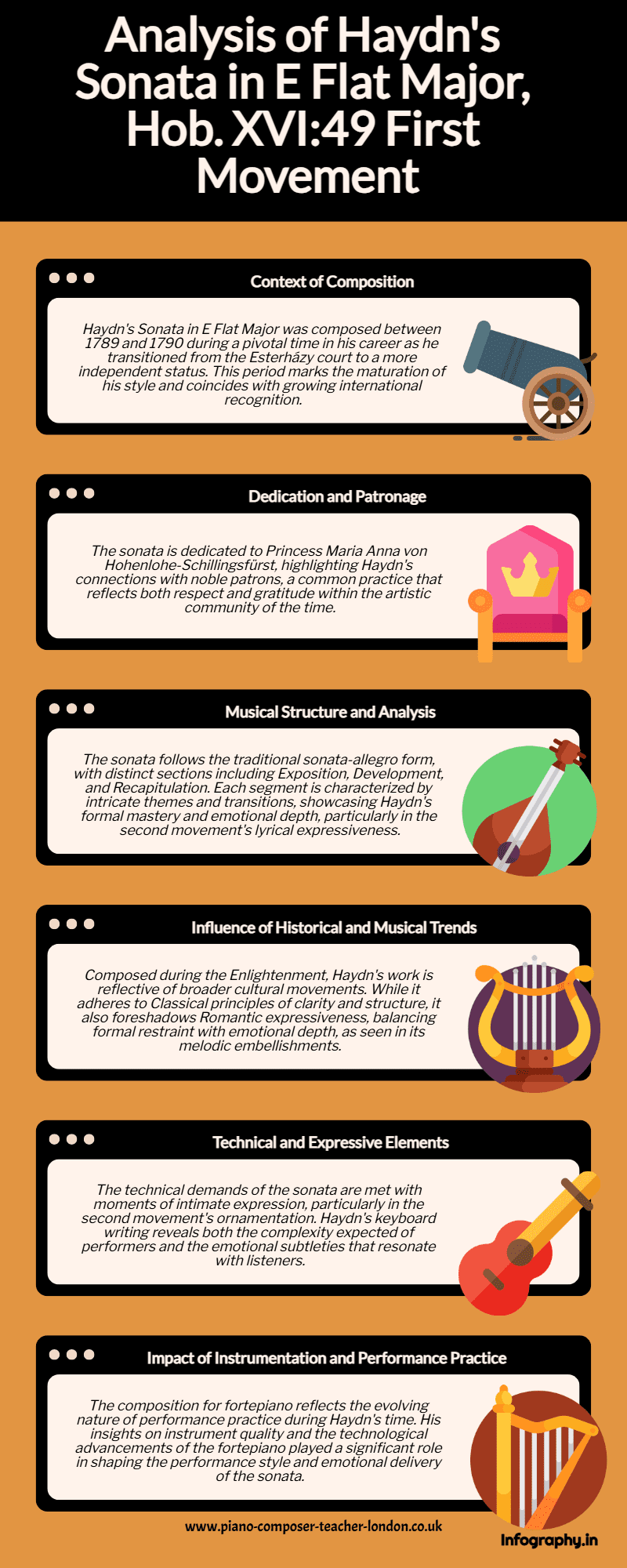
Joseph Haydn’s Piano Sonata in E-flat major, Hob. XVI:49, composed between 1789 and 1790, is a reflection of his mature style during a pivotal period of his career. To provide a comprehensive understanding, let us first explore the personal, political, and musical background of this composition, as well as its specific dedicatory and stylistic elements.
1. Haydn’s Personal and Professional Context (1789–1790)
During the late 1780s, Haydn was at the height of his career. By this time, he had already spent nearly three decades serving as Kapellmeister at the court of the Esterházy family, primarily under Prince Nikolaus II Esterházy. However, by the late 1780s, Haydn’s role at the Esterházy court was evolving. In 1790, Prince Nikolaus passed away, and his successor, Prince Anton, had less interest in maintaining the court’s music ensemble. This allowed Haydn greater freedom, both personally and professionally, to travel and compose independently.
The sonata was composed at the Esterháza palace, where Haydn resided during his service. This period also marked the transition towards the end of his full-time duties at the Esterházy court, and it foreshadowed Haydn’s celebrated London visits that began shortly after, in 1791. It was a time when Haydn’s international reputation was growing, and his works were increasingly appreciated by wider European audiences.
2. Dedication of the Sonata
The Sonata Hob. XVI:49 was dedicated to Princess Maria Anna von Hohenlohe-Schillingsfürst, a highly regarded noblewoman and accomplished musician. The princess’s musical aptitude and aristocratic standing made her an ideal dedicatee, as Haydn had long been involved in patronage relationships with European aristocracy. This dedication also reflects the common practice of the time, where composers dedicated works to noble patrons, both as a form of homage and in gratitude for their support.
3. Political and Historical Context
The late 18th century was a period of significant political and social change across Europe. Although Austria, where Haydn lived, was relatively stable compared to revolutionary France, the intellectual and political currents of the Enlightenment and pre-Revolutionary movements were widely felt. In 1789, the French Revolution had begun, signalling the start of a turbulent era across the continent. While Haydn himself was not directly involved in political matters, the cultural atmosphere in Europe, particularly with Enlightenment ideals and calls for liberty, permeated much of the intellectual discourse.
In terms of its impact on Haydn’s music, the Enlightenment fostered an emphasis on clarity, form, and balance, all hallmarks of the Classical style to which Haydn contributed significantly. Although the Sonata Hob. XVI:49 does not carry overt political messages, the spirit of balance, rationality, and formal elegance present in the work can be viewed as a reflection of these broader cultural currents.
4. Musical Context and Style
The sonata was composed when Haydn’s musical style had reached full maturity. His works of this period demonstrate greater complexity, emotional depth, and structural innovation compared to his earlier compositions. Sonata Hob. XVI:49 is no exception; it is regarded as one of his finest piano sonatas, notable for its lyrical qualities, formal mastery, and expressive nuances.
In terms of style, this sonata reflects several characteristics of the Classical period:
- Form: The sonata follows the traditional sonata-allegro form, with a first movement marked “Allegro” and a second movement marked “Adagio e cantabile”. Using sonata form with its contrasting themes and developmental sections typifies the Classical era’s focus on form and structure.
- Expressiveness: The second movement, particularly, exhibits a profound lyricism and emotional depth. It has often been remarked upon for its operatic quality, which might have been influenced by Haydn’s experience with vocal music during his time at the Esterházy court.
- Technical Brilliance: While the sonata is demanding in terms of technique, it also showcases Haydn’s keyboard writing’s more personal and intimate side, especially in the second movement’s use of ornamentation and melodic embellishment.
5. The Influence of Historical and Musical Trends
Musically, Haydn was at the forefront of the Classical style, which by the late 18th century had moved towards a more defined emphasis on symmetry, thematic development, and clarity of form. At the same time, Haydn’s music, including this sonata, was increasingly imbued with an emotional richness that presaged the Romantic era. The Sonata Hob. XVI:49 demonstrates this balance between Classical restraint and Romantic expressiveness, particularly in the delicate, song-like slow movement.
F. J. Haydn was also influenced by his contemporaries, including Mozart, whose piano works and symphonies had a profound effect on Haydn, especially during the 1780s. The exchange of musical ideas between the two composers, combined with the broader trends of the Classical period, certainly informed the writing of this sonata.
6. Impact of External Factors on the Sonata
In the Sonata Hob. XVI:49, the general atmosphere of change and intellectual curiosity that characterised Europe in the 1780s influenced the broader cultural context in which Haydn worked. Additionally, the shift in his professional life—moving from the confines of the Esterházy court towards a more independent career—may have given Haydn the creative freedom to experiment more in his compositions during this time, the latter is evident in the unique second movement, especially the inner section in B flat minor, and exquisite and insightful gem in his musical corpus
Another factor was the instruments available at that time. On that note, we have a letter Haydn wrote On July 4, 1790, to Madame Genzinger (he dedicated this Sonata to her), which presents his opinion on the fortepiano of the day:
“It is quite true that my friend Herr Walther is very celebrated, and that every year I receive the greatest civility from that gentleman, but between ourselves, and speaking frankly, sometimes there is not more than one instrument in ten which you could really describe as good, and apart from that they are very expensive. I know Herr von Nikls fortepiano: it’s excellent, but too heavy for Your Grace¨‟s hand, and one can’t play everything on it with necessary delicacy. Therefore I would like Your Grace to try one made by Herr Schanz; his fortepianos are particularly light in touch and the mechanism very agreeable. A good fortepiano is absolutely necessary for Your Grace, and my Sonata [no. 59 in Eb ] will gain double its effect by it.” (László Somfai, The Keyboard Sonatas of Joseph Haydn: Instruments and Performance Practice, Genres and Styles (Chicago: The University of Chicago Press, 1995), 12.)
[…]During the period of Haydn‟s visits to London, fortepianos made by Broadwood had more reliable keyboards and foot pedals than those of other manufacturers. According to László Somfai, Haydn might have had impressions of these instruments and worked on significant fortepianos with a range of five and a half octaves in London. In addition, he listened to the virtuoso performances of Clementi and Jan Ladislaus Dussek, who was famous for his pedalling, and he noted in his diary that John Field played the fortepiano excellently.”[…]
(Excerpt from Yaokun Yang in her HAYDN PIANO SONATAS: AN EXAMINATION OF STYLE AND PERFORMANCE – Page 17)
An original facsimile of this piece can be requested from this website:
Piano Sonata Hob. XVI:49 « Facsimile edition (facsimilefinder.com)
OVERVIEW
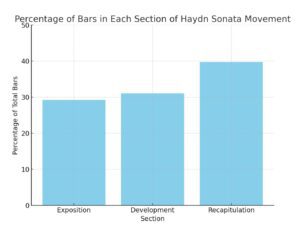
Firstly, we will calculate the percentage of each movement of this first movement.
- Total number of bars in the first movement:
- Exposition: Bars 1-64 → 64 bars
- Development: Bars 65-132 → 68 bars
- Recapitulation: Bars 133-219 → 87 bars
- Total bars = 64 + 68 + 87 = 219 bars
- Percentage of each section:
- Exposition=(21964)×100≈29.22%
- Development=(21968)×100≈31.05%
- Recapitulation=(21987)×100≈39.73%
So, the percentages of the bars in each section relative to the total movement are approximately:
- Exposition: 29.22%
- Development: 31.05%
- Recapitulation: 39.73%
Tempo markings according to different editions
-Carl Adolf Martienssen (1881-1955): Allegro [non troppo]
-Karl Päsler (1863-1942): Allegro non troppo
-Sigmund Lebert (1822-1884): Allegro crotchet = 120
-Theodore Baker 1851-1934: Allegro crotchet = 120
-Adeline Charpentier The Music Master: Allegro Crotchet = 152
–Ignaz moscheles_(1794-1870): Allegro Crotchet = 152
-Louis Köhler (1820-1886): Allegro
-Oeuvres complettes (Vol.1, No.3) -Leipzig Breitkopf und Härtel, 1799: Allegro
-First edition – Vienna Artaria, n.d.[1791]: Allegro
-Holograph manuscript, 1790: Allegro
EXPOSITION – Structure of Haydn Piano Sonata in E Flat Major Hob XVI 49
EXPOSITION (Bars 1-64)
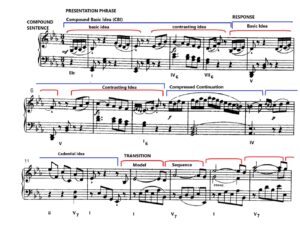
Bars 1-12: Primary Theme – (Compound Sentence) in Eb
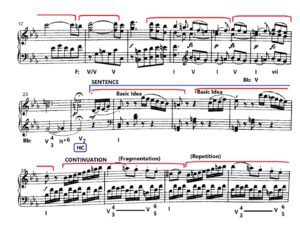
Bars 13-24: Transition (Bridge) modulating to Bb
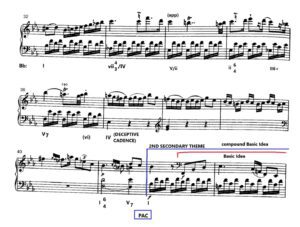
Bars 24-41: First Secondary or Subordinate Theme (ST I)
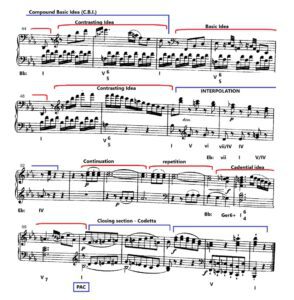
Bars 42-59: Second Subordinate or Secondary Theme (ST II)
Bars 60-64: Closing section.
The exposition starts with a compound sentence. According to William Caplin, a compound sentence is an expanded musical theme structure that enlarges the conventional eight-bar sentence form commonly found in classical music. In a standard sentence, the presentation section consists of two basic ideas, each typically two bars long, totalling four bars. However, in a compound sentence, these basic ideas are themselves extended, often to four bars each, making the presentation section eight bars in length.
The continuation and cadential sections are similarly expanded, resulting in a theme that is generally 16 bars long instead of the usual eight. (In this particular Sonata, we observe that the compound sentence is twelve long as the continuation is compressed) This extended form allows for more extensive development and variation of thematic material within the framework of classical formal functions. The bar’s compound sentence maintains the characteristic features of a sentence—such as repetition, fragmentation, and harmonic acceleration—but does so on a larger scale, providing a broader canvas for musical expression.
According to the same author, a compound basic idea is a four-bar musical unit that functions as a basic idea within a theme but is itself composed of smaller motivic elements. Unlike a typical basic idea, which is usually two bars long, a compound basic idea extends to four bars yet does not lead to a cadence or provide a sense of closure. It often combines two distinct or varied two-bar ideas to form a single, larger unit. This compound structure introduces the primary thematic material of a piece and serves as a foundational element in the formal organisation of classical themes.
DEVELOPMENT – Structure of Haydn Piano Sonata in E Flat Major Hob XVI 49
Before we plunge into this section, we will clarify some terms that will appear in this section, such as Core and Pre-core. Both terms are coined by William Caplin:
“Pre-core/Core Technique Development sections are considerably less conventional in their phrase structural organization than expositions are. Unlike an exposition, which almost always brings the three functions of the main theme, transition, and subordinate theme, we cannot predict in advance which component parts a given development may contain. One mode of organization, however, appears frequently: the pre-core/core technique.
The core of a development establishes a relatively large-sized model (4–8 mm.), which is sequenced one or more times. Subsequent fragmentation leads to an HC (or dominant arrival) of either the home key or a development key, after which there appears a standing on the dominant. The core of the development typically projects an emotional quality of instability, restlessness, and dramatic conflict. A core is usually preceded by a pre-core , a passage of lesser emotional intensity than the core. “
(Analyzing Classical Form, Page 273)
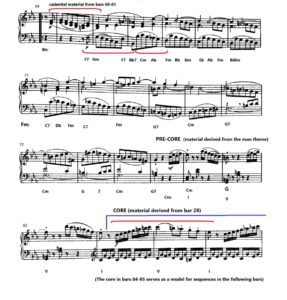
We will observe the Pre-Core is presented in bar 80, derived from the Main Theme (Bar 1) to let the Core be introduced in bars 84-87 derived from the 2nd Secondary Theme from bars 28-29 in the exposition.
The Development starts with material from the closing section, now in C minor, as a smooth continuation from the end of the exposition, immediately presented through imitative counterpoint between hands providing a “stretto” effect, which brings the first sense of movement, closing in a Half Cadence in G major.
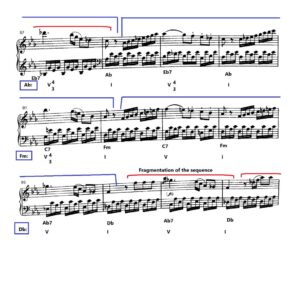
The Pre-Core (discussed in the previous paragraph) makes its appearance in bar 84 and the Core (the model in C minor Key) in bar 84, continuing in C minor, is now more settled in this key.
The model of 4 bars in C minor continues with its counterpart in A flat major, making this a descending third sequence in bar 88.
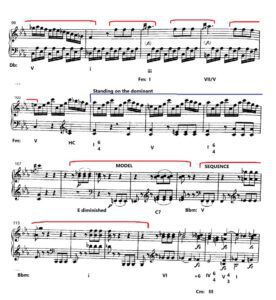
In bar 96 a fragmentation of the model occurs, now in D flat major (notice that the Order in the sequence started in C minor, then A flat Major to go to F minor and finally, the fragmentation in D flat major, all in descending order by thirds: Cm-Ab-Fm-Db)
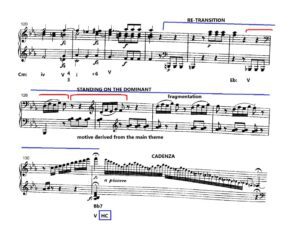
This process will be fragmented again to created a climax of the development, reaching a standing on the dominant in bar 104 that will continue until bar 107, where Haydn presents another model of four bars; this will be the start of the re-transition to the re-exposition through a highly unstable harmonic passage going through B flat minor, C minor, reaching by a chromatic bass line (from B natural to B flat in bar 125) to E flat (home key of the piece)
To another standing on the dominant in B flat seventh until the final cadenza in bar 131.
RE-ELABORATION – Structure of Haydn Piano Sonata in E Flat Major Hob XVI 49
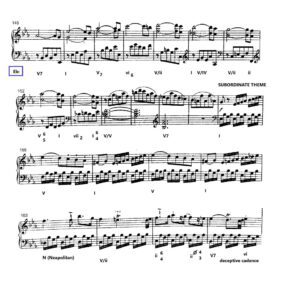
Bars 132-143 Main Theme
As convention, the Theme is re-stated exactly as in the exposition.
Bars 143-157: Non-Modulatory Transition in E flat Major
In this section we observe the changes in harmony to keep it into the home key from bar 150, which establishes the IV degree (Ab) instead of C minor (bar 19 in the exposition)
Bars 158-171: Subordinate Theme
The First Subordinate Theme is now in the home key, giving a calmer feeling. We observe a brief development of the II degree (F minor) through a Neapolitan Cadence from bar 163 to 165, quickly abandoning the degree to land into the Dominant seventh chord of Eb major.
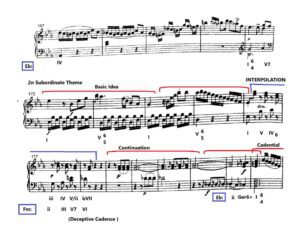
Bars 172-185: 2nd Subordinate Theme
The Theme is in the home key as well, as convention dictates in the Sonata Form. In bar 177 an Interpolation leads briefly to F minor through a deceptive cadence to then arrive to the Coda in bar 186.
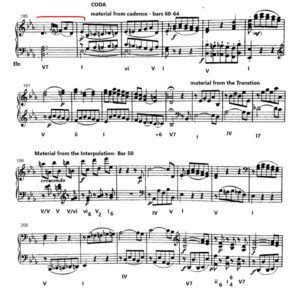
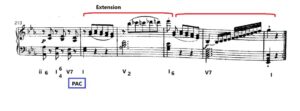
Bars 186-218: Coda
The Coda brings some previous elements, such as:
-Cadential material from bars 60 – 64 (bar 186)
-Transition material from bar 12 (bar 196)
-Interpolation from bar 50 (Bar 199 and bar 211)