
 TRIAL LESSON
Haydn Sonatas, Music Theory Resoucers
Haydn Sonata in E Minor Hob XVI 34 – Third Movement Analysis

Mar
Haydn Piano Sonata in E Minor Third Movement Complete Analysis
Haydn Sonata in E Minor Hob XVI 34 – Third Movement Analysis
Overview of Haydn Piano Sonata in E Minor Third Movement
In this analysis, we will use William Caplin’s terminology (“Analyzing Classical Music”) as well as the symbols of analysis of Jan LaRue (“Guidelines for Style Analysis”)
The Jan LaRue symbols are explained in this free lesson from our Musical Analysis Course:
7.1 – Main Symbols of Analysis – Compose your Music
Historical and Stylistic Context
Haydn’s Piano Sonata in E minor, Hob. XVI/34 (often numbered as No. 53), holds a special place in his output as one of his few minor-key sonatas.
Composed in the late 1770s and published in London in 1783, this sonata emerged during Haydn’s Sturm und Drang (“storm and stress”) period, when he explored darker emotional tones in response to contemporary aesthetic trends.
Minor keys were unusual for Haydn – of his roughly 50+ piano sonatas, only a handful (around five) are in minor keys (notably in C minor, G minor, B minor, C♯ minor, and E minor, which is the piece we are analysing here)
This rarity highlights the significance of Hob. XVI/34: Haydn reserved minor mode for heightened drama and expressivity, contrasting with the cheerful character for which he was best known.
In the E minor Sonata, Haydn employs the minor mode to impart a turbulent, restless mood associated with Sturm und Drang, but he balances pathos with wit and elegance. The third movement (Finale: Molto vivace) especially exemplifies Haydn’s Classical style fusion of dramatic intensity and light heartedness. Despite being in a minor key, the finale’s opening refrain presents a simple, folk-like melody over a churning Alberti bass, projecting a breezy, toe-tapping character.
Haydn plays with major–minor contrast throughout the rondo: sections in E minor alternate with sections in the major mode (maggiore) as a form of tonal relief, a common Classical-era strategy in minor-key works. These shifts to major are largely coloristic; the movement retains an underlying spirit of “bubbly good spirits” and humour even when toggling between minor and major.
As William Caplin observes, Classical rondos generally “tend to be light and more relaxed in character,” less overtly dramatic than minor-key first movements.
“Rondo forms tend to be treated somewhat differently by each of the three classical composers. Haydn,[…] normally writes the first couplet as an interior theme. Mozart, on the contrary, likes to use a subordinate theme complex for that same couplet.
Indeed, this distinction between Haydn and Mozart relates to these composers’ differing orientation toward slow movement forms: the former prefers the large ternary (with its central unit being an interior theme), while the latter cultivates the sonata without development form, which engages transition and subordinate-theme functions.
Another composer-specific tendency concerns the tonal region of the interior theme used as the second couplet in the five-part rondo. Here, Haydn favors a minore, Mozart the subdominant.”
(“Analyzing Classical Form” – William Caplin. Page 664)
This is evident in Haydn’s E minor finale, where the sombre E minor tonality is imbued with “Haydn-esque” playfulness and clarity of phrase structure instead of unremitting gloom.
Haydn’s use of minor keys in sonatas was thus strategic and expressive. In Hob. XVI/34, the minor mode supports a stormy effect (as heard in the agitated first movement and touches of minor in the Adagio), while the finale’s rondo form lets Haydn alternate that storminess with sunny major-key episodes. This approach illustrates Haydn’s innovative balance of emotional depth and classical decorum: even as the sonata ventures into rare minor-key territory, it does so within the elegant, structured framework typical of the Classical style. Haydn Piano Sonata in E Minor Third Movement Complete Analysis.

Differences in Tempo among Editions
There are some differences in tempo among different versions.
Just the performance direction “Molto vivace” appears in the following editions:
Oeuvres complettes (Vol.1, No.2)
Breitkopf und Härtel, 1799.
Louis Köhler 1820-1886-Peters
Karl Päsler 1863-1942
Carl Adolf Martienssen 1881-1955
Christa Landon 1921-1977
Georg Feder 1927-2006
126 the crotchet (quarter) beat in the following edition:
Moscheles:1794-1870
120 the crotchet or quarter note beat in the following editions:
Sigmund Lebert 1822-1884
Hans von Bülow 1830-1894
Theodor Baker
Formal and Structural Analysis of Haydn Piano Sonata in E Minor Third Movement
The third movement of the E minor sonata is cast as a rondo, alternating a recurring refrain theme (A) in the home key with contrasting couplets (episodes or B) in major keys. Overall, the movement follows a five-part rondo pattern A–B–A–B–A, where “A” represents the refrain in E minor and “B” are the interior episodes (often marked Maggiore for their parallel major mode, in this case, E major). According to Caplin’s form-functional theory, each large section (refrains and episodes) can be understood as a Ternary Form within the larger rondo form.
In other words, the refrain itself has an ABA structure (sometimes called exposition–contrasting middle–recapitulation in Caplin’s terms:
“If the exposition (A) is repeated and if the contrasting middle (B) and recapitulation
(A´) are repeated together, then the resulting form is traditionally termed
a rounded binary […] From a functional point of view, the small ternary and rounded binary are identical forms.”
(“Analyzing Classical Forms” Page 196)
The episodes or Couplets exhibit their own Ternary forms. Before a detailed analysis of the movement, below we can delineate the form in general terms:
Overall Form
The form of this piece delineates the following pattern:
Refrain 1 (Ternary form)
Bars 1 to 8: A
Bars 9 to 13: B
Bars 14 to 19: A’
Couplet 1 (Maggiore) or Interior Theme (Ternary form)
Bars 20 to 26 a
Bars 27 to 32: b
Bars 33 to 40: a’
Refrain 2 (Ternary Form) First return
Bars 40 to 47: A
Bars 48 to 57: B
Bars 58 to 67: B ornamented
Bars 68 to 75: A’
Couplet 2 (Maggiore) or Interior Theme (ornamented)
Bars 76 to 82 a
Bars 83 to 90: b
Bars 91 to 98: a’
Refrain 3 (Ternary Form) Second return
Bars 98 to 105: A
Bars 106 to 113: A ornamented
Bars 114 to 123: B ornamented
Bars 124 to 133: B’ ornamented + closing section
Indeed, Haydn uses the couplet as an interior theme, Caplin says about it:
“The second couplet of most five-part rondos features this thematic function, and the first couplet of that form may also be built as an interior theme, especially in rondos by Haydn.”
(“Analyzing Classical Form” – William Caplin. Page 653)
“The interior theme (like that found in the second part of a large ternary), is set in the opposite mode of the home key –maggiore in the case of this Rondo- or the submediant”
(“Analyzing Classical Form” – William Caplin. Page 643)
It is noteworthy that in this rondo, Haydn uses the transition between Refrains as a single thematic unit. Caplin comments about this specific device:
The functions of transition and subordinate theme (Couplets) may be fused into a single thematic unit (“Analyzing Classical Form” – William Caplin. Page 652)
“A distinct transition is sometimes entirely omitted, in which case the end of the main theme is immediately followed by a subordinate theme beginning directly in the new key (For example, In this piece, the beginning of the Couplet in E major in bar 20). In such cases, the subordinate theme is likely to include a dominant arrival to give emphasis to the subordinate-key dominant.”
(In bar 26 the arrival to B major, Dominant of E major) (“Analyzing Classical Form” – William Caplin. Page 651)
Breakdown of Haydn Piano Sonata in E Minor Third Movement
Below is a breakdown of the movement’s form, along with the phrase structure, harmonic plan, cadences, and thematic development in each section:
- Refrain 1 (Bars 1–19) – E minor. The main theme is stated as a small ternary: A (bars 1–8), B (9–13), A′ (14–19) compressed recapitulation. Regarding the latter, Caplin states, “More typically, however, the A´ section is compressed into a single consequent phrase”. (“Analyzing Classical Form” Page 198) Which is the case from bar 14. (marked A’ on the score)
The A section presents an eight-bar theme that is folk-like and clearly phrased. This theme could be analysed as a period (4+4), but it has a rounded design: it begins in E minor and surprisingly modulates to the relative major (G major) for a cadence. In fact, the first phrase ends with a perfect authentic cadence (PAC) in G major, illustrating Haydn’s playful tonal shift even within the refrain.
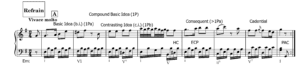
The brief B section or contrasting middle (bars 9–13) introduces a development of the motive, and crucially it leads the harmony back toward E minor through a sequence of descending 5ths (G-C-F’#-B – chords are written above the staff on the score).
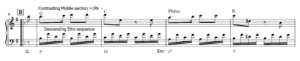
The cadence in E minor at bar 19 clinches the tonic and makes the refrain a self-contained unit. Thematically, Haydn’s refrain is straightforward and memorable – its two-bar basic idea (a folk-like tune) is stated and then immediately varied by the tonal detour to G major, showcasing Haydn’s ingenuity in phrase extension and harmonic surprise.
Episode (Couplet) 1 (Bars 19–40) – E major (Maggiore). The first episode shifts to the parallel major, providing a sunny contrast to the minor-mode refrain. It is marked Maggiore in some editions, indicating the change of mode. This section is also structured as a Ternary (a–b–a′): a (19–26), b (27–32), a′ (33–40). The “a” section introduces a new theme in E major, marked as Contrasting Middle Section >1Pa, which means that the motivic material derives from the Basic Idea, 1Pa. This motive is lighter in character and texture, with an intermittent accompaniment on the left hand.
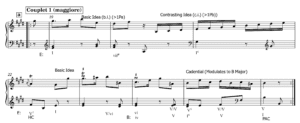
This new theme serves as an interior theme – a subordinate melodic idea not heard in the refrain. Harmonically, the episode traverses away from E major’s stability to facilitate the return to E minor later: the b section (27–32) offers a variant of the main motive of the Couplet but ornamented (Bars 27-28) and is repeated in bars 29 and 30.
By mid-episode, Haydn modulates towards the dominant of the home key. The episode eventually gravitates to B major (the dominant of E minor) – a pivotal move that sets up the refrain’s return.

The a′ subsection (33–40) reprises the episode’s theme (or a variant of it), now in a key that leads smoothly into the parallel major. Haydn ensures the episode ends with a perfect cadence resolving in E major.
This is a common strategy in minor-key rondos: the major-mode episode is designed to end on V of the minor tonic, creating a seamless link (a retransition) back to the minor refrain. The phrase structure here remains balanced – for example, an 8-bar idea (bars 17–24) could be expanded or repeated, and the contrasting b section is short, keeping the episode compact (24 bars total).
Thematic development in Episode 1 or Couplet 1 is relatively independent: Haydn introduces fresh motifs in E major rather than directly quoting the refrain. However, the cheerful character and motivic play maintain the rondo’s overall coherence. By ornamenting the episode’s reprise (a′) Haydn adds interest. The clear PAC in E major at bar 40 signals the end of this interior theme and strongly prepares the upcoming return of the Refrain 2 or A at bar 41 (notice the change of key signature)
- Refrain 2 (Bars 41–75) – E minor. The main theme returns in the tonic, but Haydn varies and extends it, preventing a mere literal repeat. Refrain 2 still carries the outline of the small ternary A–B–A′ but with extensions/ornamentation: A (40–47), B (48–57), B varied (58–67), A′ (68–75). The A section (41–47) restates the refrain theme in E minor. Listeners’ familiarity with the tune allows Haydn to play with it – adding trills and slight rhythmic alterations, for example, the syncopated rhythms in bar 70 or the addition of notes at the beginning of the Ornamented B’ in bar 58 (one hallmark of Classical rondo technique is to vary the refrain upon its returns).
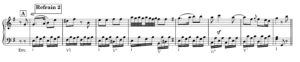
The B section (48–57) again serves as the contrasting middle, but this time Haydn embellishes and expands it. Instead of only a few bars of digression, he repeats the B-section material in an ornamented sequence (bars 58–67 are essentially B′, an extended variant of B). This means Refrain 2’s middle section is longer and more developmental, touching additional harmonies (Bars 61-62 on the ii and vi degrees) and sequencing the motive. Throughout this middle, the harmony ventures to the relative major (G), keeping the tonal interest, ending on a feminine cadence in bar 67, creating a moment of suspense with an additional Fermata and delay on the resolution chord, G major.
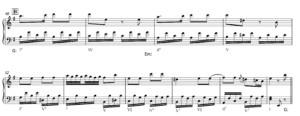
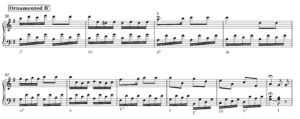
By bar 67, A′ (68–75) brings back the refrain melody in E minor to close the section. This reprise is slightly decorated by the syncopated rhythms in bar 70 to differentiate it from the initial statement. The cadence at bar 75 confirms E minor (a PAC), formally closing Refrain 2. According to Caplin’s framework, such alterations still fulfil the formal functions of the refrain: the A sections state and re-confirm the theme (presentation and closure), while the expanded B functions like a miniature development or continuation, intensifying harmonic tension before resolution.
Thematic variation is evident here in the way Haydn reworks the B-section idea – adding ornamentation, and shifts in dynamics with the use of sf (sforzato) in bar 45 and the trill in bar 60 – effectively treating it as a variation technique. This not only maintains interest in the refrain’s return but also smoothly leads into the next episode.
- Couplet 2 (Bars 76–97) – E major (Maggiore, varied). The second episode provides another major-mode contrast, and it is often a revisiting of the first episode’s material in a varied manner, especially in the narrow range created by the accompaniment, now in a higher register.
Like Couplet 1, it is in E major (the parallel major), but Haydn now enriches the texture or figurations (hence it is sometimes described as “ornamented”). This section again follows a ternary form (a–b–a′): a (76–82), b (83–90), a′ (91–97). The part recalls the theme from the first episode, now embellished (for example, with added trills and turns in bars 78 to 80). Harmonically, it stays in E major initially but leads toward B major at bar 82. The b part (83–90) departs to new keys, much as before. Notably, Haydn engages in deeper thematic development here: he takes material from the main refrain and works it into this episode. The comparison is shown below:
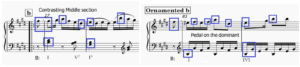
This clever integration creates a link between the refrain and the episode, increasing the rondo’s unity. The middle of Couplet 2 drives toward B major again: by bars 87–90, the music reaches a PAC in B major (dominant of E), echoing the strategy of Couplet 1.
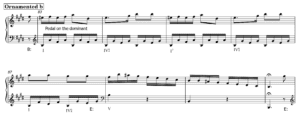
The a′ section (91–98) returns to the episode’s opening theme in E major, now shortened to wrap up the episode. It cadences convincingly in E major in bar 97. By the end of this section, the parallel major is simply dropped to a minor mode, allowing the final return of A. Overall, Couplet 2 intensifies the rondo’s major–minor dialogue: it starts and ends in the bright E major, showcasing the episode theme in a more virtuosic light, while subtly recalling the refrain’s motives. The use of inversion and ornamentation demonstrates Haydn’s sophisticated thematic transformation within a formally tight-knit episode.
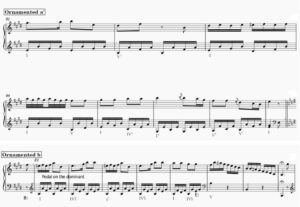
- Refrain 3 and Closing (Bars 98–133) – E minor. The final refrain arrives, bringing back the A theme for the last time and driving the movement to its conclusion. Haydn treats this Refrain 3 as a culmination: it is the most elaborated statement of the rondo theme, incorporating variations and a closing extension (coda). The structure can be seen as A – A ornamented – B ornamented – B′ + Closing: A (98–105), A ornamented (106–113), B ornamented (114–123), B′ + closing material (124–133). Instead of a strict ABA′, Haydn expands the A section itself by immediately restating the theme with embellishments.
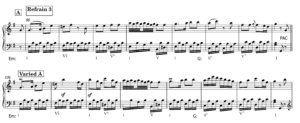
Next, the B section returns (114–123), but unlike earlier iterations, it is heavily ornamented and expanded. Haydn may sequence the B-section idea to new harmonic heights or include dramatic pauses or rapid passagework here. The harmony in this final B section likely ventures through the relative major G and back to the dominant, as earlier refrains did; indeed, the music moves to G major around bar 115 and again around 124.
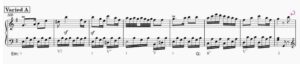
By bar 124, a modified version of B’s cadence occurs – and in bar 130 a deceptive cadence occurs– launching directly into the closing section (130–133). In bars 124–133, Haydn drives to the final cadences: this B′ + closing might incorporate fragments of the refrain’s motive, adding rapid repeated notes characteristic of a closing flourish. The tonal focus here is squarely on E minor; any remaining major-mode coloration is dispelled as the piece heads to closure. We can regard bars 124–133 as a coda merged with the end of the refrain – it serves to reinforce the tonic and provide a satisfying conclusion beyond the strict ABA form. Caplin notes that codas and expanded cadential sections are common in closing off a rondo, adding emphasis to the final return.
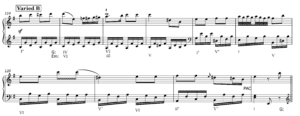
The movement accordingly ends with a robust, perfect authentic cadence in E minor, firmly closing the rondo and the sonata. The thematic material in this final refrain is heightened through variation: by repeating A and extending B, Haydn ensures the listener’s expectation of closure is both delayed and delightfully fulfilled. The refrain’s joyous character, even in minor, shines through these embellishments, aligning with Caplin’s observation that even minor-key rondos often project a lighter effect until the very end.
The alternation of E minor and G major within this refrain (as earlier) also continues – for instance, the refrain theme briefly shifts to G major during its developmental spins – Before the music triumphantly returns to E minor for the final bars
In sum, Refrain 3 functions as both a recap of the main theme and a concluding section that ties together the rondo’s key contrasts and motivic ideas one last time, with Haydn’s hallmark wit (through ornamental surprises) and formal clarity guiding the listener to a convincing finish.
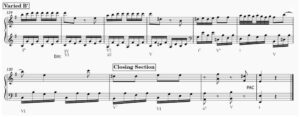
Confirmation of the formal division: The breakdown provided (Refrain 1, Couplet 1, Refrain 2, Couplet 2, Refrain 3) indeed accurately captures the rondo structure of this movement. According to Caplin’s theoretical framework, the refrain sections exemplify tight-knit themes (like small ternary forms) within the larger form, and the episodes are subordinate themes that contrast in key and mood.
The described sections and bar ranges align with how a Classical five-part rondo is constructed, though different analyses may vary slightly on bar count due to repeats or cadential overlaps. Notably, the Caplin-esque approach confirms that each refrain is a self-contained theme (often ending with a PAC in tonic by its final A′), and each episode is a contrasting digression that still closes in a way to lead back to the refrain (commonly by ending on the dominant of the tonic, as we see with the B-major cadences).
The phrase structures are generally symmetric or in standard units (4- or 8-bar phrases), but Haydn introduces slight asymmetries (like the 7-bar phrase at Refrain 2’s start, or the extended B sections) to prevent monotony. Harmonically, the movement showcases a repertoire of Classical modulatory practices: the refrain toggles between i and III (minor tonic and relative major) – a hallmark of small ternary designs in minor
– While the episodes explore the parallel major (I) and its dominant (V of i) to provide brightness and forward momentum. Cadences are clearly articulated at the end of each subsection, often as perfect authentic cadences (except for transitions where Haydn uses half cadences or dominant prolongations to push onward). The thematic development is skilfully handled through variation and motivically linked episodes, as discussed, which is very much in line with Haydn’s practice and Caplin’s observations on Classical forms. Thus, the structural division given is correct and illuminates how this rondo finale is crafted: it conforms to Classical formal principles as analysed by Caplin (exposition, contrasting middle, return), while also exemplifying Haydn’s creativity in phrase expansion and tonal contrast within that framework.
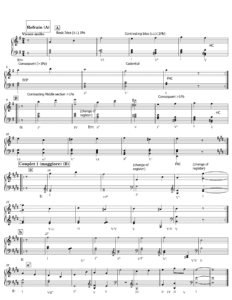
Structural representation of the Refrain and Couplet
To better visualise the form, it is important to take the ornamentation and non-structural notes to observe the harmony and melodic overall structure:
Graphical Representation of Section Proportions
To better visualise the form, the following chart shows the proportional length of each section of the movement as a percentage of the total 133 bars (not counting repeats). This illustrates the relative scope of refrains versus episodes in the rondo:
| Section | Bar Range | Number of Bars | Percentage of Total |
| Refrain 1 (A) | 1–19 | 19 bars | ~12% |
| Episode 1 (Couplet 1, Maggiore) | 19–40 | 22 bars | ~18% |
| Refrain 2 (A′, first return) | 41–75 | 35 bars | ~26% |
| Episode 2 (Couplet 2, Maggiore) | 76–97 | 22 bars | ~17% |
| Refrain 3 & Coda (final return) | 98–133 | 36 bars | ~27% |

As the table shows, the refrains (combined) occupy roughly half the movement, which is typical for a rondo (the recurring theme dominates the form). The first refrain is relatively short (only 12% of the piece), while the later refrains are longer due to Haydn’s expansions (the final refrain plus coda is the single largest section, about 27%). Each episode is slightly different in length, with the first episode (~18%) a bit longer than the second (~17%). Overall, the alternation of sections is fairly balanced: Haydn distributes the musical narrative evenly between the returning A sections and the contrasting episodes. This balance of proportions contributes to the movement’s clarity – listeners get just enough of the refrain to recognize it, then a contrasting episode for variety, then the refrain again, and so on, in a well-proportioned cycle. The near-equal percentages of the two episodes and the incrementally growing refrains (from 12% → 26% → 27%) reflect Haydn’s practice of making each return of the rondo theme more substantial, leading up to a final extended statement and coda.
In summary, Haydn’s Finale to the E minor sonata is an exemplary Classical rondo in a minor key. It combines a clear formal design (as illuminated by Caplin’s form-functional analysis) with inventive twists in phrase structure and key colour. Historically, it stands out for its minor mode drama amid Haydn’s works, yet it remains stylistically Classical – balanced, witty, and ultimately optimistic in spirit. The movement’s form, content, and context thus all interconnect: the Sturm und Drang expressivity of the 1770s finds its outlet in a minor-key rondo that still adheres to the elegant proportions and thematic coherence championed by theorists like Caplin.
Through this finale, we see Haydn at his best – innovating within tradition – yielding a piece that is as formally satisfying as it is emotionally compelling.
Sources for Haydn Piano Sonata in E Minor Third Movement Complete Analysis
- William E. Caplin, Analyzing Classical Form (Oxford University Press, 2013) – for formal function concepts and Classical form
mtosmt.org - Joel Galand, “Formenlehre” Revived – review of Caplin’s theory (discusses small forms and rondo)
esm.rochester.edu
- Vancouver Recital Society, Program Notes: Haydn Sonata in E minor – historical context on Haydn’s minor-key sonatas and stylistic character
vanrecital.com
- Analysis by Tonic Chord (tonic-chord.com) – detailed bar-by-bar breakdown of Hob. XVI/34’s finale, used to confirm harmonic cadences and modulations
tonic-chord.com - Gisela Paterno, Haydn Sonata Hob. XVI/49 – Third Movement Analysis, WKMT Blog – example of Caplin’s approach applied to a Haydn rondo (for comparison of terminology and structure)
piano-composer-teacher-london.co.uk - Robbins Landon, Haydn: Chronicle and Works – catalog of Haydn’s sonatas (for the number and keys of minor sonatas)
en.wikipedia.org