
 TRIAL LESSON
Haydn Sonatas, Music Theory Resoucers
Haydn Sonata in E Minor Hob XVI 34 – Second Movement Analysis
15
Apr
Apr
Haydn Sonata in E Minor Hob XVI 34 Second Movement Analysis
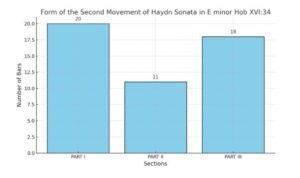 Haydn Piano Sonata in E minor Hob.XVI:34 – 2nd Movement (G major, Ternary Form)
|—— A (Exposition) —|– B (Contrasting Middle) —-|—– A’ (Recapitulation) ——-|
| Bars 1–20 | Bars 21–31 | Bars 32–49 |
| Approx. 41% | Approx. 22% | Approx. 37% |
| G major | Modulates (E minor, A
minor, D major) | G major (ornamented, varied) |
Haydn Piano Sonata in E minor Hob.XVI:34 – 2nd Movement (G major, Ternary Form)
|—— A (Exposition) —|– B (Contrasting Middle) —-|—– A’ (Recapitulation) ——-|
| Bars 1–20 | Bars 21–31 | Bars 32–49 |
| Approx. 41% | Approx. 22% | Approx. 37% |
| G major | Modulates (E minor, A
minor, D major) | G major (ornamented, varied) |


Haydn Sonata in E Minor Hob XVI 34 – Second Movement Analysis
Overview
The second movement of Haydn’s Sonata in E minor Hob XVI:34 is indeed in G major, the submediant major (III degree) key relative to the tonic E minor. This shift provides a brighter and more lyrical contrast to the dramatic first movement, a hallmark of Haydn’s ability to balance emotional depth and structural clarity.Historical Context
- Late 1770s: By the late 1770s, Haydn was firmly established as a composer of high regard in Europe. He was still in service to Prince Esterházy, composing regularly for the court. This period marked a time when Haydn was experimenting with form, structure, and emotional expression, laying the groundwork for what would later evolve into the mature Classical style.
- The sonata was likely intended for a skilled amateur or a smaller, intimate audience, which was common for keyboard sonatas of this period.
The Second Movement in G Major
- Key Choice: The move to G major (the relative major of the main key, E minor) softens the tension established in the first movement. G major’s pastoral quality adds to the serene and elegant character of the second movement.
- Form and Structure: As part of Haydn’s middle-period works, the movement retains a balance of simplicity and sophistication. Its ternary form (ABA) allows for lyrical expressiveness while staying structurally clear and accessible.
Stylistic and Interpretive Notes
- Gallant Style: The melodic lines are straightforward, characterised by elegance and grace, consistent with the galant style popular at the time. This movement demonstrates Haydn’s skill in writing flowing, cantabile melodies with understated accompaniment.
- Dynamic Subtlety: The piece likely makes use of dynamic nuances, a characteristic Haydn was beginning to explore the keyboard with its dynamic range.
- For the Fortepiano: Although it may still have been played on a harpsichord, the evolving fortepiano was starting to influence composers, allowing for expressive dynamics, which this movement likely takes into account.
Analysis of Joseph Haydn Piano Sonata in E minor – 2nd Movement
The analysis nomenclature is taken from the book of “Analyzing Classical Music” of William Caplin, and the symbols of analysis are taken from the analyst Jan LaRue. For further details, please refer to our analysis course website, in which all the pertinent information is there for further clarification: 7.1 – Main Symbols of Analysis – Compose your MusicDifferences Between Editions
There are some differences in tempo among different versions.- Just the word “Adagio” appears in the following editions:
- Adagio 96 the quaver or 8th note beat in the following edition:
- Adagio 50 the crotchet or quarter note beat in the following editions:
Innovative Aspects
One of the distinctive features of this sonata is the seamless connection between the first and second movements, in which the final cadence ends with three repeated E-notes creating a feeling of suspense (unconventional ending for a first movement) giving way to the second movement (Adagio) This connection is almost re-created in the second to third movements, achieved through a deceptive cadence and then the ending on a Half cadence on B major (dominant of the tonic key, E minor) that leads directly into the finale with the instruction “attacca subito”. This approach was relatively uncommon in Haydn’s sonatas and demonstrates his experimental approach to form and continuity.General Form and Structure
The second movement is in ternary form (ABA):- A Section (Bars 1–20): The main theme unfolds in G major, characterised by its song-like melody adorned with graceful ornamentation. The harmonic progression is straightforward, emphasising the tonic (I) and dominant (V) chords, with occasional use of the Pre-Dominant function (ii) to enrich the harmonic palette. This section concludes with a perfect authentic cadence (PAC) in G major
- B Section (Bars 21–31): This contrasting middle section introduces a modulation to E minor, the relative minor of G major, providing a poignant contrast to the opening theme. The texture becomes more intricate, featuring arpeggiated figures and increased harmonic tension. The harmonic journey traverses through E Major before resolving back to G major, setting the stage for the return of the A section.
- A’ Section (Bars 32–49): The recapitulation brings back the main theme in G major, now with subtle variations and added ornamentation, demonstrating Haydn’s inventive approach to thematic restatement. The movement concludes with a deceptive cadence leading into a half cadence in E minor, seamlessly transitioning into the third movement.
Haydn Piano Sonata in E minor Hob.XVI:34 – 2nd Movement (G major, Ternary Form)
|—— A (Exposition) —|– B (Contrasting Middle) —-|—– A’ (Recapitulation) ——-|
| Bars 1–20 | Bars 21–31 | Bars 32–49 |
| Approx. 41% | Approx. 22% | Approx. 37% |
| G major | Modulates (E minor, A
minor, D major) | G major (ornamented, varied) |
Formal Structure and Harmonic Analysis of J Haydn piano sonata in E minor – 2nd Movement
First Section (A)
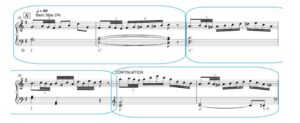
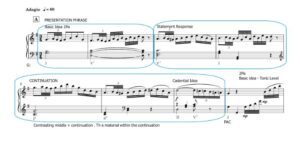
Bars 1–8 SENTENCE
Bars. 1–4: Presentation Function
- Basic Idea (Bars 1–2): A lyrical two-bar melody in the right hand over a subdued chordal accompaniment. See score “1Pa”
- Repetition of Basic Idea (Bars 3–4): A slightly varied restatement, still in G major. See score “Statement Response”
- This 4-bar unit sets up the chief melodic material in a typical “presentation” fashion: a 2-bar idea repeated to establish thematic identity, unfolded over a prolongational progression I-V-V-I.
Bars. 5–8: Continuation & Cadential Function
- Here, Haydn increases the surface rhythmic activity through a fragmentation of the Basic Idea, 1Pa, moving toward a cadence.
- By mm. 7–8, we get a cadential progression that leads to a PAC (Perfect Authentic Cadence) in G major at bar 8.
- These four bars fulfil continuation (heightened tension/motion) and cadential (closing) functions in Caplin’s sense.
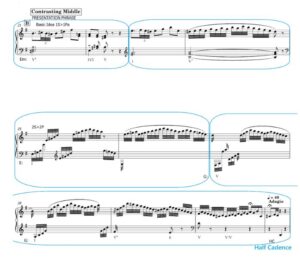
 Bars 9-17 Contrasting Middle
- Bars 9-14: Prolongational function
- Basic Idea (Bars 9-12): New motive (1N) on G major on a prolongational progression I-V V-I
- Sequential progression (Bars 13-16) The new motive is developed through an ornamented sequence in bars 13 and 14
- Deceptive cadence (Bar 15) a resolution on the vi degree of G major occurs in bar 15, making this E minor in first inversion the pivot chord to modulate to D major, dominant of G major, followed by a cadential 6/4
- Evaded cadence (Bar 18) an evaded cadence prolonged this section, that finally resolves in a
- PAC (Bar 20) in D major. Also could be considered as a Half Cadence (HC) becoming a retransition to repeat this First section, A.
2nd Section (B)
Bars 21-24: Presentation Phrase
- Basic Idea (Bars 21-22): Developmental motive based on the main motive 1S>1Pa in E minor (relative minor of the main key)
- 2S>2P (Bars 25-26) The Secondary motive derived from 2Pa (see bar 7) or 2S>2P is presented in E major
- Retransition (Bars 27-31) An expanded cadential progression is used as a retransition to the A section in G major, finishing with a half cadence (HC) in bar 31
3rd Section (A’)
Bars 32-35: Presentation Function
- Basic Idea (Bars 32-33): A lyrical two-bar melody in the right hand over a subdued chordal accompaniment. See score “1Pa”
- Repetition of Basic Idea (Bars 34-35): with slightly varied restatement, still in G major. See score “Statement Response”
- This 4-bar unit sets up the chief melodic material in a typical “presentation” fashion: a 2-bar idea repeated to establish thematic identity.
Bars 36-37: Continuation
- The continuation repeats the basic idea (1Pb) an octave higher, moving towards a dominant of the dominant (A7) in bar 37 using a fragmentation; that is, using the dominant level from bar 34
Bars 38-39:
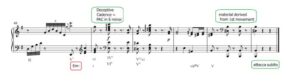
- In bars 38 and 39, a long ornamented passage starts on the dominant harmony of the main key, D major, increasing the rhythmic surface using demisemiquavers or 32nd notes, starting an expanded cadential progression in bar 39 until bar 42 in which Haydn resolves into a deceptive cadence on the vi degree, extending the end of the second movement.
- After the deceptive cadence there is an ornamented (by thirds) scalic passage falling to the B note, the dominant of E minor (the key of the next movement) preparing the harmonic path, now clarifying the intention to go towards the E minor key through this pedal on the highest note
Bar 45 to 49:
- In bar 45 we have another deceptive cadence, but now reinterpreted as a PAC in E minor in retrospective, starting a Coda on the dominant harmony
- Hayd uses the same device from the first movement, a three-note motive (repeated B major chords) to transition directly to the third movement. The performance direction “Attacca subito” means that the performer shouldn’t make any pause from the second movement to the third. This innovative aspect among movements denote Haydn’s cyclical sense, taking the Sonata form to another level of connection in a higher dimension.