
 TRIAL LESSON
Pianists, Piano Lessons
Paul Lewis pianist in London: Beethoven, Schubert and the Art of Serious Piano Listening
Jul
Paul Lewis pianist in London | Beethoven & Schubert
WKMT London Piano Journal
Paul Lewis pianist in London: Beethoven, Schubert and the Art of Serious Piano Listening
A cultured guide to Paul Lewis for London listeners, adult pianists and students who want to hear Beethoven and Schubert with clearer ears.
Quick summary: who Paul Lewis is
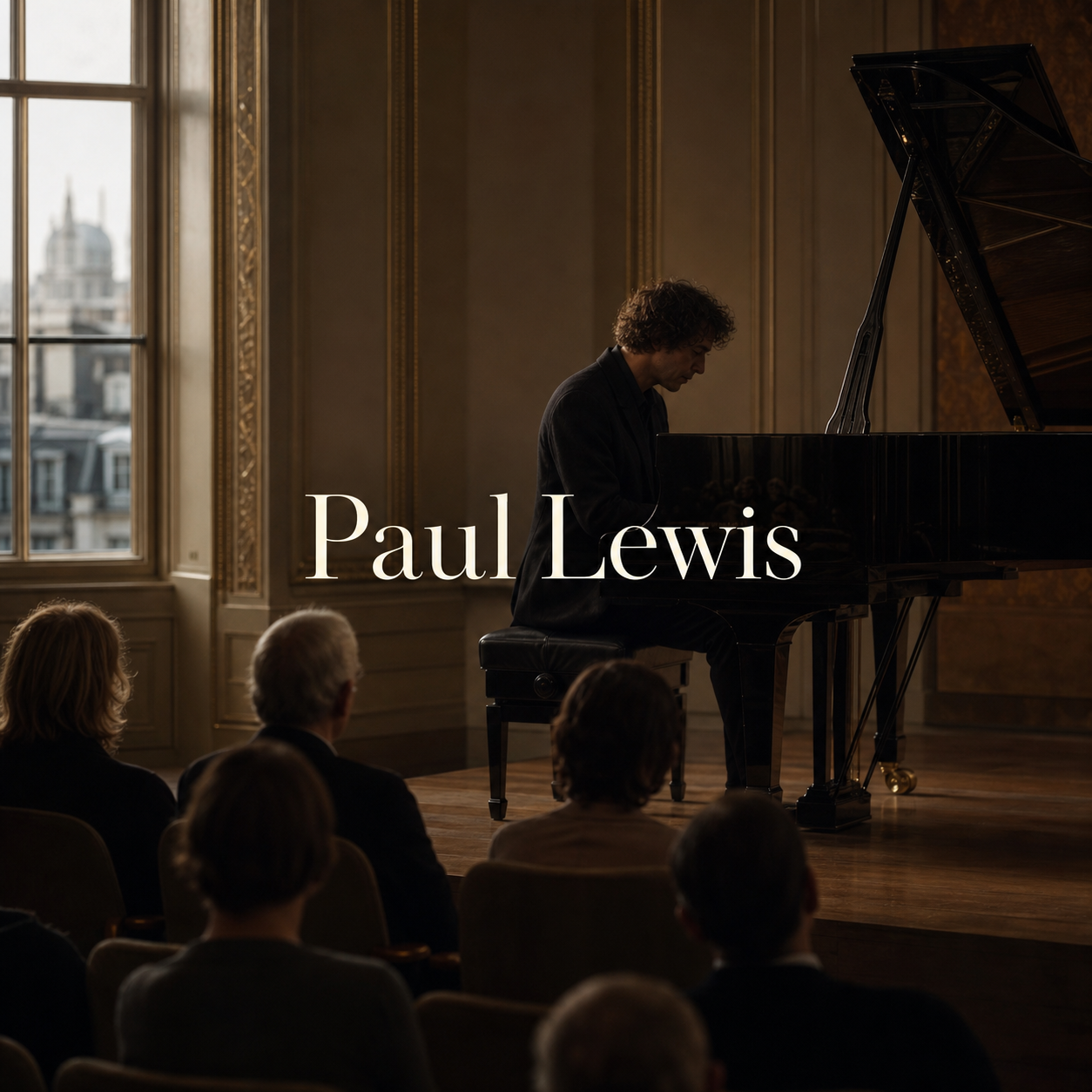
Paul Lewis is an English classical pianist, born in Liverpool in 1972, internationally admired for Beethoven, Schubert and the central European repertoire. His official biography records major awards, a CBE, honorary degrees, regular appearances with leading orchestras and a long association with harmonia mundi recordings [1].
Beethoven, Schubert, Brahms, Haydn, Mozart and Liszt.
Royal Festival Hall, BBC Proms, Guildhall training and repeated Wigmore Hall appearances.
Structural fidelity, tonal candour, patience and emotional proportion.
Why Paul Lewis matters to London audiences
London hears many virtuoso pianists; Lewis stands out because his authority rarely asks to be noticed. The public face of his career is prestigious enough: Royal Philharmonic Society Instrumentalist of the Year, Gramophone awards, Diapason recognition, a CBE, and concerto work with orchestras including the London Symphony Orchestra and Philharmonia [1][2]. Yet his deeper appeal is less decorative. He has built trust through long projects: complete Beethoven sonatas and concertos, late Schubert, song cycles with Mark Padmore, and carefully planned recital series.
That matters to a London listener because the city rewards concentration. A Wigmore Hall evening is not a stadium event; it asks the audience to notice weight, silence and transition. Lewis’s playing suits that space. Maestro Arts quotes The Times praising his fidelity to musical structure and inner spirit, a neat description of why his best performances feel deliberate without feeling dry [3].
He also offers an antidote to a common modern listening problem. Many recordings are consumed as highlights: a famous opening, a climactic return, a fast finale. Lewis makes better sense when heard as a whole argument. The shape of a sonata movement, the patience of a variation set, or the slow unfolding of a Schubert song can feel modest at first, then increasingly inevitable. That is why his work is useful for adult learners as well as concertgoers. It teaches the ear to value continuity.
Listen for the refusal to hurry expressive arrival. In Lewis’s Beethoven and Schubert, climaxes often feel earned by harmonic direction rather than imposed by volume.
Signature repertoire: Beethoven and Schubert
For many listeners, Paul Lewis pianist searches begin with Beethoven. His complete sonata set helped define his international profile, and his Beethoven concerto cycle has travelled widely. The official biography notes that he became the first pianist to perform the complete Beethoven concerto cycle in a single BBC Proms season in 2010 [1]. This is not a decorative statistic; it points to stamina, architectural memory and a feel for Beethoven as a complete world rather than a sequence of isolated showpieces.
Begin with a middle-period sonata if you want directness, then move to the late works. In the famous sonatas, listen for how Lewis separates dramatic pressure from theatrical exaggeration. The pulse is firm, but the rhetoric is not inflated. In the slow movements, notice how the left hand carries moral weight: bass direction, inner voices and harmonic colour tell the story before the melody declares it.
In Beethoven, that balance is especially important because the music can tempt pianists into constant assertion. Lewis’s strength is often the opposite: he lets a small rhythmic cell, a bass turn or a harmonic delay do the work. This does not make the playing small. It makes the rhetoric more trustworthy. The listener hears force because the structure demands it, not because the pianist has decided to manufacture grandeur.
Schubert asks a different kind of patience. Harmonia mundi records Lewis’s 2022-25 exploration of Schubert’s completed sonatas across around forty venues, and his discography includes the late piano works and the three great song cycles with Mark Padmore [2]. The Schubertian quality to hear is not softness; it is distance. A phrase may seem simple, then reopen from another angle. Lewis’s restraint lets those second thoughts speak.
For pianists, Schubert under Lewis’s hands is a lesson in proportion. The melody may look plain on the page, but the emotional difficulty lies in judging how long a sound should be allowed to remain alive. Too much pedal blurs the harmony; too little warmth turns the music into an exercise. The best listening exercise is to follow one repeated figure through a movement and ask how its meaning changes as the key, register and surrounding texture shift.
Discography highlights for a serious listener
Use recordings as preparation rather than background. The table below gives a practical route through the catalogue without turning listening into homework.
| Recording area | Why it matters | Listen for |
|---|---|---|
| Beethoven sonatas | The foundation of his public reputation. | Bass logic, clean rhetoric, tension without noise. |
| Beethoven concertos | A full concerto-cycle view of Beethoven’s public voice. | Dialogue with orchestra and long-range pacing. |
| Schubert sonatas | The late works show Lewis at his most inward. | Silence, modulation and emotional afterthought. |
| Songs with Mark Padmore | A lesson in pianistic listening, not accompaniment as background. | How the piano breathes with text and memory. |
| Brahms and Liszt | Shows weight and depth beyond the Beethoven-Schubert frame. | Dark colour, inner voicing and controlled resonance. |
How to listen: a guided evening at home
Set aside ninety minutes. Begin with one Beethoven sonata movement, preferably something familiar, and write down only three observations: pulse, bass line and the point at which the music changes temperature. Then hear a Schubert slow movement. Do not search for drama first. Follow the harmony as if it were a change in light across a room. Finally, listen to one song with Padmore and Lewis; notice how the piano carries scenery, weather and memory before the voice has finished explaining itself.
This method is valuable for adult pianists because it trains practical judgement. A good performance is not made from emotion alone. It depends on deciding when to release sound, when to keep tempo plain, and when a phrase should lean without becoming sentimental. Those decisions are also central to adult piano lessons at WKMT, especially for returning players who want musical authority rather than speed alone.
If you are preparing for a live recital, make the final listen shorter, not longer. Choose one movement from the programme and hear it twice: once for melody, once for bass. Then stop. A crowded listening plan can make the concert feel like a test. A focused plan gives you a few musical landmarks, leaving room for surprise when the pianist shapes a transition differently on the night.
Map the exposition, return or song stanza before judging the performance.
Ask how colour clarifies harmony rather than merely beautifying sound.
Notice whether pauses create thought, breath or tension.
Paul Lewis in London: Wigmore Hall, Proms and concert-day judgement
London is part of Lewis’s artistic biography. He studied with Joan Havill at the Guildhall School of Music and Drama before private study with Alfred Brendel [1]. His recital career includes London’s Royal Festival Hall, and the BBC Proms milestone gives his Beethoven profile a distinctly local stamp. For chamber-scale listening, Wigmore Hall remains especially relevant: its artist page lists recent and forthcoming Lewis appearances, including 2026 Schubert, Beethoven, chamber and solo programmes [4].
Details change, so concert planning should be checked at source. Last checked on 2026-07-11, Wigmore Hall listed a Paul Lewis solo recital on 21 May 2026 with Debussy, Mozart and Poulenc, tickets from GBP 18 to GBP 50 plus a booking fee, and a further London Mozart+2 event on 19 November 2026 [5]. For a first visit, arrive early, read the programme before the lights dim, and resist the temptation to over-prepare. One focused recording and one short biography will sharpen the ear more than a week of anxious listening.
The Wigmore habit is worth cultivating. Its scale changes how one hears piano sound: pedalling, voicing and the decay of a final chord become part of the experience. For Lewis, whose best effects often depend on control rather than display, that intimacy is useful. Sit where the whole instrument speaks rather than chasing a glamorous view of the keyboard. The point is not to watch technique; it is to hear decisions.
For students taking piano lessons in London, a recital by Paul Lewis is a model of artistic economy: fewer gestures, clearer structure, deeper listening.
Teaching, collaborations and what pianists can learn
Lewis’s training lineage matters without turning him into a museum exhibit. Joan Havill gave him a London conservatoire foundation; Alfred Brendel helped shape the long-view seriousness for which he is now known. Maestro Arts notes his chamber and song work, his Midsummer Music role, and his 2026-27 Mozart+ series, which places Mozart beside later composers to show influence rather than chronology alone [3].
For a pianist, the lesson is practical: build programmes that reveal relationships. A Beethoven sonata can prepare the ear for Schubert; Mozart can clarify Poulenc; a song cycle can teach pedalling and breath better than an etude. Teachers should use Lewis not as an idol but as a study in proportion.
At the piano, this means asking cleaner questions. Where is the phrase travelling? Which note in the chord carries expressive weight? Does the left hand support the melody or disturb it? Is the silence before a return tense, tender or merely empty? A mature interpretation often begins with these small distinctions. Lewis’s playing is useful because it makes them audible without turning them into slogans.
Study serious piano listening in London
WKMT helps pianists connect repertoire, tone and concert culture through structured one-to-one training and a classical London environment.
FAQ and sources on Paul Lewis Pianist In London
Is Paul Lewis best known for Beethoven? Beethoven is central to his reputation, but Schubert, Brahms, Haydn, Mozart and chamber work are also essential to understanding his artistry.
Where can London listeners hear Paul Lewis? Check Wigmore Hall, Southbank Centre, BBC Proms listings and the official Paul Lewis events page. Dates and ticket availability change quickly.
What can adult pianists learn from him? Clarity of structure, listening before playing, tonal discipline and the courage to let quiet music remain quiet.
- Paul Lewis official biography https://www.paullewispiano.co.uk/biography/
- harmonia mundi Paul Lewis artist page and discography https://www.harmoniamundi.com/en/artistes/paul-lewis/
- Maestro Arts Paul Lewis profile https://www.maestroarts.com/artists/paul-lewis
- Wigmore Hall Paul Lewis artist page https://www.wigmore-hall.org.uk/artists/paul-lewis
- Wigmore Hall Paul Lewis recital page