
 TRIAL LESSON
Uncategorized
Music and Maths: How Piano Helps Children Understand Pattern, Rhythm and Number
Aug
Music and Maths – Complete Guide
A parent’s guide to rhythm, pattern and number
Music and Maths: How Piano Helps Children Understand Pattern, Rhythm and Number
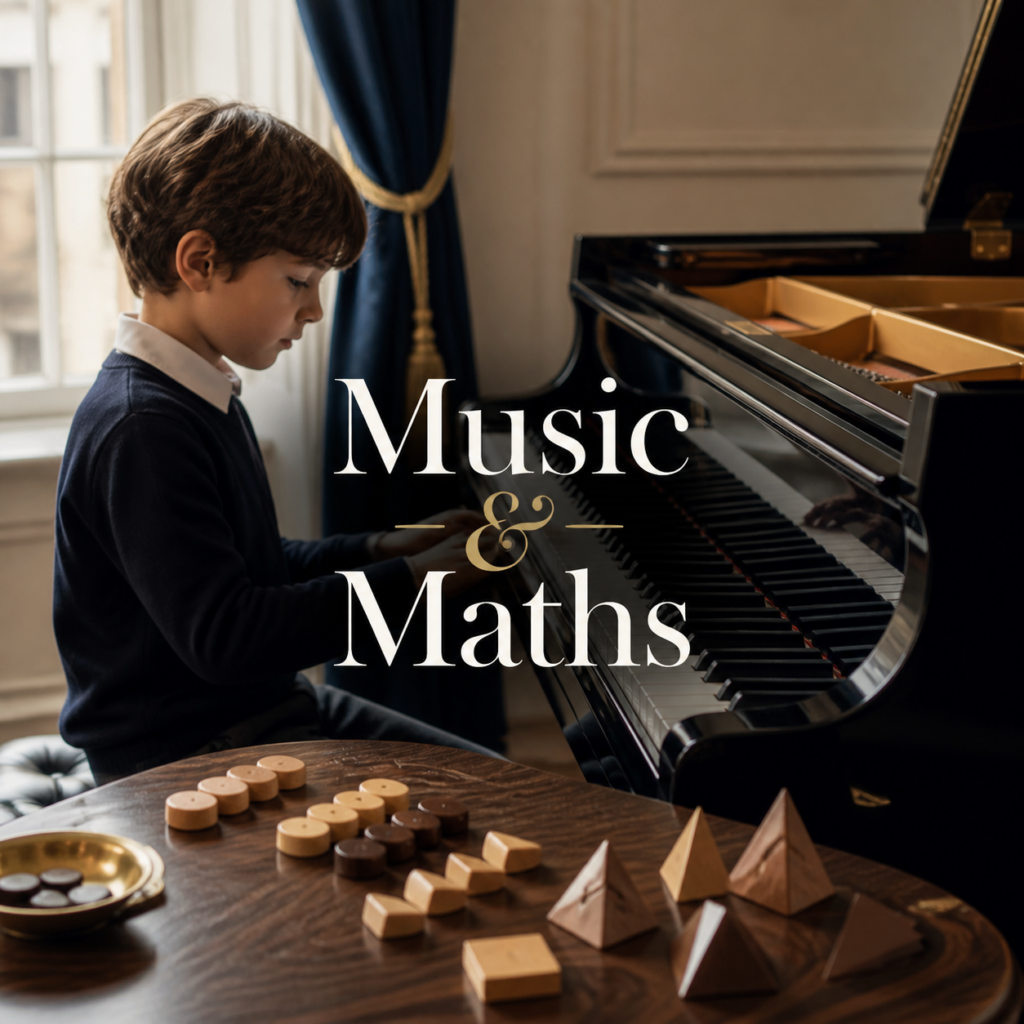
The keyboard makes several mathematical ideas audible and physical. That can enrich a child’s understanding, provided we distinguish a useful learning connection from the much larger claim that music lessons automatically improve maths grades.
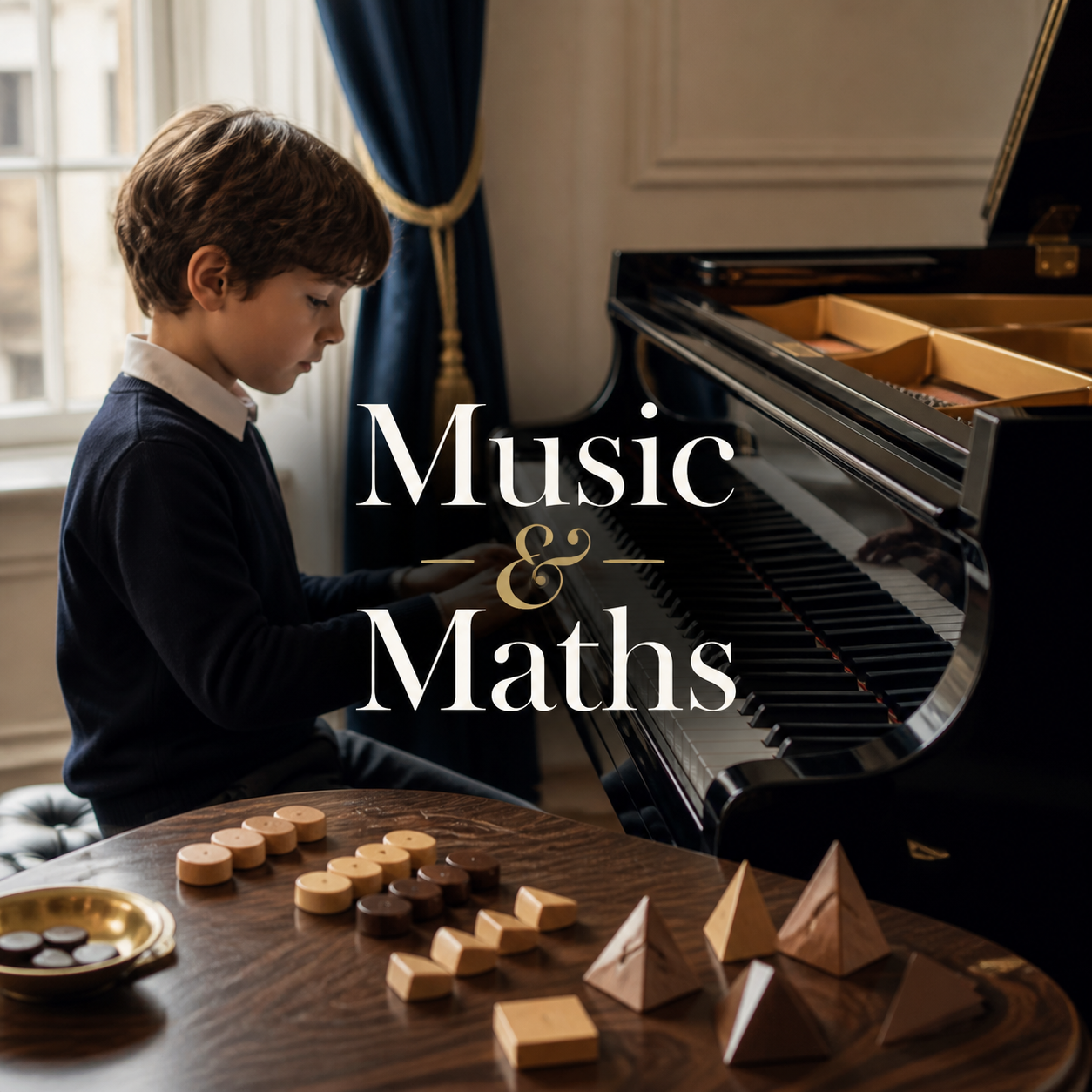
The short answer: piano study is rich in counting, grouping, proportion and pattern. These shared ideas can make maths more concrete, but ordinary instrumental tuition is not a substitute for mathematics teaching.
Why music and maths belong together
Music unfolds in time, and time must be organised. A steady pulse divides a minute into recurring units; a bar groups those units; a rhythm distributes longer and shorter sounds across them. Before a child names any mathematical relationship, the body can feel it through walking, clapping and playing.
At the piano, these relationships become unusually clear. The keyboard repeats the same arrangement of black and white keys. Scales follow ordered patterns of tones and semitones. A short motif can return unchanged, begin on another note or be extended. Young pianists constantly compare: higher and lower, longer and shorter, same and different, one hand against the other.
Four shared ideas
The important word is relationship. Music does not turn a melody into a worksheet. It gives a child another medium in which order, equality, division and proportion have consequences they can immediately hear.
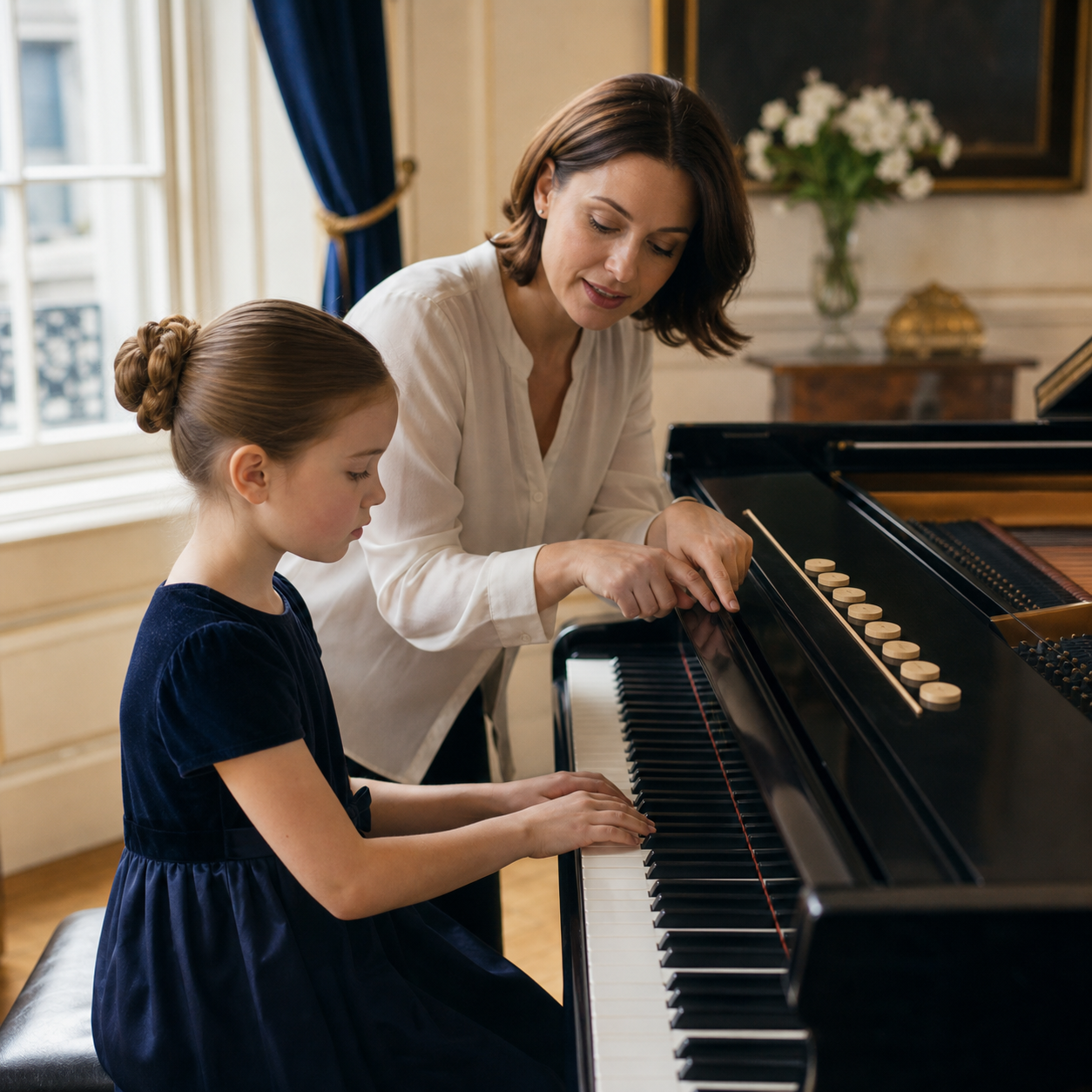
There is also a difference between recognising a pattern and explaining it. A very young pianist may know that a group of two black keys is followed by a group of three without having language for the rule. Later, the teacher can ask what repeats, what changes and what the pupil predicts next. That progression—from perception to description to deliberate variation—is valuable in both disciplines, even though the knowledge remains rooted in its musical setting.
What research on music and maths actually says
The evidence needs careful reading. A 2020 multilevel meta-analysis examined cognitive and academic outcomes from music training in children. Once study quality and active control groups were taken seriously, it found no convincing causal benefit for general mathematics attainment or other broad “far-transfer” outcomes. In plain English, learning an instrument should not be sold as a reliable way to raise unrelated test scores.
That does not make the educational connection empty. It changes the question. Instead of asking whether music produces a general intelligence boost, we can ask whether explicitly connecting musical and mathematical representations helps children understand a particular concept.
A small classroom study published in Developmental Science followed 77 nine-year-olds across three classes. Two groups learned fractions through integrated music-and-maths lessons using whole, half, quarter and eighth-note durations; a comparison group received ordinary fraction lessons. The strongest gains appeared when musical pieces, rhythmic activity and mathematical representations were deliberately joined. The sample was modest and classes, rather than individual pupils, were assigned to conditions, so the result is promising rather than definitive.
This distinction between near and far transfer is useful. Near transfer occurs when the new task closely resembles what has been practised: using note durations to reason about part–whole relationships is a plausible example. Far transfer would mean that instrumental study independently improves broad mathematical achievement. The conceptual distance is much greater, and evidence for that claim is substantially weaker. Parents can therefore welcome a specific bridge without turning it into a universal promise.
For parents
Choose piano for music. Value its discipline, expression and craft. Treat mathematical connections as a thoughtful teaching advantage, not a promised academic shortcut.
Recent research on executive function is also mixed in emphasis. A 2025 three-level meta-analysis reported small to moderate effects across some components of musical training, while the broader far-transfer review remains much more sceptical. Different inclusion criteria and study designs matter. The responsible conclusion is that focused musical tasks may practise attention, inhibition and working memory, but families should not assume a guaranteed effect on school mathematics.
How piano makes number, fraction and pattern tangible
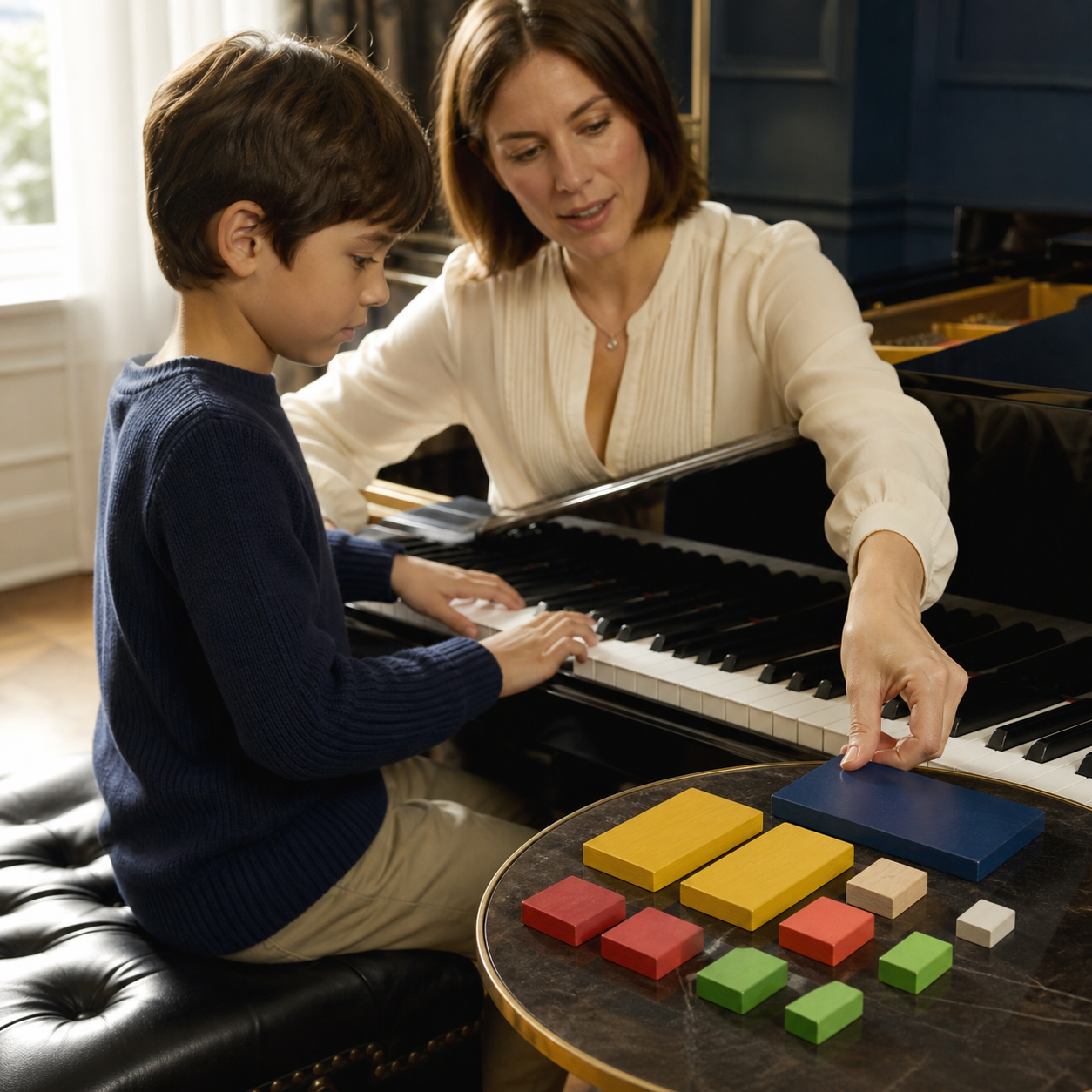
Consider a four-beat bar. Four crotchets fill it; two minims fill it; eight quavers fill it. The notation offers a vivid part–whole model, although musical note names should not be treated as a complete definition of mathematical fractions. A crotchet is a quarter of a semibreve in that familiar hierarchy, while its actual duration depends on tempo and context.
Subdivision is equally useful. A child who maintains a steady beat while placing two even sounds inside each beat experiences multiplication and division together: the number of beats remains stable, yet the number of events doubles. When the child returns to one sound per beat, the density halves.
| At the piano | Mathematical idea | What a child is doing |
|---|---|---|
| Keeping a pulse | Equal units | Maintaining consistent intervals |
| Filling a bar | Parts of a whole | Combining durations to meet a total |
| Playing a scale | Ordered pattern | Following and predicting a sequence |
| Transposing a motif | Invariant relationship | Preserving a pattern from a new starting point |
“The strongest bridge is not a clever analogy added afterwards. It is a child hearing that an ordered relationship has remained intact.”
Music and maths by age: realistic expectations
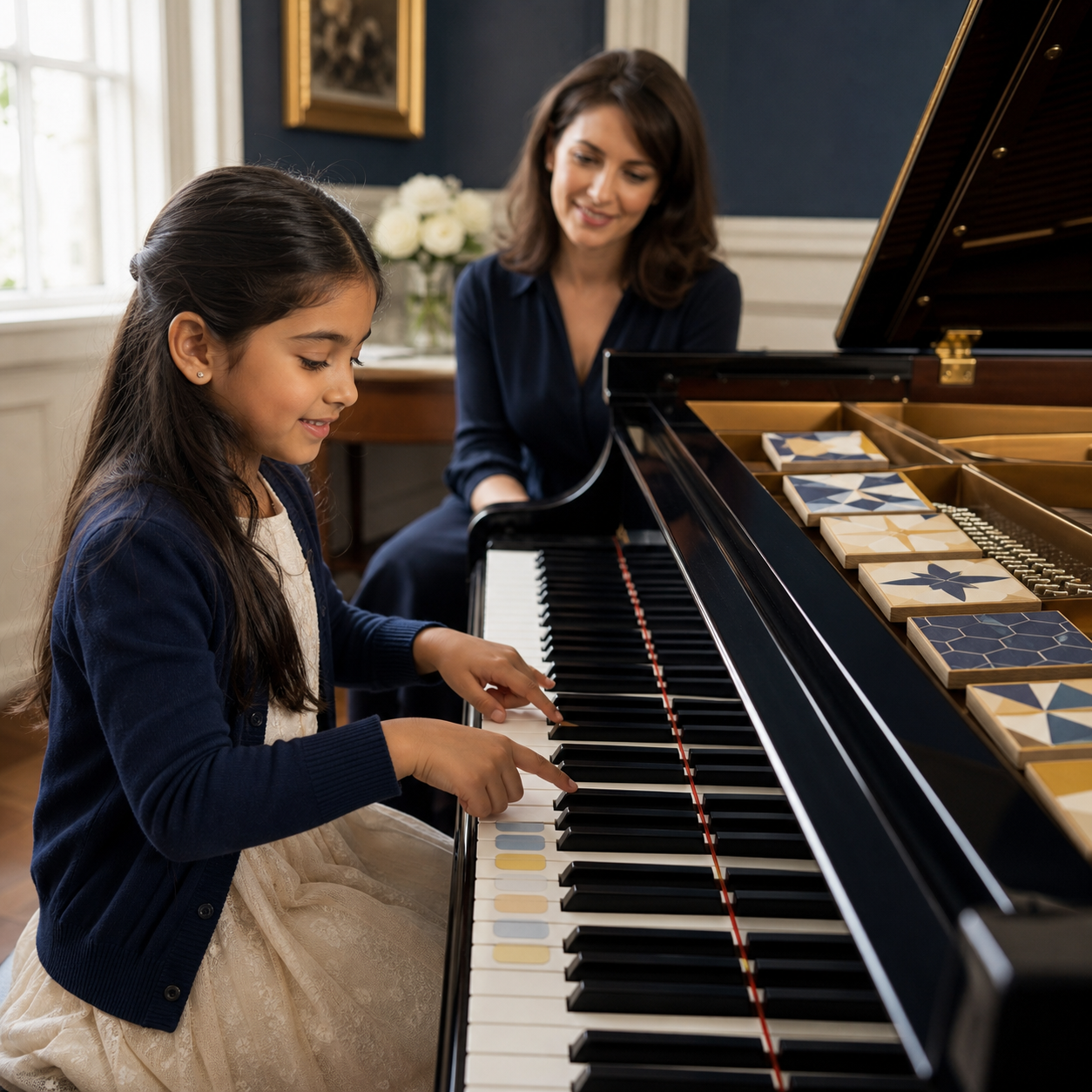
Ages three to five: the foundation is steady pulse, matching and small quantities. A young child may copy a two-sound pattern, stop and start with the teacher, or notice that two groups sound the same. The aim is not formal fraction language. It is one-to-one correspondence, reliable sequence and the delight of prediction.
Ages five to seven: children can connect symbols to actions more deliberately. Simple note values can support conversations about halves, quarters, doubling and grouping. England’s Key Stage 1 mathematics programme asks pupils to work with counting, simple fractions, patterns and measures; its music programme develops listening, playing and the organisation of sound. Piano offers a natural meeting place, while each subject retains its own teaching.
Ages eight to twelve: the palette broadens. Compound rhythms introduce different kinds of subdivision. Scales reveal repeating interval patterns. Chords can be compared by structure, and transposition tests whether a relationship survives a change of pitch. At this age, an explicit music-and-fractions link can be useful, especially when the teacher checks that the child understands the maths rather than merely memorising a musical rule.
Development is not perfectly tied to birthdays. Musical experience, confidence with symbols, motor coordination and school learning all affect what feels accessible. The best sequence follows observed readiness. A seven-year-old may reason fluently about rhythmic halves while still needing support to coordinate two hands; an older beginner may grasp proportion quickly but need time to establish pulse. Neither profile is a deficit. It simply tells the teacher where to begin.
Teacher’s note
A child who struggles with arithmetic should still be taught by an appropriate classroom or specialist practitioner. Piano can supply meaningful examples and confidence, but it should never be presented as therapy or remediation without suitable evidence and expertise.
Curriculum and graded exams: useful parallels, different goals
The national curricula for mathematics and music sit beside one another for good reason: both are substantial disciplines. The mathematics programme develops fluency with number, fractions, measure, ratio and algebraic thinking. The music programme develops performance, listening, composition, notation and understanding of pitch, duration, tempo and structure.
Graded piano study can reinforce organised progression. ABRSM and Trinity syllabuses assess musical performance and related musicianship, not school mathematics. Reading rhythms, noticing time signatures, maintaining tempo and responding to aural patterns nevertheless keep quantitative relationships active inside a musical purpose.
Parents interested in that route can read WKMT’s overview of UK music examination boards. For a focused explanation of pulse and metre, the article on steady beat, rhythm and tempo offers a useful second step.
Choosing children’s piano lessons that use the connection well
A good teacher begins with the child in front of them. For one pupil, counting aloud may clarify a rhythm; for another, movement or imitation may work better. Mathematical language should illuminate the music, not interrupt every phrase. Equally, musical metaphors should be checked against correct mathematical meaning.
Ask how a teacher develops pulse, reading and pattern recognition; how explanations change with age; and how progress is communicated without turning every lesson into a test. In London, practical consistency matters too. A manageable journey, a realistic home routine and a calm relationship with the teacher will do more for sustained learning than an impressive claim about cognitive benefits.
Listen for answers that are concrete but not rigid. A thoughtful teacher might describe how a pupil first internalises pulse, then reads increasingly varied rhythms, hears larger phrase structures and eventually analyses form. They should also be comfortable saying when a mathematical comparison has reached its limit. Precision builds trust: a note value can model proportional duration, but a musical performance still involves gesture, accent, tempo and expression that no fraction alone can capture.
WKMT’s structured piano lessons for children in London provide the primary pathway for families who want individual guidance. Parents may also find the broader article on music education benefits helpful when weighing musical, social and practical expectations.
Give pattern and rhythm a musical home
Explore a thoughtful lesson pathway for a young beginner, with musical development as the central purpose and age-appropriate connections introduced naturally.
Questions parents often ask
Will piano lessons improve my child’s maths grades?
There is no reliable basis for promising that result. Instrumental learning contains mathematical structures and may support particular concepts when the link is taught explicitly, but broad academic transfer is uncertain.
Are note values the same as fractions?
They can model part–whole relationships very effectively. The comparison has limits because musical duration depends on beat, tempo and notation context, so it should complement rather than replace formal fraction teaching.
What is the best age to introduce the connection?
It can begin informally in the early years through pulse, matching and repeated patterns. Fraction language becomes more useful when a child has the corresponding mathematical foundation, usually during primary school.
Sources on music and maths
- Sala and Gobet, “Cognitive and academic benefits of music training with children: A multilevel meta-analysis”, Memory & Cognition (2020).
- Azaryahu et al., “‘MusiMath’ and ‘Academic Music’”, Developmental Science (2020).
- “Boosting executive function in children aged 3–12 through musical training”, three-level meta-analysis (2025).
- National curriculum in England: mathematics programmes of study, Department for Education.
- National curriculum in England: music programmes of study, Department for Education.
- Piano syllabuses and graded pathways, ABRSM.
- Piano and keyboard syllabus information, Trinity College London.
Sources and time-sensitive syllabus links last checked 11 August 2026.