
 TRIAL LESSON
Piano Lessons
Music and Academic Performance: What Parents Should Know About Piano, Learning and School Results
Aug
Music and Academic Performance Guide
A clear evidence guide for parents
Music and Academic Performance: What Parents Should Know About Piano, Learning and School Results
Music and academic performance are often discussed as though one automatically improves the other. The research is more interesting, and more useful, when parents separate association from proof.
The short answer: music is education, not an academic shortcut
Children who learn instruments often achieve well at school. That pattern is real enough to deserve study, but it does not tell us why it appears. Families who can sustain lessons may also differ in income, parental education, school support, time and expectations. Children who already concentrate well may be more likely to continue music. Researchers therefore distinguish correlation, where two things occur together, from causation, where one produces the other.
The strongest conclusion is reassuringly modest. A good musical education gives a child musical knowledge, expressive skill, attentive listening, coordination and the experience of improving through guided practice. Those outcomes matter in their own right. Some habits may help elsewhere, but parents should be wary of claims that a weekly lesson will automatically raise marks in English or mathematics.
For families considering structured piano lessons for children in London, the useful question is therefore not “Will this improve every school subject?” but “Will this teaching help my child become an engaged, skilful and increasingly independent musician?”
Choose piano because your child can grow as a musician. Regard better study habits, confidence or academic engagement as welcome possibilities rather than promised outcomes.
What research on music and academic performance actually finds
A 2020 multilevel meta-analysis brought together 54 studies, 254 effect sizes and 6,984 children. When the authors accounted for the quality of study design, the estimated overall effect of music training on general cognitive and academic outcomes was essentially zero. Small positive effects appeared mainly in studies without random allocation and without an active comparison group. This is a powerful warning against turning attractive associations into universal promises.
Other research shows why the discussion remains open. A seven-year Hungarian study of 76 pupils found that early musical abilities predicted later school averages, with rhythm perception and reproduction explaining 11% of the variance in Grade 7 results. Yet a predictive relationship does not establish that lessons caused the later marks. The sample was small, and musical aptitude may travel alongside other advantages.
A longitudinal study following 250 primary pupils in China reached a similarly careful conclusion. Children receiving music training developed more strongly in music and showed an independent relationship with second-language performance. Music training did not independently explain later first-language or mathematics results once relevant factors were considered. These mixed findings are exactly why a balanced parent guide must resist sweeping claims.
“The fairest promise is musical progress. Wider educational transfer is possible, variable and difficult to isolate.”
Why positive associations still appear
Instrumental learning is a demanding activity. A child reads symbols, anticipates sound, coordinates two hands, listens for error, regulates tempo and remembers instructions. Piano adds a particularly visible pattern system: pitch moves across the stave and keyboard, rhythm is organised in time, and both hands carry related but independent material. These are rich learning experiences, even when they do not transfer neatly into examination scores.
Selection also matters. A 2023 UCL study compared changes in English and mathematics results from ages 11 to 16 for 701 pupils. Instrumentalists showed stronger change in mathematics, but not English, and the relationship varied with duration, instrument and socioeconomic status. The authors describe an association; observational data cannot fully remove the possibility that family resources, motivation or earlier attainment influenced both instrumental study and school results.
The Education Endowment Foundation rates arts participation as having a moderate average impact on attainment, while stressing substantial variation between approaches and a moderate evidence base. That category includes several art forms, not piano alone. It is useful context for schools, but it is not a personal forecast for an individual child.
| Claim | Best reading | Parent response |
|---|---|---|
| “Music improves grades” | Associations exist, but strong causal evidence for broad attainment is inconsistent. | Do not use marks as the sole measure of lesson value. |
| “Piano trains concentration” | It repeatedly exercises task-specific attention, listening and correction. | Notice whether focus within practice becomes steadier. |
| “A musical child is smarter” | Ability, opportunity, family background and training are difficult to separate. | Avoid labels; support the child’s actual interests and progress. |
The habits piano can genuinely cultivate
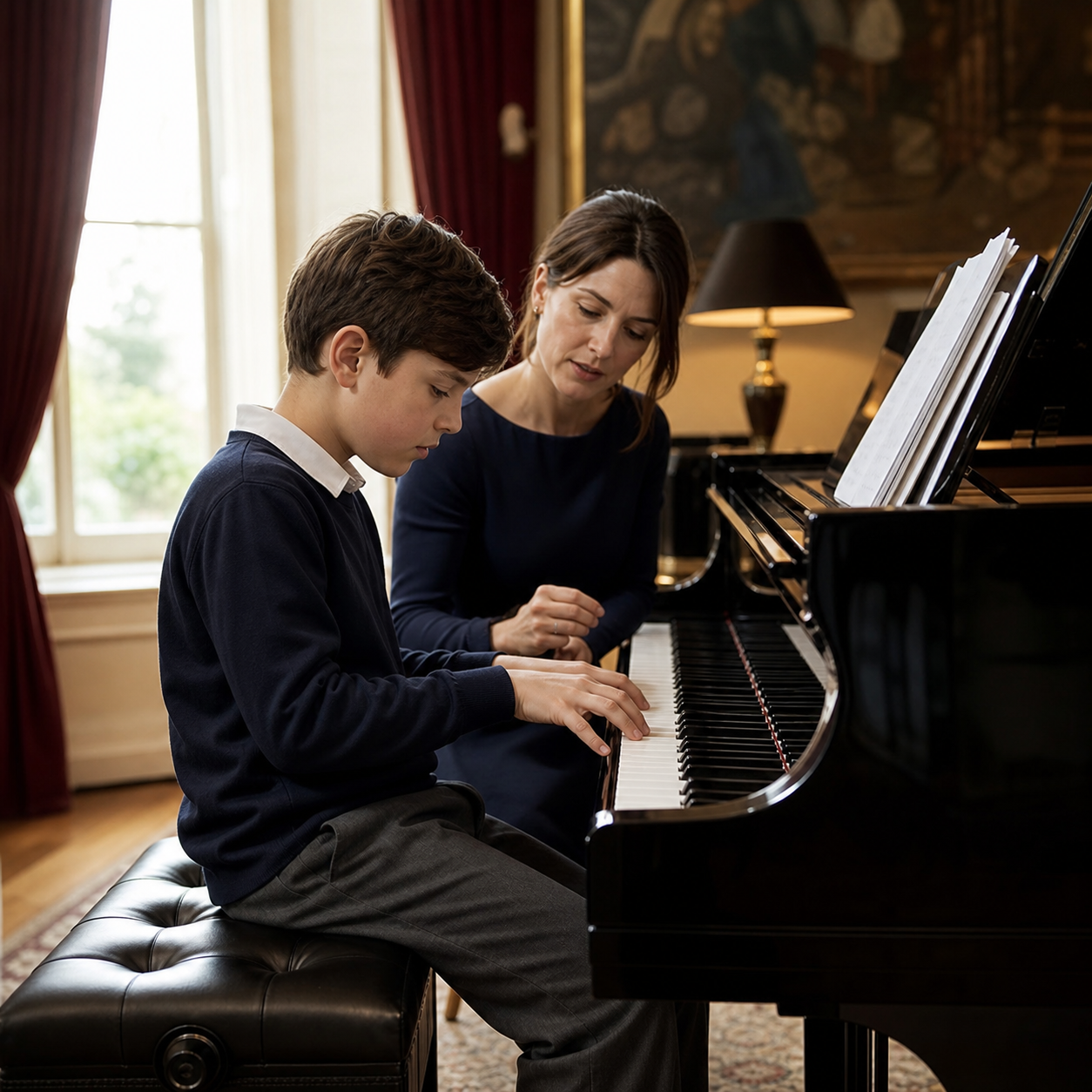
The most believable connections between piano and school life are not magical transfers. They are habits that a thoughtful teacher makes explicit. A pupil learns to divide a large piece into short sections, practise slowly, notice a precise error, change one variable and try again. That resembles effective learning in many subjects, but the child still needs guidance to recognise and reuse the habit elsewhere.
Name one small musical goal before beginning.
Listen for rhythm, tone or coordination, not vague “better playing”.
Change tempo, fingering or practice length in response to evidence.
Finish by identifying what improved and what comes next.
This cycle is close to metacognition: thinking about how one learns. It can support independence, particularly when the teacher asks concrete questions rather than merely prescribing repetition. WKMT’s guide to music and executive function explores related attention and self-regulation ideas, while the evidence cautions against claiming that one activity transforms every general capacity.
Transfer is most plausible when adults name it. “You solved that bar by slowing down and checking one detail; could the same method help with this difficult homework question?”
A routine that supports school rather than competing with it
Music should not become another source of household pressure. During busy school weeks, a short attentive practice can be more valuable than a long, resentful session. The appropriate length depends on age, experience, repertoire and concentration. Consistency matters, but rest and flexibility matter too.
Parents can help by protecting a predictable time, reducing distractions and asking about the musical aim rather than demanding a number of minutes. A younger beginner may work in several brief bursts. An older pupil can plan sections independently and keep a simple record of what needs attention. Before examinations or concerts, teacher and family should agree priorities so that piano, homework, sleep and recreation remain in proportion.
A practical routine begins with the school calendar. On a light evening, the child can explore new material; on a demanding evening, the goal might be one careful phrase, a scale pattern or listening through a piece. Weekend time can consolidate rather than compensate for missed weekdays. This prevents the familiar cycle of neglect followed by an exhausting session. It also teaches a truthful lesson about progress: regular, intelligent contact matters more than heroic last-minute effort.
Within WKMT’s wider approach to classical piano study in London, musical standards and humane pacing belong together. A teacher can preserve ambition while adjusting the route when school demands change.
Is practice purposeful, emotionally manageable and compatible with sleep and homework? If not, adjust the plan with the teacher. More pressure is rarely the only answer.
For practical ways to keep family support constructive, see WKMT’s piano practice tips for parents. The aim is a dependable learning environment, not surveillance.
How parents should measure progress
If grades are not a fair test of piano’s value, what should families notice? Begin with musical outcomes: a steadier pulse, more fluent reading, better listening, freer coordination, a richer sound and a growing ability to interpret a phrase. Then look at learning behaviours within music: starting without prolonged negotiation, recovering after a mistake, accepting feedback and completing a manageable plan. These indicators can be discussed at the end of each half-term, giving parent, pupil and teacher a shared picture of progress that is richer than a grade alone.
Academic changes should be observed cautiously over time. A child may become more organised or confident without a dramatic movement in school marks. Conversely, a high-achieving pupil may struggle musically and still gain something important from patient work. School achievement is shaped by subject teaching, prior knowledge, language, health, attendance, family circumstances and many other influences. Piano is one part of a child’s education, not a controlled intervention isolated from life.
Choosing lessons with realistic expectations
England’s National Plan for Music Education frames music as an entitlement: children should have opportunities to sing, play an instrument, create music together and progress in their interests. Ofsted likewise warns that justifying music chiefly through supposed benefits to other subjects can diminish the discipline itself. Those principles offer parents a sound basis for choosing tuition.
Ask whether the teacher sets age-appropriate musical goals, teaches healthy technique, explains practice clearly and communicates without exaggeration. A good first lesson should reveal how the child responds to rhythm, listening, keyboard geography and instruction. It should not promise a future examination result from the mere act of enrolling.
Explore a thoughtful start at the piano
WKMT’s private children’s lessons are adapted to age, concentration and musical readiness, with clear guidance for parents and a trial lesson before regular study.
A sensible conclusion on music and academic performance
The evidence does not support a simple promise that piano lessons raise grades. It does support something more durable: music is a complex field of knowledge in which children can learn to listen, coordinate, interpret, persist and express an idea. Some of those habits may accompany stronger academic outcomes, while study quality, family background and prior ability complicate the picture.
Parents do not need an inflated claim to justify music. Choose excellent teaching, protect a calm routine and evaluate the musical child in front of you. If better concentration or school engagement follows, welcome it. The central achievement remains the growth of an attentive, capable young musician.
Sources on music and academic performance
- Sala & Gobet, Cognitive and academic benefits of music training with children: a multilevel meta-analysis, Memory & Cognition, 2020 (checked 15 August 2026).
- Baker, Hallam & Rogers, Does learning to play an instrument have an impact on change in attainment from age 11 to 16?, UCL / British Journal of Music Education, 2023 (checked 15 August 2026).
- Józsa et al., Long-Term Impacts of Early Musical Abilities on Academic Achievement, 2022 (checked 15 August 2026).
- Yang et al., A Longitudinal Study on Children’s Music Training Experience and Academic Development, Scientific Reports, 2014 (checked 15 August 2026).
- Education Endowment Foundation, Arts participation (checked 15 August 2026).
- Ofsted, Research review series: music, 2021 (checked 15 August 2026).
- Department for Education and DCMS, The power of music to change lives: a national plan for music education, updated 2024 (checked 15 August 2026).