
 TRIAL LESSON
Pianists, Piano Lessons
Beatrice Rana in London: Sound, Structure and the Art of Serious Piano Listening

Jul
Beatrice Rana in London
WKMT London listening guide
Beatrice Rana in London: Sound, Structure and the Art of Serious Piano Listening
Beatrice Rana offers more than formidable technique. Her playing shows how colour, rhythm and large-scale architecture can remain alive at the same time, giving London listeners and serious pianists a particularly rich model of musical attention.

Quick facts: a pianist formed by curiosity
Rana began piano lessons at four and made an orchestral appearance at nine, playing Bach’s F minor keyboard concerto. Her formal development joined the long guidance of Benedetto Lupo with composition studies and later work with Arie Vardi in Hanover. The sequence matters because it helps explain a distinctive balance: the keyboard is never treated as a display surface alone. Harmonic direction and instrumental colour remain part of the same thought.[1]
International attention accelerated after first prize at the Montreal International Competition in 2011, followed by the silver medal and audience award at the Van Cliburn International Piano Competition in 2013. A BBC New Generation Artist appointment and a Borletti-Buitoni Trust fellowship followed. These milestones gave her broad platforms, but the musical identity had already become clear: muscular control, unsentimental lyricism and an appetite for works in which detail serves architecture.[1][7]
Great pianism does not ask us to choose between beauty and structure. It makes the beauty audible because the structure is understood.
Why Beatrice Rana matters now
Virtuosity is abundant in contemporary piano playing. What distinguishes Rana is the way she resists turning virtuosity into a single expressive category. In Prokofiev, attack can be incisive without becoming metallic. In Ravel, shimmer is carefully voiced rather than washed in pedal. In Bach, independent lines retain character while the span of a variation cycle remains perceptible. The listener hears both the grain of a phrase and its destination.
This is especially valuable for adult concertgoers. A dazzling passage may first register as velocity, yet Rana’s playing invites a second hearing: which voice carries the argument, where the harmony tightens, how the bass changes the direction, and why a return sounds altered after everything that has happened. Serious listening is not a test of specialist knowledge. It is the practice of noticing relationships.
Her precision also changes the emotional scale of a performance. When accompaniment figures are lucid, a melody does not need to be inflated to remain present. When the bass has direction, a climax can grow from harmonic pressure instead of extra volume. This restraint matters in an intimate London hall, where small differences of attack and release travel clearly. Rana’s playing often trusts the room and the score, allowing tension to accumulate without constant underlining.
A sound-world built from contrast
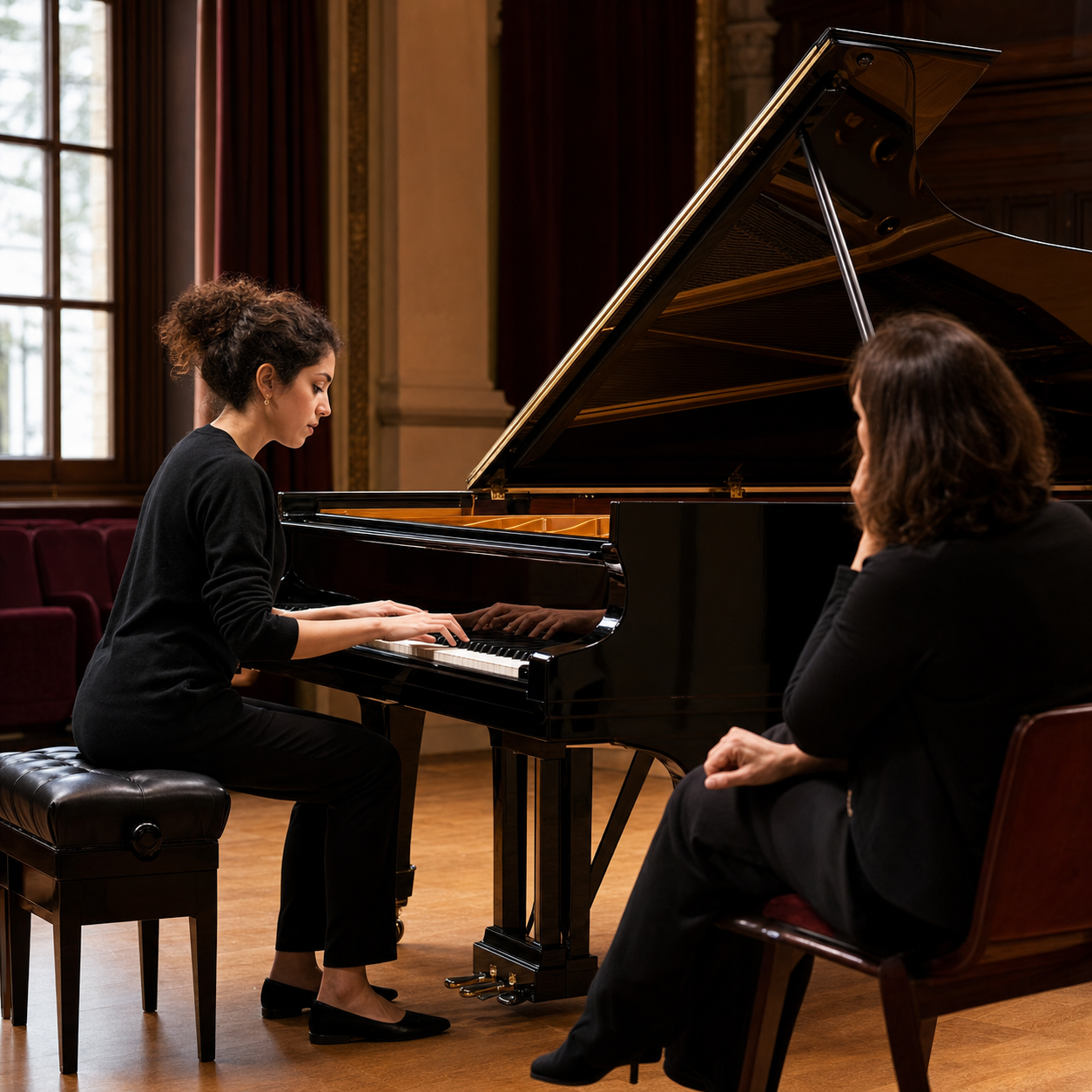
Rana’s discography makes an unusually clear listening curriculum. Her 2015 Warner Classics concerto recording paired Prokofiev’s Second Concerto with Tchaikovsky’s First, placing density, propulsion and lyrical release under pressure. The 2017 Goldberg Variations then revealed a more inward command: clean contrapuntal speech, rhythmic poise and a refusal to confuse seriousness with heaviness.[1]
The 2019 Ravel and Stravinsky album broadened the palette again. Miroirs asks the pianist to grade resonance with exceptional care, while La Valse, Petrushka and The Firebird require orchestral imagination from ten fingers. Warner’s album presentation rightly connects these works with early twentieth-century Paris, but the deeper link is pianistic: colour must be organised. A brilliant sonority that obscures rhythm or inner voices soon becomes anonymous.[5]
Her return to Bach in the keyboard concertos completes the circle. Rana has described Bach as music that outlives the technologies of its own period. On a modern piano, that means using weight, release and articulation to suggest different layers without pretending the instrument is a harpsichord. The result is not historical imitation; it is modern clarity informed by style.[6]
Listen, too, for the length of her gestures. In a lyrical passage, the important unit is rarely an isolated beautiful note. It may be a four-bar rise, a delayed resolution or a sequence whose intensity depends on each repetition arriving with a new shade. Rana’s control of voicing helps the ear retain those connections. One can admire the surface immediately, yet the performance grows more persuasive when heard as a chain of causes and consequences.
Beatrice Rana in London: a Wigmore Hall thread
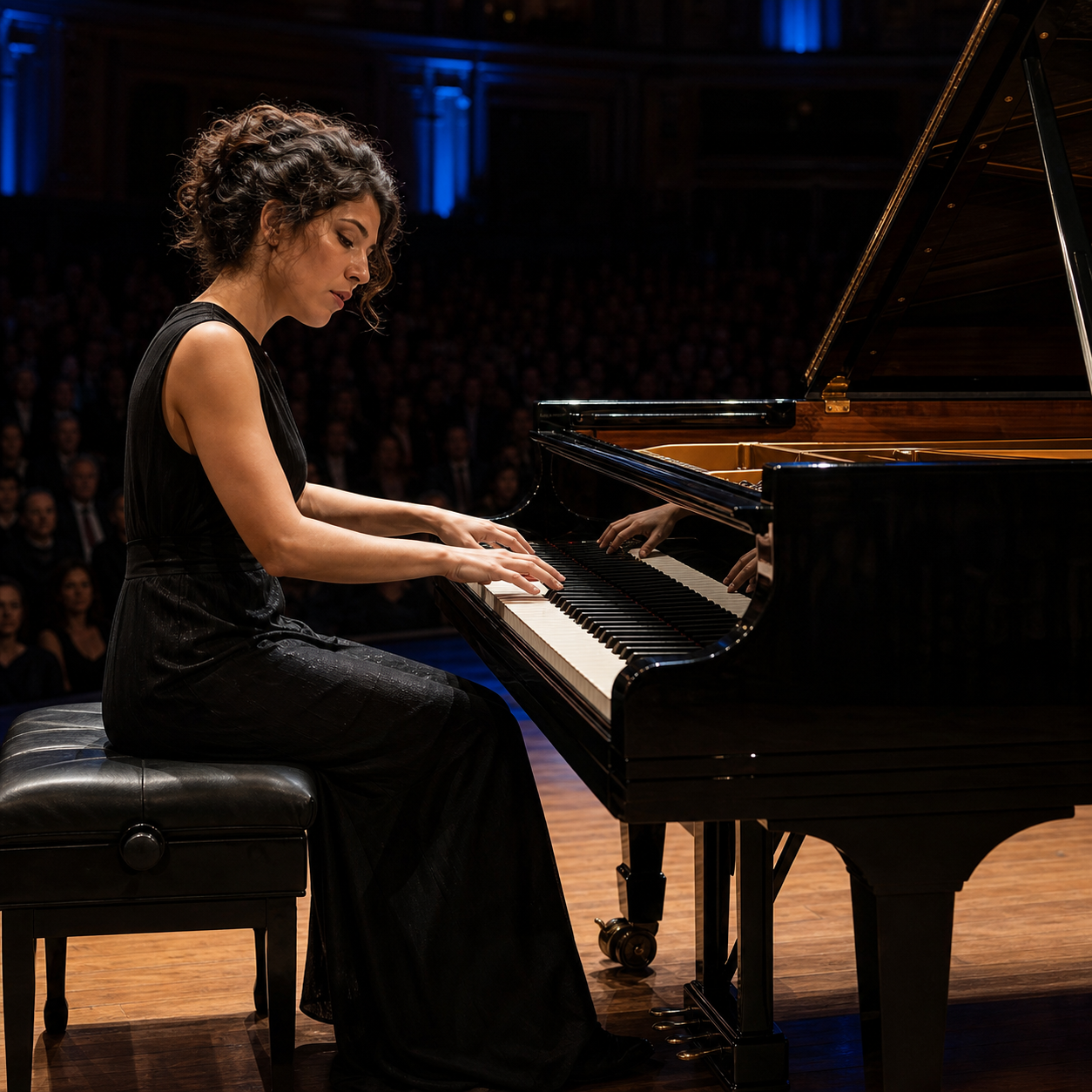
London has heard Rana across its principal concert spaces, including the Barbican, Royal Albert Hall, Royal Festival Hall and Wigmore Hall.[1] Wigmore Hall has been particularly revealing. The venue announced a Rana residency for its 2022–23 season, placing her among artists entrusted with sustained programming rather than a single appearance.[3]
A July 2023 concert linked to her ClassicheFORME festival paired Arensky’s First Piano Trio with Rachmaninov’s Symphonic Dances for two pianos. That programme showed another dimension of her musicianship: collaboration. Chamber playing exposes whether a pianist can listen while projecting, adjust colour to a string instrument, and keep a large form moving without dominating it.[4]
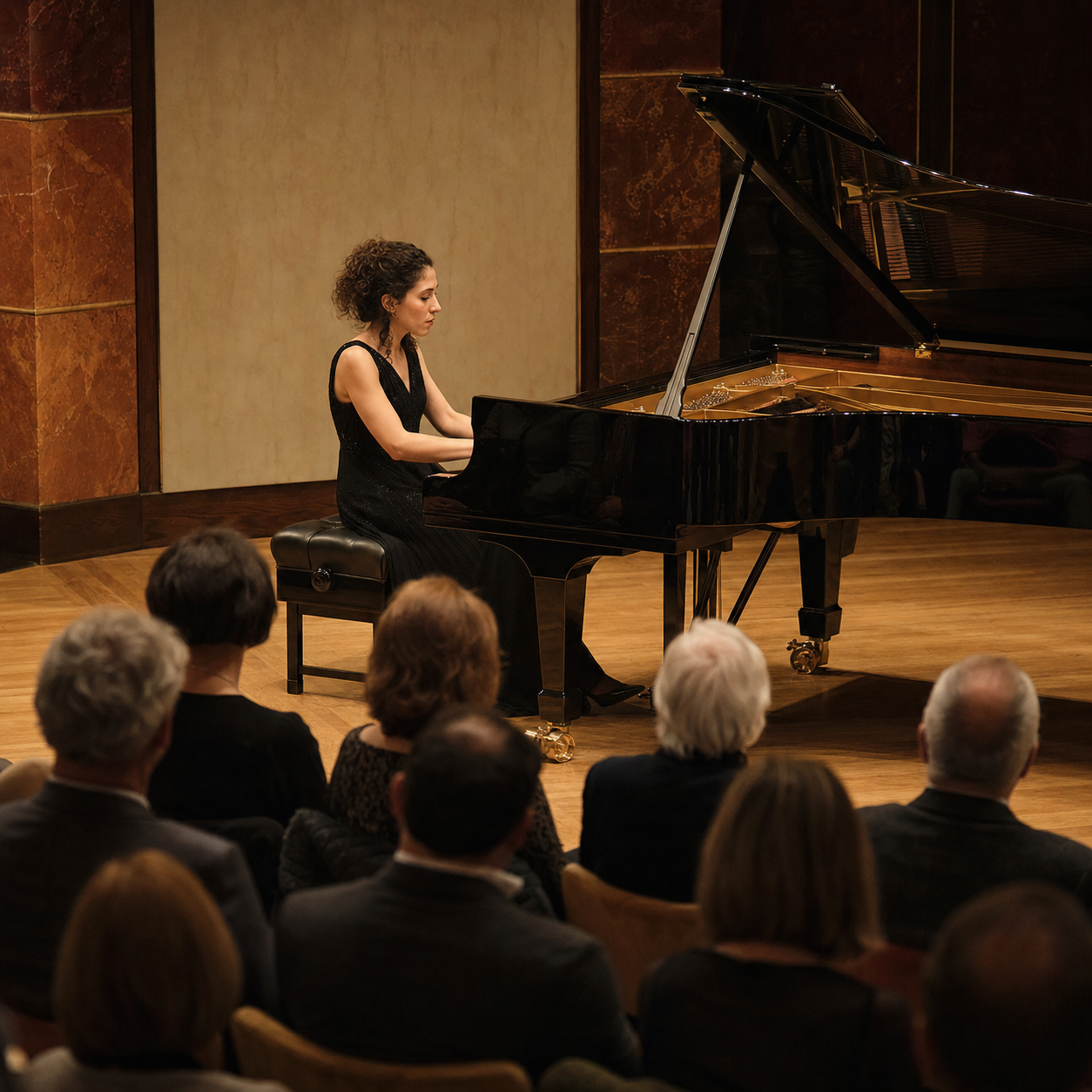
On 25 January 2026, her Wigmore Hall recital moved from selected pieces in Prokofiev’s Romeo and Juliet through Debussy’s second book of Études, Pletnev’s arrangement of The Nutcracker Suite and Prokofiev’s Sixth Sonata. The sequence joined character, sonority and wartime tension. It also made a compelling case for hearing virtuosity as dramatic pacing rather than speed alone.[2]
Concert schedules change, so readers looking for a future Beatrice Rana London appearance should use the artist and venue listings rather than recycled ticket pages. Wigmore Hall’s artist archive provides a reliable record of her appearances, while the Royal Festival Hall page gives current travel and access information. Details last checked on 24 July 2026.[2][8]
The London thread is useful because the city’s halls ask different questions of a pianist. Wigmore Hall rewards fine gradations and conversational detail. The Royal Festival Hall demands a broader projection across a large auditorium. The Barbican combines clarity with a more expansive acoustic, while the Royal Albert Hall tests long-range communication on a monumental scale. Rana’s presence across these venues confirms that her musicianship is not dependent on one type of room; balance and pacing adapt while the underlying priorities remain recognisable.
A five-pass listening framework
Choose one movement rather than an entire album. The point is not to manufacture a verdict but to hear more precisely on each return.
What emotional temperature is established before you analyse a detail?
Where does the beat feel stable, flexible or deliberately suspended?
Follow melody, bass and one inner line. Which one changes the meaning?
Notice how touch and pedal separate foreground from atmosphere.
After the ending, identify the moment that made the destination inevitable.
Use the framework without stopping the recording during the first pass. Continuity is musical evidence: it tells you whether a detail belongs to a local effect or to the shape of the whole movement. On later passes, note one or two moments rather than producing a running commentary. A single change in bass direction, pedalling or articulation may explain an entire transition. Finally, listen once more without the checklist. The aim is fuller experience, not permanent analysis.
Where to begin with the recordings
| Recording | Listen for | Best starting question |
|---|---|---|
| Bach: Goldberg Variations | Independent voices and cumulative pacing | How does each variation remember the aria? |
| Prokofiev: Piano Concerto No. 2 | Rhythmic force, density and long crescendos | Where does weight become direction? |
| Ravel: Miroirs | Layered resonance and transparent voicing | Which line remains clear inside the pedal? |
| Bach: Keyboard Concertos | Articulation, ensemble exchange and balance | Who leads, and how quickly does leadership change? |
What serious pianists can learn
The practical lesson is not to copy a surface sound. Rana’s tone depends on instrument, hall, repertoire and musical intention. The transferable habit is to connect every technical choice with a listening purpose. Practise a melody with the accompaniment barely touched, then reverse your attention and hear the bass as a line. Remove pedal long enough to test finger connection. Restore it only when you know which resonance the harmony needs.
For returning adults, this can be liberating. Progress is no longer measured only by tempo or repertoire difficulty. A modest passage becomes advanced work when balance, timing and harmonic direction are consciously heard. That is one reason adult piano lessons at WKMT can move naturally between technique and interpretation: the ear decides what the hand must learn.
Try one further experiment at the keyboard. Play a phrase at half volume while preserving its direction, then repeat it at full tone without allowing the accompaniment to thicken. If the line disappears when the volume drops, the problem may be voicing rather than confidence. If it becomes rigid when the volume rises, the body may be adding effort that the musical idea does not require. These small tests turn admiration for a concert artist into useful, personal study.
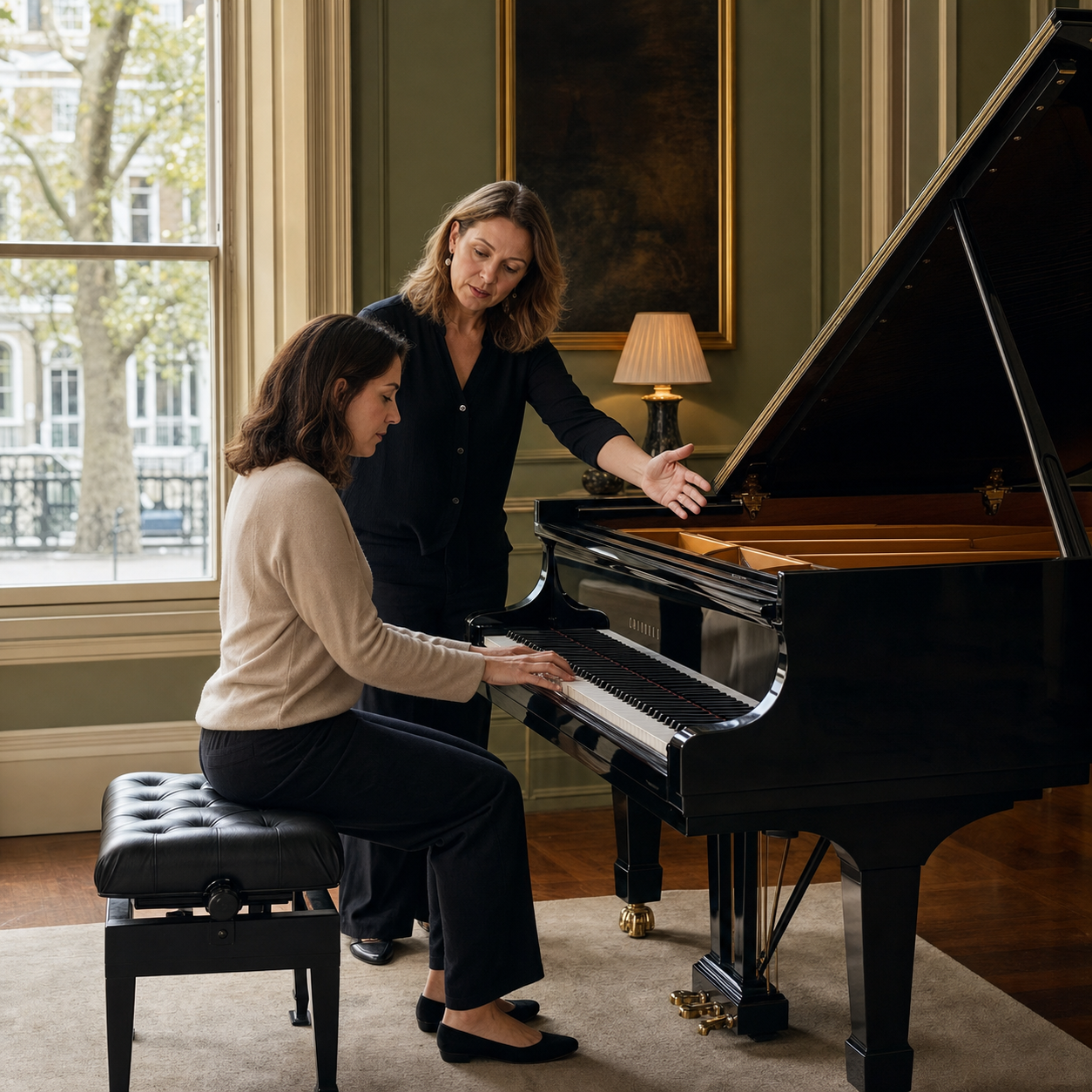
Turn close listening into confident playing
WKMT connects classical repertoire, technical clarity and interpretation through focused piano study in London.
Questions and sources about Beatrice Rana in London
How do you pronounce Beatrice Rana?
In Italian, Beatrice is approximately “beh-ah-TREE-cheh”, with Rana close to “RAH-nah”.
Which Beatrice Rana recording is best for a first listen?
Start with Miroirs for colour, the Goldberg Variations for counterpoint, or Prokofiev’s Second Concerto for scale and rhythmic power.
Where has Beatrice Rana performed in London?
Her official profile lists Wigmore Hall, the Barbican, Royal Albert Hall and Royal Festival Hall among her London venues.[1]
- Warner Classics: Beatrice Rana artist profile and releases
- Wigmore Hall: Beatrice Rana recital, 25 January 2026
- Wigmore Hall: 2022–23 season and residency announcement
- Wigmore Hall: ClassicheFORME concert, 9 July 2023
- Warner Classics: Ravel and Stravinsky album
- Warner Classics: Bach Keyboard Concertos
- Borletti-Buitoni Trust: 2016 fellowship announcement
- Southbank Centre: Royal Festival Hall visitor information