
 TRIAL LESSON
Piano Lessons
Music and Social Skills: What Children Learn Around the Piano
Aug
Music and Social Skills
Children, music and human connection
Music and Social Skills: What Children Learn Around the Piano
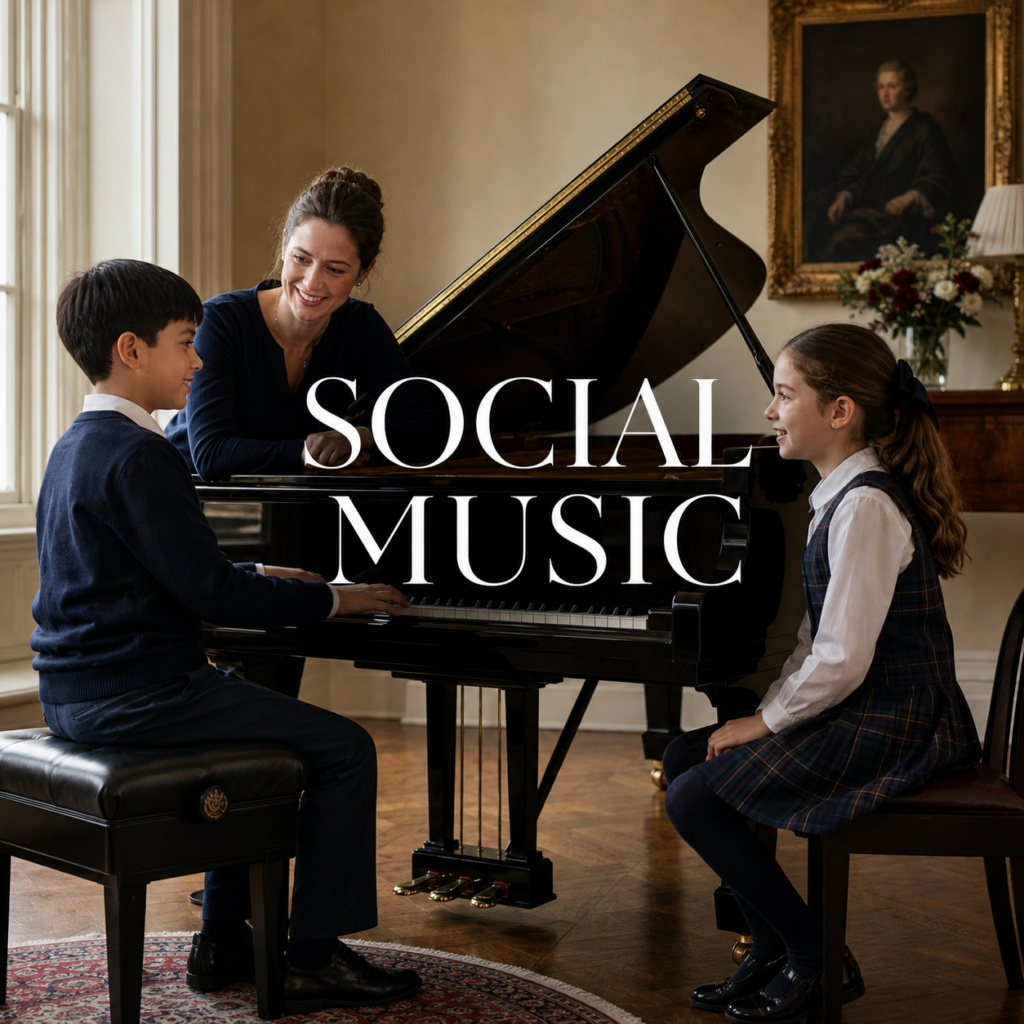
Piano study is usually described in musical terms. Yet a thoughtful lesson also asks a child to listen, wait, respond, recover and communicate: small social acts that give music its life. Guide on Music and social skills.
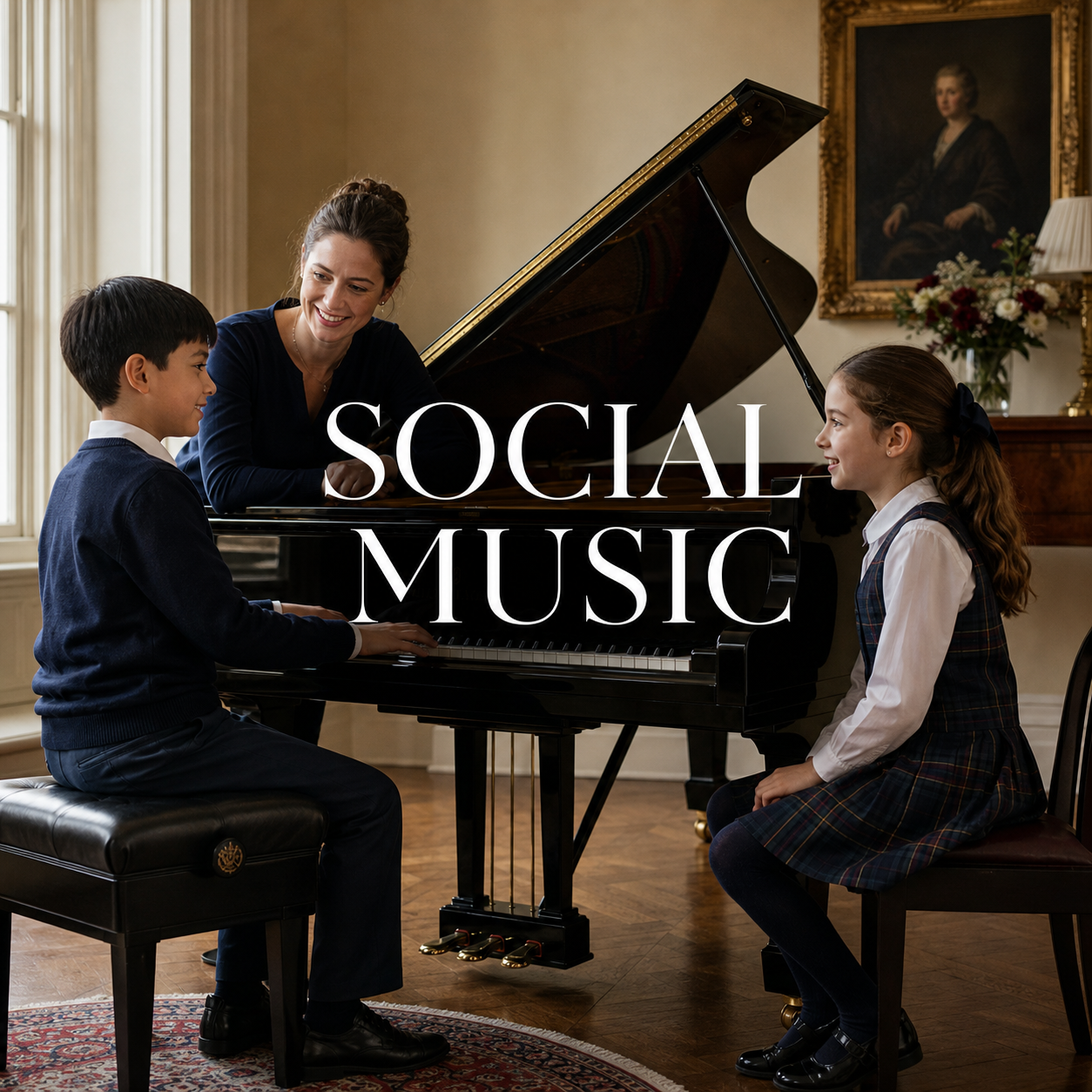
Music and social skills meet whenever a child notices another person’s timing, makes room for a response or adjusts a phrase after listening. These abilities are not automatic rewards for owning a piano. They emerge when musical study is relational: when a teacher models attentive exchange, a parent supports without taking over, and performance is treated as communication rather than display.
Research gives parents reason for interest, but also reason for care. Studies link shared music-making with synchrony, empathy, cooperation and social bonding, while results vary by programme, age and measurement. Music should not be sold as a guaranteed route to a more sociable child. Its value is subtler and more useful: it creates repeated, meaningful situations in which children can practise social attention.
What the research actually suggests
A 2023 review of early social communication through music describes singing and rhythmic interaction as powerful forms of caregiver-child exchange. Musical timing helps partners coordinate attention and emotion before children can explain those processes in words. The review is broad, covering infancy and specialised contexts, so it should not be reduced to a promise about piano grades. Its central insight is nevertheless relevant: music is inherently interactive when people shape timing and expression together.
Experimental and observational studies point to several possible mechanisms. Shared pulse can produce synchrony, the experience of coordinating in time. Musical games require turn-taking. Duets make each player monitor another line. Group activity can create belonging. A 2025 study of pairs of primary-school children found a relationship between musical synchrony and empathy, while earlier work has associated group music lessons with aspects of sociability. Other longitudinal research has produced mixed results, reminding us that teaching design and the child’s wider environment matter.
Four social movements inside music
Notice the teacher, partner, pulse and emotional character.
Hold an idea until there is space for it.
Shape sound in relation to what was heard.
Recover together when timing or communication slips.
Turn-taking begins with a musical phrase
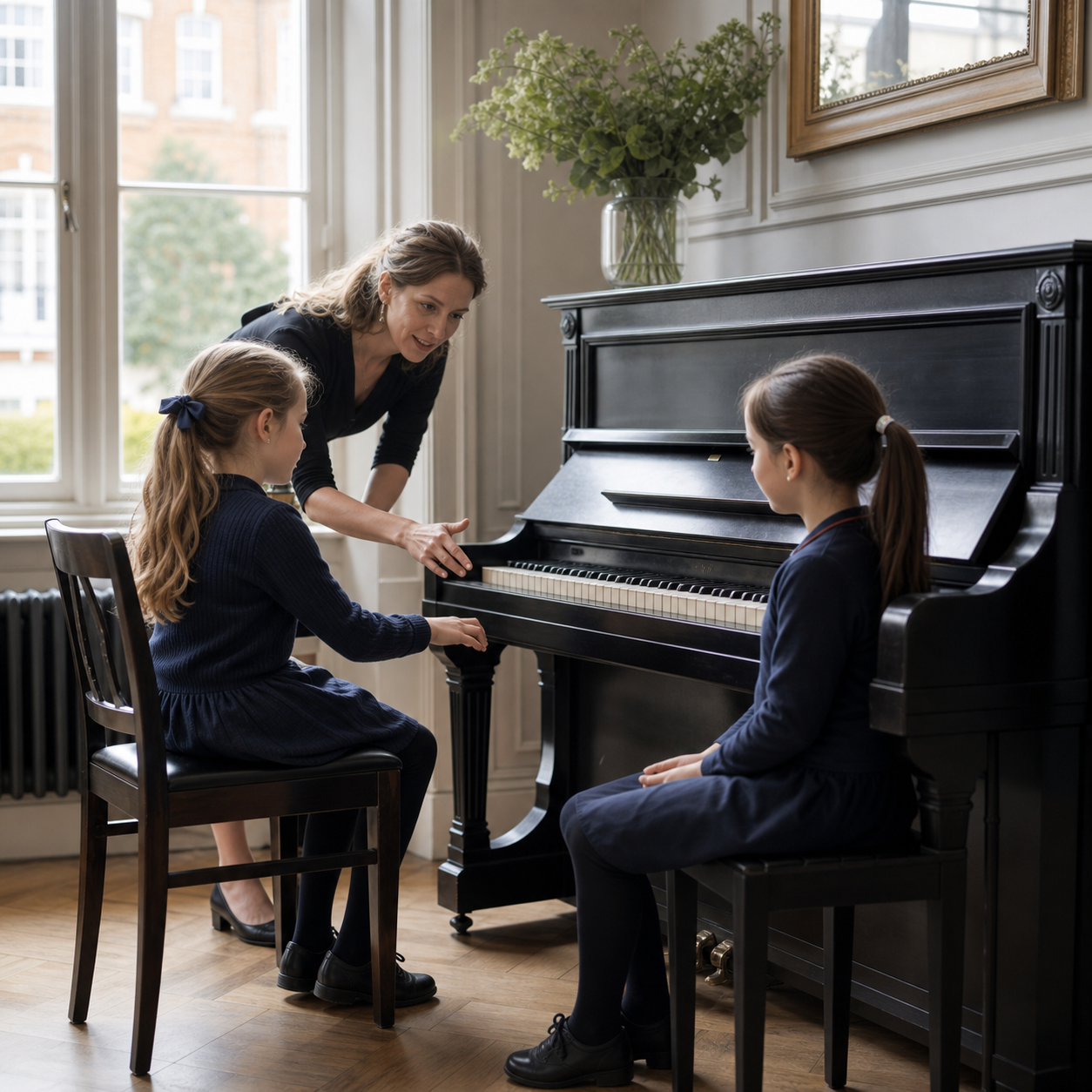
A teacher plays two bars; the child answers. One child completes a phrase; another begins. These modest exchanges make conversational structure concrete. The pupil must resist entering too soon, remember what has just happened and offer something that belongs to the same musical world.
At the piano, turn-taking can be built into an ordinary lesson without turning it into a game detached from musical quality. Teacher and pupil might trade a rhythm on one note, alternate the bass and melody of a duet, or take turns judging whether a cadence feels complete. The point is not mere obedience. The child learns that listening changes the next action.
This is also where frustration can become productive. If a duet loses its pulse, neither player can repair it by pretending the other person is not there. They must stop, locate the shared beat and begin again with clearer preparation. The musical error becomes a safe rehearsal for a wider social truth: repair matters more than avoiding every misunderstanding.
A socially alert musician does not simply wait for a turn; they use the waiting to understand what the music needs next.
Shared attention: teacher, child and parent
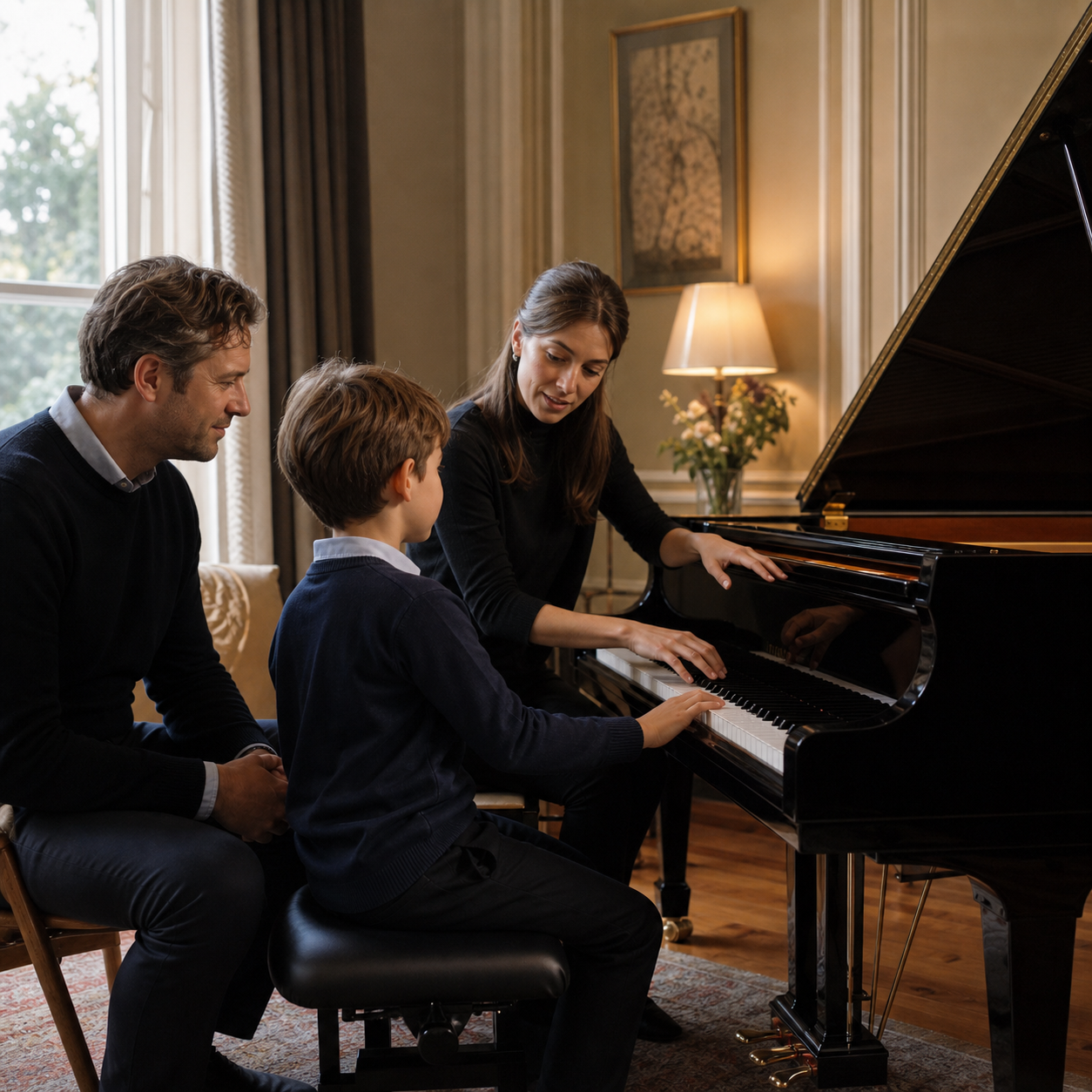
Young pupils often learn inside a triangle of relationships. The teacher sets a musical task, the child experiments, and the parent helps the routine survive between lessons. When that triangle is balanced, it can support autonomy and trust. The adult’s role is to make attention possible, not to provide every answer.
For families considering structured piano lessons for children in London, it is worth asking how a teacher manages this relationship. Do they address the child directly? Can they make correction feel specific rather than personal? Do they show parents how to support practice without turning the home into a second classroom?
Shared attention is especially visible when everyone listens to one detail: the end of a phrase, the balance between hands, or the silence before an entry. The child experiences adults cooperating around a musical question rather than competing for control.
Parents can protect this atmosphere at home by asking open, audible questions. “Can you show me where the phrase changes?” invites explanation; “Why have you forgotten that again?” closes it down. A child who learns to describe a difficulty is developing musical self-awareness, but also the ability to seek help without surrendering responsibility.
How social demands change with age
| Stage | Musical situation | Social capacity being rehearsed |
|---|---|---|
| Early years | Copying pulse, singing and answering tiny phrases | Shared attention, imitation and accepting a simple boundary |
| 5–8 | Duets, lesson dialogue and first performances | Turn-taking, listening and recovering from mistakes |
| 9–12 | Ensemble entries, interpretation and peer feedback | Cooperation, perspective-taking and quiet leadership |
| Teen years | Independent rehearsal and public performance | Responsibility, self-advocacy and respect for other performers |
Age bands are guides, not deadlines. A musically confident ten-year-old may still need help waiting for feedback; a shy six-year-old may listen with remarkable sensitivity. Good teaching responds to the pupil in front of the instrument rather than forcing a developmental script.
From private lesson to ensemble awareness
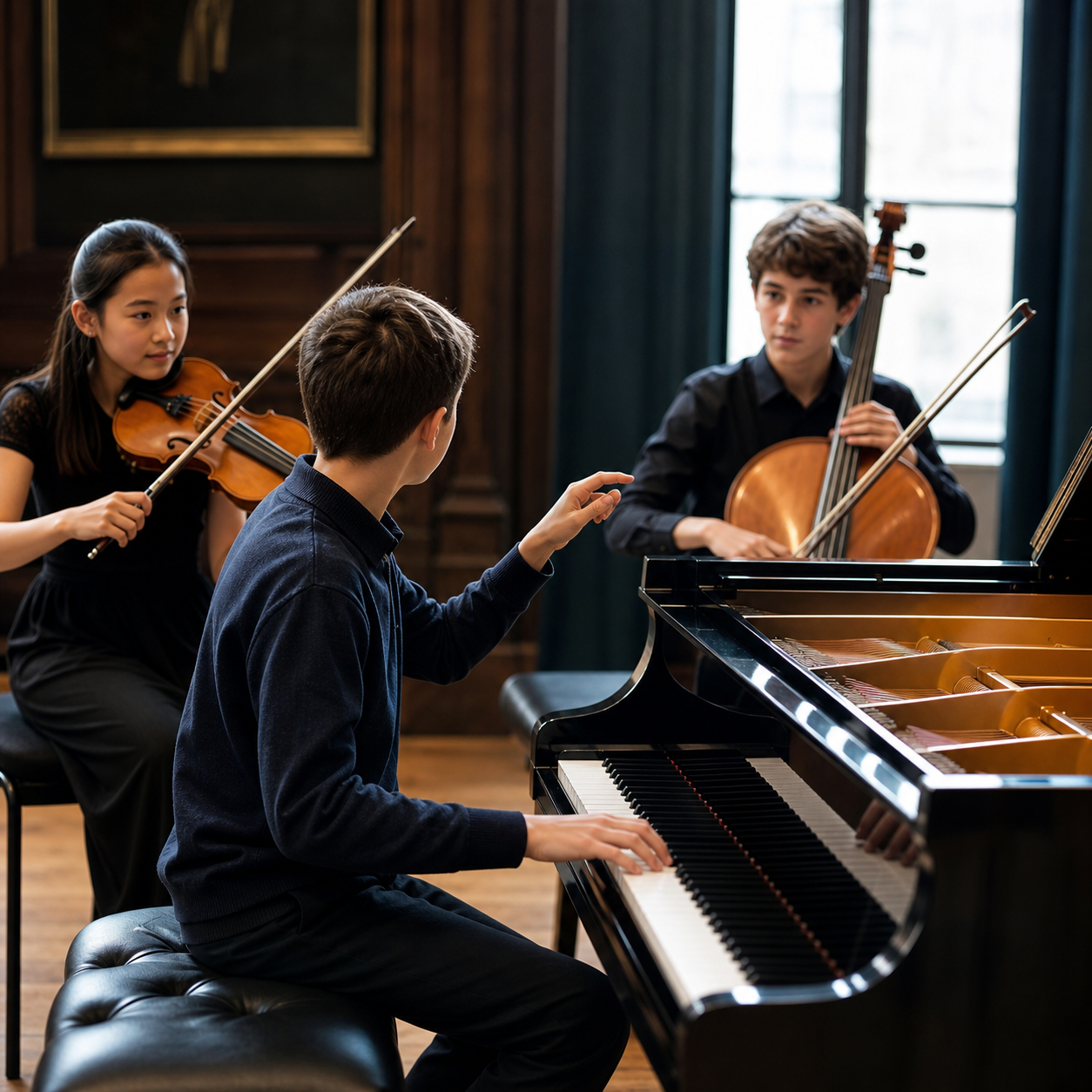
One-to-one piano study is not the same as group music, yet it can prepare a child for it. Duets with the teacher, accompaniment, performance classes and student concerts ask the pianist to hear beyond their own part. The keyboard is particularly revealing because it can carry rhythm, harmony and melody at once; a young pianist quickly discovers that playing more loudly is not the same as leading well.
Accompanying is especially valuable. The pianist must notice breathing, allow another player space and keep going when a partner takes an unexpected amount of time. Even a four-hand arrangement can introduce these habits. The lower player may have to provide steadiness; the upper player may shape melody without rushing. Each role matters, and neither makes musical sense in isolation.
Research on group music cannot simply be transferred to every private lesson. A solitary practice routine may develop concentration without directly rehearsing cooperation. The social potential appears when individual work leads back into exchange: playing for someone, accompanying, discussing an interpretation or hearing a peer with generosity.
Parents looking for practical guidance can also consult WKMT’s piano practice advice for parents and its discussion of music and confidence in children. Confidence is most valuable when it supports participation, not when it demands constant visibility.
What parents can notice without turning childhood into a test
Social growth is easily spoiled when every interaction becomes evidence to collect. Instead, watch for small changes across months. Does your child tolerate another person’s musical idea for longer? Can they accept a correction and remain engaged? After a recital, can they name something they enjoyed in another pupil’s playing? Do they begin to offer help without taking over?
None of these behaviours should be attributed to piano alone. School, siblings, temperament and ordinary maturation all contribute. The lesson gives families one clear setting in which attentive habits can become visible.
- Listen for: fewer interruptions and more specific responses.
- Watch for: a steadier recovery after a shared mistake.
- Encourage: appreciation of peers without comparison.
- Avoid: using performance confidence as proof of sociability.
Performance as communication, not ranking
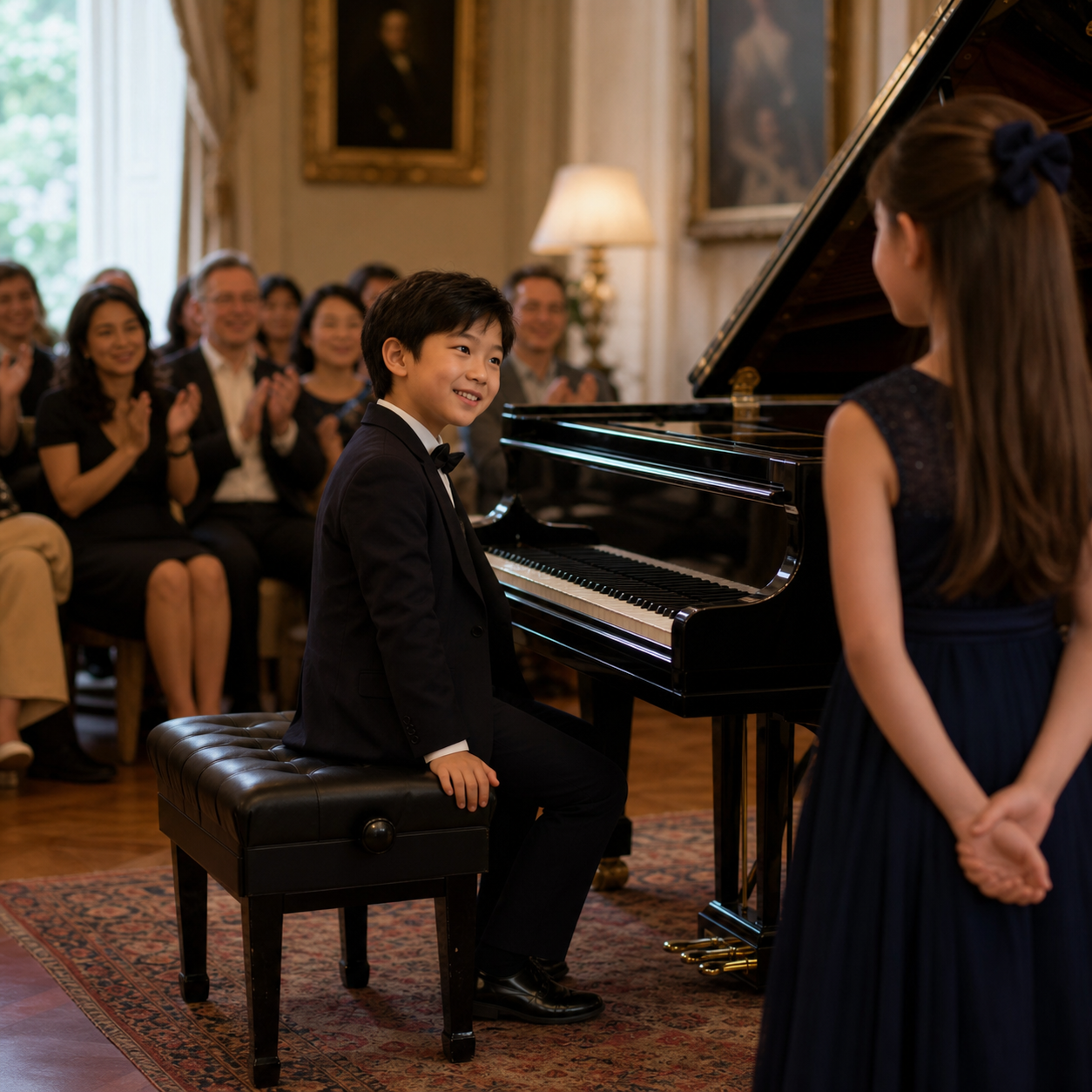
A well-run student performance teaches two complementary roles. The performer accepts attention, manages uncertainty and shares a prepared musical thought. The audience gives silence, concentration and warm recognition. Children need both experiences.
Before the concert, practical responsibilities deepen that learning. Arriving on time, checking an entry with a duet partner, adjusting the bench for the next pupil and leaving the instrument ready are forms of musical citizenship. They may look insignificant beside a polished performance, yet they teach that an event belongs to everyone who helps it function.
Competition has its place for some young musicians, but social learning is richer when concerts also model collegiality. Teachers can invite pupils to introduce a piece, thank an accompanist and comment on a musical detail they admired. Parents can resist ranking performances on the journey home. The essential question is not “Who was best?” but “What did you hear?”
A lesson built around attentive musicianship
For London families, WKMT offers children’s piano study that brings technique, listening and musical communication into the same thoughtful process.
Three questions parents often ask
Does piano make children more sociable?
Not by itself. Thoughtful lessons can rehearse listening, turn-taking and communication, while duets and performances add genuine shared experience. Outcomes depend on the teaching, the child and the wider environment.
Are group lessons better for social skills?
Group settings offer more direct peer interaction, but private lessons can build the listening and self-regulation that make group music successful. Many children benefit from a combination over time.
What if my child is shy?
Shyness is not a musical defect. A calm teacher can offer structured, low-pressure participation and let confidence grow gradually. Listening deeply and contributing quietly are also social strengths.
Sources ON Music and social skills
- Early social communication through music: state of the art and future perspectives, Developmental Cognitive Neuroscience, 2023.
- Actions and feelings in sync: synchrony and empathy in children’s dyadic musical interactions, Frontiers in Psychology, 2025.
- Onset age of musical lessons and sociability in childhood, Frontiers in Psychology, 2018.
- Musical training in the development of empathy and prosocial behaviours, Frontiers in Psychology, 2021.
- Music, drama and social development in Portuguese children, Frontiers in Psychology, 2023.
- Shared home music activities and later child outcomes, UCL Discovery / Early Childhood Research Quarterly.
- Turn-taking in musical and spoken activities, empathy and self-esteem, Frontiers in Psychology, 2021.
Research and internal links last checked 18 August 2026. This article discusses educational development and does not offer clinical or therapeutic advice ON Music and social skills