
 TRIAL LESSON
Haydn Sonatas, Music Theory Resoucers
Prolongational Chord Progressions – Full Guide for Pianists and Composers
Feb
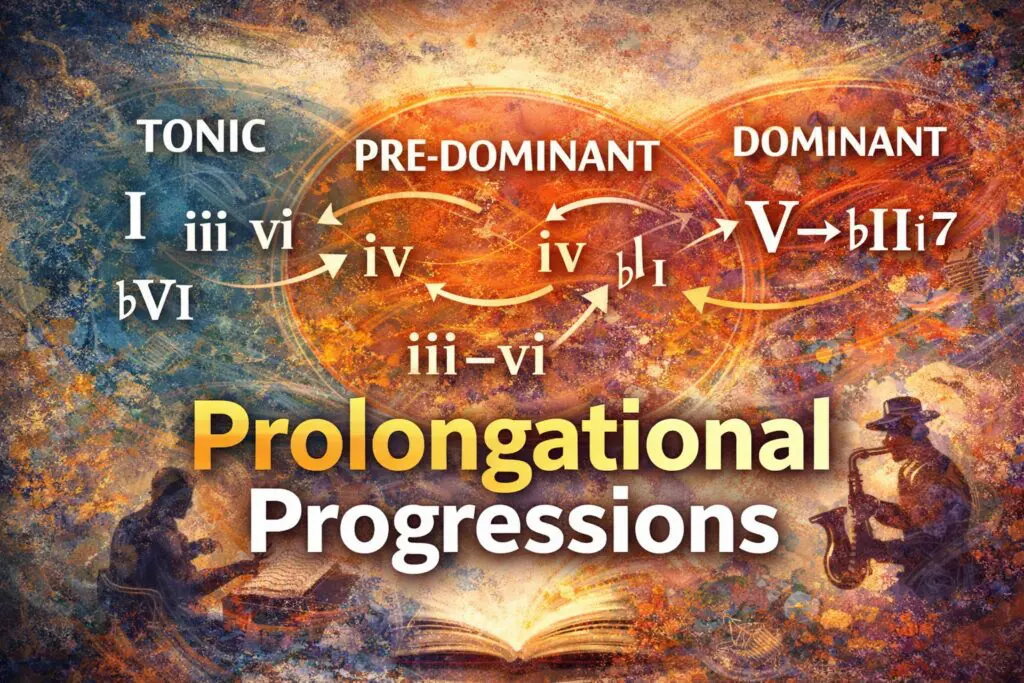
Prolongational Chord Progressions Complete Guide
Prolongational Chord Progressions – Full Guide for Pianists and Composers
If you’ve ever felt that a passage is doing something emotionally even when the chord labels barely change, this guide will show you why—and how to use it. Prolongational chord progressions Guide for pianists and composers.
Grounded in William Caplin’s idea that harmony can stay, move, or arrive, the article focuses on the art of prolongational progressions: sustaining one harmonic function (tonic, pre-dominant, or dominant) while creating compelling surface motion through pedal points, neighbouring chords, passing chords, and functional substitutes—from Classical “standing on the dominant” to modal interchange and tritone colour.
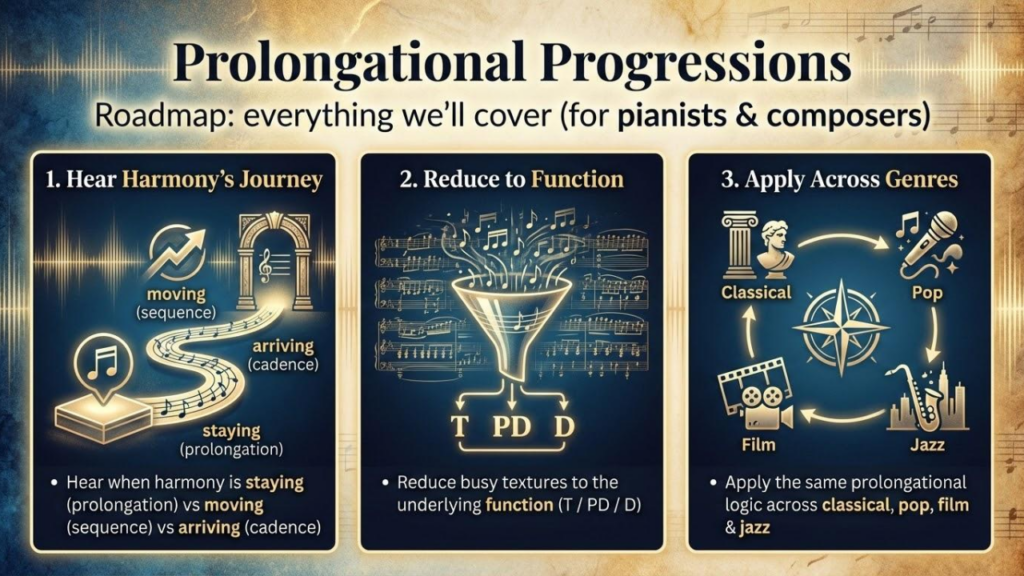
Pianists will learn to read the harmonic map for clearer phrasing, voicing, and timing; composers will gain a toolkit for extending harmony with intention and controlling tension without losing direction.
By the end, you’ll be able to hear what’s structural vs decorative and design your own prolongations across classical, pop, film, and jazz styles.
Understanding Harmonic Progressions – Three ways harmony moves
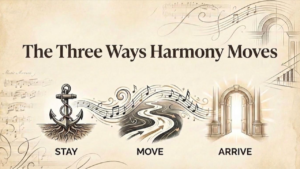
The Three Types of Progressions
In tonal music, harmonic progressions fulfil distinct roles in shaping the sense of movement, repose, and closure.
According to William Caplin, every musical phrase is articulated by one or more of three harmonic progression types:
- Prolongational Progressions – maintain a single harmony over time, enriching its surface; Staying within a function, deepening it rather than leaving it.
- Sequential Progressions – move through patterned root motions, often leading away from or toward stability; It is a harmonic motion by pattern.
- Cadential Progressions – bring closure by confirming the key through a tonic–pre-dominant–dominant–tonic trajectory. (Preparing, intensifying, and achieving arrival).
In Summary:
 Prolongational – Stays on one function and “decorates” it.
Sequential – Repeats a pattern at new pitch levels.
Cadential – Moves towards closure ( Half Cadence or HC, Perfect Authentic Cadence or PAC, Imperfect Authentic Cadence or IAC, Plagal Cadence, etc.).
Prolongational chord progressions Guide for pianists and composers
For pianists:
Understanding how these functions will help pianists phrase more meaningfully, reveal structure in their interpretation, and support harmonic rhythm with touch and dynamics.
For Composers:
If we follow Caplin’s trio – prolongational, sequential, and cadential – you can think of them as three “verbs” of harmony: stay, move, and arrive. Once you hear and think in those verbs, several things become much easier in your composing:
- Think in functions and phrases, not isolated chords.
- Control tension, motion, and closure with intention.
- Diagnose and fix structural problems in your pieces.
- Borrow and transform models from the repertoire intelligently.
Plan everything from a 4-bar phrase to an entire movement with a clear harmonic storyline.
Once you internalise them, they become less like “theory categories” and more like three different gears in a car: you don’t want to drive a whole journey stuck in first gear – and you don’t want to compose a whole piece stuck in one progression type either.
The three Harmonic Functions – Prolongational Chord Progressions
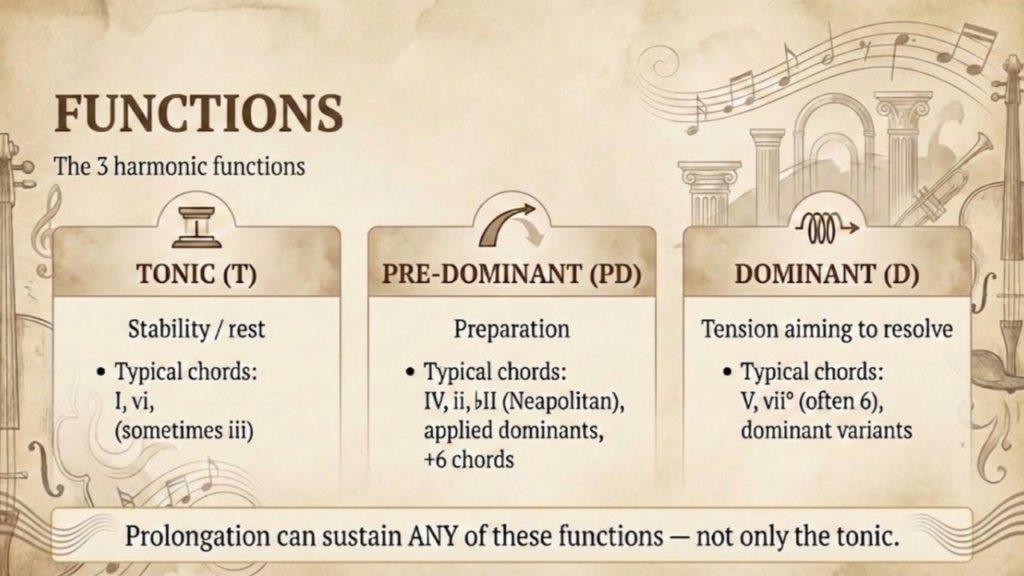
In William Caplin’s approach to Classical form, harmony doesn’t just name chords; it does things—Tonic (T), Pre-Dominant (PD), Dominant (D), and Tonic (T) again. Prolongation keeps a function alive, sequence carries material forward by replication, and cadence moves from PD to D to T to punctuate musical speech. In summary:
Tonic (T) – stability, rest
Pre-dominant (PD) – preparation
Dominant (D) – tension aiming to resolve
In order to fully understand this concept, we may stop for a moment to classify these three types of functions before continuing.
- The Tonic function is represented most strongly by the Tonic chord. Then, the second would be the SubMediant (vi) and in some cases the iii or Mediant can serve as well.
- The Pre-Dominant function is larger than the tonic. Its main function is to lead to the dominant family chords (hence its name) Examples of these are: IV, iv, ii , ♭II (Neapolitan), secondary (applied) dominants of the dominant (such as V/V ), and the various “augmented-sixth” chords which also act as a secondary dominant to the V.
- The Dominant function includes the V and VII (usually in first inversion) chords in their various positions. Iii (the submediant, usually in first inversion) can function as a dominant substitute in some contexts (as in the progression V – iii – vi ).
You can go to my previous article “Tonic, Pre-Dominant and Dominant: The Three Harmonic Functions Every Pianist and Composer Should Know (with Piano Examples and exercises)”
This is a necessary and foundational introduction to the topic of progressions we will cover in this article. Prolongational chord progressions Guide for pianists and composers. Here is the link:
https://www.piano-composer-teacher-london.co.uk/harmonic-functions-in-music/
In this article we will focus on the first progression and all its sub-categories:
The Prolongational Chord Progression
Prolongational Chord Progressions: Exploring the Room
Imagine a film scene where the camera lingers on a single room. The characters move, the light changes, small objects are rearranged – but we never leave that room. We are not going anywhere new; we are discovering what that one space can contain.
Prolongational progressions do exactly that with harmony. They keep us “in the same room” – on a tonic, a pre-dominant, or a dominant – while the surface moves, decorates, and intensifies. In Caplin’s terms, they are one of the three basic types of harmonic progression, alongside sequential and cadential progressions.
Prolongation extends the presence of one harmony—most often the tonic—through various elaborations, thus creating motion on the surface.
Think of a prolongational progression as establishing a ‘home base’. Its job is to solidify a single harmony—usually the tonic—without really going anywhere. As we said before; It’s like exploring a single room from different angles before starting a journey. This creates stability and sets the scene.
It is staying in character.
We can see prolongation in other branches of the Arts:
Painting – you stand in front of one painting, walk closer, step back, look at different corners: same object, changing perspective.
Film – a long tracking shot that stays in one location while the camera moves.
Storytelling – a writer spends two pages describing one moment in a character’s mind before the plot actually advances.
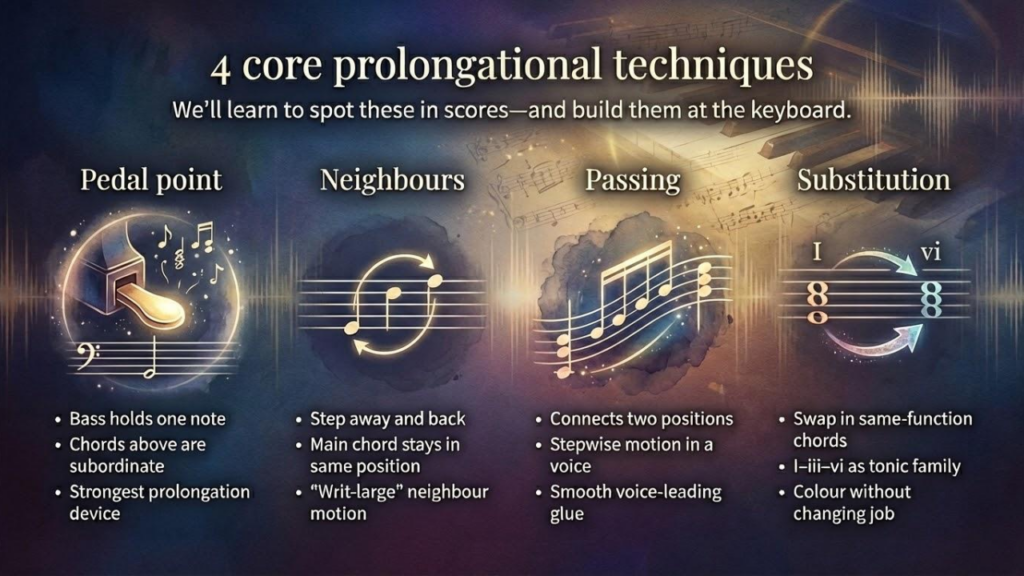
Caplin classifies them into four compositional techniques:
1.- Pedal Point
The bass sustains (or stubbornly repeats) one note, usually the root of the prolonged harmony, while upper voices move through embellishing chords. The pedal note belongs to the prolonged harmony; the changing chords above it are subordinate. While the pedal note can be any note of the harmony, the two most commonly used are the tonic and the dominant note, the latter is called “standing on the dominant” (We will discuss this topic later in the article) – Prolongational chord progressions Guide for pianists and composers.
You can have many types of chords above a pedal point; the harmonies that have one or two notes in common won’t clash with the pedal note, you can add chords more distant from it, producing more dissonant result like in the case of the last chord above, the D7/C in which we have a dominant seventh D-F#-A-C over the C note as a pedal.
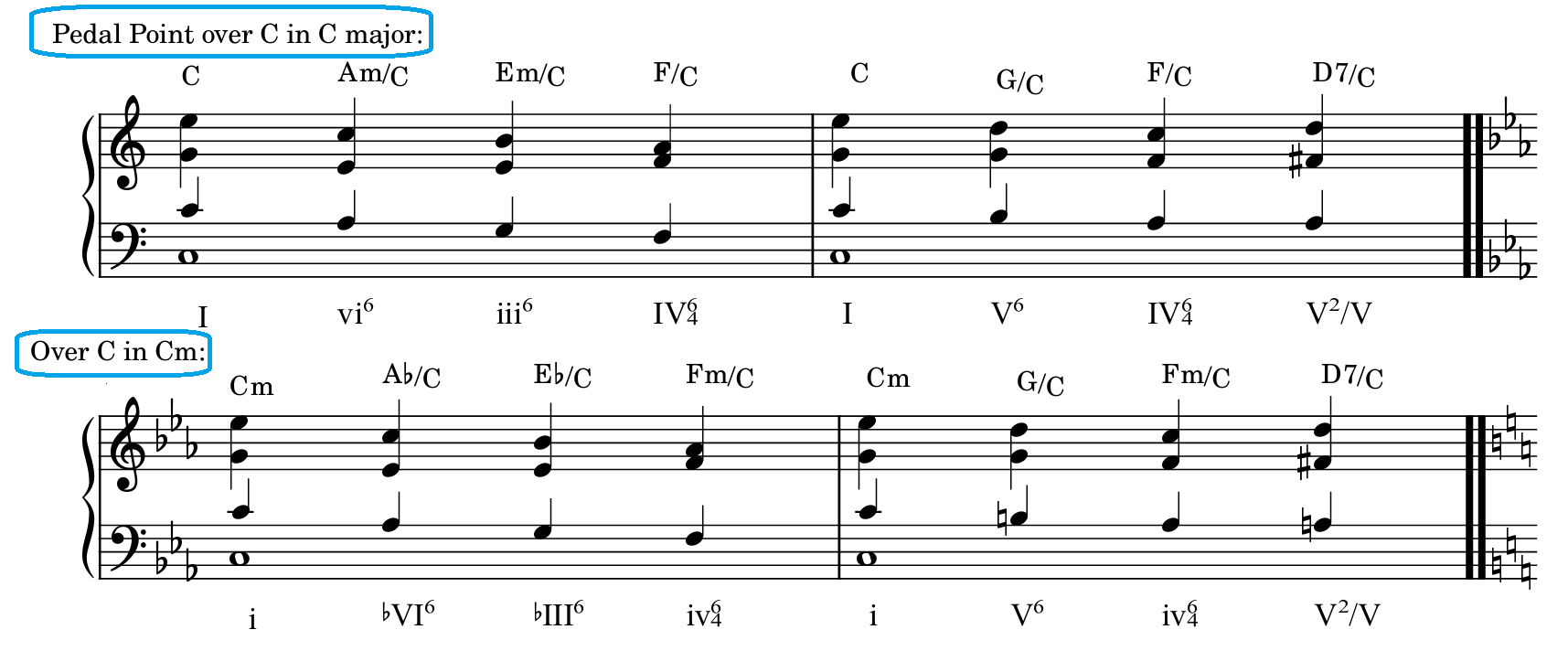
The chords such as the ones shown in the first bar in the example above will be more consonant against the pedal tone, thus producing different shades over the prolonged pedal note.
It is considered the most forceful way of prolonging a harmony. Most often, this device appears at the beginning and end of a phrase.
2.- Neighbouring Chords
Prolong a harmony by stepping away and back, while the bass and inversion of the main chord remain the same. The prolonged harmony remains stable while moving briefly to an adjacent harmony. As Caplin says in page 12: “An individual harmony is prolonged by one or more neighboring chords when the prolonged harmony remains in the same position (root position or inversion) from the beginning to the end of the progression”.
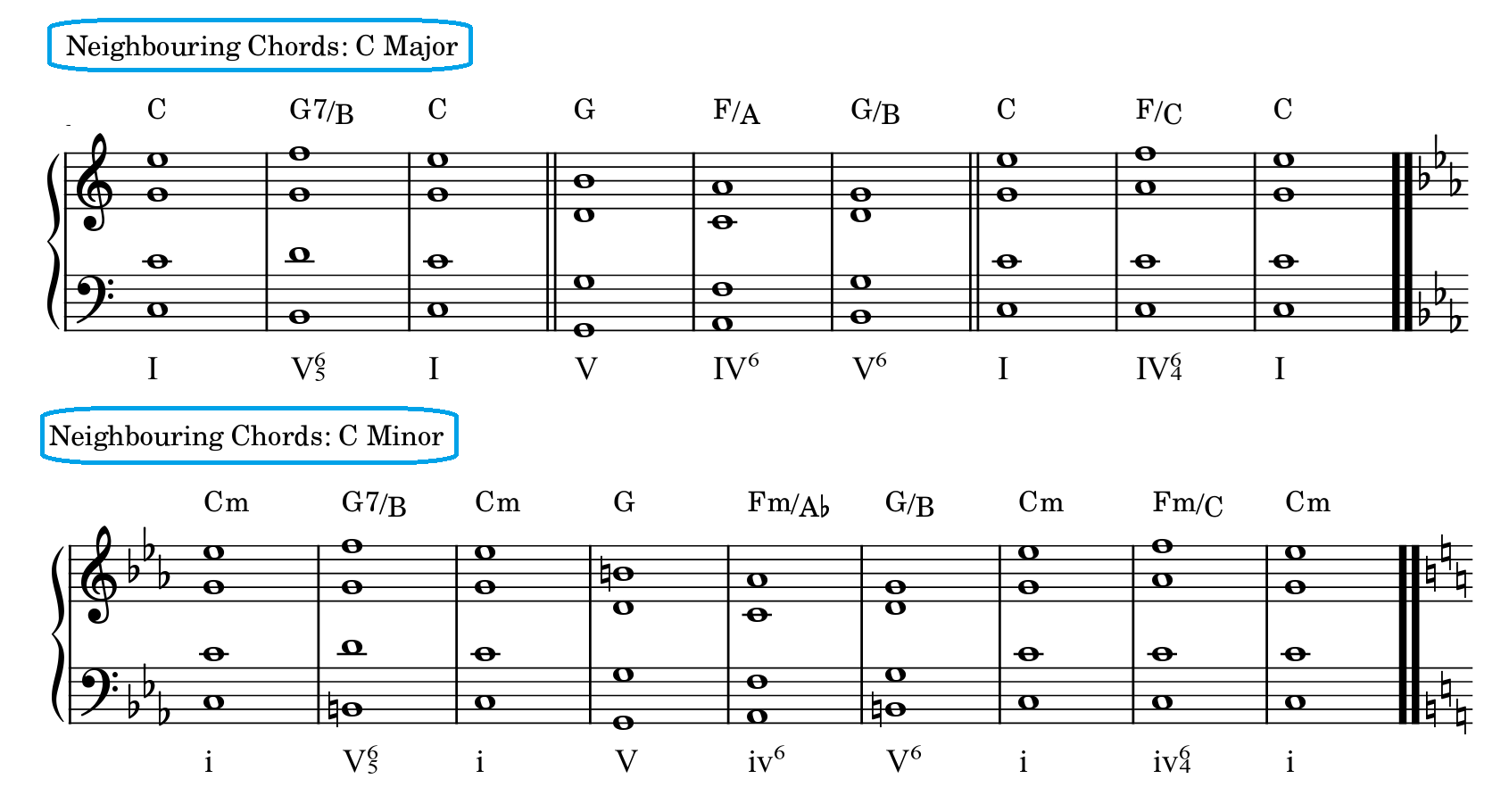
From a Schenkerian viewpoint, this is just neighbour motion writ large: that little step away and back (E–F–E) is “magnified” into chordal level. (See the soprano voice in the first 3 bars and the last three bars of the example above)
TIP: It is fundamental that the prolonged harmony stays always in root position and the neighbouring chords in any inversion; the reason for this is because the prolonged chord needs to sound stronger and solid (therefore, in root position) in comparison to the rest of the neighbouring ones, expressing the hierarchy of the first one.
3.- Passing Chords
Fill the space between two positions of the same harmony (or between two harmonies of the same function) by stepwise motion in at least one voice.
A given harmony is prolonged by one or more passing chords when the prolonged harmony changes position from the beginning to the end of the progression.
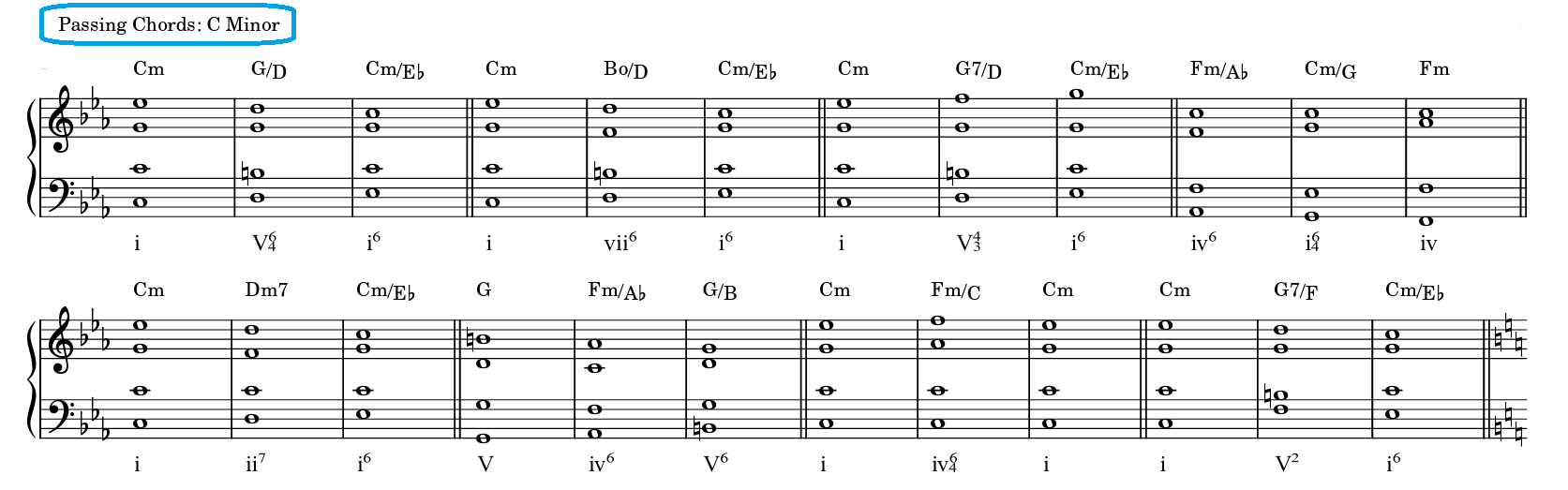
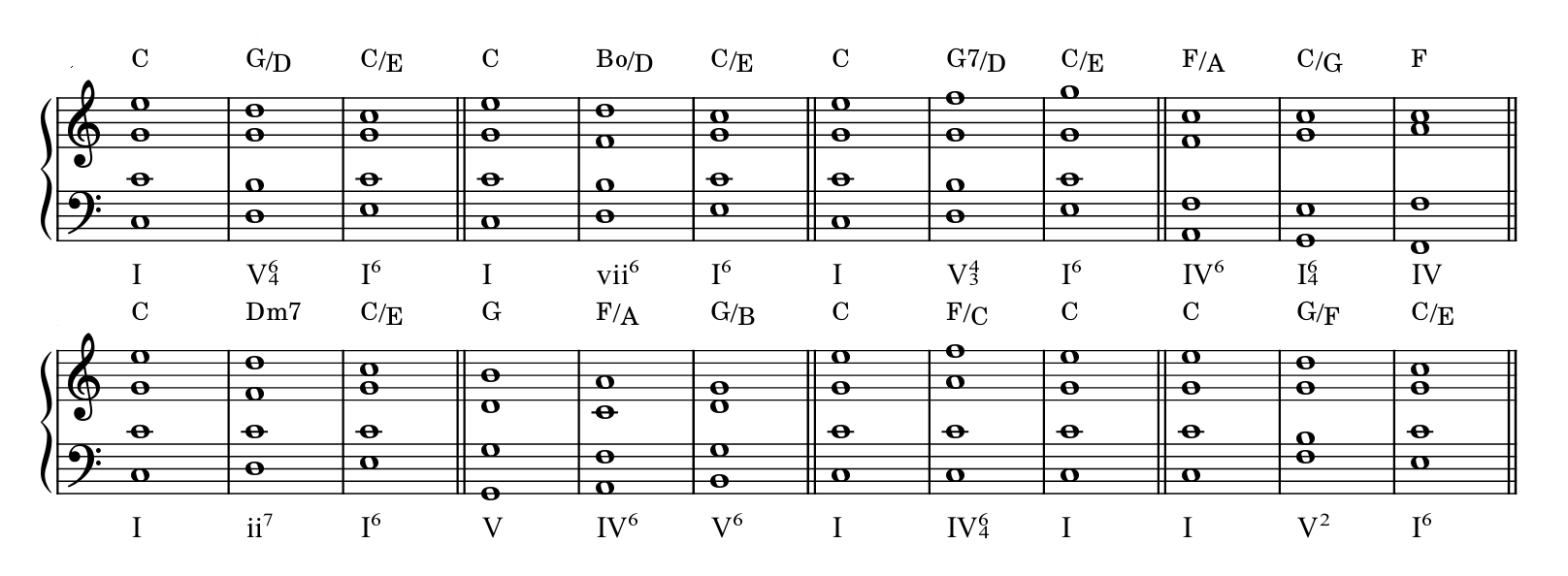
Observe in the examples above how the bass notes move either up or down a step along with the upper voice moving in contrary motion or parallel motion, this creates a much smoother voice leading between the voices.
4.- Substitute Harmonies
Replace the prolonged harmony with another chord of the same function. Caplin stresses that VI is best understood as a tonic substitute, not a pre-dominant: in VI–V, tonic function moves directly to dominant, bypassing a pre-dominant.
Common tonic substitutes in major:
- VI (vi) – shares two tones with I (e.g. C–E–G vs A–C–E).
- iii – shares two tones with I (E–G–B).
- I6 – same chord, different position.
Substitutes for other functions exist too (e.g. ii for IV as PD substitute, or VII° for V in minor), but Caplin’s basic examples focus heavily on tonic – Prolongational chord progressions Guide for pianists and composers.
In such cases, the original harmony and substitute harmony have two chord tones in common, which largely accounts for their functional similarity. For example: the Tonic family chords I – iii – vi are interrelated one with each other by two notes. In C major, C has two notes in common with A minor, the vi (C and E), and E minor (iii) has two notes in common with C major (E and G)
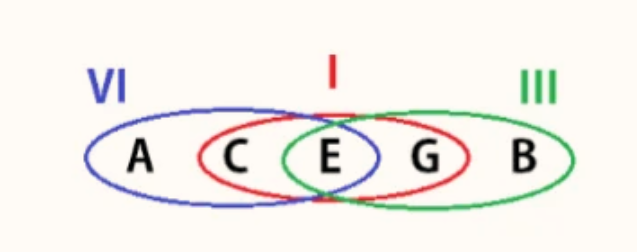
*See my article Tonal families for more information:
The substitute VI and ii chords can prolong the previous I and IV harmonies respectively.
Passing chords can be introduced between the original and substitute harmonies to effect even more complex prolongations.
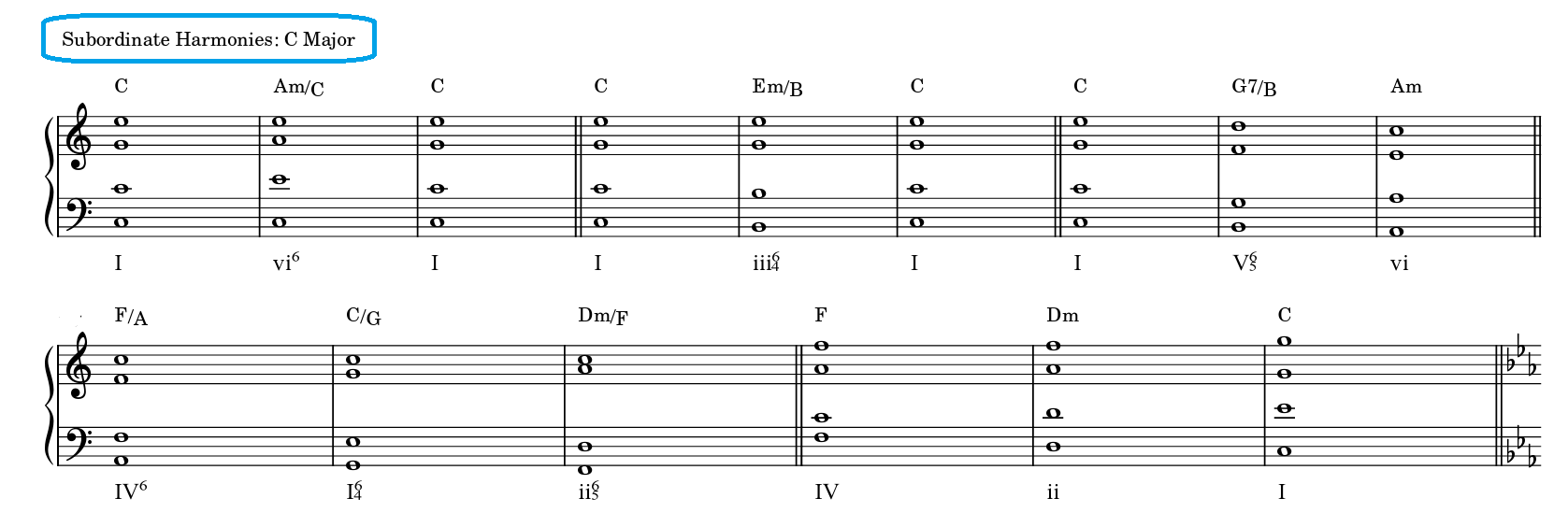
In the above graphs the substitute chords appear between brackets. We have the ii replacing the IV, which is the main chord, and the iii replacing the tonic chord, being the main chord. Observe how the voice leading smooths the transitions either by keeping the bass note the same, or moving it by step either by creating a neighboring note to the next or passing note – Prolongational chord progressions Guide.
Sub-Categories within Subordinate Harmonies
Tritone Substitution (Dominant Substitution)
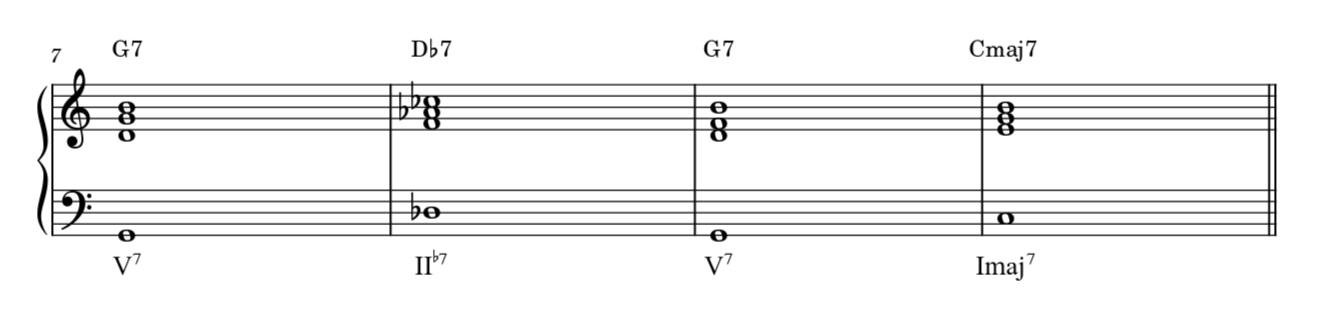
The tritone substitution — e.g., D♭⁷ replacing G⁷ in a ii–V–I in C major — shares the same tritone interval (B–F) and hence resolves identically to the tonic.
Both G⁷ and D♭⁷ lead to Cmaj7:
- G⁷ = G–B–D–F
- D♭⁷ = D♭–F–A♭–C♭(=B)
The voice-leading functions are nearly identical:
- F (or F in both chords) → E (3̂ of C)
- B or C♭ → C (1̂ of C)
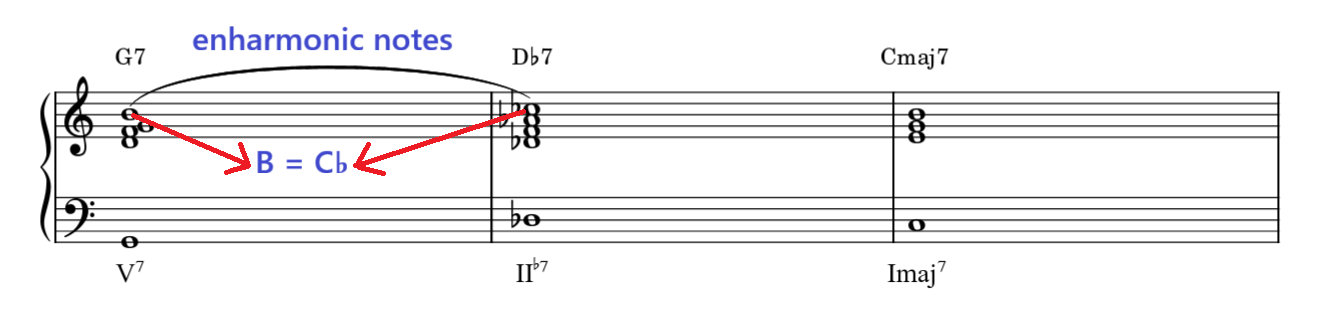
So in harmonic function, D♭⁷ still behaves as a Dominant, though its root and colour are altered.
According to Caplin, it can be analysed as a subordinate dominant harmony when it appears within a dominant prolongation or as a chromatic substitute that decorates a larger dominant function.
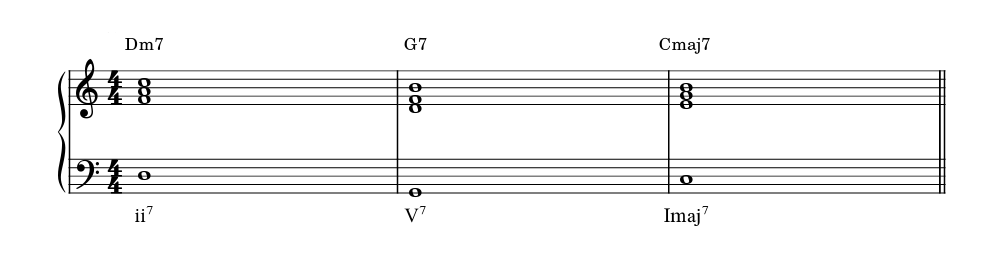
Reharmonised ii–V–I with tritone substitution:
| Dm7 – G⁷ – Cmaj7 | (original)
| Dm7 – D♭⁷ – Cmaj7 | (Subordinate harmony applied)
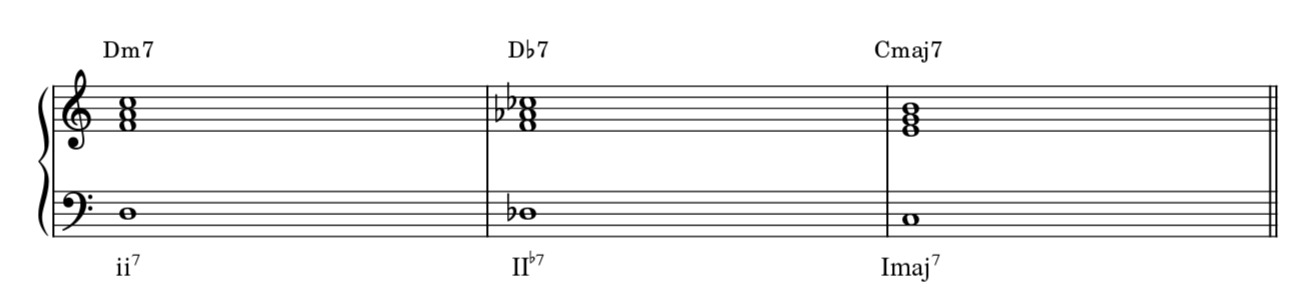
Here, D♭⁷ replaces G⁷ entirely.
So in this linear progression, it retains the dominant’s syntactic role, not merely subordinate status — it is the dominant.
But if you embed both (e.g., V⁷ → ♭II⁷ → I), the ♭II⁷ functions subordinately within the dominant prolongation.
So we can say:
As a substitution, the ♭II⁷ assumes the dominant’s functional role.
As a passing chromatic decoration within a dominant field, it is subordinate.
Effect in music:
- Creates chromatic root motion (down a semitone).
- Softens V–I’s a stark fifth leap. (The roots move a semitone instead of a perfect 5th)
- Adds colourful voice-leading while maintaining function.
- Enables smooth modulations and parallel II–V lines (e.g., Dm7–D♭7–Cmaj7).
When a tritone substitution occurs without functional shift, it fits neatly into these models:
- V → ♭II⁷ → V = Neighbouring progression within dominant function
(♭II⁷ is a chromatic neighbour dominant)
- ii⁷ → ♭II⁷ → I = Prolonged dominant resolution, with ♭II⁷ decorating the V function before arrival.
Thus, the tritone substitution can indeed serve as a subordinate chord in a prolongational progression — much like how V⁶ or vii°⁷ can function subordinate to V in Classical syntax.
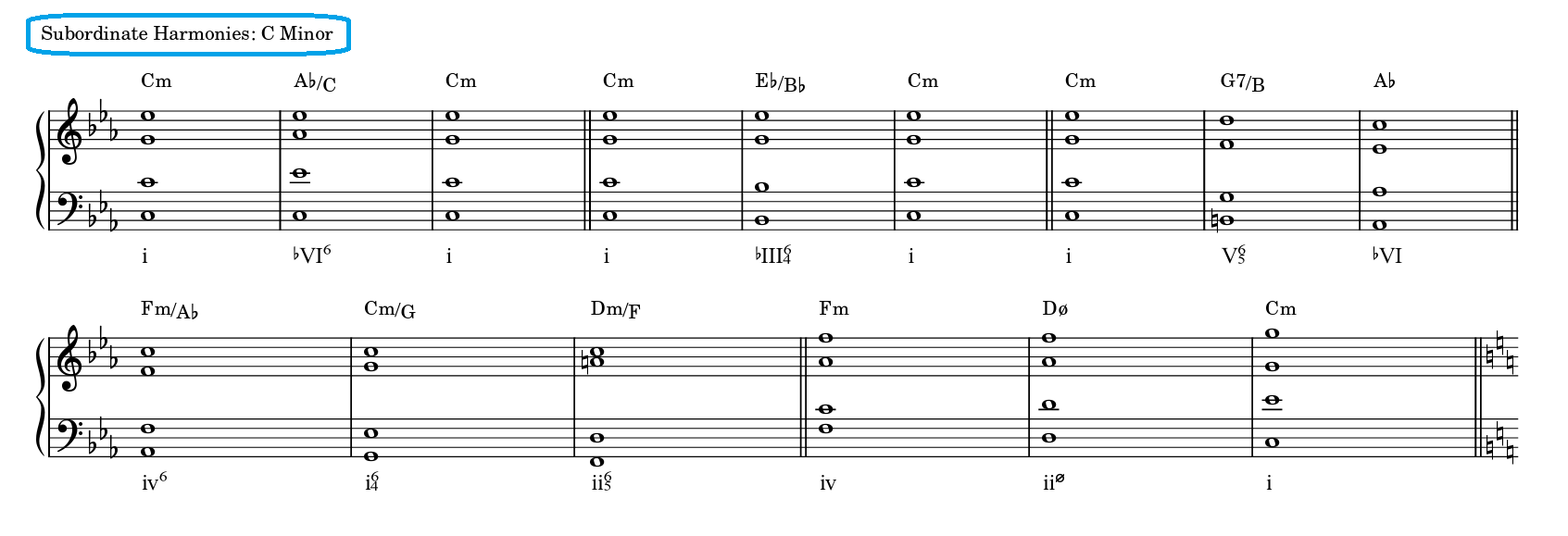
Subordinate Harmonies with Modal Interchange
I. TONIC FAMILY (T)
Tonic prolongations are stable, reflective, or lyrical.
Modal mixture here adds colour and warmth without creating forward drive.
| Borrowed / Altered Chord | From Which Mode | Progression Example | Prolongational Type | Effect / Expression |
| I–♭VI⁶–I | Parallel minor (Aeolian) | C–A♭–C | Neighbour | Darker, dramatic |
| I–ii°–I | Parallel minor (Dorian) | C–D°–C | Passing | Subtle tension / mystery |
| I–♭III–I | Parallel minor (Aeolian) | C–E♭–C | Neighbour | Poetic, modal serenity |
| I–♭VII⁶–I | Mixolydian | C–B♭–C | Neighbour | Folk / open / plagal colour |
| I–iv⁶4–I | Parallel minor | C–Fm–C | Passing | Intimate / warm |
| i–vi⁶–i | Minor borrowed from parallel major | Cm–Am–Cm | Neighbour | bittersweet |
| I–♭II–I | Phrygian | C–D♭–C | Neighbour | Exotic / archaic |
| I–vii°⁶–I⁶ | Parallel minor | C–B°–C | Passing | Chromatic embellishment |
| I–v⁶–I | Parallel minor | C–Gm–C | Neighbour | Subtle softening of tonic |
| I–♭VII⁶–IV⁶4–I | Mixolydian | C–B♭–F–C | Extended Neighbour | Pop-rock plagal feel |
Modal interchange tonic prolongations enrich stability with expressive colour — they dwell on repose but introduce character: nostalgia (iv), nobility (♭VI), or earthiness (♭VII).
II. PRE-DOMINANT FAMILY (PD)
Pre-dominant prolongations prepare tension gently — they move away from tonic but do not yet seek closure.
Borrowed chords here often deepen the harmonic palette before reaching the dominant.
| Borrowed / Altered Chord | From Which Mode | Progression Example | Prolongational Type | Effect / Expression |
| IV–iv–IV | Parallel minor | F–Fm–F | Neighbour | Pathos, gentle melancholy |
| IV–ii°–IV | Parallel minor | F–D°–F | Passing | Dissonant colour, subtle tension |
| ii–iv–ii | Parallel minor | Dm–Fm–Dm | Neighbour | Softer pre-dominant hue |
| ii–♭VI–ii | Aeolian | Dm–A♭–Dm | Neighbour | Cinematic / mysterious |
| IV–♭VII–IV | Mixolydian | F–B♭–F | Neighbour | Folk-like, grounded |
| IV–♭II–IV | Phrygian | F–D♭–F | Neighbour | Dramatic, exotic |
| ii–♭II6–ii | Phrygian | Dm–D♭6–Dm | Passing | Chromatic approach to dominant |
| IV–♭VI–IV | Aeolian | F–A♭–F | Neighbour | Expansive, romantic hue |
| ii–♭III–ii | Aeolian | Dm–E♭–Dm | Neighbour | Colouristic / jazz inflection |
| IV–♭VII–♭III–IV | Mixolydian | F–B♭–E♭–F | Extended | Spacious / cinematic pre-dominant field |
Modal interchange pre-dominants often evoke a Romantic or cinematic atmosphere — they expand the preparatory space before the dominant, heightening emotion without yet demanding resolution.
III. DOMINANT FAMILY (D)
Dominant prolongations maintain forward tension.
Borrowed chords here often intensify the pull to tonic through chromatic or modal inflection.
| Borrowed / Altered Chord | From Which Mode | Progression Example | Prolongational Type | Effect / Expression |
| V–♭II⁷–V | (Tritone sub) | G7–D♭7–G7 | Neighbour | Chromatic brightness, jazz-inflected tension |
| V–♭VI–V | Aeolian | G–A♭–G | Neighbour | Dramatic / cinematic suspense |
| V–vii°–V | Minor borrowing | G7–B°–G7 | Passing | Classical inner-voice tension |
| V–♭II–V | Phrygian | G–D♭–G | Neighbour | Dark, modal dissonance |
| V–♭III–V | Aeolian | G–E♭–G | Neighbour | Colouristic / modal shading |
| V–V7(♭9/♯9) | Altered (melodic minor) | G–G7♭9–G7 | Colour expansion | Intensified dominant pull |
| V–iv–V | Parallel minor | G–Fm–G | Neighbour | Romantic / dark hue |
| V–bV°–V | Chromatic passing | G7–G♭°–G7 | Passing | Jazz tension / line cliché |
| V–♭VII7–V | Mixolydian | G7–F7–G7 | Neighbour | Bluesy / funk colour |
| V–II⁷–I | Lydian (II7 cadence) | G7–D7–C | Cadential | Tritone sub resolution (can also be primary) |
Modal interchange within the dominant field colours the tension — producing shades of brightness (Lydian ♭II⁷), drama (Phrygian ♭II), or bluesy relaxation (Mixolydian ♭VII7).
All remain within the dominant function if they resolve (directly or indirectly) to tonic.
In Caplin’s Terms
- All these chords prolong their primary harmonic function — they orbit the same functional centre.
- They do not form progressions (T→PD→D) but instead expand one function through colouristic substitution.
- Their effect is expressive: enriching stability or tension through modal resonance, while maintaining formal logic.
Modal interchange subordinate harmonies are colouristic elaborations that preserve the harmonic function but transform its emotional hue — allowing composers to stretch functional time with expressive depth.
If you are interested in knowing more about it, here are two articles to keep in mind:
“Crafting Emotional Landscapes: The Role of Modal Interchange in Music”
https://www.piano-composer-teacher-london.co.uk/modal-interchange/
“How to Use Modal Interchange? A Composer’s Guide”
https://www.piano-composer-teacher-london.co.uk/how-to-use-modal-interchange-a-composers-guide/
Musical Examples Through Different Genres
🎹 For the Pianist – Reading the Harmonic Map
As a pianist, you’re not just playing notes; you’re interpreting a story told through harmony. Recognising whether the music is lingering, travelling, or landing will fundamentally shape your phrasing, dynamics, and touch.
✍️ For the Composer – Your Narrative Toolkit
As a composer, these devices are your primary storytelling devices. You can consciously use them to control the emotional arc of your music, whether you’re writing a sonata, a film score, a jazz standard, or a pop hit.
By thinking in terms of staying (prolongation), travelling (sequence), and arriving (cadence), you move beyond simply stringing chords together. You start to think like a storyteller, guiding your listener through a carefully crafted emotional and musical narrative.
Pedal Point
The bass sustains a note (usually the root of the prolonged harmony) while upper voices move through embellishing chords.
1. Baroque Examples
In Baroque music, prolongation often takes the form of pedal points or sequences over static basses, maintaining a tonic or dominant foundation while the upper voices create motion and ornamentation.
The opening J.S.Bach’s Prelude in C minor BWV 847 brings a pedal Point on the Tonic note, C, and over it we see the subdominant (which shares a note with the chord), then, a more dissonant combination: the Dominant chord with a flattened 9th over the same note C. The tonic again, a submediant (belonging to the tonic family) and finally a dominant of the dominant, which we see its seventh note C on the Bass:
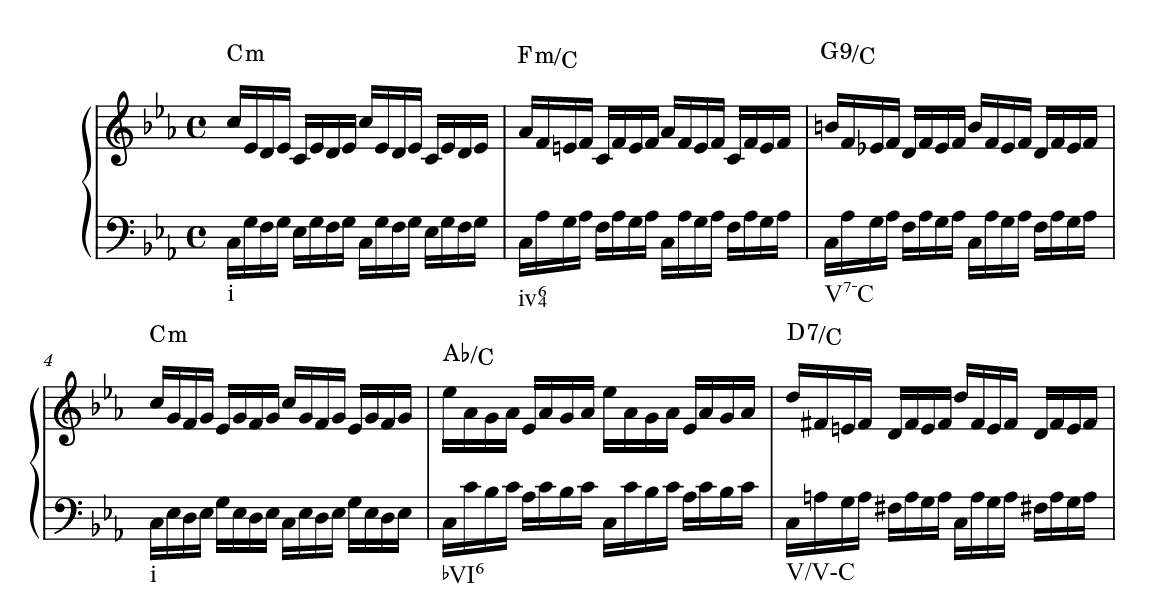
In this excerpt, listen to how the bass pedal keeps the harmony grounded while the upper parts weave motion above it. Some sonorities will feel relatively stable because they share tones with the implied harmony; others will feel more biting because they clash more strongly with the pedal.
This is the key idea: dissonance here is not “harmonic travel”. It’s tension inside a stable harmonic space.
So analytically, we learn to say:
“The music is still prolonging the same function, but the surface has intensified.”
Below we can see a graph that shows just the harmonic progression:
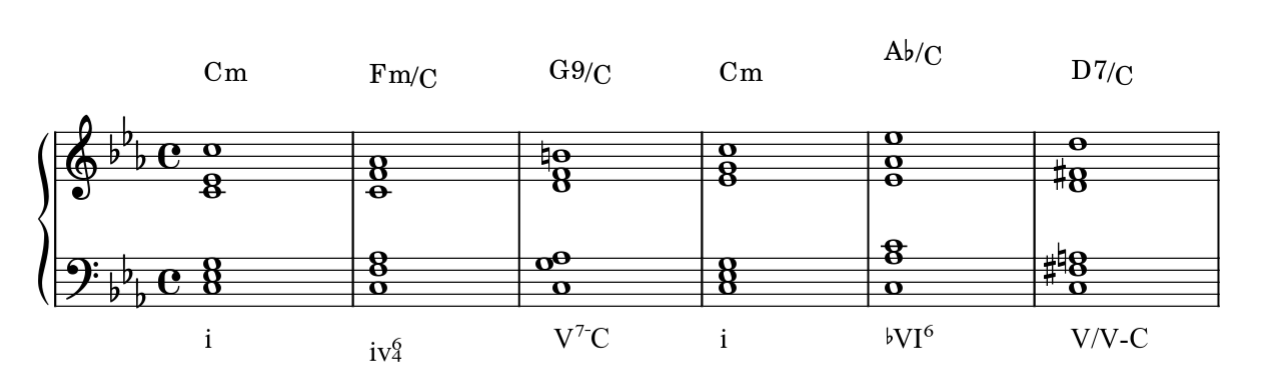
Here we can see the harmonic structure without any melodic or rhythmic ornamentation; observe how the voice leading represents a chorale, this is a very common technique in Bach’s music. We can learn from him that despite the surface movement brought by the movement of the voices, there is always a solid structure behind it; no wonder he was called “the Architect of Music”!
2. Classical Examples
Classical composers used prolongation to create stability within formal beginnings — particularly in presentation phrases and themes that begin with harmonic stasis before sequential motion.
One detail is crucial here: hierarchy. In Classical writing, the prolonged harmony is often reinforced by being in a stronger position—commonly root position—while the neighbouring or decorative chords appear in inversion.
That’s a practical clue both for analysis and performance:
- If one chord keeps returning in a “heavier” position, that chord is often the structural one.
- The others function like decorations: they animate, but they do not govern.
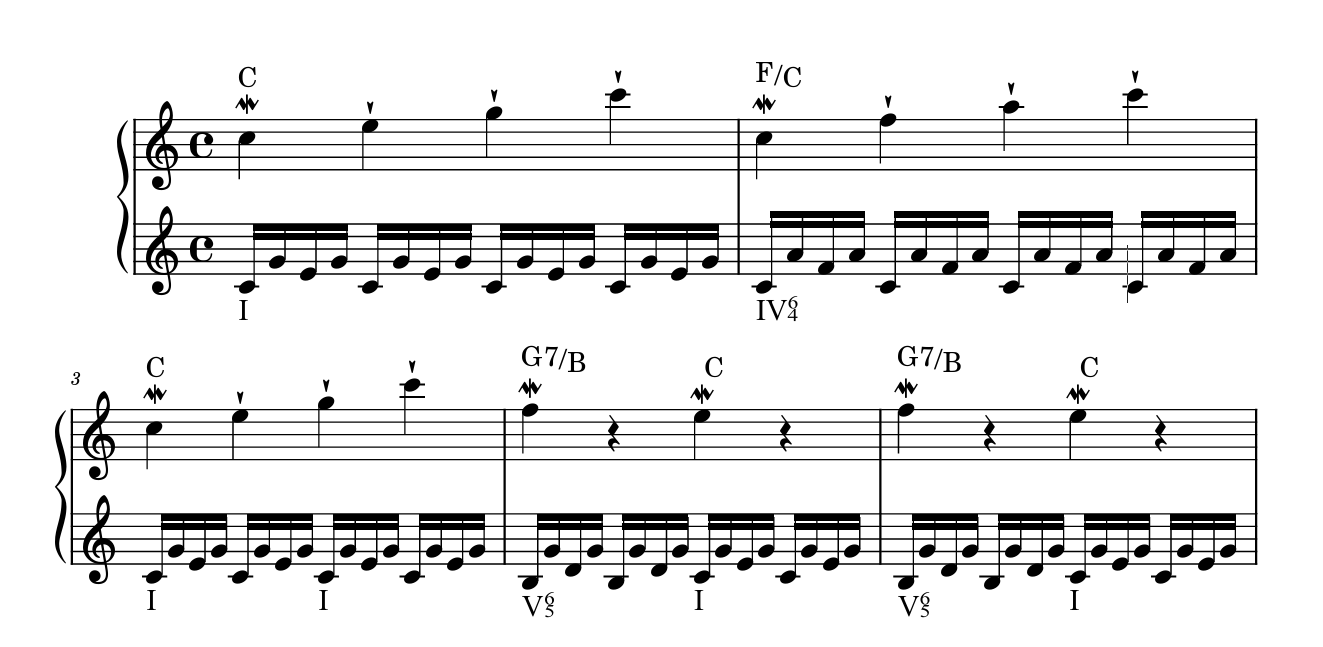
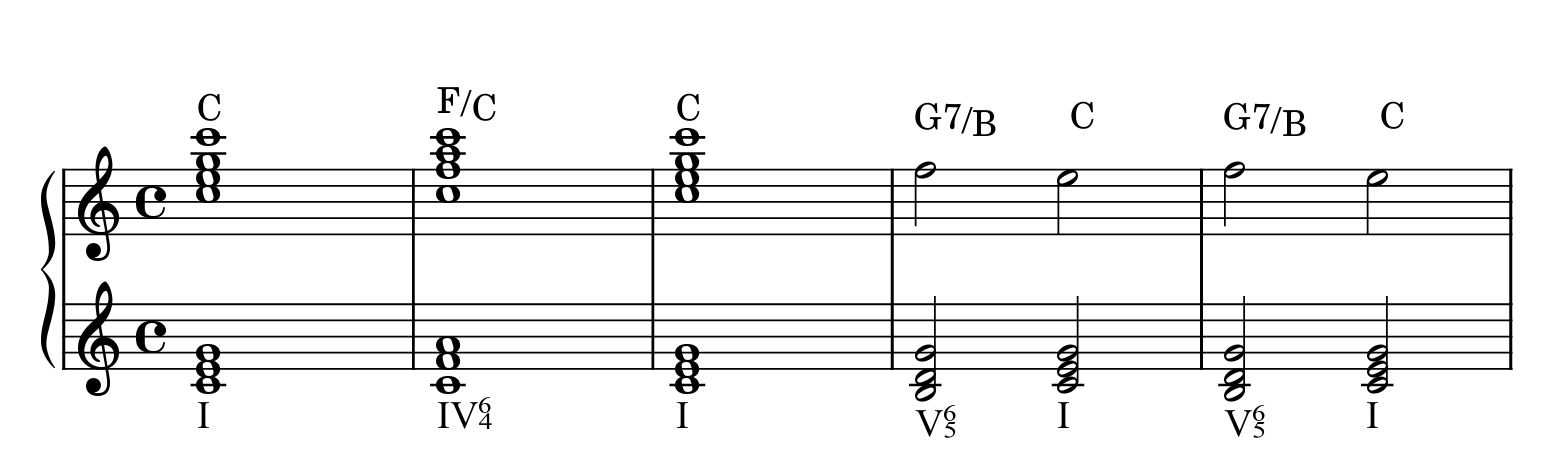
The opening of Joseph Haydn’s- Allegro (1st movement) – Sonata in C Major Hob XVI/1. The first three bars state the main motive through a prolongation of the tonic chord with an ornamentation of the tonic through a Subdominant in second inversion, making a pedal on the C, the tonic. In bars 4 and 5 we have another tonic prolongation on the first inversion of the dominant with the tonic. Observe that the tonic is in root position, making it stronger in relation to the other chords which are always in inversion to clarify which chord is the most important in the progression. In this case, the tonic (C major) – Prolongational chord progressions Guide for pianists and composers.
Below we see only the structural harmony of the beginning of the Sonata:
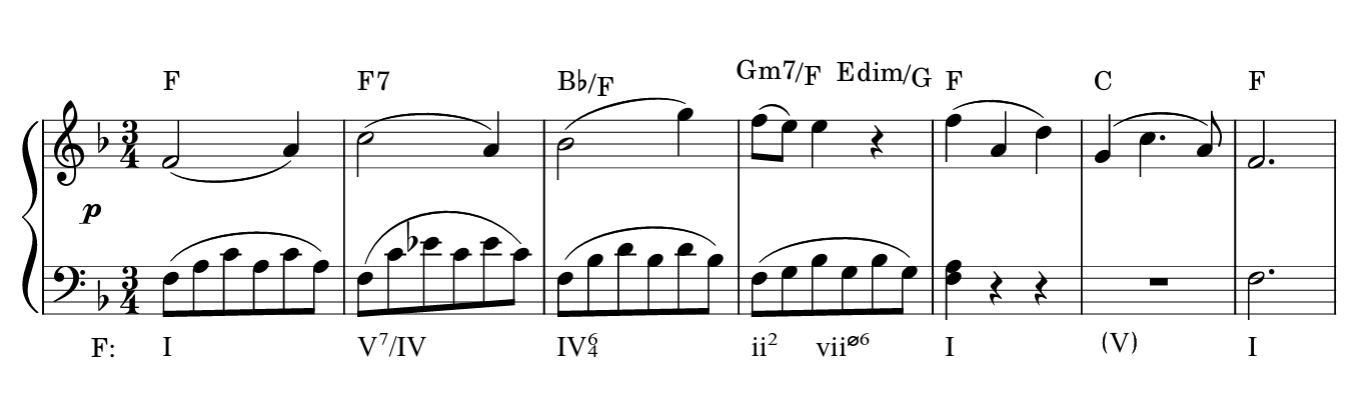
Mozart’s Sonata in F major, K. 332, opening bars (Pedal on the tonic through a dominant of the subdominant, subdominant in 2nd inversion and the seventh degree in first inversion going back to the tonic chord. (F major, the tonic is the prolonged harmony which allows the basic idea to deploy itself from bar 1 to 7).
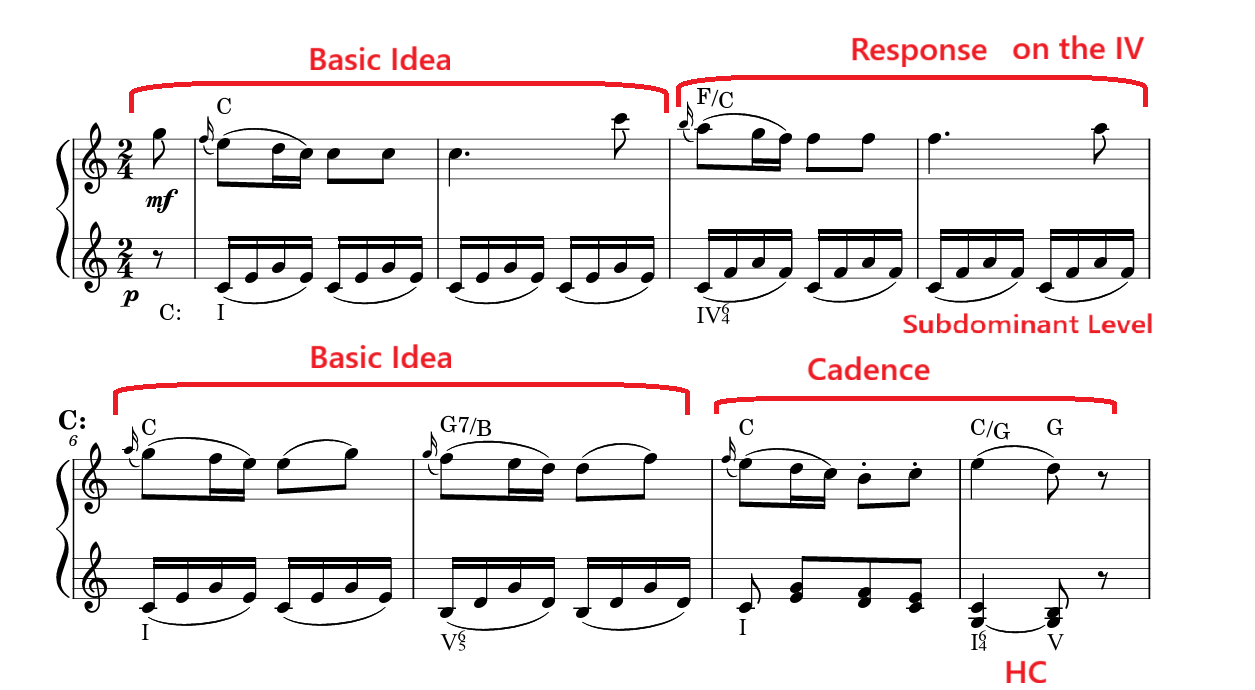
In this Mozart Sonata K. 309 (3rd, Movement) at the beginning of the Rondeau, a basic idea in bars 1 and 2 on the tonic level, the response version is supported by subdominant harmony on the second inversion; this allows the listener to have another “version” of the motive, it’s not a transposition per se, is exposing the basic idea on the subdominant harmony creating changes but at the same time, being consistent with the initial idea. The motive appears again in bars 5 and 6 where the tonic prolongation ends in bar 7 just before the half cadence (HC) on the dominant in bar 8.
3. Romantic Examples
Romantic prolongations frequently use expanded pedal points or modal inflections (especially the subdominant iv in major keys) to delay resolution and enhance expressivity.
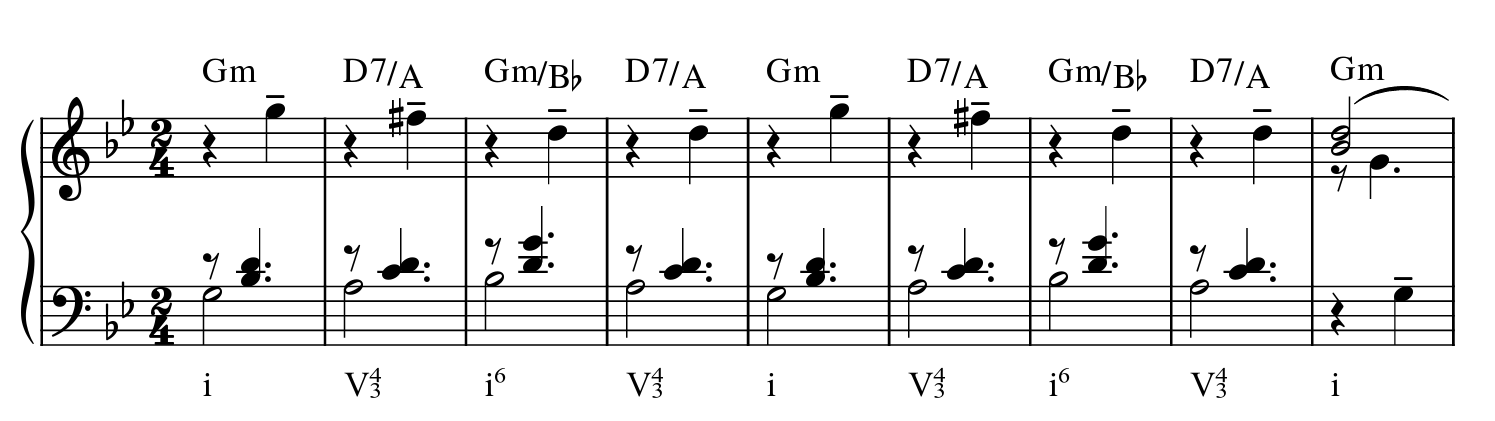
The Sick Doll Composed by Peter Ilyich Tchaikovsky. The piece is in G minor. The initial phrase starts on the tonic in root position, going to its first inversion in the third bar through a Dominant chord (D7/A) in second inversion; this is repeated twice:
4. Pop Examples
Pop prolongation tends to rely on looped progressions where a tonic field is varied through inversion, melody, or texture — maintaining stability while refreshing the sound.
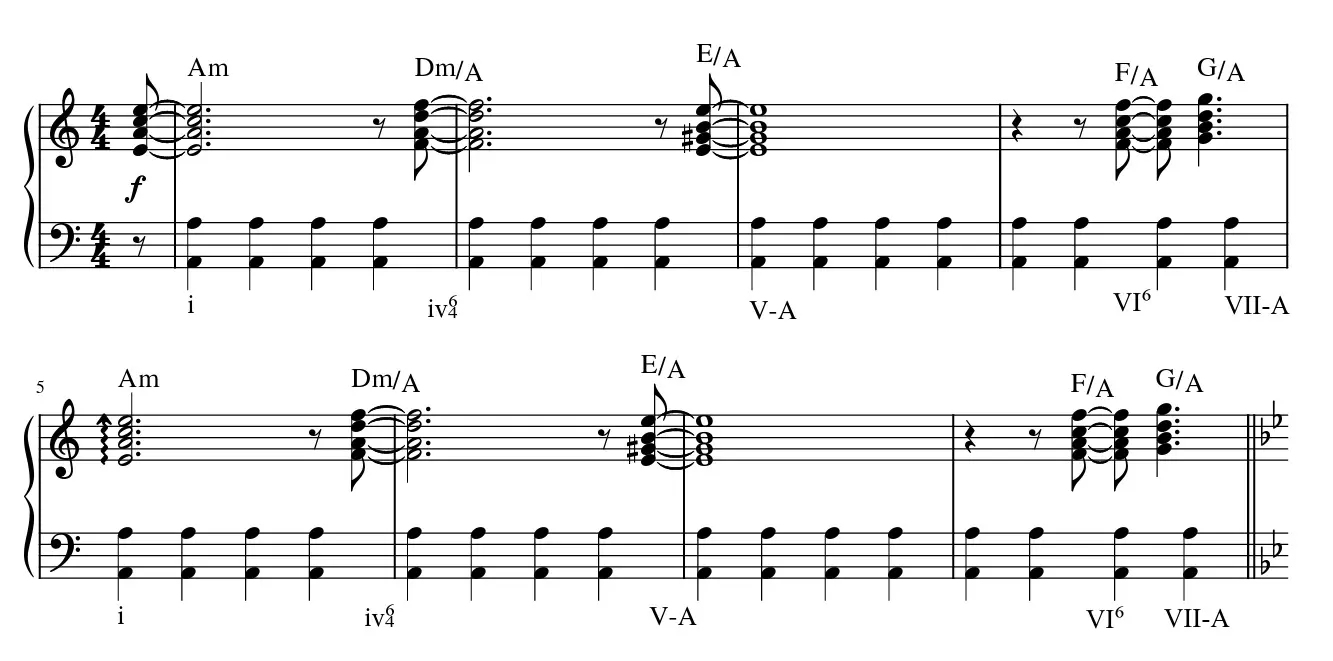
The Intro of Elton John’s “I’m Still Standing” (in A minor in this version) we have another case of Pedal point on the Tonic note, A.
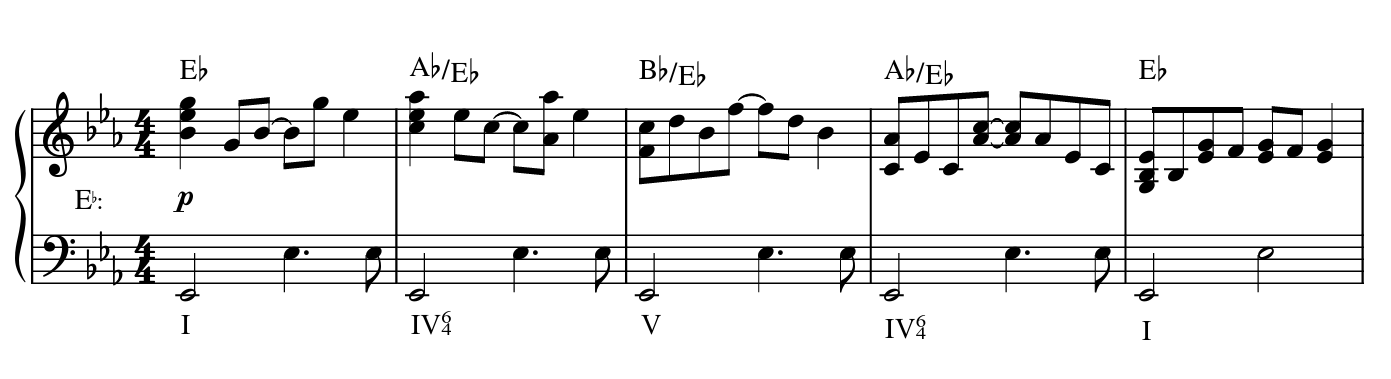
Another example from the same composer, Elton John’s “Your Song” – I–IV–V (over pedal note Eb) – IV- I motion adds warmth and expansion to the tonic area.
5. Film Music Examples
Film composers frequently employ pedal tones, static harmonic textures, and modal layers to create emotional continuity, prolonging the tonic field for dramatic or atmospheric effect.
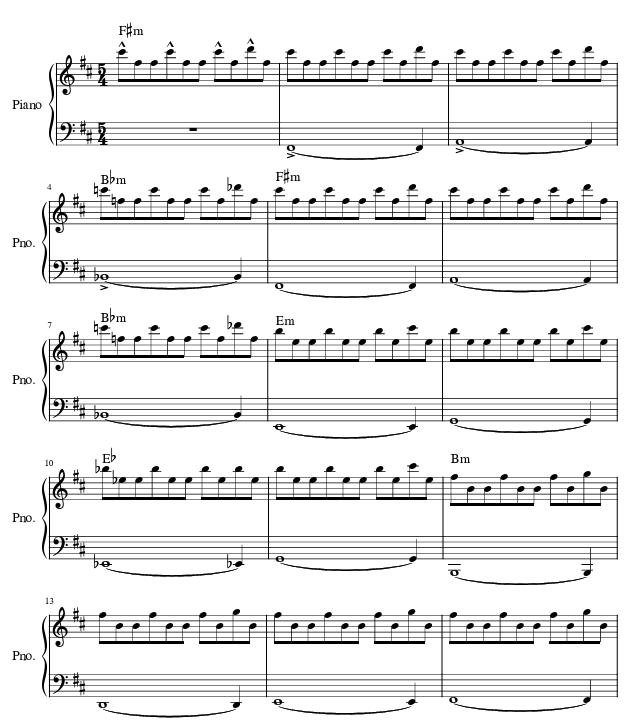
In a suspenseful scene from a thriller, a composer might prolong a single dissonant chord with unsettling string textures. The harmony isn’t moving, which is precisely what creates the feeling of being trapped and unable to escape. A memorable example of this is the motion picture “Halloween”, the Michael Myers Theme:
- The theme is centred on a repeated ostinato in 5/4, built from a tonal ambiguity between F# minor and Bb minor..
- The main figure alternates two notes (A–C–A–C–A–C–A–C–A) outlining the minor 3rd, occasionally touching a B♭, which adds a Phrygian darkness (♭2).
- There is no functional progression — no tonic–dominant movement, no cadential release, but a prolonged set of chords over a distinctive rhythmic-melodic pattern: F#m – Bbm – Em – Eb – Em – Eb – Bm
- The harmony, though simple, remains static; it does not “go anywhere,” creating a suspended loop that refuses closure.
The listener’s expectation of harmonic change is continually denied. The result is an anxious sense of immobility — the feeling that danger is present but not advancing, an auditory embodiment of being stalked.
Below we see an excerpt (Notice there are no repetitions in this version to fit it in one page)
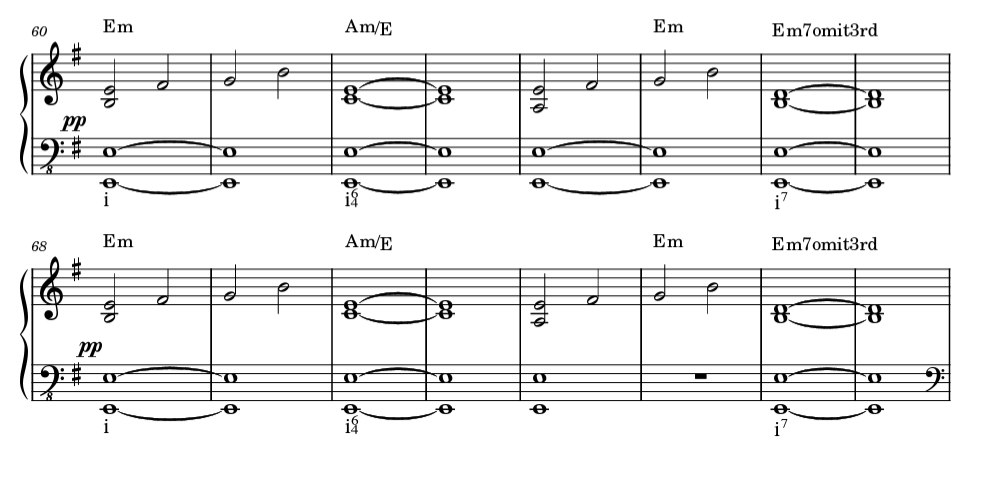
Another example from Film Music is from Hans Zimmer’s Final Ascent (No Time to Die) — prolonged tonic pedal on E creates harmonic suspension before the climax.
The last example in this category comes by the hands of John Powell – How to Train Your Dragon (2009):
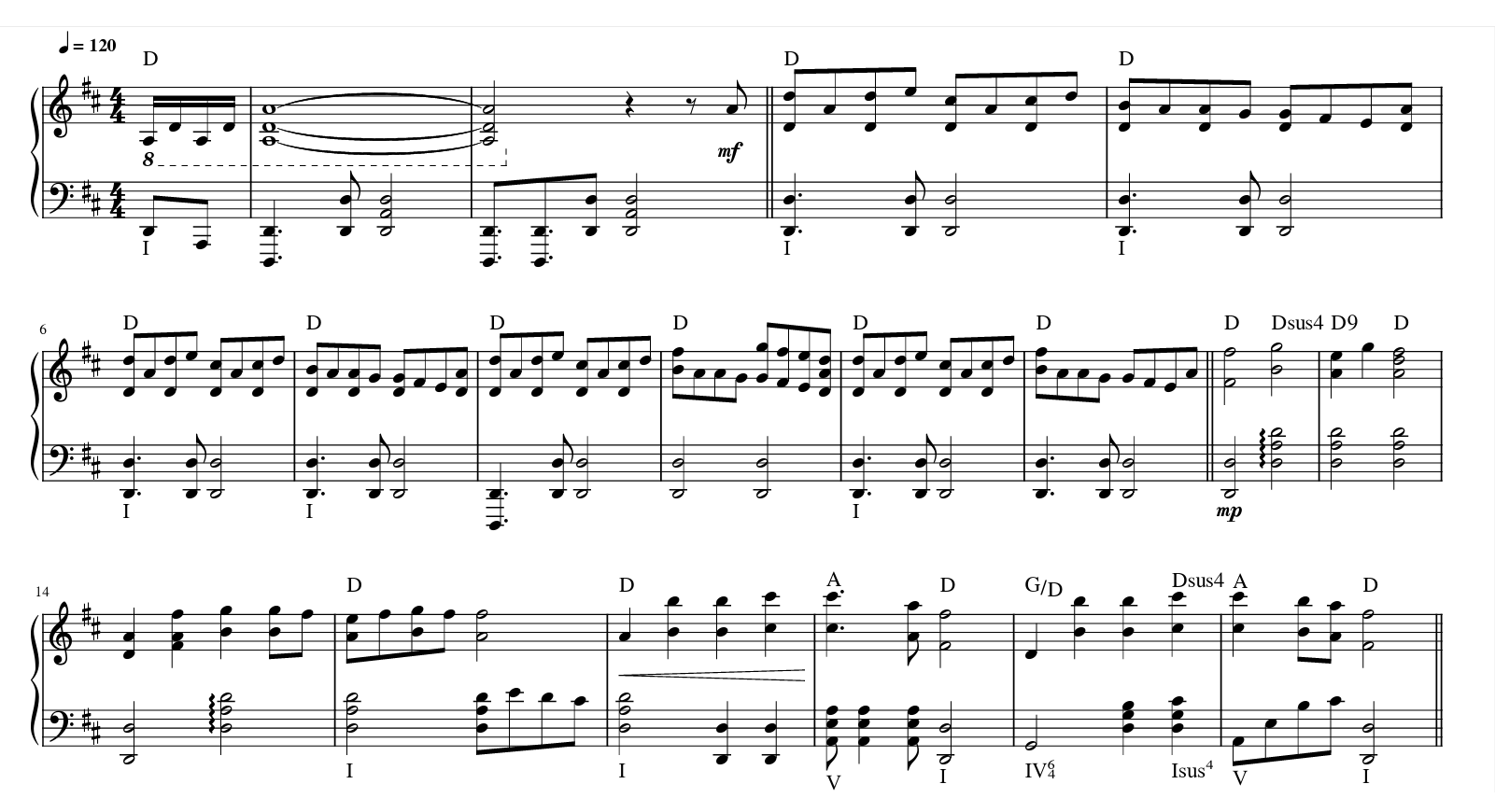
In the key of D Major, we have a sustained tonic pedal on D and over this, several added notes (added 2nds and 6ths: A and E notes) oscillations give a sense of flight and openness thanks to the lack of third and various suspended chords.
This prolongation lasts until bar 17 in which we see the dominant chord, A Major.
→ Prolongation by orchestral layering. In this example we see the piano arrangement for a better reading)
6. Jazz Examples
In jazz, prolongation appears in modal vamps, static dominant fields, and quartal harmonies, creating a sense of suspended tonality.
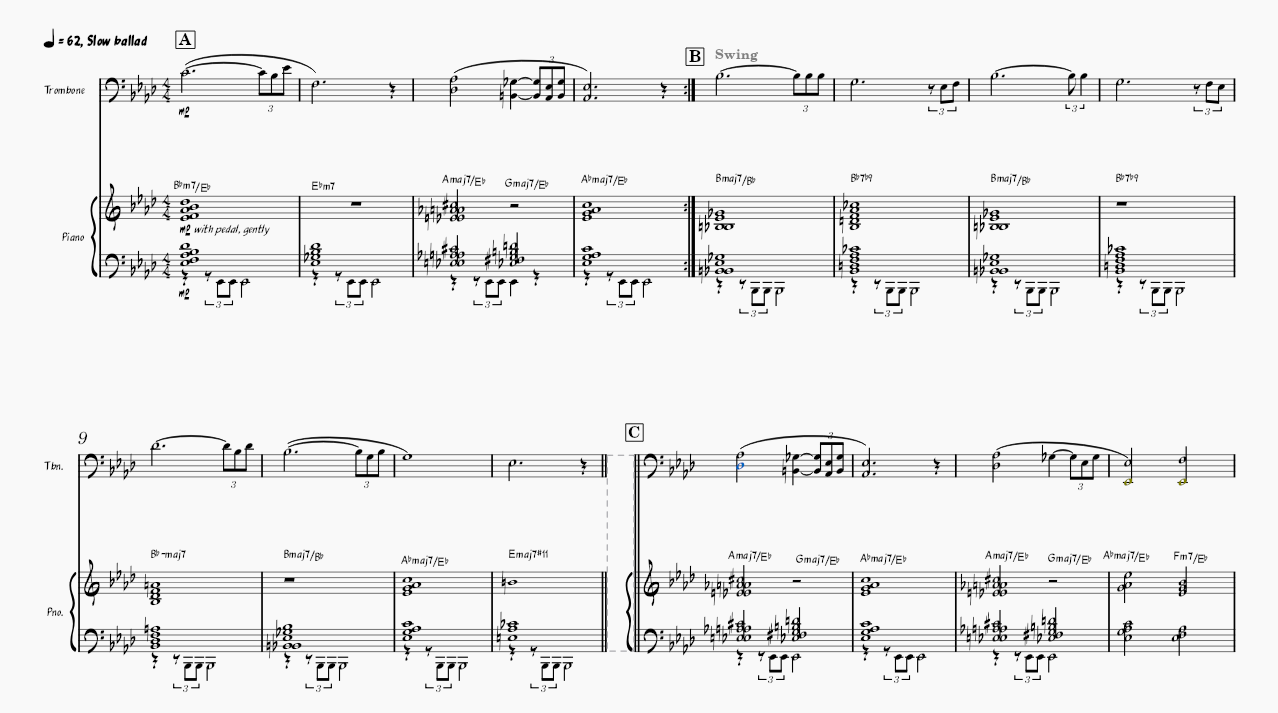
John Coltrane – Naima (1959):
The tonic (B♭m7) is prolonged with chromatic embellishing chords and pedal bass over E flat; It is a Tonic prolongation via pedal and upper chromatic planning firstly over E flat and then over B flat.
Bill Evans, Peace Piece (1958) — prolonged tonic through quartal voicings over a sustained pedal C.
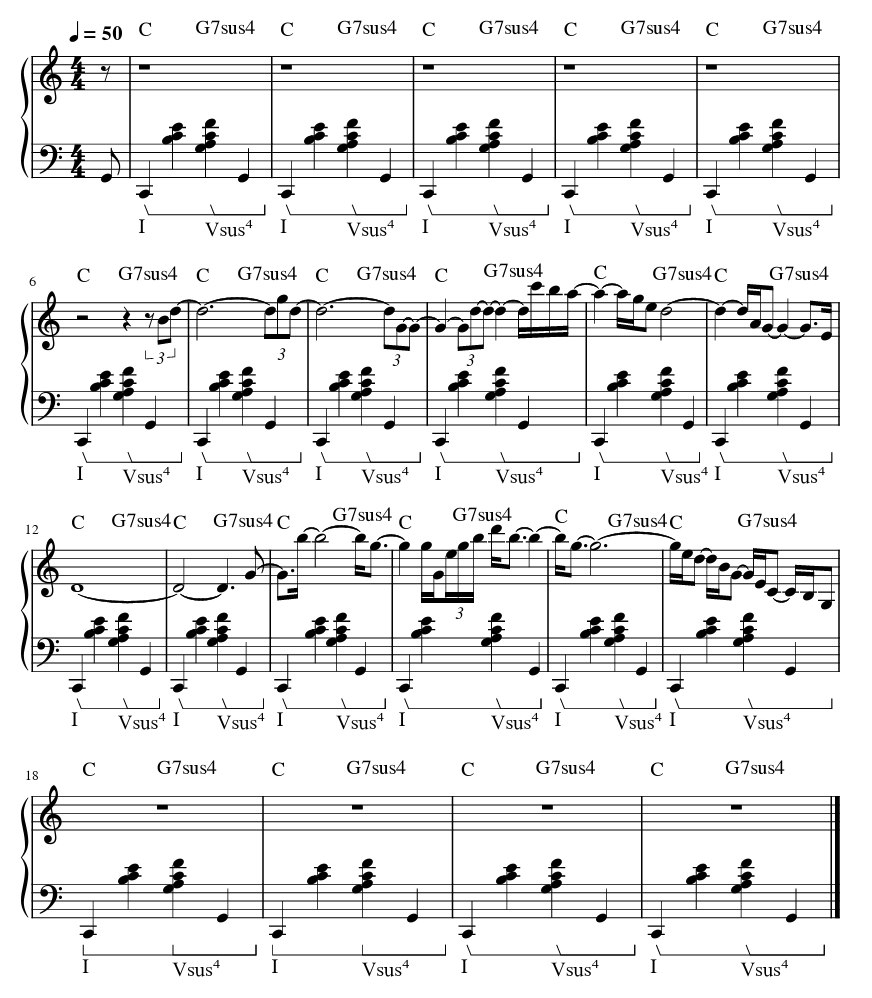
- Pianistic focus: Keep the pedal note stable and shape upper voices dynamically, highlighting harmonic colour.
In jazz, pedal points and vamps can prolong a tonic field for a long time. The harmony stays “in charge”, while the colour does the storytelling.
What creates motion here?
- voicing changes,
- added tones,
- chromatic colour,
- and sometimes planning gestures that shift harmony in parallel while the listener still hears the same functional centre.
So the lesson is: prolongation is not about being harmonically boring. It’s about designing surface evolution that serves a stable structural centre.
Sub-Categories of Pedal Points: Dominant prolongation and “Standing on the dominant”
1. Definition
In Caplin’s terminology, standing on the dominant is a passage where the harmony remains on V (the dominant of the home key) for an extended span, often several bars, while the surface (motives, textures, dynamics, register) continues to change.
Key points of the definition:
- The underlying harmony is V and stays V throughout the passage.
- The dominant is often reinforced by a dominant pedal in the bass.
- Upper voices may use neighbouring, passing, and substitute chords, but these are all subordinate to the dominant function.
- It typically occurs after a strong arrival on V (often a half cadence) and before the return to I.
You can think of it as the music lingering on the cliff edge – we are clearly away from the tonic, and we stay there, suspended on V – prolongational chord progressions guide.
2. Function
- a) Formal function
“Standing on the dominant” usually serves formal preparation:
- In sonata-form developments, it often:
- Marks the end of the core (or pseudo-core) and
- Prepares the retransition into the recapitulation.
- In other contexts (themes, codas), it can:
- Extend a half cadence,
- Act as a post-cadential prolongation on V, or
- Provide a “launching pad” into a new section.
In Caplin’s language, it belongs to continuation / concluding functions rather than initiating ones: it is rarely the start of a theme; it’s what happens when we already know where we are (on V) and we are deliberately kept there.
- b) Harmonic function
Harmonically, its role is to:
- Prolong the dominant function over multiple bars.
- Intensify the need for resolution to tonic (I).
- Make the eventual return to I – especially the recapitulation tonic – feel inevitable and strongly justified.
Even if the surface shows various chords (ii, vii°, V⁷ with added notes, 6/4 chords, chromatic embellishments), they are heard as decorations or transformations of V, not as genuine functional departures.
3. Uses in composition
Here are the main ways a composer can use a standing on the dominant:
3.1 In a development section (classic case)
- After a core full of sequences and modulations, the composer:
- Drives to V of the home key – often articulated as a clear half cadence.
- Then stays on V for several bars:
- Dominant pedal in the bass.
- Fragments of the main motives in the upper voices.
- Increasing rhythmic energy and dynamics.
Purpose:
- To anchor the music back in the home key area after wandering.
- To accumulate tension so that the recapitulation tonic (I) feels like a powerful release.
- To create a sense of suspense and expectation – like holding a breath before the return.
3.2 As an extended half-cadential area in a theme
Within a main theme or transition, a composer may:
- Arrive on V (half cadence) at the end of a phrase.
- Then linger on V with repetitions, figuration, and perhaps varied motives.
Purpose:
- To lengthen the cadential moment without actually resolving it.
- To give performers and listeners time to feel the dominant’s pull.
- To smooth the move into the next thematic idea or section.
3.3 As a structural “frame” for motivic work
Because the harmony is held constant, standing on the dominant is a perfect playground for motivic development:
- You can fragment the main idea.
- Sequence it rhythmically or intervallically without changing function.
- Play with texture and register (tremolos, broken chords, octaves, call-and-response between registers).
The dominant acts like a fixed backdrop against which the motivic drama unfolds.
3.4 As a dramatic device (beyond classical style)
In later styles (Romantic, film, jazz-influenced writing), the same idea appears in different dress:
- Long V⁷ or V⁹ pedals under swirling figurations.
- Ostinato on the dominant while orchestral colour changes above.
- In film music, a dominant pedal sustains tension under a build-up towards a big arrival.
The expressive effect is always similar: holding tension, delaying gratification, heightening the listener’s anticipation.
EXAMPLES:
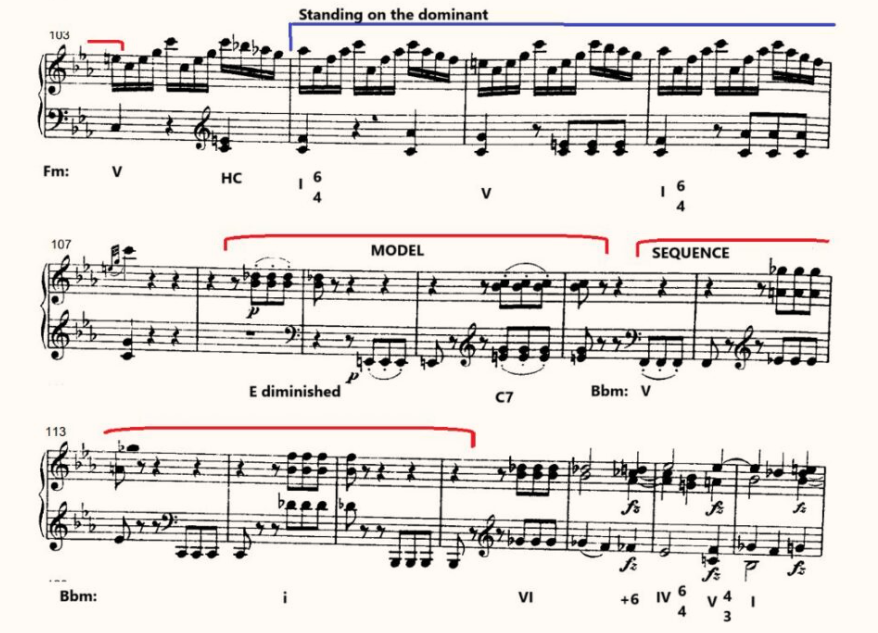
1. Haydn – Piano Sonata in E-flat major, Hob. XVI:49, I, Development, c. bars 94–107
In my analysis of this sonata, I quote Caplin’s description of a development as: pre-core → core (sequences) → HC or dominant arrival → standing on the dominant → re-transitional instability.
Below you can find my full article and analysis of this Sonata:
- In the development of Hob. XVI:49 I:
- A vigorous core drives toward a half cadence in G major (dominant of C minor).
- Then Haydn reaches a long dominant (G major harmony), which is prolonged from about bar 104 to 107.
- This is a classic standing on the dominant: motives are fragmented and repeated, but the harmony stays on V.
- In other words:
- “We’ve climbed to the cliff edge (the HC); now Haydn keeps us dangling there on V, repeating ideas and thickening texture, before we move into the retransition and, later, the recapitulation tonic.”
2. Muzio Clementi – Sonatina Op. 36 No. 4 in F major (First movement, Development, Bars 43-46)
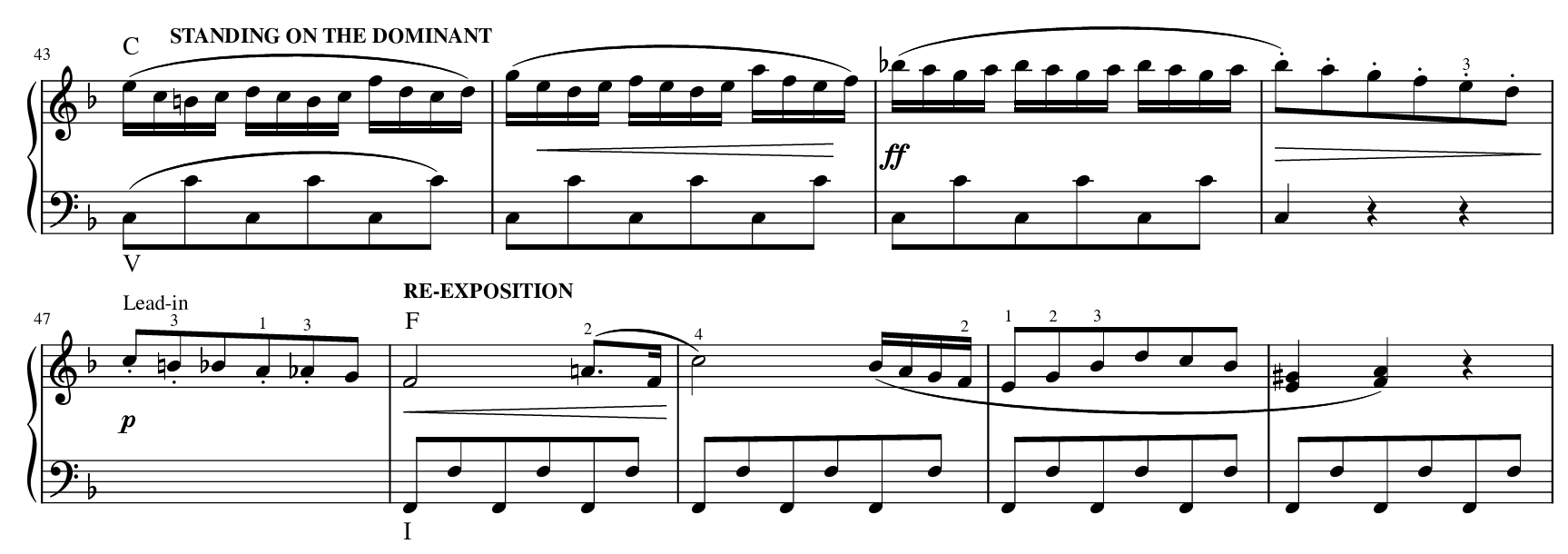
- Here we have a Standing on the Dominant on C major, the Dominant of the main key, F major, to retransition to the main theme (the re-exposition)
- The phrase reaches a half-cadential V.
- Clementi lingers on that V, repeating and varying the material over the same dominant harmony.
How to recognise and use it
How to recognise it:
- Look for a clear dominant arrival (often a half cadence).
- Check whether the harmony then stays on V for several bars.
- Ignore the surface figuration at first; reduce to bass + simple upper notes.
- If it’s essentially all V (with passing/neighbour/substitute decorations), it’s standing on the dominant.
How to use it in compositions – Example:
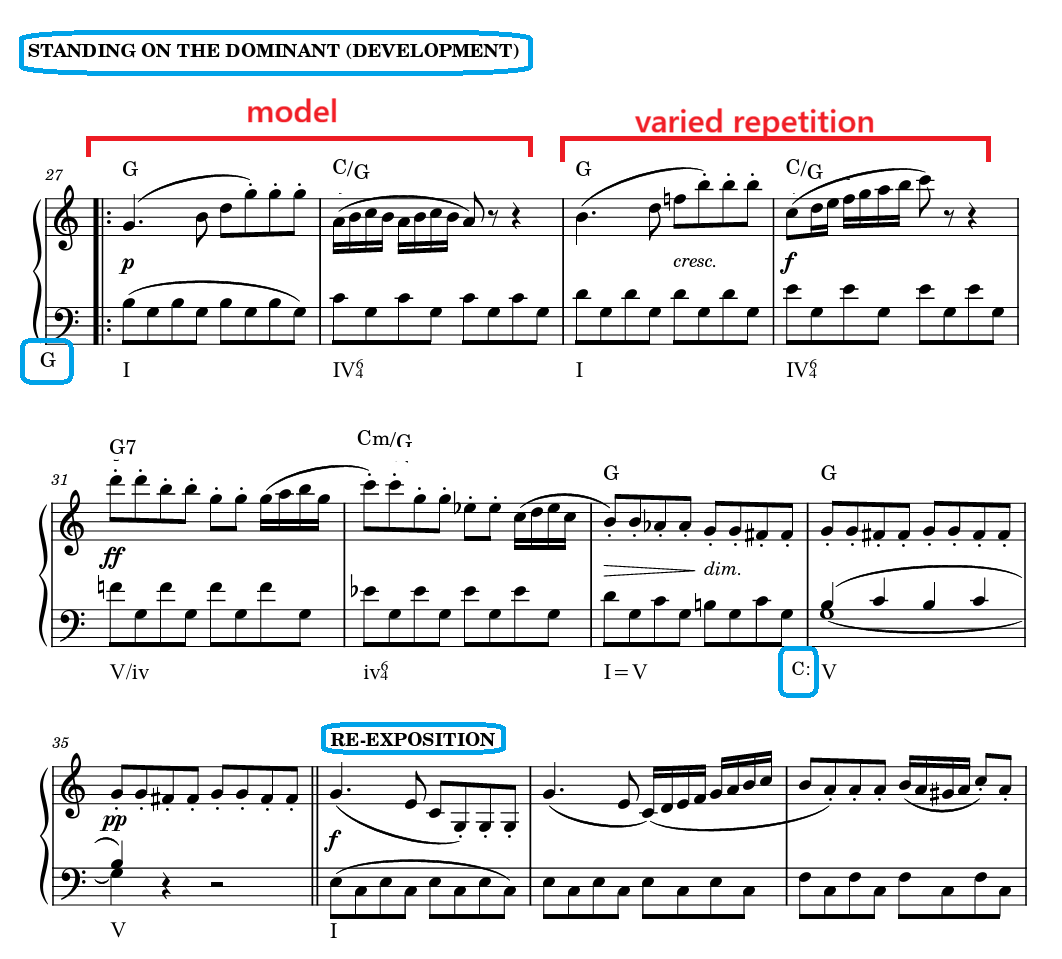
- In another example, the Sonatina Op. 36 No. 3 in C Major by Muzio Clementi, he:
- Chooses a strong V chord (G major as V of C).
- Holds G in the bass for 9 bars. (27 to 35 on the score)
- Additionally, he varies the:
- Motive of two bars, in which the first one (bar 27) is an inversion of the main theme on the dominant level
- In Bar 28, the second part of this motive, he changes the rhythm, adding more short notes (semiquavers)
- The texture is broken chords, more specifically, Alberti bass.
- After building tension, resolves to I in a clear, well-spaced cadence in bar 36 with the beginning of the re-exposition on the tonic key
- We immediately feel what “standing on the dominant” does:
- It stretches the moment before the resolution,
- It gives them space to develop ideas,
- And it makes the final I land with much more impact.
Sub-Categories of Pedal Points: Ostinato
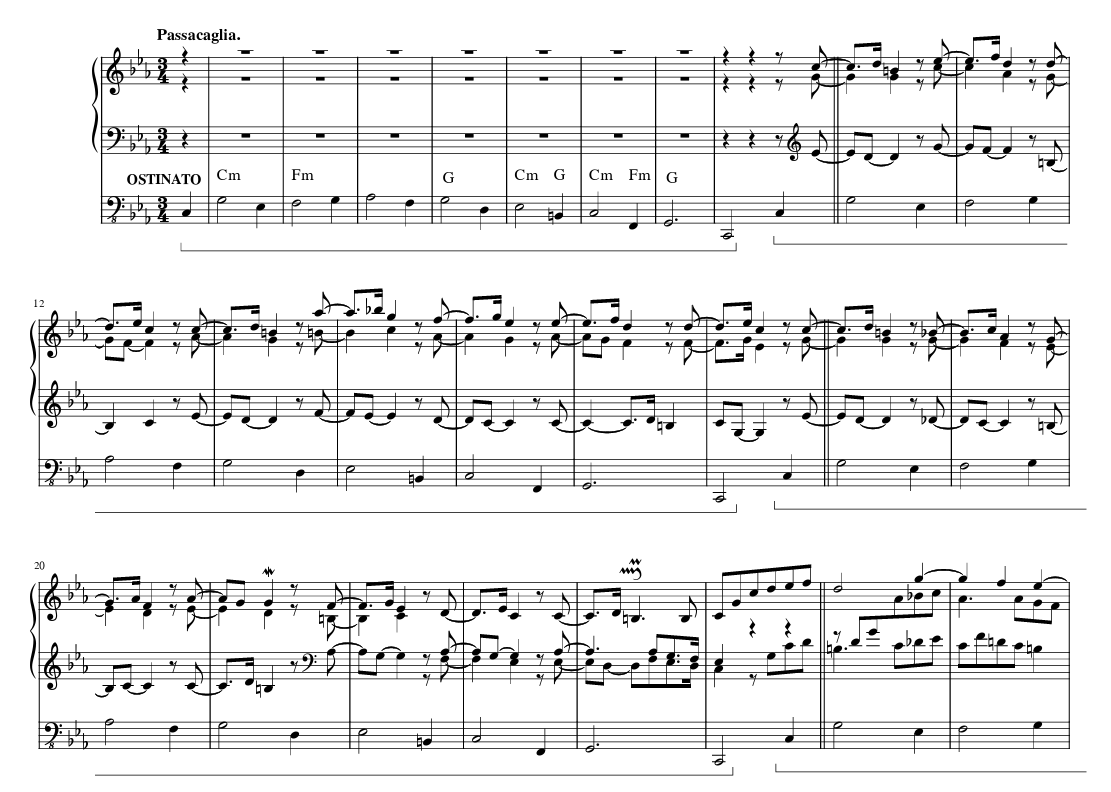
An ostinato is a short musical idea that repeats persistently—it may be melodic, rhythmic, harmonic, or a mixture of these. In practice, the repetitions may be exact or may admit small adjustments (transposition, registral change, slight rhythmic alteration), but the defining feature is perceived recurrence in a stable voice or layer.
What makes ostinato especially powerful is that it creates a structural constant: while other parameters change (melody, texture, counterpoint, orchestration), the listener hears the repeating pattern as a ground—a reference-point that stabilises time and harmony.
How ostinato links to prolongation
An ostinato becomes a “prolongational-progression ostinato” when:
- The repeating pattern locks in a single function (commonly T or D) for an extended span; and
- The changing harmonies above it are heard mainly as decorations (neighbours, passing motions, diminutions, suspensions) that do not overturn the governing function.
Typical cases:
- Dominant pedal ostinato (standing on V): prolongs D.
- Tonic pedal / tonic-pattern ostinato: prolongs T.
- Ground-bass ostinato (passacaglia/chaconne): repeats a fixed bass-and-implied-harmonic scaffold that often preserves a stable tonal centre over many repetitions.
Why this is “prolongational” in the Caplin sense
Although Bach’s ground implies its own recurring harmonic circuit, the crucial Caplin-style point is perceptual:
- Over long stretches, the listener experiences a single, stable harmonic framework—the repeating ground—as the governing harmony-plan.
- The continuously changing counterpoint above it (register, texture, rhythmic activity, figuration) is heard as embellishment and intensification of that underlying plan, not as a new “theme with new harmonic goals” each time.
That is precisely the logic of harmonic prolongation: a deep-level harmonic support persists “through” surface chords and contrapuntal events – prolongational chord progressions guide for beginners.
Passacaglia in C minor BWV 852: How Bach makes the prolongation audible (techniques)
Across the 20 variations, Bach strengthens the sense that the ostinato is the “true floor” of the piece by:
- Textural stratification
-
-
- The pedal’s recurring eight-bar line acts as a structural anchor on the Bass Voice.
-
- Manual parts become progressively more active (figuration, imitation, registral spread), but the ear keeps tracking the ground as the stable referent.
- Contrapuntal intensification (without losing the ground)
- Variations can thicken into multi-voice counterpoint, but the ear continues to “hear through” to the repeating bass framework—classic prolongational hearing.
- Large-scale articulation by grouping
- Analysts often point to notable internal highlights and groupings (e.g., passages singled out around bars 96–120 and 144–168 in some discussions), which function as intensifications within the same repeating ground structure.
Bridge into the fugue (a structural “payoff”)
Bach then derives the fugue’s material directly from the passacaglia ground:
- The first half of the ostinato becomes one fugue subject, and a transformed version of the second half becomes another; they combine as a double fugue.
This is a particularly elegant demonstration of “prolongational thinking” across movements/sections: the ostinato is not merely accompaniment—it is generative structure.
I made an analysis of the Ostinato of this piece in my article “How to write a Melody” :
The analysis can be seen in point No. 5: “How to combine Harmony, Rhythm and melody” (links below)
https://www.piano-composer-teacher-london.co.uk/how-to-write-a-melody-2/
A repeating eight-bar bass line (C–G–E♭–F–G–A♭–F–G–D–E♭–B–C–F–G–C) prolongs the tonic area across many variations, functioning as a broad tonic field.
→ Prolongational device: ostinato bass defining a stable harmonic function.
Neighbouring Chords
The prolonged harmony remains stable while moving briefly to an adjacent harmony.
- Classical Period
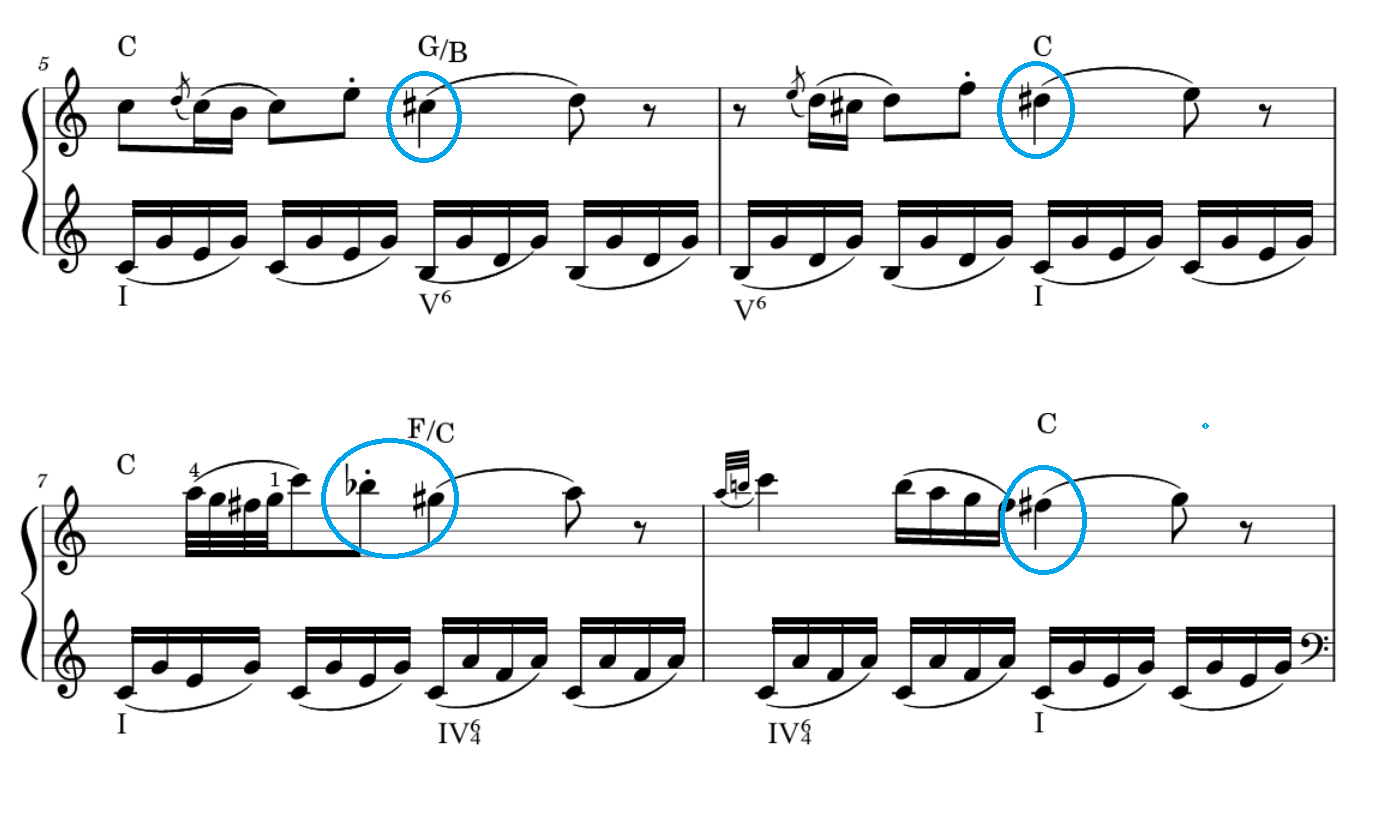
Mozart, Piano Sonata No. 1 in C major, K.279 (I), bars 5–8:
In the opening of K.279, bars 1–4 project a clear tonic beginning in C major. Bars 5–8 (in the commonly used editions) are the four bars that begin with the change to the continuous semiquaver “legato” accompaniment (the left hand shifts into a treble clef and starts an arpeggiated figuration).
From a Caplin-oriented viewpoint, what matters is that these bars do not “advance” the harmony towards a cadence. Instead, they prolong tonic function through prolongational progressions and neighbouring/embellishing sonorities, creating motion and expectation without cadential closure.
1) Bars 5–6: tonic prolonged, but “tinted” with dominant-directed chromaticism
Surface
-
- The left hand spins a steady arpeggiation that strongly anchors the tonic area (the figuration keeps the sense of C major “in the ground” due to the root position).
- The right hand moves in longer note-values and introduces chromatic pitches (notably C♯, D♯, G♯ and then F♯), which “brighten” the line and point towards the G note – dominant territory without actually arriving there.
Hearing it functionally (Caplin)
Caplin’s prolongational progression idea is useful here: we often experience a harmony as continuing even while the surface adds embellishing chords/tones.
A practical reading is:
- Bar 5: I (C major) is prolonged.
- D♯ is best heard as an altered tendency tone that projects dominant direction (it behaves like a leading tone up to D, scale-degree 2), but without establishing a cadential dominant.
- Bar 6: still within tonic prolongation, but the added C♯ makes the “dominant pull” more explicit.
- C♯ + D♯ strongly creates a forward impulse (chromatic intensification) while withholding the cadential dominant that would articulate a formal boundary.
2) Bars 7–8: tonic “expands sideways” via a neighbouring tonic-substitute (vi) and chromatic neighbour-tones
The big shift
Across bars 7–8, the accompaniment’s arpeggiation and the melodic behaviour strongly bring F Major (IV) to the foreground.
The expressive detail: chromatic double-neighbour around A
In the melody you get striking chromatic notes such as B♭ and G♯ in close proximity. In voice-leading terms, that’s a classic double-neighbour figure enclosing A:
-
- B♭ = upper chromatic neighbour to A
- G♯ = lower chromatic neighbour to A
- resolving back to A
So, while the harmony leans towards IV (F Major), the melody intensifies it through a highly audible neighbour-motion.
A compact functional summary
A way to describe bars 5–8 is:
- Bars 5–6: Tonic prolongation (I) with chromatic dominant-directed inflections
- Bars 7–8: Neighbouring tonic expansion via IV (F Major), intensified by chromatic neighbour-tones (B♭ / G♯) and continued motion that prepares what follows rather than closing anything.
Passing Chords
Connecting two positions of the same harmony by stepwise motion.
Classical Period:
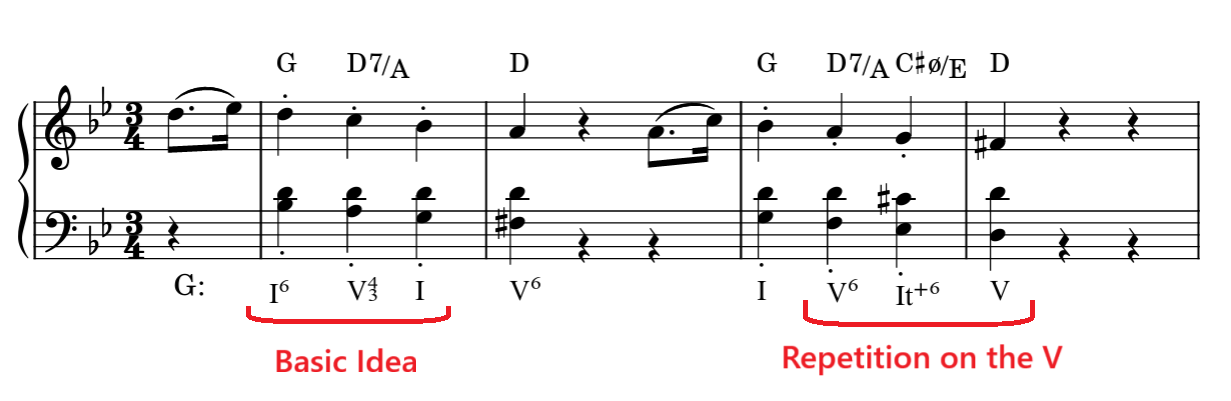
Beethoven, Bagatelle in G minor, Op. 119, No. 1
The basic idea starts on the first inversion of the tonic and goes to the root position. The basic idea is repeated on the dominant level from the first inversion of the dominant and ends in root position:
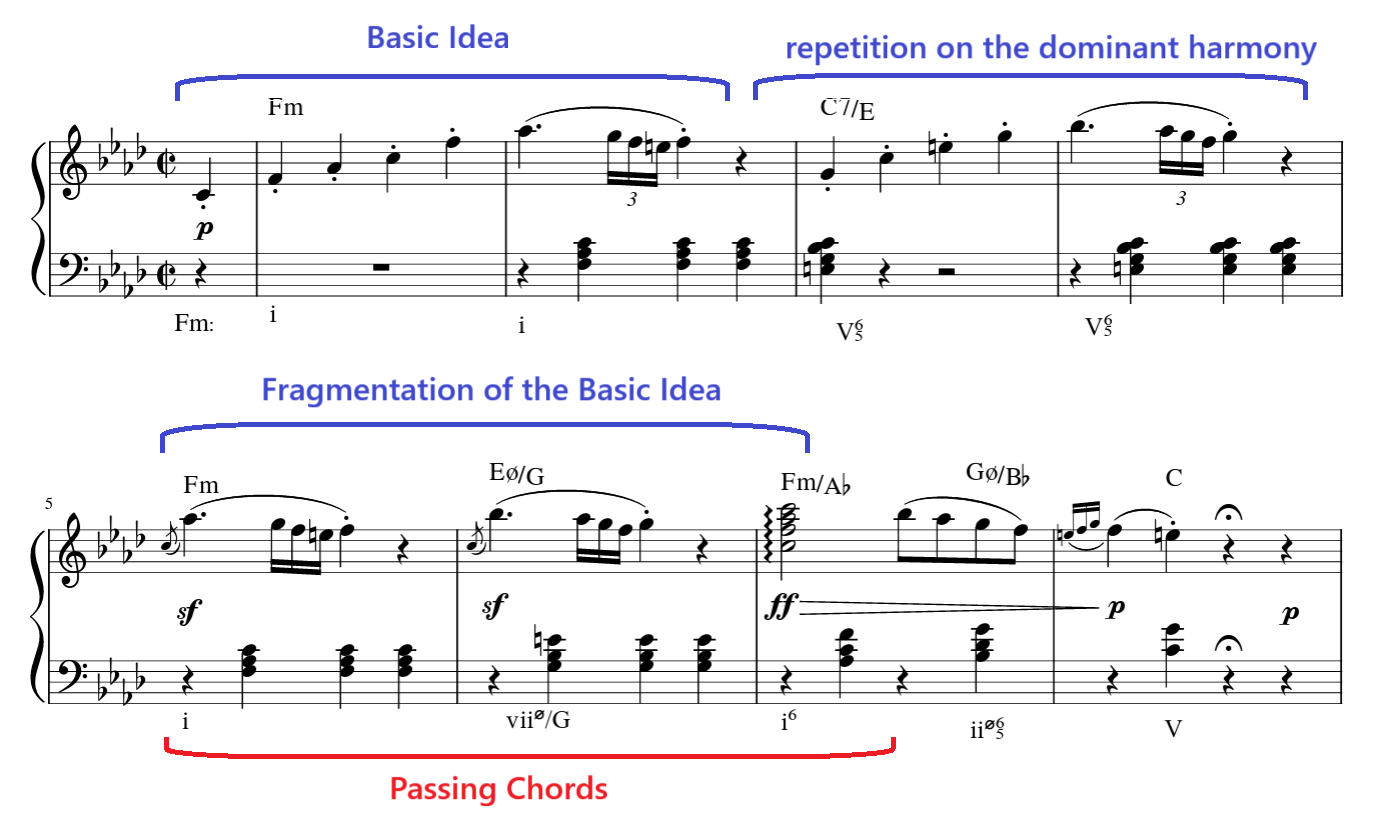
Beethoven Sonata Op. 2 No. 1
Bars 5–7 – I–V⁶–I⁶: The sentence begins with a 2-bar. basic idea, supported by tonic harmony (prolonged by neighbouring chords) The idea is repeated, now harmonised by the dominant in bars 3 and 4. In bars 5 to 7, the harmonic rhythm speeds up with a fragmentation of the basic idea over passing chords from the tonic in root position to the tonic in first inversion:
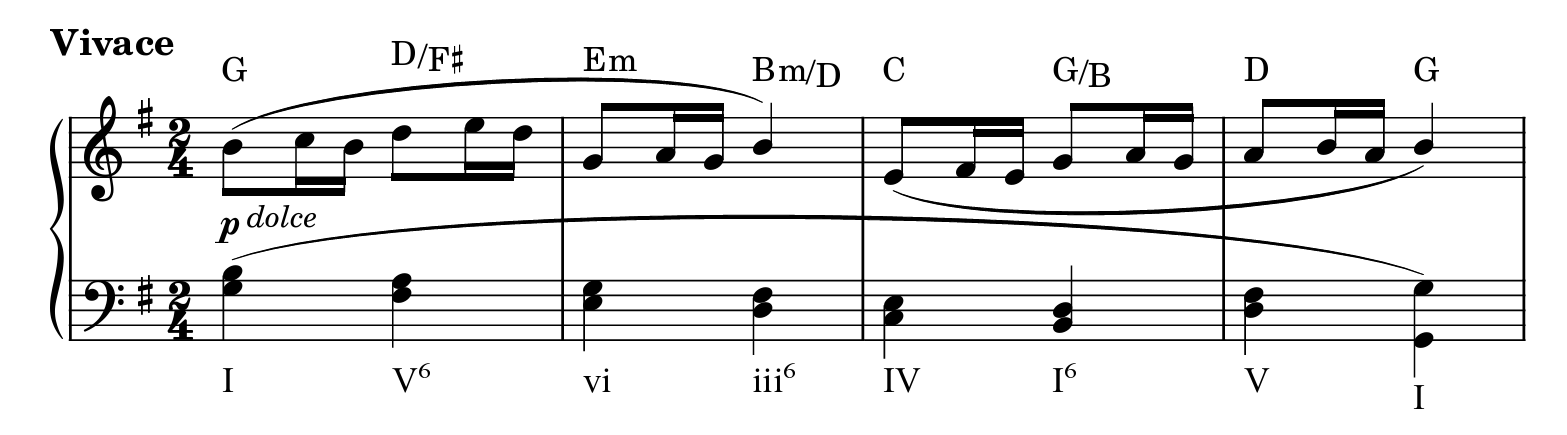
Beethoven, Piano Sonata in G major, Op. 79, iii (Vivace), bars 1–4
1) The large-scale harmonic job
Bars 1–4 are dominated by tonic prolongation through a stepwise descending bass.
So: most of the “chord changes” early on are passing in function, even if they resemble “real” harmonies when labelled with Roman numerals.
2) The core prolongational mechanism: descending stepwise bass and “linear” harmonies
In bars 1–4, Beethoven sets up a very clear descending bass line (moving by step) articulated in half-bar units (each beat in 2/4). Over that stepwise bass, the harmony is best heard as I being prolonged by a passing progression.
A workable harmonic hearing (by beat) is:
Bar 1
-
- beat 1: I (G major) — the tonic “pillar” in root position.
- beat 2: V6 (D Major) — leading-tone sonority over F♯ in the bass — passing connector.
Bar 2
-
- beat 1: vi (E minor) — tonic-substitute colour within the prolongation.
- beat 2: iii6 (B Minor) — here functioning subordinately, as part of the linear descent rather than cadential closure.
Bar 3
-
- beat 1: IV (C major) — colouristic support for the continuing descent.
- beat 2: I6 (G/B) — a passing tonic-inversion sonority.
Bar 4
-
- beat 1: V (D Major) — Dominant closure.
- beat 2: I (G major) — return-point that completes the 4-bar descent.
Why these are “passing” (prolongational) rather than functional-cadential
- The ear tracks a single linear descent in the bass; the “harmonies” mainly name the vertical result of that line.
- Nothing in bars 1–4 behaves like a cadential dominant that must resolve; the motion is continuous and non-climactic.
- Several sonorities appear as dyads in the accompaniment; the missing chord-members are supplied/implicated by the melodic line and tonal syntax—typical of passing-progression writing.
FILM MUSIC
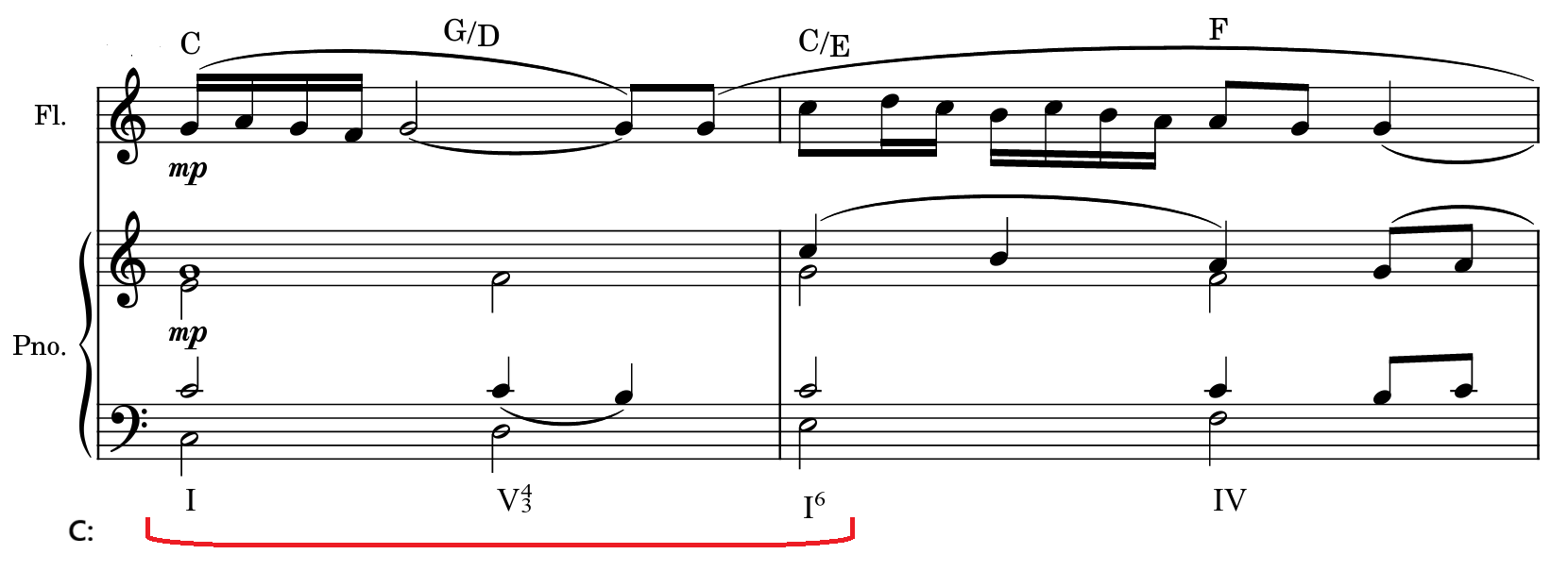
Ennio Morricone – Gabriel’s Oboe (1986):
C major tonic prolonged through I–V⁶₄–I₆, sustaining peaceful stasis.
→ Classical-style prolongation in film idiom.
ROCK MUSIC
Led Zeppelin, “Stairway to Heaven” — Introduction, Bars 1-4
Prolongation via a chromatically descending bass line
The first 4 bars (repeated 4 times), gives the first phrase as:
| a E/g# | C/g D/f# | FM7 | a |
How it works (prolongationally):
- The ear locks onto a tonic-centred span while the bass traces a chromatic descent—a pop/rock analogue to common-practice linear prolongation.
- Whether one hears the sonority as a fleeting dominant-inversion (E/G♯) or as A minor with line-chromatic bass, the key point is: the passage’s rhetorical function is not cadential arrival but continuity + colour—a prolongational “holding pattern” at the start of the song.
- The hierarchy of the A minor is expressed by being the only chord in root position, thus making it gravitationally heavier than the other chords, all in inversions.

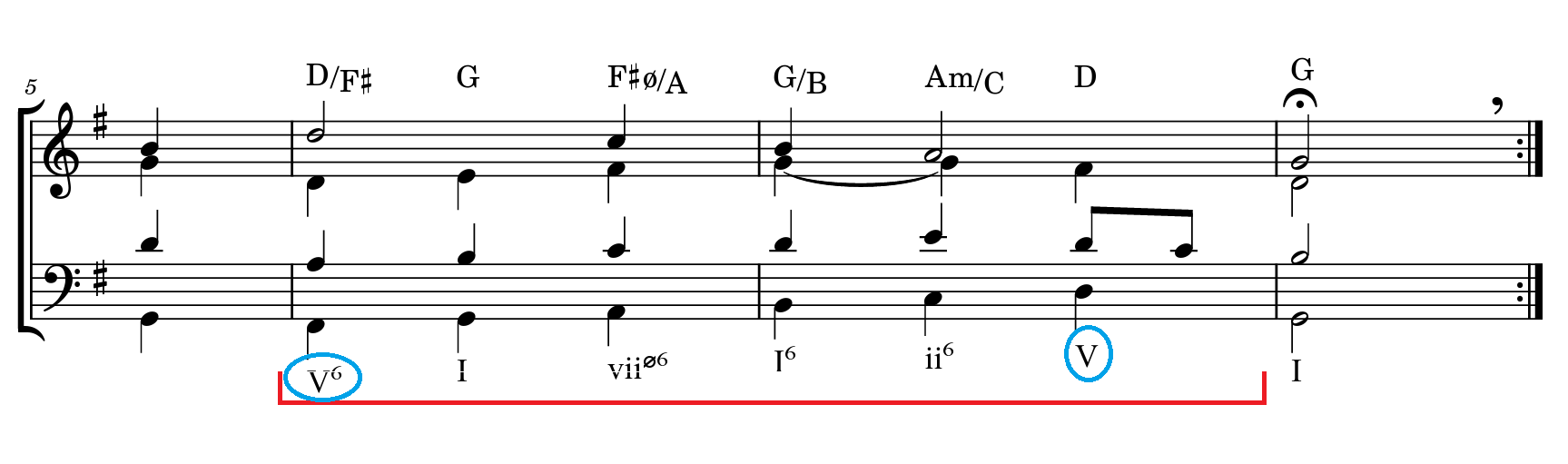
J. S. Bach, Chorale “Aus meines Herzens Grunde”, BWV 269 — Bars 5-6
Function being prolonged: Dominant (D)
A chorale texture makes passing chords especially clear because the voices move with near-textbook contrapuntal control. In this chorale, bar 5 starts on V6 (first inversion of the Dominant of G major, the main Key) and prolongs to the root position at the end of bar 6.
How it works (prolongationally):
- The bass participates in a stepwise line, and the harmony that appears “in between” is best heard as a supporting sonority for that line.
- In Caplin functional terms: this is a D span whose internal surface is animated by passing voice-leading, not by a new functional module.
Subordinate Harmonies:
In Caplin’s functional theory, a subordinate harmony is a chord that expands or elaborates a primary functional harmony (Tonic, Pre-Dominant, or Dominant) without changing its underlying function.
It exists within a prolongational progression, not as a step in functional succession.
In other words:
A subordinate harmony does not move the music forward functionally — it prolongs the current harmonic state.
Romantic Music Example:
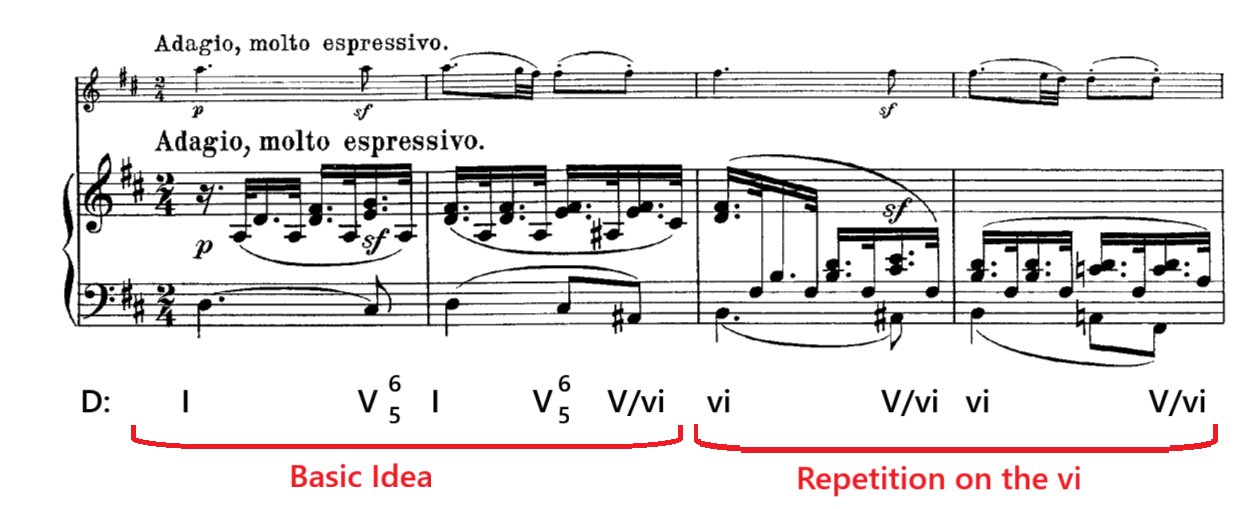
Beethoven, Violin Sonata in A, Op. 30, No. 1 (2nd Movement)
In this piece, the basic idea in bars 1 and 2 is repeated sequentially down a third, from the tonic to the submediant, prolonging the tonic harmony:
Pop Example:
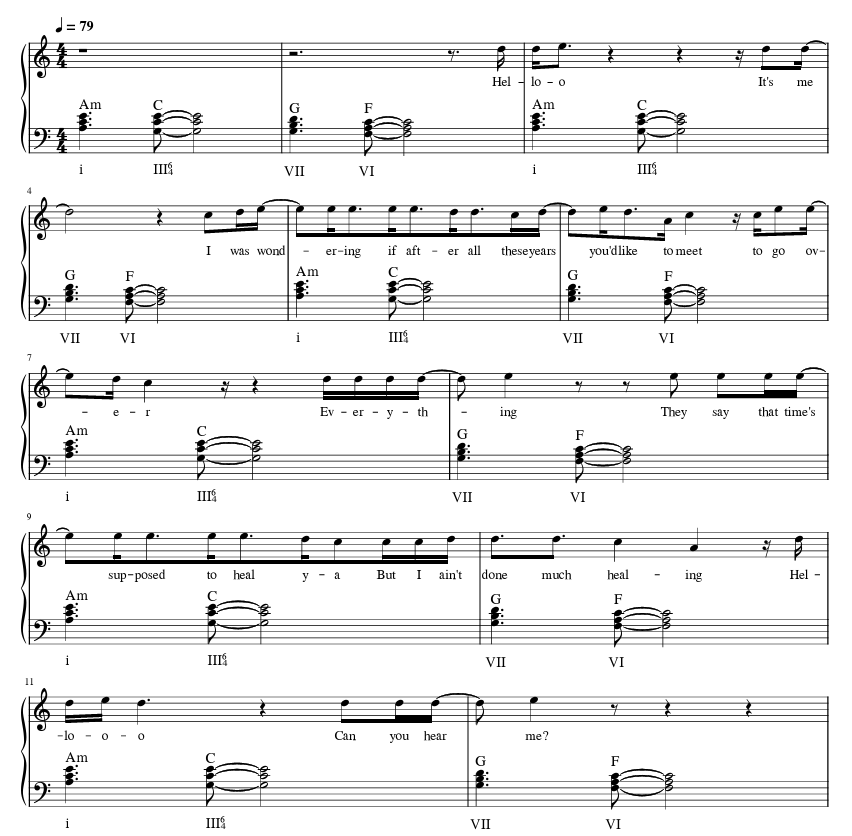
Adele – Hello (2015):
Opening i–III–VII–VI (in this example: Am-C-G-F) The tonic, Mediant and Submediant belong to the tonic family and the VII (major) belongs to the subdominant family. The loop remains in the tonic field; functionally prolongational since harmonic direction does not change.
→ Substitute chord prolongation.
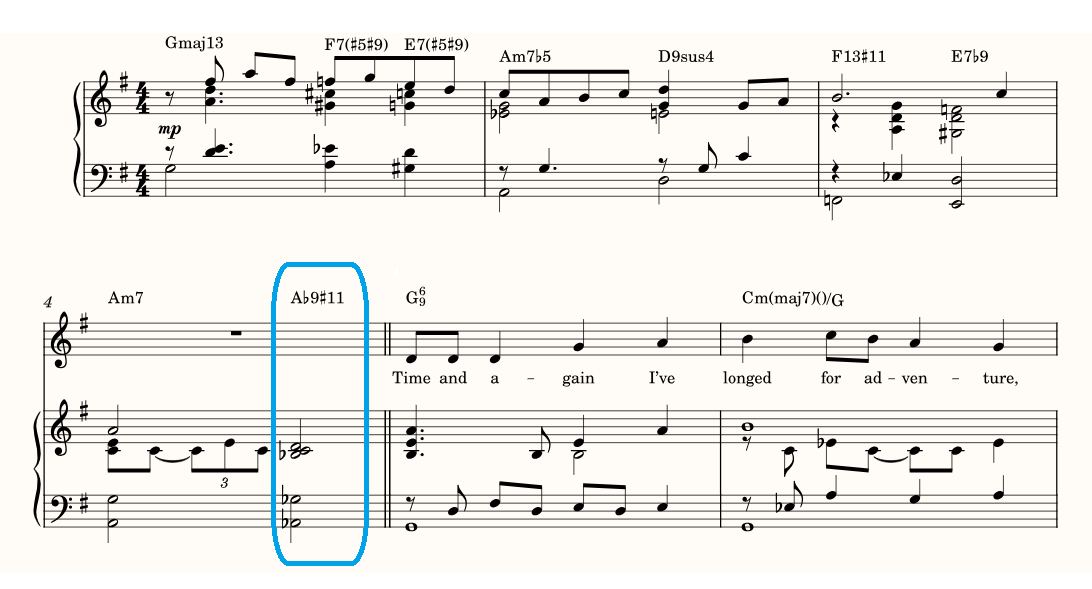
Jazz –“All the Things You Are” – Jerome Kern
The normal progression | Am7 – B♭7 – Gmaj7 |
is often re-harmonised as | Am7 – A♭7 (tritone sub for D7) – Gmaj7 |.
Effect: introduces chromatic bass movement (A–A♭–G) while preserving resolution.
https://musescore.com/user/39593079/scores/6928294
Adapting Prolongational Chord Progressions Across Genres in Your Own Compositions
Prolongation, as Caplin describes, is the art of sustaining a single harmonic function while introducing surface variety, tension, or movement – Continuing with prolongational chord progressions guide.
This concept transcends style: whether a Bach prelude or a Hans Zimmer soundtrack, prolongation keeps music alive within a single harmonic space.
To apply this concept creatively, composers can reinterpret prolongational techniques through the aesthetic and textural language of each genre.
Below are practical strategies for translating the same underlying harmonic logic into different musical idioms.
1. From Baroque Pedal to Modern Drone
In Baroque composition, a pedal point often anchors the tonic or dominant while upper voices weave contrapuntal motion.
In contemporary writing, this can become a drone texture — a sustained tone or chord layer that evokes space or contemplation.
How to adapt:
- Replace continuo-style pedal bass with synth pads, strings, or ambient textures.
- Retain contrapuntal motion by introducing melodic fragments, arpeggios, or motifs above the drone.
- Gradually vary the voicing, density, or orchestration while keeping the pedal stable.
Example:
Transform Bach’s Prelude in C major into a modern cinematic cue by sustaining a low C in the bass, layering minimalistic arpeggios, and slowly evolving harmonic colour through added tones (add9, maj7).
2. From Classical Neighbour Chords to Pop Oscillations
Classical composers like Mozart or Haydn used I–V⁶–I or I–IV–I to gently vary the tonic harmony.
In pop, this becomes the oscillating loop — a hypnotic progression that prolongs the tonic through alternation.
How to adapt:
- Choose a tonic-based two-chord loop (e.g., I–V⁶, I–IV, or I–vi).
- Emphasise rhythmic and textural variation rather than harmonic change.
- Keep the loop diatonic for stability, or introduce modal colour (e.g., iv in major).
Example:
Coldplay’s Clocks transforms I–V⁶–I into a rhythmic pattern: each change rearticulates the tonic field, not a new function.
Composers can emulate this by varying inversion, rhythm, or voicing rather than function.
3. From Romantic Pedal to Jazz Modal Vamp
Romantic composers often prolonged tonic or subdominant fields with expressive chromaticism and colour chords.
In jazz, the same principle evolves into modal vamps, sustaining one tonal area while allowing rich chordal extensions.
How to adapt:
- Use 7th, 9th, 11th, or 13th chords as prolonged sonorities.
- Alternate between two modal regions (e.g., Dm7 ↔ G13sus4) without functional motion.
- Allow improvisation or melodic evolution over the static harmony.
Example:
Chopin’s prolonged iv in major (e.g., Fm in a C major piece) can inspire a jazz vamp like Cm7–Fm9, preserving the same subdominant warmth but in a modern harmonic language.
4. From Classical Stability to Film Atmosphere
Film composers reinterpret prolongation as a textural and emotional device rather than a strict harmonic one.
Zimmer, Shore, and Jóhann Jóhannsson frequently build entire cues from tonic prolongation, creating vast emotional arcs without harmonic change.
How to adapt:
- Sustain a tonic or modal centre (e.g., D Aeolian).
- Introduce subtle orchestral or timbral changes instead of chordal shifts.
- Employ gradual layering, rhythmic expansion, or motivic transformation to simulate progression.
Example:
Zimmer’s Interstellar organ drone prolongs tonic through register and texture, not function — a direct modern analogue of a Bach pedal point transformed by orchestration and emotional intent.
5. Cross-Genre Composition Exercise: “Transforming a Prolongation”
Try the following to internalise the flexibility of prolongational design:
Step 1 – Write a Baroque Model:
Compose four bars on a tonic pedal (C in bass) with upper voices moving through I–V⁶–I patterns in contrapuntal texture.
Step 2 – Classical Transformation:
Convert it into a homophonic phrase using simple triads (I–V⁶–I–I⁶), suitable for a Mozart-style sentence opening.
Step 3 – Romantic Expansion:
Add chromatic colouring (I–iv–I⁶, or Imaj7–IVm6) and expressive melody above.
Step 4 – Jazz Reinterpretation:
Transform the harmony into modal chords: e.g., Cmaj7–F9–Cmaj9. Add rhythmic comping or a walking bass.
Step 5 – Pop Adaptation:
Simplify the rhythm into a four-bar loop: C–G/B–C–Am. Add a groove or arpeggiated piano figure.
Step 6 – Film Atmosphere:
Sustain a C drone with gradually shifting harmonic colour (add9, sus4, 11). Use dynamic and textural evolution to create momentum.
This exercise demonstrates that the logic of prolongation remains constant — the language changes, but the structural principle endures.
Each genre finds its own way to express stability through motion, the essence of harmonic prolongation.
Takeaways 
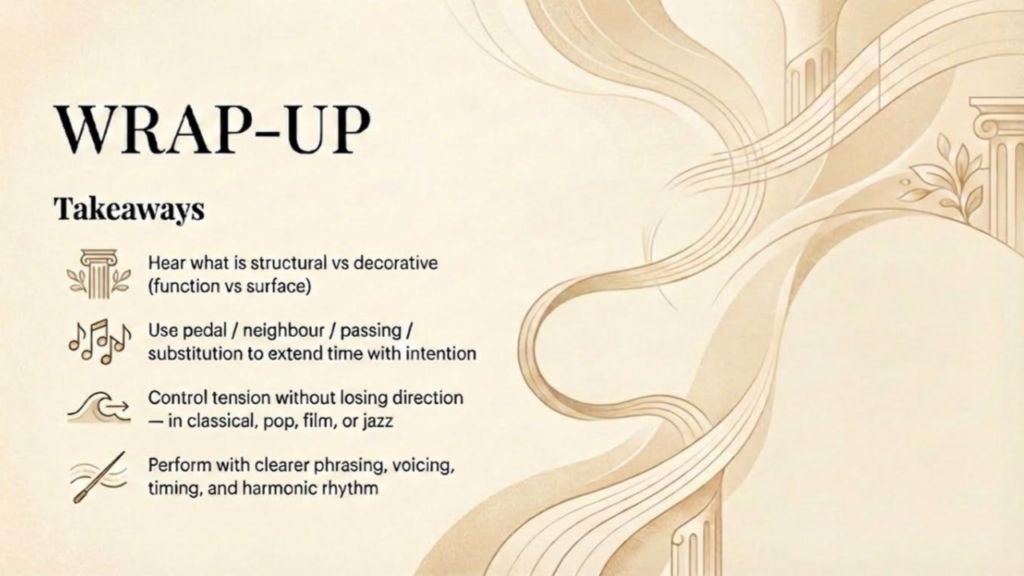
To wrap up: prolongation is the art of keeping one function in charge while creating expressive surface motion.If you remember one sentence, make it this:Not every chord change is a functional change.Once you start hearing hierarchy—structural versus decorative—your playing becomes clearer and your composing becomes more intentional.