
 TRIAL LESSON
Pianists, Piano Lessons
Wilhelm Kempff – From Musical Training to International Fame
Mar
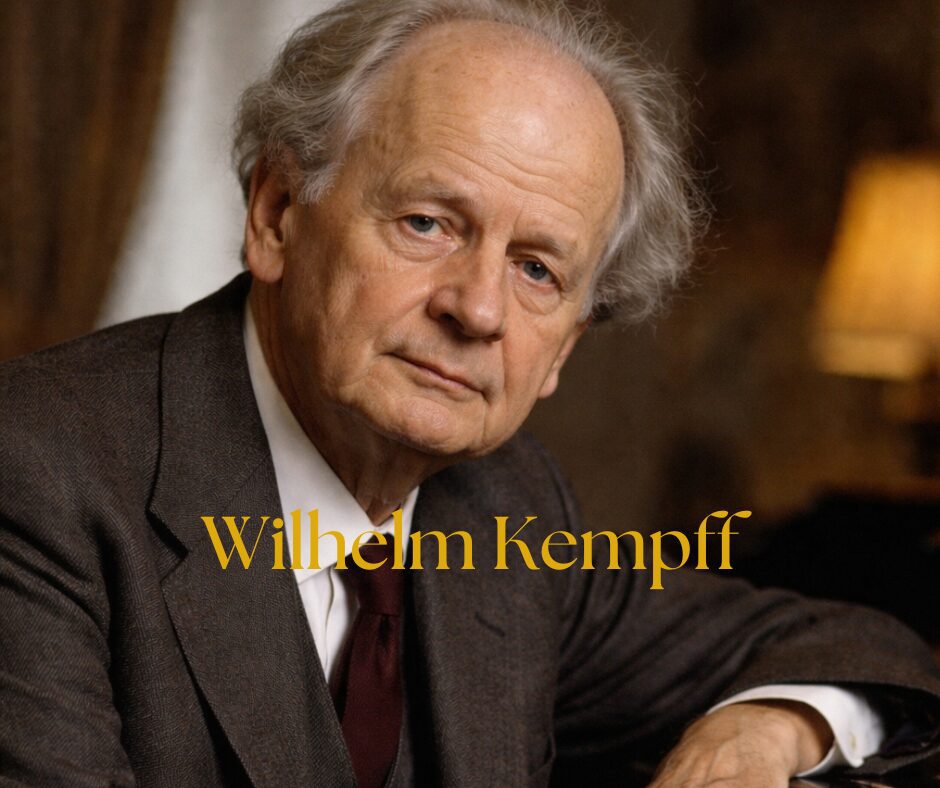
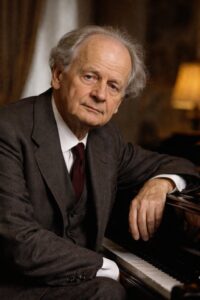
Wilhelm Kempff
Wilhelm Kempff – From Musical Training to International Fame: The Life and Education of Wilhelm Kempff
Wilhelm Kempff was a highly respected pianist known for his ability to infuse calmness, clarity, and deep emotion into his art.
The twentieth century witnessed the rise of many outstanding piano virtuosos, and Kempff was considered one of the most refined among them. He had a unique way of allowing melodies to flow naturally, creating depth in music without relying on excessive volume or speed. His contribution to classical performance and his influence on generations of pianists remain significant and worthy of study.
Early Life
Kempff was born in 1895 in Jüterbog, a small town in Brandenburg, Germany. From an early age, he was surrounded by music, as his father served as a church organist and choir leader. This musical environment deeply shaped his childhood and inspired a lifelong passion for sound and harmony.
As a young boy, he began piano lessons and quickly demonstrated a natural sensitivity to tone and phrasing. He was not only interested in technical skills such as finger movement but also in harmony, structure, and the emotional character of different musical forms. These early experiences laid the foundation for his mature artistic voice.
Education at the Berlin Hochschule für Musik
Wilhelm Kempff continued his professional formation at the renowned Berlin Hochschule für Musik, where his artistic identity took clearer shape. Studying at one of Germany’s leading conservatories gave him access to rigorous academic training and exposure to both established German traditions and evolving musical trends of the early twentieth century. During this period, he refined his understanding of classical structure while deepening his sensitivity to Romantic expressiveness. The disciplined environment strengthened his technical control, but more importantly, it sharpened his interpretative thinking and musical maturity.
His experience demonstrates how transformative education at a top-tier institution can be. Intensive programs often demand consistent performance, analytical thinking, and the ability to handle multiple assignments at once. Modern students face similar academic pressure, balancing lectures, written tasks, and practical projects. Many seek additional support to manage these responsibilities effectively. Some even consider services where they can buy college essay to stay on track with deadlines while focusing on their primary goals. When choosing such support, it is essential to ensure originality, subject expertise, and timely delivery. Just as Kempff’s structured education strengthened his artistic discipline, today’s students benefit most from reliable academic guidance that helps them maintain high standards and achieve consistent results.

Developing His Own Playing Style
Unlike many pianists who sought to impress audiences with technical brilliance alone, Kempff aimed to communicate meaning and emotion through simplicity and refinement. He believed the piano should “sing,” even in technically demanding passages.
His style was shaped by:
- Early experience with church and vocal music
- Thorough academic study of musical structure
- A belief that music should sound natural and unforced
This approach resulted in performances that felt intimate and thoughtful rather than dramatic or overly theatrical. Listeners often described his interpretations as spiritual and deeply human.
International Success
Kempff’s international recognition developed gradually. Political circumstances in Europe during the first half of the twentieth century limited his global exposure for some time. However, after World War II, he began performing more widely across Europe and beyond.
Audiences were drawn to the sincerity of his interpretations and the peaceful strength of his performances. His recordings gained worldwide appreciation, and he became especially admired for his interpretations of the German classical repertoire. Through concerts and recordings, he established himself as one of the leading pianists of his generation.
Teacher and Musical Guide
In addition to his performing career, Kempff was also a dedicated teacher and mentor. He conducted masterclasses and worked closely with young pianists, encouraging them to search for meaning behind the notes rather than focusing solely on technical perfection.
Although his own compositions did not achieve the same recognition as his performances, he remained honest about his artistic journey. He openly discussed challenges and limitations with his students, helping them grow with humility and awareness.
The Basis of His Fame
Kempff’s success was rooted in disciplined musical training combined with a deeply personal connection to music. From his childhood experiences in church to his advanced conservatory studies, each stage of his development contributed to a refined artistic identity.
He viewed performance as a bridge between composer and listener. This philosophy continues to inspire pianists today, reminding them that true artistry lies not in display but in communication.
Conclusion on Wilhelm Kempff
Wilhelm Kempff’s journey was structured, thoughtful, and driven by dedication to musical truth. His education, life experiences, and commitment to expressive clarity shaped a legacy that continues to influence pianists around the world. Through his recordings and teachings, his calm yet profound musical voice remains alive for new generations of listeners and performers.
Do not miss our post about Artur Schnabel at WKMT Blog.
Extra Version of Wilhelm Kempff & His British Performances
Wilhelm Kempff — life, recordings and his relationship with Britain
Quick snapshot & fact box
- Born: Nov. 25, 1895, Jüterbog, Brandenburg (Germany). Son and grandson of church musicians; father was organist at St. Nicolai in Potsdam.
- Died: May 23, 1991, Positano, Italy (age 95). Suffered from Parkinson’s disease in later years.
- Roles: Concert pianist, teacher, composer (two symphonies, four operas, chamber works). Director of the Stuttgart Conservatory (1924–29); founder of a Potsdam piano school (1929) and a summer academy in Positano (1957).
- Repertoire: Especially revered as an exponent of Beethoven and Schubert. He recorded all 32 Beethoven sonatas (three cycles) and 18 of Schubert’s sonatas, as well as concertos and solo works by Bach, Chopin, Liszt, Brahms, etc. Many of Kempff’s readings are considered benchmarks of the Germanic tradition.
- Signature style: Praised for a “limpid touch, vivid, precise phrasing” and an almost instinctive rapport with the piano. Even in late life, critics noted a poetic intelligence behind his playing.
- Milestones: First major recital in 1917 (Beethoven Hammerklavier Sonata); London debut at Wigmore Hall, 27 Oct 1951 (Beethoven Op.111, Schubert D.960, Liszt Deux Légendes); final concert 1981 (Paris).
Why Kempff matters today
Kempff’s legacy endures in the classical canon and teaching. He “remains to this day one of the most important pianists of the 20th century”, a rare symbol of longevity (performing career over 60 years) and fidelity to musical tradition. A 125th-anniversary essay by Deutsche Grammophon describes him as a pianist “born from the spirit of the instrument” whose interpretations seem “reinventing the music at the moment of interpretation”. His complete Beethoven sonata recordings (especially the 1964–65 stereo cycle) influenced generations, much as Schnabel’s cycles did earlier. In an era of strong individuality, Kempff offered an approachable, reflective vision of classical and Romantic repertoire: Andrew Clements noted that even in late recordings Kempff’s “hymn-like simplicity” and clarity gave fresh insight into Brahms and Schubert.
It is Kempff’s combination of romantic warmth and classical poise that resonates with modern listeners. His style—“the richly beautiful sound of the nineteenth-century pianists” coupled with intellectual depth—continues to appeal to those seeking musical integrity. Today he is celebrated through major reissues (e.g. DG’s Wilhelm Kempff Edition 80-CD box) and remains a benchmark performer of Bach, Beethoven and Schubert sonatas in conservatory curricula.
Early life and training of Wilhelm Kempff
Kempff was born into a musical family in Jüterborg, Brandenburg. A prodigy, he began formal lessons at age six. At nine he won a scholarship to the Berlin Hochschule für Musik, studying piano with Heinrich Barth (Rubinstein’s teacher) and composition with Robert Kahn. In 1917, at just 21, he gave his first major recital in Berlin: the program included Beethoven’s Hammerklavier Sonata and Brahms’s Paganini Variations. Kempff’s early career was distinguished: he earned Mendelssohn Prizes for piano and composition, joined the Berlin Cathedral Choir tours (organ/piano), and quickly built a reputation in Scandinavia and Germany.
By the early 1920s Kempff was a sought-after teacher. In 1924 he succeeded Max Pauer as director of the Stuttgart Conservatory. He also led summer masterclasses at the Marble Palace in Potsdam alongside pianists Edwin Fischer and Walter Gieseking. These teaching roles reflected his broader musical interests: he composed (two symphonies, multiple operas) and was elected to the Prussian Academy of Arts in 1932.
International career — chronology of Wilhelm Kempff
Kempff’s concert career spanned the globe. In the 1920s he toured Europe and beyond: he played Turkey in 1927, and famously flew to South America on the Graf Zeppelin in 1934 for concerts. Throughout the 1930s he championed the large Germanic repertoire (Beethoven, Brahms, Schubert, Bach) and made extensive tours of Europe and Japan (ten visits between 1936–79). (Kempff’s Japan popularity was such that a mountain was nicknamed “Kempff-san” in his honor.) He also took roles in music education: after Stuttgart he founded a piano school in Potsdam (1929) and later, in 1957, launched an academy for pianists in his adopted home of Positano on the Amalfi Coast.
In 1925, at age 29, Kempff made one of the very first recordings of Beethoven’s music: he recorded Beethoven’s Piano Concerto No.1 (Berlin Staatskapelle, Polydor) – likely the first ever recording of that concerto. Over the next decades he recorded extensively for Deutsche Grammophon, including three complete Beethoven sonata cycles (mono in the 1950s; stereo in the 1960s) and two cycles of Beethoven concertos (with Paul van Kempen/Leitner and the Berlin Philharmonic).
Despite a world-wide career, Kempff’s appearances in Britain came relatively late. According to Andrew Porter (writing 2009), Kempff’s “belated London debut” was in 1951 at Wigmore Hall. After that debut and subsequent visits, he continued to perform internationally well into his 70s. He gave his final concert in Paris in 1981 and retired due to ill health. He died in 1991 at age 95 in Italy, leaving behind seven children and a vast recorded legacy.
Wilhelm Kempff in Britain and London
Though Kempff was famous on disc, British audiences knew him mostly through recordings until he first came to London. His London debut was at Wigmore Hall on 27 October 1951. The program was ambitious: Beethoven’s Sonata Op. 111, Schubert’s late Sonata in B♭ major (D.960) and Liszt’s Deux Légendes. British reviews noted his clarity and ardor. (An Eloquence Classics essay recalls his “limpid touch… and […] ‘hair and fingertips’ enthusiasm” in that Wigmore recital.) Wigmore Hall’s own scheduling archives (RCM Library) confirm Kempff’s appearance, which contradicts earlier assumptions that his London debut was in 1953.
Kempff returned to London several times. Two notable concerts took place at the Queen Elizabeth Hall (on the South Bank). On 5 June 1969 he performed J.S. Bach’s Chromatic Fantasia and Fugue, Beethoven’s Hammerklavier Sonata and several Brahms pieces (Intermezzos and a Ballade). These recitals were recorded by the BBC. A 2003 Guardian review of the BBC Legends CD of these 1969/72 recitals remarks on Kempff’s advanced age but still praises his “hymn-like simplicity” in the Brahms. (Andrew Clements quipped that one would “qualify for a bus pass” hearing Kempff “at his peak”, noting the recordings capture him in his late 70s as his “star was beginning to fade”.)
Kempff did not perform British premieres of unfamiliar repertoire – he avoided contemporary works – but his recitals reinforced his status as a great Beethoven and Schubert interpreter. British musical press was generally laudatory. The Musical Times listed him as “among the foremost pianists” of his generation. (For example, an August 1961 Musical Times notes his Beethoven and Mozart recordings.) The Times and The Guardian praised his spacious, thoughtful style. One critic noted that Kempff’s Beethoven playing was “poetic” and highly individual, with a natural rubato; others highlighted the radiant tone and firm, uncluttered textures of his Chopin and Bach. In private testimonials, British musicians like Benjamin Britten and staff of the BBC admired Kempff’s dignity and intelligence on stage. Overall, Kempff was seen in the UK as a noble and authentic artist – sometimes inconsistent in live concerts, as Alfred Brendel later remarked, but capable of moments of transcendent beauty.
The Kempff sound — interpretive profile and comparisons
Wilhelm Kempff’s playing is often contrasted with his contemporaries by its combination of classical restraint and romantic warmth. Critics have noted that Kempff’s interpretations are thoughtful and uncluttered, yet animated by deep feeling. His touch was described as “limpid” – clear and transparent – with “vivid, precise phrasing”. At the same time, Kempff brought “enthusiasm and grandiose theatricality” – a flamboyance inherited from the 19th-century Viennese tradition. As Kempff himself said, his playing was “born from the spirit of the instrument”, suggesting an almost improvisatory freshness grounded in long study.
In Beethoven, Kempff favored lyrical breadth over bravura. He tended to play tempi flexibly, letting phrases sing naturally. His late-cycle Beethoven (1964–65) is still praised for its authority and poetic weight: one writer remarked that Kempff’s recording of the Hammerklavier is a “breath of fresh air – pure musicianship” compared to more muscular modern players. By contrast with more extroverted players like Schnabel, Kempff’s Beethoven is usually calm, spacious and measured, yet never dull. In the Hammerklavier, for instance, he shapes the fugue with precision and a warm tonal palette, foregoing excessive accents or technical show.
Schubert was perhaps an even deeper affinity. Kempff’s renditions of Schubert sonatas reveal a natural lyricism and introspection. He recorded Schubert’s Sonata in B-flat (D.960) early in his London debut, and later champions works like D.958 and D.894. His Schubert style is often called “Mahlerian” – long-breathed and melancholy. Kempff’s playing in Schubert fantasias or Moments Musicaux is graceful and unhurried. For example, his famous 1935 recording of Liszt’s Schubert paraphrase “Horch, die Lerch” highlights a gauzy, songlike cantilena – the same sensitivity one hears in Schubert’s introspective passages.
In Bach, Kempff combined clarity of structure with emotional depth. He recorded Bach’s Goldberg Variations and Chromatic Fantasia, treating them with a singing legato that modern audiences find striking. His Bach transcriptions (some originally for orchestras or guitars) became part of his recital repertoire; an RCA release of his Bach transcriptions from the 1970s shows him playing with reverence, agility and a rich soundscape. Kempff did not pursue Baroque purity dogmatically – he used generous pedaling and a romantic cantabile approach – but he always maintained contrapuntal clarity (each voice in a fugue is distinctly voiced).
Comparisons: Kempff can be seen as midway between the two great Beethoven lineages of his time. From the older tradition (Busoni/Schnabel) he inherited structural seriousness; from the younger (Arrau/Gieseking) he took beauty of tone and rubato freedom. Brendel said Kempff was “more variable than any other great artist”, but also acknowledged his “noble style of visionary delivery”. British reviewers similarly noted Kempff’s singular profile: he was less aggressive than Horowitz, less stark than Brendel, but often more transparent in voicing than many. This blend of old-style color and modern thought made Kempff a unique presence on records.
Selected discography & listening guide plus teaching, legacy and timeline
Kempff’s recorded legacy is vast; the following selections highlight major achievements:
- Ludwig van Beethoven: Complete Piano Sonatas – Kempff recorded all 32 sonatas twice. His stereo cycle (DG, recorded 1964–65) is widely admired for its intellectual clarity and warmth; many critics cite it as the definitive performance. (The mono DG cycle (1951–56) also remains available.) A convenient modern set is DG’s Kempff Edition 80-CD box (catalogue DG 4823302 25), which reissues all his piano recordings.
- Ludwig van Beethoven: Piano Concertos Nos.1–5 – Notable releases include a DG mono set (early 1950s) with Paul van Kempen and the Berlin Philharmonic, and later stereo versions (Nos. 4–5 with Leitner, DG 1972). Kempff’s 1945 Polydor recording of Concerto No.5 (Emperor) and the complete cycle (DG) are frequently reissued on Naxos Classics archives and Deutsche Grammophon.
- Franz Schubert: Piano Sonatas – Kempff recorded 18 of Schubert’s sonatas (omitting incomplete movements). Highlights include the B-flat Sonata D.960 and C minor D.958 (DG mono/stereo), and Moments Musicaux Op.94. His 1930s acoustic-era recordings (recently reissued by APR/Marston) are revered for their lyrical spontaneity.
- Johann Sebastian Bach: Goldberg Variations & Chromatic Fantasia – He championed these works; notably he recorded the Goldbergs in 1957 (DG) and the Chromatic Fantasia & Fugue in 1953 (London, Decca). These are recommended for their singing tone. Other Bach: Kempff’s Well-Tempered Clavier Vol. I (1957) and later Bach Preludes & Fugues are available (DG 1999).
- Johannes Brahms: Selected works – Kempff’s Intermezzi and Ballades recordings (DG) from the 1950s and live BBC Legends recitals (1969/72) display the “gorgeous… spacious” quality noted by critics. His Handel Variations (Op.24) and Op.118 Intermezzi (DG stereo 1973) are also worth hearing.
- Franz Liszt: Petrarch Sonnets – One of Kempff’s signature solos; he recorded the two Petrarch Sonnets (Poc.104 & 123) in London 1951 (Decca). These sweeping late-Romantic character pieces (S159) are available on DG reissues and showcase his rich, poetic tone. He also recorded Liszt’s Années de pèlerinage, 1st year in 1959 (DG).
- Frederic Chopin: Selected pieces – Kempff’s studio Chopin (DG, late 1950s) emphasize songlike nuance over flash. Not a Chopin specialist, but his B-major Nocturne Op.9 No.2 and Barcarolle Op.60 (live 1978) are noted for beauty (even if some critics wished for more technical brilliance).
Listening picks (recommended tracks): Beethoven Sonata Op.111 (C minor) – Kempff’s interpretation from his Wigmore debut (1951). Schubert Sonata in B♭, D.960 – late Schubert lyricism (also from 1951 Wigmore recital). Bach Chromatic Fantasia & Fugue, BWV 903 – his 1953 London studio take (DG). Liszt Deux Légendes – the virtuosic Liszt transcriptions Kempff played at Wigmore 1951. Brahms Intermezzos Op.118 – late recital favorite, “hymn-like” simplicity (Queen Elizabeth Hall, 1969).
Teaching & legacy: Besides concerts, Kempff was a dedicated educator. He led annual summer courses in Positano for decades (from 1957 onward), and his Potsdam and Stuttgart classes influenced many European pianists. Notable pupils included Gisela Sott and Nina Tichman. Kempff’s interpretations remain models; his widespread recordings (revived by labels like Deutsche Grammophon and Naxos) and published masterclasses ensure his teaching legacy lives on. An 80-CD Kempff Edition (DG) and many individual reissues keep his artistry in circulation.
Timeline highlights:
- 1895: Born in Jüterborg, Brandenburg.
- 1917: First major recital (Beethoven Hammerklavier, Berlin).
- 1924: Appointed head of Stuttgart Conservatory.
- 1929: Founded Potsdam piano school.
- 1934: Concert tour to South America (by Graf Zeppelin).
- 1951: London debut at Wigmore Hall (Oct 27).
- 1957: Founded Positano summer piano academy.
- 1964: First U.S. recital (Princeton) and recording of second Beethoven concerto with Leitner.
- 1969: Queen Elizabeth Hall recital (Lond.).
- 1981: Last concert (Paris).
- 1991: Died in Positano (May 23).
FAQs on Wilhelm Kempff
Q: What repertoire and style is Kempff best known for? Kempff was especially celebrated for Beethoven and Schubert. He recorded all Beethoven piano sonatas and concertos, and many late Schubert sonatas. Critics describe his style as a blend of transparency and warmth: he used a “limpid touch” and classical clarity, yet with romantic expressiveness. His playing is often seen as less dramatic than some peers, focusing instead on purity of voicing and thoughtful phrasing. He also championed Bach (Goldberg Variations, Chromatic Fantasia) and composed operas and symphonies.
Q: How long did Kempff’s performing career last? Remarkably, his career spanned over six decades. He gave his first major recital in 1917 (at age 21) and did not retire until 1981 (age 85). Even in his late 70s and 80s he performed public concerts. He died in 1991 at 95. This longevity made him a rare figure in the modern era: as DG notes, “a rare symbol of longevity and fidelity” in performance.
Q: Was Kempff also a teacher or school founder? Yes. Kempff held significant academic posts and masterclasses. He was director of the Stuttgart Music Academy (1924–29) and co-led summer courses in Potsdam with Edwin Fischer. In 1929 he opened a studio in Potsdam. Notably, from 1957 until his retirement he ran an annual piano academy in Positano, Italy, nurturing young pianists. His teaching emphasized natural, vocal tone and respect for musical line – principles he embodied in his own playing.
Further Reading & Resources
- Wilhelm Kempff profile at Deutsche Grammophon (125th-birthday feature).
- LA Times obituary (May 25, 1991).
- Andrew Clements, The Guardian, review of Kempff BBC Legends (27 June 2003).
- Orfeo Music artist biography (Kempff).
- Eloquence Classics essay “From Shellac to Stereo” (Kempff).
For detailed research on Kempff’s British performances and recordings, sources include BBC Proms archives, Wigmore Hall programmes, and the RCO Concert Programmes database.
Call to action: For more on classical piano masters, pedagogy and concert programmes, see WKMT London for resources and educational programs in Western classical music.