
 TRIAL LESSON
Music Theory Resoucers, Piano Lessons
How to Use Modal Interchange? A Composer’s Guide
Jun
How to Use Modal Interchange? A composer’s Guide
Modal Interchange in Composition: A Practical and Expressive Guide
What Is Modal Interchange?
Modal interchange (also called mode mixture) is the borrowing of one or more chords from a parallel mode of the key you are in.
If you are writing in C major, you might “visit” C Dorian, Phrygian, Lydian, and so on—each shares C as its tonic but offers a contrasting interval pattern, and therefore a contrasting mood.
Need a refresher?
See my companion article “Crafting Emotional Landscapes: The Role of Modal Interchange in Music” and its video walk-through:
Quick Recap (already introduced)
- The seven church modes: Ordered from bright to dark, each with a unique interval structure.
- Analogy: The tonic is the “sun,” with borrowed chords as visiting planets.
- Historical precedents: From the Picardy third to the Neapolitan chord, illustrated across Renaissance, film, and game music.
Why Use Modal Interchange?
- Emotional contrast – a fleeting shift from major to minor (or vice versa) startles, tugs, or consoles.
- Modal colour – every mode carries a long-established affect: Dorian feels ancient yet hopeful; Lydian, radiant; Phrygian, tense and exotic.
Psychomusicological tests show listeners reliably map brighter modes to positive valence and darker modes to tension or melancholy. - Harmonic variety – borrowed chords freshen over-familiar diatonic progressions.
- Smooth transitions – a borrowed chord can double as a pivot to a remote key without a jarring modulation.
How Modal Interchange Works?
-
The theory in one sentence
We momentarily exchange the prevailing major or minor scale for a parallel mode: We keep the tonic chord intact, import the colour you want from different modes, then return home. Because many tones remain common with the diatonic chords we already have in our scale, the key centre still exerts a centripetal pull, keeping the stability of our tonic.
(For more information, go to the Primary and Secondary chords in my previous article)
-
Borrowable-chord cheat-sheet
| Source mode | Common borrowed chords (in a major key) | Typical affect |
| Aeolian (natural minor) | iv, ♭VI, ♭VII, ii° | nostalgia, sadness |
| Dorian | ii, ♭III, IV (in minor keys) | hopeful minor
Epic feelings |
| Phrygian | ♭II (Neapolitan), ♭vii | exotic, ominous |
| Mixolydian | ♭VII, v (♭7) | folk-like |
| Lydian | II, vii (♯4) | luminous, soaring |
| Locrian | ♭V, ♭iii (rare) | unstable, eerie |
(Bold = especially common in tonal repertoire.)
Borrowing chords while your home key is minor
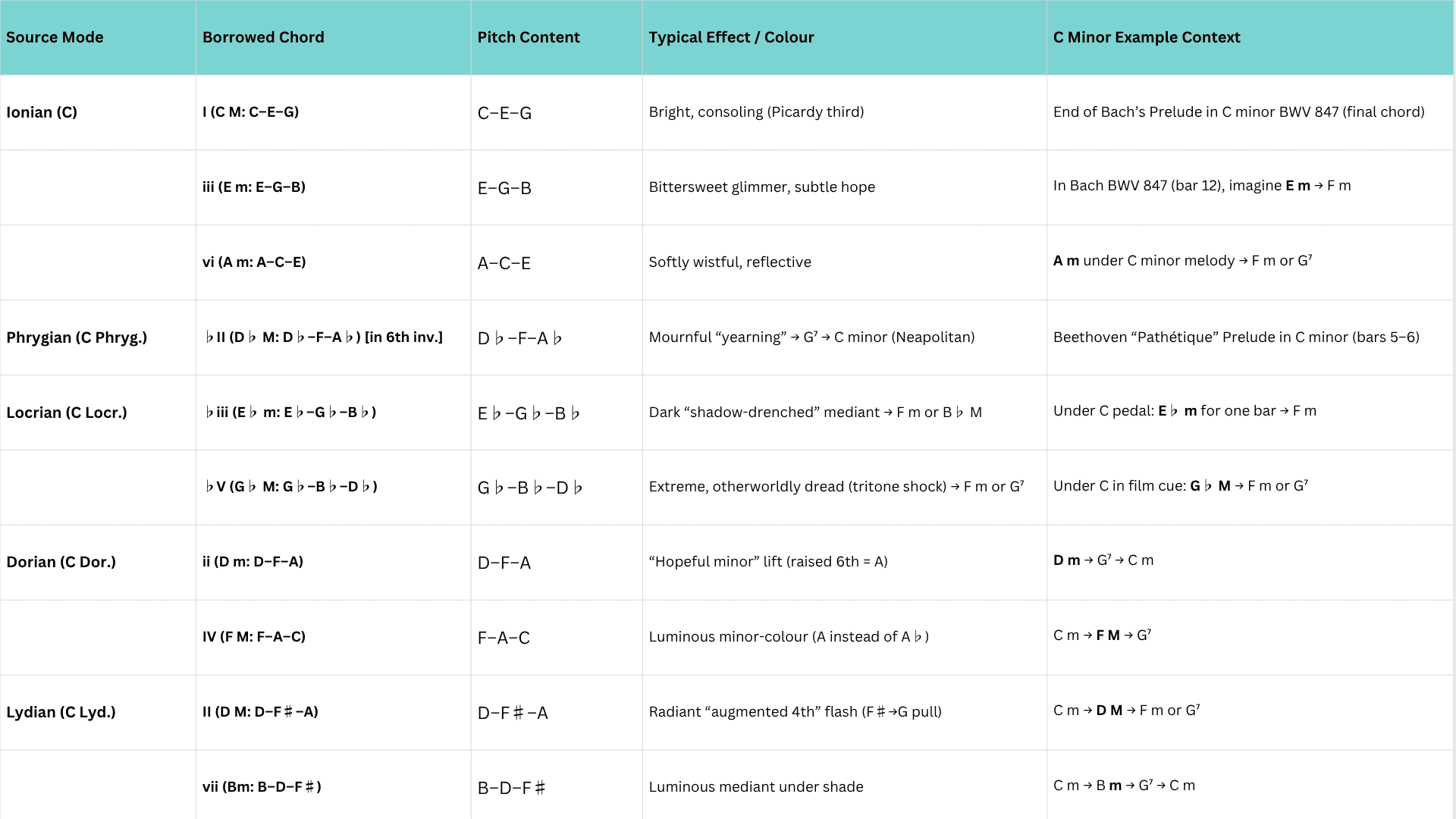
Modal interchange is a two-way street: So far we saw the examples of each mode considering a major tonic, but a minor tonic can just as readily “borrow up” from its parallel modes. The modes used from a minor key are Lydian, Ionian, Dorian, Phrygian and Locrian and each one offers specific effects that impact the music in different ways. Let’s break them down:
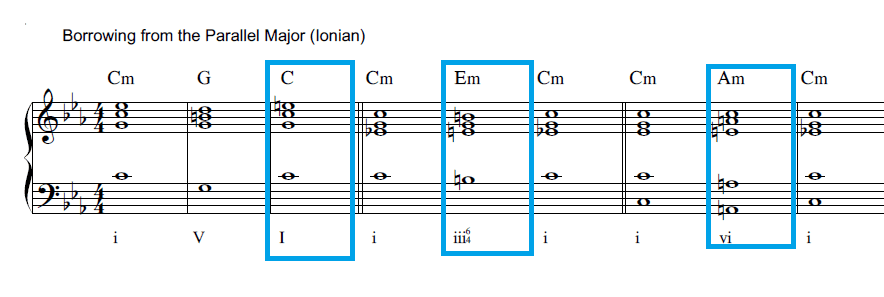
1. Borrowing from the Parallel Major (Ionian)
When you “borrow up” from the C Ionian ( or C major), you raise one or more of the flattened degrees in C minor (♭3, ♭6, ♭7). These are the chords you’ll most often see:
- I (C major C–E–G)
Effect: A sudden shaft of brightness (the classic “Picardy third” effect). Feels consoling at the end of a dark passage.
- iii (E minor E–G–B)
Effect: A bittersweet shift, giving an unsettling mood if it is used after the tonic or the VI degree, often fleeting. (Useful in film music)
- vi (A minor A–C–E)
Effect: Softly wistful or reflective—like a passing “memory chord” under C minor. (Handy in creating quick shifts in film or game music)
2. Borrowing from the Phrygian Mode
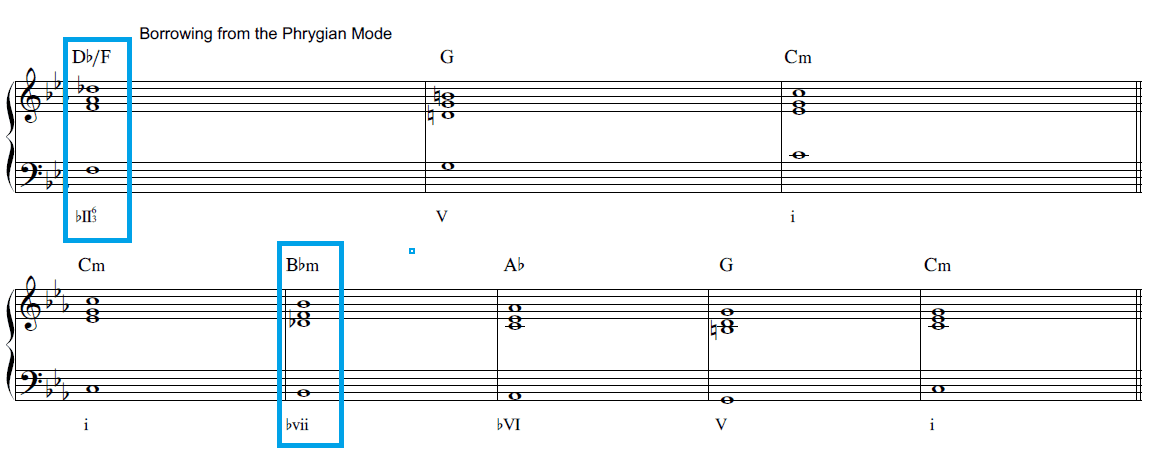
Compared to C Aeolian (C–D–E♭–F–G–A♭–B♭), its unique pitch is D♭. Therefore:
- ♭II (D♭ major D♭–F–A♭)
(Almost always used in first inversion: D♭/F, i.e. “Neapolitan ⁶”.)
Effect: A “yearning,” almost plaintive tug toward the V chord. That F→G tone in the bass is deeply expressive, evoking tragic poignancy.
- ♭vii (B♭ minor: B♭–D♭–F)
Effect: A sudden “false modulation” to B♭ with a minor third (D♭). Since B♭ major (VII) is not unusual in Aeolian, but B♭ minor is foreign, you get a ghostly, unexpected tint.
C minor example: Starting on C, drop into B♭ minor for one bar, then pivot to A♭ major (♭VI) or G⁷ to re-anchor in C minor. The ear perceives a brief “mysterious diversion” helped due to the voice-leading on the bass through descending 2nds: C-B♭-A♭-G
Note: Although C Phrygian also contains chords like E♭ major, F minor, G minor, A♭ major, B♭ major (all of which are already diatonic in Aeolian), the true “Phrygian-only” colour in C minor is D♭ major (♭II) and ♭vii (B♭m).
3. Borrowing from the Locrian Mode
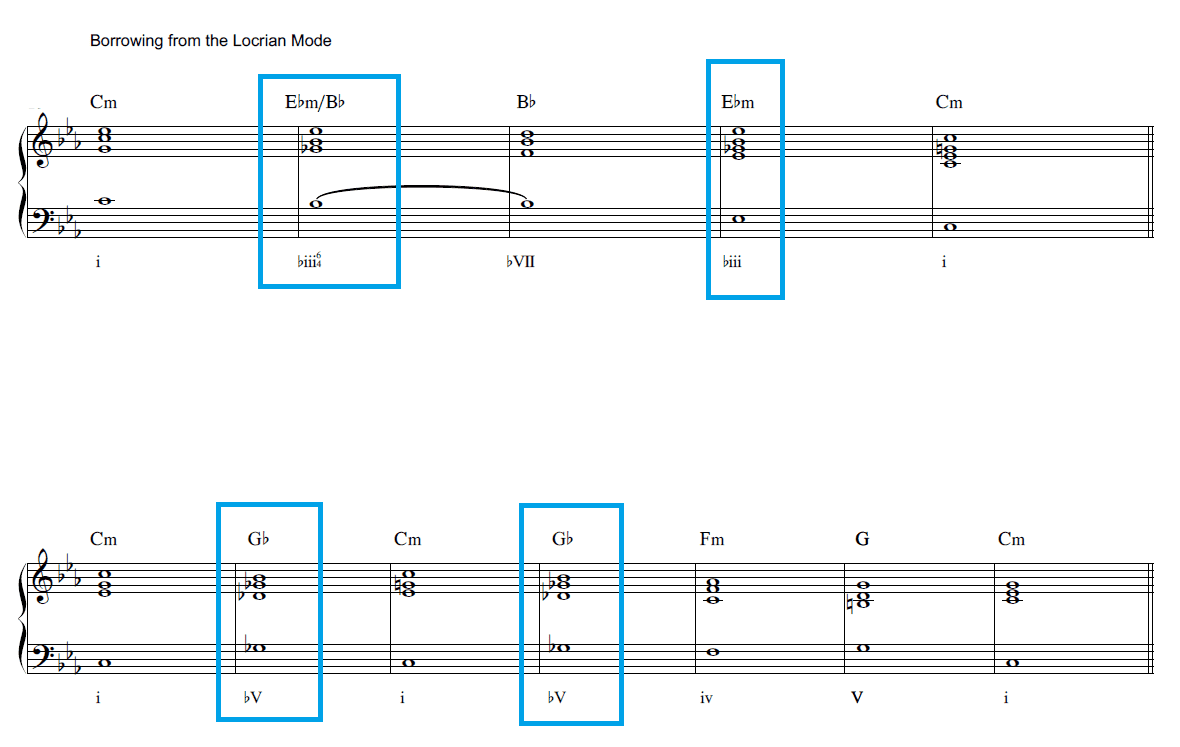
Compared to C Aeolian (C–D–E♭–F–G–A♭–B♭), the unique pitches are D♭ and G♭. From those, you can build exactly two non-Aeolian triads (and they must be used sparingly, as “shock-colours”):
- ♭iii (E♭ minor: E♭–G♭–B♭)
Effect: A dark, “shadow-drenched” mediant. Since C→E♭ is normal, but E♭→G♭ (minor third) steals away the expected E♭ major, you get a sudden “sinking” sorrow.
C minor example: Under a sustained C in a film cue, play E♭ minor for one bar, then resolve to F minor (iv) or B♭ major (VII). The momentary turn to E♭ minor “deepens the gloom.”
- ♭V (G♭ major: G♭–B♭–D♭)
Effect: An extreme, almost “unearthly” horror-film colour. The tritone C→G♭ is a classic “destabiliser.”
C minor example: In a suspense cue, have the orchestra hold a pedal C, then undercut it with G♭ major for a beat. Next, slip to F minor or G⁷ so the listener never fully leaves C minor, but feels that jolt of dread.
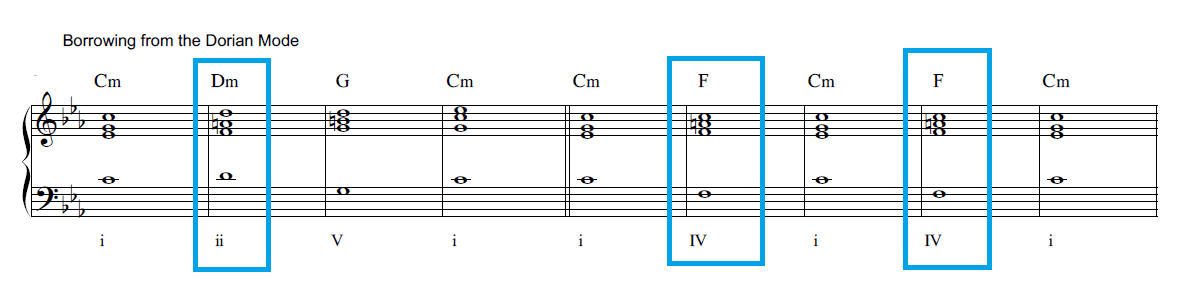
4. Borrowing from the Dorian Mode
Compared to C Aeolian (C–D–E♭–F–G–A♭–B♭), the unique pitch is A natural (instead of A♭). These chords feel “hopeful-minor” because of that raised 6th:
- ii (D minor: D–F–A)
- IV (F major: F–A–C)
Effect (general): Any chord from C Dorian “lifts” C minor with a subtle optimism (A natural). For example, D minor (ii) → G⁷ → C minor is gentler than D° → G⁷ → C. F major (IV) in C minor feels luminous but still retains a minor “under-current.”
C minor example: In a moody jazz-in-minor pass, sliding from C minor → D minor (ii as borrowed from Dorian) → G⁷ → C minor gives a quiet sense of hope. Likewise, F major (IV) under C minor material is a classic “Dorian-flavour” lift.
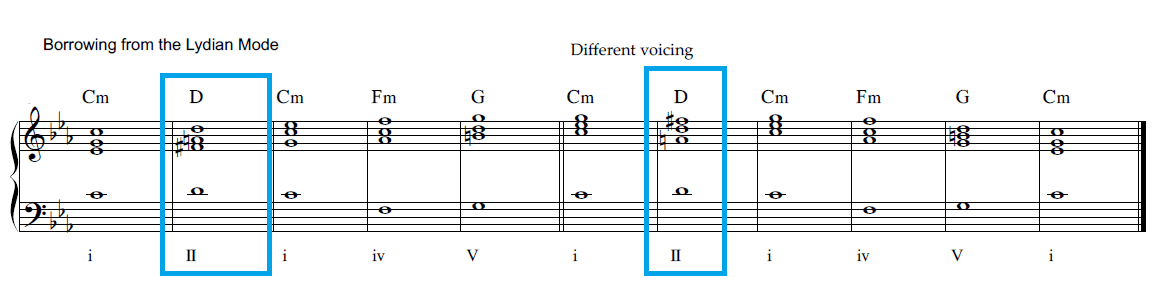
5. Borrowing from the Lydian Mode
Compared to C Aeolian (C–D–E♭–F–G–A♭–B♭), the unique pitch is F♯ (augmented 4th) along with E natural and A natural/B natural.
Effect (general): Any chord from C Lydian feels luminous and “soaring,” thanks to that F♯ → G half-step pull. For instance, D major (II) under C minor material is a sudden radiant flash before descending back to F minor or G⁷.
C minor example: To create a bright interlude, slip into D major (II) under a C minor melody for one bar, then return to F minor (iv) or G⁷ (V). The ear perceives a brief “Lydian sunshine.”
Creative Tasks
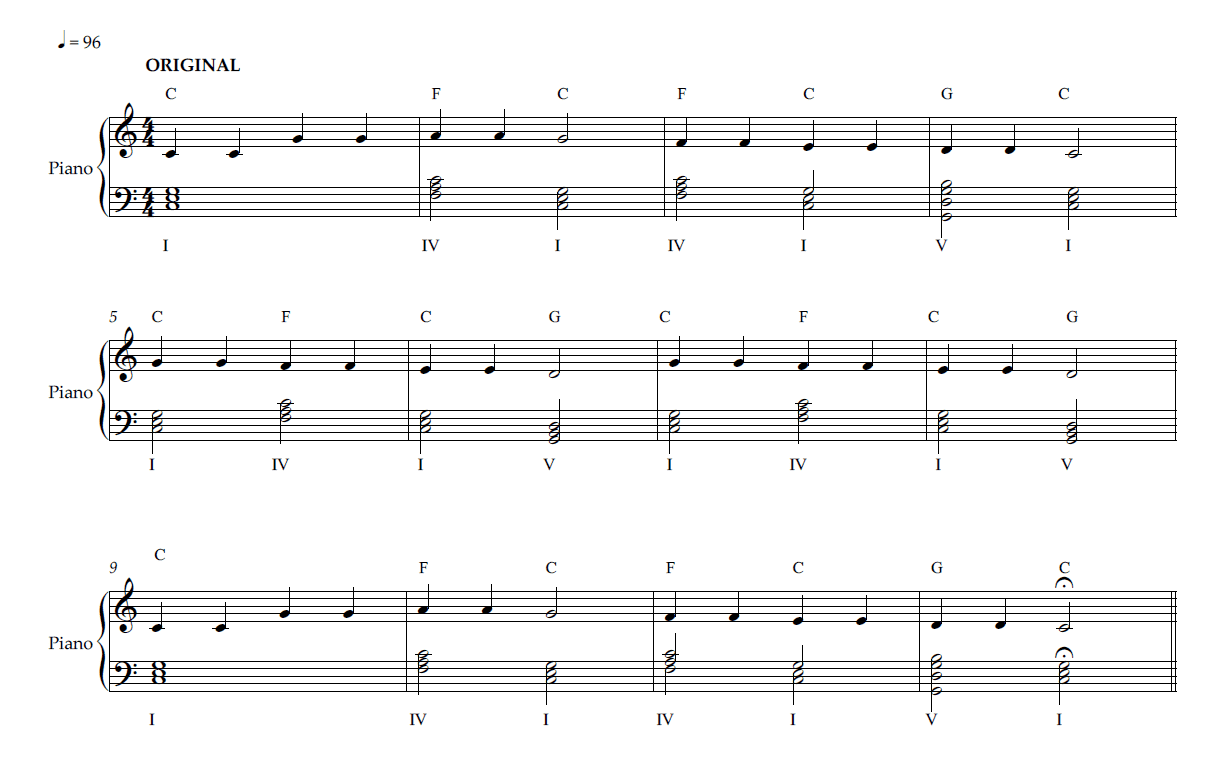
Re-harmonisation of “Twinkle, Twinkle Little Star”
A very useful exercise to learn how to use modal interchange in our compositions is to first start re-harmonising an existing melody, in this case “Twinkle, Twinkle Little Star”
This popular song that actually comes from a French folk song Ah vous dirai-je, Maman! (if you want to know a curious fact, Mozart used this theme to compose 12 variations based on it in his Sonata K. 265)
Our goal is to learn how to harmonise a melody using modal interchange
Step 1: Start with the harmonic analysis of the piece
In the example, we observe that above the staff we have the name of the chords, for example: C, F and G. and below it, the Roman Numerals: I, IV and V.
This particular piece is harmonised only with the primary chords (I, IV, V)
Difference between Chord substitution with Diatonic Chords and Modal Interchange
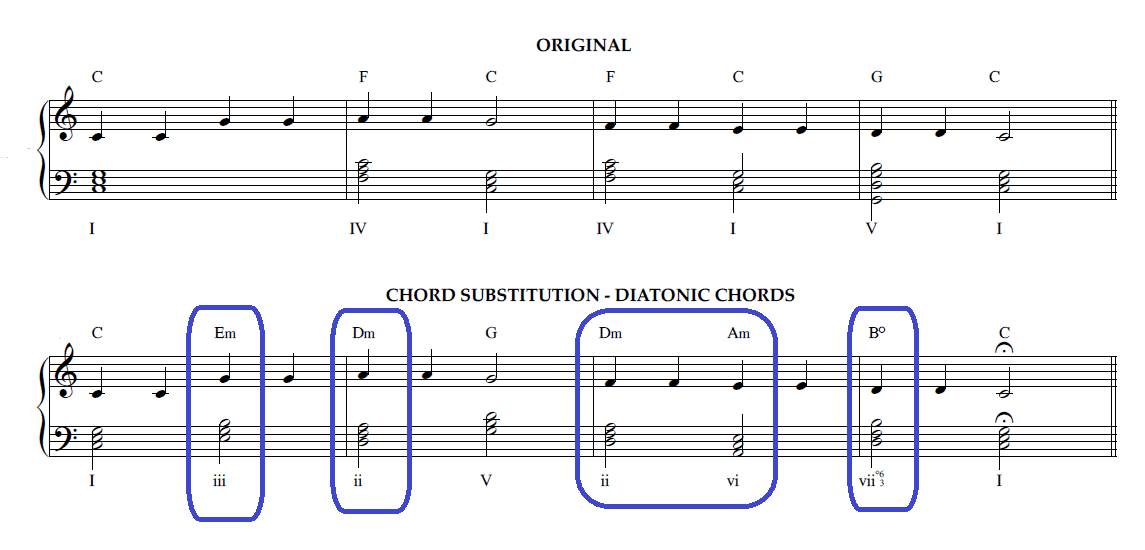
Here we have a harmonisation using diatonic chords, adding the Mediant in the first bar (Em on the third beat), also replacing the Subdominant (IV) with the Supertonic (ii) and finally replacing the Dominant (V) with the Leading Chord (vii) in first inversion.
The ii belongs to the same family as the IV (the subdominant family)
The vi and iii belongs to the same family as the tonic (Tonic family)
The V belongs to the same family as the vii( Dominant family)
If you want to know more about family chords, here are two articles I wrote that expands on the topic:
These changes are perfectly fine and done quite frequently, but they are not Modal Interchange, but Chord Substitution with Diatonic Triads as all the replacements belong to the same scale and key.
This does not mean that chord substitution and modal interchange cannot be combined. In fact, in the next examples, we will combine them.
In the following exercise, the goal is to harmonise the same piece through different shades by using the modes available from light to dark, that’s to say, from Lydian to Locrian.
Colouring a Melody – Modal Interchange
The melody is like an object we observe. By using modal interchange, we cast a different light on the same object, changing the “contrast levels” by choosing different modes upon it.
We need to choose chords that align with the melody that we have at hand, that means that the chords used need to contain at least one note of the melody.
We will do 5 versions, let’s start!
- VERSION 1
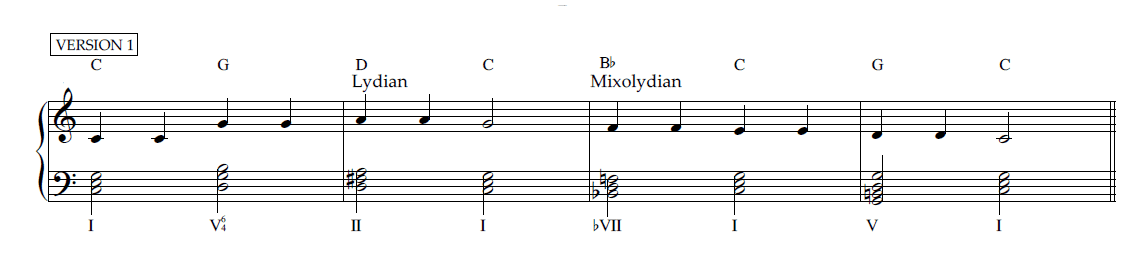
In this first version, we will harmonise the first 4 bars of this piece. We can see how we selected the first chord, the D major taken from the Lydian mode (II) to provide a brighter light on the A note.
The second chord is the B flat (taken from the Mixolydian mode) harmonising the F note. Although this is a major chord, it still creates a tinge of a darker feeling over this part of the melody. So, the F note (the object) never changes, but the colour we apply upon it does, thus, producing an effect on it.
- VERSION 2
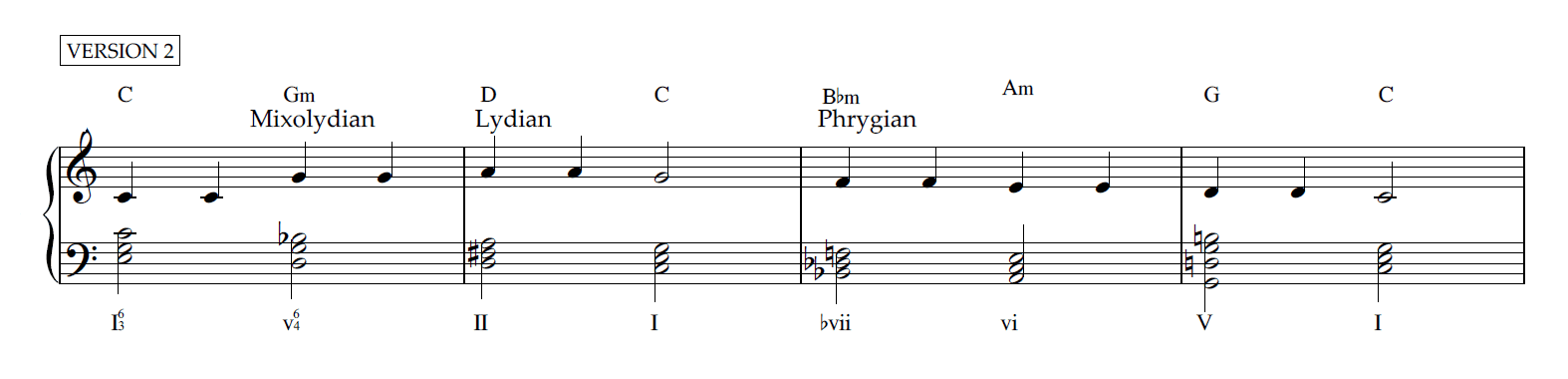
In version 2 , the B flat minor (the flattened minor seventh taken from the Phrygian mode) now gives a darker contrast to the same F we coloured in version 1.
In the first bar, the G major has changed now to G minor (taken from the Mixolydian mode). Again, the purpose of this harmonisation is to give a darker hue on the melody.
Finally, the A minor in bar 3 is a chord substitution using the 6th degree of a scale.
Overall, we have turned the melody darker compared to the first version.
Voice leading and Bass line:
Notice how the bass line goes from a E note to a G note:
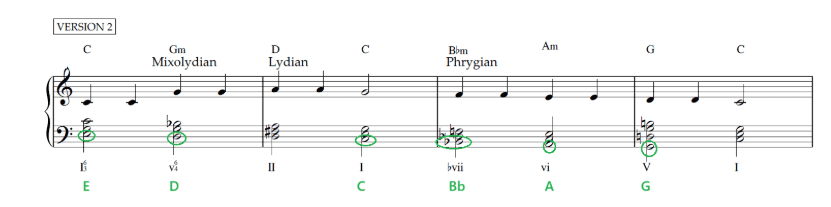
The choice of different chords plus the use of inversions adds a powerful voice leading towards a pivot chord, in this case, the dominant chord, G.
- VERSION 3
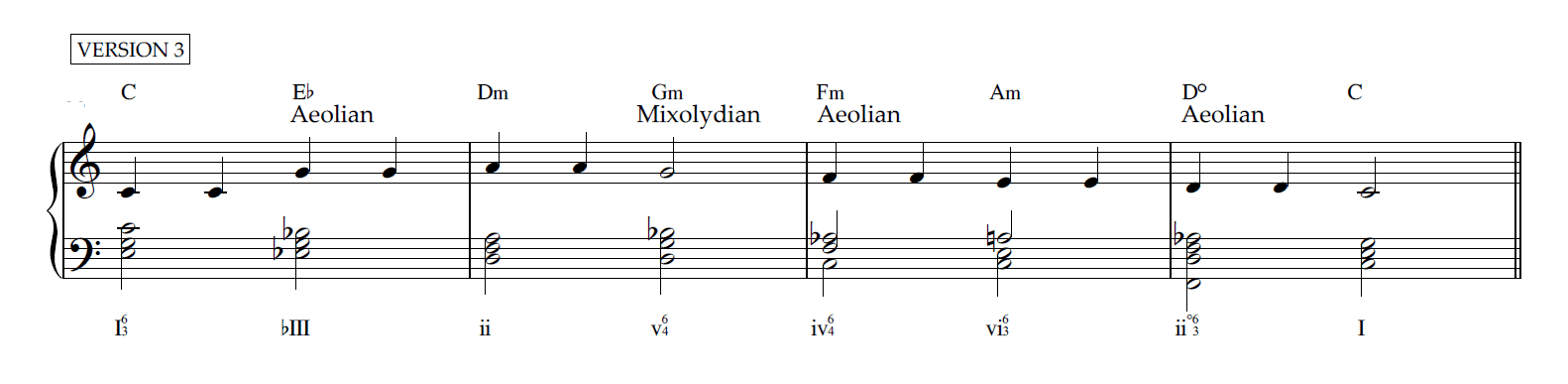
The G note on the first bar is now coloured by an E flat major (taken from the Aeolian Mode) Although this mode is darker as it has two flats (B and E flats), the chord is still a major one.
Then, a chord substitution from the F major to the D minor (both belonging to the subdominant family) but now the A on the melody has gained a darker contrast, still diatonic though.
The G in bar 2 that so far has always been harmonised with the tonic, now has turned much darker thanks to the G minor (taken from the Mixolydian Mode)
After which we have the F minor (taken from the Aeolian Mode) to keep the F note on the dark side.
The A minor is a chord substitution from the C tonic to the submediant (the vi degree) both chords belong to the same Tonic family.
Finally, the D diminished (taken from the Aeolian mode) is very common to finish phrases in ballads or Jazz (Autumn leaves is a good example) This chord is in first inversion (the F on the Bass) creating a kind of plagal cadence (normally IV – I) what it makes it similar is the 4th degree on the bass, keeping the bassline motion the same (Subdominant to the tonic, or in this case, the F going to the C)
Version 3 is the darkest so far, and here we face a crossroads: how dark can we go?
An important thing to consider when we are harmonising (or re-harmonising as in this case) is to consider how faithful we will remain from the initial mood of the melodic line, to the intent of the composer.
The question we need to ask ourselves is how emotional contrast are we going to inflect on the melody and how much harmonic variety are we going to apply?
How much we shift in the emotional mood is very personal and it depends on each composer and piece.
- VERSION 4
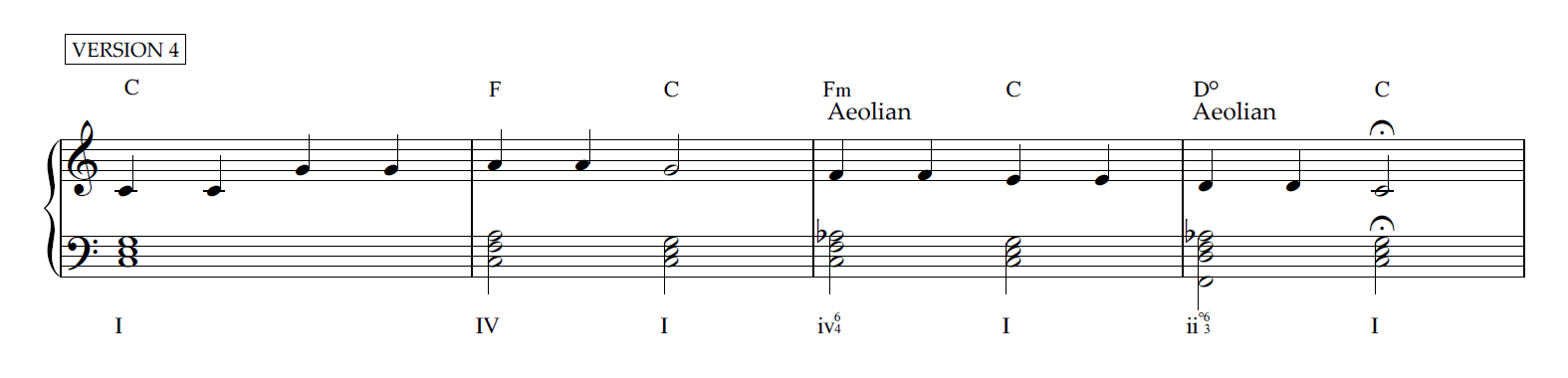
In this version, we use the most common modal interchange:
The minor 4th (or minor subdominant) in this case, the F minor and the same ending as version 3, the D diminished or diminished 2nd degree taken from the same mode, the Aeolian.
- VERSION 5
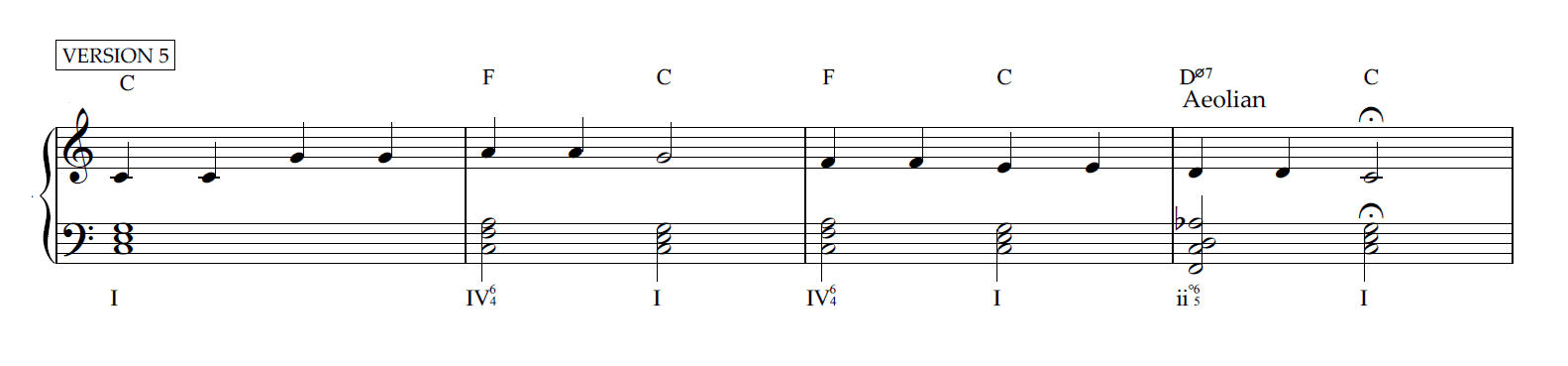
The final version, just using the Diminished 2nd degree, shows a subtle use of Modal Interchange. This case represents a subtle way to apply this technique, providing a fleeting colour at the end of the phrase. This version shows that borrowed chords should be used scarcely, giving a hint of harmonic colour at the end of a passage, making the listener pay attention to inform us we are closing the phrase.
- FULL VERSION
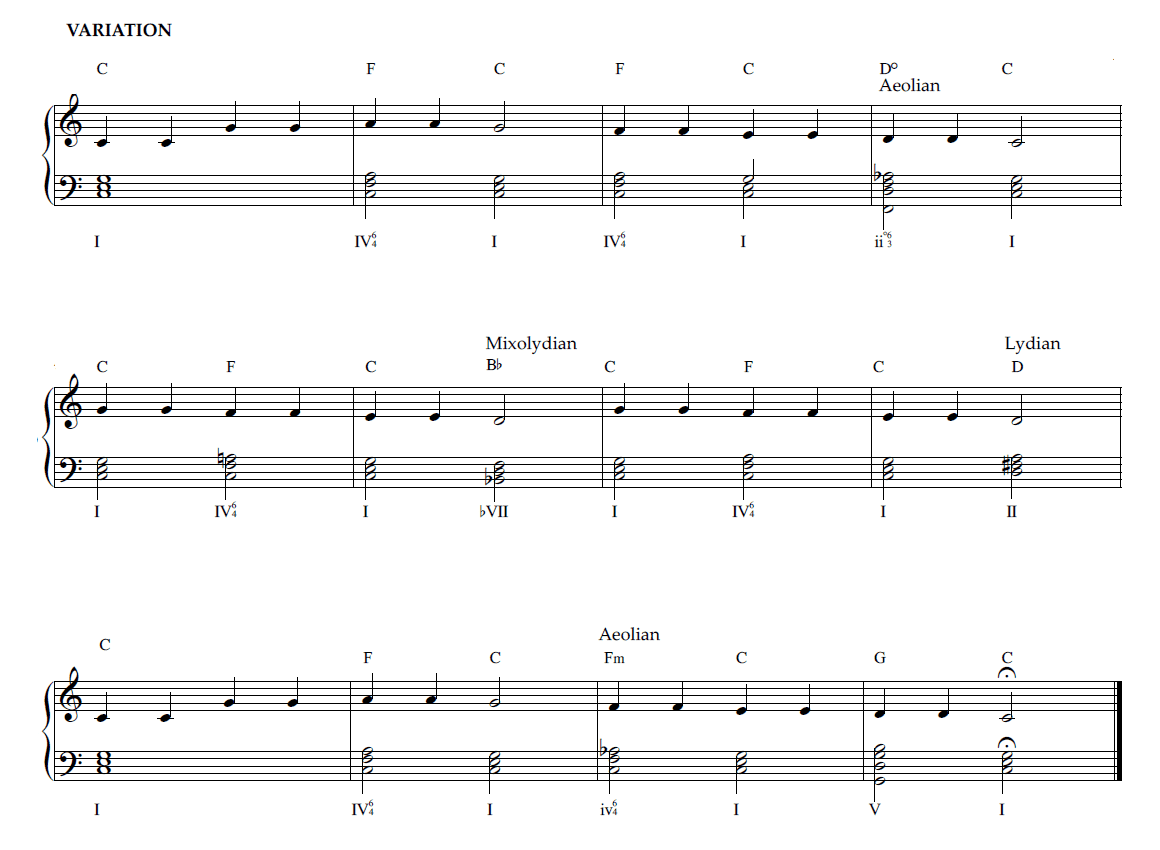
In the final version, we use 4 modal interchanges:
In the first 4 bars, or first phrase, the D diminished forming a plagal cadence instead of a perfect authentic cadence (compared with the original)
In the second phrase (second line in the example) also called “contrasting middle” that functions as a contrast between the first and third phrases. This is the perfect moment to explore further with harmonic colours, that’s why I used two chords, the B flat major from the Mixolydian and the D major from Lydian, both on the D notes.
Both D notes are considered an “object” over which we cast two different lights: the first one with the mixolydian mode (darker) and then, by repeating the same passage, now the D appears brighter under the D major from the Lydian, providing a hopeful and uplifting effect before the re-exposition of the first phrase.
The fact that makes the D major brighter than it actually is, is because we have harmonised the first version with B flat major, making the same note in comparison, brighter on the second time.
In the last phrase, the classical minor subdominant is taken from the Aeolian to lead to the end of the theme.
Common Pitfalls – and Fixes
| Problem | Remedy |
| Borrowed chord lingers and feels like a modulation
(See Version 3) |
Limit to ≤ two bars or resolve promptly via V. |
| Leap from Lydian straight to Prhygian jarred the ear
(See Version 2) |
Try a nearer mode (Dorian or Aeolian) first.
(See Version 1) |
| Melody clashes with altered note | Revise tune or borrow from a different mode sharing that pitch. |
| Over-used iv–ii°–I cliché
(See Version 4) |
Explore Lydian II or Dorian IV- instead. |
A Ten-Step Workflow to Master Modal Interchange in your Music
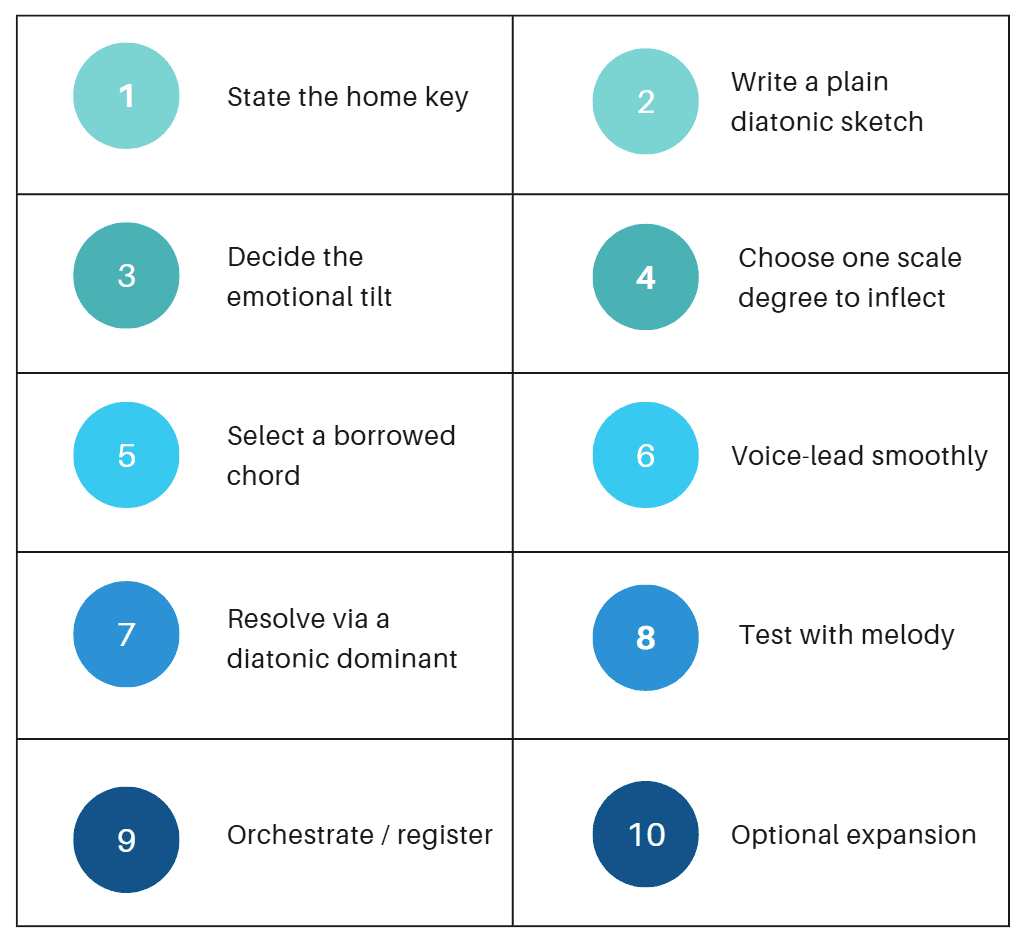
In this section we will learn how to compose a theme having in mind how we are going to affect it with modal interchange. We will plan our entire form—mapping out where and when each modal visit happens so your piece builds tension, releases, and ultimately feels utterly compelling. The task of the composer is being the architect of the piece, planning ahead every step of the way, and here are the steps:
1. State the home key – Feel the tonic “gravity”
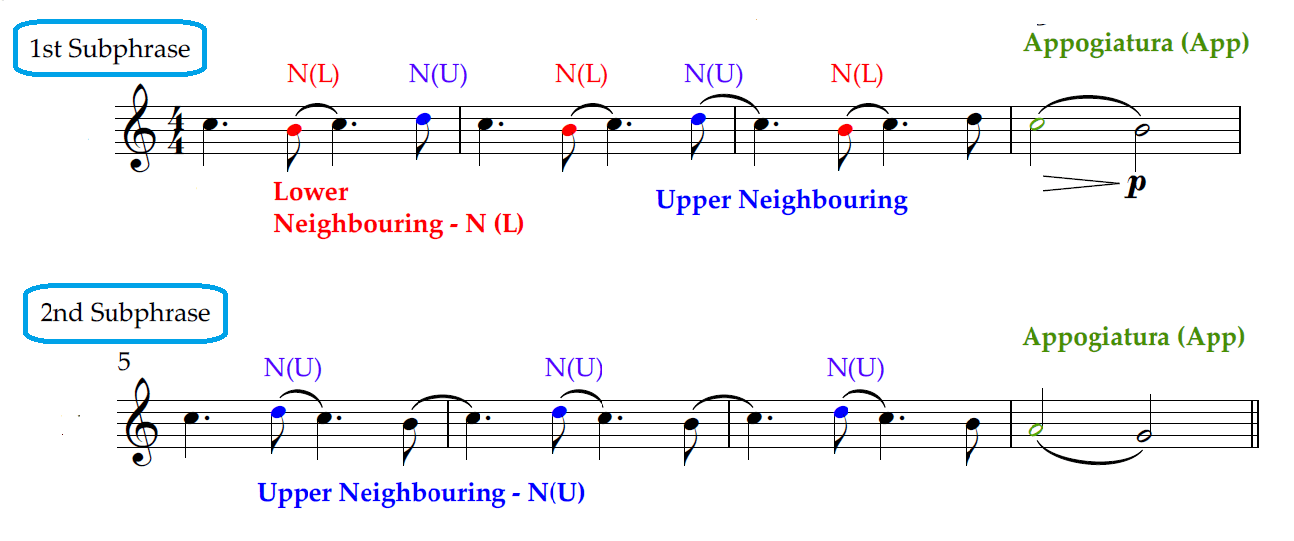
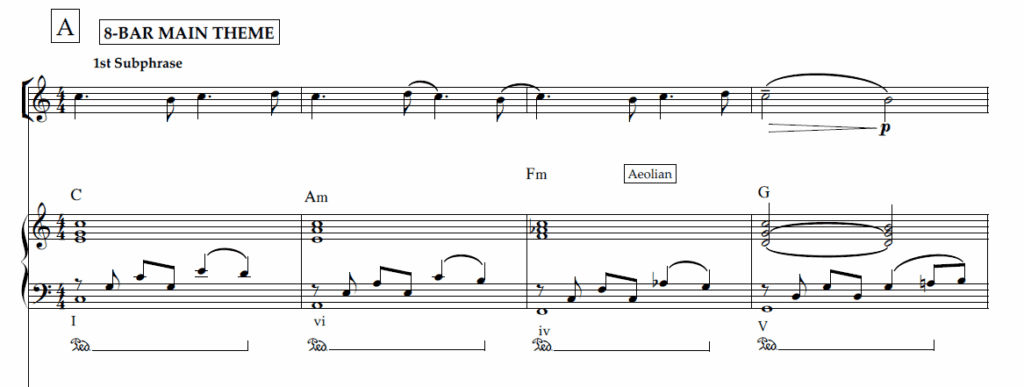
The motive of our 8-Bar Main Theme is designed by one rhythmic cell by a dotted crotchet on the tonic note which is thought to be a pivot note (C) in the melody with lower and upper neighbouring notes using quavers creating the motion forward through upbeats (notated as N(L) in red and N(U) in blue on the score.
Both subphrases ending with appoggiaturas on the first beat resolving down to the third of the dominant chord (B) in bar 4 and on the root (G) in bar 8:
2. Write a plain diatonic sketch (e.g. I–vi–IV–V)
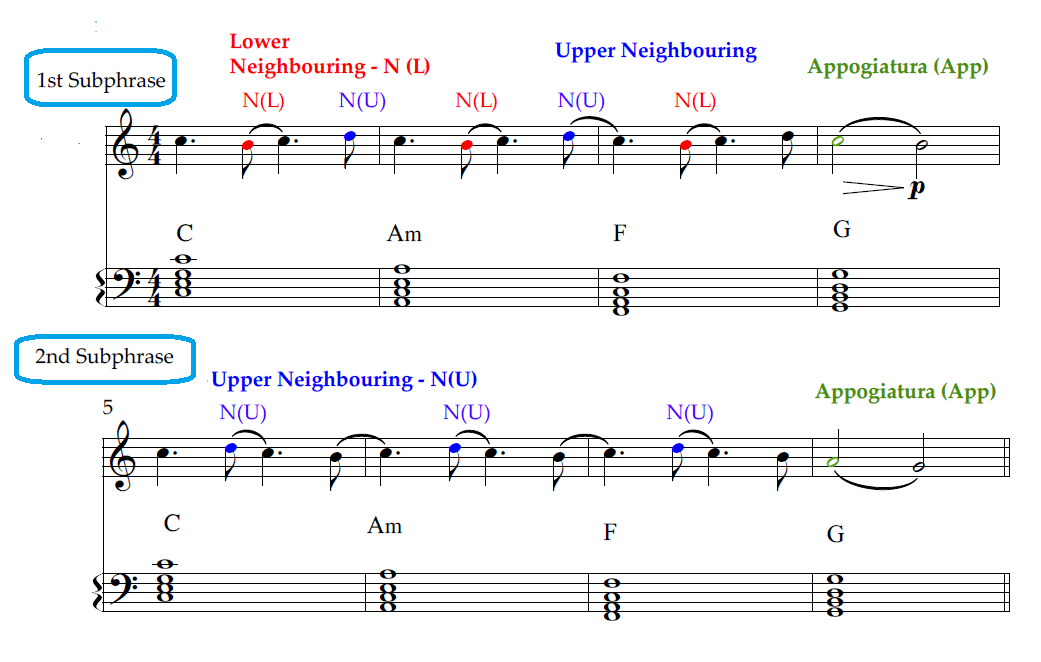
Building our theme on a solid harmonic foundation will allow us to further develop it with mode mixture. The Tonic-Submediant-Subdominant and Dominant harmonic progressions is one of the most common and stable as it contains two stable chords (I and vi), the predominant (IV) and finally a Dominant (V) that allows the phrase to go back to where it started, making it perfect for a looping phrase such as this. The melodic line using the tonic note, C to be pivot note gives a strong gravitational pull towards the tonic:
3. Decide the emotional tilt using the bright↔dark ladder
To do that, we design the overall structure. The sections are six in total:
Section A – Main Theme – Bars 1-8
Section B – Variation of A – 9- 20
Section C – New Theme – Bars 21-28
Section D – Variation of the New Theme – Bars 29 – 36
Section E – Break – Bars 37 – 40
Section F – Re-exposition of the Main Theme – Bars 41 – 48
Section G – Outro – Bars 49- 53

In this chart we see how many times we use the modes and in which bar and section:
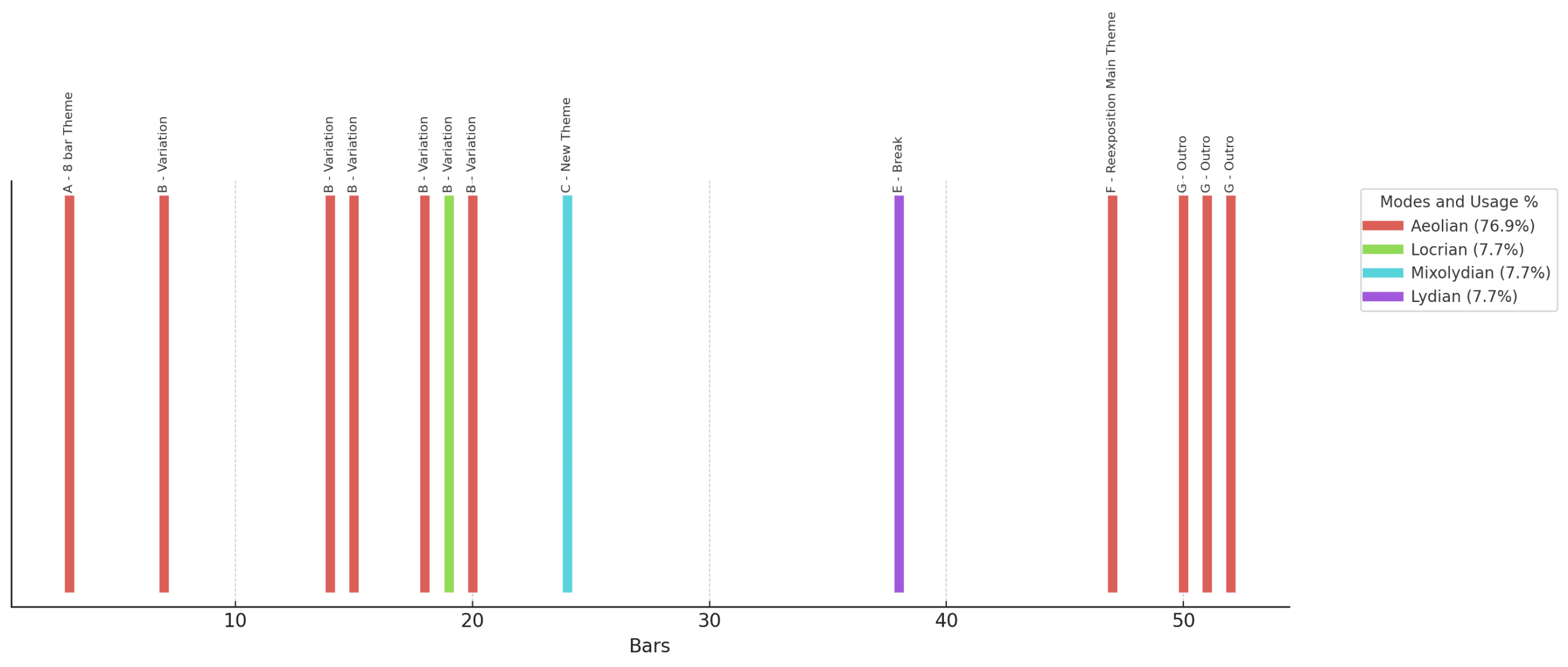
From the chart above we can see the Aeolian mode is used at the beginning (sections A, B) and end of the piece (sections F and G), leaving the Lydian< Phrygian and Mixolydian to the inner sections (sections C and E). The D section, located in the middle of the piece, remained purely diatonic to provide a contrast and also, as the section is the most active due to its surface rhythm (all quavers) to balance the melodic-rhythmic activity it is best to balance things leaving the harmony untouched.
4. Choose one scale degree to inflect (♭3, ♭6, ♭7, or ♯4 depending on the mode)
| BARS | CHORD | DEGREE | MODE | SECTION |
| 3 | Fm | iv | Aeolian | A – 8 bar Theme |
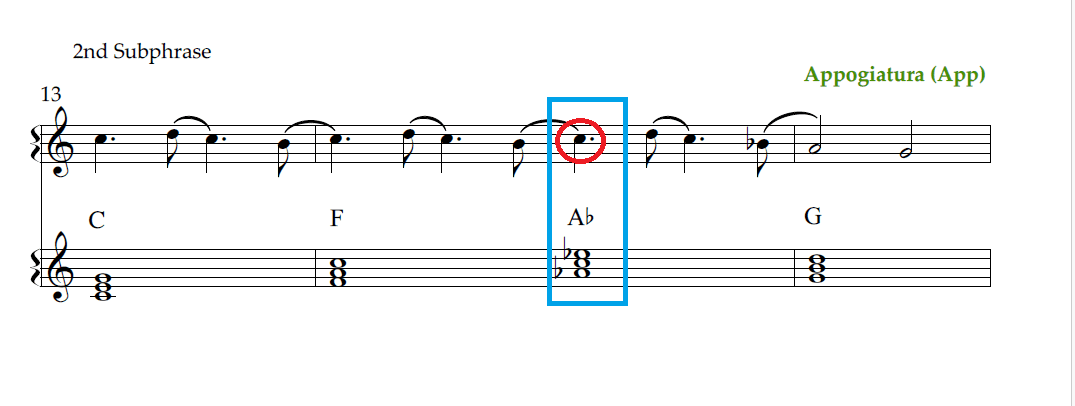
| 7 | A♭ | ♭VI | Aeolian | B – Variation |
| 14 | A♭ | ♭VI | Aeolian | B – Variation |
| 15 | E♭ | ♭III | Aeolian | B – Variation |
| 18 | A♭ | ♭VI | Aeolian | B – Variation |
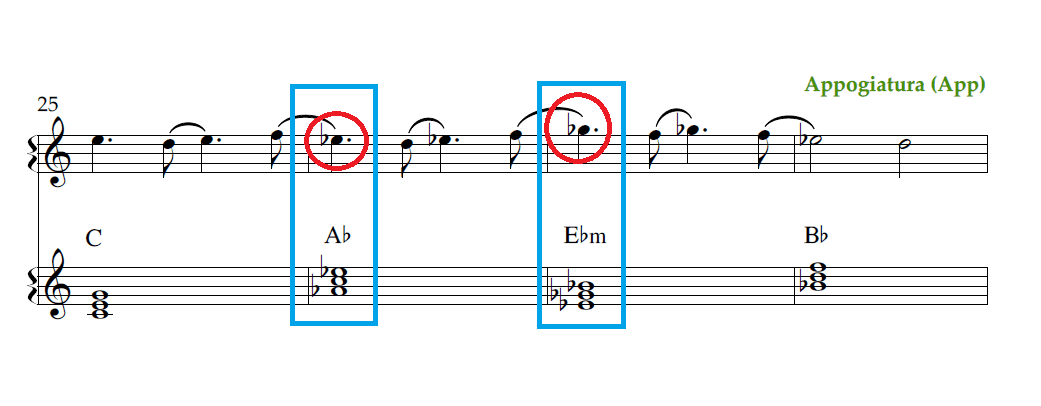
| 19 | E♭m | ♭iii | Locrian | B – Variation |
| 20 | B♭ | ♭VII | Aeolian | B – Variation |
| 24 | B♭ | ♭VII | Mixolydian | C – New Theme |
| 38 | D | II | Lydian | E – Break |
| 47 | A♭ | ♭VI | Aeolian | F – Reexposition Main Theme |
| 50 | Fm | iv | Aeolian | G – Outro |
| 51 | A♭ | ♭VI | Aeolian | G – Outro |
| 52 | B♭ | ♭VII | Aeolian | G – Outro |
5. Select a borrowed chord that carries that note
You can use the chart or https://modal-interchange-chart.com/
(The explanation is in my previous video/article about what is Modal Interchange)
The selection of chords taken from modes start slow in the main theme, using F minor (iv) and A♭ (♭VI) both taken from the Aeolian, which is the most common mode mixture. (See point number 6)
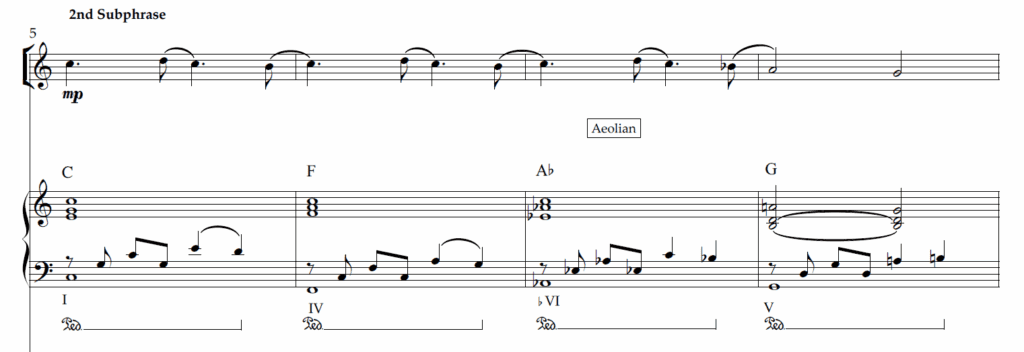
In the B section, which is a variation of A, as the pivot notes are no longer C , but E and G, the colouring turns more contrasting, transforming E to E♭ using A♭ (♭VI) and E♭ (♭III) also from Aeolian in the first subphrase. In the second subphrase, the darkest colour so far, the G has changed to G flat, this means it is coloured by the ♭iii or E♭minor taken from the Locrian mode.
6. Voice-lead smoothly – keep one common tone (Schoenberg’s “anchor”)
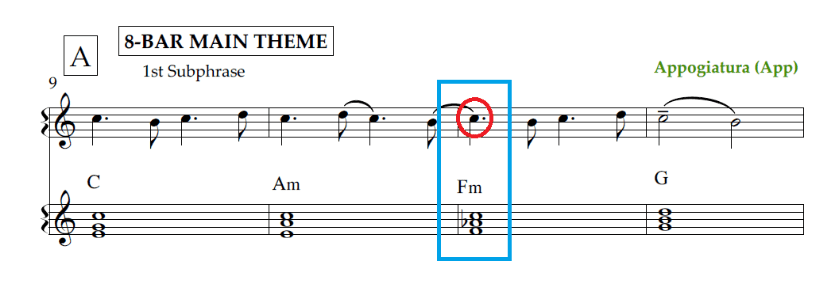
In the Main theme, we see why we selected F minor to colour the C note on the melody in bar 11 (both have the note C in common)
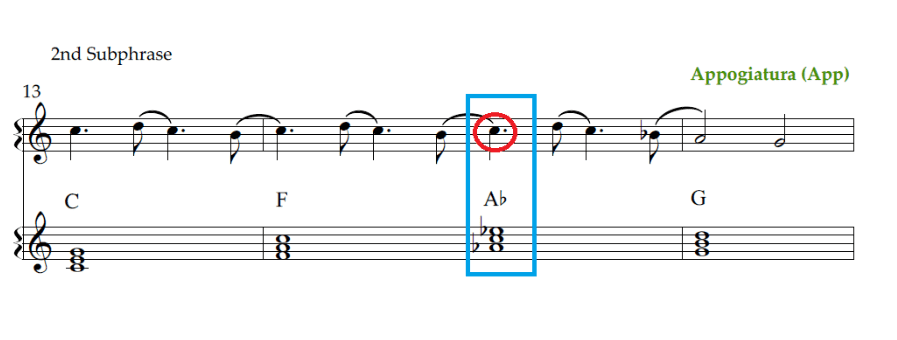
In bar 15, we have the same case, in which A flat major contains the note C, in perfect alignment with the melody.
In the E section (the Break) we also take advantage of the anchor note, A in the melody to borrow the brightest chord, D major from the Lydian mode:
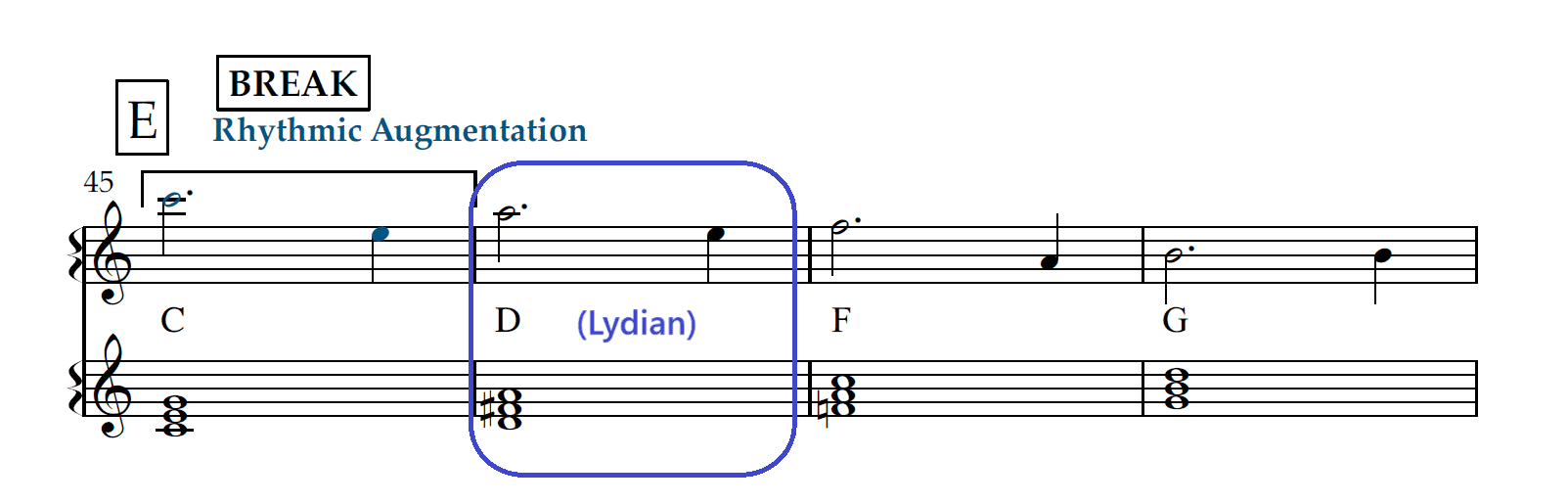
7. Resolve via a diatonic predominant or dominant so the tonic remains central. One fundamental characteristic of mode mixture is that we keep the harmonic progressions centripetal (that means the gravitational field of the tonic is not jeopardised by the pull of other chords) Returning to the tonic through the dominant ensures the tonic remains strong.
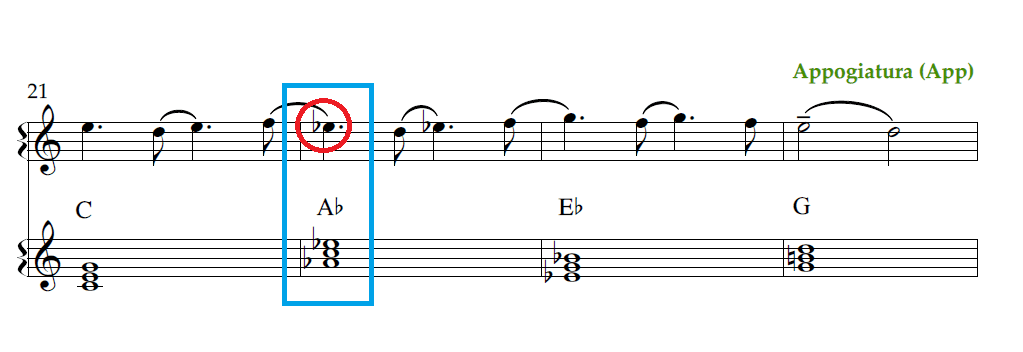
The harmonic progression always ends in the Dominant (G major) and comes back to the tonic again, to keep the piece centripetal (the gravitational pull towards the tonic chord, C major)
This happens in all the subphrases except in the B section where there is a modal interchange to the Aeolian using the ♭VII (B♭)
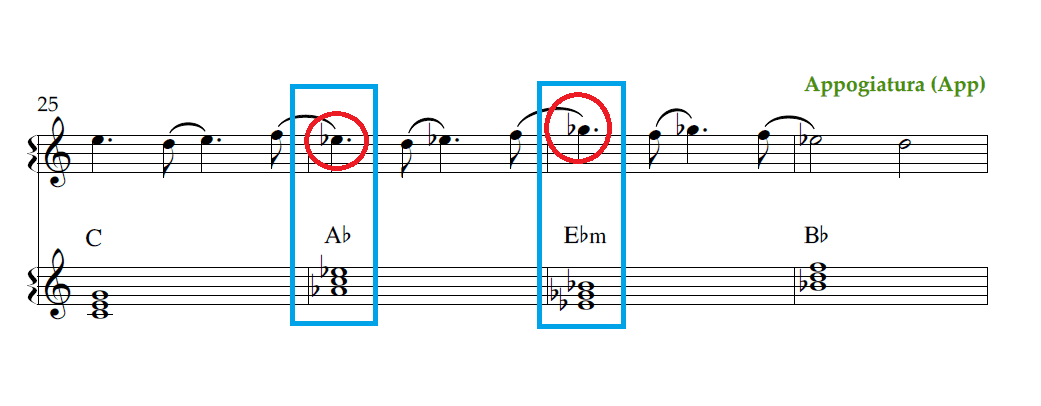
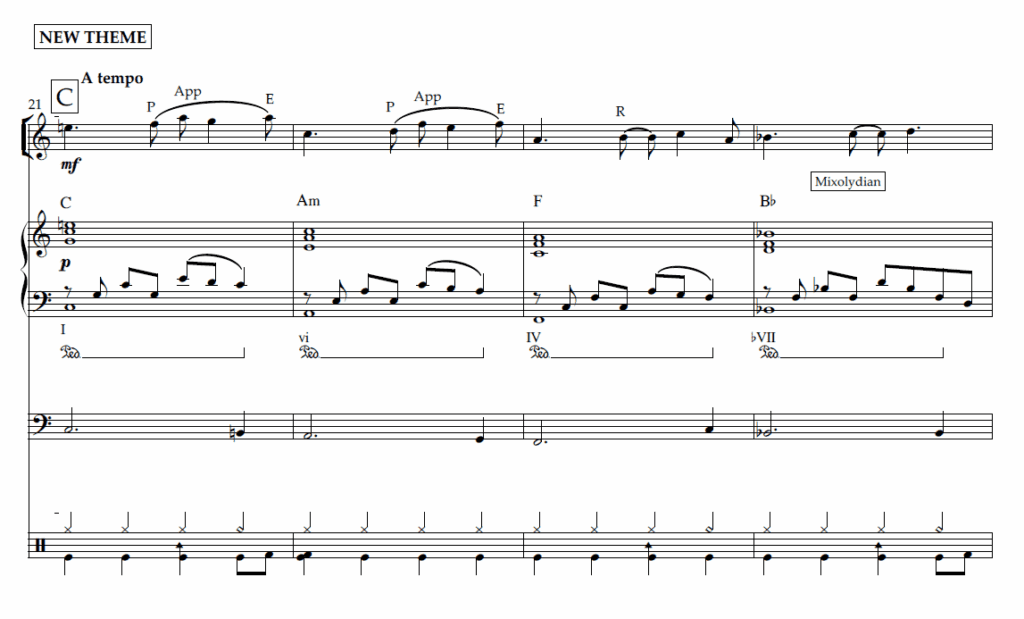
And in the C section with the New Theme, a ♭VII is also used:
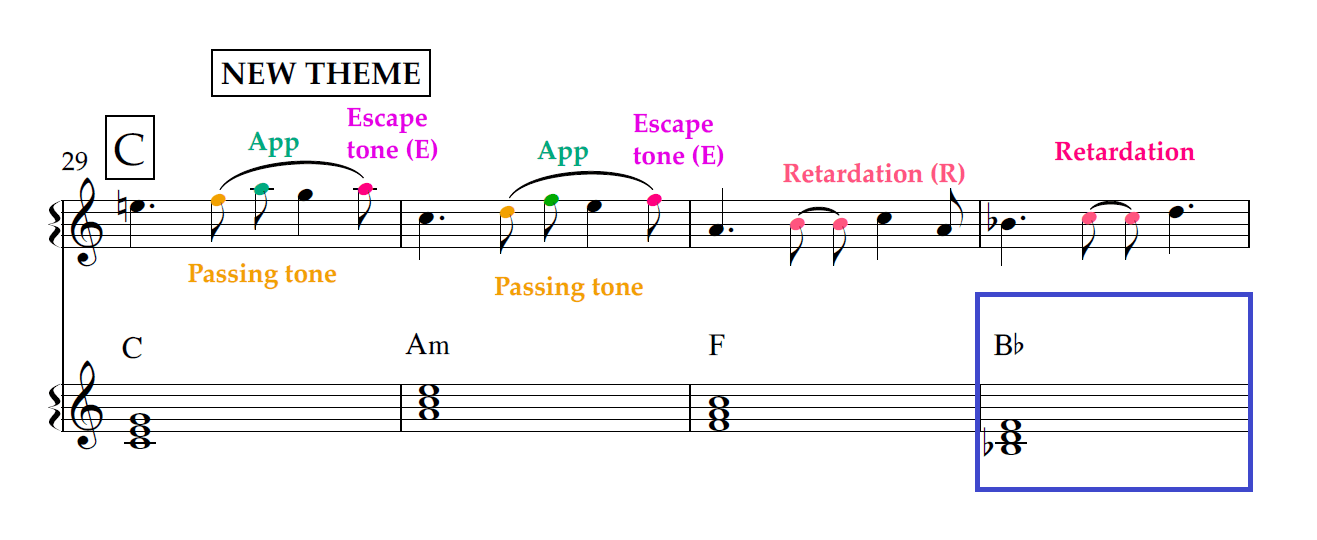
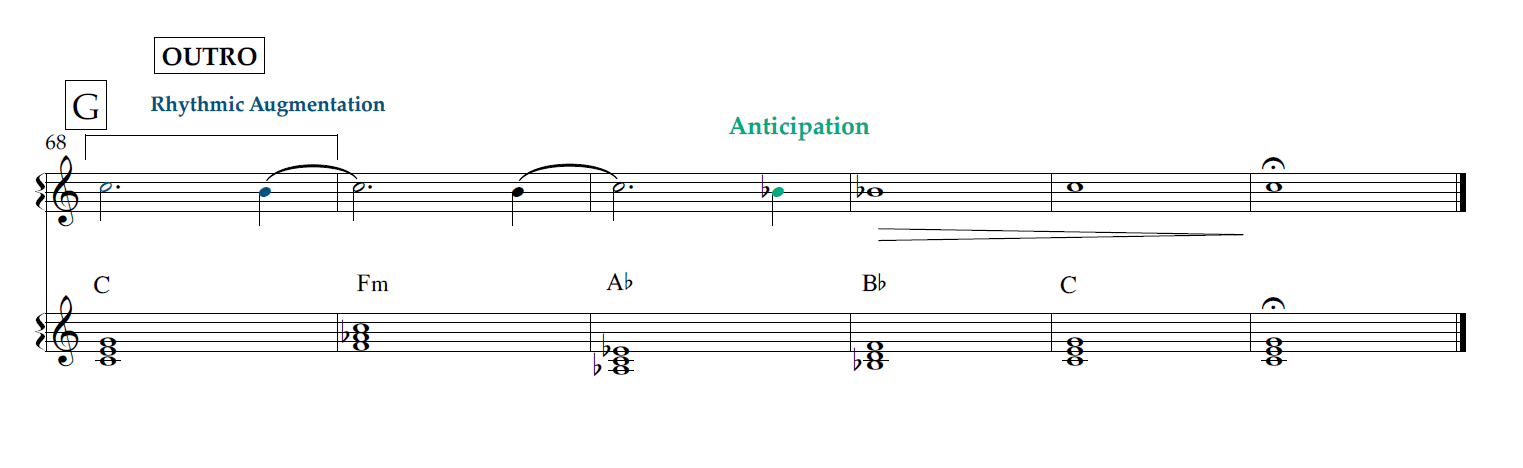
Finally, in the G section (Outro) the use of ♭VI – ♭VII -I (A♭ – B♭-C) gives an epic character to the end of the piece:
8. Test with melody – adjust line or chord if any clashes arise
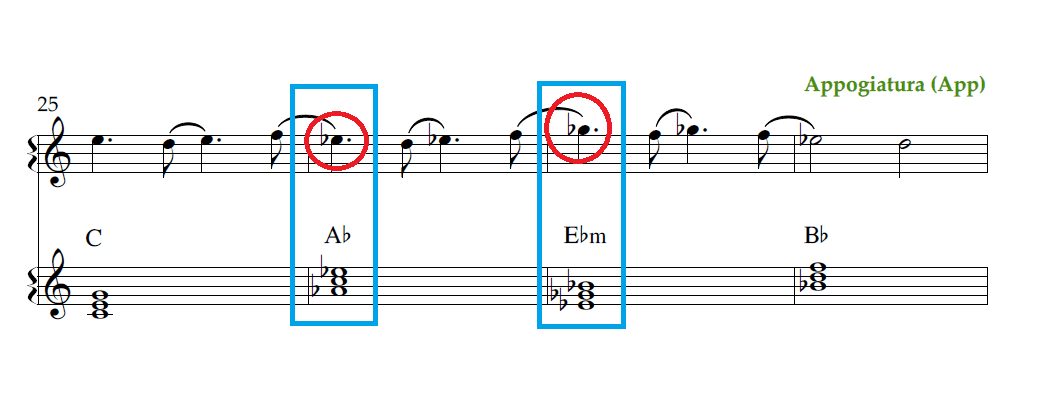
Sometimes, the melody needs to be adjusted to match the new harmonic colours. In bars 26 and 27 we modified slightly the melody a semitone lower (E flat and G flat) to accommodate the harmony, preventing melody clashes against the A flat major and E flat minor chords.
9. Orchestrate / register – spotlight the modal note (top voice, colour-doubling)
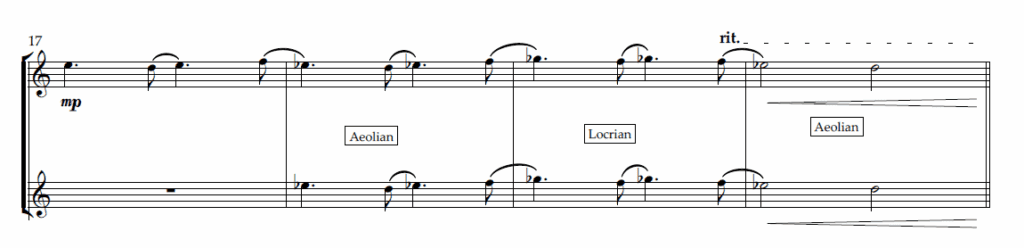
In bars 14, 15, 18, 19 and 20, an oboe doubles the flute and adds a more poignant effect to the Aeolian and Locrian modal interchanges.
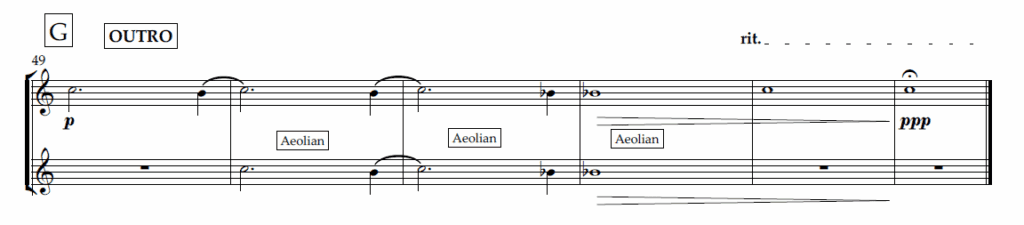
Same device in bar 50-52 when the clarinet adds a smoother timbre in the G Outro section
10. Optional expansion – Addition of percussion (drums), a bass line (Bass) and a pianistic accompaniment (Piano)
Voice-Leading & Function
- Keep the tune mostly diatonic. (Hindemith: mixture often alters harmony first, melody later if at all.)
- Identify Compatible Chords Pick chords from the parallel minor or mode. Ensure melody notes align—or adjust them slightly if needed
- iv–I cadences – let ♭6 fall by semitone to 5; hold common tones. (bar 3 iv to V)
- Label functionally – ♭VI acts like a subdominant predominant that leads to the dominant (Bar 7 to 8 – A flat major to G major)
- Refine the Emotional Arc Use modal interchange to shape tension and release dynamically across your piece.
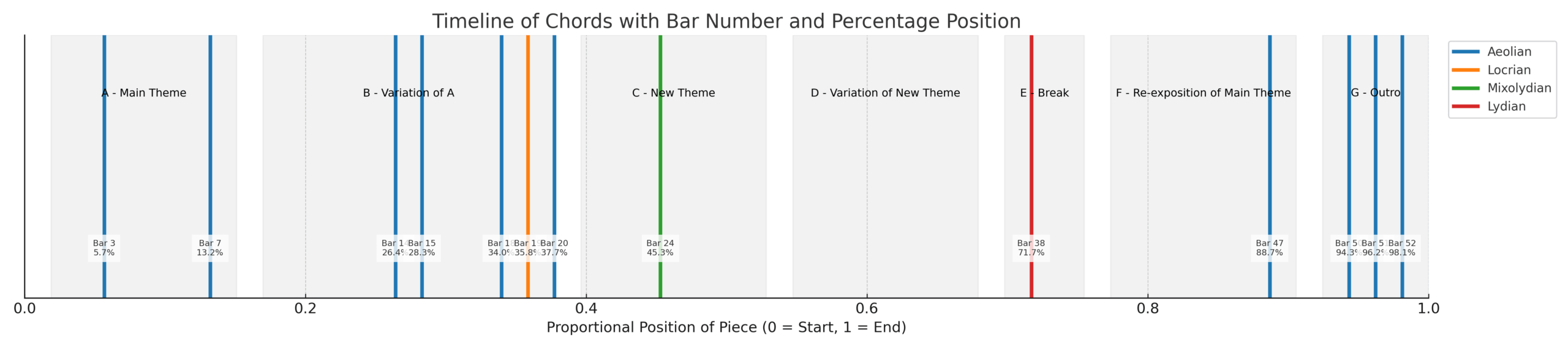
I quote again the chart shown above to define the progression and distribution of the modal interchange used in the piece:
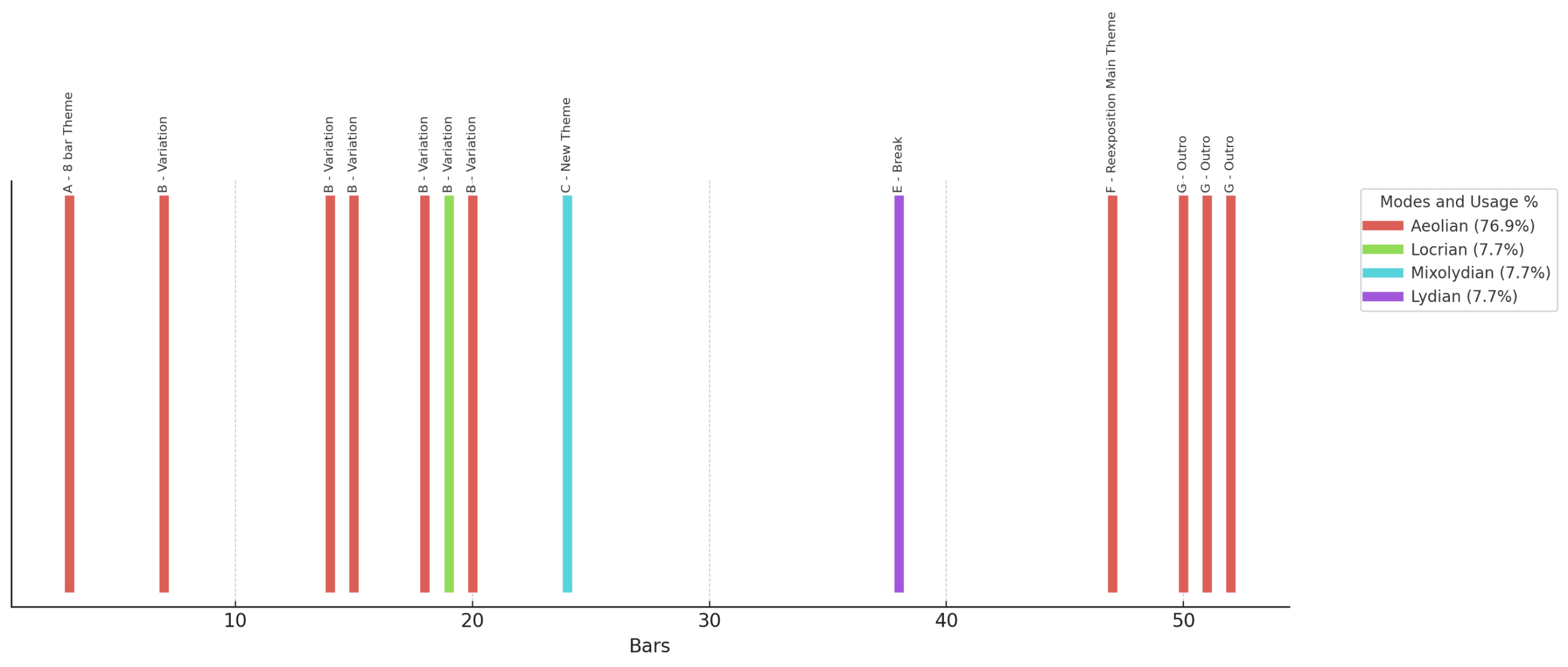
Borrowed chords taken from the Aeolian start scarcely in the first 10 bars (bars 3 and 7) in the A section (Main Theme)
Then, in section B, there is an accumulation of modal chords from Aeolian in bars 14, 15, 16, 18 and 20. The use of the Locrian in bar 19 defines this section as the darkest of the piece in harmonic terms. It is worth noting that the Locrian is not isolated, but within an Aeolian context. (See 6. Common Pitfalls – and Fixes: Leaping drastically from one mode to another)
In the next section, C, the new theme only has one mode mixture to the Mixolydian, that means the harmonic colour went from dark to a lighter mode.
The D section offers a pause in any mixture, keeping the whole section diatonic.
The E section, or “break” contains the brightest mode, the Lydian in bar 38 (71% of the total piece)
Notice how the darkest and brightest chords are used only once in the whole piece. The Locrian at the 37% and the Lydian at the 71%, the latter appearing approximately at double the time the darkest mode appeared. These details are not random, as composers, we should design the overall architecture or “Emotional Arc” of the piece.
At the end of the piece, in the last 2 sections, F and G, we go back to the initial mode mixture to the Aeolian.
To be more precise, here is a chart that shows when exactly the modes are used within the sections, and the proportional length (each vertical line is the chord’s entry)
Wrap-up Of How to Use Modal Interchange
What we’ve seen:
- What Modal Interchange Is – Borrowing one or more chords from a parallel mode to add new colours to your harmonic palette.
- Why We Use It – For emotional contrast (major ↔ minor shifts), established modal affects (Dorian’s hopeful minor, Lydian’s radiance, Phrygian’s tension), fresh harmonic variety, and smooth pivots to remote keys.
- How It Works – Momentarily swap your home scale for a parallel mode, import the chord(s) you need, then return “home” so the tonic still feels central.
- Your Borrowable-Chord Cheat Sheet – Know which chords each mode yields (e.g. ♭VI/♭VII from Aeolian; II/♯IV from Lydian).
- Minor-Mode Borrowing – Borrow “up” to the major parallel (♭III, ♭VI, ♭VII) for shafts of light in a minor key.
- Creative Tasks – Learn by re-harmonising an existing melody (we used “Twinkle…”), applying step-by-step chord swaps, voice-leading, and modal colour.
- Composition of a piece – Use of modal interchange:
- Planning the Emotional Arc – Map out where each modal colour enters and recedes so that your piece’s trajectory—from calm to tension to release—feels deliberate.
- Proportions and Placement – Be meticulous about how often and how long you stay in a borrowed mode in each section, ensuring that your listeners sense the impact without losing tonal grounding.
The aim of using Modal Interchange:
To unlock rich, expressive resources beyond diatonic safety—enabling you to craft fleeting flashes of tension or warmth, evoke specific affects, and keep listeners engaged by weaving in unexpected but contextually grounded colours. Crucially, by planning ahead, you control the ebb and flow of emotion, guaranteeing that each borrowed chord arrives at just the right moment and in just the right amount.
Key insights from this article:
- Think of modes as “visits” to other harmonic planets around your tonic sun—plan each visit’s timing and duration.
- Keep it simple: Borrow one chord at a time, mind your voice-leading, then return home.
- Use your ear: Modal colours are felt as much as they’re theorised—experiment until it sings.
- Balance is everything: Too much modal detour can blur your home key; too little may feel underwhelming. Sketch your form so each section’s modal palette serves your narrative.
- A two-way street: You can borrow down (major → minor) just as readily as up (minor → major).
- Plan and pivot: A single borrowed chord can serve as a pivot to remote keys or as a flash of modal colour within your home key, but only if you’ve sketched its role in your overall arc.
Final comment for composers:
Modal interchange is one of the most accessible yet powerful tools in your compositional kit—no need for special theory degrees or exotic instruments. By carefully plotting your emotional trajectory and calibrating how and where each borrowed chord appears, you ensure every twist of colour lands with purpose.
Start small, trust your ear, and let each modal visit reveal a new facet of your musical story. In the words of the great modal practitioners, “Keep your tonic in sight, but don’t be afraid to take the scenic route.” Your next composition is waiting for its modal secret: go forth and borrow boldly!
References for How to use Modal Interchange
Benward, Bruce, and Marilyn Saker. Music in Theory and Practice, Vol. I. W. W. Norton & Company, 8th ed., 2009.
Benjamin, Thomas, Michael Horvit, and Robert Nelson. Techniques and Materials of Music: From the Common Practice Period Through the Twentieth Century. Thomson Schirmer, 7th ed., 2008.
Berklee College of Music. Berklee Harmony Complete. Berklee Press, 2019.
De Leeuw, Ton. Music of the Twentieth Century: A Study of Its Elements and Structure. Amsterdam University Press, 1964 (Eng. trans. 2005).
Hamm, Chelsey (ed.). Open Music Theory, Version 2. Pressbooks, 2022.
Hanson, Howard. Harmonic Materials of Modern Music: Resources of the Tempered Scale. Appleton-Century-Crofts, 1960.
Horvit, Michael, Thomas Benjamin, and Robert Nelson. Techniques and Materials of Music – see Benjamin et al.
Jarvis, Brian, and John Peterson. [See chapters on “Form” and “Diatonic Harmony” in Gotham et al., Open Music Theory, Version 2, 2022.]
La Motte, Diether, der Kontrapunkt. Barenreiter-Verlag, 1981 (Spanish trans. Contrapunto, Editorial Labor, 1991).
Machlis, Joseph. Introduction to Contemporary Music. W. W. Norton & Company, 2nd ed., 1979.
Machlis, Joseph. Music in Theory and Practice, Vol. I – see Benward & Saker above.
Moseley, Brian, and Kris Shaffer (eds.). Open Music Theory, Version 1. Hybrid Pedagogy, 2018.
Naus, Wayne J. Beyond Functional Harmony. Advance Music, 1998.
Persichetti, Vincent. Twentieth-Century Harmony. W. W. Norton & Company, 1961.
Peterson, John, and Brian Jarvis. [See chapters on “Chromaticism” and “Tonicization” in Gotham et al., Open Music Theory, Version 2, 2022.]
Rahn, John. Basic Atonal Theory. University of Nebraska Press, 1996.
Ruhnke, John F., and Eric M. Lea. (See “Ear Training” assignments in Benward & Saker’s Music in Theory and Practice, Vol. I.)
Scharff, Kris (ed.). Open Music Theory, Version 1 – see Moseley & Shaffer above.
Searle, Humphrey. Twentieth-Century Counterpoint: A Guide for Students. John Day Co., 1954.
Schoenberg, Arnold. Theory of Harmony (Harmonielehre). Trans. Roy E. Carter. University of California Press, 1978.
Shaffer, Kris; Moseley, Brian; and Wharton, Robin (eds.). Open Music Theory, Version 1.
Stein, Erwin (ed.). Practical Guide to Schoenberg’s Theory of Harmony. Universal-Edition, 1923.
Ulehla, Ludmila. Contemporary Harmony: Romantic through the Twelve-Tone Row. Schirmer Books, 1996.
Ulehla, Ludmila. [See “Contemporary Harmony” above.]
Walker, A. Peter (ed.). (See “Orchestration” assignments in Benjamin et al., Techniques and Materials of Music.)
Williams, Tom Schneller. Modal Interchange and Semantic Resonance in Themes by John Williams. Journal of Film Music, Vol. 6, no. 1, 2013.
De Waldye, Vincent (ed.). (See “Modal Resources” in Hanson, Harmonic Materials of Modern Music.)