
 TRIAL LESSON
Music Theory Resoucers, Piano Lessons
How to Write Music for Piano: A London Teacher’s Composer‑Pianist Toolkit (Motifs, Harmony, and Texture)
Feb
How to Write Music for Piano Complete Guide
How to Write Music for Piano — A London Teacher’s Composer‑Pianist Toolkit (Motifs, Harmony & Texture)
Introduction — what this guide gives you
There is a particular kind of satisfaction in writing for the piano: you can test an idea the moment it occurs, hear it fail, adjust it, and try again — all without waiting for a rehearsal slot or an obliging ensemble. That makes the instrument a superb laboratory for composers, and a practical one for pianists who want to write their own music.
This guide is for London-based pianists (and anyone who thinks like one): adult learners, piano teachers, conservatoire students, and curious amateurs who want a clear method for how to write music for piano from the first spark to a performance-ready short piece. We move step by step: capturing motifs, building harmony with sensible voice-leading, choosing texture and register, shaping form and pacing, notating clearly, then dealing with UK copyright, PRS registration, and early performance pathways in London.
The tone is intentionally workshop-like: practical decisions, explained with just enough theory to make them repeatable.
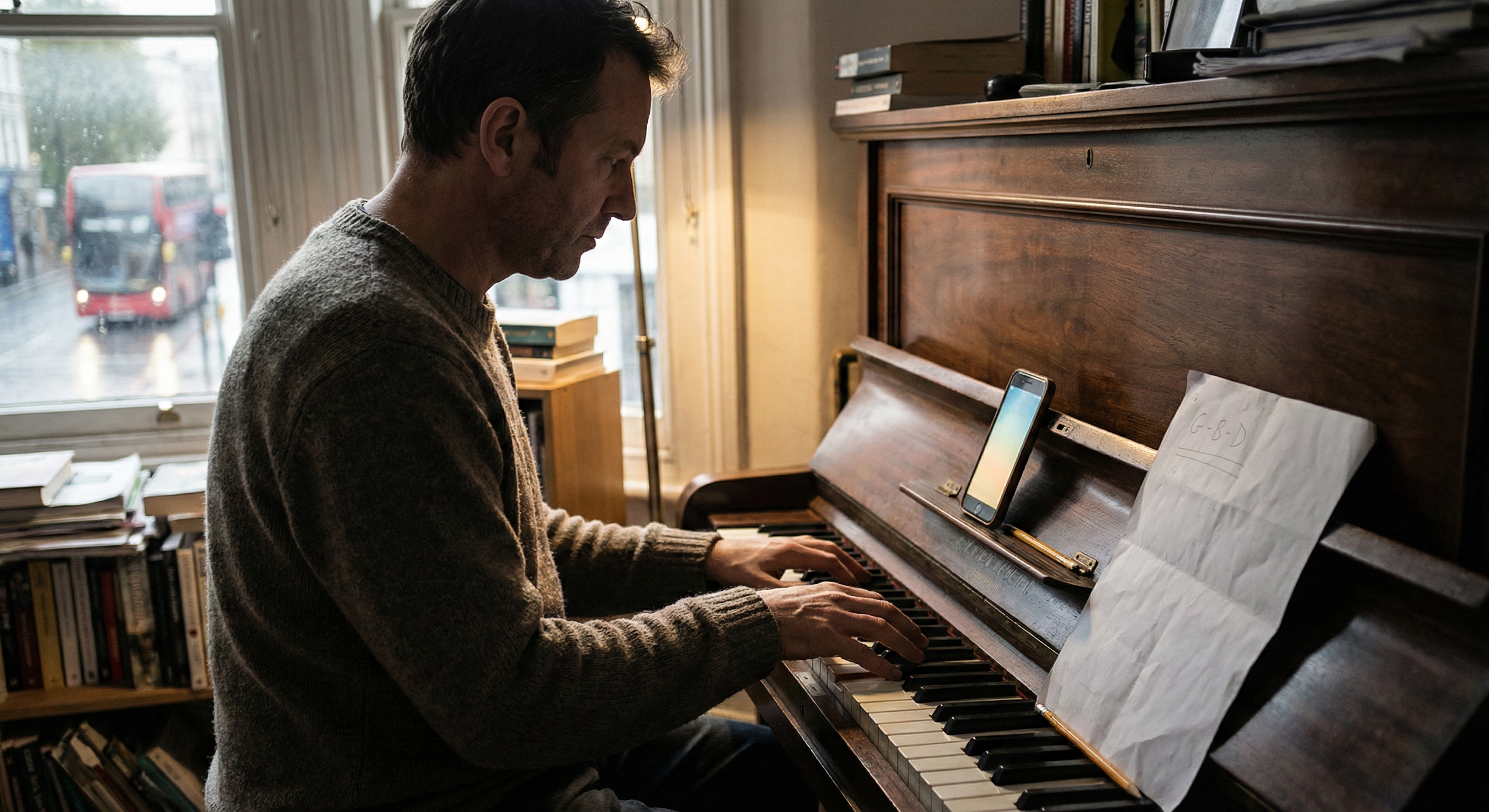
Writing for piano is a fast feedback loop: play the idea, hear it, adjust it, and try again—until the motif feels inevitable under the hands.
Quick Start: from idea to a 1‑minute sketch
Capture the seed — motif, rhythm, gesture
Start at the piano, not the page. Improvise freely and listen for a small object you can recognise when it returns: a rhythm, an interval, a two‑to‑four‑note turn of melody. The point of a motif is not complexity; it is identity. A strong melody is one a listener can recognise quickly, even when it appears in a new guise.
Practical habits help. Record your improvisation on your phone, or jot down fragments the moment they appear. If you wait until later, the brain will rewrite the idea into something safer and less interesting.
Quick Start drill (10 minutes)
- Improvise for 2 minutes and record it.
- Pick one 2–4 note motif you can sing back immediately.
- Play it three times: plain, then in a new register, then with a new rhythm.
- Stop while it still feels fresh; you are collecting material, not proving a point.
Make a 1‑minute sketch at the piano
Choose a key (or at least a home chord) and give your motif simple harmonic support. For a first sketch, favour clear structure over ambition: an ABA (ternary) or AABA shape is often enough for one minute of music. The aim is coherence: a theme, a contrast, and a return that sounds intentional.
Decide on an accompaniment model early, because it will determine the piece’s physical feel under the hands:
- Block chords or sustained harmony for a lyrical, unhurried line.
- Ostinato (a repeated pattern) for propulsion and psychological insistence.
- Alberti bass (broken-chord pattern, often root–fifth–third–fifth) for classical momentum and clarity.
Work in short spans: 8–16 bars is plenty. Listen for a clear tonic (the home key) and for phrase lengths that make sense in the body — often 4 or 8 bars. If you can play your draft through without apologising for it, you have the sketch you need.
Motif & thematic development
Building blocks — motif, phrase, question/answer
A motif is a short musical idea that can survive repetition. Beethoven’s four-note knock in the Fifth Symphony is the stock example because it proves the point: a tiny cell can carry an entire movement. For piano writing, think in tiers: motif becomes phrase; phrase becomes a question; the next phrase becomes an answer.
In practice, you might state your motif plainly in the first phrase, then answer it with a slight change: a different ending, a different harmony, a shifted register. This is how you create a sense of conversation rather than a loop.
Variation techniques you can actually use
Development is repetition with consequences. The listener should feel the idea returning, but not in exactly the same clothes. Common techniques are straightforward:
- Transposition: move the motif to a new pitch level.
- Sequence: repeat it stepwise higher or lower, creating lift or descent.
- Inversion: flip the direction of intervals (up becomes down).
- Rhythmic alteration: keep pitches, change the rhythm.
- Augmentation / diminution: stretch or compress the note values.
One small example in words is enough to make this practical. If your motif is C–E–D (a rising third, then step down), you can:
- Sequence: C–E–D, then D–F–E, then E–G–F.
- Invert: C–A–B (down a third, then step up).
- Augment: keep the pitches but double the rhythm values for a more reflective middle section.
As the piece grows, return to the original motif at structural moments. Even a brief work feels “composed” when the ear can trace a family resemblance through contrasting sections.
Harmony & progression for piano
Idiomatic harmonisation: left hand patterns, register choices
Harmony does two things at once: it supports the melody and it organises time. For many piano miniatures, you can do a great deal with familiar progressions (I–IV–V–I, for instance), provided the voice-leading is clean. The piano is unforgiving here: clumsy chord changes sound clumsy because the instrument exposes every moving part.
Use simple voice-leading principles: keep common tones in the same voice when possible, and move other voices by step. If you move from C major (C–E–G) to F major (F–A–C), keep C as a common tone and let E resolve to F by step. As a rule of thumb, avoid making any single voice leap more than a third unless you want the leap to be heard as expression rather than accident.
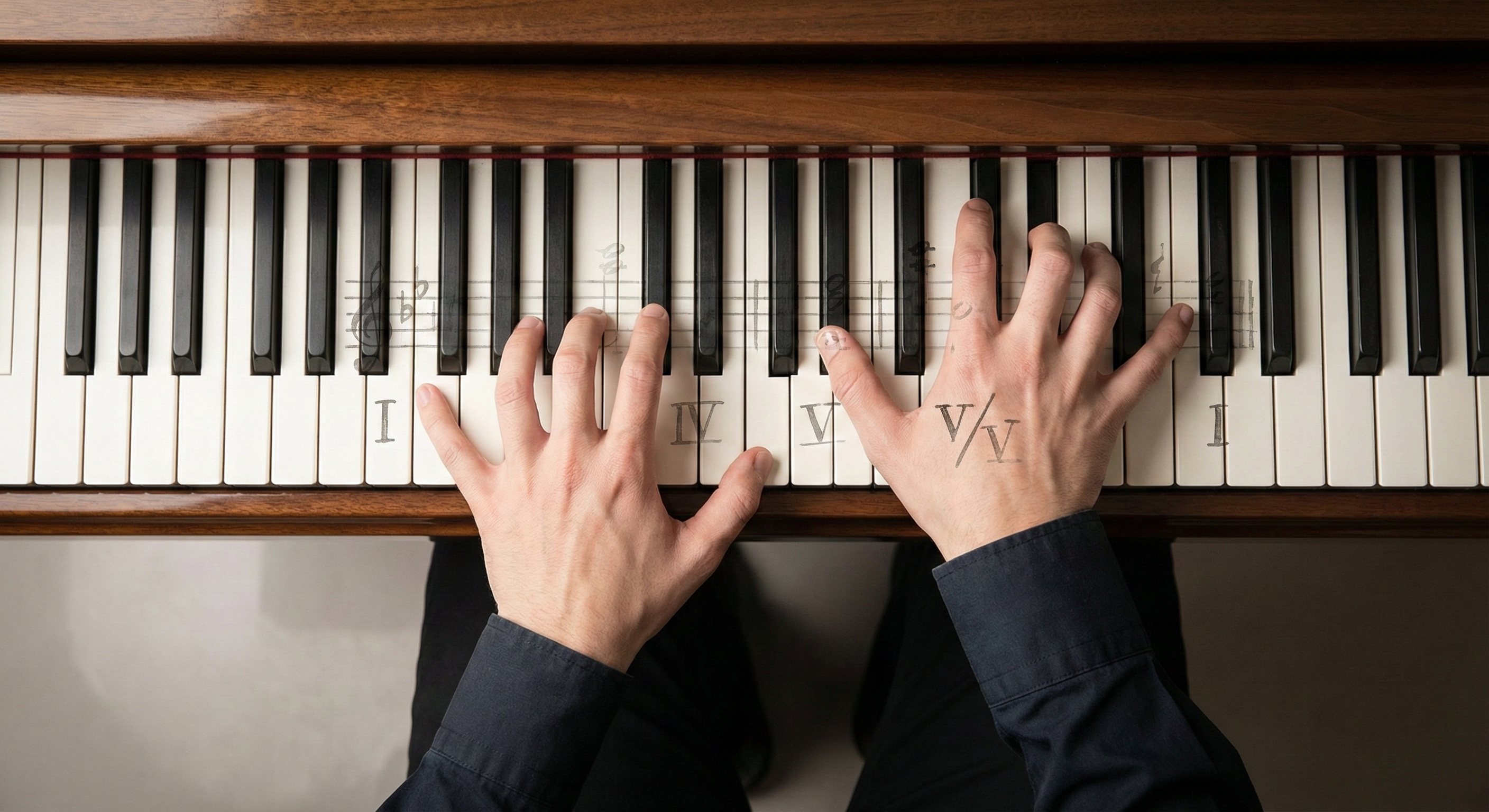
Progression recipes that work with motifs (with colour when you need it)
Once the diatonic basics are stable, add colour in controlled doses. Two reliable tools are secondary dominants and modal mixture.
A secondary dominant is the dominant of a chord other than the tonic. In C major, if you want D minor (ii) to feel briefly highlighted, precede it with A major (its V). That single alteration increases tension and direction without requiring a full modulation.
Modal mixture (borrowing chords from the parallel minor/major) is another way to deepen the palette. A classic gesture is the Picardy third: in a minor-key piece, ending on a major tonic chord for a restrained lift. Used sparingly, it reads as character rather than trick.
Think in cadences: plan points of arrival. A simple I–V–I (or IV–V–I) gives closure; tonic chords create rest. Your motif will feel more persuasive when it has harmonic punctuation.
Texture, voicing & registration
From single line to full piano texture: choose your model
Texture is the composer’s way of controlling attention. On the piano you can move from a single melodic line to dense chordal writing in a few beats — which is exactly why choices must be deliberate.
These are the common accompaniment models, and when they earn their place:
- Block chords: best when the melody needs space and the harmony should feel “architectural”.
- Broken-chord patterns: provide motion without changing harmony too quickly.
- Alberti bass: a classical solution that creates rhythmic and harmonic energy and keeps the texture lucid.
- Ostinato: useful when you want insistence or a sense of inevitability.
- Stride: a jazzier lift, with the left hand moving between bass notes and mid-range chords.
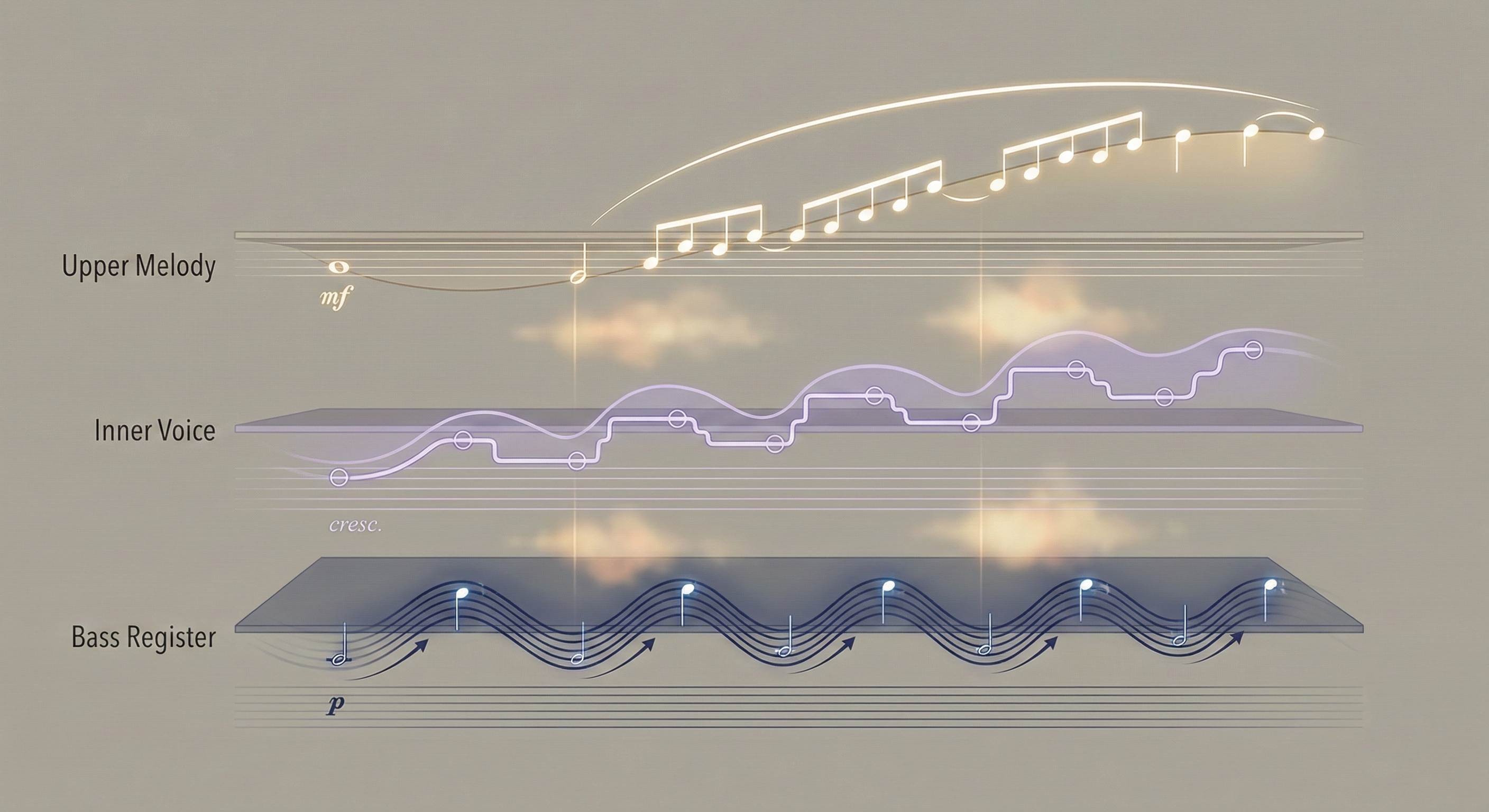
Voicing, inner lines, pedal, and why register matters
Piano writing lives or dies by voicing. Typically, the melody sits in the right hand’s mid-to-upper register while bass and harmonic support occupy the left hand below. This is not a rule of style; it is a rule of acoustics. If your accompaniment crowds the melody’s register, the ear will struggle to decide what matters.
Use inner voices as quiet narrative. An inner line can appear as the top note of the left-hand pattern, or as a passing note inside right-hand chords. The effect is richness without thickness — a very different thing from simply playing louder.
Registration is a compositional choice: high writing tends to sound brighter and more exposed; the mid-range can feel intimate; the bass provides weight. Moving the melody up an octave for a climactic phrase is one of the simplest ways to signal arrival.
Pedal should serve clarity. Mark it if you want a performer to connect harmonies, but change pedal with harmonic changes or at phrase boundaries to avoid blur. Fingerings are worth notating at shift points: if the physical solution is obvious to you at the piano, it may not be obvious on the page.
Form, pacing & length
Practical forms for short piano pieces
A short piece benefits from a form the listener can grasp on first hearing. Binary (AB), ternary (ABA), and short theme-and-variation forms are reliable because they balance repetition with contrast. In an ABA, the return of A does not need to be a photocopy: a thicker texture, a countermelody, or a shifted register can make the reprise feel earned.
Pacing is where many early pieces falter. Keep phrases balanced — a 4‑bar question often wants a 4‑bar answer — unless you are deliberately stretching time for surprise. Use tempo markings and dynamics to shape the arc: build intensity to a peak, then release. Structure is not academic; it is how the listener keeps trust in you.
Notation, revision & preparing for performance
Notation and simple engraving discipline
Once the musical decisions are made, notate with the performer in mind. Clear notation is a form of respect. Use notation software if possible (MuseScore and Sibelius are commonly recommended) to produce legible staves and spacing. At minimum, include:
- time signature, key signature, and tempo marking
- dynamics and expressive changes (crescendo, subito piano, etc.)
- articulation (slurs, staccato, accents) and phrasing
- pedal indications where the harmonic intention is not obvious
- fingerings at awkward shifts or wide spans
Revision checklist: test it like a pianist
Revision is not an admission of failure; it is the job. Play the piece through repeatedly and record yourself. Listen for transitions that drag, for rhythms that sit awkwardly, and for textures that are harder to play than they sound. If a passage is physically unpianistic, it will not become elegant through willpower — rewrite the voicing, adjust the spacing, or simplify the pattern.
Sometimes the best improvement is subtraction: cut a repeat, shorten a bridge, or let an idea end before it explains itself. When you can perform the piece confidently and consistently, it is ready to be heard by other people.
Publishing, copyright & performance in London
Copyright and PRS: the essentials
In the UK, your work is automatically protected by copyright, which lasts for 70 years after your death. If you want to collect royalties from performances, broadcasts, or recordings, register as a writer with PRS for Music. PRS licenses uses of members’ music and collects and distributes royalties. If you self-publish (for example, through digital sheet music platforms), you can still join PRS independently; if you work with a publisher, they will often handle registration as part of the process.
Early performance pathways in London
London rewards composers who are pragmatic. Major schemes exist for those ready to apply: the Philharmonia Composers’ Academy offers workshops with players and a premiere at the Royal Festival Hall, while the LSO Helen Hamlyn Panufnik Scheme supports emerging composers with orchestral workshops and a culminating commission premiered at the Barbican.
For piano pieces specifically, look beyond headline institutions. Smaller series and open calls can be just as valuable early on: community ensembles, student recitals, and composer-development listings (via Sound and Music, PRS Foundation, and Musical Chairs) can help you secure first hearings. Apply widely; hearing your work performed is not merely gratifying — it is diagnostic.
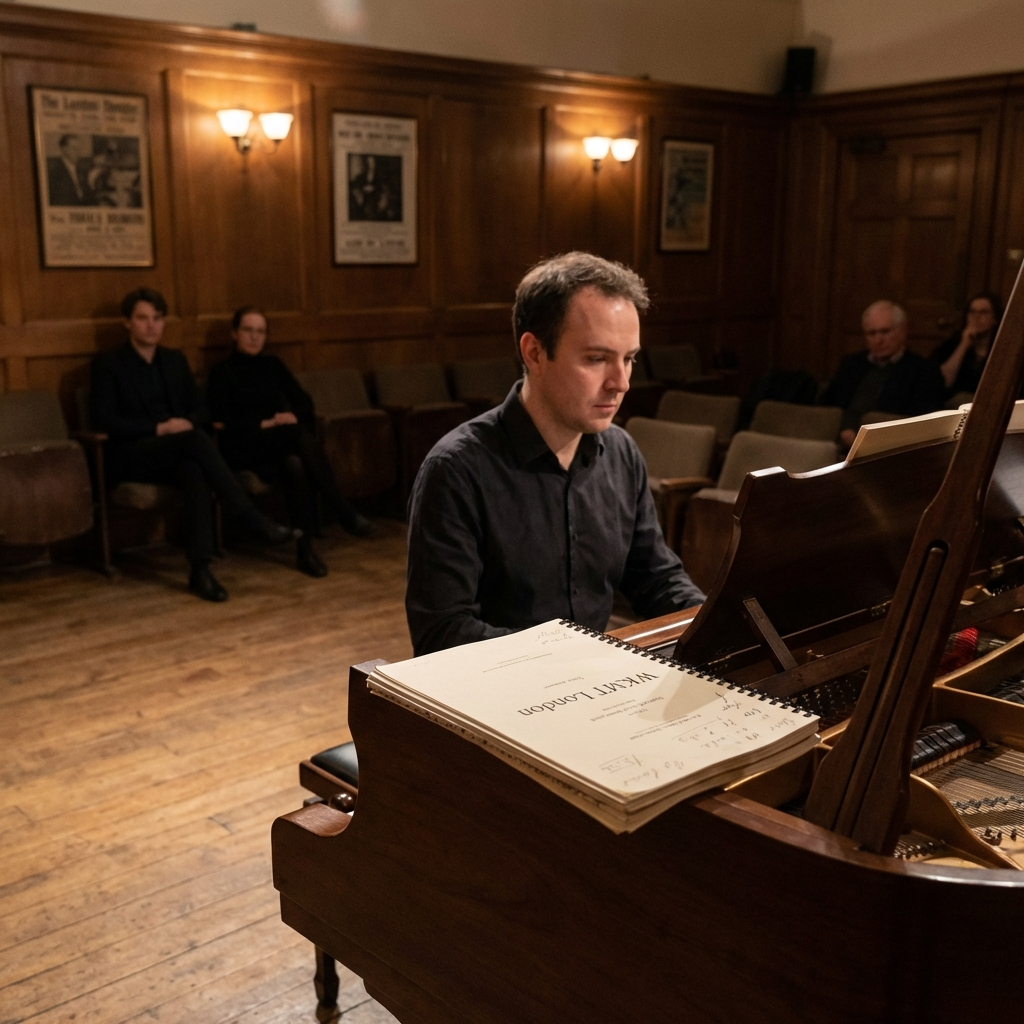
If you are building confidence, a studio performance can be the right first step. At WKMT, we often encourage composer‑pianists to test a short new piece in a low-pressure setting before taking it to larger venues. Then, WKMT London Music Festivals could also be a potential option for your piece premiere!
FAQ
- How do I choose a good key for my piece?
- Choose a key that suits your motif and your hands. C major and A minor are often the simplest to manage on the page. Major keys tend to read as brighter; minor keys as more pensive. If you later want contrast, you can shift key using common tones or chromatic alterations.
- Do I need to join PRS or find a publisher?
- Publisher contracts are optional. Joining PRS as a writer is the practical step if you want performances and broadcasts to be tracked and paid. You can self-publish and still register works with PRS.
- How do I harmonise a melody for piano without making it sound clunky?
- Use voice-leading: keep common tones, move other parts by step, and avoid large leaps in inner voices. Start with simple progressions and add colour later through secondary dominants or modal mixture.
- What’s the quickest way to make a short piece feel “finished”?
- Give it a clear form (ABA is often enough), plan at least one cadence that sounds like arrival, and bring your motif back near the end so the ear feels the return as closure.
- Where can I perform original piano music in London?
- Alongside major development schemes, look for composer open calls, student showcases, and community concerts. Listings from Sound and Music, PRS Foundation, and Musical Chairs are a practical starting point, and studio recitals can provide a first, useful public test.
Conclusion & next steps at WKMT
Learning how to write music for piano is less about waiting for inspiration and more about building a repeatable method: capture a motif, develop it with variation, support it with clean voice-leading, choose a texture that suits the hands, and shape a form that the listener can follow. Notate it clearly, revise it ruthlessly, then get it played — ideally by someone other than you, as soon as possible.
If you would like informed feedback on a draft, we welcome composer‑pianists at WKMT London for composition-focused piano lessons and workshops. Bring a one-minute sketch; we can turn it into a piece you are happy to sign your name to.
Ready to turn a sketch into a finished piano piece?
If you’re working through how to write music for piano and want practical, pianist-first guidance on motif development, harmony, texture, and performance preparation, consider composition-focused piano lessons at WKMT London.
Author: Juan Rezzuto, piano pedagogue and cultural entrepreneur, is CEO of WKMT London (piano teaching studio) and Santa Emilia (Galicia boutique hotel and concert venue). He combines rigorous technique with musical heritage (UK and Spanish) in mentoring new composers and performers.
Sources
Composers’ Academy | Philharmonia
Secondary Dominants – Harmony and Musicianship with Solfège
PRS for Music: royalties, music copyright and licensing
How copyright protects your work: How long copyright lasts – GOV.UK
How to Compose Your Own Piano Music – The London Piano Institute
Voice Leading Paradigms for Harmony in Music Composition – Berklee Online Take Note
Modal Mixture – Open Music Theory
Conjuring 18th-century affekt with Alberti bass on the modern piano | OUPblog
Helen Hamlyn Panufnik Composers’ Scheme | London Symphony Orchestra