
 TRIAL LESSON
Piano Lessons, Uncategorized
Debussy in London: The Composer’s City Visits, Premieres and What Pianists Can Learn

Feb
Debussy in London Complete Guide
Debussy in London — Visits, Premieres and Where to Hear Him Today
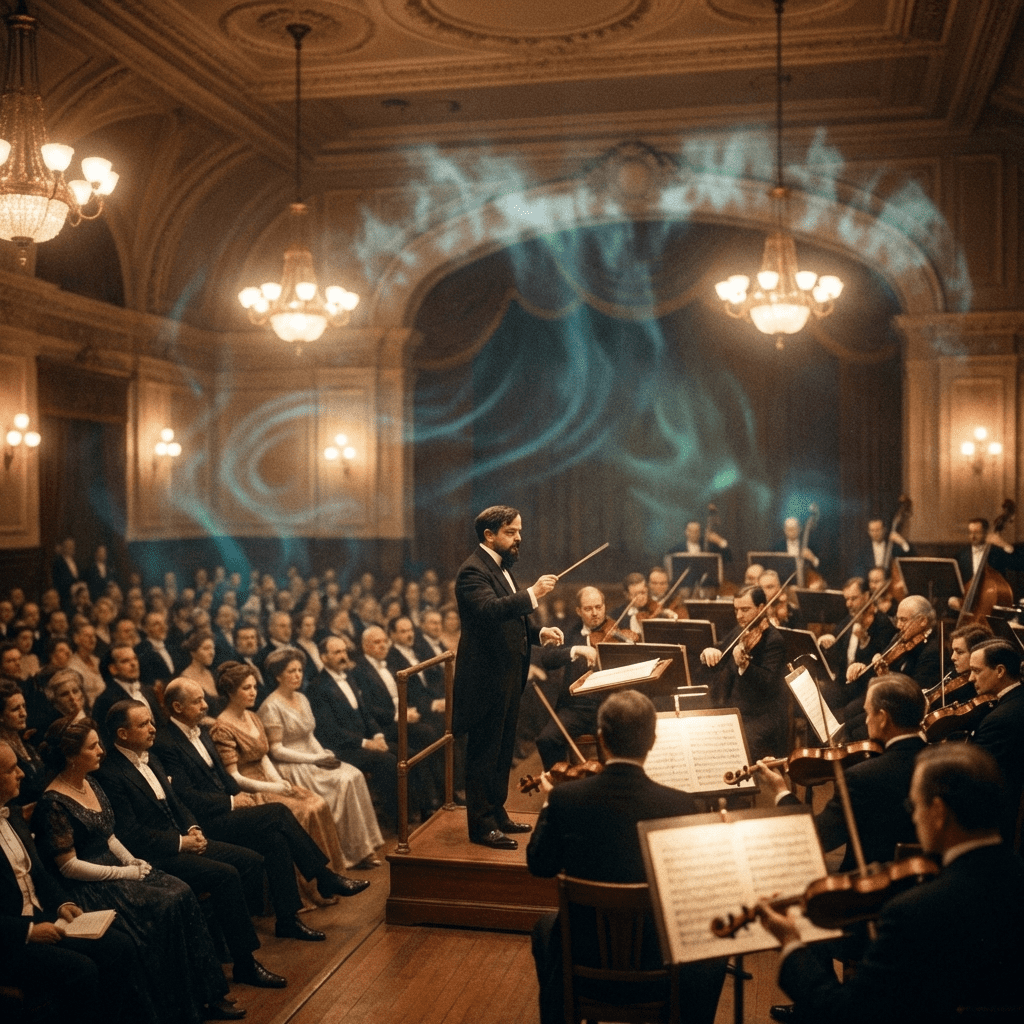
Debussy in London was less a residency than a shock of light: a few appearances, a handful of decisive programmes, and a city suddenly hearing orchestral time and colour spoken in a new dialect.
A short timeline of Debussy’s visits to London
July–August 1905: Debussy’s first English stop was not a public triumph but a private interlude. Newly divorced and travelling with Emma Bardac, he holidayed in Eastbourne and made a brief visit to London before returning to Paris. It was the sort of trip that leaves few musical traces in the record—no programme, no platform, just a quiet brush with the city.
1 February 1908 (Queen’s Hall): The real beginning of Debussy in London as a public story. Debussy appeared as conductor with the Queen’s Hall Orchestra. The concert opened with Prélude à l’après-midi d’un faune, and it brought an English premiere of La mer. Contemporary reporting captured both the warmth of the welcome and a sense that London understood it was hearing something distinct. One account described Debussy as “shy and retiring” by nature yet “heartily welcomed” on the podium, while another praised the “delicate and impressive” character of the Faun under the composer’s own baton.
April 1909 (Queen’s Hall): Debussy returned to conduct again, presenting a concentrated self-portrait: the complete Nocturnes (Nuages, Fêtes, Sirènes) alongside the Faun. A now-famous moment of concert-room theatre followed a stumble: applause, insistence, and an audience’s power to demand a second attempt.
21 May 1909 (Royal Opera House, Covent Garden): London finally met Debussy the dramatist. Pelléas et Mélisande received its first London staging at Covent Garden. Debussy was present for the production—an autograph note later confirmed the date as the first UK performance. After this, the London chapter effectively closes: he never returned and died in 1918.
Key London premieres and performances
Debussy’s London legacy is anchored to a handful of dates, but the content of those programmes matters. London’s first substantial encounter with his orchestral thinking came in the form of works that still define him in the public ear.
English premiere of La mer — Queen’s Hall, 1 February 1908
Queen’s Hall heard Debussy’s seascape at the point of maximum risk: new music, conducted by its composer, before a public trained on different forms of musical persuasion. The programme opened with Prélude à l’après-midi d’un faune and then unfolded La mer in three movements. Reports suggest a familiar first pattern in the reception of modern works: admiration for performance, uncertainty about meaning. One critic found the piece innovative but puzzling, noting that it could “give the sense of disappointment in spite of an admirable performance.” London, in other words, listened carefully—and reserved judgement where it felt it should.
Debussy conducts the complete Nocturnes — Queen’s Hall, April 1909
By 1909, Debussy’s London appearance became more deliberate: less an introduction than a demonstration of range. The three Nocturnes offer different kinds of motion—stillness, bustle, and an elusive choral shimmer in Sirènes. The evening also included L’après-midi d’un faune, as if London needed reminding that this language could whisper as well as glitter.
The concert is remembered for a moment of friction that revealed something about London audiences. After a stumble in Fêtes, Debussy tried to stop; the orchestra continued; the audience applauded and effectively forced a repeat. It is an unusually vivid image: a composer insisting on standards, an orchestra unwilling to break the flow, and a public loudly insisting that the music mattered enough to do again.
First London staging of Pelléas et Mélisande — Royal Opera House, 21 May 1909
The London premiere of Pelléas at Covent Garden was a different type of event: not a concert novelty but a full theatrical test. The production was mounted by the Grand Opera Syndicate, and Debussy attended. An autograph note later confirmed the date as the first UK performance, fixing the event in documentary terms rather than memory.
These performances also illuminate the role of London’s institutions. Sir Henry Wood, in later memoir, recalled how thoroughly he rehearsed the orchestra before Debussy’s arrival—“so that when M. Debussy came we were ready.” It reads like professional pride, but it also tells you something about the city: it wanted to meet Debussy on serious terms, not as a passing continental curiosity.
How London received Debussy — critics, audiences and press excerpts
Critical reaction to Debussy in London combined approval, surprise, and the mild impatience of a press that wanted modernity to behave more like tradition. Reviews repeatedly praised the Faun under Debussy’s baton, admiring its delicacy and control. He was described as one of the most original of the “moderns”—a label that both honoured him and kept him at arm’s length.
Yet the public response mattered just as much as the prose. The April 1909 incident in the Nocturnes suggests that Debussy’s supposed obscurity did not prevent a direct connection with listeners. The audience’s applause compelled a second attempt; afterwards, Debussy reportedly quipped that English listeners appreciated his music “even more than Parisians.” By 1909, some commentary even spoke of a Debussy “cult” making progress in England—an indication that admiration had become a social phenomenon as well as an aesthetic one.
If there was scepticism, it tended to be phrased as a request: more clarity, more strength, less “nebulous” beauty. Even then, the language of complaint was also a form of fascination. London did not merely tolerate Debussy; it tried to place him, which is how a city begins to absorb a new style.
Debussy’s influence on British music and London’s musical life
Debussy’s influence in Britain was recognised early and described without much ambiguity: there was “no mistaking the depth and width” of it. The mechanisms are familiar to anyone who has watched musical fashion become musical grammar. Harmonic ambiguity becomes permissible; orchestral colour becomes structural, not decorative; modality and whole-tone inflection slip into the bloodstream.
In Britain, Cyril Scott became a symbolic case, so marked by French Impressionism that he was dubbed the “English Debussy”. Others—Roger Quilter, John Ireland, and the wider world around them—absorbed aspects of Debussy’s palette. Ralph Vaughan Williams, who studied with Ravel, is part of the same broader openness to French colour and technique, even when the resulting music pursued different national ends.
London’s concert life adjusted accordingly. Debussy’s works began to appear more regularly; the initial sense of novelty hardened into repertoire. A critic remarking on the progress of a Debussy “cult” in England was, in effect, noticing a change in taste that would make later modernism easier to hear.
What pianists (and listeners) should listen for — repertoire, interpretations, recommended recordings
Debussy’s piano music tempts people into talking about “atmosphere” when they should be listening for decisions. The atmosphere is real, but it is made: through harmonic spacing, pedalling, and a disciplined approach to timing.
Start with the canonical gateways—Suite bergamasque (with “Clair de lune”), Estampes, Children’s Corner (including “Golliwogg’s Cakewalk”), Images, Pour le piano, the two books of Préludes, and the Études. In the Préludes, pieces such as “La cathédrale engloutie” and “Feuilles mortes” show Debussy’s gift for building large spans from small shifts. Listen for how extended chords behave less like functions and more like colours in motion; how modal and whole-tone resources soften the sense of gravity; and how resonance is treated as part of the harmony rather than an after-effect.
Interpretive listening drill (for pianists)
When you practise (or listen to) Debussy, pick one passage and make three deliberate versions: (1) minimal pedal for pure clarity, (2) generous pedal for blended colour, (3) the “true” compromise you will perform. The point is to hear how structure survives—especially through transitions—when resonance becomes part of the harmony.
Interpretively, the dividing line is often between clarity and haze. Some pianists stress architecture, others cultivate blur. Mitsuko Uchida’s recordings are often cited for clarity and structural sense, while explorations of colour can lean heavily on pedalling and timbral imagination. Historic benchmarks—Walter Gieseking and Aldo Ciccolini—still teach modern ears what it means to phrase without over-stating. Among contemporary favourites, listeners often turn to Jean-Yves Thibaudet for “Clair de lune”.
For orchestral Debussy, London ensembles have long been central to how audiences hear these scores in real space: La mer, the Nocturnes, and Prélude à l’après-midi d’un faune remain staples for the city’s orchestras and broadcasters. If you are listening with Debussy in mind rather than merely consuming familiar titles, concentrate on transitions: the way he moves between textures without telegraphing it, and the way a “soft” moment can carry the structural weight.
Where to hear Debussy in London today
Debussy in London is no longer an archival curiosity. It is part of the city’s normal musical diet—sometimes too normal, which is why it helps to choose venues where listening is encouraged rather than merely accommodated.
Wigmore Hall remains one of the most reliable places to hear Debussy in the right proportions: close enough for detail, formal enough for concentration. The hall’s programming frequently includes Debussy in solo and chamber contexts, from individual preludes to larger curated sequences, and many concerts find a second life on BBC Radio 3.
The BBC Proms at the Royal Albert Hall continues to place Debussy in a broad public setting. The research notes a 2025 Proms programme including the London Philharmonic performing La mer (date noted as last checked 2024-10-15; programmes can change). Beyond the Proms, Southbank Centre, the Barbican, and London’s main orchestras routinely programme Nocturnes, Faun, and La mer.
If you prefer Debussy at conversational distance—music heard in a room rather than projected into a hall—WKMT’s salon-scale events offer that scale of listening. You can explore current listings via WKMT’s website and follow our concert updates through the newsletter.
Research resources and archives in London
London is unusually helpful if you want to turn interest into evidence. The British Library at St Pancras holds music collections that include scores, letters, and concert programmes connected to Debussy’s reception in Britain. For period response, newspaper archives—such as those preserving early 1908 and 1909 reviews—remain indispensable, whether accessed through dedicated newspaper databases or library subscriptions.
For specialist study, the libraries of the Royal Academy of Music and the Royal College of Music are natural next steps, particularly for British periodicals such as The Musical Times. Wigmore Hall’s archive preserves programme history and contextual material reaching back to its opening era as Bechstein Hall in 1901—a valuable anchor if you are mapping how Debussy entered London’s recital culture.
A short walking map of Debussy-related London sites
You can walk Debussy in London in an afternoon. Begin at Wigmore Hall (36 Wigmore Street), still doing what it has always done: making listening feel like a civic act rather than a lifestyle choice. Continue to Covent Garden’s Royal Opera House, where Pelléas et Mélisande received its first London staging on 21 May 1909. Finally, go north to Langham Place, the former site of the Queen’s Hall—destroyed in the Second World War and now effectively replaced in the area by the BBC’s presence. The building is gone, but the coordinates matter: it was here, in February 1908, that Debussy introduced London to La mer under his own baton.
There may be no plaque to photograph, but the point of the walk is not commemoration. It is orientation—placing sound in space, and history back into the city.
Further reading, recordings and primary sources
For biography and context, Debussy studies such as Nichols are frequently recommended, and early British critical response can be traced through periodicals like The Musical Times and newspaper reviews from early 1908 and 1909. For listening, historic piano recordings by Gieseking and Ciccolini remain reference points; modern interpretations invite you to choose between clarity, colour, or an uneasy mix of both—which is often where Debussy lives best.
Conclusion on Debussy in London
Debussy’s London visits were brief, but their effect was durable. In 1908 and 1909 the city heard La mer, the Faun, the Nocturnes, and Pelléas at close range—sometimes puzzled, often impressed, and increasingly ready to make this unfamiliar language part of its own musical life. If you want to experience Debussy in London now, do it deliberately: choose a hall that rewards detail, a programme that offers contrast, and an afternoon walk that reminds you where the story began.
If you value that kind of listening, you are welcome at WKMT. Explore our concert diary and consider subscribing to the newsletter to keep track of intimate London performances where French repertoire—Debussy included—can be heard without distance.
Hear Debussy up close with WKMT
For salon-scale concerts where detail carries, explore our listings and keep in touch for upcoming London programmes featuring French repertoire—Debussy included.
FAQs
- When was Debussy’s first London concert, and what did he perform?
- He first appeared as a conductor in London on 1 February 1908 at Queen’s Hall, opening with L’après-midi d’un faune and giving the English premiere of La mer.
- Which Debussy works had major London premieres in 1908–09?
- La mer received its English premiere at Queen’s Hall on 1 February 1908, conducted by Debussy. Pelléas et Mélisande had its first London staging at Covent Garden on 21 May 1909, with Debussy in attendance.
- How did London critics react to Debussy?
- Reviews praised the delicacy and control of the Faun under Debussy’s baton and recognised him as an original “modern”, while some critics found La mer innovative but initially puzzling despite admiring the performance.
- Did Debussy influence British composers?
- Yes. Contemporary British commentary noted the breadth of his influence. Cyril Scott was even dubbed the “English Debussy”, and other British composers absorbed elements of Debussy’s harmonic language and colour.
- Where can I hear Debussy in London today?
- Wigmore Hall regularly programmes Debussy in piano and chamber recitals, and the BBC Proms and London orchestras frequently include works such as La mer, Nocturnes, and Prélude à l’après-midi d’un faune. Always check official listings as programmes can change.
Sources
The Guardian (Observer review, 2 Feb 1908); Eastman School/Sibley Music Library (Debussy La mer exhibits); Interlude.hk article on Cyril Scott; Wigmore Hall official schedule; Colin’s Column BBC Proms review; Rare Book Insider (Debussy autograph listing); Wedgebill Music blog quoting Musical Times (1908–09)
The Guardian (Observer review, 2 Feb 1908)
Eastman School/Sibley Music Library (Debussy La mer exhibits)
Interlude.hk article on Cyril Scott
Wigmore Hall official schedule
Colin’s Column BBC Proms review
Rare Book Insider (Debussy autograph listing)
Wedgebill Music blog quoting Musical Times (1908–09)