
 TRIAL LESSON
Music Theory Resoucers, Piano Lessons
Crafting Emotional Landscapes: The Role of Modal Interchange in Music
14
May
May
Modal Interchange in Music (Mode Mixture & Borrow Chords)
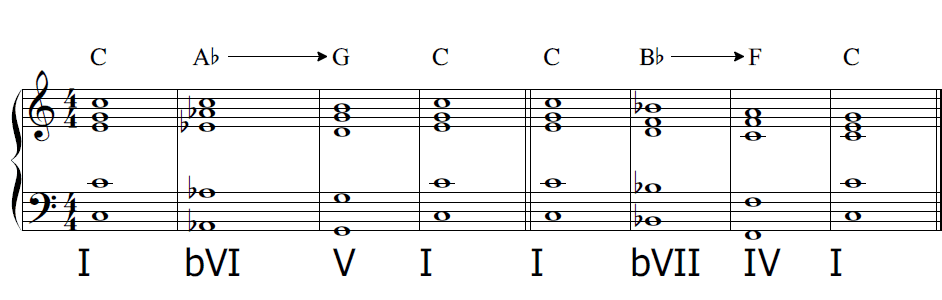
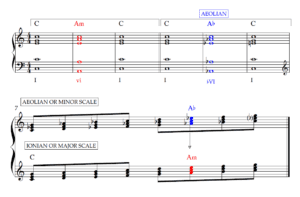 With modal interchange, however, composers will sometimes choose chords more for their colour than for strict functional necessity. In many cases, a borrowed chord can serve a similar function to its diatonic counterpart, but provides a different emotional flavour. For example, in C major, an A♭ major chord (♭VI) often acts as a predominant, typically moving to G (V) and then back to C – in much the same way a diatonic ii or IV chord would function before the V. Likewise, a ♭VII chord (B♭ major in C major) often moves to IV or directly back to I, rather like a V/V (secondary dominant) would move to V or I – but the character of ♭VII is more modal or folk-like compared to the leading-tone push of a true secondary dominant.
 And now, translated into notes:
 And lastly, the more conventional version in ascending scalic form:
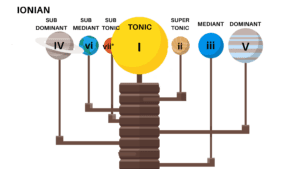
 Each chord in the tonal system has a specific function, and as this system is so stable, it allows borrowing different chords or “planets” let’s say, from another solar system; those different solar systems in music are called “modes”.
For example, this is how the Aeolian system would look like:
Each chord in the tonal system has a specific function, and as this system is so stable, it allows borrowing different chords or “planets” let’s say, from another solar system; those different solar systems in music are called “modes”.
For example, this is how the Aeolian system would look like:
 Notice how the quality of the chords (planets) have changed: Now the VI, VII and III are flats, the ii is diminished and the iv and v are minors if we compare it with the Ionian or major scale.
 Each mode has a distinct character. Musicians often describe modes along a brightness–darkness spectrum depending on how their intervals relate to the major scale. Modes that resemble the major scale (fewer lowered notes) sound “brighter”, while those closer to the natural minor (more lowered notes) sound “darker”.
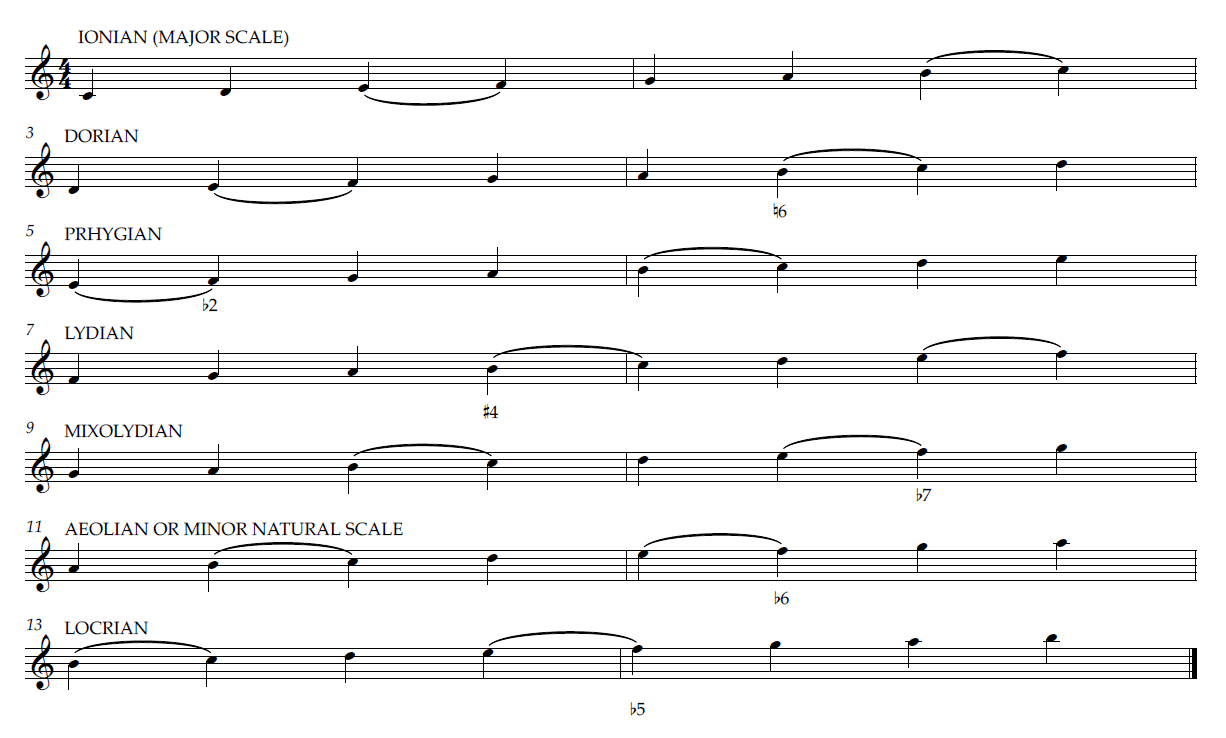
In the following chart, we can see the score with the intervallic structure where the semitones are represented by slurs below the notes.
Harmonically, if we stack thirds on every note, we will form triads on top of each one of them, forming chords that will be used in modal mixture.
The Roman numerals and the chords (based on the C as the tonic) and the slurs on the notes show where the semitones are in the scale.
The modes are organised in three types, according to the type of triad they have as their tonic:
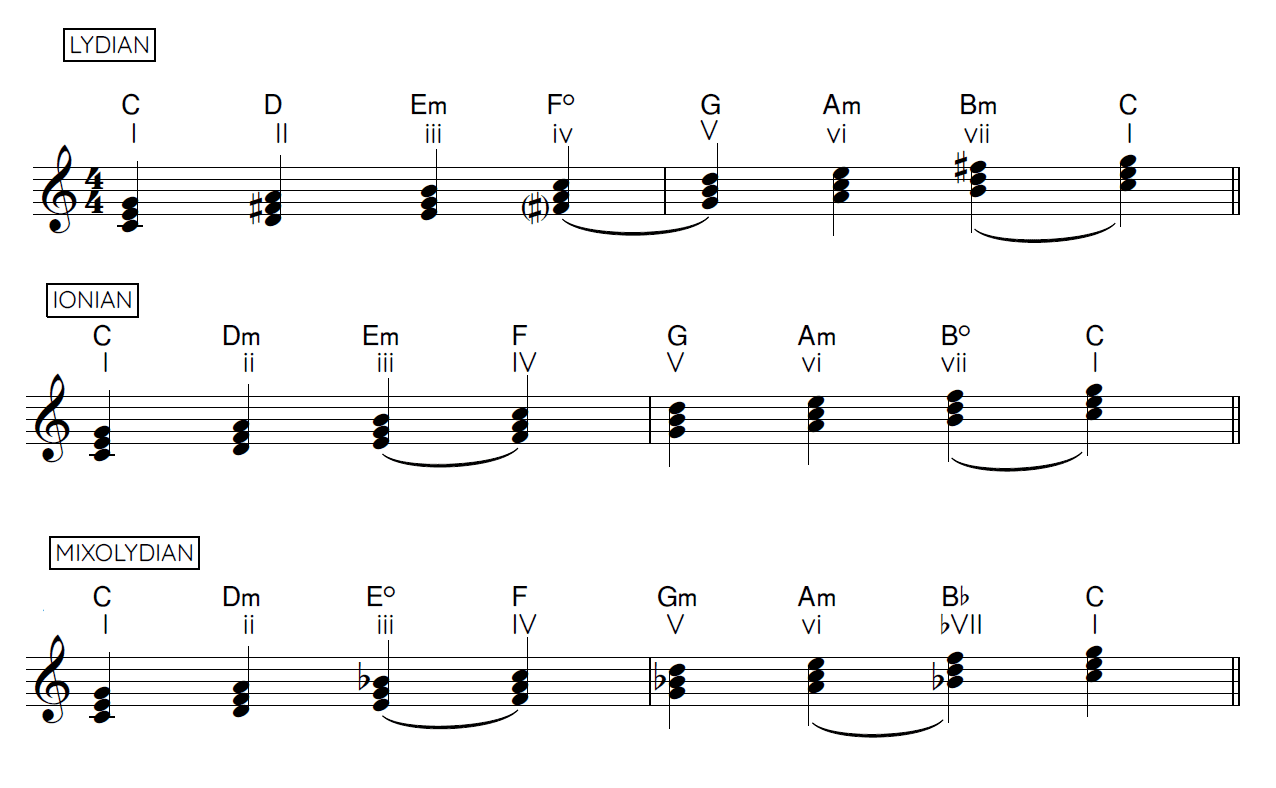
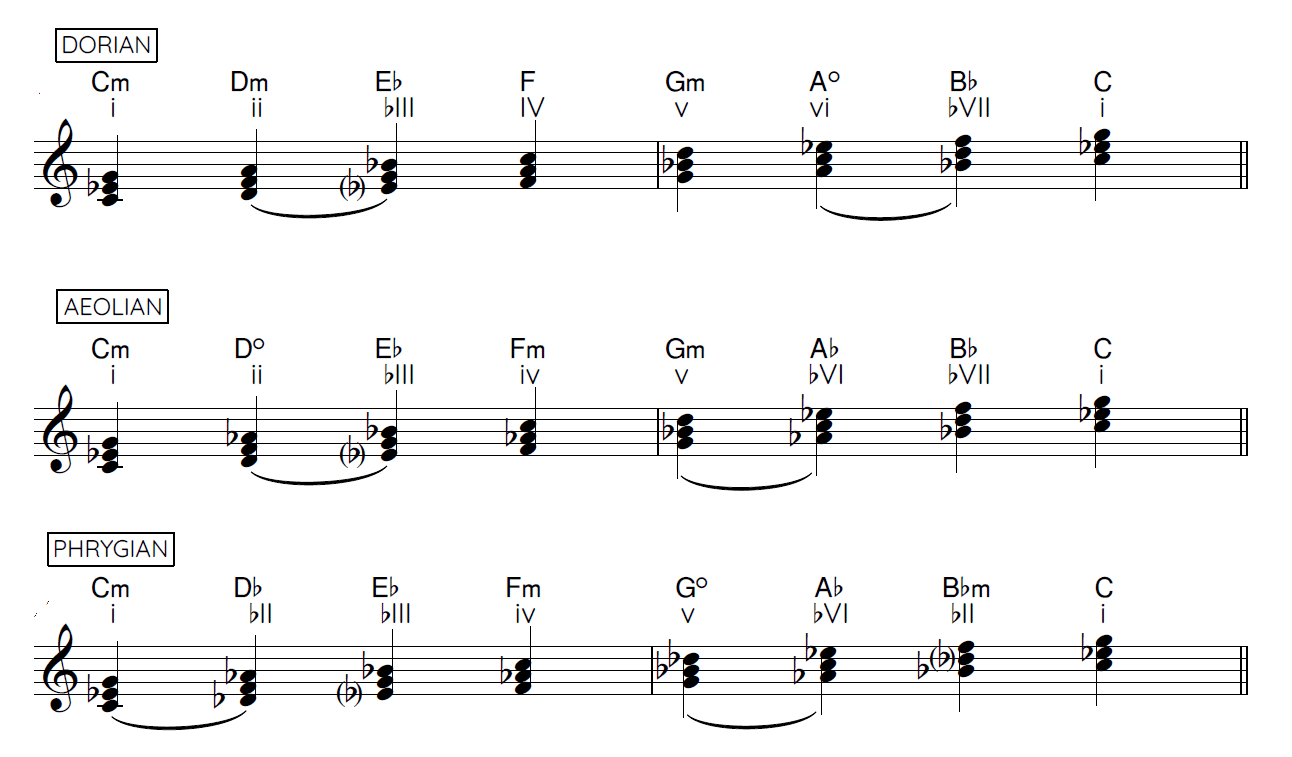
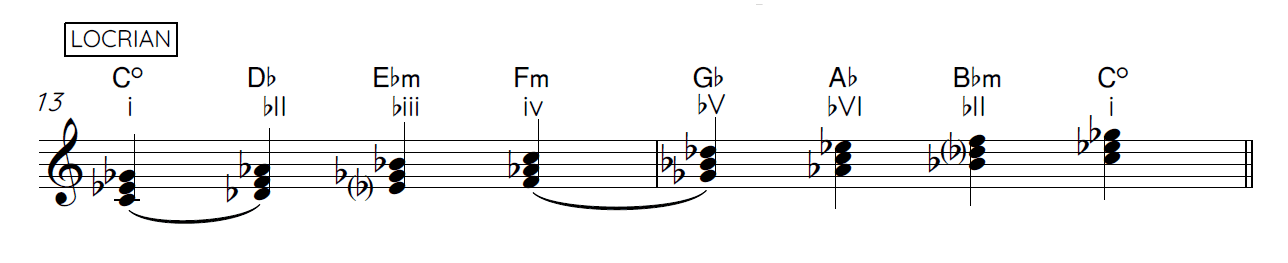 Naturally, this example only shows one tonic, the C note. If you want to find very quickly all the possible chords on every key, I highly recommend this very useful website in which you can find all the possibilities with triads and even with 7th chords by clicking the desired tonic:
https://modal-interchange-chart.com/
Additionally, to help you find easily the main keys from which to work, here is a website in which you can find all the keys and diatonic chords (and their degree names):
https://muted.io/circle-of-fifths/
Naturally, this example only shows one tonic, the C note. If you want to find very quickly all the possible chords on every key, I highly recommend this very useful website in which you can find all the possibilities with triads and even with 7th chords by clicking the desired tonic:
https://modal-interchange-chart.com/
Additionally, to help you find easily the main keys from which to work, here is a website in which you can find all the keys and diatonic chords (and their degree names):
https://muted.io/circle-of-fifths/
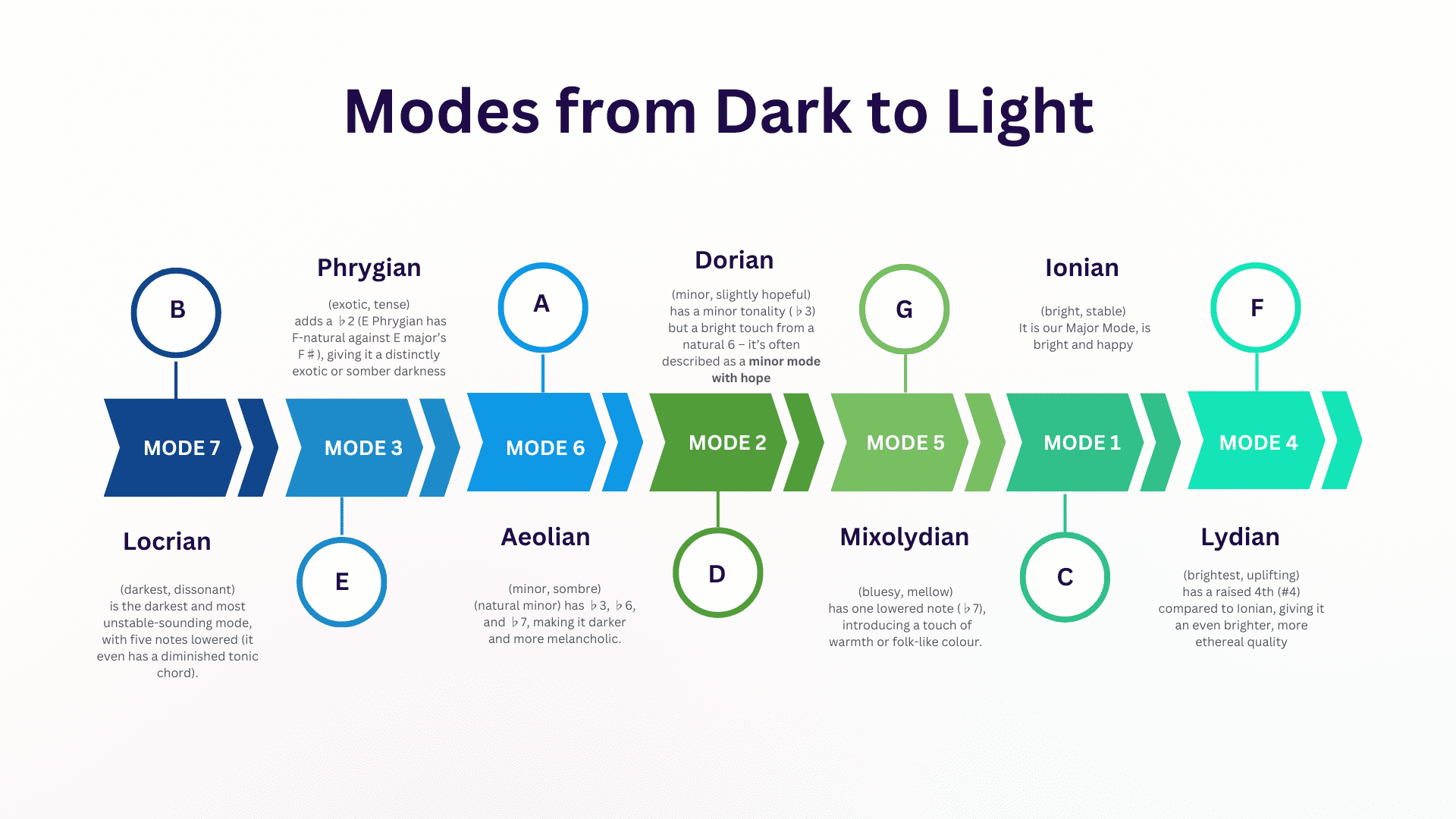 In the figure above, Lydian is at the far right (brightest) and Locrian is at the far left (darkest). Notice how Lydian has a raised 4th (#4) compared to Ionian, giving it an even brighter, more ethereal quality. Ionian (major) is bright and happy. Mixolydian has one lowered note (♭7), introducing a touch of warmth or folk-like colour. Dorian has a minor tonality (♭3) but a bright touch from a natural 6 – it’s often described as a minor mode with hope (think of a jazz or folk minor sound). Aeolian (natural minor) has ♭3, ♭6, and ♭7, making it darker and more melancholic. Phrygian adds a ♭2 (E Phrygian has F-natural against E major’s F♯), giving it a distinctly exotic or sombre darkness. Locrian is the darkest and most unstable-sounding mode, with five notes lowered (it even has a diminished tonic chord).
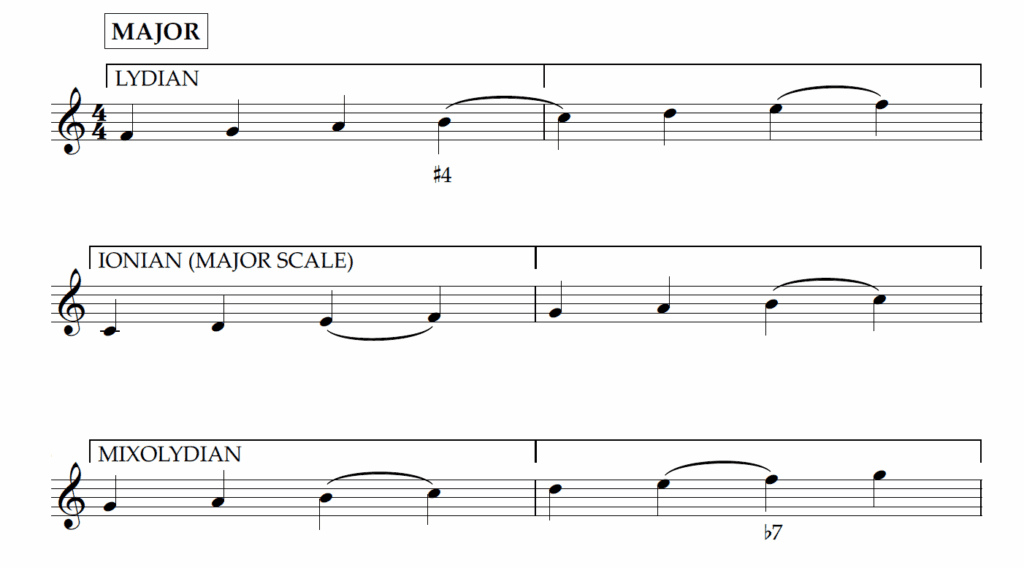
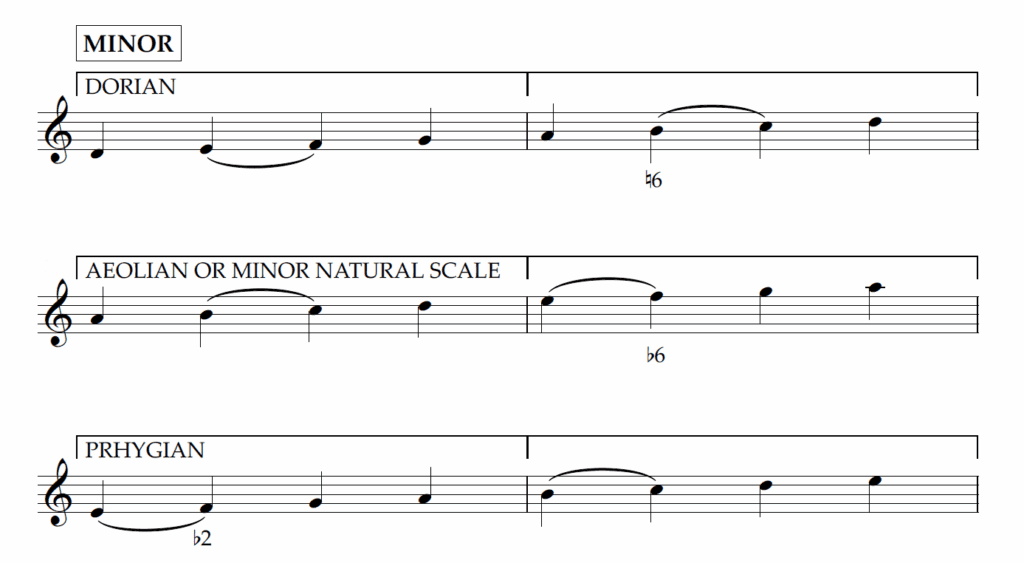
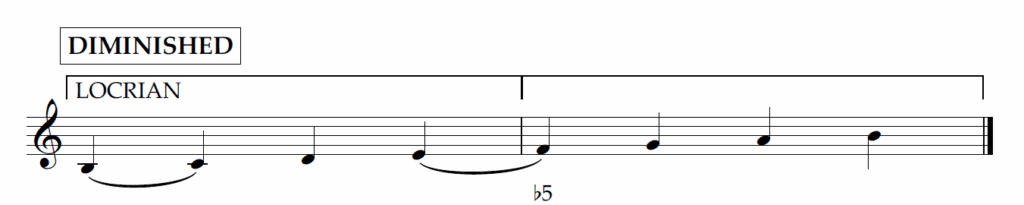 In terms of scale degrees relative to the major (Ionian) scale:
 Key point: When we use modal interchange, we do not change the tonic – we are not modulating to a new key. Instead, we momentarily switch the scale beneath our melody/harmony to one of the darker or lighter modes that share the tonic. This injects emotion by leveraging the contrast between major and minor (or other modal inflections) within a stable tonal centre.
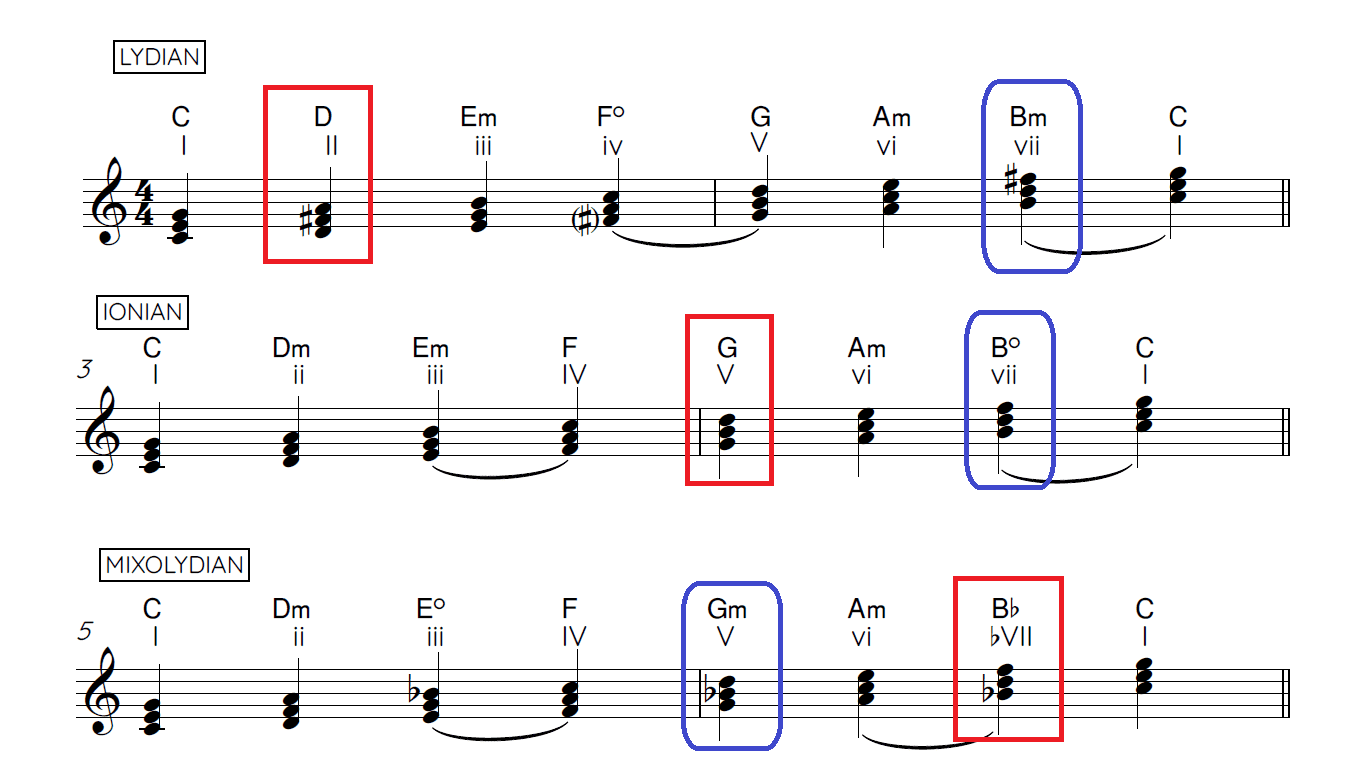
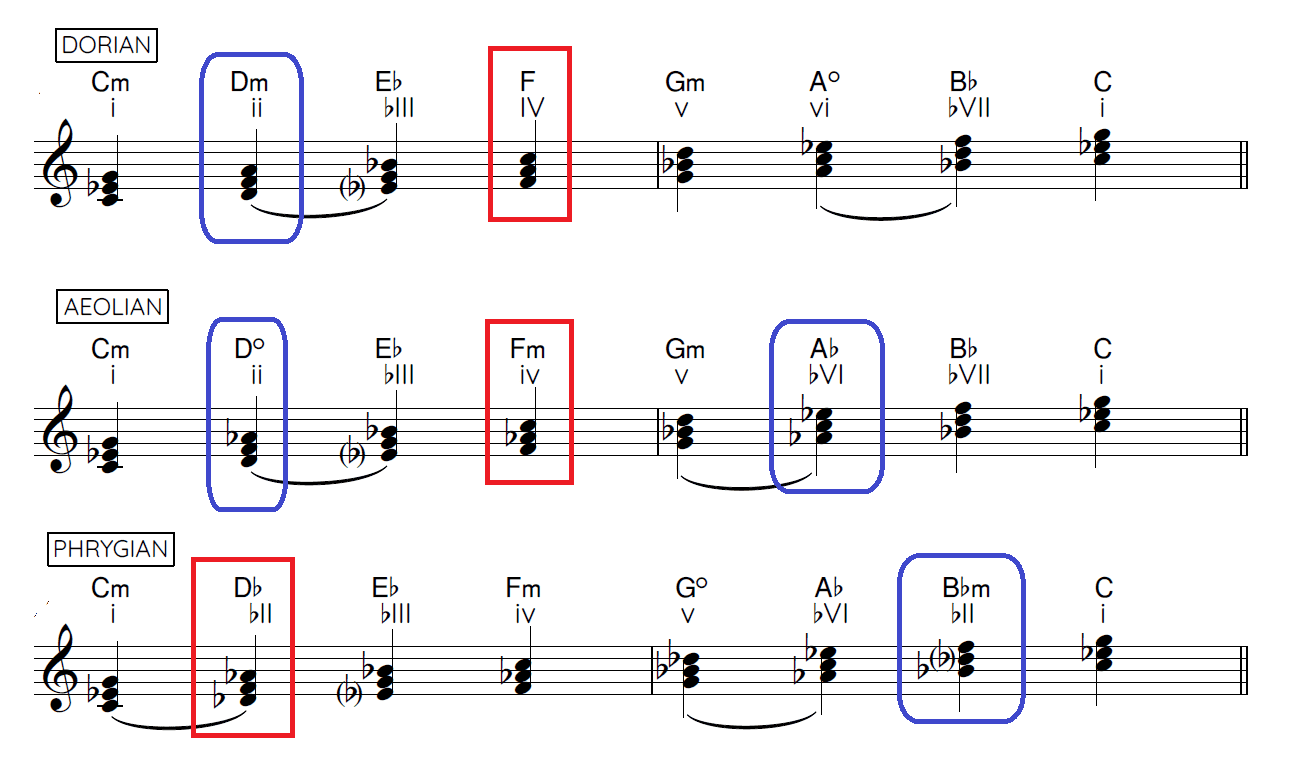
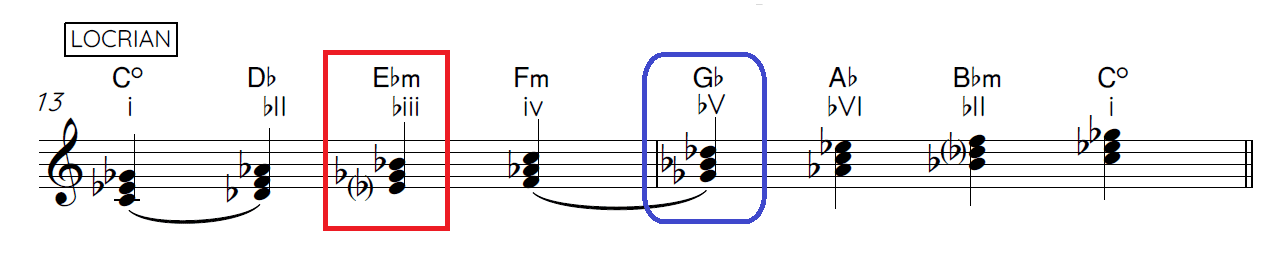 Notice that we never use diminished chords (except for the Ionian or Major mode) the reason is that the diminished chords produce a gravitational effect towards notes that are not the tonic, in which case, we would be dealing with centrifugal forces (the weakening of our tonic) rather than centripetal forces (reinforcing the tonic)
The exception is the Ionian or Major mode, as the diminished chord resolves on the tonic, making it the more stable of them all. (No wonder it was chosen to be the main mode!)
Notice that we never use diminished chords (except for the Ionian or Major mode) the reason is that the diminished chords produce a gravitational effect towards notes that are not the tonic, in which case, we would be dealing with centrifugal forces (the weakening of our tonic) rather than centripetal forces (reinforcing the tonic)
The exception is the Ionian or Major mode, as the diminished chord resolves on the tonic, making it the more stable of them all. (No wonder it was chosen to be the main mode!)
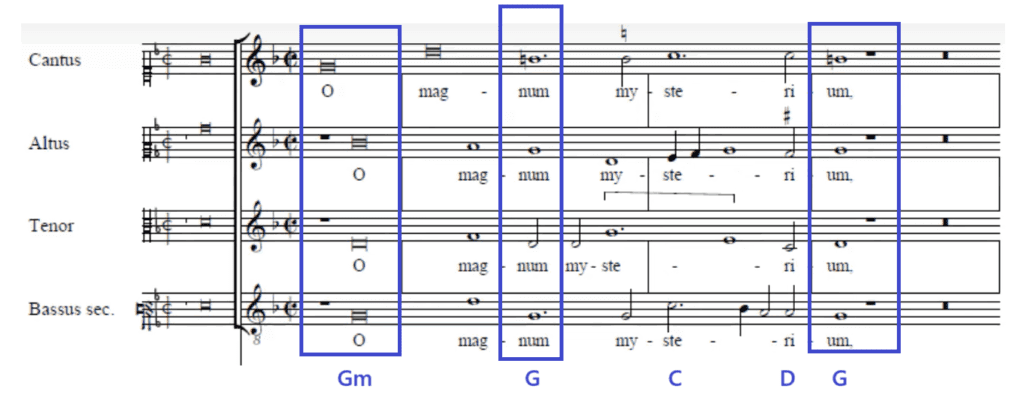 This interchange between minor and major tonic (called “Finalis” in the Renaissance) keeps throughout the piece. You can listen and follow the score from the following link:
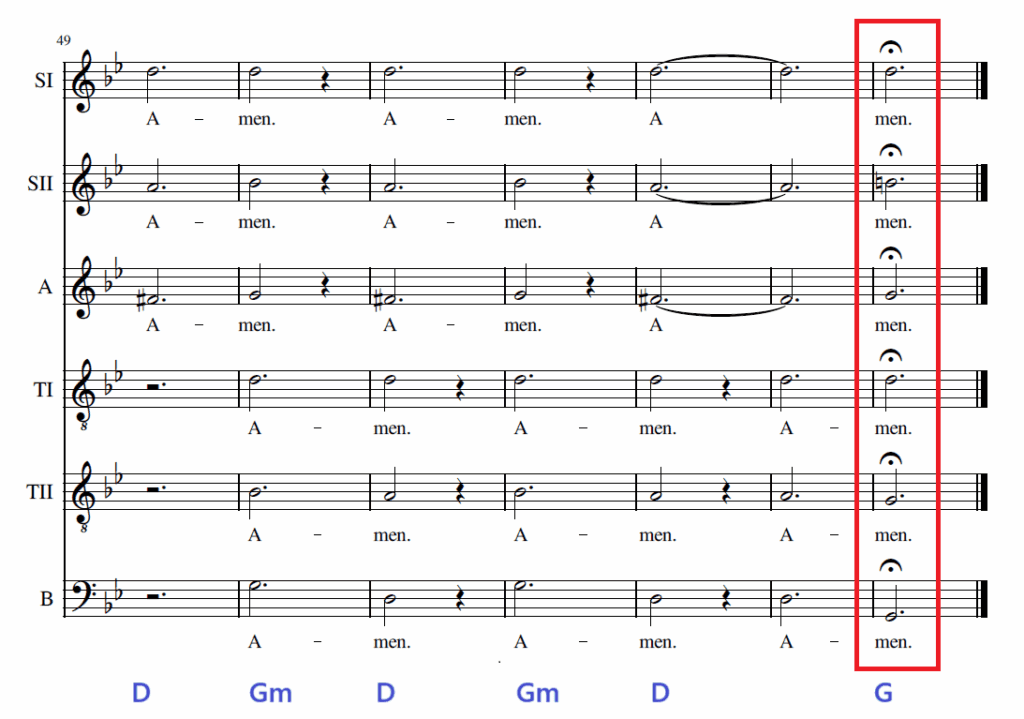
Conversely, some Renaissance pieces in a minor-like mode would end on a major chord – the famous Picardy third, where a final chord is major (with a raised 3rd) in an otherwise minor context. The Picardy third, common in 16th-century sacred music, is effectively borrowing the tonic chord from the Ionian mode (major) in a piece that was otherwise in Aeolian (natural minor). This adds a moment of brightness at the end – an early example of modal interchange’s emotional effect, like in the following example by Nicolas Gombert in his Ave Maria at the end of the piece – From G Aeolian (Minor) to G major at the final cadence:
This interchange between minor and major tonic (called “Finalis” in the Renaissance) keeps throughout the piece. You can listen and follow the score from the following link:
Conversely, some Renaissance pieces in a minor-like mode would end on a major chord – the famous Picardy third, where a final chord is major (with a raised 3rd) in an otherwise minor context. The Picardy third, common in 16th-century sacred music, is effectively borrowing the tonic chord from the Ionian mode (major) in a piece that was otherwise in Aeolian (natural minor). This adds a moment of brightness at the end – an early example of modal interchange’s emotional effect, like in the following example by Nicolas Gombert in his Ave Maria at the end of the piece – From G Aeolian (Minor) to G major at the final cadence:
 Another Renaissance development was the recognition of Ionian and Aeolian modes (major and natural minor scales) as valid modes, thanks to theorists like Henricus Glareanus. In 1547 Glareanus published Dodecachordon and added Ionian (mode 11) and Aeolian (mode 9) to the traditional modal system.
If you want to know more about this, there is an excellent video about the modes from the You tube Channel “Early Music Sources”:
This essentially acknowledged the major and natural minor scales. As composers began using Ionian (major) and Aeolian (minor) more often, the duality of major vs minor tonality emerged.
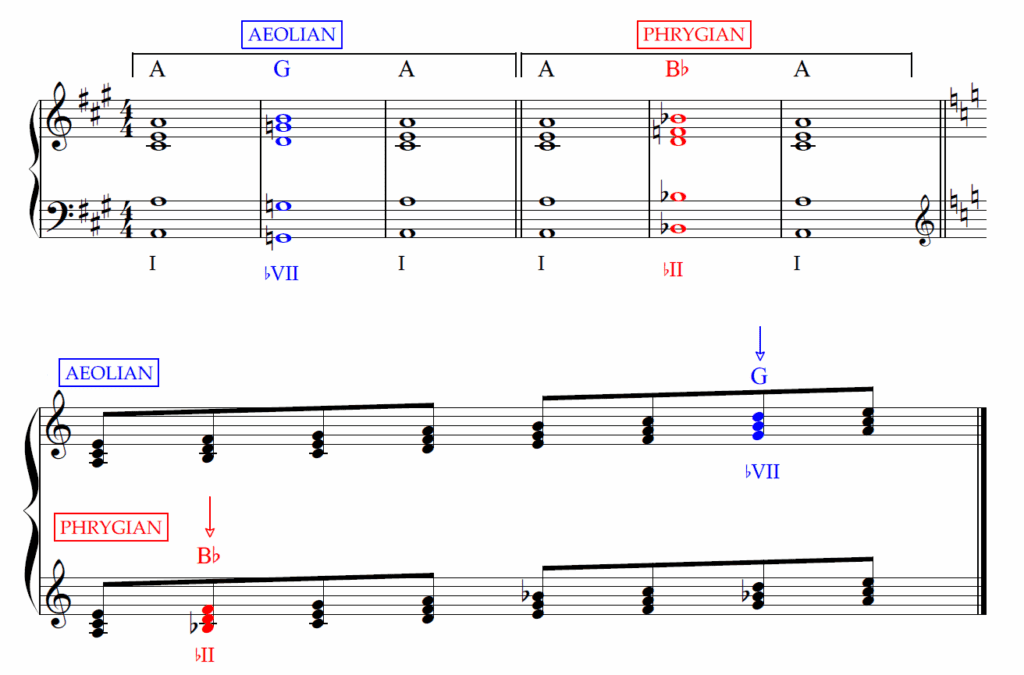
Late Renaissance and Mannerist composers started to play with this duality for emotional effect – for instance, a madrigal might shift from a major-sounding section to a minor-sounding one to reflect a text’s change of mood. We can think of this as a proto-form of modal interchange: the modal system allowed certain flexibility, and composers could turn a mode “major-ward” or “minor-ward” by selective alterations. In fact, some modes are very closely related (e.g. A Aeolian and E Phrygian share the same pitches – one person’s Aeolian could be another’s Phrygian on a different final). This interrelatedness meant a piece might oscillate between modal centres without a clear sense of modern modulation.
There is an example of this with the “Missa L’homme armé – Kyrie” by Josquin Des Prez (minute 2:45 of the YouTube link) in which in the context of A Aeolian, a B-flat note on the Bass appears, giving the chord of B flat major (a flattened 2nd degree, characteristic of the Phrygian mode)
Another Renaissance development was the recognition of Ionian and Aeolian modes (major and natural minor scales) as valid modes, thanks to theorists like Henricus Glareanus. In 1547 Glareanus published Dodecachordon and added Ionian (mode 11) and Aeolian (mode 9) to the traditional modal system.
If you want to know more about this, there is an excellent video about the modes from the You tube Channel “Early Music Sources”:
This essentially acknowledged the major and natural minor scales. As composers began using Ionian (major) and Aeolian (minor) more often, the duality of major vs minor tonality emerged.
Late Renaissance and Mannerist composers started to play with this duality for emotional effect – for instance, a madrigal might shift from a major-sounding section to a minor-sounding one to reflect a text’s change of mood. We can think of this as a proto-form of modal interchange: the modal system allowed certain flexibility, and composers could turn a mode “major-ward” or “minor-ward” by selective alterations. In fact, some modes are very closely related (e.g. A Aeolian and E Phrygian share the same pitches – one person’s Aeolian could be another’s Phrygian on a different final). This interrelatedness meant a piece might oscillate between modal centres without a clear sense of modern modulation.
There is an example of this with the “Missa L’homme armé – Kyrie” by Josquin Des Prez (minute 2:45 of the YouTube link) in which in the context of A Aeolian, a B-flat note on the Bass appears, giving the chord of B flat major (a flattened 2nd degree, characteristic of the Phrygian mode)
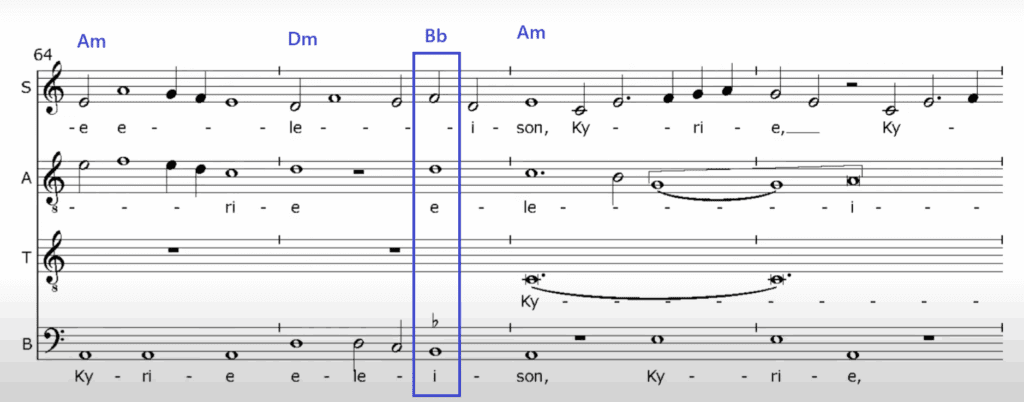 We need to observe, though, that this “Proto-Modal Interchange” cannot be seen under the perspective of a tonal system, but through the lens of the Contrapuntal techniques and the voice leading rules by the time, which were very different from the modern ones.
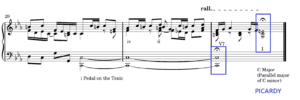
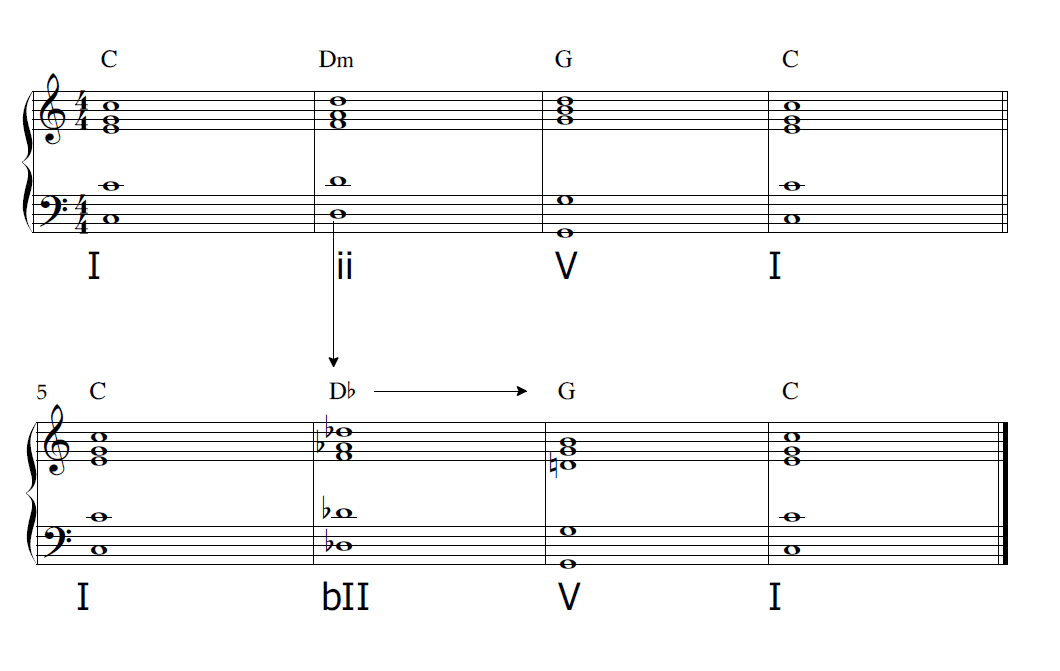 By the end of the Baroque, mixture chords like iv (minor subdominant in a major key), ii° or iiø (diminished supertonic), ♭VII, etc., were appearing, though sparingly and usually quickly resolved.
 A good example of this is in the chorale “O Schmerz! Hier zittert das gequälte Herz,” Bach employs a Neapolitan chord (G♭ major in the key of F minor) on the word “Plagen” (“torments”). This harmonic shift intensifies the depiction of Christ’s agony in the Garden of Gethsemane, using the Neapolitan to underscore the depth of suffering (bars 5 and 7):
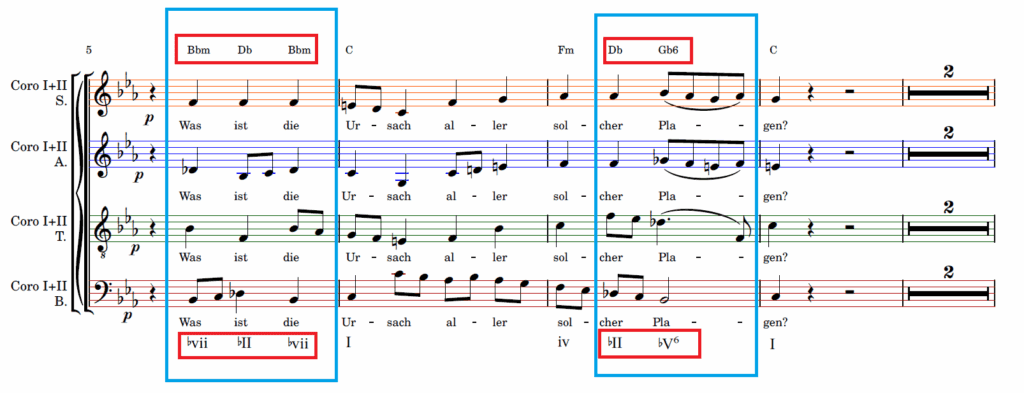 Johann Sebastian Bach – St. Matthew Passion, No. 19
 (minute 3:57)
Summary (Classical): Mode mixture became a recognised technique in the classical vocabulary. Composers, while generally sticking to diatonic progressions, would “borrow” the parallel minor’s chords to enrich a major-key passage (and occasionally vice versa). This era codified the typical palette of borrowed chords: minor iv, ♭VI, ♭VII, ii° (often in first inversion as the “Neapolitan 6th”), etc., which are taught in classical harmony courses. Such chords appear briefly and return to diatonic chords, thus expanding harmonic colour without changing key.
(minute 3:57)
Summary (Classical): Mode mixture became a recognised technique in the classical vocabulary. Composers, while generally sticking to diatonic progressions, would “borrow” the parallel minor’s chords to enrich a major-key passage (and occasionally vice versa). This era codified the typical palette of borrowed chords: minor iv, ♭VI, ♭VII, ii° (often in first inversion as the “Neapolitan 6th”), etc., which are taught in classical harmony courses. Such chords appear briefly and return to diatonic chords, thus expanding harmonic colour without changing key.
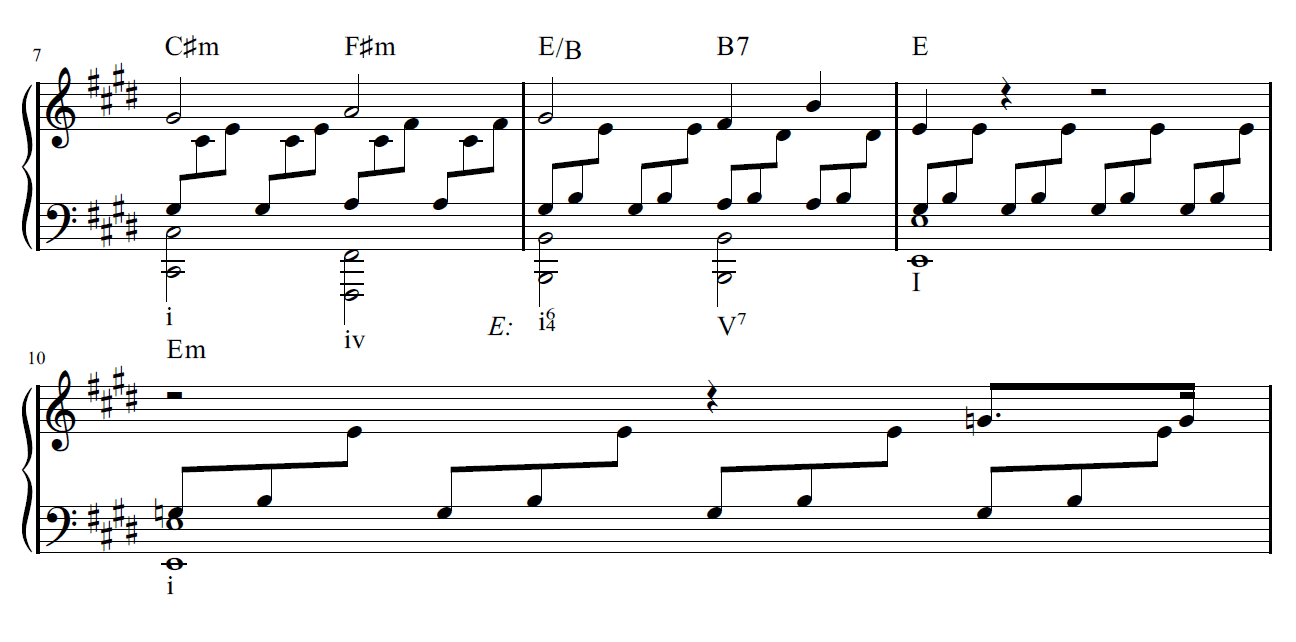
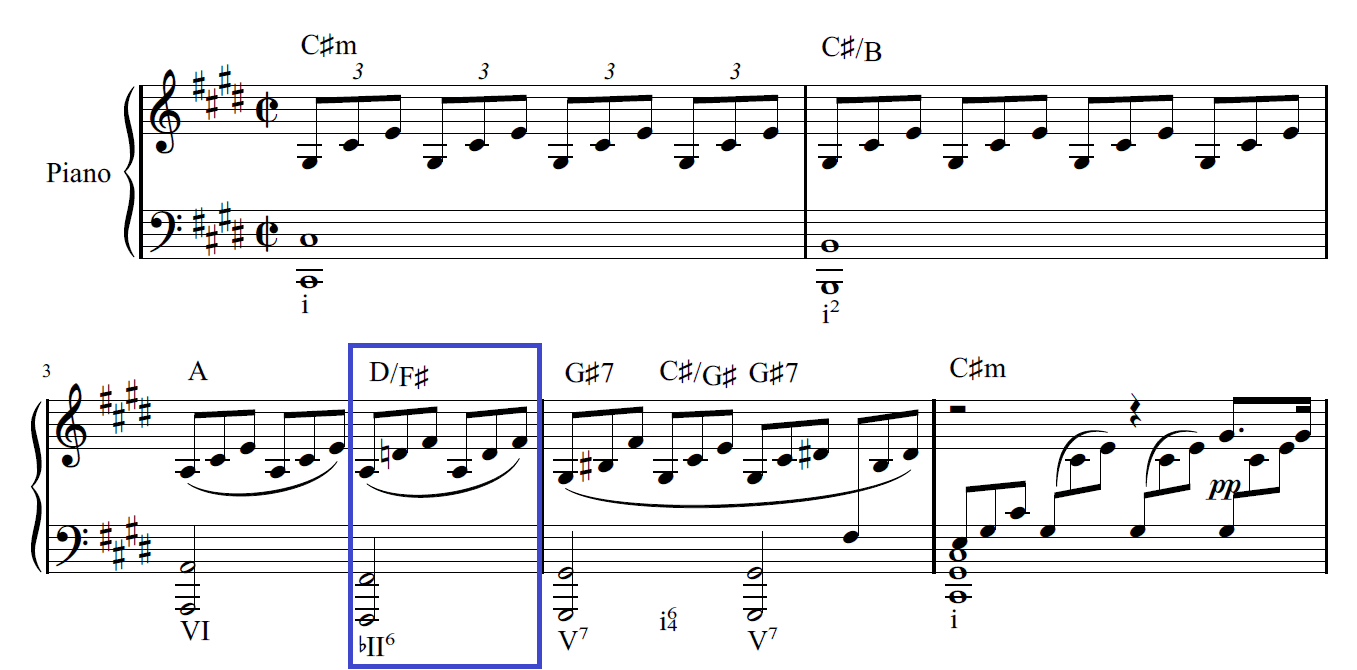 In bar ten, Beethoven makes another mode mixture after resolving in E major (relative major of C#m, the tonic key) taking a surprising turn to E minor in bar 10, using this to later modulate to B minor (bar 13) as part of the harmonic path from C#m to F#m:
 Minute 12:24
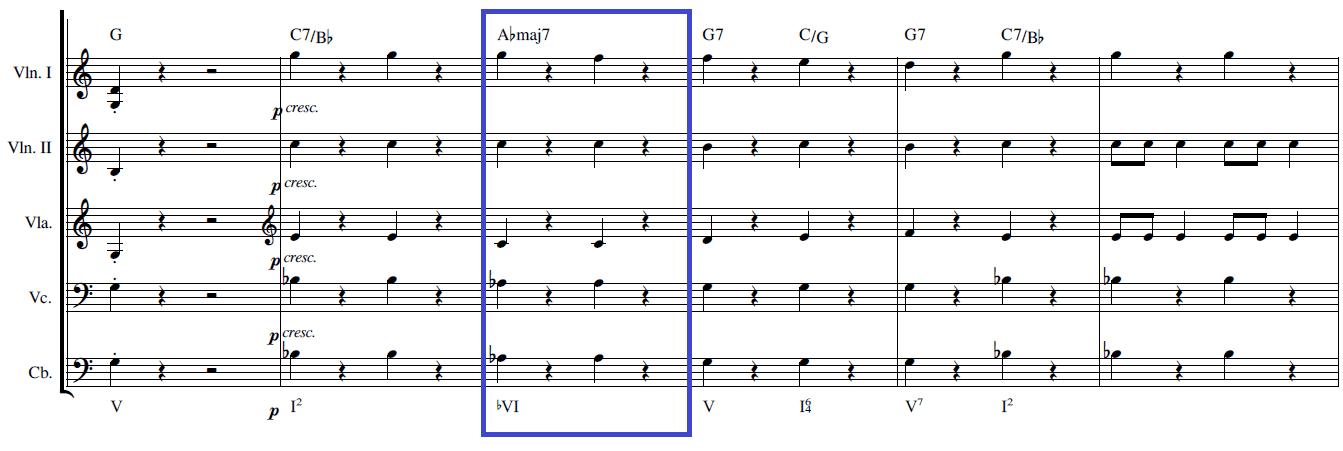
Beethoven’s Symphony No. 5 (C minor) ends in a triumphant C major, but along the way he explores the major/minor interplay in bar 45 in which he uses the ♭VI (A♭ Major) and iv (F minor) in bar 50:
Minute 12:24
Beethoven’s Symphony No. 5 (C minor) ends in a triumphant C major, but along the way he explores the major/minor interplay in bar 45 in which he uses the ♭VI (A♭ Major) and iv (F minor) in bar 50:
 Minute 29:11
 Minute 0:10
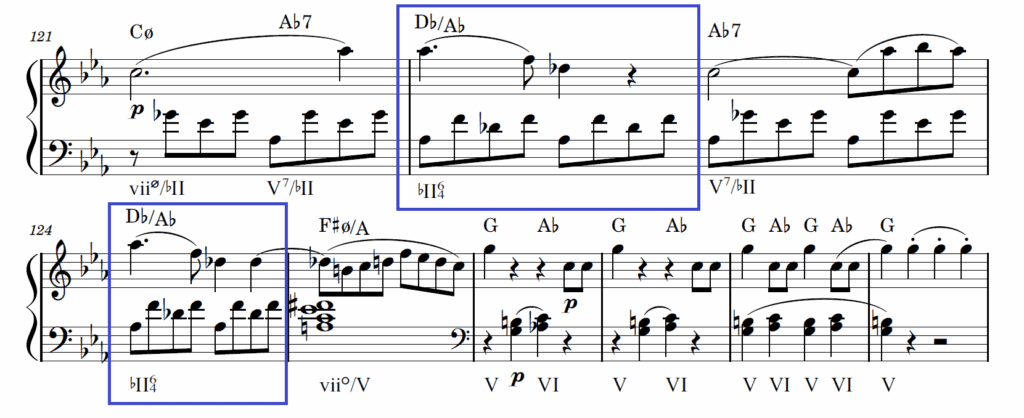
Sometimes composers put the Neapolitan in root position, tonicised it, or even modulated it. To tonicise the Neapolitan, composers add a seventh to the VI, making it into a secondary dominant—V7 /N.
Minute 0:10
Sometimes composers put the Neapolitan in root position, tonicised it, or even modulated it. To tonicise the Neapolitan, composers add a seventh to the VI, making it into a secondary dominant—V7 /N.
 (Minute 2:58)
Romantic composers didn’t limit themselves to borrowing from just the natural minor; they might pull in chords from various parallel modes or altered scales. For instance, Franz Liszt, influenced by Hungarian folk music, sometimes mixed modes in daring ways (like using the Hungarian minor scale – minor with sharp 4 – effectively blending minor with a bit of Lydian). As harmony grew more chromatic, the line between “borrowed chord” and “temporary modulation” blurred, but crucially, many Romantic works still preserve a central tonic while roaming through a colourful modal landscape. Wagner’s operatic harmony, for example, often shifts modes to intensify emotion (a hero’s theme might appear once in major, once in minor). By the end of the 19th century, mixture was so commonplace that the distinction between diatonic and chromatic chords was more fluid.
Mode mixture became richer and more frequent. Composers would sometimes sustain the parallel minor flavour for extended passages (what some theorists call “large-scale mixture”). The vocabulary of borrowed chords expanded (augmented sixth chords, for instance, can be seen as borrowed from the minor or related modes). Nonetheless, these chromatic chords usually resolve in a way that reaffirms the original key, keeping the music centripetally oriented to the home tonic even while exploring distant colours.
(Minute 2:58)
Romantic composers didn’t limit themselves to borrowing from just the natural minor; they might pull in chords from various parallel modes or altered scales. For instance, Franz Liszt, influenced by Hungarian folk music, sometimes mixed modes in daring ways (like using the Hungarian minor scale – minor with sharp 4 – effectively blending minor with a bit of Lydian). As harmony grew more chromatic, the line between “borrowed chord” and “temporary modulation” blurred, but crucially, many Romantic works still preserve a central tonic while roaming through a colourful modal landscape. Wagner’s operatic harmony, for example, often shifts modes to intensify emotion (a hero’s theme might appear once in major, once in minor). By the end of the 19th century, mixture was so commonplace that the distinction between diatonic and chromatic chords was more fluid.
Mode mixture became richer and more frequent. Composers would sometimes sustain the parallel minor flavour for extended passages (what some theorists call “large-scale mixture”). The vocabulary of borrowed chords expanded (augmented sixth chords, for instance, can be seen as borrowed from the minor or related modes). Nonetheless, these chromatic chords usually resolve in a way that reaffirms the original key, keeping the music centripetally oriented to the home tonic even while exploring distant colours.
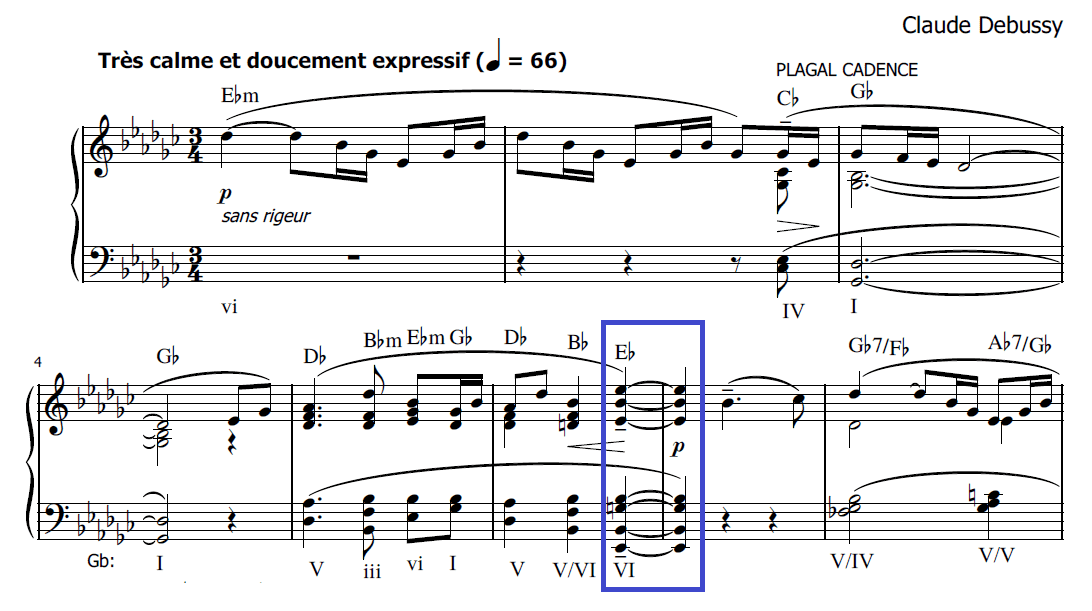 “The Girl with the Flaxen Hair”, is mostly in G♭ major (Ionian) but clearly uses modal interchange with G♭ Mixolydian (♭7) in bar 15 with a F flat major:
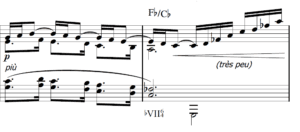 Or Lydian with the 2nd Degree as Major (Ab major) in bar 23:
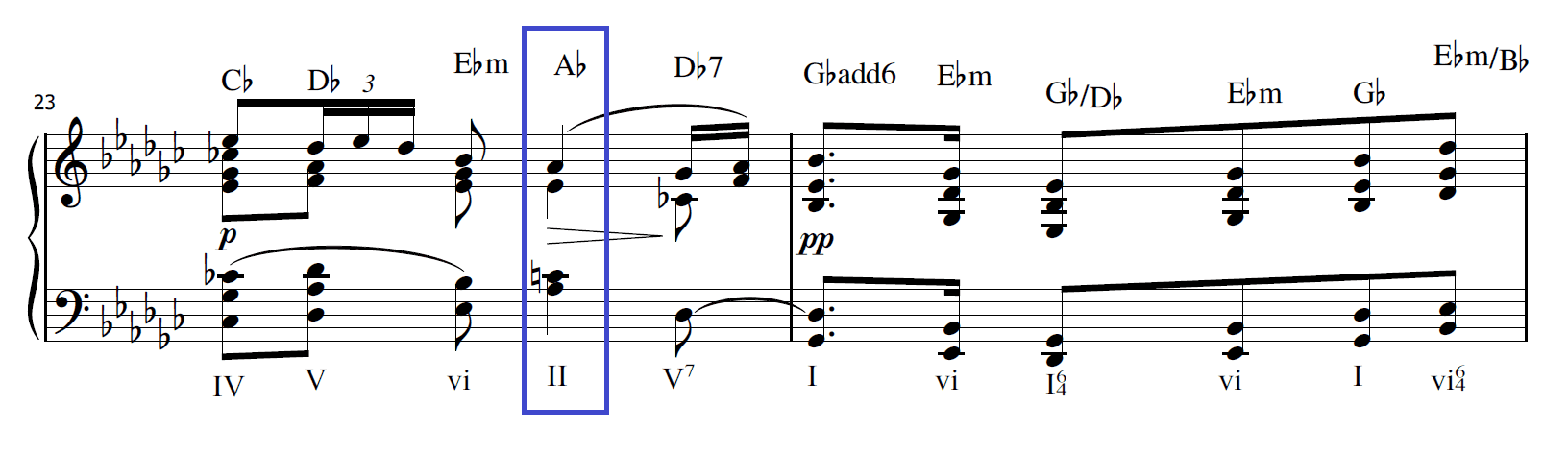 In early 20th-century classical music, composers like Ralph Vaughan Williams combined modality with tonality, an effect often called pastoral – e.g. a melody might be in a major key but harmonised with a sudden iv (minor subdominant) to evoke folk-like modality.
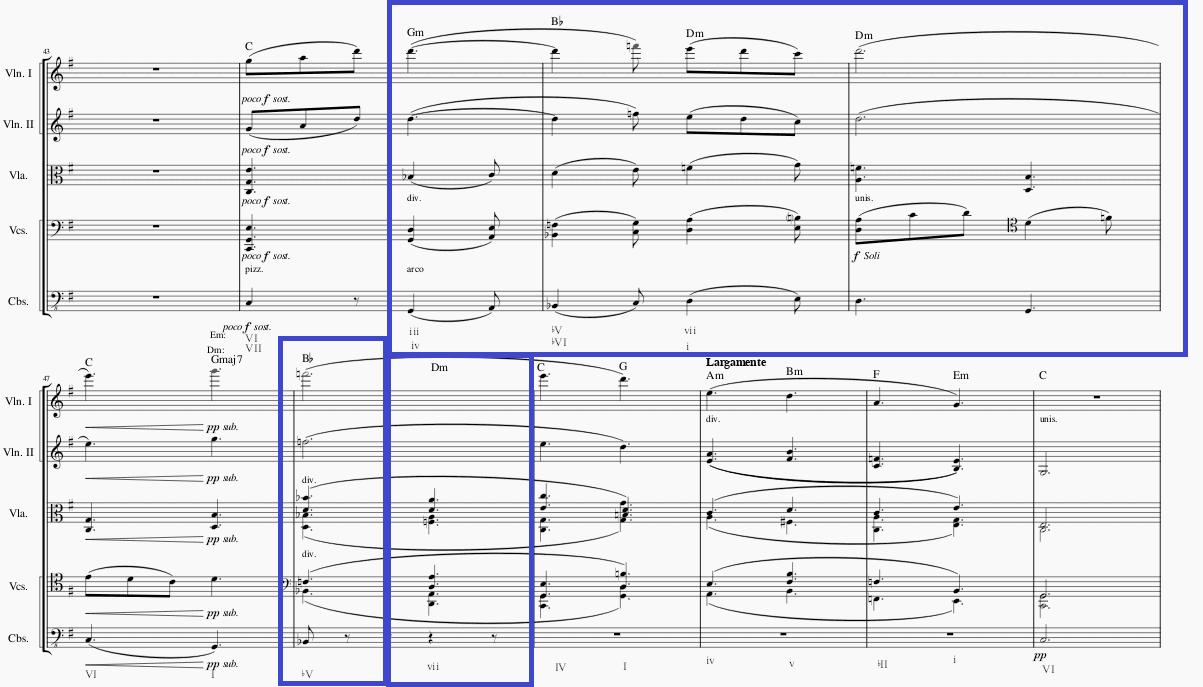
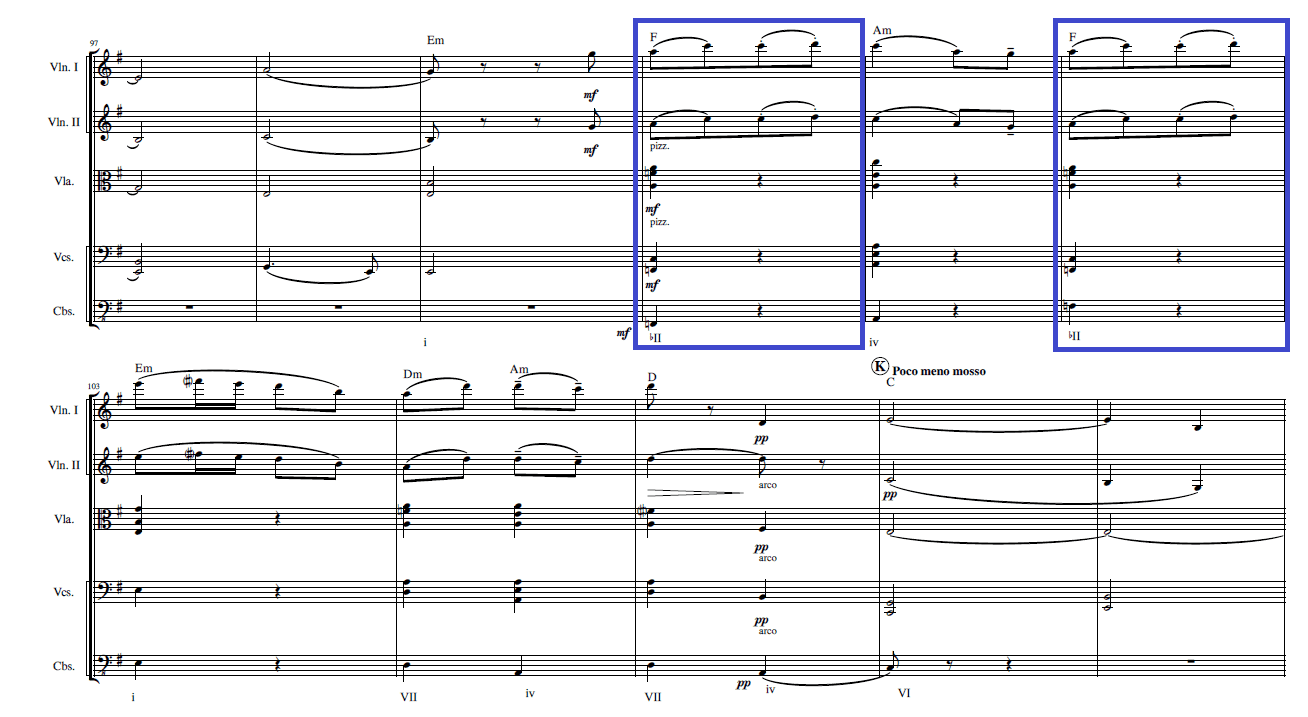 In the same piece, there are two borrowed chords from the E Locrian: G minor (♭iii) in bar 44, and B flat major (♭V) from the same mode. Although this passage (Bars 44-46) could be also seen as a development of the Dm, with those same chords being the ♭VI (B♭) and iv (G minor). This hypothesis loses its strength if you consider that Williams goes back and forth too quickly to chords related to the main key, E minor. The resulting sound gives a harmonic ambiguity through these transitions between modes that enhances the piece’s ethereal quality:
 https://musescore.com/official_scores/scores/6938018
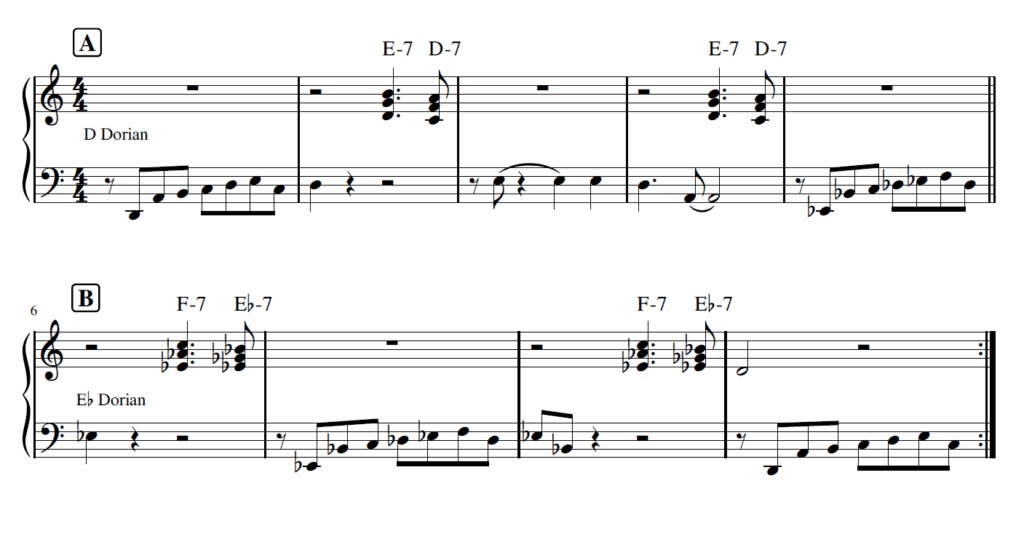
 In the 1950s and 60s, modal jazz also emerged (using one mode static for solos), but even in modal jazz compositions, switching between mode colours (e.g. Miles Davis’s So What flips between D Dorian and E♭ Dorian) can be seen as a kind of interchange between modal centres (though that borders on modulation).
 “Hedwig’s Theme” – Harry Potter and the Sorcerer’s Stone (2001)
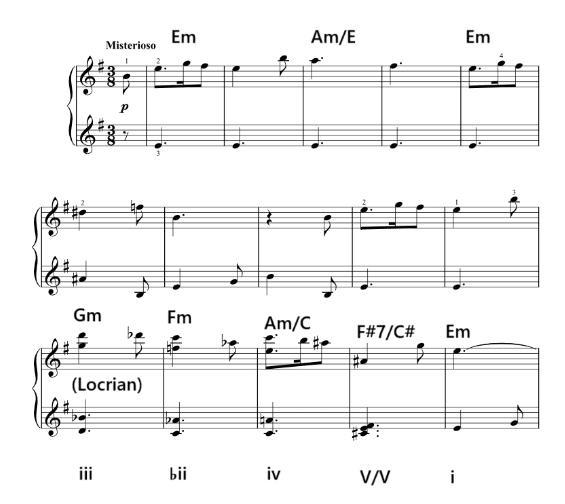
Williams crafts this theme in E minor but integrates the Locrian mode by lowering the 2nd degree, introducing a B flat, forming the G minor chord. The following chord, F minor, could be seen as a borrowed chord from the Phrygian (♭II) but in this case, minor. It is worth noticing that in this case, the modal mixture is not “by the book” as Williams is using a colouristic harmony to create a magical and whimsical atmosphere, aligning with the enchanting world of Harry Potter.
“Hedwig’s Theme” – Harry Potter and the Sorcerer’s Stone (2001)
Williams crafts this theme in E minor but integrates the Locrian mode by lowering the 2nd degree, introducing a B flat, forming the G minor chord. The following chord, F minor, could be seen as a borrowed chord from the Phrygian (♭II) but in this case, minor. It is worth noticing that in this case, the modal mixture is not “by the book” as Williams is using a colouristic harmony to create a magical and whimsical atmosphere, aligning with the enchanting world of Harry Potter.
 The Raiders March (Indiana Jones Theme) – John Williams
The piece is primarily set in C major, but Williams incorporates chords from parallel modes to create contrast and interest. One notable example is the use of the ♭II chord (D♭ major), borrowed from the Phrygian mode. This chord introduces a bold, adventurous quality that aligns with Indiana Jones’ character.
The Raiders March (Indiana Jones Theme) – John Williams
The piece is primarily set in C major, but Williams incorporates chords from parallel modes to create contrast and interest. One notable example is the use of the ♭II chord (D♭ major), borrowed from the Phrygian mode. This chord introduces a bold, adventurous quality that aligns with Indiana Jones’ character.
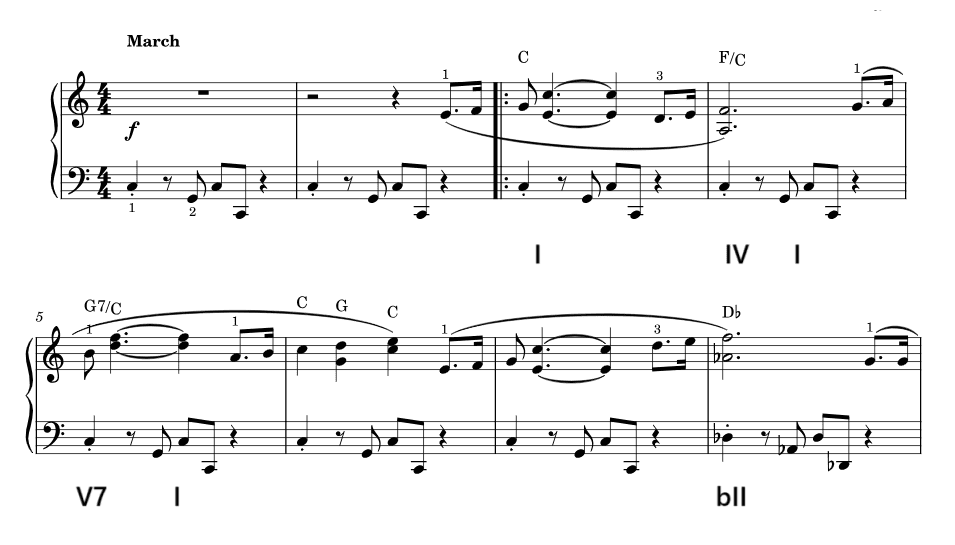
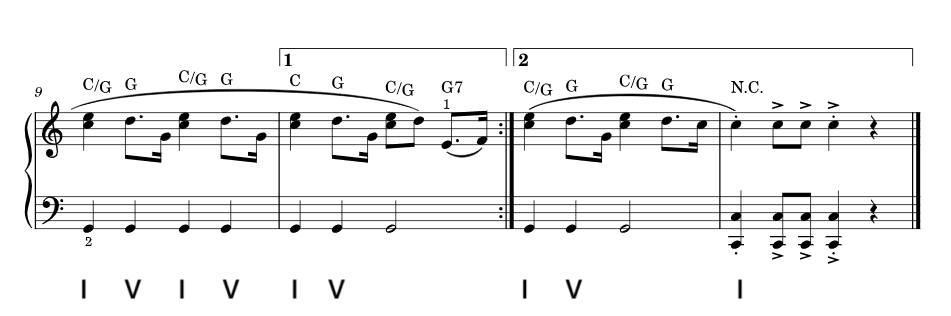 In bars 19 and 23 and example is the use of the ♭VII chord (B♭ major), borrowed from the Mixolydian mode:
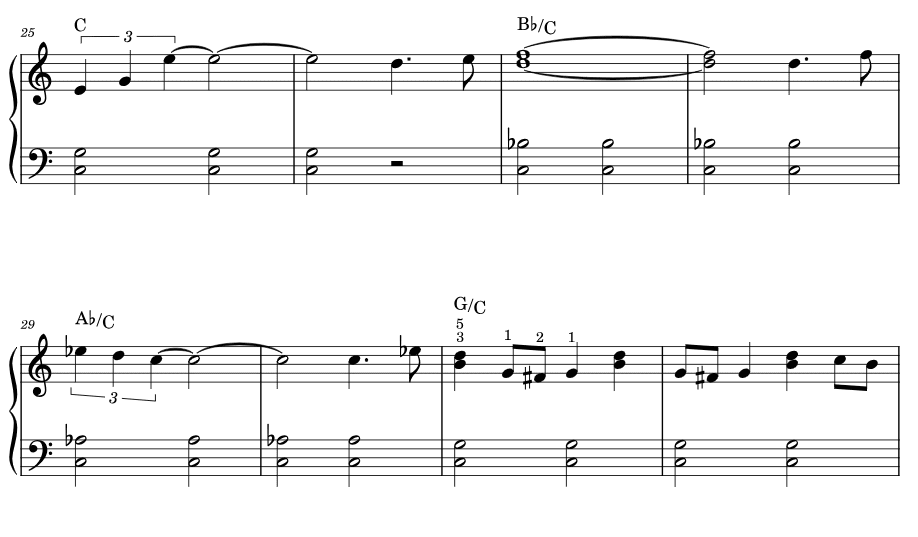 Another instance is the ♭VI chord (A flat major), borrowed from the parallel minor key (C minor). This chord adds a touch of poignancy and depth, reflecting the complexities of the character’s journey (bar 29)
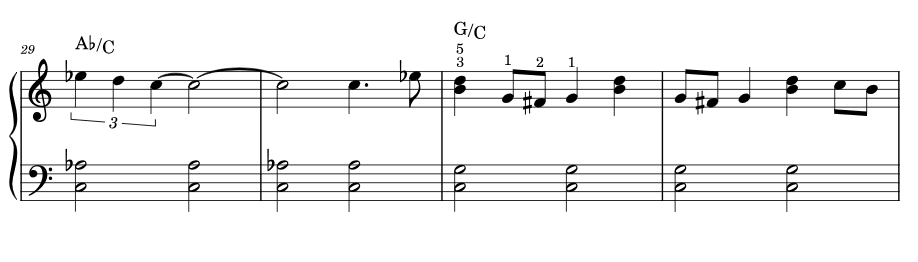
 https://musescore.com/user/27687306/scores/4913846
In Summary
The 20th century saw both a modal revival (composers deliberately using old modes) and a continuation of 19th-century chromaticism.
In popular music, the theory of “modal interchange” became codified and taught as a way to enrich chord progressions
Film composers frequently employ modal interchange to enrich their harmonic language and evoke specific emotions. This technique allows for subtle shifts in mood, enabling composers to introduce elements of surprise, tension, or poignancy that align with the narrative’s demands.
Musicians now freely mix parallel modes as a creative choice. The core idea remains: it’s about adding “colour chords” to a key without abandoning the key.
https://musescore.com/user/27687306/scores/4913846
In Summary
The 20th century saw both a modal revival (composers deliberately using old modes) and a continuation of 19th-century chromaticism.
In popular music, the theory of “modal interchange” became codified and taught as a way to enrich chord progressions
Film composers frequently employ modal interchange to enrich their harmonic language and evoke specific emotions. This technique allows for subtle shifts in mood, enabling composers to introduce elements of surprise, tension, or poignancy that align with the narrative’s demands.
Musicians now freely mix parallel modes as a creative choice. The core idea remains: it’s about adding “colour chords” to a key without abandoning the key.
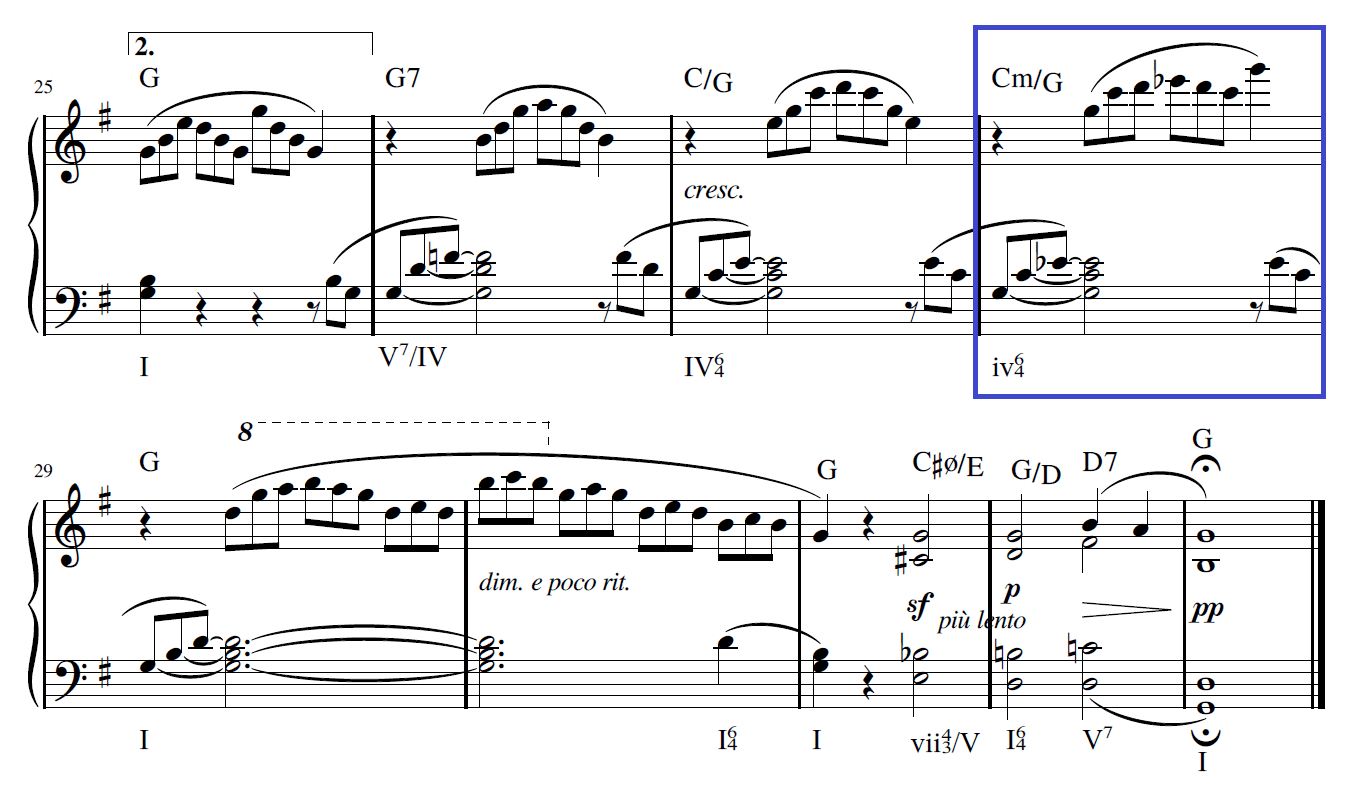 https://www.youtube.com/watch?v=1pcoX8x6gEU&list=RD1pcoX8x6gEU&start_radio=1
Minute 1:32
Conversely, in a minor-key context, borrowing a major chord (like the Picardy third or a IV major in a minor key taken from the Dorian mode) can inject a ray of hope or brightness, again for contrast.
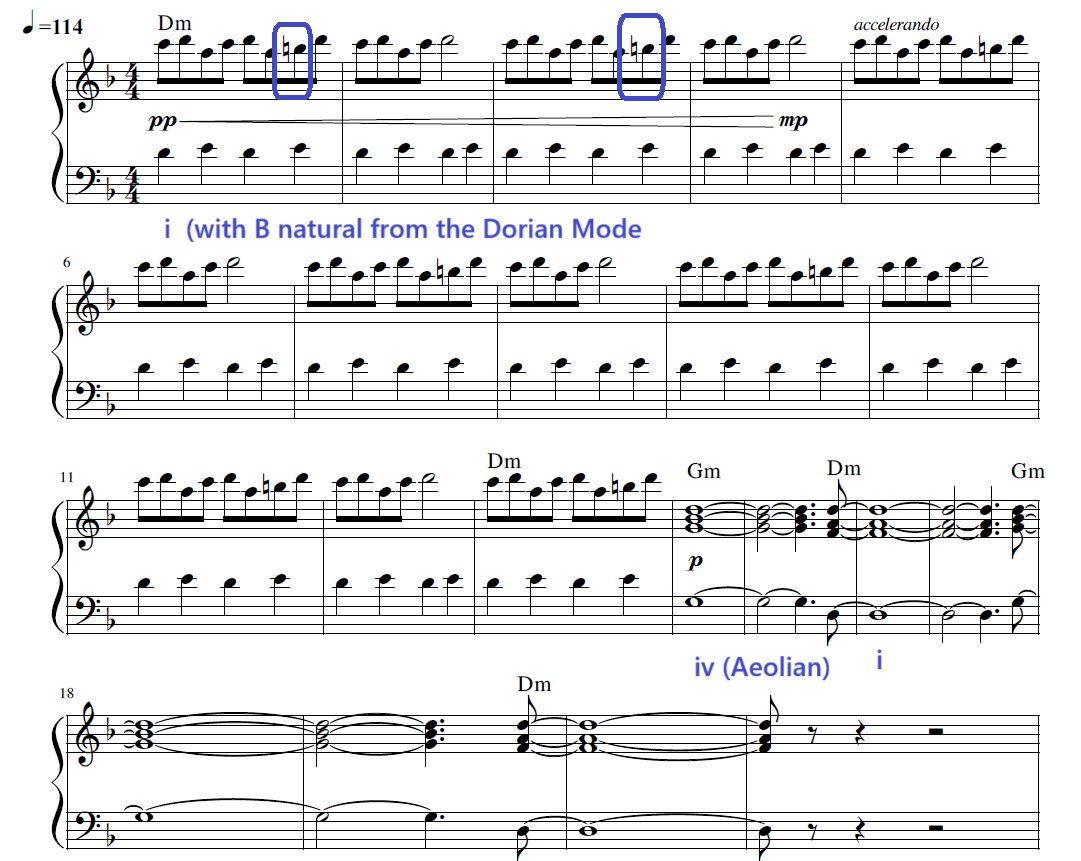
In “Black Magic Woman” (Carlos Santana) – is Often described in D minor but borrows from D Dorian with the frequent presence of the raised sixth (B natural), adding a subtle brightness and warmth, complementing Santana’s expressive guitar style.
https://www.youtube.com/watch?v=1pcoX8x6gEU&list=RD1pcoX8x6gEU&start_radio=1
Minute 1:32
Conversely, in a minor-key context, borrowing a major chord (like the Picardy third or a IV major in a minor key taken from the Dorian mode) can inject a ray of hope or brightness, again for contrast.
In “Black Magic Woman” (Carlos Santana) – is Often described in D minor but borrows from D Dorian with the frequent presence of the raised sixth (B natural), adding a subtle brightness and warmth, complementing Santana’s expressive guitar style.
 Humans naturally respond to major vs minor (studies often associate major with happy/bright, minor with sad/dark), so juxtaposing them enriches the emotional palette. It’s like adding a surprising spice to a dish – just enough to notice the flavour, not so much as to change the cuisine.
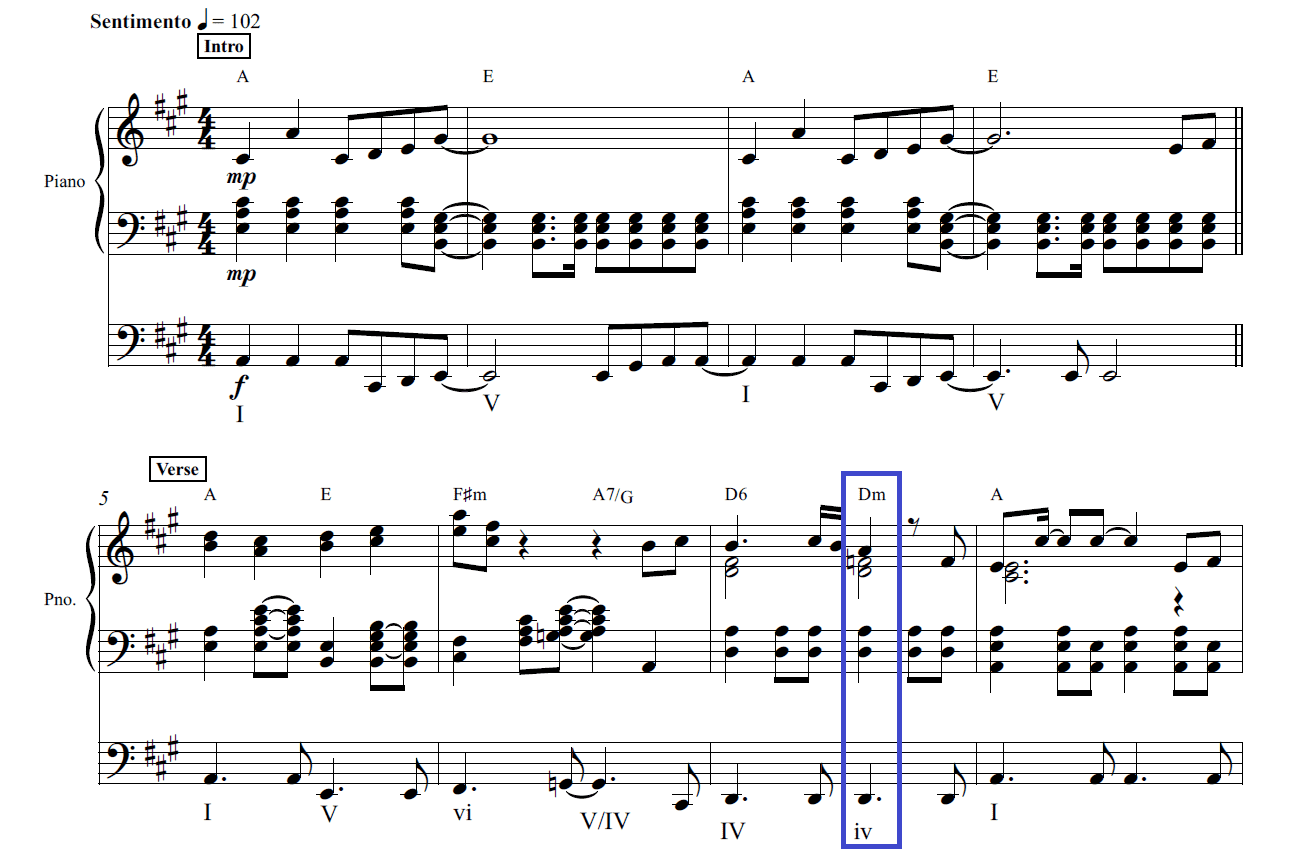
For example, the minor iv chord in a major key is often described as having a wistful or nostalgic effect – “happy, but with a hint of sadness.” Songwriters from classical to pop exploit this; the progression I–iv–I is famously touching (heard in songs like The Beatles’ “In My Life”, discussed later, and countless film scores). One music theorist describes the major to minor IV shift as “a colourful, bittersweet feeling of longing”. That sums it up well: modal interchange often triggers complex emotions – a mix of bright and dark, happy and sad.
Humans naturally respond to major vs minor (studies often associate major with happy/bright, minor with sad/dark), so juxtaposing them enriches the emotional palette. It’s like adding a surprising spice to a dish – just enough to notice the flavour, not so much as to change the cuisine.
For example, the minor iv chord in a major key is often described as having a wistful or nostalgic effect – “happy, but with a hint of sadness.” Songwriters from classical to pop exploit this; the progression I–iv–I is famously touching (heard in songs like The Beatles’ “In My Life”, discussed later, and countless film scores). One music theorist describes the major to minor IV shift as “a colourful, bittersweet feeling of longing”. That sums it up well: modal interchange often triggers complex emotions – a mix of bright and dark, happy and sad.
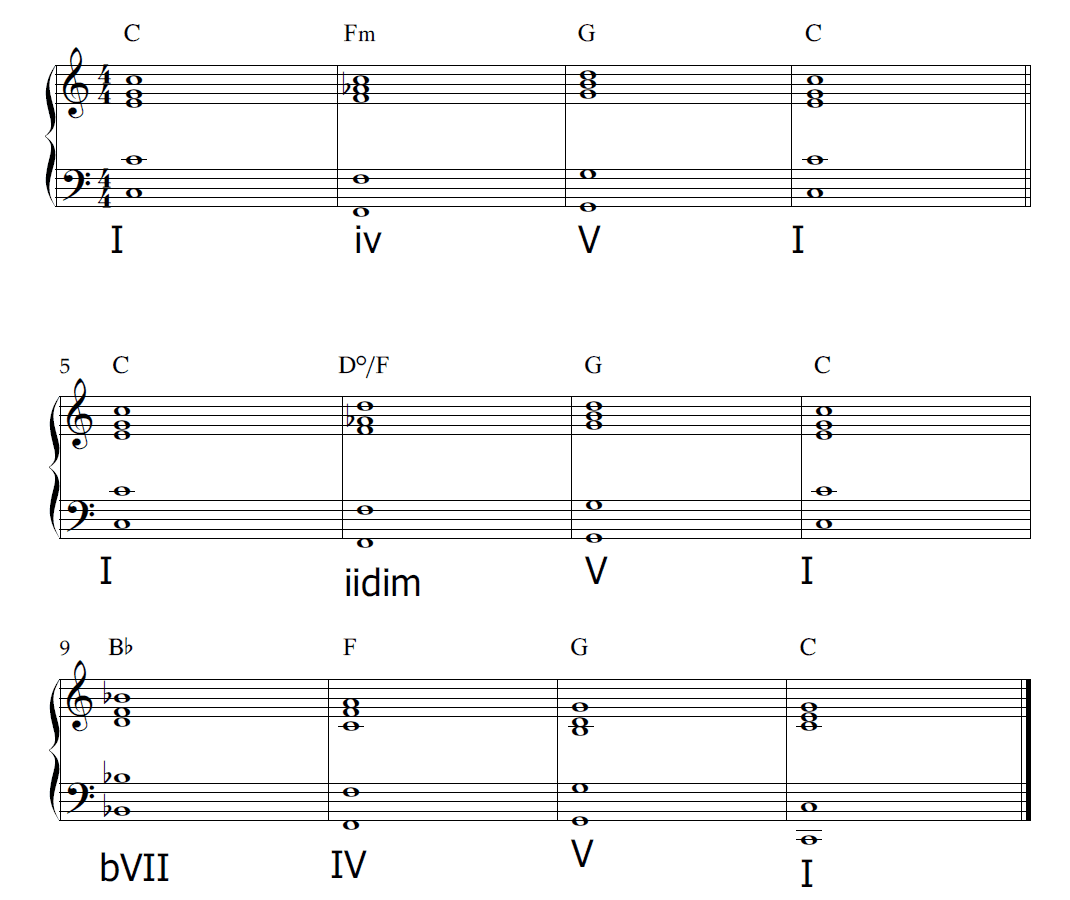
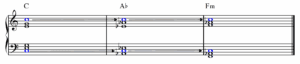
 Another way to look at it: borrowed chords often share common tones with diatonic chords or have voice-leading that makes sense in the key. In C major, A♭ (♭VI) shares the note C with the tonic chord C (C-E-G and A♭-C-E♭ have C in common). F minor (iv in C) shares F and C with the diatonic F major (IV). These common tones act as anchors, so the ear doesn’t feel completely lost:
 We can see how these common notes can be used in an example, having the C note as the recurring note in the melody, changing the progression from the C, to the F, Fm and finally G in the first subphrase (bars 1-4) In the second subphrase, the progression slightly changes from C to F, then A♭, descending to G:
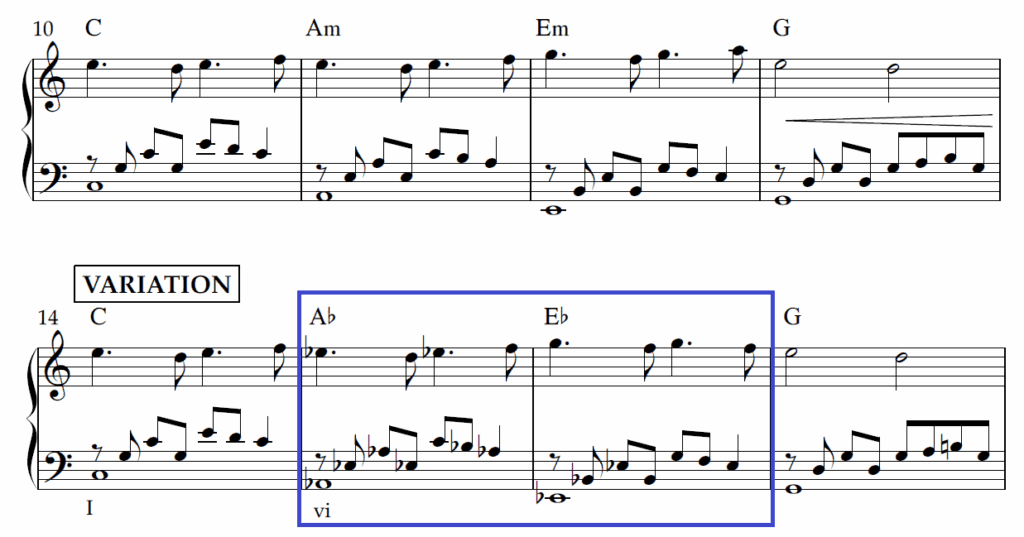
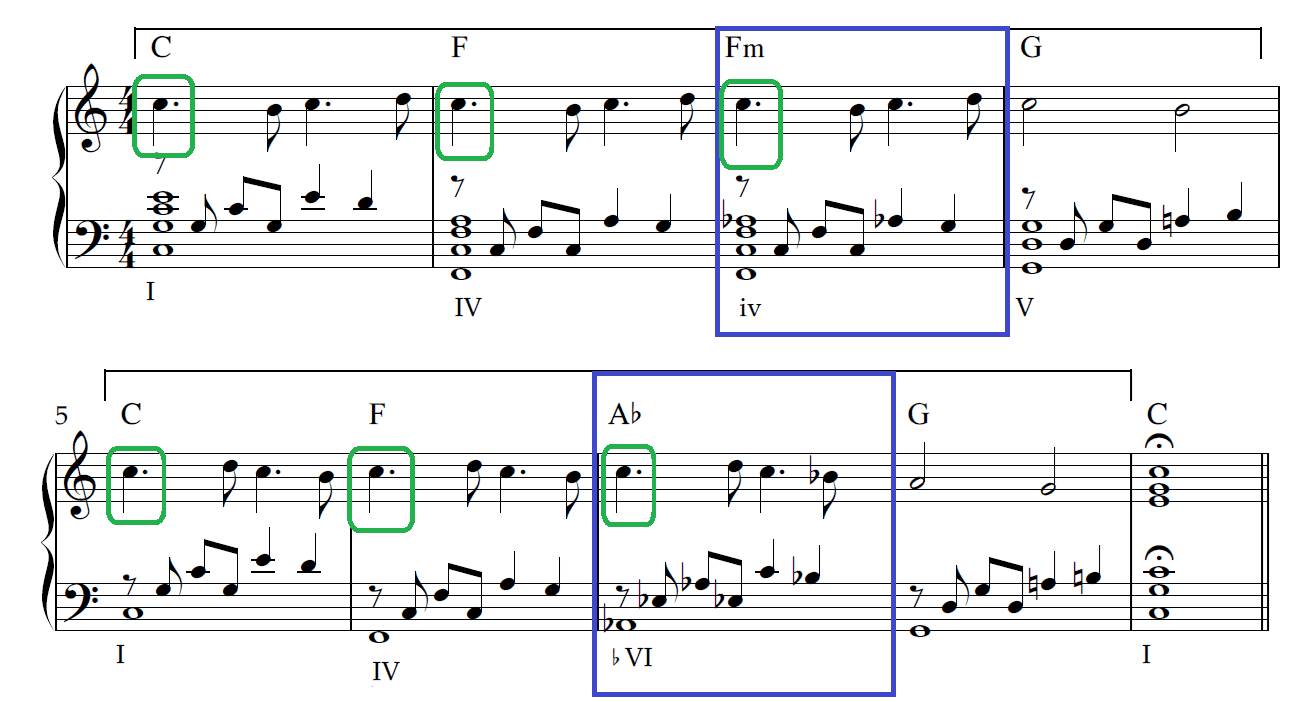 The differences like E♭ instead of E in the A♭ chord on the melodic line, stand out just enough to add colour, but not enough to make us think “we’re in a new key of E♭ major” – especially if handled briefly.
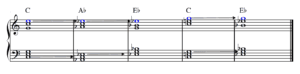 Below we see an example that uses two borrowed chords: E♭ and A♭ (Bars 15 and 16) on the “Variation” section. The first statement of the phrase have Am (vi) and Em (iii) in bars 11 and 12 respectively:
 Another theoretical perspective is using transformations or voice-leading: Neo-Riemannian theory, for example, describes how a major chord can slip to its parallel minor by lowering the third (e.g. C major C–E–G to C minor C–E♭–G). That single semitone change (E to E♭) is a smooth voice-leading move, but it changes the chord’s quality and mode. So one can navigate the space of chords through minimal changes.
A tonic major to tonic minor change is the simplest modal interchange (sometimes a composer will assert the tonic in both major and minor forms within a piece, almost as if toggling the mode). These smooth transformations allow for expressive harmonic shifts without losing coherence. (see the example previously stated in the Romantic Era of Beethoven – Piano Sonata No. 8 in C Minor, Op. 13 (“Pathétique”) 2nd movement.
Another theoretical perspective is using transformations or voice-leading: Neo-Riemannian theory, for example, describes how a major chord can slip to its parallel minor by lowering the third (e.g. C major C–E–G to C minor C–E♭–G). That single semitone change (E to E♭) is a smooth voice-leading move, but it changes the chord’s quality and mode. So one can navigate the space of chords through minimal changes.
A tonic major to tonic minor change is the simplest modal interchange (sometimes a composer will assert the tonic in both major and minor forms within a piece, almost as if toggling the mode). These smooth transformations allow for expressive harmonic shifts without losing coherence. (see the example previously stated in the Romantic Era of Beethoven – Piano Sonata No. 8 in C Minor, Op. 13 (“Pathétique”) 2nd movement.
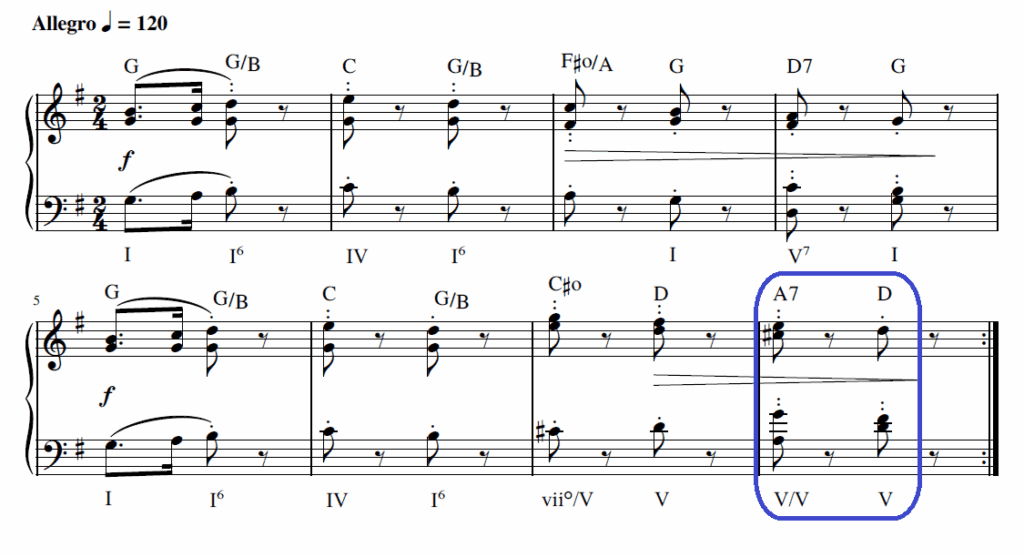 Borrowed chords, by contrast, are not functioning as dominants to something; they are directly taken from the parallel mode. So an A♭ chord in C is explained as “borrowed ♭VI from C minor” (it’s not a secondary anything in C major; it doesn’t neatly fit into the dominant/leading-tone framework of the diatonic key).
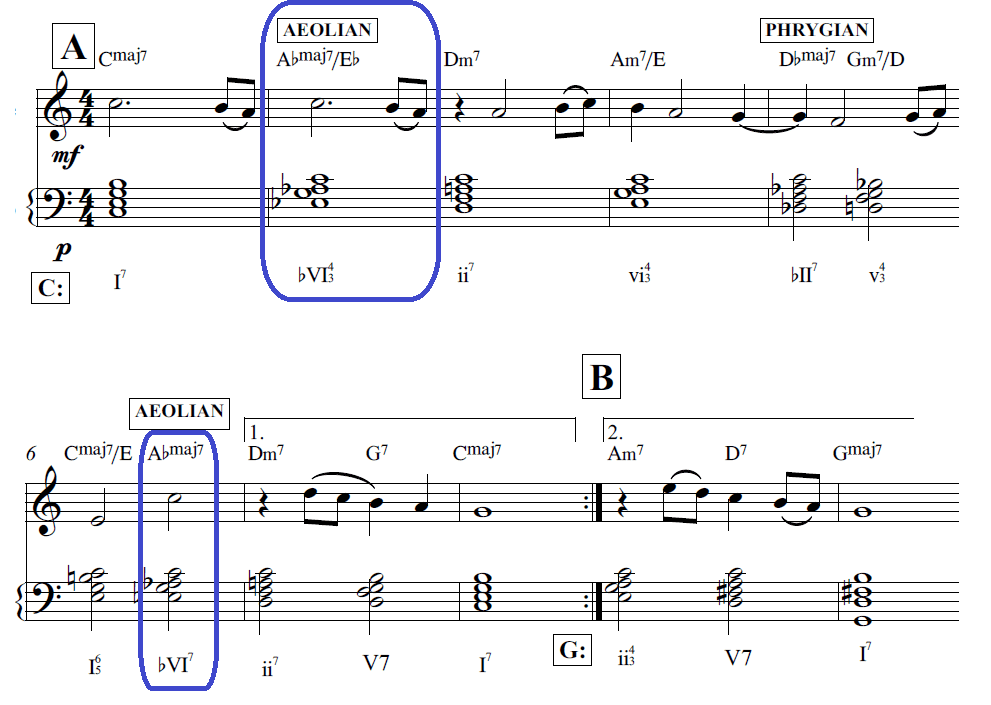 In analysis, one simply labels it with a flat sign (♭VI) or similar, rather than reinterpreting it in a new key. Unlike secondary chords, which are labeled by their function (V/whatever), borrowed chords are usually just labelled by scale degree with an accidental.
In short, secondary dominants momentarily imply a new tonic (they are mini-modulations), whereas modal mixture chords imply a new scale on the same tonic. This is a key conceptual difference.
In analysis, one simply labels it with a flat sign (♭VI) or similar, rather than reinterpreting it in a new key. Unlike secondary chords, which are labeled by their function (V/whatever), borrowed chords are usually just labelled by scale degree with an accidental.
In short, secondary dominants momentarily imply a new tonic (they are mini-modulations), whereas modal mixture chords imply a new scale on the same tonic. This is a key conceptual difference.
 Borrowed chords can often serve similar functions to their diatonic counterparts (for example, ♭VI in major often moves to V, acting as a predominant like ii or IV would). But sometimes they’re used more for colour than function.
A composer might choose IVm instead of IV simply because of the unique emotional colour it gives, even though IV could have done the functional job.
Many borrowed chords can be seen as chromatic substitutions for diatonic chords that fulfill the same role in progressions. For instance, a ♭VII (B♭ major in C) often moves to IV or I – much as a V/V (D major to G) might, but ♭VII has a more modal, folky character compared to a secondary dominant. Thus, modal interchange enriches the harmonic vocabulary, giving alternate chords for the same jobs that evoke different feelings.
Borrowed chords can often serve similar functions to their diatonic counterparts (for example, ♭VI in major often moves to V, acting as a predominant like ii or IV would). But sometimes they’re used more for colour than function.
A composer might choose IVm instead of IV simply because of the unique emotional colour it gives, even though IV could have done the functional job.
Many borrowed chords can be seen as chromatic substitutions for diatonic chords that fulfill the same role in progressions. For instance, a ♭VII (B♭ major in C) often moves to IV or I – much as a V/V (D major to G) might, but ♭VII has a more modal, folky character compared to a secondary dominant. Thus, modal interchange enriches the harmonic vocabulary, giving alternate chords for the same jobs that evoke different feelings.
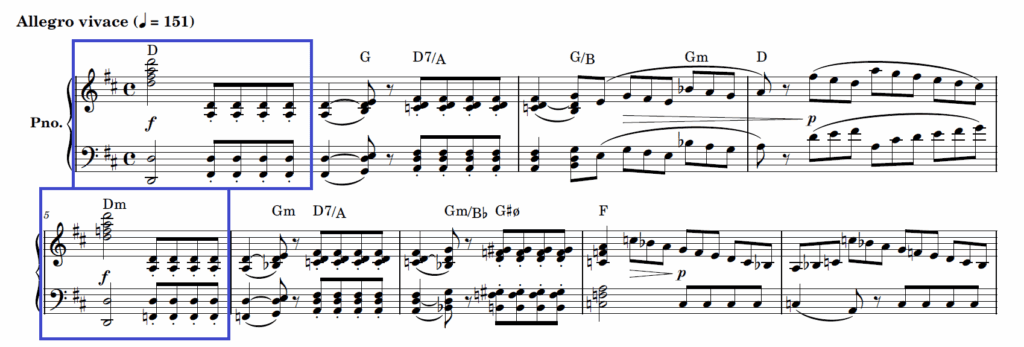 Chopin’s Prelude in C Major (Op. 28 No. 1), though brief, ends with an unexpected A♭ major chord (♭VI in C) that leaves a dreamy question mark hanging – a very Romantic effect. In opera, composers used modal interchange to enhance drama: Don Giovanni (Mozart) has moments where a scene in a major key turns minor to reflect a sudden change in the plot’s emotion. In Carmen, Bizet plays between minor and major iterations of the famous Habanera motif to reflect Carmen’s capricious nature (the refrain is in D minor but the final cadence of the opera is in D major – ironically triumphant at the moment of tragedy). Puccini and Verdi also utilized mixture; for example, an aria might start in a key and end on a big major chord even if the aria was mostly minor, to give a cathartic release (a legacy of that Picardy-third tradition). Overall, classical genres often use modal interchange in a structural way (theme and variation in major/minor) and a local way (individual borrowed chords for colour).
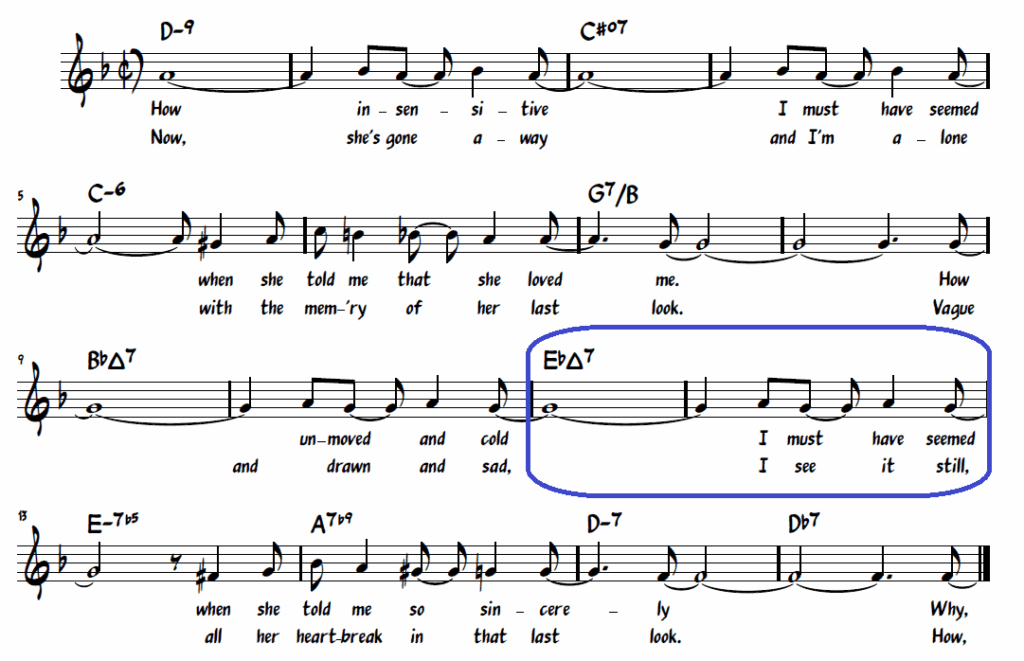
 Bossa nova and jazz-influenced Latin songs also used it – e.g. the bossa “How Insensitive” (Jobim) is in D minor but features an E flat major (Prhygian ♭II) toward the end of the phrase in bar 11, a poignant brightening of the minor mood with a Neapolitan chord:
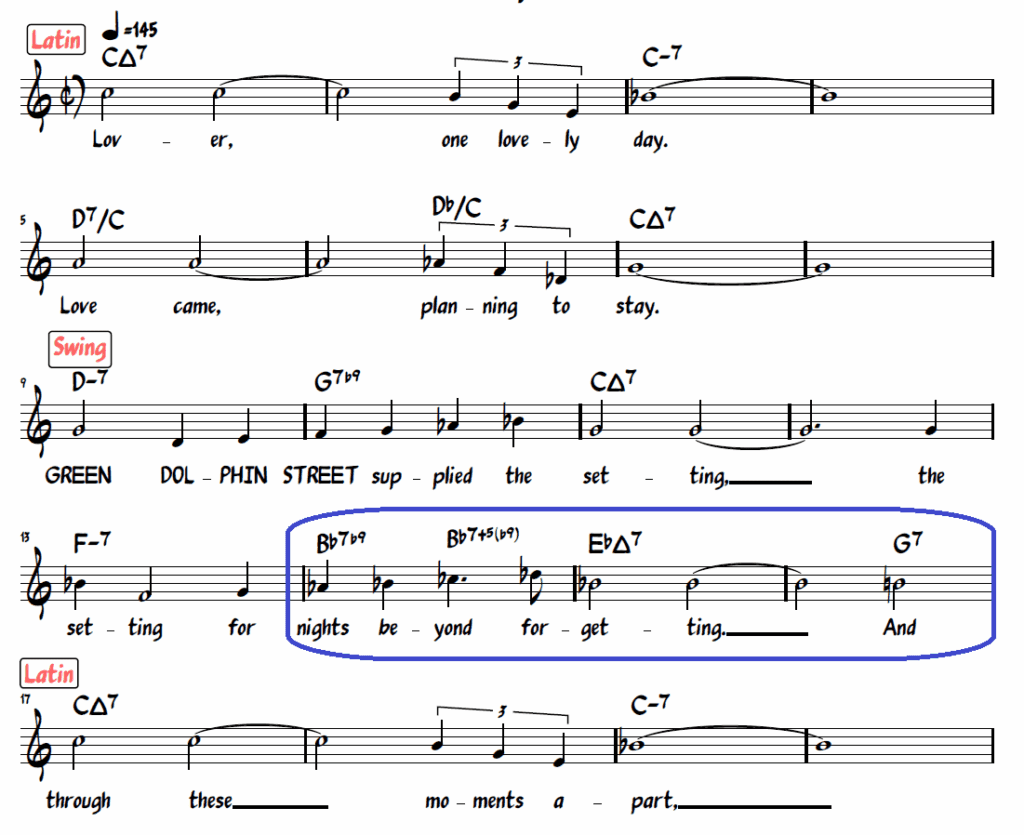
 In jazz improvisation, players leverage modal interchange by superimposing scales: if a band plays an A♭maj7 chord in C major, the soloist might momentarily slip into the C Aeolian mode (or A♭ Lydian, etc.) to match that chord’s origin. Jazz pedagogy explicitly instructs: identify the borrowed chord’s source and use that scale over it. Jazz also blurred into soul/R&B; a song like “Never Can Say Goodbye” (The Jackson 5) is in D major but the chord progression moves through D Dorian, Lydian, Phrygian and back to Ionian in a few bars – a complex use of modal interchange that jazz listeners will also recognise from tunes like “Green Dolphin Street” (which the Jackson 5 progression quotes). In modern jazz compositions and fusion, modal interchange is used even more liberally, sometimes stringing together a series of different parallel mode chords for color (e.g. going up and down the brightness scale of modes).
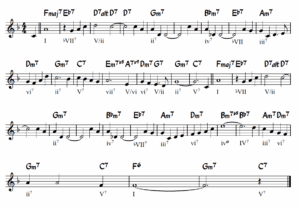
(Jazz): Henry Mancini – “Days of Wine and Roses”. Key: F major. In the bridge, after establishing F, the chords move: B♭m6 → E♭7 → D7 → Gm7 → C7 → F. The B♭m6 is a clear borrowed iv chord (B♭ minor in F major). It introduces a melancholic feel fitting the song’s wistful lyrics. The E♭7 that follows could be interpreted as a ♭VII (from F minor) except it functions as a tritone substitute for A7 (secondary dominant to D7), so that one blurs lines. But unquestionably, that opening B♭m is modal interchange, as is the fact that Mancini often ends the tune on an Fmaj7 followed by an Fm(maj7) in the coda for a haunting finish (major to minor fade-out). Jazz arrangers often reharmonize diatonic sequences by inserting such chords – e.g. turning a I–IV–V into I–iv–♭VII–V etc., to add richness.
In jazz improvisation, players leverage modal interchange by superimposing scales: if a band plays an A♭maj7 chord in C major, the soloist might momentarily slip into the C Aeolian mode (or A♭ Lydian, etc.) to match that chord’s origin. Jazz pedagogy explicitly instructs: identify the borrowed chord’s source and use that scale over it. Jazz also blurred into soul/R&B; a song like “Never Can Say Goodbye” (The Jackson 5) is in D major but the chord progression moves through D Dorian, Lydian, Phrygian and back to Ionian in a few bars – a complex use of modal interchange that jazz listeners will also recognise from tunes like “Green Dolphin Street” (which the Jackson 5 progression quotes). In modern jazz compositions and fusion, modal interchange is used even more liberally, sometimes stringing together a series of different parallel mode chords for color (e.g. going up and down the brightness scale of modes).
(Jazz): Henry Mancini – “Days of Wine and Roses”. Key: F major. In the bridge, after establishing F, the chords move: B♭m6 → E♭7 → D7 → Gm7 → C7 → F. The B♭m6 is a clear borrowed iv chord (B♭ minor in F major). It introduces a melancholic feel fitting the song’s wistful lyrics. The E♭7 that follows could be interpreted as a ♭VII (from F minor) except it functions as a tritone substitute for A7 (secondary dominant to D7), so that one blurs lines. But unquestionably, that opening B♭m is modal interchange, as is the fact that Mancini often ends the tune on an Fmaj7 followed by an Fm(maj7) in the coda for a haunting finish (major to minor fade-out). Jazz arrangers often reharmonize diatonic sequences by inserting such chords – e.g. turning a I–IV–V into I–iv–♭VII–V etc., to add richness.
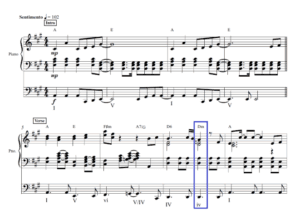 Another Beatles song, “Hey Jude”, is largely F major; at the line “better… to let her under your skin,” the chords move from F (I) to E♭ major (♭VII) and then to B♭ Major (IV) – a classic Mixolydian subdominant resolution that gives that section a soulful, aching quality in the triumphant na-na-na coda.
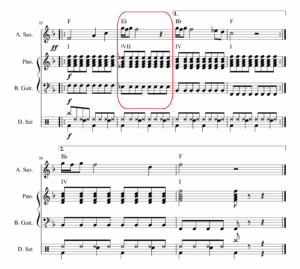 The Beatles’ “Lucy in the Sky with Diamonds” moves to ♭VII (B♭ major) and ♭VI (A♭ major) in the pre-chorus of a song nominally in A major, giving it a psychedelic modal sound.
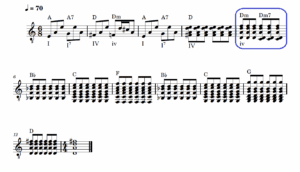 Radiohead’s “Creep” (G major) uses a modal interchange twist: the progression G–B–C–Cm (I–III–IV–iv). The C–Cm shift (major IV to minor iv) is precisely the same device of mixing modes, and it gives the song its signature melancholic twist on the word “creep” as it lands on that C minor.
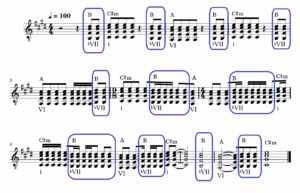
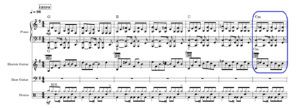 Many rock songs use the ♭VII chord as well (borrowing from mixolydian or minor). For instance, “All Along the Watchtower” (Dylan/Hendrix) in C♯ minor uses B (♭VII) major in the chorus:
 “Kashmir” from Led Zeppelin, is built upon a subtle but richly evocative modal harmony, mainly in Mixolydian, borrowing the minor subdominant or iv chord in Aeolian is G minor (G–B♭–D). By borrowing that iv (Gm), we get a darker, more plaintive colour than the bright G major of Mixolydian while retaining the D pedal in the bass.
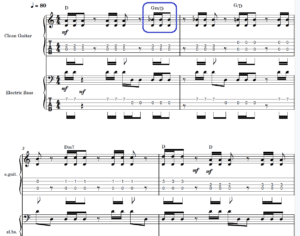 Green Day’s “Wake Me Up When September Ends” (G major) uses C minor (iv) in the bridge to deepen the emotional impact in bar 10.
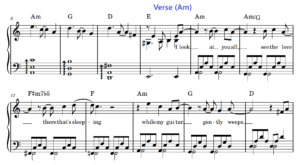
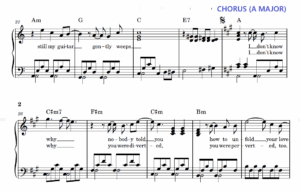 In pop-punk and rock, the progression I–♭VII–♭VI–♭VII is almost a cliché for a brooding anthemic sound (essentially descending through the borrowed chords); this progression is notably used in “While My Guitar Gently Weeps” (The Beatles – though that actually fully shifts key to the relative A major from the main key, A minor in the Chorus section)
(Classic Rock): Blood, Sweat & Tears – “Spinning Wheel” (1968). Key: C major. The verse progression descends stepwise: C → B♭ → A♭ → G. In Roman numerals: I → ♭VII → ♭VI → V. B♭ and A♭ are borrowed from C minor (Aeolian). They give the song a funky, soulful character – a straight diatonic descent C–B♭–A–G would have been plain mixolydian, but making that A natural into A♭ (thus A♭ major chord) brings in a bluesy colour. The song promptly resolves to C, so these chords feel like a Colourful detour (and indeed, they sing “ride a painted pony” over that progression – quite literally painting the harmony with borrowed colours). This ♭VII–♭VI–V is a staple of late-60s/70s rock and soul.
Excerpt from “Spinning Wheel” by Blood, Sweat & Tears (Section in the key of C major). The progression I → ♭VII → ♭VI → V is indicated (C to B♭ to A♭ to G), borrowed chords from the C Aeolian (C minor scale)
In pop-punk and rock, the progression I–♭VII–♭VI–♭VII is almost a cliché for a brooding anthemic sound (essentially descending through the borrowed chords); this progression is notably used in “While My Guitar Gently Weeps” (The Beatles – though that actually fully shifts key to the relative A major from the main key, A minor in the Chorus section)
(Classic Rock): Blood, Sweat & Tears – “Spinning Wheel” (1968). Key: C major. The verse progression descends stepwise: C → B♭ → A♭ → G. In Roman numerals: I → ♭VII → ♭VI → V. B♭ and A♭ are borrowed from C minor (Aeolian). They give the song a funky, soulful character – a straight diatonic descent C–B♭–A–G would have been plain mixolydian, but making that A natural into A♭ (thus A♭ major chord) brings in a bluesy colour. The song promptly resolves to C, so these chords feel like a Colourful detour (and indeed, they sing “ride a painted pony” over that progression – quite literally painting the harmony with borrowed colours). This ♭VII–♭VI–V is a staple of late-60s/70s rock and soul.
Excerpt from “Spinning Wheel” by Blood, Sweat & Tears (Section in the key of C major). The progression I → ♭VII → ♭VI → V is indicated (C to B♭ to A♭ to G), borrowed chords from the C Aeolian (C minor scale)
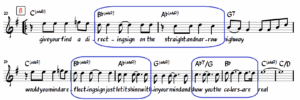
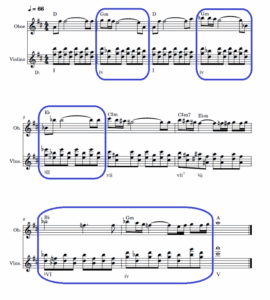 Similarly, Howard Shore’s “Shire Theme” in The Lord of the Rings is in D major but prominently features a ♭VII (C major) giving it a folksy, ancient feel (mixolydian touch), as well as a minor iv in the development for a touch of sadness – reflecting the bittersweet peace of the Shire.
Disney songs and Musical Theatre are replete with examples: “Over the Rainbow” in G major famously uses an E♭ (♭VI) on “somewhere” to magical effect – in that case it’s actually functioning as a pivot towards a temporary new key (B♭), but it’s often cited as a gorgeous modal colour in itself. Disney often goes for the classic I–iv–I or I–♭VII–♭VI–I feels.
Consider “Let It Go” from Frozen: in the chorus, as Elsa belts, the progression moves IV–iv in the subdominant area (“storm rage on”), injecting a sudden minor colour in an otherwise major anthem.
In “Beauty and the Beast” (the title song), We have a modal interchange to the C mixolydian to the v (G minor) in bar 12:
Similarly, Howard Shore’s “Shire Theme” in The Lord of the Rings is in D major but prominently features a ♭VII (C major) giving it a folksy, ancient feel (mixolydian touch), as well as a minor iv in the development for a touch of sadness – reflecting the bittersweet peace of the Shire.
Disney songs and Musical Theatre are replete with examples: “Over the Rainbow” in G major famously uses an E♭ (♭VI) on “somewhere” to magical effect – in that case it’s actually functioning as a pivot towards a temporary new key (B♭), but it’s often cited as a gorgeous modal colour in itself. Disney often goes for the classic I–iv–I or I–♭VII–♭VI–I feels.
Consider “Let It Go” from Frozen: in the chorus, as Elsa belts, the progression moves IV–iv in the subdominant area (“storm rage on”), injecting a sudden minor colour in an otherwise major anthem.
In “Beauty and the Beast” (the title song), We have a modal interchange to the C mixolydian to the v (G minor) in bar 12:
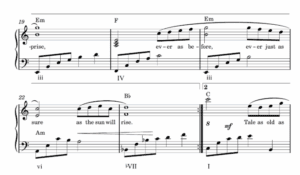
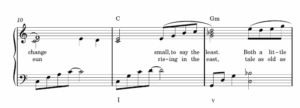 Another borrowed chord during the bridge modulation, the music touches on the parallel minor briefly (listen for a minor iv or a ♭VI as Mrs. Potts sings about “as the sun will rise”) in bar 23:
 These subtleties add to the emotional complexity – Disney often wants to make the audience feel both the joy and the pain of love simultaneously, and mode mixture is a direct way to that heartstring.
Musical theatre composers like Andrew Lloyd Webber use modal interchange extensively – e.g. “All I Ask of You” (from Phantom of the Opera) is mostly in D♭ major but features a C♭ Major chord (♭VII) when the lyrics turn more earnest, illustrating vulnerability amid happiness.
These subtleties add to the emotional complexity – Disney often wants to make the audience feel both the joy and the pain of love simultaneously, and mode mixture is a direct way to that heartstring.
Musical theatre composers like Andrew Lloyd Webber use modal interchange extensively – e.g. “All I Ask of You” (from Phantom of the Opera) is mostly in D♭ major but features a C♭ Major chord (♭VII) when the lyrics turn more earnest, illustrating vulnerability amid happiness.
 Opera in the 19th century had already set the stage for this, and film music is essentially the inheritor of that tradition. Modern film/game scores also use darker modes for exotic or intense atmospheres: e.g. a villain’s theme might borrow from Phrygian (♭II chord for that “Eastern” or ominous sound).
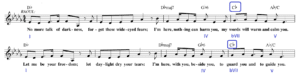
Nobuo Uematsu For instance, in “Aerith’s Theme” from FFVII start in E major in a straightforward key but will throw in a v (Mixolydian) or ♭VI and iv (Aeolian) to shift to a modal feeling that gives the music a folk or ancient character:
Opera in the 19th century had already set the stage for this, and film music is essentially the inheritor of that tradition. Modern film/game scores also use darker modes for exotic or intense atmospheres: e.g. a villain’s theme might borrow from Phrygian (♭II chord for that “Eastern” or ominous sound).
Nobuo Uematsu For instance, in “Aerith’s Theme” from FFVII start in E major in a straightforward key but will throw in a v (Mixolydian) or ♭VI and iv (Aeolian) to shift to a modal feeling that gives the music a folk or ancient character:
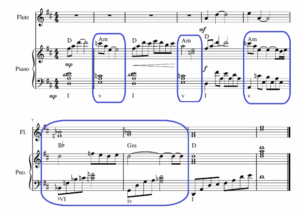
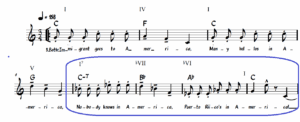
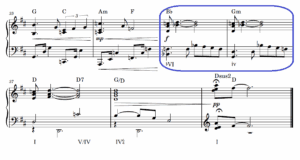 On the same Movie, the Song “America” has the Classic progression C → B♭ → A♭ → C. In Roman numerals: I → ♭VII → ♭VI → I B♭ and A♭ are borrowed from C minor (Aeolian):
 In all these genres, modal interchange enriches the music by expanding the harmonic vocabulary beyond the diatonic. The borrowed chords stand out and are often the most memorable moments of a piece. They also tie many genres together – a classical minor iv, a jazz minor iv, a rock minor iv, and a Disney minor iv all essentially perform the same task of deepening the emotion. It’s a wonderful common thread across musical styles.
Each genre and example above shows that modal interchange is a versatile tool: it can be subtle (one chord) or bold (extended passages), it can convey joy, sorrow, nostalgia, or exoticism, and it links the theory of centuries past with the music of today.
In all these genres, modal interchange enriches the music by expanding the harmonic vocabulary beyond the diatonic. The borrowed chords stand out and are often the most memorable moments of a piece. They also tie many genres together – a classical minor iv, a jazz minor iv, a rock minor iv, and a Disney minor iv all essentially perform the same task of deepening the emotion. It’s a wonderful common thread across musical styles.
Each genre and example above shows that modal interchange is a versatile tool: it can be subtle (one chord) or bold (extended passages), it can convey joy, sorrow, nostalgia, or exoticism, and it links the theory of centuries past with the music of today.
Comprehensive Guide on Modal Interchange
Modal interchange, also known as mode mixture or borrowed chords, is a musical technique that enriches harmony by drawing chords from parallel modes. This guide will explain modal interchange in depth – from its definition and historical origins to practical applications across genres. It’s designed for a wide audience:- Piano Students seeking to understand the theory behind pieces they play
- Composition Students looking to apply modal interchange in their writing
- Music Theory enthusiasts aiming for deeper knowledge
- Improvising Musicians wanting to spice up their solos
- Jazz musicians expanding their harmonic vocabulary
- Music producers enhancing their tracks
- Film, game, and musical composers seeking advanced harmonic tools
What is Modal Interchange? (Definition & Etymology)
Modal interchange is the practice of borrowing chords from a parallel mode or scale to use in a given key. In simpler terms, when you’re in a major key, you might temporarily use a chord from the parallel minor, or vice versa. For example, if a song is in C major (C Ionian), the composer might “borrow” a chord from C minor (C Aeolian), such as A♭ major, and use it in the C major context. Because C major and C minor share the same tonic note “C”, these borrowed chords can fit surprisingly naturally, adding new colour without fully changing key.
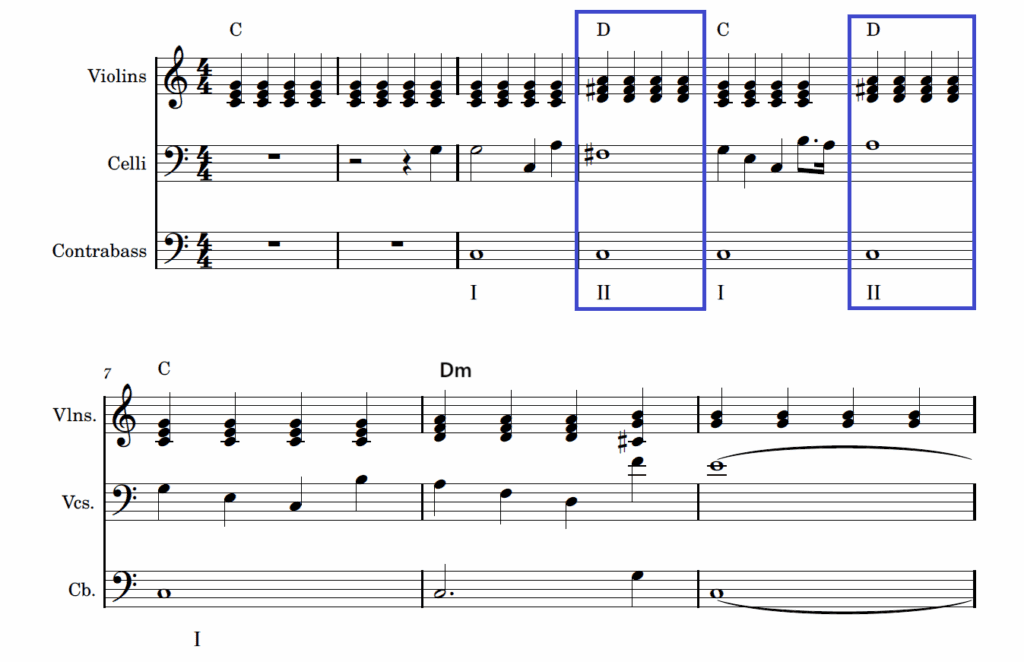
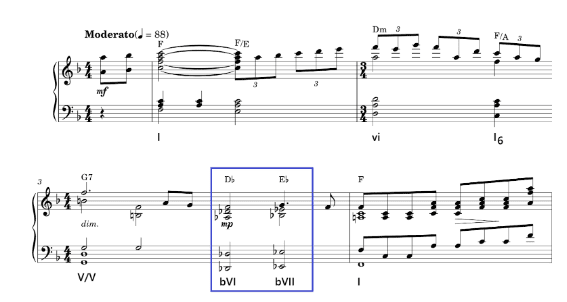
With modal interchange, however, composers will sometimes choose chords more for their colour than for strict functional necessity. In many cases, a borrowed chord can serve a similar function to its diatonic counterpart, but provides a different emotional flavour. For example, in C major, an A♭ major chord (♭VI) often acts as a predominant, typically moving to G (V) and then back to C – in much the same way a diatonic ii or IV chord would function before the V. Likewise, a ♭VII chord (B♭ major in C major) often moves to IV or directly back to I, rather like a V/V (secondary dominant) would move to V or I – but the character of ♭VII is more modal or folk-like compared to the leading-tone push of a true secondary dominant.
Synonyms
Over the years, theorists have used various terms for this idea. In classical theory it’s often called mode mixture or modal mixture, and the chords are called borrowed chords. In jazz and contemporary theory, the term modal interchange is common. Older sources even use the term mutation for changes of mode. All these refer to the same core concept: mixing the major and minor forms of the scale (or other modes) within one piece.Etymology
The concept of borrowing chords emerged as the tonal system developed. The word “borrowed” conveys that we momentarily borrow a chord from another scale (usually the parallel minor or major), then return to the home key. Mode mixture literally means mixing the modes (major/minor) in one context. The term modal interchange is more modern, popularised in jazz and song writing to emphasise swapping (“interchanging”) chords between parallel modal scales. No matter the name, the principle is the same. “The major/minor duality is a basic attribute of the tonal system; using mixture enables a composer to focus on this duality within a single piece or passage.” – Aldwell & Schachter, Harmony and Voice Leading In summary, modal interchange refers to adding “flavour” to a key by incorporating chords from parallel modes. It widens the palette of available harmonies beyond the standard seven available diatonic chords on every key, allowing composers and players to introduce subtle surprises and emotional nuances, without breaking the stability and gravitational centre of the tonic.What is the gravitational centre of a tonic?
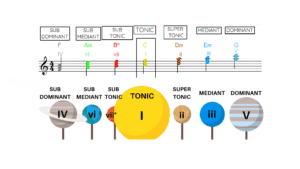
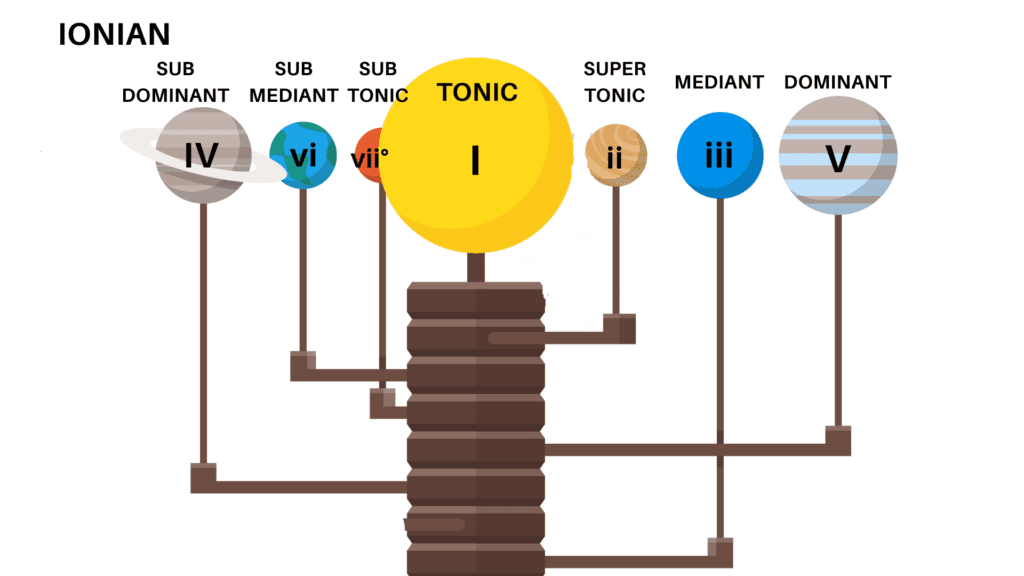
In traditional tonal theory, every chord has a function (tonic, dominant, pre-dominant, etc.), like members of a hierarchy that drive the progression forward. One way to think of it is to imagine the chords as planets orbiting the Tonic, which is the sun of our musical “solar system.” Each chord has its specific place and gravitational pull in relation to the tonic. Normally, composers choose chords to fulfil these functional roles. Some planets are nearer the sun, such as the leading tone and the supertonic (we could relate those to Mercury and Venus, both a second away from the “Sun”). Then we have the Earth and Mars, that’s to say, the Mediant (III) and the Submediant (VI) both a third away from the tonic. Lastly, the biggest planets, Saturn and Jupiter: The IV (subdominant) and the V (Dominant) a perfect 5th away from the tonic, which by the way are the primary chords within the scale (the chords with the more gravity among other chords or “Planets”) If we translate this system to a Major scale, the representation would look like this:
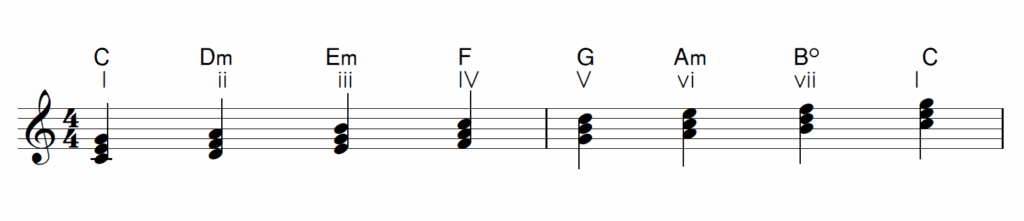
And now, translated into notes:
And lastly, the more conventional version in ascending scalic form:
Each chord in the tonal system has a specific function, and as this system is so stable, it allows borrowing different chords or “planets” let’s say, from another solar system; those different solar systems in music are called “modes”.
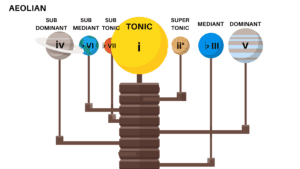
For example, this is how the Aeolian system would look like:
Notice how the quality of the chords (planets) have changed: Now the VI, VII and III are flats, the ii is diminished and the iv and v are minors if we compare it with the Ionian or major scale.
Foundations: The Musical Modes or Greek Modes
To understand modal interchange, it helps to know the musical modes we can borrow from. In Western music, the seven traditional diatonic modes are: Ionian, Dorian, Phrygian, Lydian, Mixolydian, Aeolian, and Locrian. These modes all share the same seven notes in a differing order. So basically we have the same amount of tones and semitones (5 tones and 2 semitones) but as we start on different notes, their order changes; this can be related to a musical permutation of notes. For example, using only the white keys on a piano (the C major scale pitches):- C Ionian (the major scale): C–D–E–F–G–A–B
- D Dorian: D–E–F–G–A–B–C (a minor scale with a raised 6th)
- E Phrygian: E–F–G–A–B–C–D (a minor scale with a lowered 2nd)
- F Lydian: F–G–A–B–C–D–E (a major scale with a raised 4th)
- G Mixolydian: G–A–B–C–D–E–F (a major scale with a lowered 7th)
- A Aeolian (the natural minor scale): A–B–C–D–E–F–G
- B Locrian: B–C–D–E–F–G–A (a diminished scale with a lowered 2nd and 5th)
Each mode has a distinct character. Musicians often describe modes along a brightness–darkness spectrum depending on how their intervals relate to the major scale. Modes that resemble the major scale (fewer lowered notes) sound “brighter”, while those closer to the natural minor (more lowered notes) sound “darker”.
Understanding the Greek Modes
In ancient Greek music theory, modes—referred to as harmoniai (αρμονία)—were deeply intertwined with the concept of ethos (ἔθος or ἦθος), the idea that music could influence a person’s character and emotions. These modes were often named after various Greek regions or peoples, such as Dorian, Phrygian, and Lydian, reflecting the belief that each mode embodied the characteristics associated with its namesake.Origins and Associations
The term harmonia in early Greek writings did not merely denote a scale or mode but encompassed a broader musical style characteristic of a particular region or people. For instance, the Aeolian harmonia was likely associated with the melodic style of Greeks speaking the Aeolic dialect, rather than a specific scale pattern. Philosophers like Plato and Aristotle discussed how different harmoniai could affect the soul and behaviour. In Plato’s Republic, he suggests that exposure to certain musical modes can shape a person’s character, advocating for the Dorian and Phrygian modes in education while warning against the Lydian and Ionian modes for their potentially softening effects.Characteristics of Specific Modes
The ancient Greeks attributed specific emotional and ethical qualities to each mode: Dorian: Considered strong and virile, embodying qualities like courage and discipline. Plato favoured this mode for its educational value. Phrygian: Associated with ecstatic and emotional expressions, often linked to passionate or intense feelings. Lydian: Described as intimate and lascivious, this mode was thought to have a softening influence, leading Plato to caution against its use in certain contexts. Mixolydian: Viewed as plaintive or mournful, associated with lamentation and sorrow. Ionian: Regarded as soft and convivial, promoting relaxation and pleasure. Aeolian: Associated with melancholy and introspection, evoking a sense of sadness or pensiveness. Locrian: Considered unstable and dissonant, often linked to mystery or tension.Intervallic structure of the Modes
Modes are scales defined by unique sequences of Tones (T) and Semitones (ST). Below we have all the modes now starting from the C, that’s to say, the same Tonic:| Mode | Intervals | Example (C-based) |
| Lydian | T–T–T–ST–T–T–ST | C D E F♯ G A B C |
| Ionian | T–T–ST–T–T–T–ST | C D E F G A B C |
| Mixolydian | T–T–ST–T–T–ST–T | C D E F G A B♭ C |
| Dorian | T–ST–T–T–T–ST–T | C D E♭ F G A B♭ C |
| Aeolian | T–ST–T–T–ST–T–T | C D E♭ F G A♭ B♭ C |
| Phrygian | ST–T–T–T–ST–T–T | C D♭ E♭ F G A♭ B♭ C |
| Locrian | ST–T–T–ST–T–T–T | C D♭ E♭ F G♭ A♭ B♭ C |
- Majors (Lydian, Ionian and Mixolydian)
- Minors (Dorian, Aeolian and Phrygian)
- Diminished (Locrian)
Major Modes:
Minor Modes:
Diminished Mode:
Naturally, this example only shows one tonic, the C note. If you want to find very quickly all the possible chords on every key, I highly recommend this very useful website in which you can find all the possibilities with triads and even with 7th chords by clicking the desired tonic:
https://modal-interchange-chart.com/
Additionally, to help you find easily the main keys from which to work, here is a website in which you can find all the keys and diatonic chords (and their degree names):
https://muted.io/circle-of-fifths/
Modes Ordered from Bright to Dark
Each mode is different and they have been categorised according to a gradient that goes from bright to dark:- Locrian (darkest, dissonant) – Starting on B
- Phrygian (exotic, tense) – Starting on E
- Aeolian (minor, sombre) – Starting on A
- Dorian (minor, slightly hopeful) – Starting on D
- Mixolydian (bluesy, mellow) – Starting on G
- Ionian (bright, stable) – Starting on C
- Lydian (brightest, uplifting) – Starting on F
B – E – A – D – G – C – F
In the figure above, Lydian is at the far right (brightest) and Locrian is at the far left (darkest). Notice how Lydian has a raised 4th (#4) compared to Ionian, giving it an even brighter, more ethereal quality. Ionian (major) is bright and happy. Mixolydian has one lowered note (♭7), introducing a touch of warmth or folk-like colour. Dorian has a minor tonality (♭3) but a bright touch from a natural 6 – it’s often described as a minor mode with hope (think of a jazz or folk minor sound). Aeolian (natural minor) has ♭3, ♭6, and ♭7, making it darker and more melancholic. Phrygian adds a ♭2 (E Phrygian has F-natural against E major’s F♯), giving it a distinctly exotic or sombre darkness. Locrian is the darkest and most unstable-sounding mode, with five notes lowered (it even has a diminished tonic chord).
Semitone Placement and Modal Brightness
Modes differ in brightness due to the position of semitones relative to the tonic. If you see the chart below, we have the brightest of the modes, the Lydian, in which the semitones are placed between the 4th to 5th note of the scale (the farthest of all modes) and from the 7th to the 8th on the second tetrachord Then, the Ionian, in which the first tetrachord now changes, has the semitone a note closer: from the 3rd to the 4th note of the scale, and the second tetrachord exactly the same as the Lydian. Following the same pattern of the first tetrachord, we have the Mixolydian. The difference now is that the semitone on the second tetrachord is a note closer: from the 6th to the 7th, being this mode the “Darkest” of the major modes. Among the minor modes, we start with the Dorian: The first tetrachord now has changed its semitone a note closer to the tonic, from the 2nd to the third note, keeping the second tetrachord as the Mixolydian. Our Natural Minor scale, or Aeolian mode, changes the pattern slightly on the second tetrachord, now with its semitone a note closer from the 5th to the 6th note. The “Darkest” of the minor modes is the Phrygian, as it moves its semitone of the first tetrachord a note closer: From its 1st note or tonic to the second note. Finally, the darkest of all modes, the Locrian, which is the only one having both semitones within the first tetrachord: from the 1st to the 2nd and the 4th to the 5th, producing a diminished 5th between the tonic and the 5th degree, making this mode the most unstable and almost unusable if using the full triad.
In terms of scale degrees relative to the major (Ionian) scale:
- Lydian: #4 (one raised scale degree, very bright)
- Ionian: (no alteration, bright)
- Mixolydian: ♭7 (one flat, slightly less bright)
- Dorian: ♭3, ♭7 (two flats, minor but not as dark as natural minor because 6 is natural)
- Aeolian: ♭3, ♭6, ♭7 (three flats, the natural minor scale)
- Phrygian: ♭2, ♭3, ♭6, ♭7 (four flats, a very dark minor)
- Locrian: ♭2, ♭3, ♭5, ♭6, ♭7 (five flats, extremely dark and unstable)
Key point: When we use modal interchange, we do not change the tonic – we are not modulating to a new key. Instead, we momentarily switch the scale beneath our melody/harmony to one of the darker or lighter modes that share the tonic. This injects emotion by leveraging the contrast between major and minor (or other modal inflections) within a stable tonal centre.
Main and Secondary chords in Mode Mixture
Every mode has two chords that outline its character. Each mode is different and by using these specific chords, composers can depict the specific colour and mood of each mode. The red chords are the primary and the blue chords are the secondary ones. The primary are distinctive of that mode and the secondary are chords that, although still depict the mode, are not as strong the first Primary ones:MAJOR MODES:
MINOR MODES:
DIMINISHED MODE:
Notice that we never use diminished chords (except for the Ionian or Major mode) the reason is that the diminished chords produce a gravitational effect towards notes that are not the tonic, in which case, we would be dealing with centrifugal forces (the weakening of our tonic) rather than centripetal forces (reinforcing the tonic)
The exception is the Ionian or Major mode, as the diminished chord resolves on the tonic, making it the more stable of them all. (No wonder it was chosen to be the main mode!)
A Brief History of Modal Interchange
Modal interchange has deep historical roots, going back to the Renaissance and evolving through the Baroque, Classical, Romantic, and modern eras. We will step through each period to see how the practice of mixing modes developed:Renaissance Origins (Modal Music)
In Renaissance music (1400s–1600s), the concept of major/minor keys as we know them today did not yet exist. Composers wrote in modes – scales like Dorian, Phrygian, etc., derived from medieval church modes. There was not yet a fixed harmonic structure. The text (commonly Hymns) would determine the types of modes to be used, and although the modes had certain cadence points that were part of the common practice, the Contrapuntal technique allowed fluidity in the vertical aspect of the music. For example, in Giovanni Gabrieli’s – O Magnum Mysterium (1587) The beginning is clearly on G minor, dictated by the opening chord, but changes abruptly to the parallel major chord, G major in bar 3, and even more, cadences in G major in bar 5:
This interchange between minor and major tonic (called “Finalis” in the Renaissance) keeps throughout the piece. You can listen and follow the score from the following link:
Conversely, some Renaissance pieces in a minor-like mode would end on a major chord – the famous Picardy third, where a final chord is major (with a raised 3rd) in an otherwise minor context. The Picardy third, common in 16th-century sacred music, is effectively borrowing the tonic chord from the Ionian mode (major) in a piece that was otherwise in Aeolian (natural minor). This adds a moment of brightness at the end – an early example of modal interchange’s emotional effect, like in the following example by Nicolas Gombert in his Ave Maria at the end of the piece – From G Aeolian (Minor) to G major at the final cadence:
Another Renaissance development was the recognition of Ionian and Aeolian modes (major and natural minor scales) as valid modes, thanks to theorists like Henricus Glareanus. In 1547 Glareanus published Dodecachordon and added Ionian (mode 11) and Aeolian (mode 9) to the traditional modal system.
If you want to know more about this, there is an excellent video about the modes from the You tube Channel “Early Music Sources”:
This essentially acknowledged the major and natural minor scales. As composers began using Ionian (major) and Aeolian (minor) more often, the duality of major vs minor tonality emerged.
Late Renaissance and Mannerist composers started to play with this duality for emotional effect – for instance, a madrigal might shift from a major-sounding section to a minor-sounding one to reflect a text’s change of mood. We can think of this as a proto-form of modal interchange: the modal system allowed certain flexibility, and composers could turn a mode “major-ward” or “minor-ward” by selective alterations. In fact, some modes are very closely related (e.g. A Aeolian and E Phrygian share the same pitches – one person’s Aeolian could be another’s Phrygian on a different final). This interrelatedness meant a piece might oscillate between modal centres without a clear sense of modern modulation.
There is an example of this with the “Missa L’homme armé – Kyrie” by Josquin Des Prez (minute 2:45 of the YouTube link) in which in the context of A Aeolian, a B-flat note on the Bass appears, giving the chord of B flat major (a flattened 2nd degree, characteristic of the Phrygian mode)
We need to observe, though, that this “Proto-Modal Interchange” cannot be seen under the perspective of a tonal system, but through the lens of the Contrapuntal techniques and the voice leading rules by the time, which were very different from the modern ones.
Baroque Era (Birth of Tonality)
Picardy Third
The Baroque period (1600s–early 1700s) saw the gradual shift from modal music to tonal (major/minor) music. By the late 17th century, composers like Corelli, Vivaldi, and J.S. Bach was thinking mostly in terms of keys (major and minor scales) rather than old church modes. However, they still inherited some modal practices. The use of the Picardy third continued – many Baroque pieces in minor end on a major chord, a clear example of modal mixture (borrowing from the parallel major). More broadly, Baroque composers began to mix the major and minor forms of the scale within a piece. For instance, a piece in C major might contain a passage where A♭ (from C minor) appears, or a piece in C minor might use an A♮ (from C major or melodic minor). In Bach’s music, we find numerous chords that imply mixture. A famous example is in J.S. Bach’s Fugue No. 2 in C minor BWV 847 (Well-Tempered Clavier – Book I) – he resolves on a C major (parallel major of the minor key, C minor) on the final chord after a pedal on the tonic.
Neapolitan Chord (♭II)
Another device from the Baroque that relates to modal interchange is the Neapolitan chord (♭II). This name comes from a group of opera composers in Naples in the early 1600s. They were not the only composers who used the chord, but it became associated with them and was named after their city. The Neapolitan (e.g. D♭ major chord in C minor, or in C major contexts) became a common chromatic predominant. The Neapolitan is an altered ii chord, and as such it functions and behaves like a pre-dominant. It usually leads to the dominant, although it occasionally can return to tonic harmony. It can be thought of as borrowing the II chord from the Phrygian mode (since in C minor, the ii° chord’s root is D, but if you flatten it to D♭ and make it major, you have something akin to C Phrygian’s II chord). While classical theory often treats the Neapolitan as a special case, it’s essentially another colour from outside the diatonic major scale that remains within the gravitational pull of the home key.
By the end of the Baroque, mixture chords like iv (minor subdominant in a major key), ii° or iiø (diminished supertonic), ♭VII, etc., were appearing, though sparingly and usually quickly resolved.
A good example of this is in the chorale “O Schmerz! Hier zittert das gequälte Herz,” Bach employs a Neapolitan chord (G♭ major in the key of F minor) on the word “Plagen” (“torments”). This harmonic shift intensifies the depiction of Christ’s agony in the Garden of Gethsemane, using the Neapolitan to underscore the depth of suffering (bars 5 and 7):
Johann Sebastian Bach – St. Matthew Passion, No. 19
Classical Era (Common Practice Harmony)
In the Classical period (c.1750–1820, composers like Haydn, Mozart, Beethoven), the rules of diatonic harmony were firmly established – yet composers used mode mixture as a creative tool within those rules.Sonata in C minor, Hob. XVI:20 – First Movement – Joseph Haydn
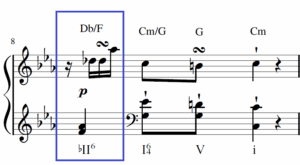
In the cadence on the first Theme, bar 8; Haydn utilises the Neapolitan chord (D♭ major in first inversion) in the key of C minor to heighten dramatic tension. The chord appears prominently as the first subject concludes, providing a striking coloristic effect. Haydn further explores this harmonic device in the finale, using it to powerful and dramatic effect:
Wolfgang Amadeus Mozart – Piano Sonata No. 14 in C minor, K. 457
Mozart frequently employed modal interchange to enrich his harmonic language. In this sonata, he incorporates chords from the parallel major key, such as the use of A♭ major (♭VI) and F minor (iv), to add emotional nuance and contrast within the predominantly minor context:
(minute 3:57)
Summary (Classical): Mode mixture became a recognised technique in the classical vocabulary. Composers, while generally sticking to diatonic progressions, would “borrow” the parallel minor’s chords to enrich a major-key passage (and occasionally vice versa). This era codified the typical palette of borrowed chords: minor iv, ♭VI, ♭VII, ii° (often in first inversion as the “Neapolitan 6th”), etc., which are taught in classical harmony courses. Such chords appear briefly and return to diatonic chords, thus expanding harmonic colour without changing key.
Romantic Era (Expanded Chromaticism)
The Romantic period (1820-1900) pushed chromatic harmony to new heights, and modal interchange flourished even further. Composers like Schubert, Schumann, Chopin, Brahms, and Liszt revelled in rich harmonic colour, often blurring the lines between major and minor. A hallmark of Romantic harmony is the mixture of major and minor modes on a broad scale: a piece might oscillate between a major key and its parallel minor for entire sections.Ludwig van Beethoven – Piano Sonata No. 14 in C-sharp minor, Op. 27 No. 2 (“Moonlight Sonata”)
In the opening movement, Beethoven introduces the Neapolitan chord (D major) in the key of C-sharp minor. This chord appears in first inversion, creating a poignant and expressive harmonic shift that enhances the movement’s introspective character:
In bar ten, Beethoven makes another mode mixture after resolving in E major (relative major of C#m, the tonic key) taking a surprising turn to E minor in bar 10, using this to later modulate to B minor (bar 13) as part of the harmonic path from C#m to F#m:
“Pathétique” Sonata Op.13 (Beethoven)
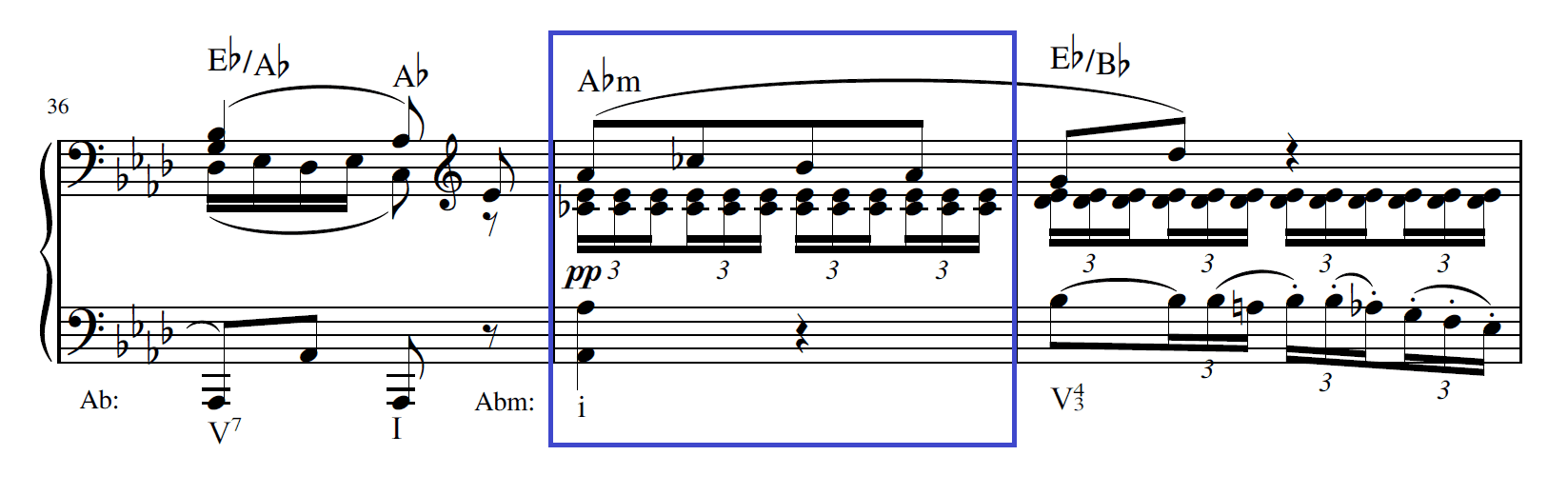
A classic instance is this second movement which is in A♭ major, yet features several A♭ minor chords and passages, painting a momentarily more sombre shade before returning to major. (Bar 37):
Minute 12:24
Beethoven’s Symphony No. 5 (C minor) ends in a triumphant C major, but along the way he explores the major/minor interplay in bar 45 in which he uses the ♭VI (A♭ Major) and iv (F minor) in bar 50:
Minute 29:11
Franz Schubert – String Quartet in C minor, D. 703 (“Quartettsatz”)
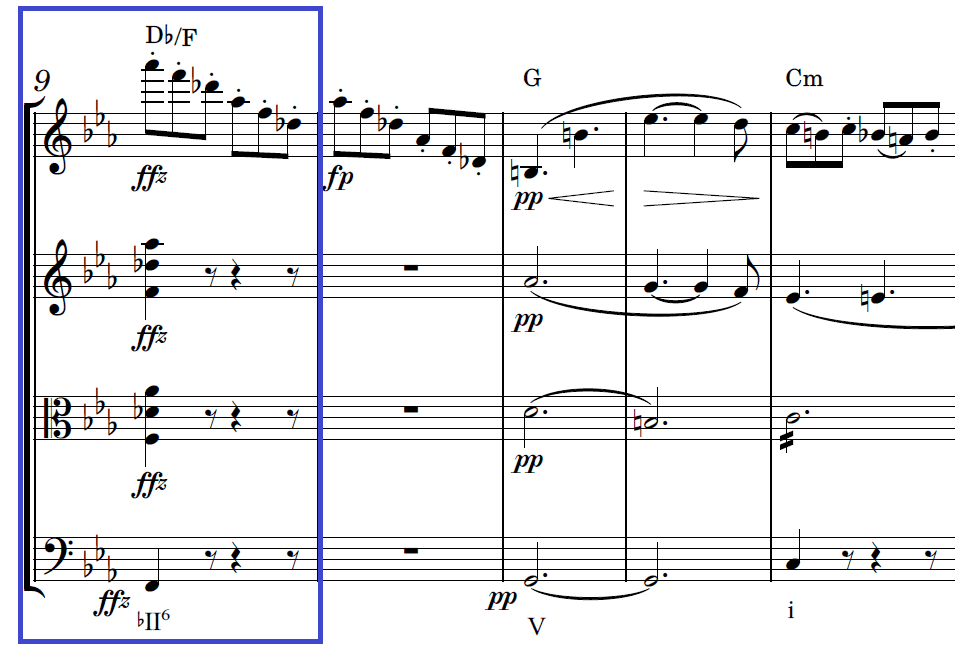
Schubert’s use of modal interchange is evident in this quartet movement. He incorporates the Neapolitan chord (D♭ major) in the key of C minor (Bar 9), contributing to the movement’s dramatic intensity. The chord’s sudden emergence provides a powerful emotional impact, characteristic of Schubert’s harmonic language:
Minute 0:10
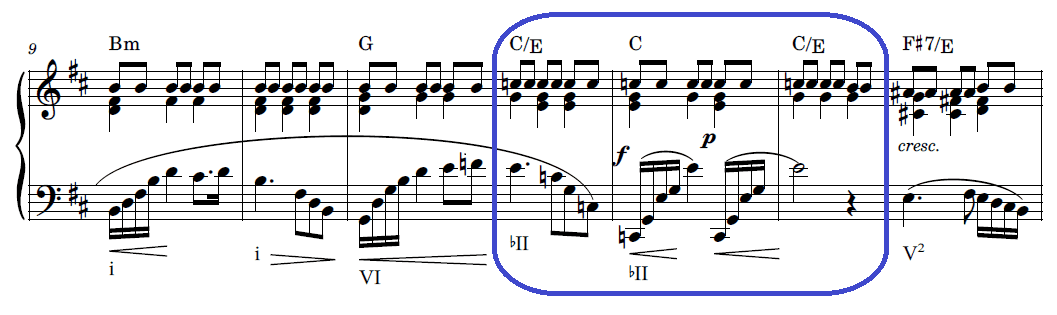
Sometimes composers put the Neapolitan in root position, tonicised it, or even modulated it. To tonicise the Neapolitan, composers add a seventh to the VI, making it into a secondary dominant—V7 /N.
Prelude in B minor, Op. 28, No. 6 (Chopin)
The score below shows a famous example in which Chopin tonicises the Neapolitan ( C Major in bar 12) putting it in root position. Before it we see the motive in G major (the VI degree of B minor, the main key) used as a secondary dominant to introduce this Neapolitan chord. Melodically, he uses the same motives he used in the main key from the beginning to keep the consistency through the passage:
(Minute 2:58)
Romantic composers didn’t limit themselves to borrowing from just the natural minor; they might pull in chords from various parallel modes or altered scales. For instance, Franz Liszt, influenced by Hungarian folk music, sometimes mixed modes in daring ways (like using the Hungarian minor scale – minor with sharp 4 – effectively blending minor with a bit of Lydian). As harmony grew more chromatic, the line between “borrowed chord” and “temporary modulation” blurred, but crucially, many Romantic works still preserve a central tonic while roaming through a colourful modal landscape. Wagner’s operatic harmony, for example, often shifts modes to intensify emotion (a hero’s theme might appear once in major, once in minor). By the end of the 19th century, mixture was so commonplace that the distinction between diatonic and chromatic chords was more fluid.
Mode mixture became richer and more frequent. Composers would sometimes sustain the parallel minor flavour for extended passages (what some theorists call “large-scale mixture”). The vocabulary of borrowed chords expanded (augmented sixth chords, for instance, can be seen as borrowed from the minor or related modes). Nonetheless, these chromatic chords usually resolve in a way that reaffirms the original key, keeping the music centripetally oriented to the home tonic even while exploring distant colours.
20th Century & Modern (Modal Revival and Beyond)
In the 20th century, the structures of tonal harmony loosened. Some composers abandoned tonality altogether, but many others rediscovered modes and modal interchange in new contexts. Impressionist composers (Debussy, Ravel) famously embraced church modes and exotic scales; they might stay in one mode for a piece (e.g. whole-tone or Lydian), or deliberately alternate modes.La fille aux cheveux de lin (Préludes, Book I, 1910) – Claude Debussy
For instance, in bar 6, we have a modal interchange to the Major VI (E flat major)
“The Girl with the Flaxen Hair”, is mostly in G♭ major (Ionian) but clearly uses modal interchange with G♭ Mixolydian (♭7) in bar 15 with a F flat major:
Or Lydian with the 2nd Degree as Major (Ab major) in bar 23:
In early 20th-century classical music, composers like Ralph Vaughan Williams combined modality with tonality, an effect often called pastoral – e.g. a melody might be in a major key but harmonised with a sudden iv (minor subdominant) to evoke folk-like modality.
The Lark Ascending (1914; rev. 1920) – Ralph Vaughan Williams
In bars 100 to 103, we see modal interchange to the Phrygian mode from E minor: ♭II (F major) to iv (A minor), then in bar 102 to the ♭II (F major) again to resolve in a Phrygian cadence to the main key, E minor (i)
In the same piece, there are two borrowed chords from the E Locrian: G minor (♭iii) in bar 44, and B flat major (♭V) from the same mode. Although this passage (Bars 44-46) could be also seen as a development of the Dm, with those same chords being the ♭VI (B♭) and iv (G minor). This hypothesis loses its strength if you consider that Williams goes back and forth too quickly to chords related to the main key, E minor. The resulting sound gives a harmonic ambiguity through these transitions between modes that enhances the piece’s ethereal quality:
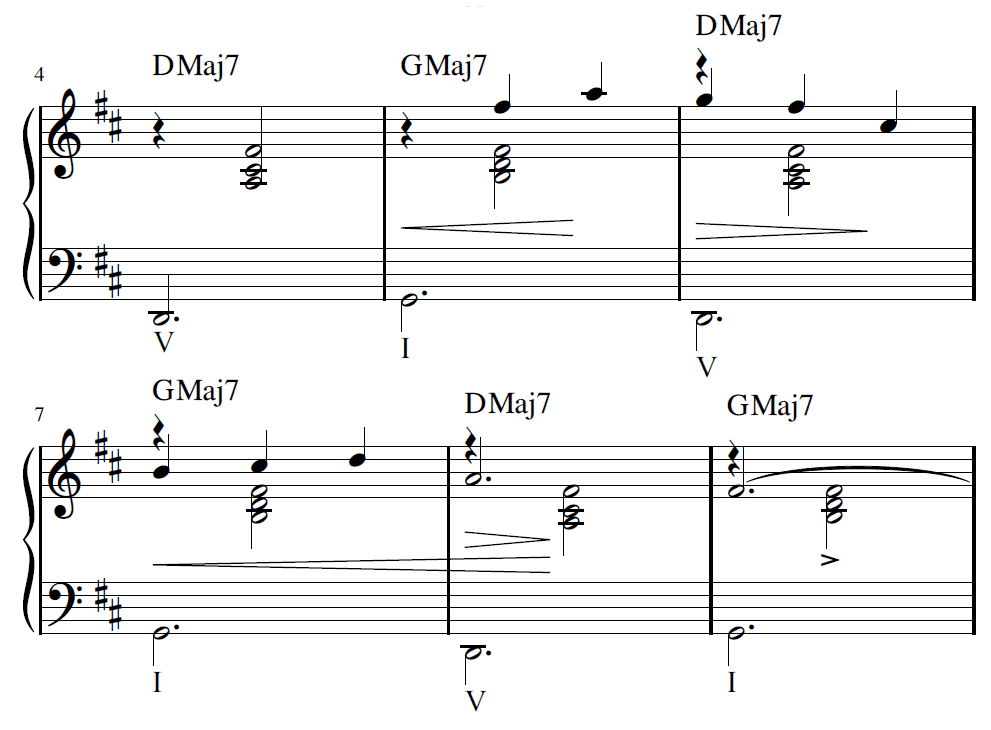
Gymnopédie No. 1 – Erik Satie
The piece is primarily set in D major, but Satie frequently incorporates chords from D minor and other modes, such as D Dorian and E Phrygian, to enrich the harmonic palette. This modal blending contributes to the piece’s ambiguous tonality and emotional depth.1. Bars 1–20: D Major with Modal Inflections
The opening alternates between Dmaj7 and Gmaj7 chords. While rooted in D major, the use of Gmaj7 introduces a Lydian flavour due to the raised fourth scale degree (C♯), subtly hinting a modal interchange with a progression I-V (Gmaj7 – Dmaj7)
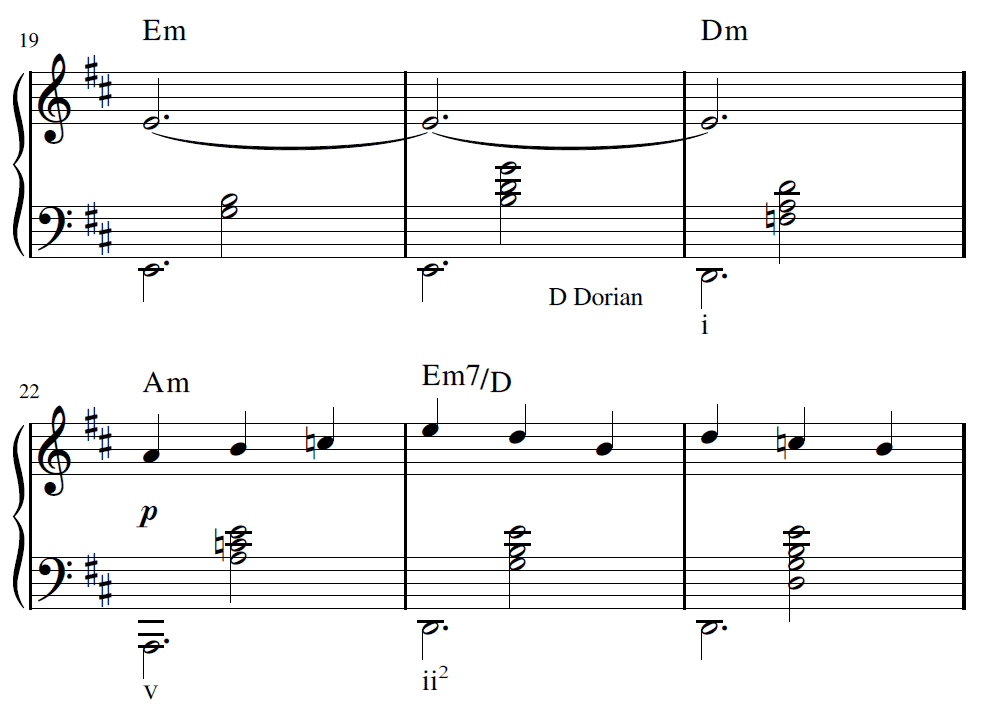
2. Bars 19–31: Shift to D Dorian
Here, Satie transitions to chords like Dm7 and Am7, borrowing from the parallel minor key of D minor. This shift introduces a melancholic tone, contrasting with the brighter opening section. The progression includes chords such as Em7/D, combining elements from the Dorian mode. This mode, characterised by a natural sixth, bridges the gap between major and minor tonalities, adding complexity to the harmonic structure.
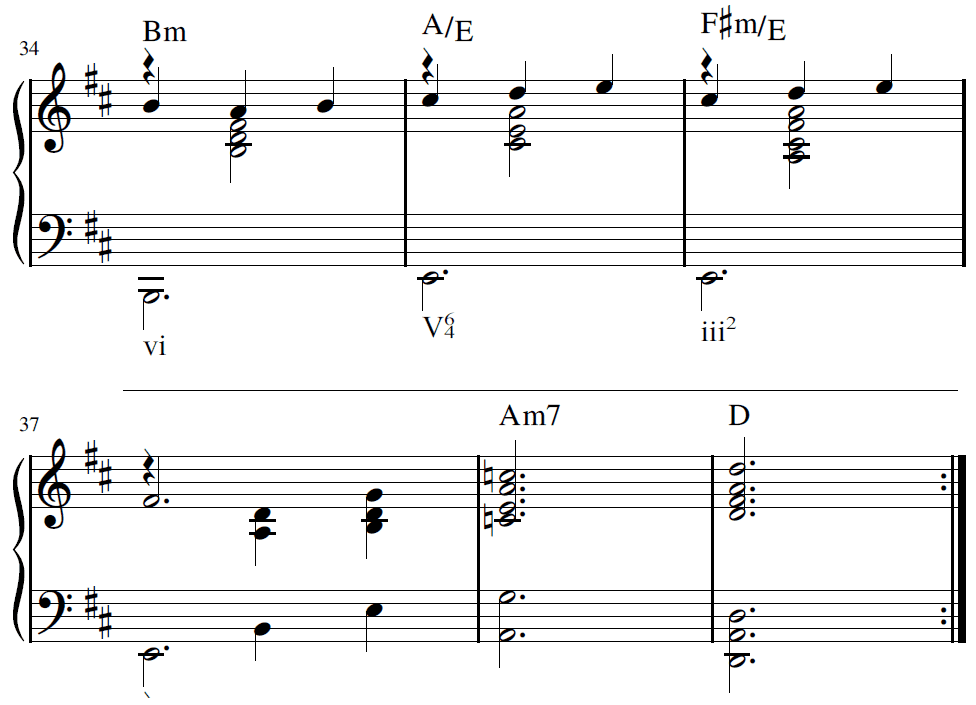
3. Bars 32–40: Return to D Major with Modal Nuances
The piece revisits D major but incorporates chords like Fmaj7 (bar 41) and Am7 (bar 43), again borrowing from the parallel minor and introducing modal interchange. These choices enhance the piece’s introspective quality. The cadence in bar 38 uses the minor dominant taken from the D Dorian (Am7) resolving in D major in bar 39 and the end with a dominant and tonic, both in the Dorian mode (Am7 – Dm)
Musical Theatre
Musical theatre composers frequently used mode mixture to tug at heartstrings – a show tune in a major key might move to the parallel minor for a bridge to convey sadness, then return to major for resolution. For example, in the song “In my Life” from Les Miserables, we have a modal mixture to the Aeolian or F minor (Flattened major 6th and 7th degrees) from the Major F major:
https://musescore.com/official_scores/scores/6938018
Jazz Music
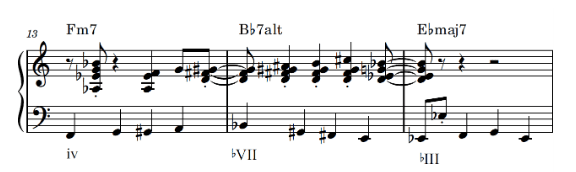
Jazz in the 20th century also integrated modal interchange. Jazz standards, though based on tonal harmony, often incorporate chords from the parallel minor. A classic example is “On Green Dolphin Street”, a jazz standard that is in C major for the A section but prominently features E♭maj7 (♭III) and B♭7 (♭VII) chords – borrowed from C minor from bars 13 to 15 – as part of its signature sound. This chord progression (I→ iv → ♭VII → ♭III) gives a sophisticated, lush feeling and is loved in jazz and film music alike.
In the 1950s and 60s, modal jazz also emerged (using one mode static for solos), but even in modal jazz compositions, switching between mode colours (e.g. Miles Davis’s So What flips between D Dorian and E♭ Dorian) can be seen as a kind of interchange between modal centres (though that borders on modulation).
Film Music
In film and game music, modal interchange became a staple for evoking emotion and drama. Composers like John Williams, Alan Menken, Nobuo Uematsu, and Hans Zimmer use it to achieve grand, epic, or nostalgic sounds. By mixing major and minor, they can, within seconds, change the mood from uplifting to bittersweet or from tense to triumphant without changing key. “Yoda’s Theme” – Star Wars: The Empire Strikes Back (1980) In “Yoda’s Theme,” Williams employs modal interchange to evoke mysticism and serenity. The melody primarily resides in C major but incorporates a #4 (D Major) in bars 4 and 6, introducing a fleeting shift toward C Lydian This subtle alteration adds a moment of Brightness, and returning to the diatonic minor II degree (D minor) reflecting Yoda’s enigmatic nature:
“Hedwig’s Theme” – Harry Potter and the Sorcerer’s Stone (2001)
Williams crafts this theme in E minor but integrates the Locrian mode by lowering the 2nd degree, introducing a B flat, forming the G minor chord. The following chord, F minor, could be seen as a borrowed chord from the Phrygian (♭II) but in this case, minor. It is worth noticing that in this case, the modal mixture is not “by the book” as Williams is using a colouristic harmony to create a magical and whimsical atmosphere, aligning with the enchanting world of Harry Potter.
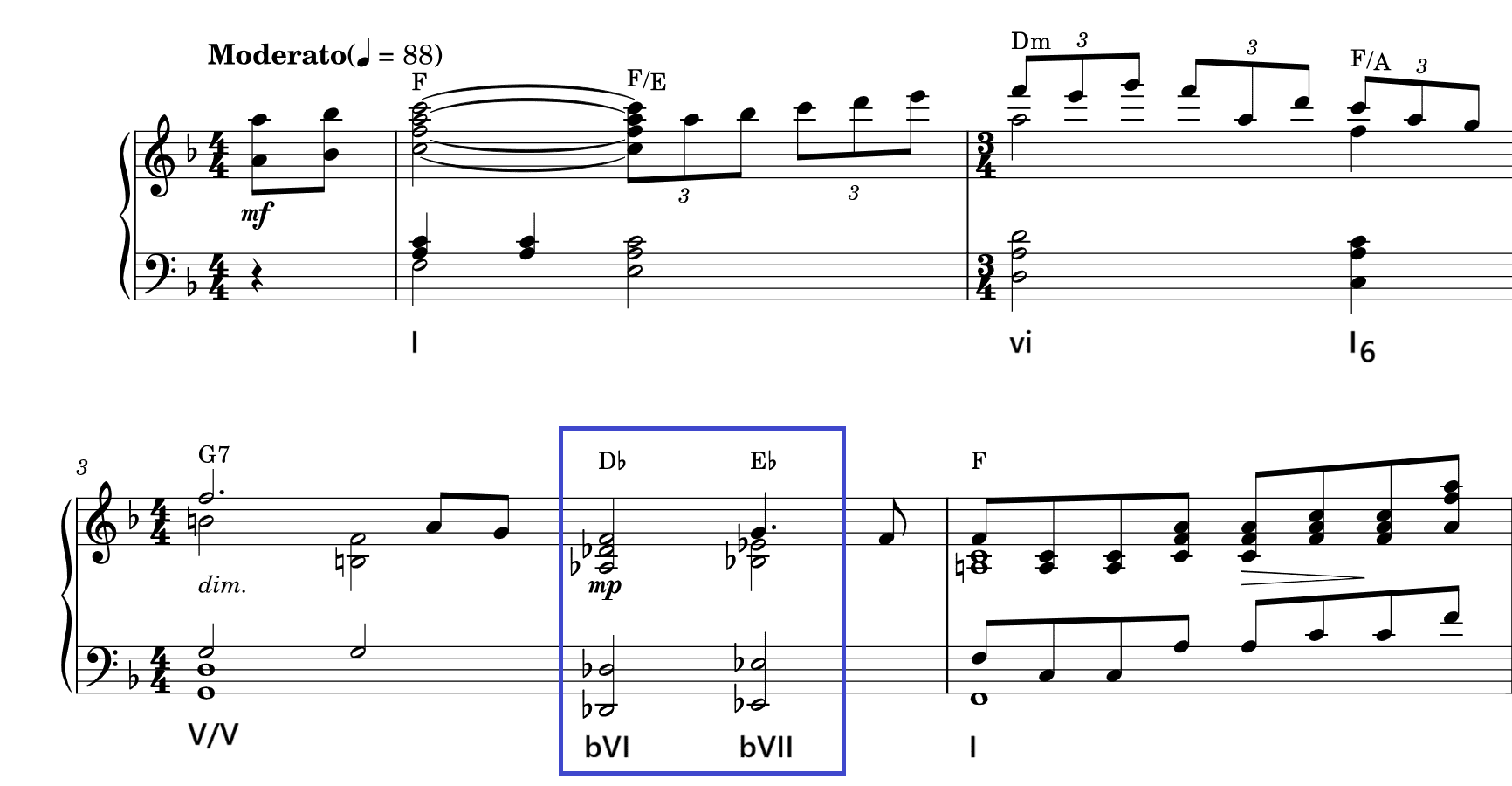
The Raiders March (Indiana Jones Theme) – John Williams
The piece is primarily set in C major, but Williams incorporates chords from parallel modes to create contrast and interest. One notable example is the use of the ♭II chord (D♭ major), borrowed from the Phrygian mode. This chord introduces a bold, adventurous quality that aligns with Indiana Jones’ character.
In bars 19 and 23 and example is the use of the ♭VII chord (B♭ major), borrowed from the Mixolydian mode:
Another instance is the ♭VI chord (A flat major), borrowed from the parallel minor key (C minor). This chord adds a touch of poignancy and depth, reflecting the complexities of the character’s journey (bar 29)
Game Music
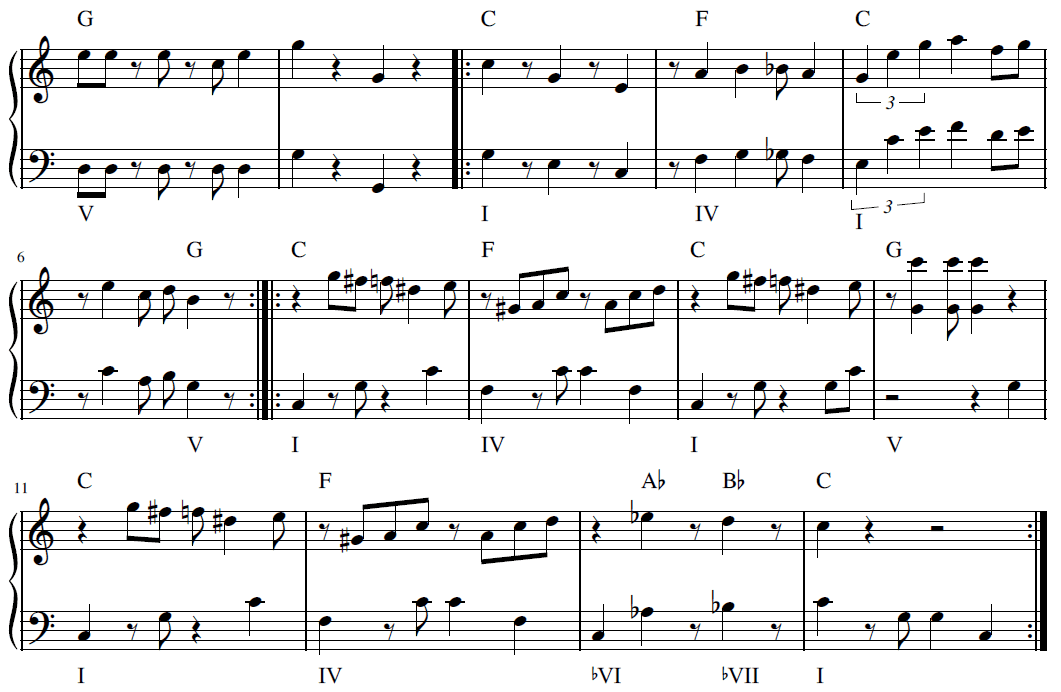
Super Mario Brothers – Theme1. Borrowing from C Minor (Aeolian): The ♭VI and ♭VII Chords
A hallmark of modal interchange in this theme is the incorporation of chords from C minor, notably the A♭ major (♭VI) and B♭ major (♭VII) chords.- Example Progression: A♭ → B♭7 → C
2. Mixolydian Mode Inflections
The theme occasionally hints at the C Mixolydian mode by emphasising the B♭ note (the lowered 7th degree), especially in melodic lines. This modal flavour adds a bluesy, folk-like character to the music, enhancing its appeal and memorability.
https://musescore.com/user/27687306/scores/4913846
In Summary
The 20th century saw both a modal revival (composers deliberately using old modes) and a continuation of 19th-century chromaticism.
In popular music, the theory of “modal interchange” became codified and taught as a way to enrich chord progressions
Film composers frequently employ modal interchange to enrich their harmonic language and evoke specific emotions. This technique allows for subtle shifts in mood, enabling composers to introduce elements of surprise, tension, or poignancy that align with the narrative’s demands.
Musicians now freely mix parallel modes as a creative choice. The core idea remains: it’s about adding “colour chords” to a key without abandoning the key.
Why Does Modal Interchange Work? (Emotion & Theory)
By now, it’s clear that using chords from parallel modes can heighten the emotional impact of music. But how and why does this work, theoretically and emotionally?- Emotional Effect – Contrast Within Continuity: One reason modal interchange is so powerful is that it provides contrast while maintaining familiarity. When a chord from the parallel minor appears in a major-key song, it’s unexpected and poignant – the mood shifts toward the “minor” (sadder, more introspective) side for a moment. Listeners sense the change in tone, often experiencing it as a tinge of melancholy or longing inserted into an otherwise happy context. Because the music quickly returns to the diatonic major chords, this sadness is transient, creating a bittersweet contrast that can be very moving.
https://www.youtube.com/watch?v=1pcoX8x6gEU&list=RD1pcoX8x6gEU&start_radio=1
Minute 1:32
Conversely, in a minor-key context, borrowing a major chord (like the Picardy third or a IV major in a minor key taken from the Dorian mode) can inject a ray of hope or brightness, again for contrast.
In “Black Magic Woman” (Carlos Santana) – is Often described in D minor but borrows from D Dorian with the frequent presence of the raised sixth (B natural), adding a subtle brightness and warmth, complementing Santana’s expressive guitar style.
Humans naturally respond to major vs minor (studies often associate major with happy/bright, minor with sad/dark), so juxtaposing them enriches the emotional palette. It’s like adding a surprising spice to a dish – just enough to notice the flavour, not so much as to change the cuisine.
For example, the minor iv chord in a major key is often described as having a wistful or nostalgic effect – “happy, but with a hint of sadness.” Songwriters from classical to pop exploit this; the progression I–iv–I is famously touching (heard in songs like The Beatles’ “In My Life”, discussed later, and countless film scores). One music theorist describes the major to minor IV shift as “a colourful, bittersweet feeling of longing”. That sums it up well: modal interchange often triggers complex emotions – a mix of bright and dark, happy and sad.
- Theoretical Explanation – Shared Tonic and Close Relations: Theoretically, modal interchange works because the borrowed chords do not undermine the tonal centre. They are centripetal – pulling back to the tonic – rather than centrifugal (which would be using secondary dominants, secondary diminished chords or a modulation, pulling away to a new tonic).
Another way to look at it: borrowed chords often share common tones with diatonic chords or have voice-leading that makes sense in the key. In C major, A♭ (♭VI) shares the note C with the tonic chord C (C-E-G and A♭-C-E♭ have C in common). F minor (iv in C) shares F and C with the diatonic F major (IV). These common tones act as anchors, so the ear doesn’t feel completely lost:
We can see how these common notes can be used in an example, having the C note as the recurring note in the melody, changing the progression from the C, to the F, Fm and finally G in the first subphrase (bars 1-4) In the second subphrase, the progression slightly changes from C to F, then A♭, descending to G:
The differences like E♭ instead of E in the A♭ chord on the melodic line, stand out just enough to add colour, but not enough to make us think “we’re in a new key of E♭ major” – especially if handled briefly.
Below we see an example that uses two borrowed chords: E♭ and A♭ (Bars 15 and 16) on the “Variation” section. The first statement of the phrase have Am (vi) and Em (iii) in bars 11 and 12 respectively:
Another theoretical perspective is using transformations or voice-leading: Neo-Riemannian theory, for example, describes how a major chord can slip to its parallel minor by lowering the third (e.g. C major C–E–G to C minor C–E♭–G). That single semitone change (E to E♭) is a smooth voice-leading move, but it changes the chord’s quality and mode. So one can navigate the space of chords through minimal changes.
A tonic major to tonic minor change is the simplest modal interchange (sometimes a composer will assert the tonic in both major and minor forms within a piece, almost as if toggling the mode). These smooth transformations allow for expressive harmonic shifts without losing coherence. (see the example previously stated in the Romantic Era of Beethoven – Piano Sonata No. 8 in C Minor, Op. 13 (“Pathétique”) 2nd movement.
- Centripetal vs Centrifugal (Interchange vs Modulation): It’s worth explicitly distinguishing modal interchange from true modulation. In a modulation, the music establishes a new key centre – you get a cadence or at least a strong dominant in the new key, and the original key is left behind (centrifugal force, pushing outward to a new tonal orbit). In modal interchange, the foreign chord is a visitor, not a new host; the original tonic remains the gravitational centre (centripetal force, pulling everything back to the home base).
One guideline:
if the tonic note still feels like resolution after the chromatic chord, you likely have a modal mixture rather than a modulation. A borrowed chord is usually transient – it appears suddenly and then the music resumes diatonic harmony soon after. There is typically no confirmation of a new key (no strong V–I cadence in the “borrowed” scaleIts purpose is to tonicise a diatonic chord, effectively temporarily visiting another key (very briefly) on the way to that chord. For instance, in G major, an A7 chord (with C♯) is V of V (D major, dominant of G). That A7 leads eventually to G through a tonicisation of the dominant chord (D). “Soldiers March” Robert Schumann
Borrowed chords, by contrast, are not functioning as dominants to something; they are directly taken from the parallel mode. So an A♭ chord in C is explained as “borrowed ♭VI from C minor” (it’s not a secondary anything in C major; it doesn’t neatly fit into the dominant/leading-tone framework of the diatonic key).
In analysis, one simply labels it with a flat sign (♭VI) or similar, rather than reinterpreting it in a new key. Unlike secondary chords, which are labeled by their function (V/whatever), borrowed chords are usually just labelled by scale degree with an accidental.
In short, secondary dominants momentarily imply a new tonic (they are mini-modulations), whereas modal mixture chords imply a new scale on the same tonic. This is a key conceptual difference.
- Colour and Voice-Leading Over Functional Necessity: In traditional tonal theory, every chord has a function (tonic, dominant, predominant, etc.).
Borrowed chords can often serve similar functions to their diatonic counterparts (for example, ♭VI in major often moves to V, acting as a predominant like ii or IV would). But sometimes they’re used more for colour than function.
A composer might choose IVm instead of IV simply because of the unique emotional colour it gives, even though IV could have done the functional job.
Many borrowed chords can be seen as chromatic substitutions for diatonic chords that fulfill the same role in progressions. For instance, a ♭VII (B♭ major in C) often moves to IV or I – much as a V/V (D major to G) might, but ♭VII has a more modal, folky character compared to a secondary dominant. Thus, modal interchange enriches the harmonic vocabulary, giving alternate chords for the same jobs that evoke different feelings.
To summarise this section:
Modal interchange works emotionally by blending the “happy” and “sad” elements of music in one context, yielding nuanced moods. Theoretically, it works because the chords share a tonic and often some tones, allowing smooth integration without loss of key identity. It’s a delicate balancing act of tension and resolution that, when done well, keeps the listener engaged and the music’s narrative compelling.Next, we’ll see how this technique shows up across a variety of musical genres – each with its own twist on modal interchange.
Applications in Different Genres (with Examples)
Modal interchange is truly ubiquitous – from classical symphonies to jazz standards, from Disney songs to rock anthems. Let’s explore how different genres make use of borrowed chords and highlight some famous examples:- Classical Music (Baroque to Romantic): In classical instrumental music, borrowed chords were an essential expressive device. Haydn, Mozart, and Beethoven frequently employed the minor iv chord in major keys. For instance, Mozart’s Piano Concerto No. 21 in C major features a section where F minor (iv in C) darkens the mood before a radiant return to C major. Beethoven often juxtaposed major and minor: his Symphony No. 5 shifts the opening motto from C minor to C major at the finale (a large-scale modal mixture giving a journey from darkness to light). In the final movement of Beethoven’s Ninth Symphony, after a long jubilant D major section (the “Ode to Joy”), there’s a surprising detour to B♭ major (a ♭VI relative to D!) during the “Seid umschlungen, Millionen” section – it’s a dramatic, almost spiritual colour shift before returning to D major triumph.
- Opening Theme in D Major: The movement begins with a lively and assertive theme in D major, characterised by its rhythmic vitality and bright tonality.
- Immediate Restatement in D Minor: Almost immediately after the initial statement, (bar 5) Schubert restates the theme in D minor, the parallel minor key. This shift is achieved by lowering the third scale degree (F♯ to F natural), transforming the mood from exuberant to more introspective.
Chopin’s Prelude in C Major (Op. 28 No. 1), though brief, ends with an unexpected A♭ major chord (♭VI in C) that leaves a dreamy question mark hanging – a very Romantic effect. In opera, composers used modal interchange to enhance drama: Don Giovanni (Mozart) has moments where a scene in a major key turns minor to reflect a sudden change in the plot’s emotion. In Carmen, Bizet plays between minor and major iterations of the famous Habanera motif to reflect Carmen’s capricious nature (the refrain is in D minor but the final cadence of the opera is in D major – ironically triumphant at the moment of tragedy). Puccini and Verdi also utilized mixture; for example, an aria might start in a key and end on a big major chord even if the aria was mostly minor, to give a cathartic release (a legacy of that Picardy-third tradition). Overall, classical genres often use modal interchange in a structural way (theme and variation in major/minor) and a local way (individual borrowed chords for colour).
- Jazz and Standards: Jazz harmony eagerly embraced modal interchange, partly through the influence of blues (where the mix of major and minor is fundamental – e.g. a blues in C will use E♭ over a C7 chord, blending major/minor third). In mainstream jazz standards, one finds many borrowed chords especially from the minor mode. A prime example is the ♭VI–♭VII–I progression in major keys, which jazz players associate with a “soulful” sound. The standard “The Days of Wine and Roses” (in F major) uses an F major to F minor (I to iv) change and a D♭7 (♭VII) chord in its bridge – both borrowed from F minor – to create a lush harmonic palette. Jazz theory often teaches modal interchange as borrowing from the parallel minor modes to create re-harmonisations. A familiar jazz tune.
Bossa nova and jazz-influenced Latin songs also used it – e.g. the bossa “How Insensitive” (Jobim) is in D minor but features an E flat major (Prhygian ♭II) toward the end of the phrase in bar 11, a poignant brightening of the minor mood with a Neapolitan chord:
In jazz improvisation, players leverage modal interchange by superimposing scales: if a band plays an A♭maj7 chord in C major, the soloist might momentarily slip into the C Aeolian mode (or A♭ Lydian, etc.) to match that chord’s origin. Jazz pedagogy explicitly instructs: identify the borrowed chord’s source and use that scale over it. Jazz also blurred into soul/R&B; a song like “Never Can Say Goodbye” (The Jackson 5) is in D major but the chord progression moves through D Dorian, Lydian, Phrygian and back to Ionian in a few bars – a complex use of modal interchange that jazz listeners will also recognise from tunes like “Green Dolphin Street” (which the Jackson 5 progression quotes). In modern jazz compositions and fusion, modal interchange is used even more liberally, sometimes stringing together a series of different parallel mode chords for color (e.g. going up and down the brightness scale of modes).
(Jazz): Henry Mancini – “Days of Wine and Roses”. Key: F major. In the bridge, after establishing F, the chords move: B♭m6 → E♭7 → D7 → Gm7 → C7 → F. The B♭m6 is a clear borrowed iv chord (B♭ minor in F major). It introduces a melancholic feel fitting the song’s wistful lyrics. The E♭7 that follows could be interpreted as a ♭VII (from F minor) except it functions as a tritone substitute for A7 (secondary dominant to D7), so that one blurs lines. But unquestionably, that opening B♭m is modal interchange, as is the fact that Mancini often ends the tune on an Fmaj7 followed by an Fm(maj7) in the coda for a haunting finish (major to minor fade-out). Jazz arrangers often reharmonize diatonic sequences by inserting such chords – e.g. turning a I–IV–V into I–iv–♭VII–V etc., to add richness.
- Rock and Pop Music: Borrowed chords are extremely common in rock and pop song writing – often they provide the hook or the emotional peak of a song. The Beatles were masters of this. A famous example: “In My Life” is in A major, and at the bridge (“In my life, I love you more”), they use an D major → D minor (IV → iv) shift, effectively a Major subdominant→Minor Subdominant in the key of A (since the chord IV belongs to the key and iv belongs to the Aeolian mode or parallel minor mode)
Another Beatles song, “Hey Jude”, is largely F major; at the line “better… to let her under your skin,” the chords move from F (I) to E♭ major (♭VII) and then to B♭ Major (IV) – a classic Mixolydian subdominant resolution that gives that section a soulful, aching quality in the triumphant na-na-na coda.
The Beatles’ “Lucy in the Sky with Diamonds” moves to ♭VII (B♭ major) and ♭VI (A♭ major) in the pre-chorus of a song nominally in A major, giving it a psychedelic modal sound.
Radiohead’s “Creep” (G major) uses a modal interchange twist: the progression G–B–C–Cm (I–III–IV–iv). The C–Cm shift (major IV to minor iv) is precisely the same device of mixing modes, and it gives the song its signature melancholic twist on the word “creep” as it lands on that C minor.
Many rock songs use the ♭VII chord as well (borrowing from mixolydian or minor). For instance, “All Along the Watchtower” (Dylan/Hendrix) in C♯ minor uses B (♭VII) major in the chorus:
“Kashmir” from Led Zeppelin, is built upon a subtle but richly evocative modal harmony, mainly in Mixolydian, borrowing the minor subdominant or iv chord in Aeolian is G minor (G–B♭–D). By borrowing that iv (Gm), we get a darker, more plaintive colour than the bright G major of Mixolydian while retaining the D pedal in the bass.
Green Day’s “Wake Me Up When September Ends” (G major) uses C minor (iv) in the bridge to deepen the emotional impact in bar 10.
In pop-punk and rock, the progression I–♭VII–♭VI–♭VII is almost a cliché for a brooding anthemic sound (essentially descending through the borrowed chords); this progression is notably used in “While My Guitar Gently Weeps” (The Beatles – though that actually fully shifts key to the relative A major from the main key, A minor in the Chorus section)
(Classic Rock): Blood, Sweat & Tears – “Spinning Wheel” (1968). Key: C major. The verse progression descends stepwise: C → B♭ → A♭ → G. In Roman numerals: I → ♭VII → ♭VI → V. B♭ and A♭ are borrowed from C minor (Aeolian). They give the song a funky, soulful character – a straight diatonic descent C–B♭–A–G would have been plain mixolydian, but making that A natural into A♭ (thus A♭ major chord) brings in a bluesy colour. The song promptly resolves to C, so these chords feel like a Colourful detour (and indeed, they sing “ride a painted pony” over that progression – quite literally painting the harmony with borrowed colours). This ♭VII–♭VI–V is a staple of late-60s/70s rock and soul.
Excerpt from “Spinning Wheel” by Blood, Sweat & Tears (Section in the key of C major). The progression I → ♭VII → ♭VI → V is indicated (C to B♭ to A♭ to G), borrowed chords from the C Aeolian (C minor scale)
- Film Music & Disney: Film score composers heavily utilise modal interchange to achieve that lush Hollywood sound, one of the most popular progressions in history is the movement from the tonic’s major chord to a minor iv chord. John Williams famously used it in Princess Leia’s theme.” In this theme, the music is in an overall major key (B♭ major for the main melody’s start on D major but it makes a poignant change to a minor subdominant with a sixth added (iv⁶). That single change (G minor over a D bass, effectively iv in D major) instantly creates a sense of longing and romantic tragedy – perfect for Princess Leia’s character. Williams uses a pedal point to anchor the key while the chord shifts, reinforcing that this is a modal mixture, not modulation. In bars 5 to 8, Williams fragments the melodic material and engages Phrygian colours built on the flattened supertonic. The temporary goal of this progression is B-flat major, a modal interchange to the Aeolian (flat VI), which arrives in bar 8 following the two bars, we have true predominant harmony for the first time in G minor again, getting us to V ( A major in bar 10) and poised for a repeat of the theme:
Similarly, Howard Shore’s “Shire Theme” in The Lord of the Rings is in D major but prominently features a ♭VII (C major) giving it a folksy, ancient feel (mixolydian touch), as well as a minor iv in the development for a touch of sadness – reflecting the bittersweet peace of the Shire.
Disney songs and Musical Theatre are replete with examples: “Over the Rainbow” in G major famously uses an E♭ (♭VI) on “somewhere” to magical effect – in that case it’s actually functioning as a pivot towards a temporary new key (B♭), but it’s often cited as a gorgeous modal colour in itself. Disney often goes for the classic I–iv–I or I–♭VII–♭VI–I feels.
Consider “Let It Go” from Frozen: in the chorus, as Elsa belts, the progression moves IV–iv in the subdominant area (“storm rage on”), injecting a sudden minor colour in an otherwise major anthem.
In “Beauty and the Beast” (the title song), We have a modal interchange to the C mixolydian to the v (G minor) in bar 12:
Another borrowed chord during the bridge modulation, the music touches on the parallel minor briefly (listen for a minor iv or a ♭VI as Mrs. Potts sings about “as the sun will rise”) in bar 23:
These subtleties add to the emotional complexity – Disney often wants to make the audience feel both the joy and the pain of love simultaneously, and mode mixture is a direct way to that heartstring.
Musical theatre composers like Andrew Lloyd Webber use modal interchange extensively – e.g. “All I Ask of You” (from Phantom of the Opera) is mostly in D♭ major but features a C♭ Major chord (♭VII) when the lyrics turn more earnest, illustrating vulnerability amid happiness.
Opera in the 19th century had already set the stage for this, and film music is essentially the inheritor of that tradition. Modern film/game scores also use darker modes for exotic or intense atmospheres: e.g. a villain’s theme might borrow from Phrygian (♭II chord for that “Eastern” or ominous sound).
Nobuo Uematsu For instance, in “Aerith’s Theme” from FFVII start in E major in a straightforward key but will throw in a v (Mixolydian) or ♭VI and iv (Aeolian) to shift to a modal feeling that gives the music a folk or ancient character:
- Musical: West Side Story’s “Somewhere” (key D major) has a famous subdominant minor: on “There’s a place for us,” the word “us” falls on a G minor chord (iv in D) and a B♭ Major (♭VI) a modal interchange to the Aeolian before resolving – Bernstein’s way of underlining the yearning in the lyrics with a harmonic sigh.
On the same Movie, the Song “America” has the Classic progression C → B♭ → A♭ → C. In Roman numerals: I → ♭VII → ♭VI → I B♭ and A♭ are borrowed from C minor (Aeolian):
In all these genres, modal interchange enriches the music by expanding the harmonic vocabulary beyond the diatonic. The borrowed chords stand out and are often the most memorable moments of a piece. They also tie many genres together – a classical minor iv, a jazz minor iv, a rock minor iv, and a Disney minor iv all essentially perform the same task of deepening the emotion. It’s a wonderful common thread across musical styles.
Each genre and example above shows that modal interchange is a versatile tool: it can be subtle (one chord) or bold (extended passages), it can convey joy, sorrow, nostalgia, or exoticism, and it links the theory of centuries past with the music of today.
Conclusion & Summary on Modal Interchange
Modal interchange is a rich and rewarding area of music theory and practice. By borrowing chords from parallel modes, you can dramatically expand your harmonic language without losing the core of your key. We saw how it has been used throughout history: from Renaissance modal nuances and Baroque major/minor blending, through Classical and Romantic expressive chords, to the modern era’s deployment in jazz, pop, rock, film, and beyond. The technique works because it provides emotional contrast (mixing bright and dark) while keeping a constant tonal centre – a musical effect listeners perceive as colour rather than disorientation.Key takeaways:
- Definition: Modal interchange (mode mixture, borrowed chords) means using chords from the parallel key or mode (same tonic) within a piece. Most often, borrowing from the parallel minor into a major key for a “minor colour,” or vice versa.
- Modes spectrum: The seven modes (Lydian to Locrian) range from bright to dark. Borrowing typically involves introducing the flatted scale degrees (♭3, ♭6, ♭7, etc.) to a major key, or occasionally the raised degrees to a minor key.
- Historical development: Originated in modal music practices; solidified in Baroque as mixing major/minor scale forms; became common in Classical/Romantic as an expressive tool; and is ubiquitous in modern music.
- Difference from modulation: Modal interchange is centripetal – it returns to the original tonic and doesn’t establish a new key. It’s typically one or two chords, not a full key change. Modulation is centrifugal – it moves the tonal center elsewhere (often indicated by perfect cadences resolving in the new key). Borrowed chords, in contrast, suggest the flavour of another mode without fully switching key – they are brief colorations that quickly resolve back to the home tonic.
- Genres: From classical to jazz to pop, borrowed chords appear everywhere – a minor iv in a major ballad, a ♭VI–♭VII in a rock chorus, a Picardy third in a Baroque mass, a ♭II “Neapolitan” in a Romantic opera, or a Mixolydian ♭VII in a film score. All are instances of modal interchange enriching the harmony of a piece.
References on Modal Interchange Guide
- “Modal Interchange – Musical Dictionary | Music Terms Made Simple”
- “Mode (music) – Wikipedia”
- “Borrowed chord – Wikipedia”
- “Brightness and Darkness in Chords, Scales and Modes – YouTube”
- “Modal Interchange in Chord Progressions (Borrowed Chords!)”
- “Modes (Part 1) – Azimuth – WordPress.com”
- “An introduction to playing the modes on your guitar – Happy Bluesman”
- “What is modal interchange and how to use it: Fundamentals Explained”
- “Modes from light to dark around the chromatic circle”
- “Modal Mixture – Open Music Theory – VIVA’s Pressbooks”
- “3.4 Modal Scales: Tutorial – Iowa State University Digital Press”
- “Q+A #40 – Why does modal interchange work? – YouTube”
- “The Musical Modes – My Music Theory”
- “Music Modes 101: Exploring the 7 Wonders of Modal Interchange – Unison Audio”