
 TRIAL LESSON
Piano Lessons
What Is the Best Age to Start Piano Lessons for Kids?
Aug
Best Age to Start Piano Lessons for Kids?
What Is the Best Age to Start Piano Lessons for Kids?
As for the choice of the most appropriate age for children to go through piano learning, parents are stuck between a plethora of evidence in an attempt to determine when exactly is the best time for their kid to begin learning piano. The question of when to introduce the child on piano lessons remains one of the most frequently asked in music learning process and it is so because the decision on when to start has to be guided with different factors which include among others; the development of motor skills, attention span and most importantly the individual desire of the child to kick-start this musical learning process. As to young children, this article will discuss the fundamental elements of the experience and the choice of the starting age that defines the effectiveness of kids piano lessons.
The Importance of Fine Motor Skills and Hand-Eye Coordination
Most piano teachers emphasize on fine motor skills and hand-eye coordination as some of the criterion for determining the appropriate age for children to enroll for the lessons. Thus for a young child it is desirable to develop these skills for him to be able to play piano well. Finger independence is therefore essential in this sense because every finger of the pianist needs to be flexible enough to address the keys independently. Nonetheless, very young children that have not be able to develop those fine motor skills that come with hand control that are very essential in playing the piano making it quite difficult to learn piano.
Whereas at the age children are still in developmental stage and have not yet fully mastered gross motor development. Such is the use of their fingers, which they require in order to play on both the white keys and the black keys of the piano. To them it may seem as an adult’s play, but they would understand and be able to coordinate their movements perfectly at around the age of six or seven, that is why it is good to start the lessons at this age. This age range is regarded the most appropriate to start taking piano lessons since it also squares with the development of motor skills coupled with the potential to comprehend basic instructions.
Attention Span & The Learning Process
However, the next factor that should be taken into account in order to define the appropriate age for piano lessons is a child’s ability to concentrate. Performing piano entails concentration and a patients’ character since a lot of time is spent in a single position. Preschool children especially those under five years are known to be less focused for long hours thus they cannot be taught structures lessons for several hours.
Since children take time in mastering the act of paying attention, there is a marked increase in their ability to pay attention to music lessons when they have clock a-age of six or seven years. The improvement can also be linked to the learners’ degree of comprehending the learning process that consists in reading sheet music, understanding the basics of music theory, and the need for the tempo. For this reason, this age is considered the most appropriate for having piano lessons, because children are more responsive in such classes.
Cognitive Function and Problem-Solving Skills
Age is another factor that is important in the sense that decision making ability and other cognitive functions that involves problem solving is taken into account. Be it ballet or playing piano, there is much more than mere act of hitting the keys: acquiring new information, being able to think about new relation between notes, and, erecting new enquiring concerning the rhythm and time. The younger children, for instance, at a median age of 3 ½ years are more likely to have a limited understanding of such concepts as the children who are 6 to 8-years-old do.
In generalizing our argument with reference to younger children learning for instance piano playing this might be an overwhelming task if the child’s cognitive function is not adequately developed. But of course, it pays off to start as early as possible and if the teacher is experienced especially with young learners, the foundation for education can be started immediately. The best way is to bring them close to the piano, with colorful impressions and interesting information, but still not overwhelm them with the necessity to memorise all the basics immediately.
The Role of Child’s Interest and Readiness
It is for sure that children’s attitude to music and their [seem] to learn are certainly one of the key constituents of identifying the optimal age for starting with piano lessons. While using the children there are those who may have passion of learning the piano as from their childhood while others may grow up with the passion of learning the instrument. A child should make it clear to himself/herself that he or she is willing to study: there is no need for stirring up the desire; otherwise, there will be no desire to study music at all.
Hand Size and Physical Development
Age, also, hand size and physical development of the child are some of the factors that should help decide when a child should start learning piano. As the action which is needed to play the piano involves the use of fingers and arms, the physical accessibility of keys is an important factor. For the children with small hands it becomes almost cumbersome to stretch across the parcels of key spaces especially when playing more advanced pieces that involve the black as well as the white keys of the piano.
Parents should allow their children embrace this product for when they grow up and their hands become bigger, they can easily control the keyboard of the piano. From about the ages of 6 or 7 years, a child seems to have developed size hands and physical coordination that can enable him or her learn to play the piano adequately. This makes it an appropriate age range to enroll children in piano, since at this age they can easily handle some of the physical forms required in playing piano.
The Influence of Piano Teachers for Kids and Instructors
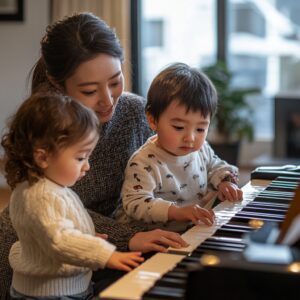
The role of a piano teacher is crucial in a child’s musical journey. An experienced and patient teacher can make a significant difference in a child’s learning process, especially for younger students. The right teacher will understand the unique needs of each child and tailor their teaching methods accordingly, ensuring that the child remains engaged and motivated.
Piano instructors who specialize in teaching young children often use creative and interactive methods to keep lessons fun and engaging. This might include incorporating games, songs, and activities that help reinforce musical concepts while keeping the child’s interest alive. Finding the right instructor is key to ensuring that the child has a positive experience and develops a love of music that will last a lifetime.
The Benefits of Group Piano Lessons and Private Lessons
When deciding on the best time to start piano lessons, parents may also consider whether their child would benefit more from group lessons or private lessons. Group lessons can be a great way for younger children to learn in a social environment, where they can interact with peers and develop a sense of camaraderie. This can be particularly beneficial for children who are shy or hesitant about learning a new skill.
On the other hand, private lessons offer individualized attention, allowing the teacher to focus on the child’s specific needs and progress at their own pace. For children who show a strong desire to learn and are ready to commit to regular practice, private lessons may be the best way to ensure that they receive the personalized instruction they need to succeed.
Building a Solid Foundation for Musical Education
If when choosing a child’s first musical instrument, one must choose between piano and some other instrument, it is better to opt for the piano if the child is to begin lessons at the right age. Music introduction at an early age is potential improve a child cognitive ability, their problem solving ability and will eventually create a life time music lover. Piano playing also gives the child a sense of rhythm, timing, coordination of the gross and the fine motor skills plus finger independence which can complement other styles of learning.
Thus, for young aged kids, it would be useful to minimize any strictness while taking piano lessons, but at the same time stressing on knowledge. This means beginning with basics instructions and as the child master levels in particulars exercises, adding the next level of difficulty. In this way, children will gain confidence in their skills, and will certainly feel that they are developing as musicians as they advance up through the levels.
The Impact of a Child’s Life on Piano Lessons
Other factors that affect a child and hence their preparedness for piano lessons include also their life and general surrounding. School terms, the child’s timetable for other activities or even home affairs and arrangements may play a great role in the kind of time a child is enrolled for piano lessons. One should always keep in mind that the child ought to have adequate time in order to be able to concentrate on the lessons to be learned whereby the piano lessons should not be accompanied by other tight schedules.
Parents need to assess the feasibility of the child being able to manage between piano lessons and the other parts of his or her life. If the activities take much time of the child, then it is wise to wait for the extra time of the child to learn the piano. In contrast, if a child shows a desire and or has a supple for music and wants to learn then parents can try and find ways of including the piano studies without putting pressure on the child.
Finding the Perfect Age to Start Piano Lessons
According to the ideas examined in the course of the research, one could state that there is no proper age to begin taking piano lessons for kids, and the parents should focus on the child’s readiness, motivation, and his or her personal development level. But the best age to start one on piano lessons would be when the child is at the age of six to seven years of age, for the simple reason that most children at this age meet the requirements in motor coordination fine, attention, and intellectual capability to make the most of their musical lessons.
There are many children who may take shorter or longer time to develop compared to other children of the same age. There are children who will be willing to learn piano at a very tender age, while others will be more appropriately to learn piano when they are slightly older. The biggest thing however, is to keep the child interested in this process and that he/she is under the able tutorship of a proficient Piano teacher.
In group lessons, individual lessons or just choosing the pieces independently children are able to develop themselves into passionate music enthusiasts that remain during their entire lives. Thus, when parents choose the right time for their child to start taking piano lessons and when they choose the right method to use, then the child will be able to establish the right foundation as he or she prepares himself for a lifetime of music making.
Discover exceptional piano lessons with WKMT, a leader in piano education since 2010. Available in-studio in London or online worldwide.