
 TRIAL LESSON
Haydn Sonatas, Music Theory Resoucers
Haydn Sonata in A Flat Hob XVI 46 – 1st Movement Analysis

Jun
Haydn Sonata in A Flat Hob XVI 46 – 1st Movement Analysis
For whom is this analysis?
The analysis of this Sonata is useful for anyone who would like to dive into this piece, especially performers who are currently studying under the Trinity or ABRSM syllabus.
This piece is included in the ATCL repertoire list (no. 115 on the list). Or if you prefer, it is included in the ABRSM Grade 8 2021& 2022, which can serve as a 4th piece if chosen for any performance exam. Also, it is within the repertoire of the Associate Diploma (ARCT) in Piano, Performer( Page 101)
Finally, for composers interested in exploring the Sonata form, this piece is unique as it explores this form in all its three movements.
BACKGROUND
This Sonata was composed in 1767. Like other works Haydn has the name “Divertimento”; this might be because this is part of his earliest works, in which we observe many of his sonatas for harpsichord or clavichord were not even called sonatas but Divertimenti or partitas in the Baroque manner.
This piece has all three movements composed in Sonata form, with an appended coda at the end of the third movement.
I will start first by giving a brief context regarding the different types of keyboard of the Keyboard instruments in Haydn’s time:
From 1755 to 1796, there were three keyboard instruments appropriate for the performance of Haydn sonatas: the harpsichord, the clavichord, and the fortepiano. […] Many composers, including Haydn, used the clavichord to produce expressive music. The harpsichord made by Shudi & Broadwood in London in 1775 had the loudest dynamic range of the three keyboard instruments under discussion. The principal disadvantage of this instrument was that the sound faded quickly, which limited its capacity for flexible dynamic expression. Due to its ingenious escape mechanism, the fortepiano gave varying power to the fingers they did not possess with the harpsichord. Nevertheless, early fortepianos were generally softer than the largest harpsichords, but not quite as sensitive as clavichords.
Georg Feder first noticed that Haydn did not go beyond d3 in works written up to 1767 (this includes Sonatas 29 in Eb and 30 in D)
We can also add that since the harpsichord ‘s principal drawback before 1780 was its inability to produce flexible dynamics, many composers, including Haydn, focused on various ways of adding voices and using arpeggios to create dynamic changes on this instrument.
(From the “HAYDN PIANO SONATAS: AN EXAMINATION OF STYLE AND PERFORMANCE By Yaokun Yang”, pages 6 and 9).
INFLUENCES FROM C.P.BACH
Haydn was highly influenced by the treatise of C.P.E. Bach, Essay on the True Art of Playing Keyboard Instruments, especially in the areas of ornamentation and articulation. Haydn discovered a volume of Bach´s sonatas around 1749 and this is what he wrote about the experience: “I did not come away from my instrument until I had played through them all, and anyone who knows me well must realise that I owe a great deal to Emanuel Bach, that I have understood him and studied him diligently. Emanuel Bach once paid me a compliment on this score himself.”
We can observe certain influences in this Sonata. One clear example is the use of what C.P. Bach calls “the Slide” which is explained by him as follows: “Bach explained: “The two-note slide is distinguished from the three-note in that it is always used in a leap, which it helps to fill in and always played rapidly, the three-note is not”.
In this Sonata, we can observe this influence in bar 26:
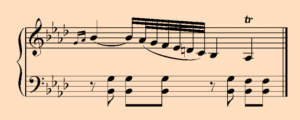
Haydn Sonata in A Flat Hob XVI 46 – First Movement
GENERAL OBSERVATIONS
Analysis of Sonata Form Section Percentages
To understand the proportions of each section within a sonata form, it’s essential to look at the number of bars in each part. In this case, we have the following:
- Exposition: 38 bars (repeated, so 38 * 2)
- Development: 38 bars
- Recapitulation: 34 bars
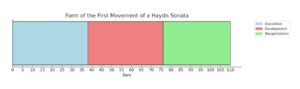
Given that the exposition is repeated, we must count its bars twice.
Step 1: Calculate the Total Number of Bars
First, let’s find the total number of bars:
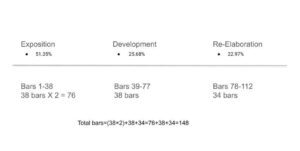
Total bars=(38×2)+38+34=76+38+34=148
Step 2: Calculate the Percentage of Each Section
Now, we’ll determine the percentage of each section in relation to the total number of bars.
Percentage=(Bars in section – Total bars)×100
Calculations
- Total Bars:
Total bars=148
- Percentage of Each Section:
- Exposition:
Bars in exposition=76
Percentage of exposition=(76148)×100≈51.35%
- Development:
Bars in development=38
Percentage of development=(38148)×100≈25.68%
- Recapitulation:
Bars in recapitulation=34
Percentage of recapitulation=(34148)×100≈22.97%
Results
- Exposition: 51.35%
- Development: 25.68%
- Recapitulation: 22.97%
Importance of Proportions in Sonata Form
The proportions in a sonata form are significant as they reflect the structure and balance essential to this musical form. The sonata form, originating in the Classical period, typically features three main sections: exposition, development, and recapitulation. The repetition of the exposition ensures that the thematic material is firmly established in the listener’s mind, often accounting for around half of the total movement.
The shorter development section explores and manipulates the themes introduced in the exposition, creating tension and contrast. Finally, the recapitulation resolves this tension by restating the main themes, usually in the tonic key, providing a sense of closure.
These proportions are not rigid but are guided by the need for balance and variety, which are hallmarks of the Classical style. Understanding these proportions helps in appreciating the architectural elegance and emotional journey crafted by composers in their sonata movements.
SYMBOLS OF ANALYSIS
For this Analysis, we will use the symbols of analysis from the book “Guidelines to Style Analysis” by Jan LaRue.
For a complete description, please refer to our website in which there is a free lesson from the Course of Analysis in which we describe the symbols and their meanings:
Click here to go to the lesson
HARMONIC ANALYSIS SYMBOLS
Before we start with the Main Theme or P1 (First primary material) we will establish that the symbols seen in the examples on the score follow the British system in which the inversions are designated by different lowercase letters after every Roman Numeral:
First inversion: b
Second inversion: c
Third inversion: d
ANALYSIS OF THE PRIMARY THEME
We will start with a small dimensional analysis of the harmonic progression used in the Primary theme.
Why?
In sonata form, the primary theme serves as the main melodic idea introduced at the beginning of the exposition. It establishes the key and sets the tone for the movement, often presenting a memorable and distinctive musical motif that recurs and is developed throughout the piece.
Given for granted that the Sonata is in the key of A-flat Major, we will start marking the most important chords:
- The tonic (I) establishes the home key, providing a sense of stability and resolution. which is A flat major (Ab-C-Eb) chord
- The dominant (V) creates tension and drives the music forward, leading to resolution back to the tonic, in this case, the E flat major (Eb-G-Bb) chord
- The subdominant (IV) D flat major (Db-F-Ab) acts as a preparatory chord, often leading to the dominant and adding harmonic variety.
HARMONIC STRUCTURE OF THE PRIMARY THEME
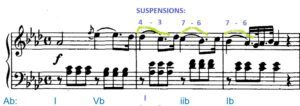
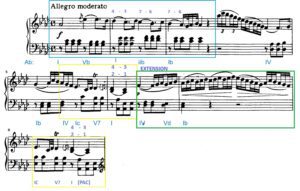
The first three bars show a prolongational progression (in Tourquoise) from I to Ib followed by a PAC (Perfect Authentic Cadence in Yellow) resolving in bar six through a feminine cadence on the second beat. On the third beat of the same bar, Haydn adds an extension (in green) to resolve with the same cadence in bar 8.
From the Harmonic rhythm, there is an insistence in tacets happening in bar three of bars:
Three: As the resolution of the first basic idea
Four: As the beginning of the new sub phrase on the Subdominant (IV)
Six: As the beginning of the extension with the same harmony, the fourth degree.
Notice that in bars two, three, six and eight I marked the suspensions as well on top of the right-hand bars, as these contrapuntal reminiscences create certain expectations on the resolution in conventionally weak beats (two and four in the context of a simple quadruple meter), being an important expressive device of this Primary Theme, playing an important role throughout the rest of the piece:
HARMONIC ANALYSIS OF THE PRIMARY THEME
TRANSITIONAL THEME OR BRIDGE
What is the function of a Transitional Theme or Bridge within an exposition?
In the exposition of a sonata form in a major mode like the one we are analysing, the transition or bridge serves several key functions:
- Modulation: The primary function of the transition is to modulate from the tonic key (I) to the dominant key (V). This shift creates harmonic interest and sets up the arrival of the secondary theme.
- Connection: It connects the primary theme to the secondary theme, providing a smooth and logical progression between these contrasting sections.
- Development: The transition often introduces new musical material or develops motifs from the primary theme, adding variety and maintaining listener interest.
- Build-up: It typically increases tension and dynamic intensity, leading to a climax before resolving into the secondary theme.
For example, in this sonata in B flat major, the transition would move from C major (I) to E flat major (V), preparing the listener for the contrasting secondary theme in E flat major. The transition often employs sequences, rhythmic acceleration, and dynamic growth to heighten anticipation.
ANALYSIS
The Bridge starts in bar 9 ending in bar 17 which is the same length as the Primary theme. Haydn Sonata in A Flat Hob XVI 46.
The material from the transitional theme (1T) is derived from the primary theme, hence the symbol 1T>1P (> means “derived from”)
Bars 9 to 12 present two elements of the primary theme: The appoggiatura (marked in colour green on the score) and the scalic passages as a “lead-in” to repeat the material, now leading to a cadence on the Dominant of E flat major, which will be the key of the Secondary theme.
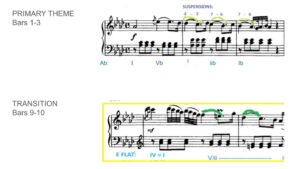
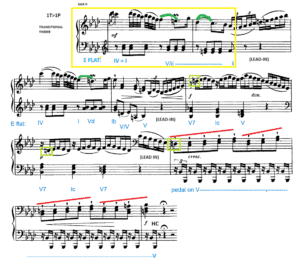
The second part of the episode lands on a pedal on the dominant (B flat) that relentlessly serves as the conduit to the Half cadence in bar 16.
Haydn serves himself from the octaves on the bass to create a rhythmic acceleration to increase the tension towards bar 16, in which he abruptly ends with a pause, or fermata creating suspense before the Secondary theme starts in bar 17.
The D note from bar 13 becomes a structural note, being the leading tone of the new key, E flat Major (marked in a light green square on the score) passing through the range of two octaves (D5 to D3).
The last two bars of the Transition use a a rhythmic augmentation from the previous Lead-ins’ (marked in red lines on the score) providing a strong directional motion towards the cadence in bar 17:
ANALYSIS OF THE SECONDARY THEME
What is the function of a Secondary Theme within an exposition? Haydn Sonata in A Flat Hob XVI 46.
The function of the secondary theme (or second theme) in a sonata form includes:
- Contrast: Provides contrast to the primary theme, often featuring a different mood, character, or melodic material.
- Harmonic Change: Establishes a new key, typically the dominant (V) in major key sonatas, enhancing the harmonic journey.
- Development Potential: Introduces new musical ideas that can be developed and explored further in the development section.
- Balancing the Structure: Balances the exposition by offering a distinct thematic section, contributing to the overall symmetry and coherence of the form.
- Resolution in Recapitulation: In the recapitulation, it returns in the tonic key, contributing to the sense of resolution and unity in the movement.
ANALYSIS
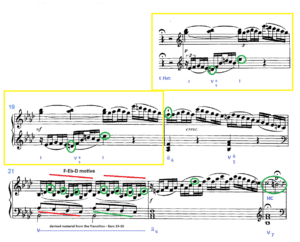
Bars 18-23
The structure of this Secondary Theme is built upon a short and not-so-evident motive: D-Eb starting in bars 9 and 10, repeated in bars 11 and 12. (marked in green in the score) followed by a small development of the same idea, now F-Eb-D in bar 21; This motive derives from the Transition (bars 15 and 16) same step-progression quavers.
The idea of F-Eb-D is also present in bar 22, which provides certain directional motion towards the Half Cadence in 23 when it finally arrives at the longer values in minims on Eb and D.
Bars 24-38
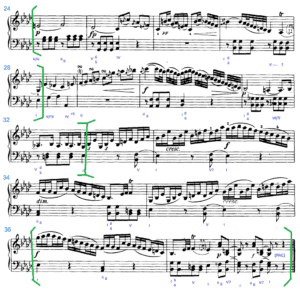
It is structured in four sections:
Bars 24 to 28: There is material from the Primary theme, especially the accompaniment, ending into a cadence in E flat major.
Bars 28 to 32: There is an elision to the second section, in which the second degree, F minor is developed in bars 29 and 30 through the ascending arpeggiation through several turns, followed by a descending release of tension through demi-sequavers leading to the second cadence in bar 32.
Bars 32 to 35: Liquidation material through broken chords on the tonic and dominant chords.
Bars 36 to 38: Cadential progression resolving into E flat major.
DEVELOPMENT
Function of the Development section:
- Modulation and Exploration: The development section often involves modulating to different keys, exploring various tonalities and creating a sense of contrast and journey from the home key established in the exposition.
- Thematic Transformation: Themes introduced in the exposition are transformed, fragmented, and developed. This can include changes in rhythm, harmony, texture, and orchestration, showcasing the composer’s creativity and skill.
- Dynamic Contrast: This section tends to have a wide range of dynamic contrasts, creating tension and excitement. It often includes dramatic shifts, climaxes, and a sense of instability, heightening the listener’s anticipation for the return to the home key.
- Harmonic Instability: The development section is characterised by harmonic instability, with frequent modulations and less predictable harmonic progressions. This serves to increase the overall tension before the resolution in the recapitulation.
- Counterpoint and Imitation: It often features intricate counterpoint and imitation, where different musical lines interact and weave together, showcasing the composer’s contrapuntal skills.
- Preparation for Recapitulation: The end of the development section often includes a retransition, preparing for the return of the main themes in the home key. This usually involves a dominant pedal or a build-up that leads seamlessly into the recapitulation.
These elements collectively contribute to the dramatic and structural integrity of the sonata form, providing contrast and development before resolving the musical ideas in the recapitulation.
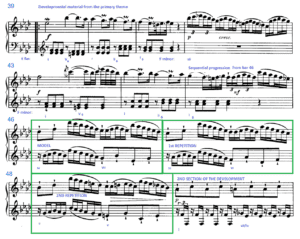
Bars 39 to 48
The Development section starts with a developmental material taken from the Primary theme, now in E flat (dominant of the main Key of the Sonata) that quickly moves to F minor, ending this material in bar 42 which leads into a sequential progression by seconds starting in bar 46 with a model on IV-VII that brings a powerful directional motion to cadence in bar 49 in the Key of F minor to start the second section of this Development.
Bars 49 to 64
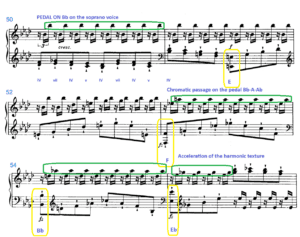
The second part of the development section is based on F minor. The rhythm is based on the pedal from bars 15 and 16 from the Exposition leading towards the Half cadence of the Primary Theme.
The voice leading systematically starts from a B flat on the Soprano’s voice in bars 50 to 52; here it starts to shift downwards through A, A flat, G flat, to F. In bar 58 it re-starts from A flat landing in E natural, the third of the Dominant chord, C major, forming the Half Cadence in bar 64:
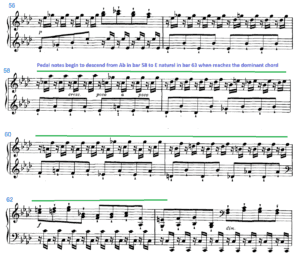
HARMONIC PATHWAYS – BARS 49 TO 64
There is a specific harmonic pathway within F minor, with some modal interchanges to the Locrian mode (flattened minor III degrees and flattened VII degrees) to go momentarily to B flat minor to go back swiftly to F in bar 60.
HARMONIC ANALYSIS
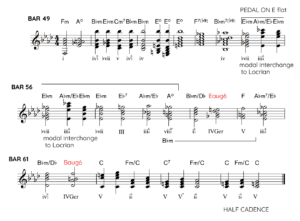
Below we can listen to a video of the harmonic pathway from bars 49 to 64:
TRANSITION TO THE RECAPITULATION
After the half cadence in bar 64, we observe a re-transition to the recapitulation, making use of the material of the Primary Theme (from bar 9 in the exposition)
From bar 68, the material is taken from the bridge (bar 12), progressing towards a perfect cadence in bars 70 and 72, with intermittent diminished sevenths chords to reinforce it.
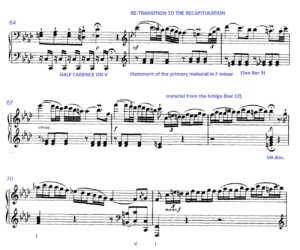
RECAPITULATION Bars 78-112
This Sonata has a particularity in the Recapitulation: The return to the Main Theme in bar 78 is not made through a strong Perfect cadence, which is formulaic in this style. On the contrary, the Dominant chord is in a first inversion, which makes the Main Theme not appear strongly (bar 78), as the convention dictates; it might be the reason why Haydn presents the same Primary Theme, now in minor mode (A flat minor) from bars 83 to 86, to reinforce the entrance of the Recapitulation.
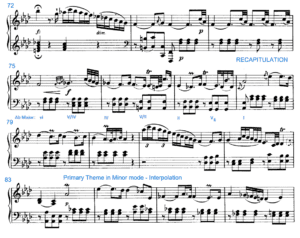
TRANSITION TO THE SECONDARY THEME – Bars 87 to 91
The transition now is to smoothly go to the Secondary Theme, now in the main Key, A flat major in bar 92 through a pedal in the Dominant, E flat:
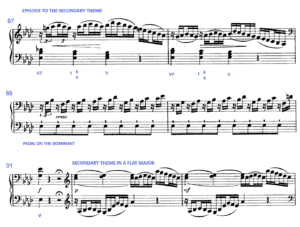
The rest of the Recapitulation doesn’t present any major changes, except for the convention of the Secondary Theme in A flat Major, with the final cadence in bars 111-112.
NOTES FOR PERFORMERS
Regarding the dynamics and accents in Haydn’s works, we can take a quote from C.P.E. Bach‟s view of dynamics is “in general, dissonances are played loudly and consonances softly, since the former rouse our emotions and the latter quiet them”
This can be very useful to take into account as many of his early sonatas were written for the harpsichord; that’s to say, the texture creates dynamics, not just the louder attack possible on a modern piano.
There is an ornament named the “Master’s ornament” as it was used commonly by Haydn, who frequently uses signs, tr, in the same piece, but the first sign became the most common among the three, replacing the traditional mordent sign.
The Beginning of the Main Theme of Haydn Sonata in A Flat Hob XVI 46
There are many editions, and the way that different editions show how to interpret the initial four bars is worth mentioning to have a clearer understanding and idea of how these suspensions could be performed.
The earliest edition is from Breitkopf und Härtel, 1799.
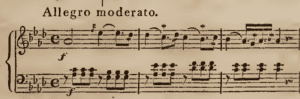
There are few indications, except the forte, the acciaccatura and the mordents on the resolutions of the suspensions.
These performance directions are also found in all different editions.
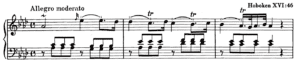
In this edition, the “Master’s sign” appears at the beginning of the Theme, but is replaced on the suspensions by trills instead of mordents as in the previous edition.
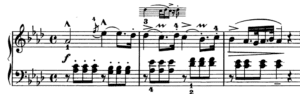
Other editions add many articulations, such as staccato on the left hand, and accents on the suspensions as well; the latter could be explained by the Essay on the True Art of Playing Keyboard Instruments, 163. (C. P. Bach) in which he says that “in general, dissonances are played loudly and consonances softly since the former rouse our emotions and the latter quiet them”. This could be the reason why some editions add accents on dissonances.
Ornaments in bar 29
In this specific bar, we could find different versions of the same passage:
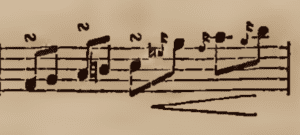
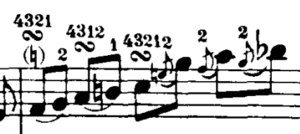
In this passage, this edition offers a specific fingering.
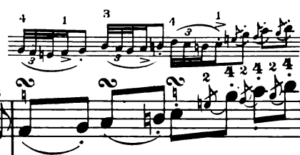
This edition offers a specific way to resolve the passage.
Complete this analysis of this Haydn Sonata in A Flat Hob XVI 46, following with the Second and Third Movements.
Discover exceptional musical analysis lessons with WKMT, a leader in music education since 2010. Available in-studio in London or online worldwide.