
 TRIAL LESSON
Haydn Sonatas, Music Theory Resoucers
Haydn Sonata in A Flat HOB XVI 46 – 2nd & 3rd Movements Analysis

Jun
Haydn Sonata HOB XVI 46 – 2nd & 3rd Movements Analysis
*Analysis of the 1st Movement Haydn Piano Sonata Hob XVI 46 in A Flat.
Haydn Sonata in A Flat Hob XVI 46 – Second Movement
The second movement also has a Sonata Form. It has a total of 80 bars:
Main Theme: bars 1-12
Secondary Theme: bars 13-28
Development: bars 29-44
Recapitulation: starts at bar 45
- Main Theme: bars 45-51
- Secondary Theme: bars 52-80
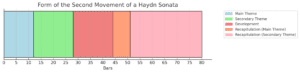
The proportions of each section in the first movement of the Haydn sonata are as follows:
- Exposition: 34.55%
- Development: 34.55%
- Recapitulation: 30.91%
PRIMARY THEME – BARS 1-12
The Primary theme starts in the main key, D flat Major, and at bar 9 after a cadence on the tonic, has a short transition to A-flat Major (Dominant) as convention dictates on a Major key Sonata form. Haydn Sonata HOB XVI 46 2nd & 3rd Movements.
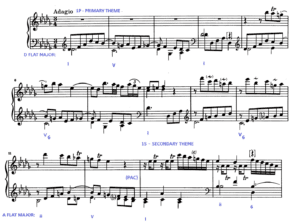
SECONDARY THEME – BARS 13 – 28
The Secondary Theme starts on the Dominant key, A flat major after a perfect authentic cadence.
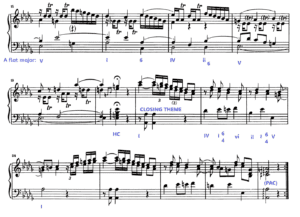
DEVELOPMENT BARS 29 – 44
The Developmental Group is based on the Primary Theme. In this section, Haydn uses this Theme contrapuntally, expanding the texture from the Exposition. The two motives in green are developed throughout.
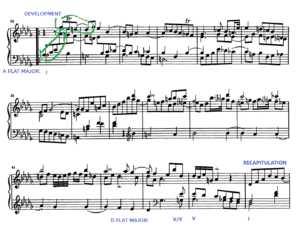
RECAPITULATION
MAIN THEME AND SECONDARY THEME BARS 45 – 59
The recapitulation is conventional up to bar 59. The Secondary Theme ends as in bar 19 of the exposition, now in the home key.
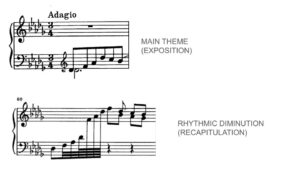
What follows is a section which does not follow convention: From bar 60 there is a closing Theme, which is a rhythmic diminution of the Main Theme.
In bars 66 to 72 we can observe the motivic material related to the Secondary Theme, now somewhat simplified, leading into the cadenza in bar 77, after which the final cadence finishes the movement.
A NOTE FOR PERFORMERS
In bar 77 we see the sign for an improvised cadenza:
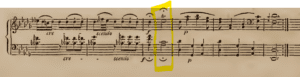
Haydn typically positions the fermata in several distinct ways. In Haydn’s piano sonatas, the fermata slurred note with a dot over it indicates that the performer should hold the tone as long as the nature of the composition calls.
As written examples from Haydn’s time do not survive, the contemporary performer needs to write their own cadenzas, but here is a word of warning: there are some editions that they indicate to play a long trill instead:
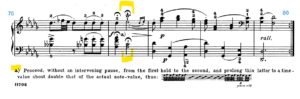
Ps. Watch the video posted at the beginning of this post to see an example of a cadenza in the minute 18:50.
Haydn Sonata in A Flat Hob XVI 46 – Third Movement
The third and last movement has a Sonata Form as the previous two movements; this does not fall into the conventional structure as the second and third movements are usually either Rondo forms or Ternary forms. The key chosen for this movement, A flat Major, is in fact conventional, as it returns to the original key. Haydn Sonata HOB XVI 46 2nd & 3rd Movements.
The summary of this Movement can be presented as follows:
EXPOSITION
Main theme: Bars 1-8
Transition: Bars 9-21
Secondary Theme: Bars 22-29
Coda: Bars 30-37
DEVELOPMENT
Bars 38 – 86
RE-EXPOSITION
Main theme: Bars 86-96
Transition: Bars 96-111
Secondary Theme: Bars 111-134
Coda: Bars 134-143
Proportions of Each Section in the Third Movement:
- Exposition (Main Theme): 5.59%
- Exposition (Transition): 9.09%
- Exposition (Secondary Theme): 5.59%
- Exposition (Coda): 5.59%
- Development: 34.27%
- Re-Exposition (Main Theme): 6.99%
- Re-Exposition (Transition): 10.49%
- Re-Exposition (Secondary Theme): 16.08%
- Re-Exposition (Coda): 6.29%

EXPOSITION
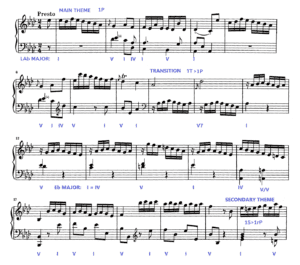
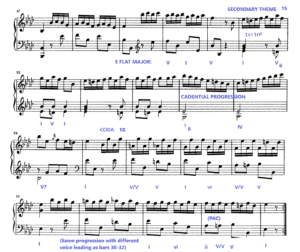
The Main Theme follows the conventional style of any third movement: Presto in speed (very fast) and presenting a flowing descending line by step motion; something that would not be conventional in a first Allegro di Sonata, as the tendency is presenting the Theme with ascending broken chords. The inner structure of the theme is divided into two-bar modules, finishing with a PAC in bar 8:
DEVELOPMENT
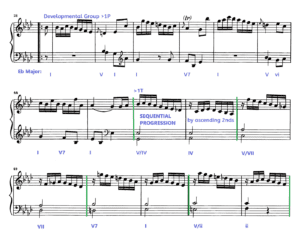
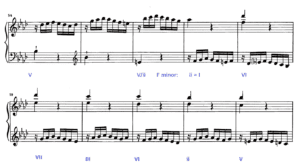
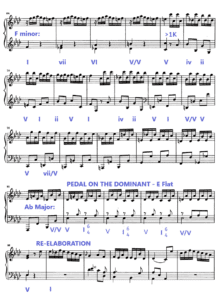
The Development mimics the exposition, starting on a theme related to the Main Theme from bars 38 to 45 in which a long modulating section (through a sequential progression marked in green on the score that explores F minor – the relative minor of the Main Key) that comes from the Transitional theme starts, ending in bar 68, which re-exposes the Cadential theme, or Coda up to bar 86 in which the Recapitulation starts in A flat Major, the main key.
RE-ELABORATION OR RE-EXPOSITION
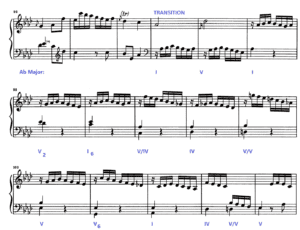
The Re-exposition starts with the anacrusis in bar 86 with the Main Theme again; the transition in bar 95 now heads to the Secondary Theme in the same key:
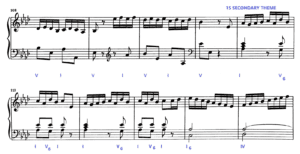
Arriving at the Secondary Theme in bar 111 with an anacrusis as well:
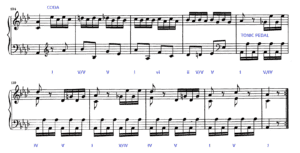
There is a Coda added in bar 134 to culminate the Sonata form of this third and last movement.
From bar 138 we observe a tonic pedal above which there are several chord changes stressing the subdominant; this gravitation around the IV degree is conventional at the end of any movement and has the function of a pre-dominant chord:
A NOTE FOR PERFORMERS
There is a general agreement in the dynamics of the first bars of this movement, here we have the oldest version available, and we can see how specifically Joseph Haydn wrote the forte and piano dynamics for the beginning of the Main Theme:

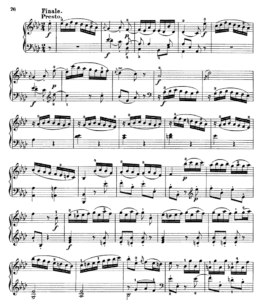
A note of warning on the slurrings; I have observed that there is no much agreement on the slurring marks on the Transition theme. I will present the same edition first (the oldest) and some others for you to observe the differences in slurring. Naturally, I will leave the choice to each performer, but I believe it is useful to know that there are some discrepancies among the editions:
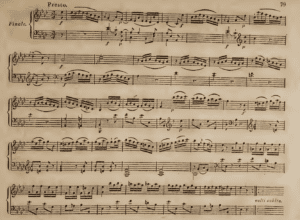
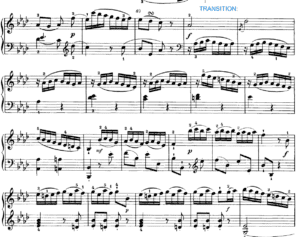
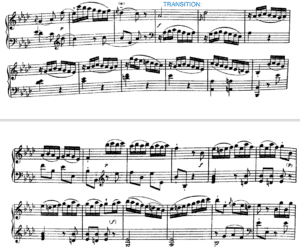
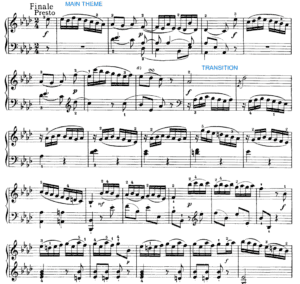
These last editions, contain turns at the cadences and staccato notes at some ends of legato notes:
Discover exceptional musical analysis lessons with WKMT, a leader in music education since 2010. Available in-studio in London or online worldwide.