
 TRIAL LESSON
Music Theory Resoucers
Understanding Syncopation in Music: A Conversational Exploration

Dec
Understanding Syncopation in Music: A Conversational Exploration
Imagine you’re at a concert, tapping your foot to a steady beat. Suddenly, the rhythm takes an unexpected turn, and you find yourself pleasantly surprised by the shift. This captivating twist is often due to syncopation, a fascinating element that breathes life into music across the world. But syncopation isn’t just a musical phenomenon—it resonates in visual arts, design, and even sculpture, where breaking patterns creates interest and engagement.
What Exactly Is Syncopation?
Think of music as a flowing river. The regular beats are like the steady current guiding the water. Syncopation is akin to rocks in the riverbed that cause ripples and waves, making the journey more interesting. It involves emphasising beats or parts of beats where it’s least expected, creating a delightful sense of surprise.
The word “syncopation” comes from the Greek “synkopē” (συγκοπή), meaning “a cutting up” or “a cutting short.” It’s derived from “syn-” (συν-), meaning “together,” and “koptein” (κόπτειν), meaning “to cut.” This etymology reflects how syncopation “cuts into” the regular flow of rhythm, interrupting the expected pattern to keep listeners engaged.

The Origins of Syncopation in Renaissance Music
Syncopation isn’t a modern invention; its roots stretch back to the Renaissance period (14th to 17th centuries). During this time, music began to explore more complex rhythms and harmonies. Composers like Giovanni Pierluigi da Palestrina and Josquin des Prez started experimenting with rhythmic displacement to add emotional depth and expressive qualities to sacred and secular music.
One of the first examples of syncopation can be found in the “Agincourt Carol” (15th Century Anonymous)
In Renaissance polyphony, where multiple independent melodies intertwine, syncopation was used to create suspension and resolution, heightening the sense of tension and release. For instance, a note from one voice would be sustained (suspended) into the next note (or notes, if there are more voices involved), creating a dissonance that resolves when the voice moves to the expected note:
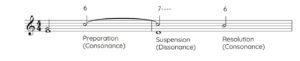
This use of syncopation added a rich, expressive layer to the music, engaging listeners in a more profound emotional experience. This technique is related to Counterpoint, more specifically, the 4th species. If you want to know more about this, you can go to my article “Counterpoint – 4th Species”
We also have a full online course about Contrapuntal techniques, in case you are interested, feel free to browse it from the following link:
Counterpoint – Compose your Music
Different Flavours of Syncopation
Syncopation isn’t a one-size-fits-all concept; it comes in various forms, each adding its own spice to music:
Off-beat Syncopation
Imagine clapping along to a song but emphasising the beats in between the main beats—the “and” when counting “one and two and three and four and.” By accenting these weaker beats, the music gains an unexpected twist. Reggae music often uses off-beat syncopation, with guitar chords striking on the off-beats, giving it that characteristic laid-back feel.
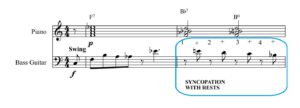
Video example:
Jazz syncopation example: Off-beat Syncopation
Suspension Syncopation
Think of a note holding over from a strong beat into a weak beat, creating tension that resolves later. It’s like someone holding a thought just a bit longer before finishing their sentence. In Renaissance music, composers like Palestrina used suspensions to add emotional depth.
This is an example from the motet of Orlando Di Lasso: Cantiones duum vocum No.1 “Beatus vir qui in sapientia morabitur” in which we see in blue colour the suspensions from 4th or 7th intervals (dissonant) to 3rd and 6th intervals (consonants) take into account that the tenor (the lower staff) must be read one octave lower than written:
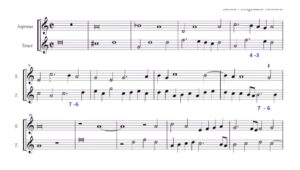
You can listen to the piece from this link:
Orlando di Lasso, Cantiones duum vocum No.1 “Beatus vir qui in sapientia morabitur”
Anticipation Syncopation
This occurs when a note is played slightly earlier than expected, anticipating the strong beat. It’s like someone eagerly interjecting before it’s their turn to speak. In pop music, anticipation syncopation is common; singers might start the next line just before the measure or bar begins.
In the following example “The Sound of Silence” by Simon and Garfunkel, we can see in blue the quavers (or 8th notes) anticipating the melody half of the beat, creating the syncopation:
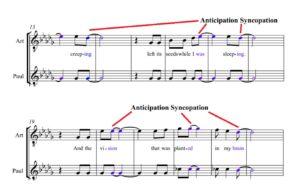
You can listen and see the score from this link:
“The Sound of Silence” ANTICIPATION SYNCOPATION Example
Even-Note Syncopation
Notes of equal duration are accented in a way that shifts the expected pattern of strong and weak beats. Jazz often employs this, with accents falling in surprising places, giving the music its distinctive swing feel.
A good example of this is the song “Straight No Chaser” by Thelonious Monk.
Monk’s melodies and comping patterns frequently use even eighth notes with accents shifted to off-beats or weaker beats. The melody challenges the listener’s sense of regular metre while maintaining even durations.
His syncopation creates a jagged, unpredictable rhythmic contour, while the underlying structure remains steady.
The syncopations are coloured blue. The following graph shows just the first bars showcasing the piano comping along with the double bass:
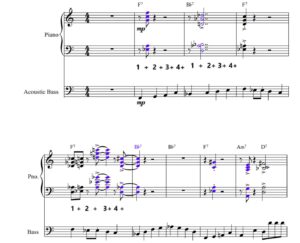
The following video shows only the piano comping, the Bass, and a very simple drum accompaniment (just to listen to the beat with a closed hi-hat) in the first part. Then, on repeating the same section, the whole band is added.
You can watch it from this link:
“Straight, No Chaser” by Thelonious Monk – Even-note syncopation example
Hemiola
A rhythmic device where the music shifts temporarily into a different meter. Imagine counting in three (“ONE two three, ONE two three”) and suddenly feeling like you’re in two (“ONE two, ONE two, ONE two”) over the same period. Hemiolas create a syncopated effect by superimposing one rhythm over another, from the Renaissance to modern times.
A famous example from “Bernstein’s America from West Side Story”
In the first section, the Refrain (“I like to be in America”).
The music alternates between 6/8 and 3/4, with the melody sometimes grouping notes into two sets of three beats (duple) and other times into three sets of two beats (triple). This shifting accent pattern creates a hemiola effect, especially when the words “in America” are sung.
Effect: The rhythmic complexity reflects the lively, multicultural dynamic of the piece and underscores the energetic and competitive mood.
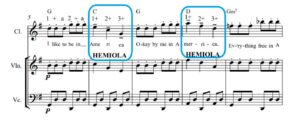
You can listen and see the score from this link:
Bernstein’s America from West Side Story: HEMIOLA EXAMPLE
Dynamic Syncopation
Accenting notes in unexpected places through changes in volume adds drama, much like a plot twist in a story.
A very good example of this device can be found in Beethoven’s Sonata Op. 2 No. 1 in F minor. The Subordinate or B theme starting in bar 33 on the left hand (blue notes) changes completely the nature of the discourse accenting with a sforzato (marked as “sf” on the score)
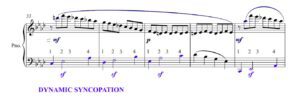
This movement is also showing different types of syncopation, such as
Suspension Syncopation (in green)
Off-Beat Syncopation (in dark blue) and
Even-Note Syncopation (in red)
Each syncopation creates different flows in the piece:
The suspension creates melodic movement (notice the numbers “7-6” below the score; these numbers reflect the intervals between the bass (D note on the left hand) and the upper notes, C (an interval of a seventh against the D, which is considered a dissonant interval) and the B-flat after it, which is considered the resolution of it (a 6th above the D note)
the off-beat creates movement forward, and the off-beat at the cadential point tells the listener by breaking the pattern on the accompaniment “Pay attention, we are about to end”
To see the whole scope of the different syncopations, watch this link:
Beethoven Sonata in F minor Op 2 No 1 Movement I – Syncopations examples
Harmonic Syncopation
Chord changes occur on surprising beats, adding tension and intrigue to the harmony.
Example: Chopin – Prelude No. 4 in E Minor, Op. 28
How: The left-hand chord changes occur just before the expected beat, creating harmonic syncopation. This is observed especially when the chord changes happen on the third beat, fractionally ahead of the melody on the fourth beat.
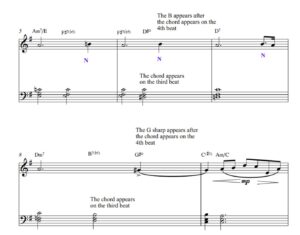
The following video shows how the harmonic rhythm with no syncopation will sound (bars 1-12) on the A section, and immediately after, from bar 13 the B section shows how the harmonic rhythm is syncopated. This harmonic displacement heightens the piece’s emotional tension, deepening its melancholic and unresolved atmosphere.
To watch the video, click on this link:
Prelude Op. 28 No. 4 in Em (Chopin) Example of Harmonic Syncopation
NOTE: In the video, just the chords appear in its full length to show how the melody and harmony combine in syncopation; the video is not showing the piece as it is, with the chords played in quavers (8th notes) as the original.
Melodic Syncopation
A melody takes an unexpected turn, like a bird changing direction mid-flight. By placing notes off the regular beat, the melody becomes more engaging.
We have a perfect example of the use of melodic syncopation in J.S. Bach’s Invention in D minor BWV 775.
Bach makes use of this type of syncopation in very specific places within the piece.
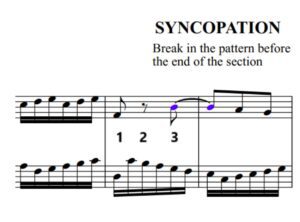
The first one in bar 14, the B flat is displaced on the third beat (weak) creating this changing in direction in the melodic contour; the use of this syncopation is to break the pattern that was displayed so far in the piece, calling the attention to the listener as he is approaching the end of a section.
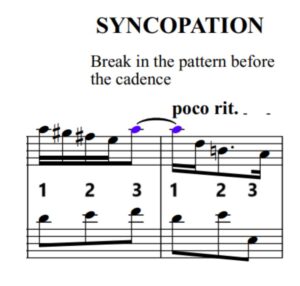
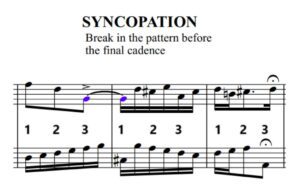
The subsequent syncopations are used in the same fashion in bars 36 and 46, both places strategically before the cadences. This device is mostly common in Bach, cleverly breaking the rhythmic patterns to announce the end of sections in bars 14 and 36, and the end of the piece in bar 46. (Notice that in bars 36 and 46 those syncopations are part of the cadence itself)
Bar 14:
Bar 36:
Bar 46:
Here is the link to watch the full piece with the annotations where the syncopations occur:
J S Bach Invention No 4 in D Minor: Melodic Syncopation example
If you are interested in the analysis of this piece, I made one some time ago, here is the link:
Analysis Bach invention Dm BWV 775
Polyrhythmic Syncopation
Dancing to two different rhythms simultaneously. This complex layering, common in African and Latin American music, creates rich textures.
Polyrhythmic syncopation adds a level of rhythmic complexity that challenges the listener’s ability to predict what happens next. By layering different rhythms, the music becomes less predictable, making it more intellectually stimulating and engaging. The listener has to pay close attention to how the different rhythms interact with one another.
Polyrhythmic syncopation forces the listener to become more aware of time as a fluid, shifting concept. The interplay between two or more rhythms with different time signatures can create a sensation of time “stretching” or “compressing,” which adds complexity to the listener’s experience of rhythm.
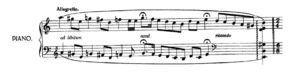
In the following example of Julian Aguirre’s Triste No. 3, we observe two distinctive layers of meter and rhythm, 6/8 on the left hand as opposed to 2/4 on the right hand.
The piece starts with a cadenza-like phrase, with no specific meter:
Then, the left hand starts in 6/8 in combination with 2/4 (observe the accents that change the grouping of the quavers or 8th notes):
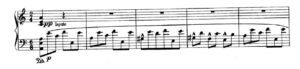
The right hand starts in 2/4 adding this complexity in the rhythmic layer:
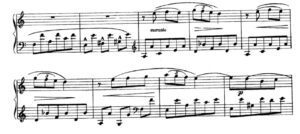
In the following link, we can see the score with the explanation in it:
Julian Aguirre triste No3 – Polyrhythm- Polymeter example
You can find the whole piece from the following link:
Julian Aguirre – 5 Tristes for Piano – YouTube
How Syncopation Impacts Music And Captivates Our Brain
Syncopation plays a fascinating role in how our brain processes and perceives music. By breaking rhythmic expectations, syncopation engages cognitive, emotional, and even physical responses, enriching our overall experience of music. Here’s a detailed explanation of how syncopation affects our brain and perception:
-
Expectations and Prediction in Music
The human brain thrives on patterns and predictions. In music, rhythm establishes a regular pattern that our auditory cortex uses to anticipate the timing of future beats. Syncopation disrupts these expectations by emphasising weaker beats or unexpected parts of the rhythm. The example of J.S. Bach is perfect for this, the expectation that he builds for the first 13 bars is “broken” in bar 14 when he introduces the syncopated B flat on the third beat. (see “melodic syncopation)
Surprise and Attention: When a syncopated rhythm defies our expectations, the brain reacts with heightened attention. This is because the brain must adjust its prediction model to accommodate the unexpected rhythm.
Dopamine Release: The element of surprise caused by syncopation can trigger a release of dopamine, the “feel-good” neurotransmitter. This is particularly evident when the brain successfully resolves the rhythmic tension created by syncopation. A perfect example of this is the suspension syncopation seen in the Orlando Di Lasso example. (See “suspension syncopation”)
-
Tension and Resolution
Syncopation creates tension by delaying or displacing expected beats, engaging the brain’s reward system when this tension is resolved. This mirrors other artistic experiences, such as suspense in storytelling or unresolved visual patterns in art.
Auditory Cortex and Reward System: The auditory cortex processes the rhythmic irregularities, while the nucleus accumbens, part of the brain’s reward system, is activated when the rhythm resolves.
Emotional Engagement: This dynamic of tension and release evokes emotional responses ranging from excitement to satisfaction, which is why syncopation often feels more “alive” or expressive.
How this works: Bach invention in E major BWV 777
In this piece, we can demonstrate how the syncopation creates an almost constant tension and release due to the suspension syncopations between voices. The first voice on the left-hand starts and the right-hand voice follows a semiquaver (16th note) later; thus creating a tension on the rhythmic surface for three consecutive bars resolving on the fourth bar; this 4-bar pattern is repeated throughout the piece.
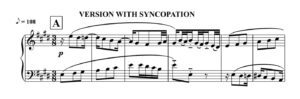
In the following video, I created two versions: the first one (marked A section on the video) shows the piece as it was composed by Bach with the syncopations and from bar 21:
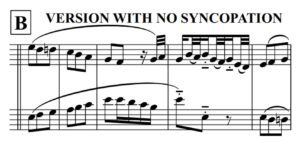
And a B section with no syncopations to show how “obvious” the piece will become without this tension-release pattern.
Note: I added a metronome click to make the syncopation even better.
J.S. Bach E major invention BWV 777 How syncopation impacts in music
-
Motor System Activation
Music, especially rhythm, strongly activates the motor system in the brain, even when we’re not physically moving.
Physical Impulse to Move: Syncopation can stimulate the motor cortex and basal ganglia, which are involved in movement. This is why syncopated music, like reggae or funk, often compels us to tap our feet, dance, or sway.
Rhythmic Groove: The irregularity of syncopation creates what is often called a “groove,” a sense of propulsion and energy that encourages physical engagement.
Example: “Uptown Funk” (Bruno Mars)
The rhythmic drive in “Uptown Funk” is a result of the meticulous layering of syncopated patterns across all instruments and vocals. Each element plays a specific role in the groove, yet they all interlock to create a seamless, propulsive rhythm that feels both tight and loose—a hallmark of funk music. The use of syncopation, dynamic shifts, and rhythmic interplay keeps the track engaging, making it irresistibly danceable.
Interlocking Patterns: The Funk Formula
The song’s rhythmic complexity comes from the way these layers interlock, with no single instrument dominating the rhythm. Each part contributes to a composite groove:
The drums provide a stable foundation.
The bass adds syncopated depth.
The guitar and horns contribute percussive, syncopated accents.
The vocals tie the rhythm to the melody, maintaining the energy.
Look at the video to see the details of all the layers in different colours
DISCLAIMER: This is not an exact arrangement of the song, but a reduction for pedagogical purposes.
“Uptown Funk” Syncopation: How the Funk Formula works
-
Cognitive Challenge and Enjoyment
Syncopation introduces complexity into music, which the brain finds stimulating and rewarding to process.
Engagement of Higher Brain Functions: Syncopation requires more cognitive effort to follow and predict, engaging areas of the prefrontal cortex associated with complex thinking and problem-solving.
Enhanced Listening Experience: The brain’s need to actively decode syncopated rhythms can make the music feel more engaging and enjoyable, particularly for listeners who are accustomed to or trained in recognising complex rhythms.
“La Mosa Donosa” Alberto Ginastera
In La moza donosa, Ginastera achieves a seamless integration of rhythmic and harmonic elements. Syncopation, inspired by the Argentine zamba, is used to disrupt expectations and create rhythmic tension, while harmonic progressions heighten this effect through chromaticism, delayed resolutions, and dynamic contrasts. The interplay between these elements captures the folk spirit of the zamba while adding layers of classical expressivity, resulting in a work that is both rhythmically vibrant and harmonically rich.
In the following video, I explain in detail the syncopated elements of the piece:
The use of syncopation in “Ginastera Danzas Argentinas No. 2 Danza de la Moza Donosa” Analysis
-
Cultural and Learned Expectations
The perception of syncopation is also influenced by cultural and musical context.
Familiarity with Syncopation: In cultures where syncopation is common (e.g., African, Latin American, Reggae or jazz traditions), listeners’ brains are primed to expect and enjoy these rhythmic complexities.
Novelty in Non-Syncopated Contexts: In music traditions with less syncopation (e.g., Western classical music), syncopation can stand out as a surprising or novel feature, drawing even more attention.
Example: “Take Five” Dave Brubeck
From bar 5, the piano has a consistent syncopated pattern on the right hand, a motif that is imitated from bar 21 on the Also Saxophone.
From bar 41, the Alto Sax offers a second motive, highly syncopated while the piano insists on the same pattern from bar 1 creating a complex rhythmic texture. Below, we can find an animated score:
Take Five Sheet music for Piano, Saxophone alto, Bass guitar, Drum group (Jazz Band) | Musescore.com
-
Emotional and Psychological Impact
Syncopation adds expressive depth to the music, influencing how we feel and interpret the emotional tone of a piece.
Excitement and Energy: Upbeat syncopated rhythms, like those in jazz or funk, evoke feelings of joy and vitality.
Duke Ellington – “It Don’t Mean a Thing (If It Ain’t Got That Swing)” The swing rhythm and off-beat accents in the brass and vocal lines create a lively, upbeat energy characteristic of the jazz era. We can observe that from the first four bars (letter A):
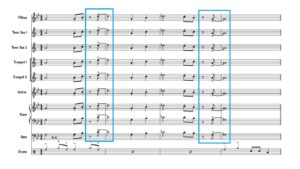
Also, from bar 1 (see score) , the melody on the flute, Trumpets and the right hand of the piano (indigo colour) plus the accents on the fourth beats in green (Tenor Sax and guitar) with the drums in yellow with their hi-hats stressing the weak beats:
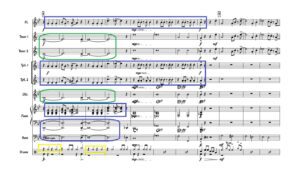
You can listen and see the score from the following link:
Tension and Drama: Slower, syncopated passages, such as those found in romantic classical music or suspenseful film scores, can evoke a sense of longing or unease.
John Williams – Jaws (Main Theme) The syncopated “da-dum” motif in the lower strings creates an iconic sense of suspense and danger. The irregular rhythm suggests the unpredictable movements of the shark, keeping the audience on edge.
Flow and Relaxation: In styles like reggae or bossa nova, syncopation creates a relaxed, swaying groove that aligns with feelings of calm and contentment.
In this example, the drums and bass create a regular rhythmic pattern, while the organ performs an even-note syncopation on the weak beats of a 4/4 time signature (2nd and 4th)
Reggae: Syncopation Example
-
Neurological Responses to Syncopation
Syncopation affects various parts of the brain, leading to a holistic response:
Temporal Lobes: Responsible for processing sound and rhythm, they interpret unexpected beats and syncopation.
Motor Cortex and Cerebellum: Involved in timing and coordination, these areas respond to syncopated rhythms by preparing the body for movement.
Reward System: The nucleus accumbens and ventral striatum are activated when the brain resolves the rhythmic surprises of syncopation, providing pleasure.
Song Example: “Timewarp” by Sub Focus
The moment in Music: Polyrhythmic syncopation is heard in the interplay between the drum breaks, bassline, and synth pads. The drum breaks are played in 2/4 or 4/4, but with syncopated elements that contrast against the bassline.
How It Works: In “Timewarp,” the fast-paced drum break keeps a consistent 4/4 pulse, but the bassline is syncopated, with off-beat hits that play at irregular intervals, often using triplets or dotted rhythms. The synth pads layer over this with long, sustained notes that emphasize a different rhythmic structure, creating a complex polyrhythmic texture.
Effect: The syncopation in the bassline adds a sense of tension and excitement, while the synth pads and drum breaks work together to create a dense, layered rhythm. This gives the track an energetic, chaotic quality, which is a hallmark of drum and bass. The shifting rhythms keep the track unpredictable and make it feel dynamic, with the listener’s attention constantly drawn to the evolving patterns.
Sub Focus – Timewarp
-
Psychological Perspectives
Novelty and Complexity: The brain enjoys novelty but also seeks balance; syncopation provides just enough complexity without overwhelming the listener.
Personal Preference: People with more musical training or exposure may derive more pleasure from syncopation, as their brains are better equipped to process rhythmic irregularities.
Song Example: “Strobe” by Deadmau5
The moment in Music: Polyrhythmic syncopation occurs during the buildup and breakdown sections, where the claps and percussion create syncopated rhythms against a steady kick drum. (from minute 4 of the video)
How It Works: The track follows a steady 4/4 rhythm with the kick drum as the foundation. (despite the constant syncopation of a quaver on the melody)
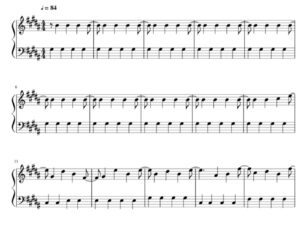
However, during the buildup, the claps and other percussive elements are layered in syncopated patterns that emphasize off-beats. These claps might fall on the “and” of beats or in uneven divisions of the measure, creating a syncopated pulse that contrasts with the steady, driving beat of the bass and kick. (from minute 7 approximately)
Effect: This creates a sense of tension and anticipation, as the syncopated percussion seems to push and pull against the steady groove. The gradual layering and variation of rhythms build excitement, helping to enhance the emotional impact of the track as it reaches its peak drop.
Deadmau5 – Strobe – YouTube
How Syncopation Brings Music to Life
Syncopation is a tool that musicians use to make their music more compelling and emotionally resonant:
- Adding Movement to Melodies: When composers want to energise a melody, they might shift notes to unexpected beats. Beethoven’s opening of his String Quartet No. 4 in C minor (Op. 18, No. 4) propels you forward, making you feel like you’re on an exhilarating journey.
- Enriching String Accompaniments: In orchestras, the string section might play syncopated rhythms that add depth and warmth. Tchaikovsky’s “Serenade for Strings” feels like a dance where partners occasionally step out of sync, creating beautiful tension between the first violins in the letter “M” of the first movement (marked as 7’30’’ in the video below) and the pizzicato strings:
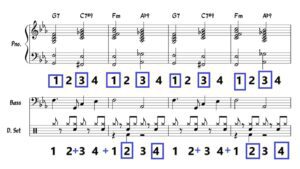
- Creating Engaging Drum Grooves: Drummers often use syncopation to craft rhythms that make you want to move. In jazz, listen to Art Blakey’s “Moanin'”—it’s like an intricate conversation where each beat offers something unexpected.
In the following link, we can see the transcription on Musescore, observe how the Chords from bar 34 are fixed on beats 1 and 3, while the drums stress beats 2 and 4, creating a steady syncopation upon which the improvisation develops (you can listen on the first YouTube link)
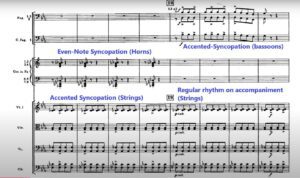
- Disrupting Musical Expectations: Composers like Igor Stravinsky loved to shake things up. In “The Rite of Spring,” syncopation challenges listeners, much like a suspenseful twist that keeps you on edge. We can listen and see in the following link how noticeable the different syncopations act as disruptors in the discourse. In minute 4’05’’ the strings’ accents are placed on irregular patterns while the horns perform an even-beat syncopation and then the bassoons from No. 19 of rehearsal expose the accented syncopations while the strings are in charge of the accompaniment, now with an even rhythm to create the necessary regularity to make this effect more powerful:
- Making Pop and Rock More Interesting: Bands like The Beatles used syncopation to stand out. In “Ticket to Ride,” the rhythm has a unique feel—like a familiar tune with surprising accents that catch your ear.
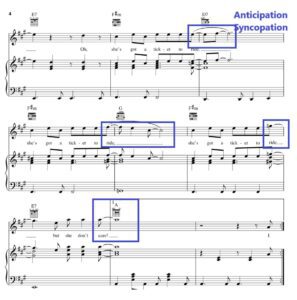
Full score:
You can listen and follow the score from this YouTube link:
Ticket to Ride – The Beatles – an easy arrangement for SA choir and piano
- Driving Dance Music: Genres like funk and disco rely on syncopation to get people dancing. James Brown’s “Papa’s Got a Brand New Bag” uses off-beat rhythms that are irresistible—the musical equivalent of a contagious smile.
We have a sample of how three types of syncopations give this to this song:
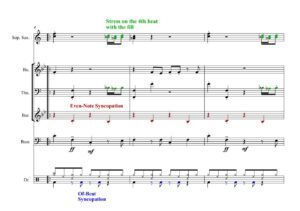
You can follow the music from this Musescore link:
YouTube link to listen to the song:
- Shaping the Sound of Reggae: The off-beat emphasis in reggae creates a laid-back groove. Bob Marley’s “One Love” feels like a gentle sway, capturing relaxation and unity.
We can see from this link the accompaniment where the keyboard organ plays the accompaniment on the 2nd and 4th beats (considered weak in a 4/4 time signature) and the drums stress slightly the 2nd and 4th with accents on the closed hi-hats, while the major stress with the Bass Drum and the Snare Drum on the third beat, but never the first (strongest in a 4/4)
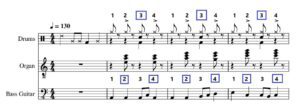
We can listen to the full accompaniment from the following link:
YouTube Link of the song:
- Enriching Cuban Music with Montunos: In Cuban music, the montuno is a syncopated piano or guitar pattern that forms the backbone of styles like son and salsa. Songs like “El Cuarto de Tula” by Buena Vista Social Club showcase montunos that invite you to dance.
How Does Syncopation Work?
Most of the songs that we listen to have this “feel” that compels us to move or dance, don’t rely on just one syncopation type, but many.
There is a basic general formula.
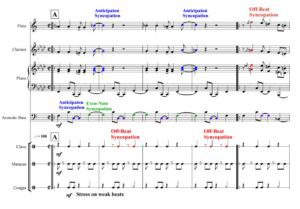
In “El Cuarto de Tula” by Buena Vista Social Club, the montuno (a syncopated piano groove) plays a key role in creating the song’s infectious rhythm and driving energy. The song features several rhythmic layers that work together to build a complex, danceable groove, each instrument adding a unique texture.
1. The Clave and Percussion
The clave rhythm (in this song, a 2-3 pattern) serves as the song’s foundation. The clave provides a steady framework while the congas, maracas, and bongos add syncopated rhythms that interact with it. For instance, the congas might emphasise offbeats, playing short bursts that complement the steady pulse of the bass and drums. These offbeat accents create tension and forward momentum, encouraging movement.
2. The Montuno on Piano
The piano montuno in “El Cuarto de Tula” is syncopated and plays a central role in the rhythm. It provides short, sharp chords that fall on offbeats or between the main beats, accentuating the “and” of each beat in a 4/4 measure. This syncopation creates a rhythmic push-pull effect with the percussion, especially when the piano emphasizes short, staccato chords while the other instruments play more continuous patterns.
3. The Bass
The bass keeps a steady pulse, but is slightly off beat using Off-Beat and Even-note Syncopations, propelling the movement forward.
4. The Maracas
The maracas provide a steady use of the quavers (8th notes) on the strong beats. By anchoring the rhythm, the bass helps the syncopations from the other instruments stand out more, making the groove feel more dynamic and energetic.
5. The Interaction of Layers
The brilliance of “El Cuarto de Tula” lies in how the syncopated montuno on the piano interacts with the percussion and bass. While the bass keeps the steady beat, the congas and timbales emphasize offbeats, creating rhythmic layers that never quite align but complement each other perfectly. The piano montuno adds another layer, pushing and pulling against the rhythm, and these layers of syncopation invite the listener to dance by maintaining an ever-shifting yet cohesive rhythmic structure.
The result is a rhythmic tension that compels the body to respond, with the syncopated rhythms interlocking and creating a sense of momentum that’s central to the Cuban dance tradition.
Below we have a video that shows the first phrase of the song, up to bar 8. Then, the rhythms are introduced one by one to see how they connect. Lastly, the Bass enters before we listen to the first phrase again with the flutes and clarinets (Melody) in this way, we can perceive how the instruments interact with each other, having the full song at the beginning in section A, then in the B section, the instruments entering one by one (being the clave first as it is the foundation of the montuno) and finally the C section in which we can listen to the first phrase again.
YouTube link:
“El cuarto de Tula” – Buena Vista Social Club – Syncopation combinations example
You can see and listen to the whole score from this link:
Strategies for Incorporating Syncopation into Your Music
If you’re a musician or composer looking to add excitement and depth, incorporating syncopation can be powerful:
- Start Simple: Experiment with off-beat syncopation by shifting accents from strong beats to weak beats.
- Use Rhythmic Displacement: Move a rhythmic pattern to start on a different beat.
- Experiment with Hemiolas: Overlay patterns of two beats over a three-beat measure or vice versa.
- Play with Anticipation and Suspension: Introduce notes just before the strong beat or hold a note over into the next beat.
- Incorporate Polyrhythms: Layer different rhythmic patterns on top of each other.
- Vary Dynamics: Use dynamic syncopation by accenting notes unexpectedly through changes in volume.
- Listen and Learn: Study pieces that effectively use syncopation across genres.
- Improvise: Allow yourself to experiment and feel the music.
- Collaborate: Work with musicians specialising in rhythmic styles.
- Use Technology: Utilize music software to experiment with rhythms.
Syncopation Across Musical Styles
Syncopation is a universal seasoning that enhances music worldwide:
Renaissance Music: Composers like Palestrina used suspension syncopation to add emotional depth. In his “Missa Papae Marcelli,” the interplay of voices creates a tapestry of syncopated suspensions that elevate the sacred text.
Classical Music: Johann Sebastian Bach’s “Brandenburg Concerto No. 5” features hemiolas that add sparkle to its melodies, making the music feel lively and dynamic.
Jazz: Syncopation is the heartbeat of jazz. In Dave Brubeck’s “Take Five,” the unusual time signature and syncopated rhythms create a cool, sophisticated vibe. Thelonious Monk’s “Straight, No Chaser” showcases playful rhythms and unexpected accents.
Ragtime: Scott Joplin’s “Maple Leaf Rag” is all about even-note syncopation. The jaunty rhythms transport you to a lively early 20th-century dance hall.
Latin Music: The bossa nova style, as in “The Girl from Ipanema” by Antônio Carlos Jobim, uses anticipation syncopation in its guitar patterns, creating a smooth, flowing feel. Brazilian samba brings to life the vibrant spirit of Carnival with its lively syncopated rhythms.
African Music: Rich with polyrhythms and off-beat syncopation, West African drumming ensembles create complex sound tapestries. Each drummer plays a different syncopated pattern, resulting in a mesmerising communal experience.
Cuban Montunos: The montuno in Cuban son music introduces syncopated piano riffs that are infectious and dance-inducing. “Chan Chan” by Buena Vista Social Club evokes images of lively streets filled with celebration.
Irish Folk Music: While traditional Irish music often maintains steady rhythms, contemporary bands like Kíla incorporate syncopation. Their song “Leath Ina Dhiaidh A Hocht” blends traditional melodies with unexpected rhythmic accents, adding a modern flair.
Balkan Music: Complex time signatures and syncopated rhythms are common. The Bulgarian piece “Gankino Horo” features hemiolas and syncopation that challenge musicians and dancers alike.
Indian Classical Music: The tala system involves complex rhythmic cycles with anticipation syncopation. Performances feature intricate improvisations that play with expectations, taking listeners on a rhythmic journey.
Jazz Explorations: Miles Davis’s “So What” uses syncopated bass lines to create a laid-back groove. The anticipation syncopation feels like a conversation full of subtle nuances.
Modern Jazz Fusion: Artists like Herbie Hancock blend jazz with funk and rock, using various forms of syncopation in tracks like “Chameleon,” where rhythms are as colourful and shifting as the name suggests.
Electronic Music: Artists like Aphex Twin use off-beat and even-note syncopation to create hypnotic, unpredictable pieces. “Windowlicker” is a prime example, with beats that twist and turn unexpectedly.
Progressive Rock and Metal: Bands like Tool use syncopation to build complex rhythms. In “Schism,” shifting beats involve off-beat and suspension syncopation, creating a puzzle that mirrors themes of communication and connection.
Syncopation Beyond Music: Parallels in Visual Arts and Design
Just as syncopation disrupts musical patterns to create interest, similar concepts exist in visual arts, design, and sculpture. Artists break visual patterns to engage viewers, creating a visual ‘syncopation’ that parallels musical rhythm disruptions.
Syncopation in Visual Arts
In visual arts, syncopation can be seen as interruption or deviation from regular patterns within a composition, creating visual interest and dynamism.
Examples in Painting
Piet Mondrian’s Abstract Compositions: In works like “Composition with Red, Blue, and Yellow”, Mondrian uses a grid with variations and asymmetries, breaking expected patterns and engaging the viewer with a visual rhythm.
Jackson Pollock’s Drip Paintings: Pollock’s “Number 1A, 1948” lacks a central focal point, with chaotic drips disrupting conventional patterns, inviting exploration.
Bridget Riley’s Op Art: Riley’s “Movement in Squares” plays with repetitive patterns, introducing variations that create illusions of movement, disrupting expectations.
M. C. Escher’s Tessellations: In “Sky and Water I”, Escher’s patterns morph gradually, creating visual syncopation that intrigues viewers.
Examples in Design
Architectural Design: Frank Gehry’s Guggenheim Museum Bilbao breaks conventional patterns with flowing curves, disrupting the cityscape’s rhythm.
Graphic Design: Designers use irregular spacing, unexpected fonts, or asymmetrical layouts to draw attention, similar to syncopation in music.
Product Design: Philippe Starck’s Juicy Salif lemon squeezer challenges expectations with its unconventional form, disrupting typical design patterns.
Examples in Sculpture
Alexander Calder’s Mobiles: Calder’s kinetic sculptures move unpredictably, breaking static expectations and introducing temporal rhythm.
Umberto Boccioni’s “Unique Forms of Continuity in Space” (1913): This sculpture distorts the human figure, breaking traditional representations to create dynamic motion.
Anish Kapoor’s “Cloud Gate”: Known as “The Bean” in Chicago, its reflective surface and organic shape disrupt regular patterns, engaging viewers with unexpected reflections.
Breaking Patterns in Art and Design
Rhythmic Repetition and Variation: Artists use repetition to create rhythm, then introduce variations to disrupt patterns, as seen in textiles and architectural facades.
Asymmetry and Balance: Intentionally unbalancing a composition leads the viewer’s eye in unexpected directions.
Contrast and Juxtaposition: Placing contrasting elements together breaks visual patterns, creating dynamic interactions.

Conceptual Parallels
Surprise and Engagement: Just as musical syncopation surprises listeners, visual arts use pattern disruptions to surprise viewers, maintaining engagement.
Emotional Impact: Breaking patterns can evoke emotions, prompting deeper responses to the artwork.
Narrative and Movement: Disruptions suggest movement or progression, leading viewers through the artwork like syncopated rhythms guide listeners.
The Syncopation of Storytelling: Breaking Patterns to Captivate
Key Parallels Between Syncopation and Storytelling
1. Rhythm and Flow in Narrative
Storytelling, like music, has a rhythm—a pattern of events, emotions, and pacing. In traditional narratives, this rhythm follows structures such as the three-act arc or Freytag’s Pyramid, which establish an expected flow. A storyteller might break the expected pacing, delaying resolutions or surprising the audience with unforeseen events.
Example: In Charles Dickens’s Great Expectations, the “delayed payoff” for Pip’s mysterious benefactor creates narrative syncopation. The truth isn’t revealed until much later in the story, keeping the audience in suspense.
2. Tension and Release
Both syncopation and storytelling masterfully play with tension and resolution to keep audiences engaged. A storyteller can create suspense by postponing critical information, and heightening the emotional stakes before resolving the conflict.
Example: In mystery novels, such as those by Agatha Christie, syncopation-like tension is achieved by introducing red herrings or delaying the revelation of the culprit.
3. Twists and Surprises
Just as syncopation surprises the listener by emphasizing unexpected beats, stories surprise us with plot twists or unexpected character developments. Plot twists function similarly by interrupting the expected narrative flow, forcing us to rethink what we know.
Example: The classic twist in The Sixth Sense by M. Night Shyamalan (“he was dead all along”) mirrors the jolt of a syncopated rhythm. It recontextualizes everything we’ve seen, just as syncopation can reshape a musical phrase.
4. Pacing and Momentum
Syncopation introduces variety into rhythmic patterns, preventing monotony and maintaining interest by creating a sense of movement and unpredictability.
In storytelling, altering pacing achieves a similar effect, like rapid sequences of events or slow, deliberate pauses in a narrative act as “rhythmic shifts,” keeping the audience engaged.
Example: The alternating fast-paced battles and introspective quiet moments in The Lord of the Rings by J.R.R. Tolkien are narrative syncopation. The abrupt shifts make the journey feel dynamic and emotionally resonant.
5. Layered Complexity
Syncopation often involves overlapping rhythms or polyrhythms, creating a rich, multi-layered sound. Similarly, storytelling can layer multiple plotlines or themes to add depth.
In Storytelling, we observe subplots or interwoven timelines that can create narrative complexity, much like syncopation does in music.
Example: The non-linear storytelling in Pulp Fiction creates a syncopated narrative rhythm, where timelines intersect and disrupt the expected sequence, much like an unexpected off-beat accent.
6. Emotional Engagement
Syncopation’s unpredictability engages the brain, keeping listeners emotionally connected. Storytelling achieves this through unexpected emotional beats by sudden shifts in tone or character emotions which can mirror this effect, keeping the audience emotionally invested.
Example: In Game of Thrones, abrupt character deaths (like Ned Stark’s) shock the audience, disrupting the expected emotional rhythm of the story and keeping viewers emotionally engaged.
7. Universality and Cultural Impact
Syncopation and storytelling are universal forms of human expression, reflecting cultural values and individual creativity.
Storytelling: Different cultures use narrative syncopation to reflect their unique perspectives, from the non-linear storytelling of Japanese anime to the cyclical narratives in African oral traditions.
Example: In oral storytelling traditions, pauses, digressions, and unexpected shifts mimic syncopation by breaking the rhythm of the tale, drawing the listener’s attention to key moments.
The Art of Disrupting Patterns
Syncopation and storytelling both thrive on breaking patterns to create something dynamic and engaging. Whether it’s an off-beat rhythm in a reggae song or a shocking twist in a mystery novel, these disruptions surprise, delight, and move us. They mirror the unpredictability of life itself, making art more reflective of our human experiences.
So, the next time a piece of music compels you to move or a story leaves you on the edge of your seat, consider how syncopation—whether in rhythm or narrative—played a role in captivating your mind and emotions.
Wrapping It Up on What Is Syncopation
Syncopation is more than a musical concept—it’s an artistic tool that transcends disciplines. By playing with expectations through off-beat accents, suspensions, anticipations, hemiolas, and visual pattern disruptions, artists create works that are exciting, engaging, and emotionally resonant. From the intricate polyphony of Renaissance music to the dynamic compositions of modern art, syncopation adds that extra bit of magic.
Syncopation is the heartbeat of creativity, a universal language that transcends time, genres, and artistic mediums. Whether it’s the unexpected off-beat accent in a piece of music, the strategic disruption of a visual pattern, or a narrative twist in storytelling, syncopation awakens our senses and keeps us engaged. By breaking conventions and challenging expectations, it captures our attention, stirs our emotions, and compels us to connect on a deeper level.
In music, syncopation transforms rhythm into a dynamic, living force—infusing melodies with energy, tension, and release. Across the arts, it mirrors the unpredictability of life, offering moments of surprise and delight that resonate universally. It’s the irregularity in the pattern, the accent where it’s least expected, that makes us lean in, listen closer, and feel more profoundly.
Syncopation offers a powerful tool to break monotony and evoke excitement. It reminds us that the most memorable experiences often come not from what is expected, but from what surprises us along the way. So, the next time a rhythm, image, or story captures your imagination, take a moment to appreciate the syncopation behind it—the artful disruption that makes the ordinary extraordinary. Let it inspire you to explore your own creative possibilities, where breaking patterns leads to boundless engagement and expression.