
 TRIAL LESSON
Pianists, Piano Lessons
Solomon Cutner in London: The British Pianist Whose Beethoven Still Teaches Discipline and Tone

May
Solomon Cutner
WKMT London Piano Culture
Solomon Cutner in London: The British Pianist Whose Beethoven Still Teaches Discipline and Tone
Solomon Cutner, known professionally as Solomon, remains one of the clearest British models for disciplined Beethoven playing, serious listening, and refined London piano study.
Why Solomon Still Matters
Solomon Cutner was born in London’s East End on 9 August 1902 and died in London on 2 February 1988. He performed under the single professional name Solomon, a choice that still gives his career a particular aura: restrained, memorable, and slightly separate from the noise of celebrity. Britannica notes his technical skill, poetic interpretation, and careful pacing; those are still the qualities that make his recordings useful for serious pianists today.
- Full name: Solomon Cutner CBE.
- Professional name: Solomon.
- London link: born in the East End; early Queen’s Hall prodigy; later associated with major British concert life.
- Known for: Beethoven, Brahms, Schumann, and an unusually disciplined sense of phrase.
- Career break: a stroke in 1956 ended his public career.
For WKMT, Solomon’s value is not nostalgia. His playing helps students hear why classical piano study in London still depends on proportion, patience, and a cultivated ear. This article supports broader classical piano study in London by treating Solomon as a listening model rather than a museum piece.
Solomon Cutner’s Early Life and London Roots
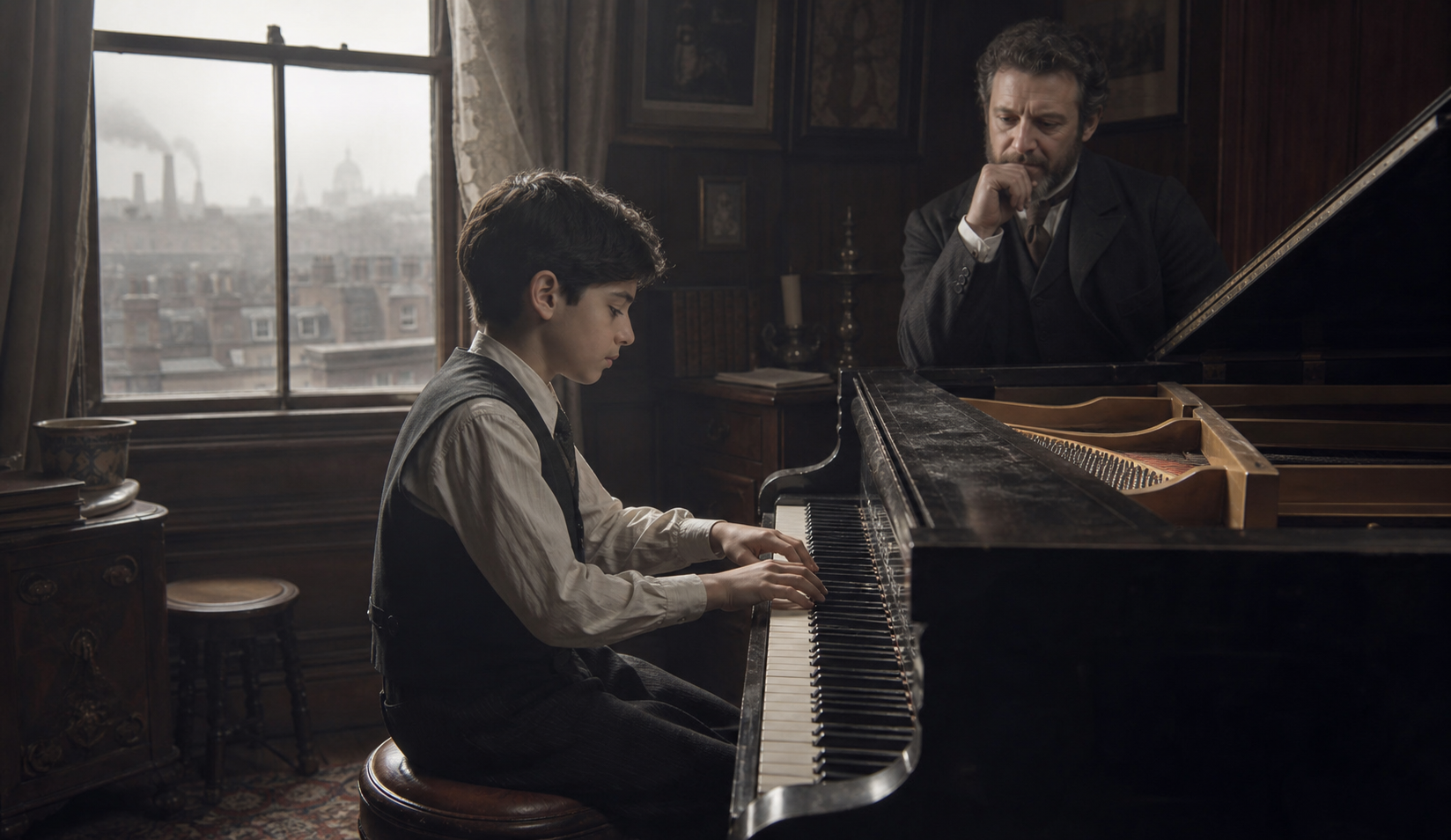
Solomon’s story begins with the pressure and promise of a prodigy. Published biographies describe him as the son of a Polish-born tailor in the East End. He began formal musical study in childhood and, according to Britannica, made an astonishing early Queen’s Hall debut with Tchaikovsky’s First Piano Concerto. The Los Angeles Times obituary also records his study with Mathilde Verne, a pupil of Clara Schumann, giving his early training a direct line back to 19th-century pianistic tradition.
The prodigy years matter because they explain both his brilliance and his later discipline. A child can dazzle; an artist must learn how to withhold. Solomon’s temporary withdrawal from performance in his teens, followed by renewed adult work, suggests a musician rebuilding around judgement rather than spectacle. London gave him a public platform, but maturity gave him shape.
That is a useful lesson for advanced students. Fast hands impress briefly. A trained ear lasts. WKMT’s work on advanced piano lessons in London follows the same principle: technique must become a servant of line, structure, and musical thought.
Rise to International Reputation
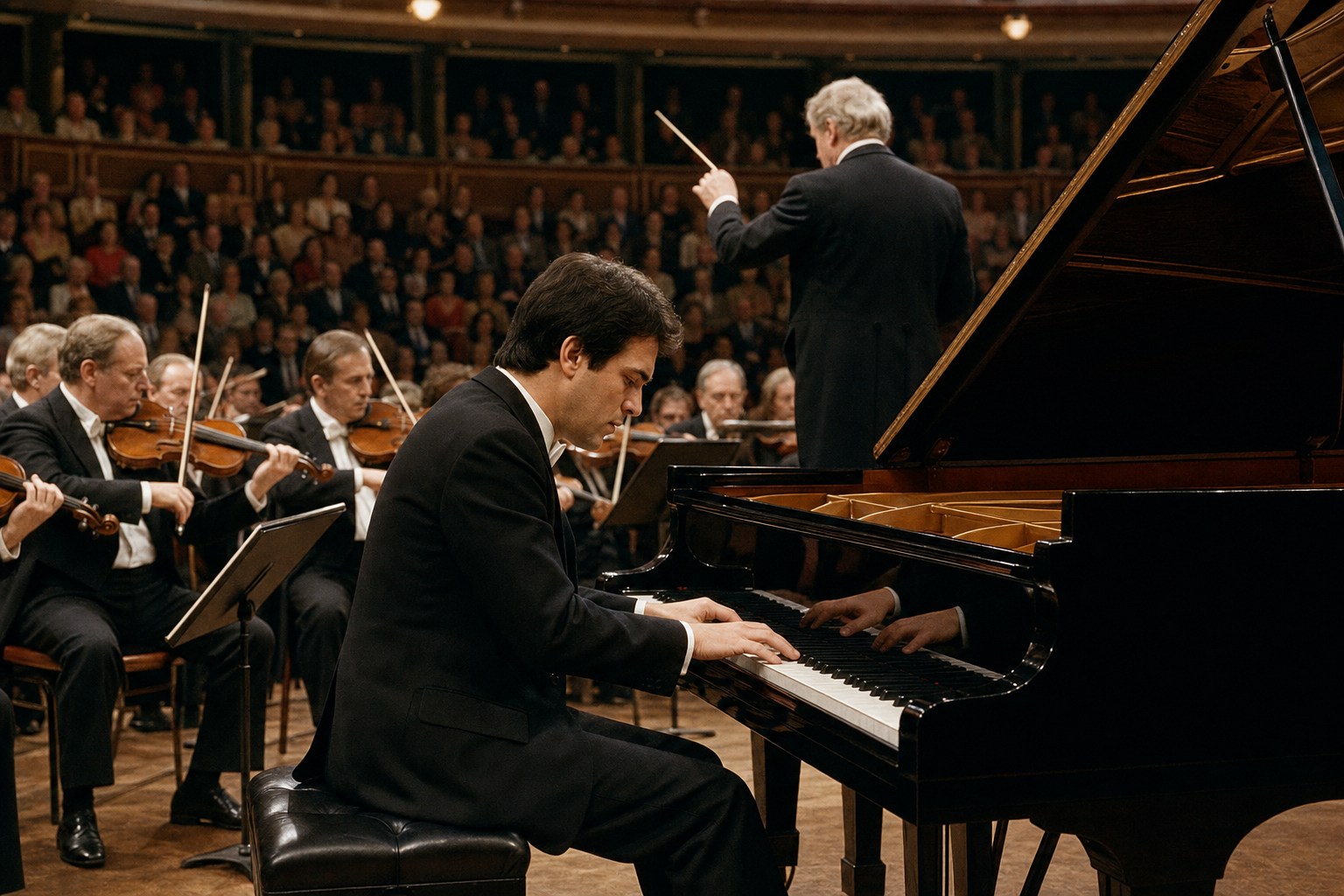
Solomon returned to public attention in the 1920s and built an international career without losing the stamp of British seriousness. Britannica records his first American trip in 1926 and his 1939 New York World’s Fair appearance, where he premiered Arthur Bliss’s Piano Concerto. During the Second World War he performed for Allied troops, then continued a wide post-war concert and recording life.
His London standing is not only biographical. BBC Proms archive material places Solomon at the piano in major programmes with the BBC Symphony Orchestra, the London Philharmonic Orchestra, Malcolm Sargent, Basil Cameron, and Adrian Boult. The 1949 Proms archive, checked on 2026-05-29, lists Solomon in substantial concerto and orchestral contexts, including Beethoven’s Emperor Concerto and Brahms’s Second Piano Concerto. Those are not decorative facts. They show him operating inside the central British concert machinery of his time.
Solomon’s authority came from measured intensity: the feeling that every phrase had been weighed before it was released.
That measured quality is precisely why he belongs beside Myra Hess, Clifford Curzon, and other British pianists whose reputations rest less on theatrical profile than on musical conscience. For London learners, his career says that seriousness need not be cold. It can be vivid because it is exact.
Signature Repertoire and Recorded Legacy: Beethoven Focus
Solomon’s recorded reputation is closely tied to Beethoven. The attraction is not weight for its own sake. In the best accounts, the bass is firm without heaviness, the right hand sings without perfume, and the architecture remains audible even in dramatic passages. He belongs to a Beethoven tradition where clarity is not a reduction of passion but the condition that makes passion intelligible.
| Work area | What Solomon teaches |
|---|---|
| Beethoven sonatas | Rhythmic spine, clean voicing, and disciplined transitions. |
| Beethoven concertos | Concerto playing as dialogue, not athletic display. |
| Brahms and Schumann | Warmth kept inside proportion; tone shaped by phrase rather than habit. |
Discographic details vary by edition and reissue, so catalogue numbers should be checked against the publisher or archive before publication notes are finalised. Still, a practical listening path can be built safely from the established repertoire:
- Beethoven piano sonatas, Solomon, HMV/EMI lineage: catalogue number not confirmed in publicly accessible catalogues. Start by listening for the relationship between left-hand pulse and right-hand rhetoric.
- Beethoven piano concertos, Solomon with British orchestral partners: catalogue number not confirmed in publicly accessible catalogues. Listen for how the piano enters as a speaking presence, not a conquering machine.
- Brahms and Schumann recordings, Solomon: catalogue number not confirmed in publicly accessible catalogues. Notice how the inner line is kept alive without sentimentalising the surface.
The strongest educational point is this: Solomon’s recordings reward repeated listening. A student may first hear restraint; a second hearing reveals pressure, pacing, and controlled risk. That is why his Beethoven remains relevant to students exploring Beethoven piano sonatas and to teachers who want interpretation to grow from evidence.
1956 Stroke, Aftermath and Pedagogical Legacy
In 1956 Solomon suffered a stroke that ended his public career. The detail is often repeated because it is tragic, but the more useful question is what survived. His recordings became the surviving studio. Later listeners could still study the pacing, the absence of vanity, and the way Beethoven’s argument was kept in proportion.
There is a danger in turning illness into mythology. The better response is respect. Solomon’s late silence throws attention back onto the recorded evidence. For pianists, that evidence teaches disciplined practice: do not confuse volume with conviction; do not rush a transition because the hands are ready before the mind is; do not decorate tone before the line is clear.
Those are not historical preferences. They are active teaching values, closely related to WKMT’s work on piano finger technique and efficient motion.
Solomon Cutner Among British Pianists
It is tempting to place Solomon in a simple line of British pianism: Myra Hess for civic nobility, Clifford Curzon for chamber-like poise, Solomon for Beethovenian discipline. The comparison is useful only if it sharpens listening. Hess often feels public and humane; Curzon often feels inward and conversational; Solomon can feel carved, as if the phrase has been reduced until only the necessary pressure remains.
That quality matters in London teaching because students often arrive with two opposite problems. Some play Beethoven as if every bar must prove force. Others soften the music until the argument disappears. Solomon offers a third route. His recorded manner suggests that drama can be structural. The hand does not need to announce strength when rhythm, voicing, and timing already carry authority.
Before adding more sound, ask whether the phrase already has direction. Solomon’s legacy is the discipline to answer that question honestly.
This is why historical listening should be part of serious tuition rather than an optional extra. A recording can become a mirror. It reveals whether a pianist is shaping music from intention or merely managing notes.
How to Listen: A Guided Path
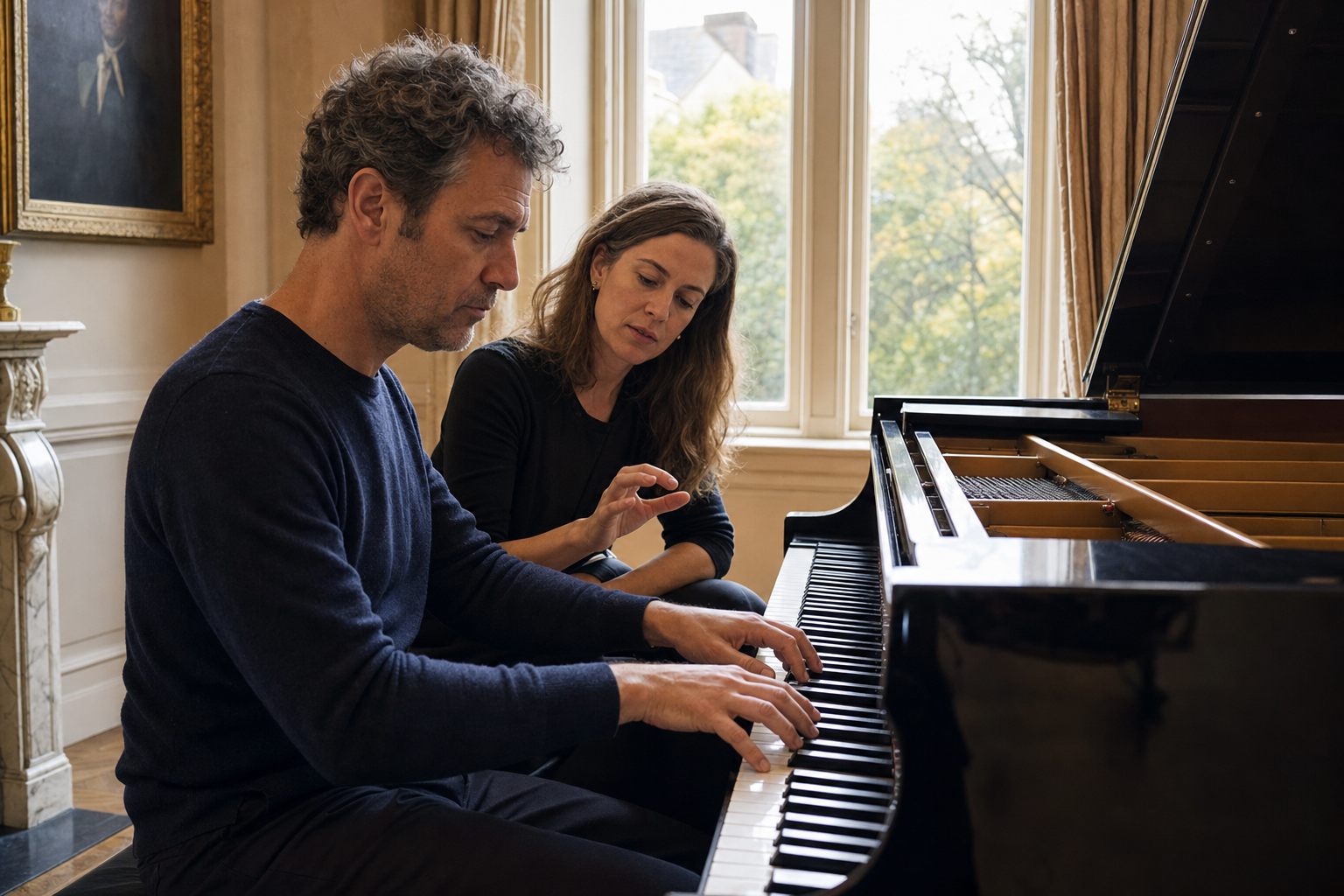
Begin with Beethoven, but do not begin by asking whether Solomon is fast, slow, modern, or old-fashioned. Ask how he makes a phrase inevitable. In a sonata movement, follow the first bass pattern for one minute. Then repeat the passage and follow the right-hand line. The third time, listen for what changes at the join between two ideas. Solomon’s art often lives in those joins.
For adult learners, this listening method is powerful because it turns admiration into study. You are not copying a historical pianist. You are learning to hear what a controlled decision sounds like. That is the bridge between Solomon’s records and practical work at the piano.
Timeline and Sources on Solomon Cutner in London
1902: born in London.
1910-1912: early formal study and prodigy appearances.
1920s: adult re-emergence and international career.
1939: Arthur Bliss Piano Concerto premiere at the New York World’s Fair.
1946: appointed CBE.
1956: stroke ends public performing career.
1988: dies in London.
Sources consulted include Encyclopaedia Britannica, the BBC Proms archive, Steinway’s Solomon artist profile, The Piano Files, the Los Angeles Times obituary, Encyclopedia.com, and the public Solomon Cutner entry used for discographic cross-checking.
FAQs and WKMT Listening CTA
Who was Solomon Cutner?
Solomon Cutner was a British pianist from London, known professionally as Solomon, admired especially for Beethoven and for his disciplined, poetic playing.
Why is Solomon associated with Beethoven?
His Beethoven recordings and concerto performances show unusually clear structure, tonal control, and seriousness without theatrical excess.
Did Solomon Cutner keep performing after 1956?
No. A stroke in 1956 ended his public performing career, leaving the recordings as the principal route into his artistry.
Study Beethoven With a More Disciplined Ear
Solomon’s recordings remind us that interpretation is built from listening, not from display. WKMT helps London pianists connect historical models with practical lesson work, tone production, and structured musical thought.
Sources for Solomon Cutner
- Encyclopaedia Britannica, “Solomon”, https://www.britannica.com/biography/Solomon-British-pianist, last checked 2026-05-29.
- BBC Proms archive, 1949 event listings, https://music-events.api.bbc.co.uk/proms/events/by/date/1949, last checked 2026-05-29.
- Steinway & Sons artist profile, “Solomon”, https://www.steinway.com/artists/solomon, last checked 2026-05-29.
- The Piano Files, “Solomon at 120”, https://www.thepianofiles.com/solomon-at-120/, last checked 2026-05-29.
- Los Angeles Times archive, “Child Piano Star Solomon Cutner, 85”, https://www.latimes.com/archives/la-xpm-1988-02-25-mn-44806-story.html, last checked 2026-05-29.
- Encyclopedia.com, “Solomon (actually, Solomon Cutner)”, https://www.encyclopedia.com/arts/dictionaries-thesauruses-pictures-and-press-releases/solomon-actually-solomon-cutner, last checked 2026-05-29.
- Solomon Cutner public reference entry, https://en.wikipedia.org/wiki/Solomon_Cutner, last checked 2026-05-29.