
 TRIAL LESSON
Piano Lessons
The Importance of Timing in Piano Practice — A Guide to Metronome Work
Nov
The Importance of Timing in Piano Practice — A Guide to Metronome Work
The Importance of Timing in Piano Practice — A Guide to Metronome Work
Timing is not a mechanical skill — it is a musical one. Here is how to develop genuine rhythmic control at the piano, from basic metronome technique to the subtleties of Chopin’s rubato.
What This Guide Covers
- Why timing matters and what it means at the piano
- How to use a metronome correctly (and avoid common mistakes)
- Subdivision practice: the most powerful timing tool available
- Dotted rhythms and reverse dotted rhythms for technical passages
- Chopin’s rubato and the steady left hand
- The Scaramuzza arm-weight approach and its connection to rhythmic impulse
- When NOT to use the metronome – The importance of timing in piano practice explained by WKMT
Why the Importance of Timing Goes Beyond Counting
The importance of timing in piano practice is something every teacher mentions in the first lesson. What is said less often is why — and what it actually means to play in time as opposed to merely counting the beats. These are different things.
Counting aloud or with a metronome is a technique. Musical timing is an achievement. A student who counts correctly can still play without real rhythmic drive if the relationship between notes is mechanical rather than felt. Conversely, a student who has genuinely internalised pulse will adapt to ensemble situations, recover from memory slips without losing their place, and phrase convincingly because they understand where the music is going. Both the counting and the feeling matter — and both can be developed with deliberate, well-designed practice.
For beginners at the piano, developing a reliable sense of pulse from the outset is one of the most valuable things a teacher can give them. For intermediate students, the challenge is usually more subtle: notes are in place but the rhythmic architecture has gaps — uneven runs, early arrivals on downbeats, rushed passage-work that loses its shape under tempo pressure. Both problems respond to the same set of tools.
“The left hand is the conductor — it must not waver or lose ground. Do with the right hand what you will and can.”
— Chopin, quoted by his student Mikuli
How to Use a Metronome Correctly
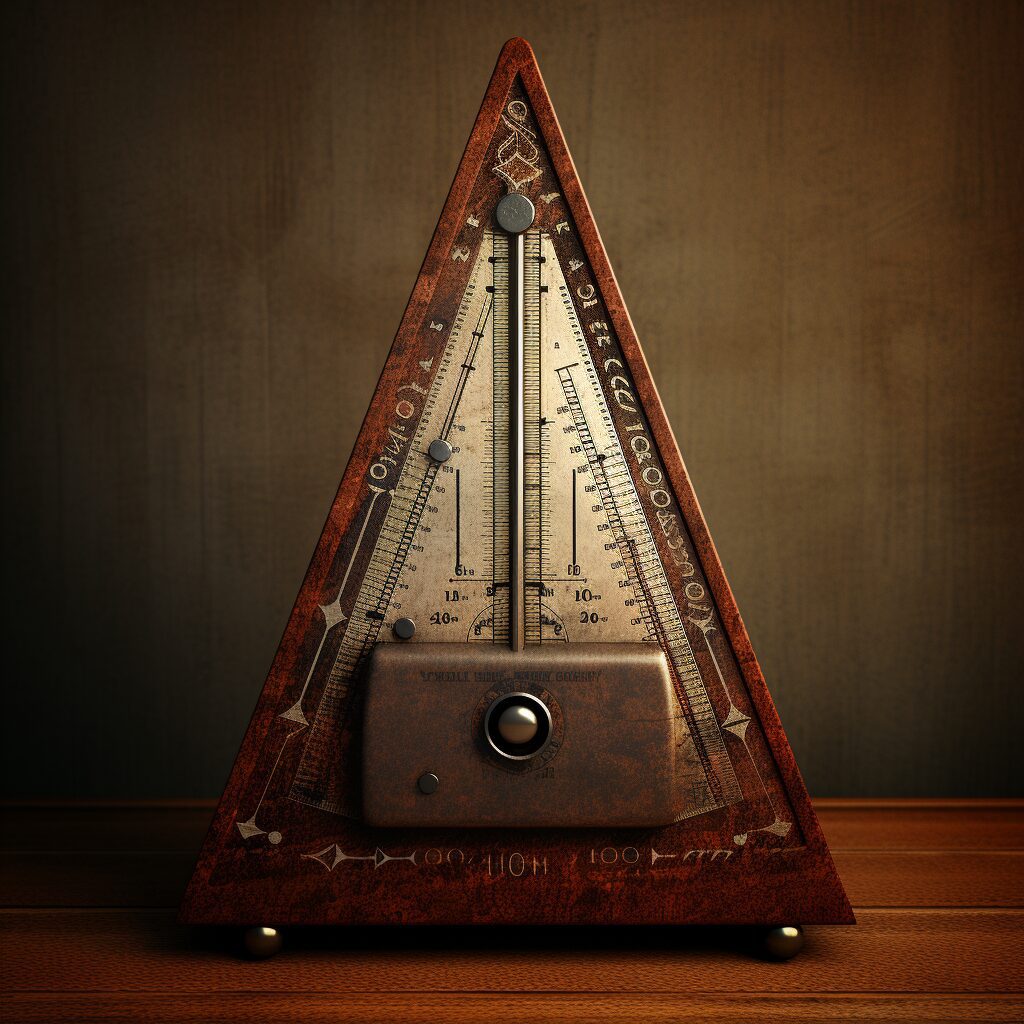
The metronome is not an overseer. It is a reference point. Students who treat it as an authority to chase will lock their timing to the click and lose the ability to lead. Students who treat it as a mirror — something that reveals the truth about where they are placing their notes — will find it invaluable.
The most common metronome errors
Four errors recur consistently in lessons where metronome use has been attempted without guidance:
- Starting too fast. The metronome should be set slower than the speed at which the passage feels easy — not at the target tempo. Begin at 60–70% of the final speed, play the passage correctly three to five times at that speed, and raise it by small increments (two to four BPM at a time) only when accuracy is consistent.
- Listening to the click instead of feeling the beat. The metronome should prompt a felt response, not a reactive one. The difference is the difference between a dancer who moves with the music and one who moves because the music told them to.
- Practising only at the small pulse. If a passage is in 4/4, most students practise with a crotchet click. Better results often come from setting the metronome to a minim (half note) so that the student must supply their own internal subdivision and feel the larger arc of each bar.
- Abandoning the metronome once a passage is comfortable. The metronome should be used at different stages: slow build-up, full-tempo consolidation, and then — occasionally — as a spot-check on passages that have been worked without it. A passage that sounds good in practice but drifts in the check-back needs more slow work.
Before using the metronome, count or sing the notes aloud at the target rhythm without playing. This separates the motor and cognitive demands of the task. Once the rhythm is clear in the mind, adding the metronome has a more immediate effect.
Subdivision Practice: The Single Most Useful Timing Tool
Subdivision is the practice of mentally or physically counting shorter note values than those printed on the page. It is the most reliable route to even timing in technically demanding passages, and it transfers directly to musical contexts where evenness is critical: Chopin’s ornamental right-hand passages, the semiquaver runs in Bach’s Inventions, the repeated-note figurations in Scarlatti.
The method is straightforward. If a passage is written in crotchets, count quavers (subdivide by two). If it is in quavers, count semiquavers (subdivide by two again). For passages with triplet groupings, subdivide into the triplet unit — three subdivisions per beat — and count aloud as you play until the placement of each note in the triplet group is physically consistent.
Where students typically benefit most from subdivision:
- Passages where the last note of a group is slightly short, causing the following downbeat to arrive early
- Bar-crossing runs where the sense of pulse disappears in the middle of the bar
- Fast repeated-note passages where the finger repetition rhythm becomes uneven under tempo pressure
- Any passage at the bottom of a build where slow tempo reveals rhythmic instability not yet solved
See also: a musical approach for studying scales, where subdivision logic applies directly to scale passage work.
Dotted Rhythms and Reverse Dotted Rhythms
Dotted rhythm practice is one of the most powerful technical tools available for passage work — and one of the least understood. Its purpose is not to practise the dotted rhythm pattern itself. Its purpose is to isolate each note’s physical preparation by exaggerating the difference in duration between consecutive notes.
The principle works as follows. Take a rapid passage of even semiquavers: C–D–E–F–G–A–B–C. In dotted rhythm practice, the student plays this as long–short–long–short: dotted semiquaver, demisemiquaver, dotted semiquaver, demisemiquaver. The long note gets full preparation; the short note gets a sharp, quick action. This builds the crisp, efficient key release needed for velocity later.
Reverse dotted rhythm (or Lombard rhythm) swaps the pattern: short–long–short–long. This isolates the notes that the dotted version rushed through — in particular, the notes following the long ones. Used together, dotted and reverse dotted rhythms address every note in a rapid passage from both directions. Any persistent unevenness will surface immediately.
| Rhythm Variant | Pattern | What It Targets | When to Use |
|---|---|---|---|
| Standard dotted | Long–short–long–short | Key preparation on odd notes; quick release on even notes | Early in technical passage work |
| Reverse dotted (Lombard) | Short–long–short–long | Key preparation on even notes; exposes skipped preparation | After standard dotted; reveals remaining unevenness |
| Triplet grouping | Short–short–long within triplet | Even third note placement in triplet figures | Chopin and Brahms triplet passage work |
Practising dotted rhythms is not about practising dotted rhythms. It is about practising every note in the passage with maximum preparation. The rhythm is the tool; evenness is the goal.— WKMT teaching principle
Chopin’s Rubato and the Steady Left Hand
Rubato is one of the most misunderstood concepts in piano technique — and one of the most instructive for understanding what musical timing actually is. Students often assume that rubato means freedom from time. In Chopin’s own practice, it meant something much more disciplined.
Chopin’s rubato works on a specific division of labour between the hands. The left hand maintains a steady, even pulse — it is, as Chopin himself described it, the conductor of the ensemble. The right hand, carrying the melody, moves freely within that pulse: leaning into emotionally significant notes, pulling back before a phrase peak, allowing a short pause before an ornament resolves. The result is the illusion of complete spontaneity over a framework of exact regularity.
Rubato cannot be added to a piece that has not yet been learnt in time. It must emerge from a foundation of rhythmic control. The correct approach:
- Learn the left hand alone, with a metronome, until the accompaniment pattern is entirely automatic
- Add the right hand melodic line in strict time, prioritising correct note values before expression
- Add expression — agogic lean, dynamic shaping, small tenutos — only once the underlying pulse is stable
- Gradually soften the metronome dependency as the piece becomes self-sustaining in tempo
This process applies directly to how to practice effectively — building from certainty rather than reaching for expression before the technical foundation is in place.
The Scaramuzza Arm-Weight Approach and Rhythmic Impulse
The Scaramuzza technique, which underpins the teaching approach at WKMT, has a specific relationship to rhythm. In the Scaramuzza approach, the physical impulse for each note comes from the natural fall of arm weight into the key — a ballistic, gravity-aided motion rather than a finger-driven percussive action. This matters for timing in a direct and practical way.
When arm weight provides the primary note-to-note impulse, the rhythm is generated by the body rather than calculated by the fingers. The timing becomes proprioceptive — felt in the muscles and joints — rather than cognitive. Students who have developed this physical sense of pulse find that it is far more stable under performance pressure than cognitively-managed timing.
For adult piano students returning to the instrument after a break, this is particularly relevant. Muscle memory from earlier in life often retains the physical feel of a passage even after the cognitive memory has faded. Slow arm-weight practice reactivates that physical memory more effectively than drilling at tempo.
See also: the importance of buffering phrases.
When NOT to Use the Metronome
- Cantabile and tone production work. Building a singing tone in slow Romantic pieces requires attention to weight, contact, and release — not click-tracking.
- Phrase shaping and arc-building. A phrase that rises toward a high point and releases has an organic push-and-pull that the metronome cannot encode.
- Lyrical slow movements at tempo. A Bach Sarabande, a Chopin nocturne at performance tempo, a late Schubert slow movement — these exist in musical time, not metronomic time.
- Sight-reading. Relying on a metronome for sight-reading prevents the student from developing the internal pulse reading that ensemble playing requires.
For more: practice makes perfect.
Is This the Right Approach for Your Stage of Learning?
The techniques in this guide are appropriate for students from late beginner through advanced levels. A beginner benefits from basic metronome use at a crotchet click. An intermediate student preparing Beethoven or Chopin should be working with subdivision practice and dotted rhythms. An advanced student will use the metronome selectively — for technical consolidation, not expressive delivery.
Timing work never ends. Professional pianists continue to use metronomes for new repertoire. The goal is not to stop needing the tool — it is to use it with increasing intelligence at each stage of development.
Frequently Asked Questions on The importance of timing in piano practice explained
What BPM should I set my metronome for piano practice?
Start at 60–70% of your target tempo. The correct starting speed is the one at which you can play the passage cleanly three times in a row without error.
How often should I practise with a metronome?
Use it consistently during the technical build-up phase of a new piece. Once a piece is fluent, use it periodically as a check rather than continuously. Do not use it for performance practice or expressive shaping work.
Is Chopin’s rubato really just the left hand steady and the right hand free?
That is the dominant interpretation, based on testimony from Chopin’s own students (Mikuli and Lenz). The accompaniment maintains a steady pulse while the melody has expressive latitude within it.
What are dotted rhythms and why do pianists use them?
Dotted rhythm practice distorts an even passage into a long–short alternation to isolate each note’s physical preparation. Each long note gets extra time to prepare; each short note gets a quick, decisive action. Combining both directions addresses the full passage. The importance of timing in piano practice explained.
Why does my timing fall apart in performance?
Usually one of three causes: technical work done at tempo without slow-practice consolidation; timing cognitively managed rather than physically felt; or insufficient practice recovering from small slips. Slow arm-weight practice and subdivision address both.
Can I develop good timing without a metronome?
Some musicians develop reliable internal pulse through ensemble experience. For solo practice, most students benefit significantly from regular metronome use, particularly in the early and intermediate stages.
Develop Your Timing with Expert Guidance in London
WKMT London offers piano lessons built around the Scaramuzza method — where rhythm is taught as a physical, felt response rather than a cognitive calculation.
Further reading: how to practice effectively · practice makes perfect · a musical approach for studying scales · all piano lessons and tuition options at WKMT London.