
 TRIAL LESSON
Piano Lessons, Uncategorized
Royal Festival Hall Classical Concerts in London
Jul
Royal Festival Hall Classical Concerts in London Complete Guide
Discover the Legacy of Royal Festival Hall Classical Concerts in London
The Royal Festival Hall (RFH) is one of London’s most iconic concert halls, a 2,700-seat modernist auditorium located in the South Bank of River Thames.Built for the Festival of Britain and officially opened on 3 May 1951, it was envisioned as a “tonic to the nation” after World War II. It became the first post-war building to receive Grade I listing (in 1981). From the start, RFH was home to Britain’s leading orchestras – today the London Philharmonic, Philharmonia, Orchestra of the Age of Enlightenment, London Sinfonietta, Chineke! and Aurora are resident ensembles here. In short, the Festival Hall quickly became a national hub for classical music and cultural renewal in London.
In its inaugural season the Hall “hosted a season to represent the entire British musical tradition”. Construction began in 1948 (the foundation stone was laid by PM Clement Attlee) and in May 1951 King George VI and Queen Elizabeth attended the grand opening concert. This gala concert – conducted by Sir Malcolm Sargent and Sir Adrian Boult – marked the Hall’s debut as a premier classical venue. The first general manager was T. E. Bean (former Hallé manager). Even at its opening, critics were struck by the Hall’s futuristic style – journalist Bernard Levin wrote of being “overwhelmed by a shock of breathless delight at the originality and beauty of the interior”. (That same optimism of postwar design still defines RFH’s spirit.)
Architecture and Interior Design
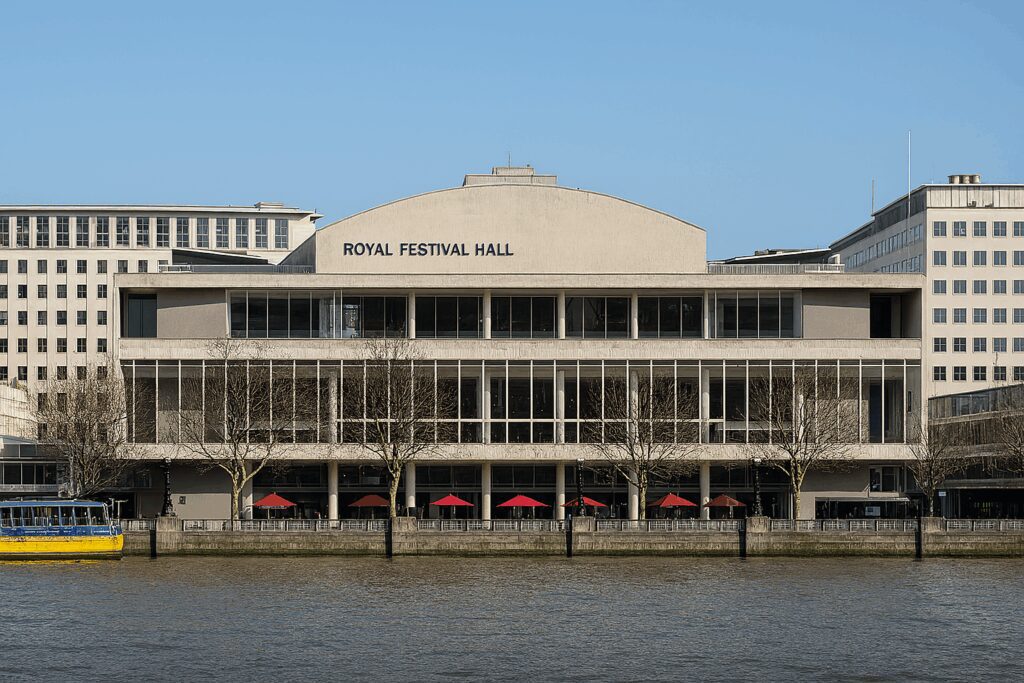
Nestled on the Thames riverbank, the Royal Festival Hall’s modernist exterior looks unlike any Victorian concert hall. Architects Robert Matthew and Leslie Martin designed it as an “egg in a box” – a curved, cantilevered auditorium encased in a generous public foyer. The plan emphasizes open, democratic spaces: sweeping staircases, riverside terraces and wide foyers where audiences can mingle. The building’s façades and three-story height (with glazed bays and concrete) embody 1950s Scandinavian-influenced modernism. Inside, the barrel-vaulted auditorium seats some 2,700 people; the tiers of rear boxes and circles create an intimate feel despite the large capacity. Furniture designer Robin Day created the original leather seats and lounges, many of which still survive today.
The RFH’s designers paid special attention to acoustics. Acoustic consultant Ralph Downes worked to make the hall suitable for a wide range of music, from chamber ensembles to full symphony. (In fact, the Hall’s organ – with 7,866 pipes by Harrison & Harrison – was itself a landmark: it influenced a whole generation of British organ design.) Early on, musicians found the Hall too “dry” acoustically for Romantic repertoire, so experiments added “assisted resonance” loudspeakers to lengthen reverberation. In the 2000s, a major £90–110 million refurbishment (completed in 2007) overhauled the entire building. Architects Allies and Morrison removed many 1960s additions, restored the original open foyers, and improved acoustics and backstage facilities. When it reopened in June 2007, the Hall had clean lines and renewed texture while preserving the spirit of its 1951 design.
Inside, RFH offers more than just the main auditorium. The Clore Ballroom (added later) seats about 440 for dinners and smaller events. Multiple bars and exhibition spaces occupy the foyers, including original Robin Day lounges and even a bust of Nelson Mandela on the riverside walkway. This blend of modernist furniture, art, and industrial materials (glass, concrete, teak) gives RFH its distinctive mid-century character. Its design was a full collaboration of top British talent – together with Matthew and Martin, designer Peter Moro and furniture guru Robin Day worked on the project. Today the South Bank Centre calls RFH a “remarkable modernist architecture” and points to performances by everyone “from Barenboim to Bowie, Maria Callas to M.I.A.” as proof of its enduring versatility.
World-Class Performances and Historical Highlights
From its earliest days, the Royal Festival Hall has hosted legendary performances. It opened with the LPO and Philharmonia orchestras under Britain’s leading conductors. In the decades since, hallmarks of the classical repertory have echoed under RFH’s roof. For example, the international virtuoso Yehudi Menuhin chose RFH for his 50th birthday gala in April 1966. In that concert his 14-year-old son Jeremy made his public debut on stage, playing Mozart’s Concerto for Three Pianos alongside Yehudi’s sisters. Hall historians note that the RFH has stood “at the forefront of London arts and culture,” showcasing a jaw-dropping range of talent. Over the years its artists have spanned classical greats (María Callas, Daniel Barenboim, Sir Colin Davis, etc.) to pop and jazz superstars (David Bowie, Sinatra’s Rat Pack, M.I.A., and others). (Indeed, the RFH even hosted Britain’s first Festival of India concerts and more recently cultural celebrations spanning world music and poetry.)
Several milestone events have taken place here: from the Philharmonia’s 80th anniversary concerts to premiering new compositions. Live recordings have been made at the Hall (Southbank publishes an album list of RFH concerts). The London Philharmonic Orchestra’s “Emperor” Concerto concert (September 2025) and Chineke! Orchestra’s Beethoven Triple Concerto (September 2025) will be part of the Hall’s centennial build-up. In short, for 70+ years RFH has been synonymous with “glorious years” of British music. Its stage is steeped in moments of history – from royal attendeance at state concerts to stirring anti-apartheid events (a Nelson Mandela bust memorializes his inspiration). Every season adds to that legacy, making the Hall a living museum of performance.
Classical Concert Programmes Today and Beyond
Today the Royal Festival Hall remains one of London’s premier classical stages. Its resident orchestras – the Philharmonia and London Philharmonic in particular – anchor its calendar, while visiting ensembles and soloists fill out a busy season. For 2025–26 (the Hall’s 75th anniversary season), highlights include programmes like “Santtu & Víkingur Ólafsson” (Philharmonia’s celebratory season opener), Beethoven’s “Emperor” Piano Concerto with the LPO and pianist Yefim Bronfman, and Chineke! Orchestra’s performance of Beethoven’s Triple Concerto. These examples showcase how RFH blends classical cornerstones with fresh innovation: commissions by Gabriela Ortiz and Errollyn Wallen join Beethoven symphonies on its 2025 roster.
The venue’s website and the Southbank Centre “What’s On” pages keep an up-to-date calendar. Future seasons beyond 2026 are announced annually, so enthusiasts can always look forward to new programmes. (For example, the Philharmonia’s 2025/26 London season notes Santtu-Matias Rouvali conducting and Víkingur Ólafsson on piano in late September 2025.) In general, classical music at the RFH is characterized by variety – full symphony concerts, chamber series, family and educational events, and even organ recitals on the Hall’s rebuilt Harrison & Harrison organ. To stay updated on upcoming seasons, audiences are encouraged to follow the Southbank Centre’s announcements or join their mailing list.
Inside the Royal Festival Hall, the main auditorium’s airy, modernist interior still reflects its 1951 heritage. The curved ceiling and warm wooden paneling (seen here during a London Philharmonic event) create a bright, clear acoustic space. The banks of rear audience boxes and wide central aisle evoke the founders’ goal of social interaction – even at concerts people could mingle in the foyers or on terraces before taking their seats. After the 2005–7 renovation, the Hall regained much of this original openness. Today audiences sit in Robin Day’s classic seats and look out towards a relatively uncluttered stage, a contrast to many older halls.
Royal Festival Hall: Classical Music Season 2025–2026
Autumn/Winter Highlights (Sep–Dec 2025)
-
Fri 26 Sep 2025, 7:30 pm – Friday Night Is Music Night: Bridgerton and Beyond
BBC Concert Orchestra features cinematic period-drama favourites -
Thu 25 Sep 2025, 8 pm – Attacca Quartet: Dowland, Glass & Pärt
A blend of Renaissance and minimalist works -
Sun 28 Sep 2025, 7:30 pm – Boris Giltburg plays Rachmaninov’s Preludes
-
Sat 27 Nov 2025, 7 pm – Haydn: From Esterháza to Hanover Square
Featuring the Orchestra of the Age of Enlightenment with Sir András Schiff
Philharmonia Orchestra (Hall resident)
-
Sun 5 Oct 2025 – Gilbert & George: Sex, Money, Race, Religion (concert + debate)
-
Sun 2 Nov 2025 – Sibelius, Lindberg & Shostakovich under Santtu-Matias Rouvali
-
Thu 6 Nov 2025 – Wagner, Strauss & Tchaikovsky: Last Songs (concert)
-
Sun 9 Nov 2025 – Bruch & Sibelius with Paavo Järvi & Alena Baeva
-
Thu 13 Nov 2025 – Philharmonia Chamber Players: Transfigured Night
London Philharmonic Orchestra (Hall resident)
-
Sat 27 Sep 2025, 7:30 pm – George Benjamin’s Ringed by the Flat Horizon, Beethoven’s Emperor (piano: Yefim Bronfman), & Tchaikovsky’s Symphony No. 5
-
Performances through Oct–Nov 2025 include:
-
Mahler’s 4th (3 Oct)
-
The Rite of Spring (22 Oct)
-
Rachmaninov’s Second Symphony (25 Oct)
-
New World Symphony (29 Oct)
-
A Sea Symphony (31 Oct)
-
Brahms’s Fourth (5 Nov)
-
Beethoven & John Adams double bill (8 Nov)
-
Romeo and Juliet (12 Nov)
-
Edward Gardner conducts Elgar (26 Nov)
-
Sheku Kanneh-Mason plays Bloch & Rachmaninov (29 Nov)
-
Spring/Summer 2026 Highlights with LPO
-
Sat 17 Jan 2026 – FUNharmonics: Peter and the Wolf (family concert)
-
Sat 17 Jan 2026, 6:30 pm – The Firebird suite + UK premiere concerto
-
Wed 21 Jan 2026 – Rhapsody on a Theme of Paganini & Prokofiev Symphony No. 2
-
Sat 24 Jan 2026 – Mahler’s Tenth (Barshai edition)
-
Wed 4 Feb 2026 – Bohemian Rhapsodies: Czech symphony showcase
-
Sat 7 Feb 2026 – LPO Showcase & The Wooden Prince
-
Wed 11 Feb 2026 – Mother Goose & modern orchestral works
-
Wed 18 Feb 2026 – LPO Showcase featuring young artists
-
Wed 18 Feb 2026 – Anne‑Sophie Mutter plays Tchaikovsky Violin Concerto
-
Wed 4 Mar 2026 – Tchaikovsky & Sibelius double bill
-
Sat 28 Mar 2026 – Beethoven’s Ninth Symphony (plus Tan Dun premiere)
-
Wed 1 Apr 2026 – Pictures at an Exhibition + modern works
-
Wed 8 Apr 2026 – Beethoven’s Pastoral Symphony (with contemporary additions)
-
Fri 10 Apr 2026 – Brahms’s Double Concerto
-
Fri 17 Apr 2026 – Carnival of the Animals (Queen Elizabeth Hall)
-
Fri 17 Apr 2026 – Terence Blanchard’s Requiem for Katrina
-
Sat 25 Apr 2026 – Opera at RFH: Berg’s Wozzeck (semi‑staged production)
-
Sun 17 May 2026 – FUNharmonics: Stan and Mabel and the Race for Space
WKMT Concert Meet-Ups at Royal Festival Hall Classical Concerts in London
London’s concert halls are not just tourist sites; they are local musical communities. At WKMT we help students and teachers experience this live. We organize open concert meet-ups at major halls like the Royal Festival Hall (and even the Royal Albert Hall), bringing our community together for live classical events. The idea is simple: gather a small group, enjoy the concert together, and discuss the music afterwards. These meet-ups reinforce our “musical community and networking” in an informal setting. In the past year our groups have attended Philharmonia and LPO concerts at RFH, giving our students firsthand exposure to professional orchestras.
Concert meet-ups are open to all WKMT students (and their families), and we also welcome adult enthusiasts. If you’re a classical music lover looking to join a group at the RFH (or other London halls), get in touch! You can call WKMT on 0207-101-4479 or email [email protected] to ask about our next meet-up. It’s a great way to enjoy world-class concerts with supportive friends and mentors, all while learning more about the music.
London’s Royal Festival Hall is more than just a building – it’s a living legacy of British classical music. From its birth at the 1951 Festival of Britain through decades of landmark performances, the Hall has remained a vital venue on London’s cultural map. We hope this post has given you a window into its story, from architecture to performances, and into the exciting concerts still to come. Whether you’re a music student, a classical enthusiast, or new to this world, there are always opportunities to experience RFH’s magic – and perhaps join us at an upcoming concert meet-up to make that experience even more memorable. Royal Festival Hall Classical Concerts in London Guide.