
 TRIAL LESSON
Piano Lessons
Music and Concentration: What Parents Should Know About Piano and Focus
Aug
Music and concentration
A parent guide to attention, practice and realistic expectations
Music and Concentration: What Parents Should Know About Piano and Focus
The relationship between music and concentration is promising, but it is often oversold. Active piano learning can exercise attention, working memory and self-control; it cannot guarantee better grades or replace clinical support. The useful question for parents is how to turn a lesson into a calm, repeatable practice of focus.
The short answer
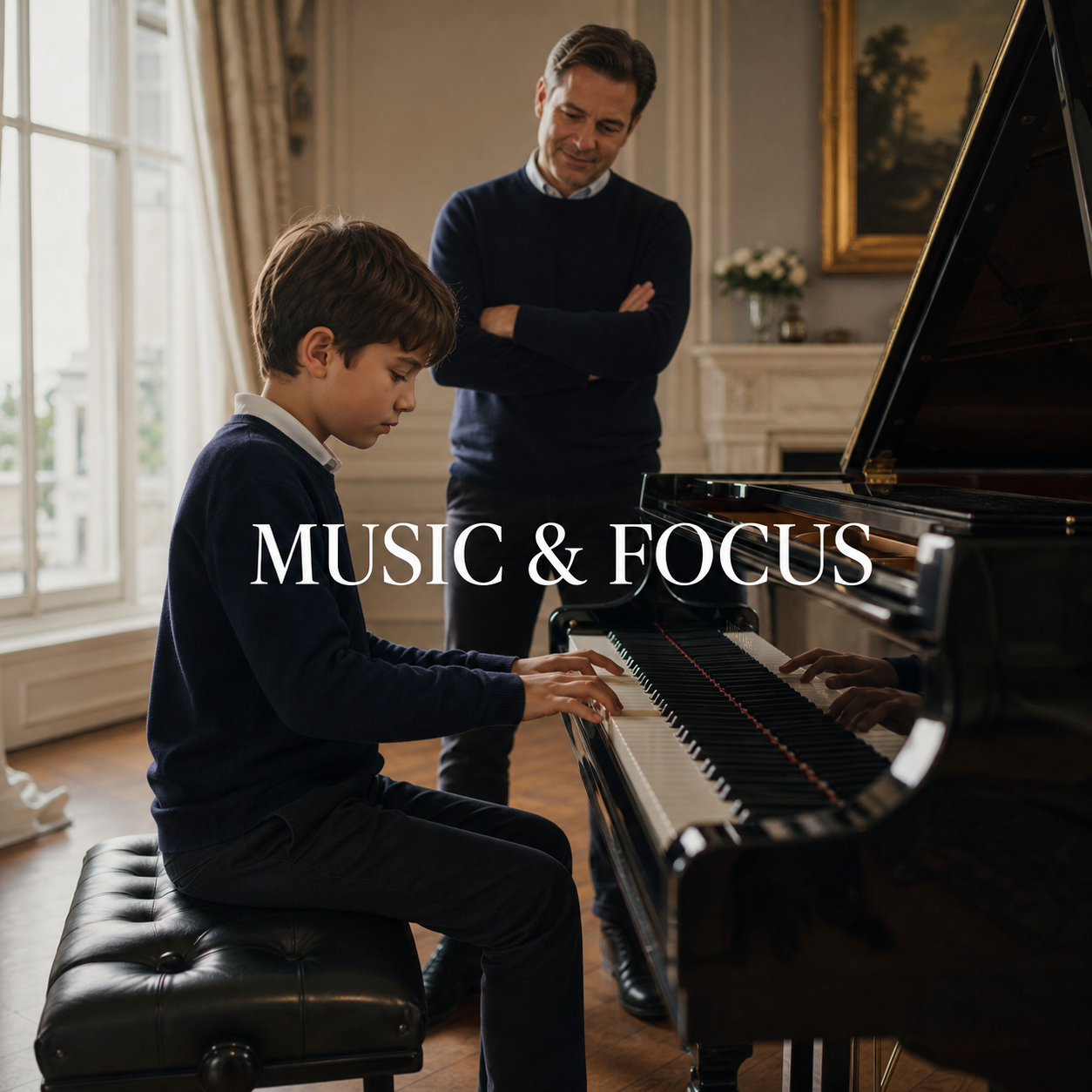
Learning music is attention in action. Evidence is strongest for modest gains in particular executive functions, especially inhibitory control and working memory in younger children. Evidence for broad improvements in school attainment is much less certain.
Music and concentration: what the research actually says
Bottom line for parents: studies justify cautious optimism, not a promise that lessons will make every child generally more attentive.
Concentration is not one single mental faculty. Researchers usually separate it into processes such as sustained attention (staying with a task), inhibitory control (resisting an impulsive response), working memory (holding and using information) and cognitive flexibility (changing approach when the rules change). A piano lesson can call on all four. A pupil must remember a short instruction, suppress an incorrect fingering, hear whether the result matches the intention and try again.
A 2022 systematic review examined 29 controlled studies involving more than 5,400 children across music and comparison groups. It found the clearest positive pattern for inhibitory control, particularly among preschool children, while results for working memory, flexibility and older pupils were mixed. Importantly, some large orchestral studies found little or no difference on executive-function tests. The authors therefore described the evidence as beneficial but heterogeneous rather than conclusive.1
More recent syntheses have reported small-to-moderate effects. A 2024 meta-analysis of preschool studies found modest pooled improvements in working memory and cognitive flexibility, although programmes varied widely in duration, content and quality.2 A separate 2024 review focused on inhibitory control and found a positive effect across controlled longitudinal studies.3 Yet a rigorous earlier meta-analysis of cognitive and academic outcomes concluded that far-transfer effects became negligible once study quality and publication bias were considered.4
For parents
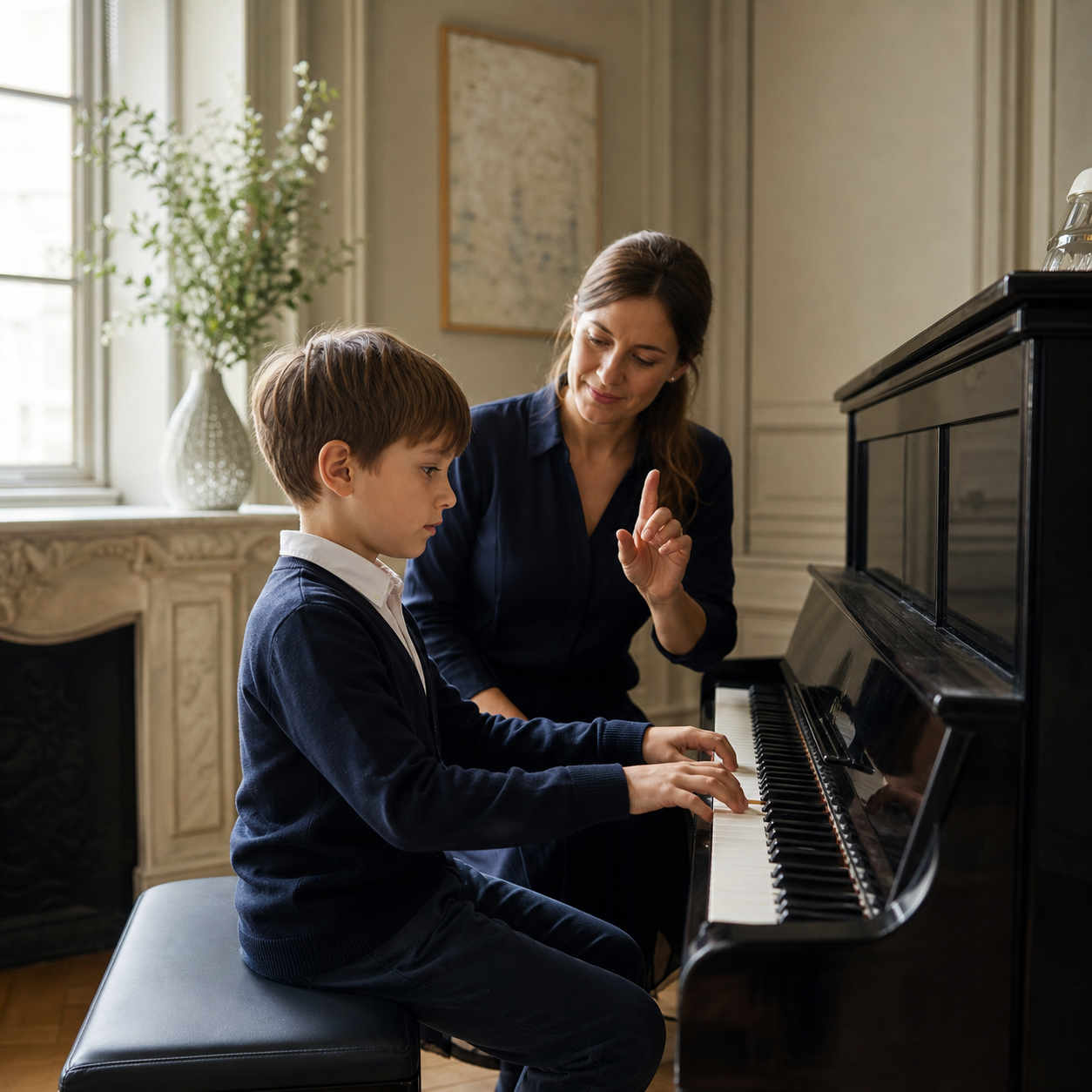
Treat concentration as a skill practised inside music, not as a guaranteed benefit transferred to every classroom task. The musical gains themselves — listening, coordination, memory, expression and independence — are already substantial reasons to learn.
Why active piano practice is different from passive listening
Bottom line for parents: playing an instrument places more organised demands on attention than simply having music in the background.
At the piano, a child has to align sound, vision, movement and timing. Even a four-note phrase requires anticipation: which finger moves next, how long the note lasts, whether the hand remains relaxed and what the ear expects to hear. When a mistake occurs, the pupil must pause the automatic response and choose a better one. That loop is a practical form of self-monitoring.
The distinction between near transfer and far transfer is helpful. Near transfer means becoming better at closely related tasks: keeping a pulse, following a musical sequence or noticing a wrong note. Far transfer means improvement in a distant domain, such as reading comprehension or mathematics. Near transfer is expected and readily visible. Far transfer is much harder to prove because family background, motivation, teaching quality and prior attainment can influence both musical participation and academic outcomes.
The focus loop at the piano
Notice rhythm, tone and the teacher’s cue.
Hold one small musical intention in mind.
Coordinate both hands and timing.
Compare the result and try once more.
A practical concentration plan for home practice
Bottom line for parents: short, purposeful practice usually develops better attention than a long session measured only by minutes.
A young beginner may work well for five to ten focused minutes; an older or more experienced pupil may manage several longer blocks. These are starting points, not age-based rules. Stop before posture, sound and patience collapse. A child who finishes a clear task successfully is more likely to return willingly tomorrow.
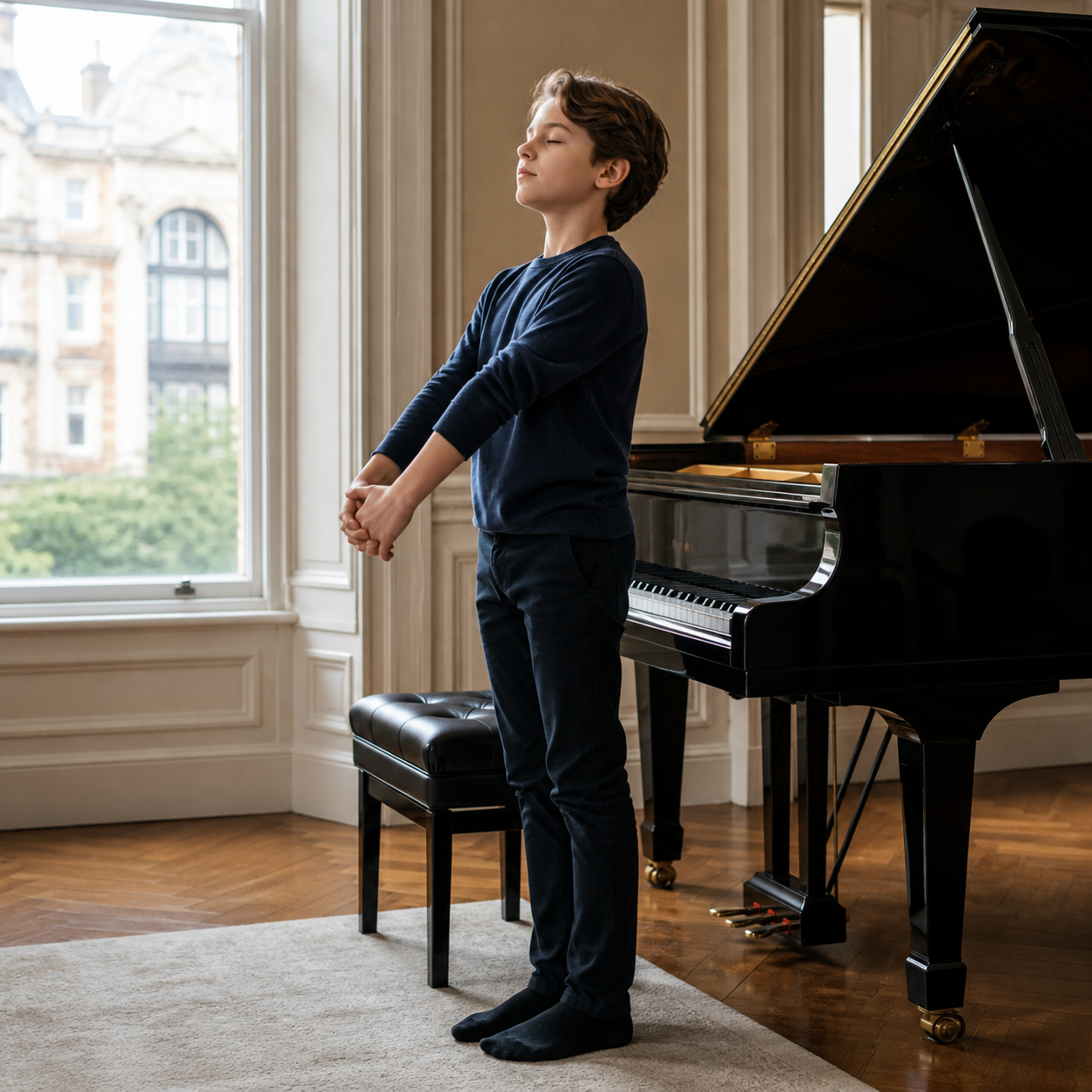
Begin by agreeing one outcome small enough to hear: an even rhythm in two bars, a relaxed change of hand position or a phrase played without stopping. Remove unnecessary choices by preparing the stool, music and pencil before the child begins. During the task, resist correcting every detail. Too many instructions divide attention and can turn practice into a test of obedience. Let the child finish, ask what they noticed, then offer one useful cue. This pattern gradually transfers responsibility from the adult to the young musician.
| Practice choice | What it trains | Parent prompt |
|---|---|---|
| One phrase, three careful tries | Sustained attention and comparison | “What will you listen for this time?” |
| Clap before playing | Impulse control and rhythmic prediction | “Can you feel the pulse before your hands begin?” |
| Name one success | Self-monitoring and motivation | “What became easier?” |
| Brief movement break | Resetting attention before fatigue | “Shall we stretch, then finish with your best phrase?” |
Teacher’s note
A vague instruction such as “concentrate” gives a child no action. A musical instruction — keep the pulse steady, release the final note together, shape the phrase to its high point — gives attention somewhere precise to go.
Background music can help mood and still hinder thinking
Bottom line for parents: music for learning and music playing behind another task are not the same intervention.
Parents sometimes infer that if piano lessons exercise concentration, background music must improve homework. Research does not support such a simple rule. A 2023 experiment found that music with lyrics impaired verbal and visual memory and reading comprehension by roughly a small effect, while instrumental music neither reliably helped nor harmed performance.5 Other reviews find mixed results because volume, familiarity, lyrics, personality and task difficulty all matter.
For reading, writing or learning verbal material, silence is the safest baseline. If a child insists that quiet instrumental music helps, compare conditions rather than argue: use the same type of homework on two days, keep volume low, and ask which condition produced accurate work with fewer prompts. Music can be useful before work as a transition ritual even when it is distracting during the task itself.
“The aim is not to make a child sit still for longer. It is to help them notice, choose and complete one meaningful musical task.”
When attention differs: ADHD, sensory needs and anxiety
Bottom line for parents: an adaptable lesson can support participation, but piano tuition is not a diagnosis or treatment.
Children vary greatly in how they regulate attention. Some need movement before sitting; some focus better when the teacher demonstrates rather than explains; others find a resonant acoustic piano, a busy page or rapid correction overwhelming. The first useful step is to tell the teacher what the child already knows about their own attention.
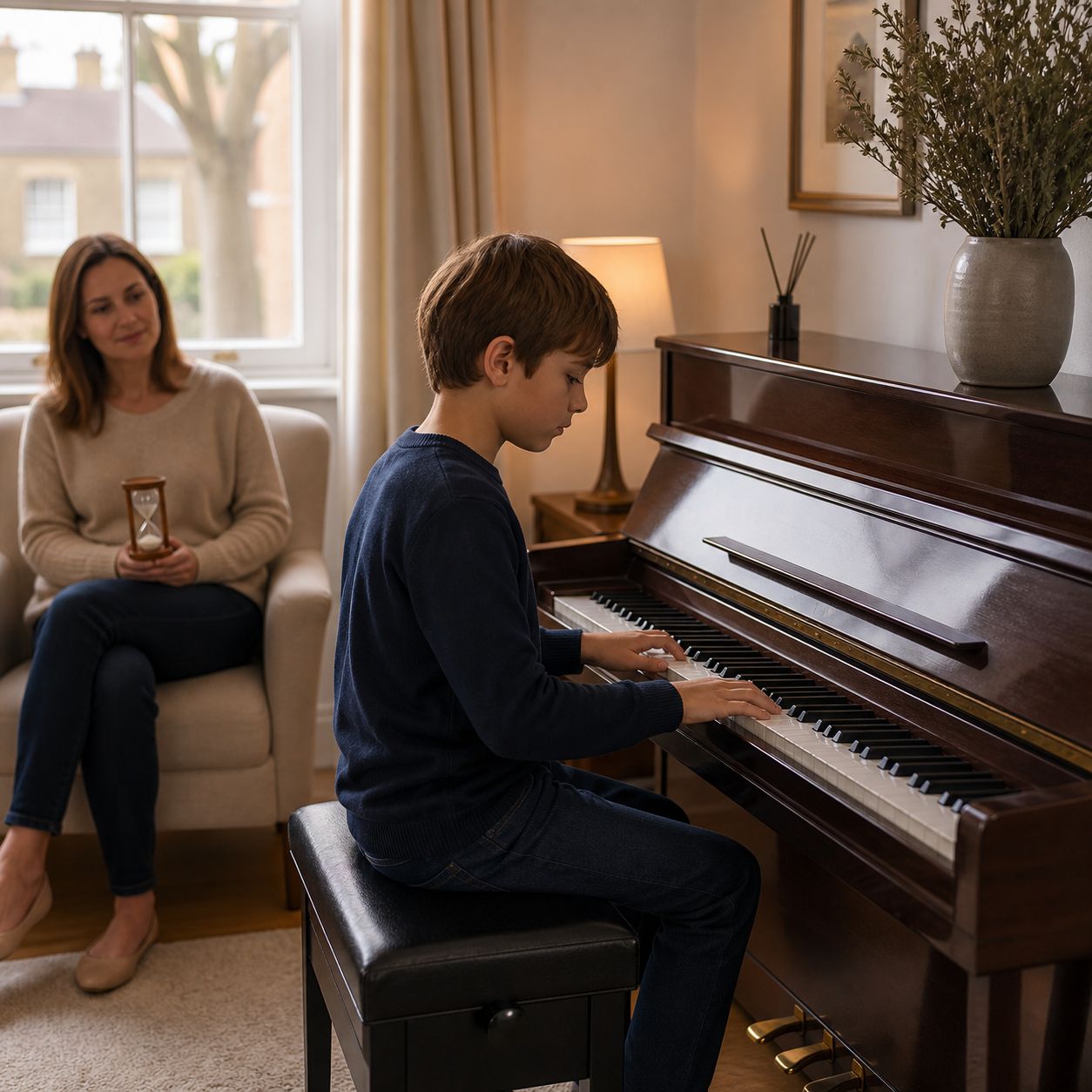
Practical adjustments may include a predictable lesson order, one instruction at a time, permission to stand for rhythm work, shorter playing blocks, fewer markings on the page and a clear choice between two tasks. NHS guidance likewise emphasises individual differences: some children find quiet helpful, while others use steady sound or movement breaks to regulate attention.6 If concentration difficulties affect school, relationships or daily life, parents should seek appropriate professional advice rather than expecting lessons to solve the problem.
A useful first conversation
Tell the teacher when the child is freshest, what signs show overload, which prompts work at home and what the child enjoys. This is more useful than a label on its own.
How to recognise genuine progress
Bottom line for parents: measure musical independence first and treat wider concentration changes as welcome but uncertain.
Progress may appear as starting without repeated reminders, listening through a complete demonstration, correcting one error independently or returning to the correct place after distraction. These are observable behaviours. A simple monthly note is more revealing than judging a single difficult evening.
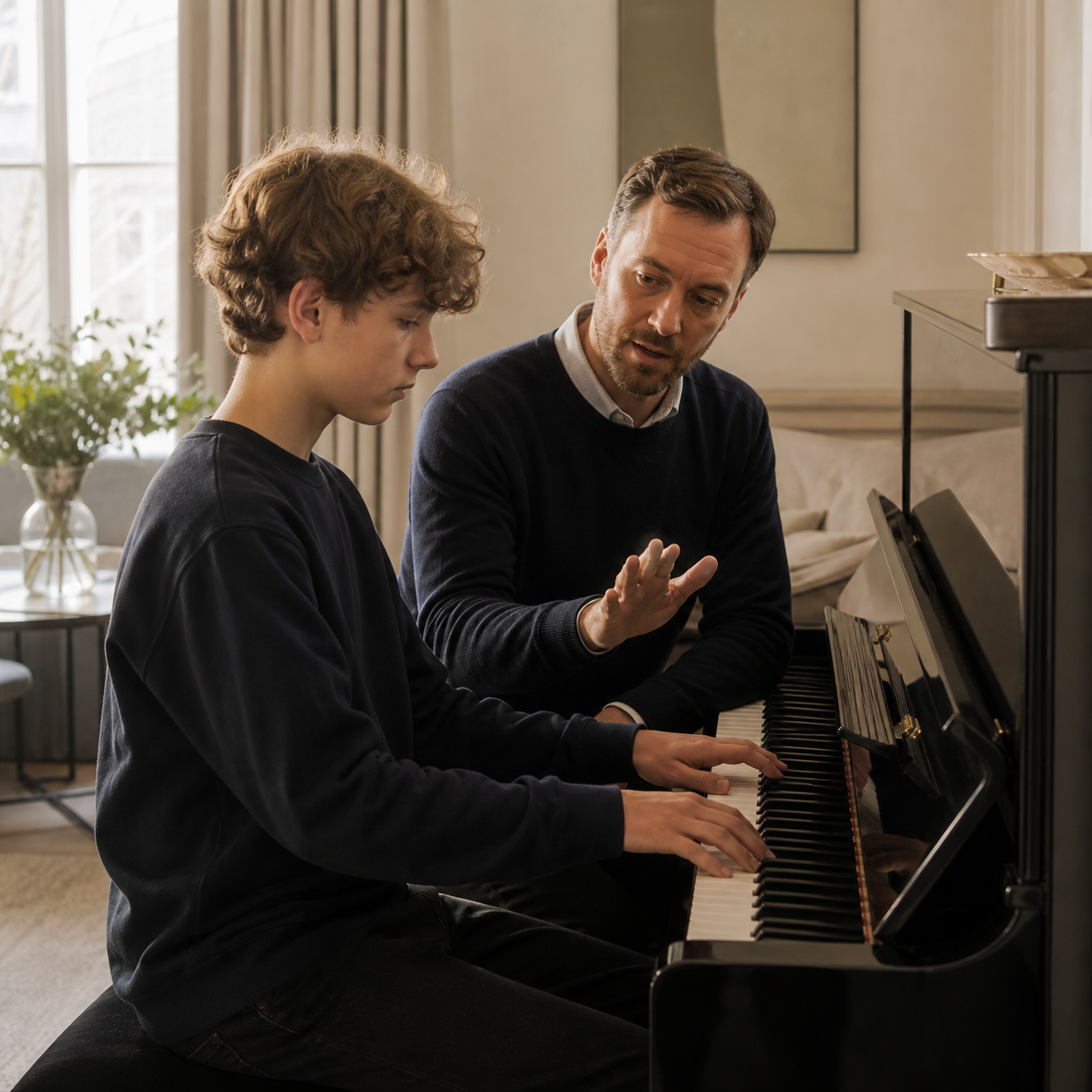
Do not compare siblings or expect a smooth upward line. New repertoire can temporarily make practice look less fluent because it demands more planning. Likewise, enthusiasm may surge before a recital and dip after it. The stable signs are better self-correction, a growing tolerance for challenge and increasing ownership of musical decisions.
For a simple record, choose three behaviours and review them once a month: beginning within a reasonable time, completing the agreed task and identifying one improvement without help. Keep the language neutral. A difficult day is information about sleep, hunger, stress or task size, not proof that the child lacks discipline. If the pattern remains difficult, the teacher can simplify the assignment or change how it is presented.
Academic outcomes should be interpreted separately. The Education Endowment Foundation’s controlled Act, Sing, Play evaluation found no evidence that music workshops improved maths or literacy more than drama workshops, although teachers reported confidence and social benefits for some pupils.7 That is a useful reminder to value music for what it teaches directly.
Building focused musical learning in London
Bottom line for parents: lesson fit matters more than grand claims about cognitive benefits.
When considering structured piano lessons for children in London, ask how the teacher sets a clear goal, adapts the length of tasks and helps the pupil hear improvement. You might also read WKMT’s guidance on how much a child needs to practise and its overview of the best age to start piano lessons. These are real questions, but the answer should remain individual.
Ofsted’s review of music education makes a related point: pupils must make music and think musically; attention is not an abstract add-on but a condition for remembering and refining musical material.8 A well-planned lesson therefore balances challenge with attainable steps, leaving the child with one precise task they can repeat at home.
A calm next step
Explore a lesson structure that gives your child clear musical goals, thoughtful feedback and room to develop at their own pace.
Sources and further reading on Music and concentration
- Degé and Frischen, Effects of music training in executive function performance in children: a systematic review, Frontiers in Psychology, 2022.
- Li et al., Effects of music training on executive functions in preschool children aged 3–6 years, systematic review and meta-analysis, 2024.
- Jamey et al., Does music training improve inhibition control in children?, Cognition, 2024.
- Sala and Gobet, Cognitive and academic benefits of music training with children, multilevel meta-analysis, 2020.
- Kiss and Linnell, Should We Turn off the Music? Music with Lyrics Interferes with Cognitive Tasks
- Royal Devon University Healthcare NHS Foundation Trust, ADHD strategies to help with distraction
- Education Endowment Foundation, Act, Sing, Play trial
- Ofsted, Research review series: music, GOV.UK