
 TRIAL LESSON
Pianists, Piano Lessons
Murray Perahia in London: Mozart, Schumann and the Art of Serious Piano Listening
Jun
Murray Perahia in London
WKMT London listening guide
Murray Perahia in London: Mozart, Schumann and the Art of Serious Piano Listening
A cultured guide to Murray Perahia, his British musical connections, his recorded legacy and the listening habits that help London pianists hear more deeply.
Why Perahia Still Matters in London
Murray Perahia belongs naturally in London musical conversation because his career joins American pianism, British institutions and a deeply European idea of listening. The exact keyword Murray Perahia usually leads readers towards biography and discography; the richer question is how his playing teaches us to listen.
Perahia is not a pianist of display for display’s sake. In Mozart he makes conversation audible. In Schumann he keeps fantasy tethered to harmonic direction. In Bach he finds warmth without clouding the contrapuntal line. For London listeners, students and serious amateurs, that makes him an ideal figure through whom to connect recordings, concert culture and study.
Listening premise: Perahia’s art asks us to hear the phrase behind the notes: where it begins, where it leans, where it releases, and why the smallest rhythmic freedom can feel inevitable.
Career Snapshot and UK Connections
Born in New York in 1947, Perahia began piano at four and later studied at Mannes College, with formative summers at Marlboro. The Academy of St Martin in the Fields notes his work with Rudolf Serkin, Pablo Casals, the Budapest String Quartet and Mieczyslaw Horszowski, as well as a lasting friendship with Vladimir Horowitz [1].
The British thread is decisive. Perahia won the Leeds International Piano Competition in 1972, the breakthrough that led to European engagements. In 1973 he made his first Aldeburgh Festival appearance, where he worked with Benjamin Britten and Peter Pears; he later served as co-artistic director of Aldeburgh from 1981 to 1989 [1].
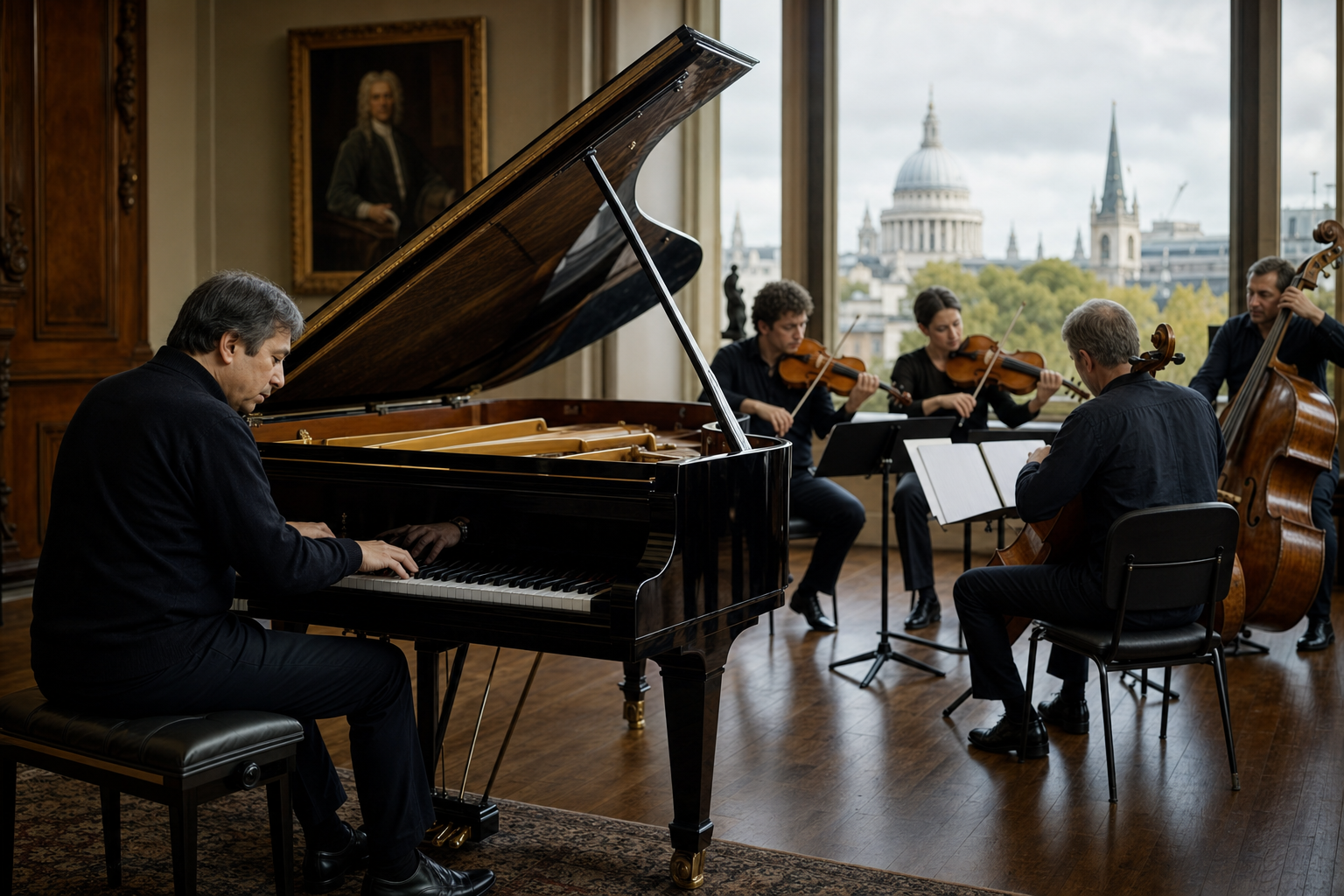
His relationship with the Academy of St Martin in the Fields added a London chamber-orchestral dimension. ASMF describes him as Principal Artist and records his work as both conductor and pianist, including tours in which he directed Beethoven’s piano concertos from the keyboard [1]. Askonas Holt also lists his honorary KBE, awarded in 2004 for services to music [2].
Repertoire and Interpretive Voice: Mozart, Schumann, Bach, Beethoven
Perahia’s Mozart is often described through warmth and transparency, but those words only become useful when we ask what they mean physically. The sound is clean without becoming brittle; inner voices are present without sounding underlined; cadences breathe as if they are spoken rather than declared.
In a Steinway interview, Perahia explains his continuing love for Mozart by pointing to the composer’s humanity: the operatic sense that even difficult characters are understood and loved [3]. That insight matters at the keyboard. The pianist’s tone must carry feeling without sentimentalising it.
His Schumann is similarly disciplined. Schumann’s sudden turns of mood can tempt pianists into exaggeration. Perahia tends instead to reveal the architecture beneath the volatility: a singing line, a hidden bass motion, a harmonic arrival that explains the preceding unrest. That is why his playing is so useful for advanced students: it shows that fantasy can be clarified without being tamed.
His Bach is shaped by a careful understanding of instrument history. In the same Steinway interview, he describes studying harpsichord sonority and reassessing discreet pedal use on the piano [3]. The point is not to modernise Bach lazily, but to preserve the sense of overhanging resonance and vocal connection.
Beethoven completes the picture. Perahia’s Beethoven does not usually trade in granite rhetoric. It prefers tension that accumulates through long-range direction. A sforzando matters because it belongs to an argument; a quiet phrase matters because it changes the weight of what follows. This is especially useful for listeners who find Beethoven sonatas impressive but opaque. Perahia’s playing helps the ear follow grammar before it chases drama.
That is why his repertoire range feels coherent. Mozart, Schumann, Bach and Beethoven are not separate compartments. They are different tests of the same musical conscience: can the pianist hear structure without becoming abstract, and can he communicate feeling without loosening the form that gives it meaning?
A Serious Listening Map
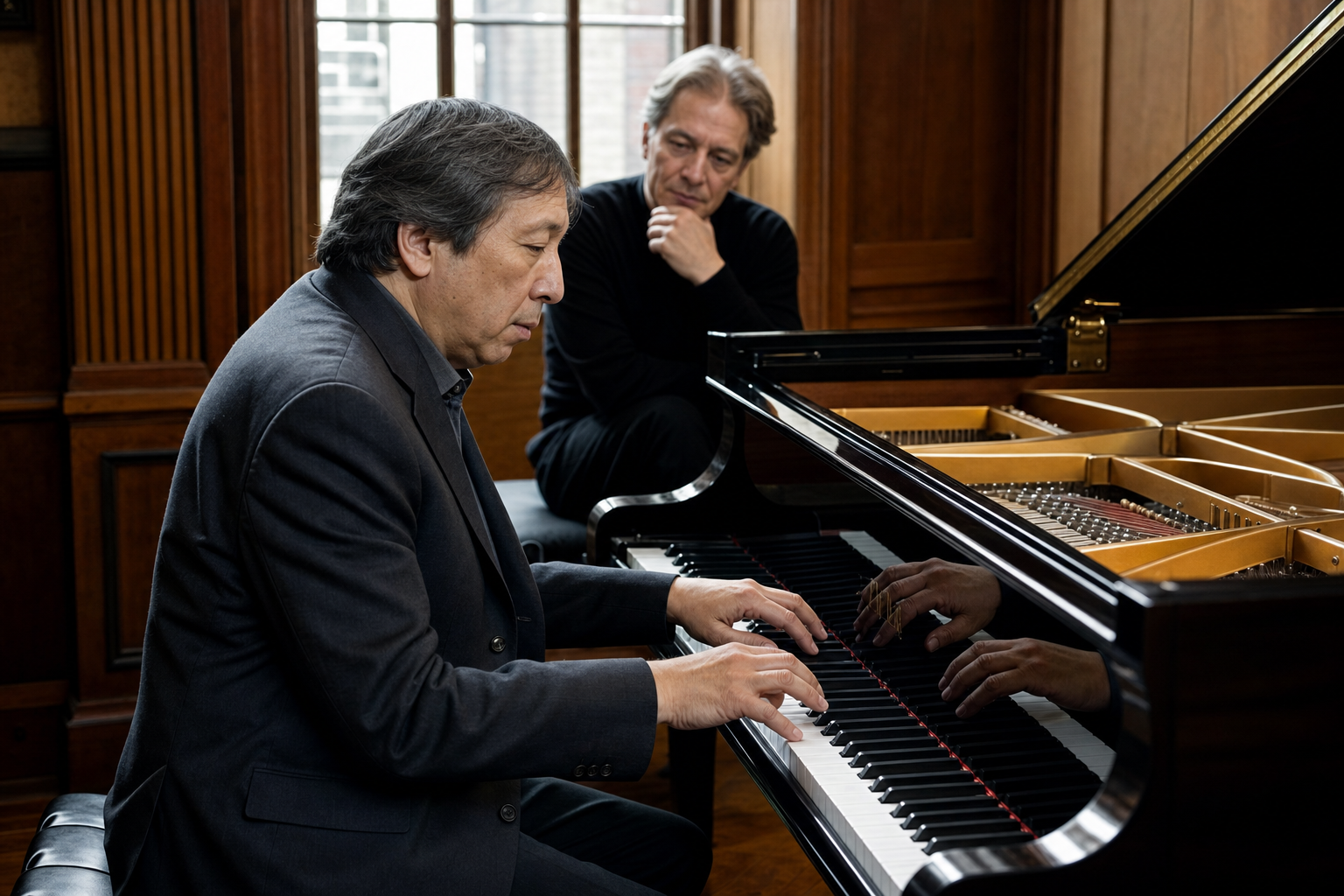
Follow one melody from start to cadence before judging the performance.
Hear whether the harmony moves with dignity, pressure or release.
Notice where tempo bends because the phrase requires space.
Compare bright articulation with cantabile weight and pedal warmth.
Five Essential Recordings for Serious Listening
Use recordings actively. Listen once for pleasure, once for structure, then once for touch. The following route keeps the focus narrow enough to be useful.
- Mozart piano concertos with the English Chamber Orchestra. Listen for conversational balance: the piano rarely sits in front of the orchestra like a lecturer. It answers, colours, interrupts and yields.
- Schumann solo works. Listen for how agitation is organised. The singing line remains legible even when the surface becomes restless.
- Bach English Suites. Listen for articulation that speaks clearly without becoming dry. The dance character should remain human, not mechanical.
- Bach French Suites. Deutsche Grammophon lists Perahia’s French Suites recording on DG, a useful late-career document of his Bach thinking [4]. Listen for warmth, restraint and luminous separation of voices.
- Beethoven sonatas. Listen for structural patience. Perahia’s work on Beethoven editions, described by ASMF and Steinway, is audible in his respect for phrase endings and dynamic detail [1][3].
Comeback, Teaching and Beethoven Editions
Perahia’s public career has also been shaped by interruptions and returns. Biographical accounts note periods of hand difficulty and renewed activity; the important lesson for listeners is not gossip about injury, but the way mature playing can deepen when virtuosity becomes more selective.
His teaching identity is equally significant. The Jerusalem Music Centre describes Perahia as its president and documents intensive work with selected young pianists through masterclasses and piano programmes [5]. That work suits his musical temperament: analysis, patience, phrase direction and a belief that a young pianist must hear the whole rather than merely polish the surface.
His Beethoven edition work reinforces the same idea. Steinway’s interview presents Perahia discussing manuscripts, sketches, first editions, phrase endings, dynamic details and fingering as musical evidence rather than mechanical convenience [3]. Fingering, in this view, is not only how one survives a passage. It can show how a phrase thinks.
Teacher’s Note
For advanced adult pianists, the most transferable Perahia habit is not a mannerism of tone. It is the refusal to separate technique from listening. The hand serves the phrase; the phrase serves the harmony; the harmony serves the expressive whole.
Critical Perspectives and What Listeners Hear
The most persuasive writing about Perahia tends to return to the same cluster of qualities: clarity, warmth, proportion, inwardness and command. Deutsche Grammophon describes his interpretations as lessons in sensibility, sophistication and expressive intensity, while noting that his approach draws attention to the music rather than the musician [6]. That is a useful description because it avoids the false opposition between intellect and feeling.
Steinway’s long interview gives the reader a more intimate version of the same idea. Perahia discusses Heinrich Schenker not as a dry theoretical system, but as a way of hearing forces beneath the notes: foreground, middle ground, background, direction and emotional necessity [3]. For a listener, this means that musical detail is never isolated. A trill, an accent, a delayed resolution or a softened cadence is heard in relation to the whole phrase.
One should also notice what critics and admirers do not usually emphasise. Perahia is not commonly valued for theatrical eccentricity, extreme tempos or conspicuous reinvention. His authority is quieter. It comes from making standard repertoire seem freshly inevitable. When this succeeds, the listener stops thinking about interpretation as an overlay and begins to hear the piece itself thinking aloud.
For adult learners: listen first for the quality of inevitability. If a phrase sounds natural, ask what made it so: touch, harmonic awareness, timing, balance, or the courage to leave something unforced.
Where to Hear Perahia-like Programmes in London
London listeners can keep Perahia’s repertoire alive even when he is not on a current bill. Look for Mozart concerto cycles, Bach keyboard evenings, Schumann recitals and chamber-orchestra programmes where the piano is treated as a partner rather than a display instrument. WKMT’s own classical concerts in London and London piano masterclasses offer a practical route into this culture.
For study, connect listening with lessons that cultivate interpretation. WKMT’s main classical piano study in London remains the primary path, with adult piano lessons at WKMT especially relevant for serious amateurs returning to Mozart, Schumann, Bach and Beethoven.
A practical London listening habit is to build small seasons for yourself. Pair one live recital with two recordings and one lesson or score-reading session. If you hear a Mozart concerto in performance, spend the following week comparing Perahia’s balancing of piano and orchestra. If a Schumann programme appears, listen for how fantasy and structure can coexist. If a Bach evening is listed, ask how the performer handles resonance without losing contrapuntal definition.
This kind of listening is modest, but it changes the ear. It teaches the pianist to notice transitions, not only themes; to hear cadences as events, not punctuation marks; and to recognise that the quietest bars often carry the strongest structural responsibility.
Listening Checklist for One Session
| Question | What to notice |
|---|---|
| Where is the melody really going? | Direction, not just beauty of sound. |
| What does the bass explain? | Harmonic pacing, tension and release. |
| When does time flex? | Rubato that follows voice-leading rather than habit. |
| How much pedal is enough? | Resonance that supports phrasing without blurring it. |
Study This Repertoire with WKMT
If Perahia’s Mozart, Schumann, Bach or Beethoven has sharpened your ear, WKMT can help turn that listening into controlled tone, phrase direction and mature interpretation.
How to Use This Guide at the Piano
Choose a short passage, ideally eight to sixteen bars, from Mozart, Schumann, Bach or Beethoven. Before playing it, listen to a Perahia recording of similar repertoire and write down one sentence only: what seems to carry the phrase? It might be the top line, the bass, a suspension, a rhythmic hesitation or a change of colour.
Then return to your own score and test the same question without copying his sound. The aim is not to become Murray Perahia. It is to use Murray Perahia as a disciplined listening model: phrase before speed, harmony before gesture, tone before volume, direction before decoration.
In lessons, this approach can be especially fruitful because it gives teacher and student a shared musical problem. Instead of saying “play more expressively”, the teacher can ask: where does this phrase want to resolve, and which note must carry that resolution? Perahia’s playing repeatedly points the ear towards that kind of exact question.
Short Questions
What is Murray Perahia best known for?
He is best known as a pianist and conductor whose repertoire includes Bach, Mozart, Beethoven, Schumann and Chopin, with major British connections through Leeds, Aldeburgh and the Academy of St Martin in the Fields.
Why is Perahia important for adult pianists?
His playing shows how tone, analysis, phrasing and restraint can work together. Adult learners often find his recordings useful because they reveal musical structure without sounding dry.
Which recording should I start with?
Begin with Mozart if you want conversational clarity, Schumann if you want expressive narrative, or Bach’s French Suites if you want late Perahia’s balance of warmth and line.