
 TRIAL LESSON
Piano Lessons
Metronome Practice at the Piano: How Adults Build Pulse Without Becoming Rigid

Oct
WKMT London adult learner guide
Metronome Practice at the Piano: How Adults Build Pulse Without Becoming Rigid
A metronome is most useful as a listening partner, not a ruler. Used selectively, it exposes where pulse bends unintentionally, helps coordinate complex movement and then steps aside so phrasing can breathe on a dependable internal beat.
In brief
Effective metronome practice at the piano begins away from difficult notes: find the pulse, clap or tap the rhythm, choose a slow workable tempo and play a short unit while listening for whether the click disappears into accurate timing. Use subdivisions for uncertainty, wider-spaced clicks for independence, and regular click-free tests. The aim is to internalise pulse, not to make every performance mechanically equal.
Metronome practice piano work begins with diagnosis
Before switching on the click, play once and identify the problem. Are you rushing through easy notes, slowing before a leap, misreading a rhythm or losing coordination between the hands? Metronome practice piano work is efficient when it answers one question. A click cannot repair fingering or tension by itself.
Set a tempo at which the chosen unit is physically comfortable and musically recognisable. Count one full bar before entering. If the click feels like an opponent, stop and tap the pulse while speaking the rhythm. Reconnect movement to time before adding the keyboard’s extra demands.
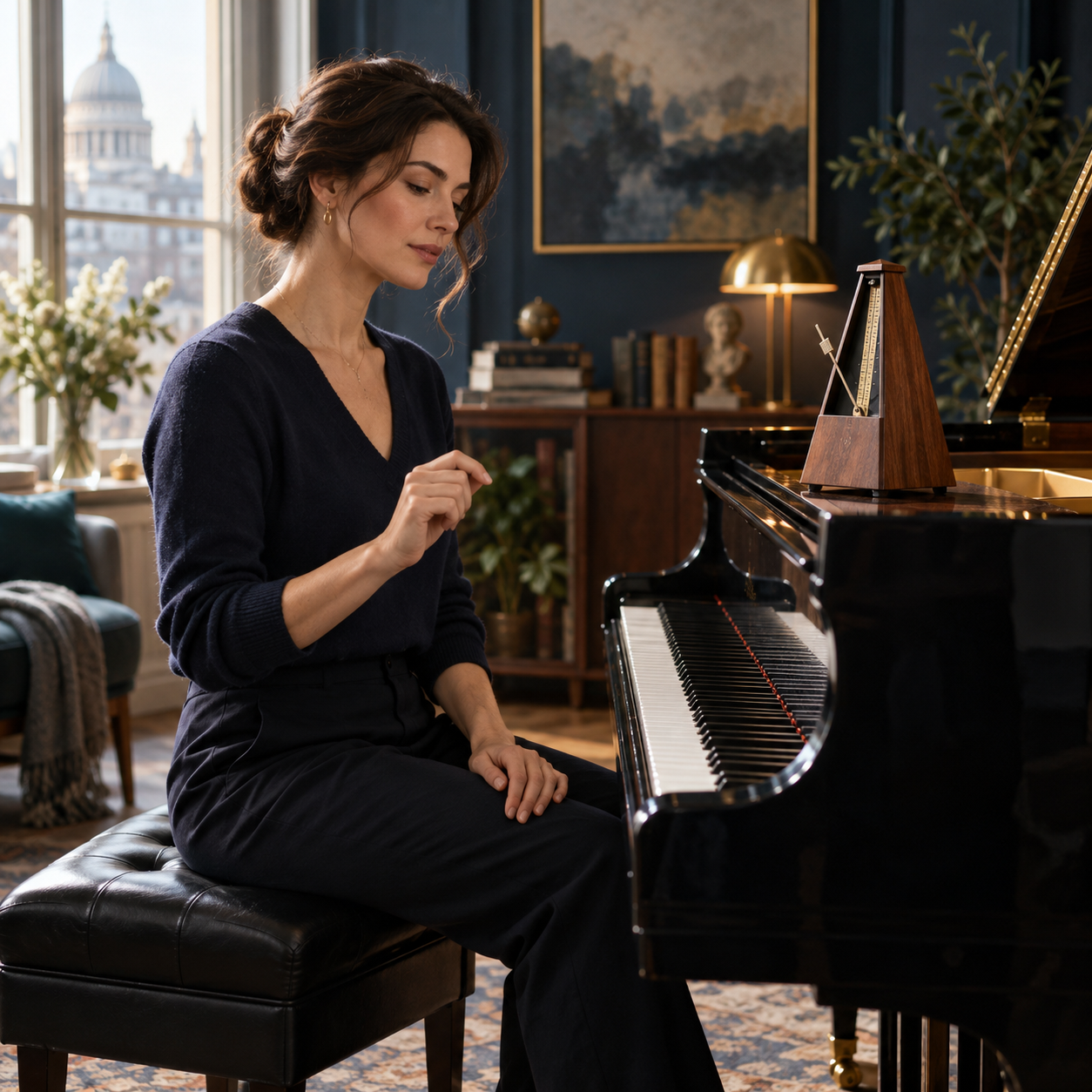
Hear subdivision before increasing speed
A steady beat contains smaller divisions. Quavers, triplets and semiquavers must be heard in relation to it, not squeezed into the spaces by hope. Place the metronome on the main beat, speak or clap the subdivisions, then play one hand. Accuracy improves when the mind knows exactly where each event belongs.
In adult piano lessons in London, a teacher can decide whether the difficulty is rhythmic, technical or perceptual. WKMT’s guide to slow practice at the piano shows how reduced tempo becomes useful when listening guides every repetition.
Use the disappearing click as feedback
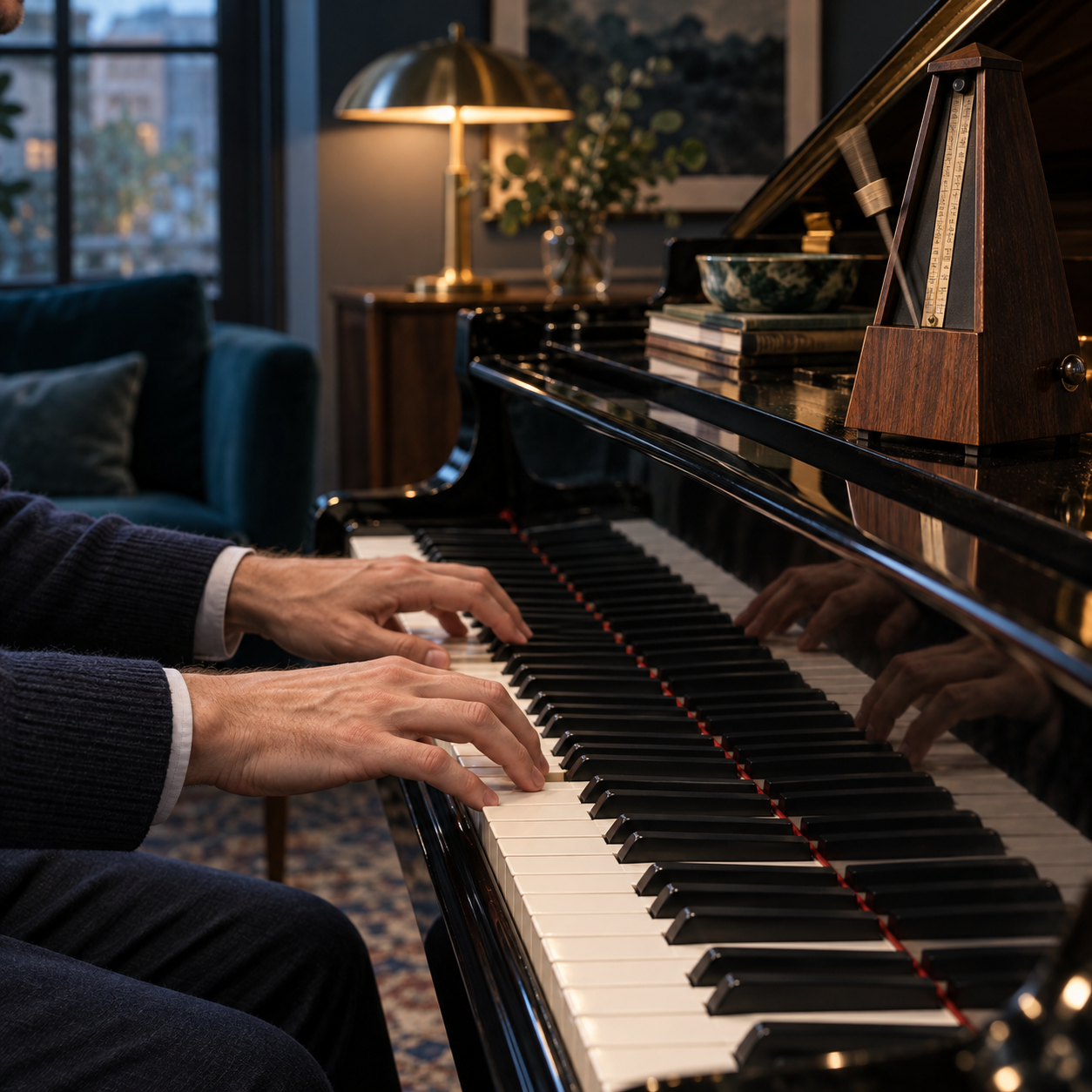
When playing is exactly aligned, the metronome may seem to disappear beneath the attack. That moment is useful feedback. If the click repeatedly emerges before you, you may be late; if it sounds after you, you may be rushing. Do not correct by lurching. Stop, hear the subdivision again and restart the small unit.
This method keeps metronome practice piano work auditory rather than punitive. Use two or three successful repetitions, then turn the click off and test whether the pulse remains. Record both versions. The contrast shows whether you have internalised time or merely followed an external signal.

The metronome should reveal time, lend support and then disappear from the musical imagination.
Widen the beat to build independence
Once a passage is stable with a click on every beat, place the click on fewer beats: perhaps two and four, once per bar, or on the second half of the bar. Wider spacing asks the player to carry more time internally. Begin with simple material, because the exercise is about anticipation, not surprise.
Classical phrasing also needs flexibility. Rubato changes local timing while preserving a convincing larger pulse. Practise the structural beat first, then shape the phrase without the metronome and finally check the surrounding bars again. Freedom becomes persuasive when departure and return can both be heard.
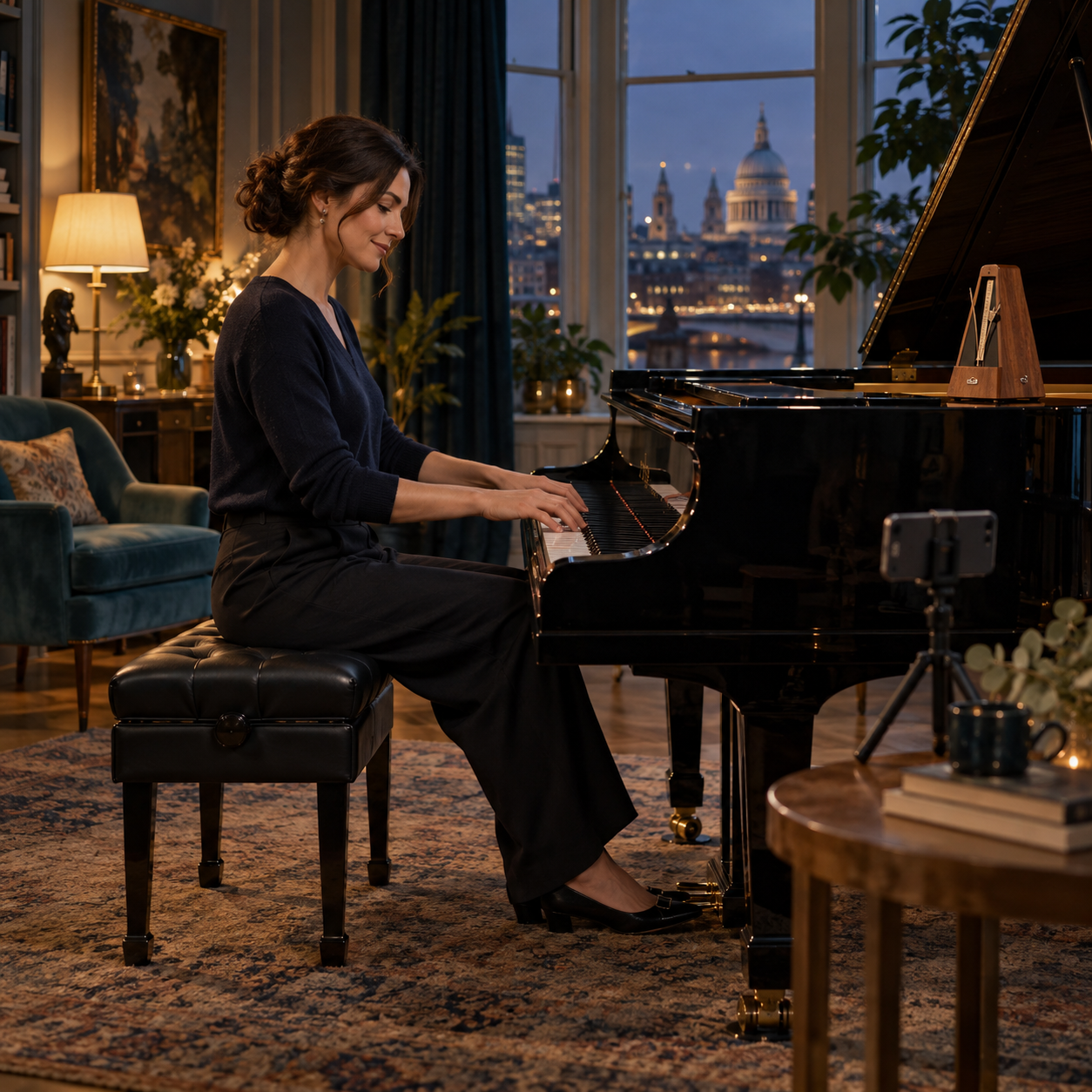
A seven-minute metronome practice piano routine
Spend one minute tapping and counting, two minutes on a short passage at a comfortable tempo, one minute with a slower subdivision check, one minute with wider-spaced clicks, and two minutes without the metronome. Note where timing changed and choose one detail for the next session.
Avoid climbing the tempo after every correct attempt. Increase only when sound, movement and pulse remain secure, and return briefly to a slower tempo after a faster test. Metronome practice piano work has succeeded when the final click-free performance feels calmer, clearer and more musically directed.
WKMT London
Build a flexible adult practice method that joins reliable pulse, comfortable movement and expressive phrasing.
Explore adult piano lessonsSources on metronome practice piano
- Encyclopaedia Britannica: metronome
- Royal College of Music Centre for Performance Science
- BAPAM healthy practice resources
- Oxford Handbook of Music Performance
- University of Pretoria research on deliberate practice
- Music Theory Online
Sources checked 10 October 2026. Educational guidance; individual circumstances and progress vary.