
 TRIAL LESSON
Pianists, Uncategorized
Maurizio Pollini in London: Modernism, Chopin and the Art of Serious Piano Listening
Jun
Maurizio Pollini in London
WKMT serious listening guide
Maurizio Pollini in London: Modernism, Chopin and the Art of Serious Piano Listening
Maurizio Pollini in London, with a listening guide to Chopin, Beethoven and modernism for serious pianists and adult learners.
Introduction
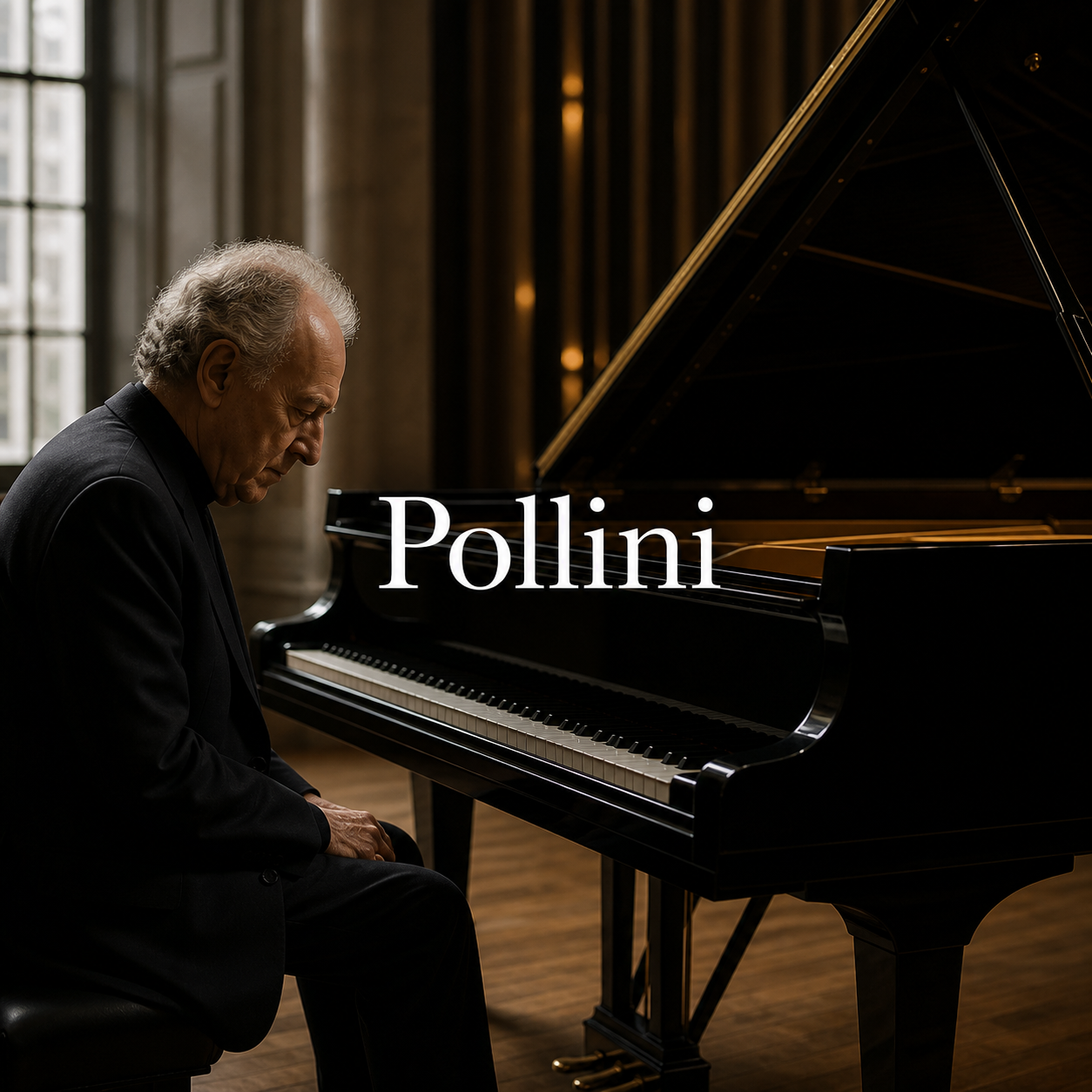
Maurizio Pollini belongs to that rare class of pianist whose reputation rests less on personality than on the force of attention itself. His playing could seem severe at first hearing: clean attack, exact release, a refusal to sweeten structure for easy charm. Yet for pianists who listen closely, that severity opens a door into tone, architecture and musical conscience.
This guide treats Pollini as a listening subject for London readers: not a museum label, but a practical way of hearing Chopin, Beethoven, Debussy and post-war modernism more seriously. It supports WKMT’s wider work in classical piano study in London, while also speaking naturally to advanced adult learners who want more than a list of famous recordings.
Pollini’s discipline is useful because it teaches the listener to hear proportion before display, and musical argument before pianistic glamour.
Life & Career
Pollini was born in Milan on 5 January 1942 and died there on 23 March 2024. Deutsche Grammophon records his early path with unusual clarity: lessons from the age of five, studies with Carlo Lonati and Carlo Vidusso, graduation from the Milan Conservatory in 1959, and private work with Arturo Benedetti Michelangeli after his Warsaw triumph [Deutsche Grammophon biography.
That triumph was the Sixth International Chopin Competition in Warsaw, won when Pollini was eighteen. The standard legend is almost too convenient: the young virtuoso conquers Chopin, then conquers the world. Pollini’s actual path was more interesting. Rather than converting the prize immediately into a conventional solo career, he withdrew enough to enlarge his repertoire, his musical language and his intellectual ground.
The early Chopin association never disappeared. His 1960s and 1970s Chopin recordings remain central to his identity, especially the Etudes and later Preludes. But Pollini did not accept the old division between Romantic repertoire and modernist difficulty. His 1972 Deutsche Grammophon debut placed Boulez’s Second Piano Sonata beside Stravinsky, Prokofiev and Webern, announcing that post-war modernism could sit inside a major pianist’s core repertory rather than at its edges.
His political and civic imagination also mattered. Pollini shared with Claudio Abbado and Luigi Nono the belief that serious music need not be socially sealed. Deutsche Grammophon notes concerts in factories and schools during the 1970s, and HarrisonParrott records his championship of Boulez, Stockhausen, George Benjamin, Bruno Maderna, Nono, Sciarrino and Manzoni [HarrisonParrott artist page.
There was still a grand tradition. Beethoven, Schumann, Brahms, Chopin, Debussy and the Second Viennese School formed the centre of gravity. Pollini recorded Beethoven’s five piano concertos live with Abbado and the Berliner Philharmoniker in 1992-93, pursued complete Beethoven sonata cycles across major cities, and completed his Deutsche Grammophon sonata cycle in 2014 [Deutsche Grammophon biography and discography.
Listening Framework
How the note begins: clean, weighted, percussive or voiced.
How sound is allowed to leave the phrase.
How resonance clarifies, colours or blurs harmony.
How tempo and phrase reveal long-range architecture.
Pollini in London
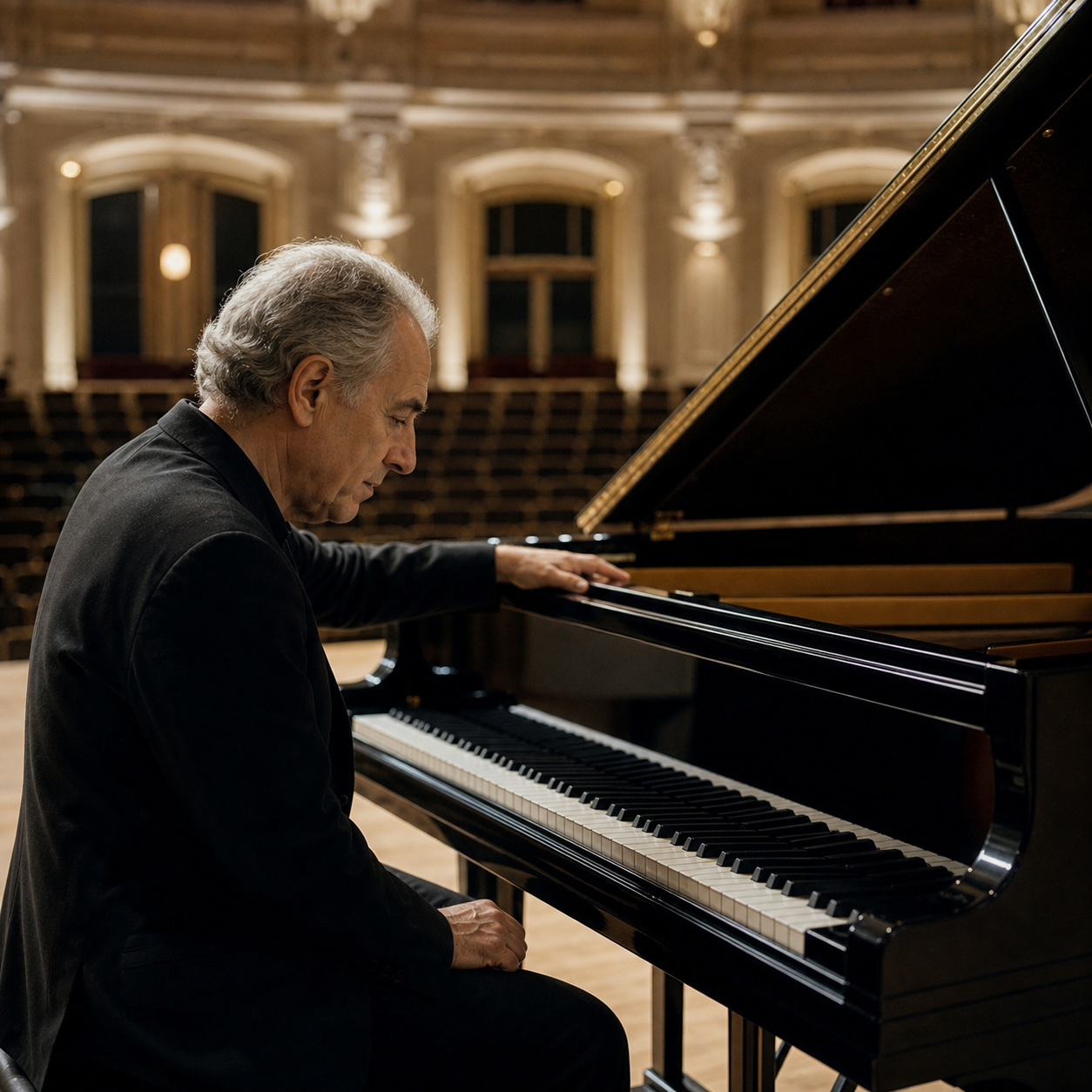
London mattered to Pollini because it rewarded both the heroic and the severe. Deutsche Grammophon describes his re-emergence after Warsaw through London and Berlin debuts, and later notes a 2011 London series that traced a wide arc from Bach to Stockhausen, through Beethoven, Chopin, Schumann and Debussy [DG biography.
His London profile included the Royal Festival Hall and the Royal Albert Hall. One available BBC Proms event record places him at the Royal Albert Hall on 10 September 1974 in Liszt’s Totentanz with the BBC Symphony Orchestra under Sir Charles Groves [BBC Music Events. That is a useful counterweight to the idea of Pollini as only a controlled studio classicist: the Proms context places his precision inside a public, risk-bearing concert culture.
The Southbank also became associated with his Beethoven. Kajimoto’s artist profile notes complete Beethoven sonata cycles in major halls including London’s Royal Festival Hall [Kajimoto artist profile. Later reviews were not always indulgent; a 2015 Royal Festival Hall response in The Arts Desk heard greatness alongside visible technical vulnerability. For adult pianists, that late-career complexity is instructive. Interpretation survives only when technique, stamina and judgement keep negotiating with time.
The London lesson is not that Pollini belonged to one venue or one season. It is that his art made sense in a city where historical recording, festival listening and serious piano teaching overlap. His London appearances give today’s listener a local reason to treat his recordings as living study material rather than distant prestige objects.
Repertoire & Interpretive Profile
Pollini’s Chopin is often described as objective, but that word can mislead. In the Etudes, objectivity does not mean coldness; it means that the musical problem is not covered by theatre. Listen to the left hand in Op. 10 No. 12 or the quiet pressure in Op. 25 No. 7. The emotion comes from proportion and control, not from applied sentiment.
In Beethoven, Pollini’s strength lies in structural pacing: the ability to make a movement feel inevitable without flattening its internal tensions. Brendel often sounds more conversational, Arrau more philosophical in weight, Argerich more volcanic in impulse. Pollini is different. He makes the listener hear the score’s argument, sometimes at the expense of immediate warmth, but rarely at the expense of coherence.
Debussy and the modernists complicate the portrait. Pollini’s Debussy can be crystalline rather than perfumed; he tends to clarify layers rather than dissolve them. In Boulez and Nono, the same quality becomes an ethical stance. The pianist does not ask modern music to apologise for itself. He gives it the same seriousness granted to Chopin and Beethoven.
This matters pedagogically. Advanced pupils often separate beauty from discipline: tone on one side, analysis on the other. Pollini suggests a harder and more useful unity. Touch, rhythm, voicing and structure are not accessories to expression. They are the means by which expression becomes trustworthy.
Teacher’s Note
For serious adult learners, Pollini is best studied in short listening sessions. Choose one page of score, one recording, and one question: where does the phrase truly turn, where does the bass change the argument, or where does the pedal alter the harmony?
Curated Discography & Listening Guide
The following selections are deliberately practical. They are not a complete discography; Deutsche Grammophon maintains the broad catalogue, including posthumous and anniversary releases [DG discography. Use these recordings as a pathway into Pollini’s listening world.
1. Starter recordings
- Chopin: Etudes Opp. 10 & 25, Deutsche Grammophon. Availability: DG catalogue and streaming platforms. Listen for: left-hand clarity that turns difficulty into musical grammar.
- Beethoven: The Late Sonatas, Deutsche Grammophon. Availability: DG catalogue, including later reissues. Listen for: long-range pacing in Op. 111’s transition from argument to stillness.
- Boulez: Piano Sonata No. 2, Deutsche Grammophon. Availability: DG catalogue. Listen for: rhythmic precision that makes modernist density sound physically inevitable.
- Debussy: Etudes, Deutsche Grammophon. Availability: DG catalogue and streaming platforms. Listen for: colour made through articulation, not atmospheric haze.
2. Deep-listening choices
- Beethoven: Complete Piano Sonatas, Deutsche Grammophon. Availability: DG complete-cycle releases. Listen for: architectural consistency across early, middle and late Beethoven.
- Nono: …sofferte onde serene…, with tape. Availability: specialist modern-music releases. Listen for: piano resonance treated as memory, distance and public grief.
- Schumann: Davidsbundlertanze, Deutsche Grammophon. Availability: DG discography. Listen for: disciplined fantasy, with character shifts held inside firm rhythm.
- Brahms: Piano works, Deutsche Grammophon. Availability: DG catalogue. Listen for: dense voicing clarified without thinning the harmonic weight.
Legacy & Influence
Pollini’s influence is not easily reduced to pupils or school. It lives in a listening ethic: score first, glamour second; modern repertoire beside canonical works; virtuosity as a responsibility rather than a decoration. The Guardian’s 2024 obituary called him one of the major keyboard figures of the second half of the twentieth century, while also acknowledging the critical debate around warmth and austerity [The Guardian.
That debate is useful. A pianist who is always loved may teach less than a pianist who unsettles us. Pollini’s legacy asks whether beauty can remain beautiful when stripped of indulgence. It also asks whether modern music can be treated as central to a pianist’s culture, not as a special-interest addition after the “real” repertoire has been played.
For London learners, the practical lesson is direct. Serious piano culture depends on listening standards: how we hear voicing, how we compare performances, how we place a recording beside a live recital, and how we let repertoire sharpen our technique.
Why WKMT Listens Closely
WKMT’s classical teaching culture is built around the same broad principle: music must be understood physically, intellectually and artistically. A Pollini recording can be a lesson in tone, but only if the listener has a framework for hearing attack, release, balance and pacing.
That is why this article supports the WKMT homepage first: Pollini’s example strengthens broad London piano authority, serious study and teacher-led listening. It also naturally supports adult piano lessons at WKMT, because mature learners often come to lessons with recordings, concerts and interpretive questions already alive in their minds.
Readers who want related WKMT context may also explore Chopin Etudes, Beethoven piano sonatas, and WKMT classical concerts in London.
Study Serious Piano Listening in London
If Pollini’s playing raises questions about structure, colour or repertoire, bring those questions into guided study. WKMT teachers help adult pianists connect listening, technique and interpretation without reducing music to display.
Conclusion & CTA
Maurizio Pollini remains valuable because he refuses passive listening. He asks the pianist to hear structure, the adult learner to respect discipline, and the concertgoer to accept that modernism and Chopin can belong to the same artistic conscience. For lessons that connect repertoire, technique and interpretation, explore WKMT’s London piano tuition or book an adult-focused trial lesson.