
 TRIAL LESSON
Piano Lessons
Lifelong Learning: Why Piano Lessons Suit Adults
Aug
Lifelong Learning Piano with WKMT London
WKMT London adult learner guide
Lifelong Learning: Why Piano Lessons Suit Adults
Lifelong learning sounds abstract until an adult sits at the piano and hears a phrase improve under their own hands. Piano study gives maturity something precise to do: listen, decide, repeat, refine and discover that musical growth can begin again without pretending to be young.
Quick answer
Lifelong learning suits piano because adults bring patience, taste, memory, self-knowledge and clear personal reasons for study. A good teacher turns those adult strengths into practical progress through tone, reading, rhythm, technique and repertoire. Piano lessons do not need to imitate childhood learning; they work best when adult experience becomes part of the musical process.
Many adults approach the piano with a private mixture of desire and hesitation. They may remember a childhood lesson that stopped too soon, a piece they have always wanted to play, or a quiet suspicion that serious music belongs to people who began earlier. That feeling is understandable, but it is not musically accurate. The adult learner does not arrive empty-handed.
An adult brings language, emotional memory, a working sense of discipline and a richer ear than they often realise. In adult piano lessons at WKMT London, those qualities are not treated as compensation for age. They are part of the teaching material. The task is to make them audible at the keyboard.
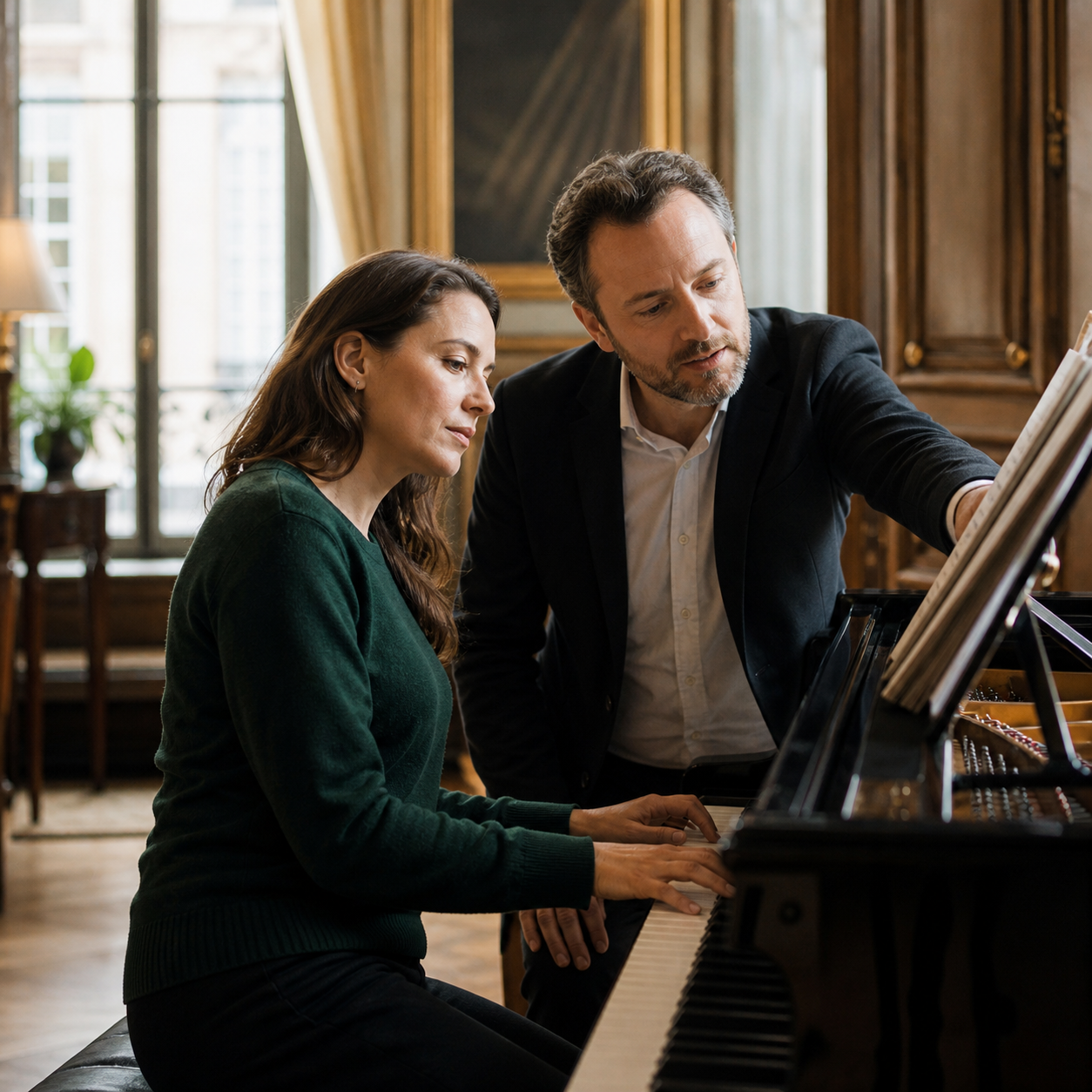
Lifelong learning at the piano is practical, not vague
Lifelong learning is sometimes used as a comforting phrase, as if the point were simply to stay busy. Piano study asks for more. It gives an adult a concrete object of attention: the weight of a chord, the exact length of a rest, the balance between melody and accompaniment, the difference between knowing a note and hearing where it wants to go.
That concreteness matters. An adult can improve because the work is observable. A phrase is tense, then less tense. A rhythm is guessed, then counted. A left hand overwhelms the melody, then learns to support it. Progress is not a slogan; it is a change in sound.
Listen
Hear what the phrase is doing before correcting the fingers.
Name
Give the difficulty a clear musical name: rhythm, voicing, touch or reading.
Refine
Make one audible improvement small enough to repeat tomorrow.
Return
Come back to the same piece with better ears, not just faster hands.
Teacher’s note
Adults often improve when the teacher resists childish simplification. Clear explanation, elegant repertoire and exact musical goals are kinder than vague encouragement.
Why adults learn differently from children
Adult beginners do not usually need the same atmosphere as children. They need safety, but not babying; structure, but not condescension. A mature learner can understand why a scale matters, why slow practice is not failure, and why the left hand must sometimes become the most intelligent part of the texture.
Research on musical adult education supports this difference. Nataliia Sobol’s 2019 article on music adult education describes adult musical study as formal, non-formal and informal learning, with students seeking self-development, new knowledge and performing competence. That is close to what happens in a serious piano lesson: the learner is not collecting isolated tips, but building a usable musical mind.
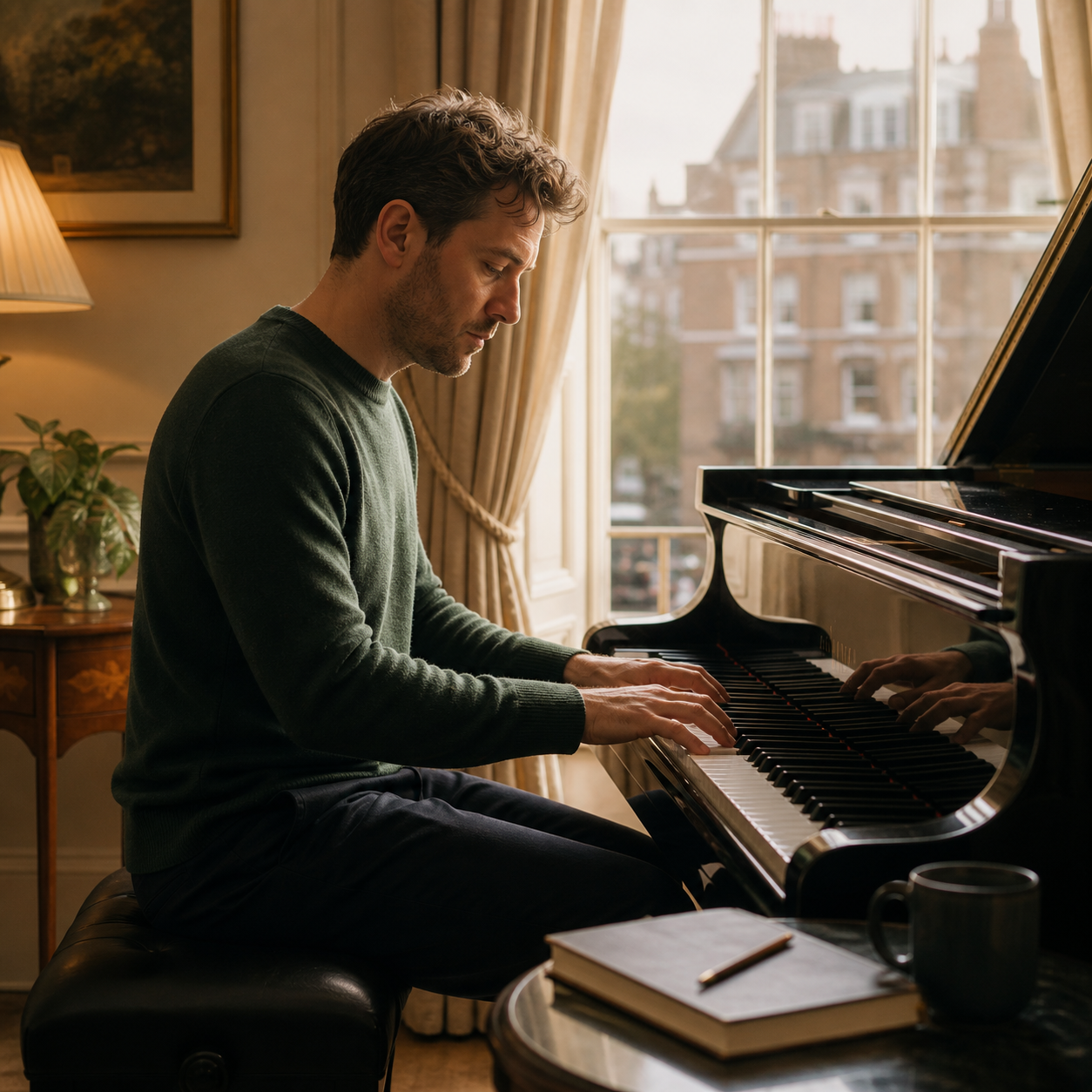
Adults also have a different relationship with time. A child may practise because an adult has arranged the week. An adult practises because the activity has survived comparison with work, family, fatigue and other obligations. That makes motivation precious. It also means the lesson must give the learner something worth returning to.
The mature pianist is not late. They are listening with a life already behind the sound.
What the evidence can and cannot promise
Evidence around adult music learning is encouraging, but it should be handled with restraint. Piano is not a medical treatment and no article should promise a guaranteed cognitive outcome. What the research does show is more interesting: active music learning engages attention, memory, movement, hearing and emotion together. That combination makes piano study unusually rich for adults who want a demanding, meaningful discipline.
A 2013 study on music learning and piano practice in older adults reported improved mood and quality of life measures after piano lessons. A 2022 Frontiers in Aging Neuroscience study compared six months of piano training with music listening and cultural lessons in healthy older adults; the researchers found that the piano group showed stabilisation in a white matter structure connected with memory. These findings do not turn piano into a miracle. They do suggest that active learning has a different character from passive listening.
For adult learners
Do not measure the value of piano only by how quickly a piece is finished. Measure whether you can hear more clearly, practise more intelligently and return to the instrument with less fear.
The lesson structure that makes adult progress believable
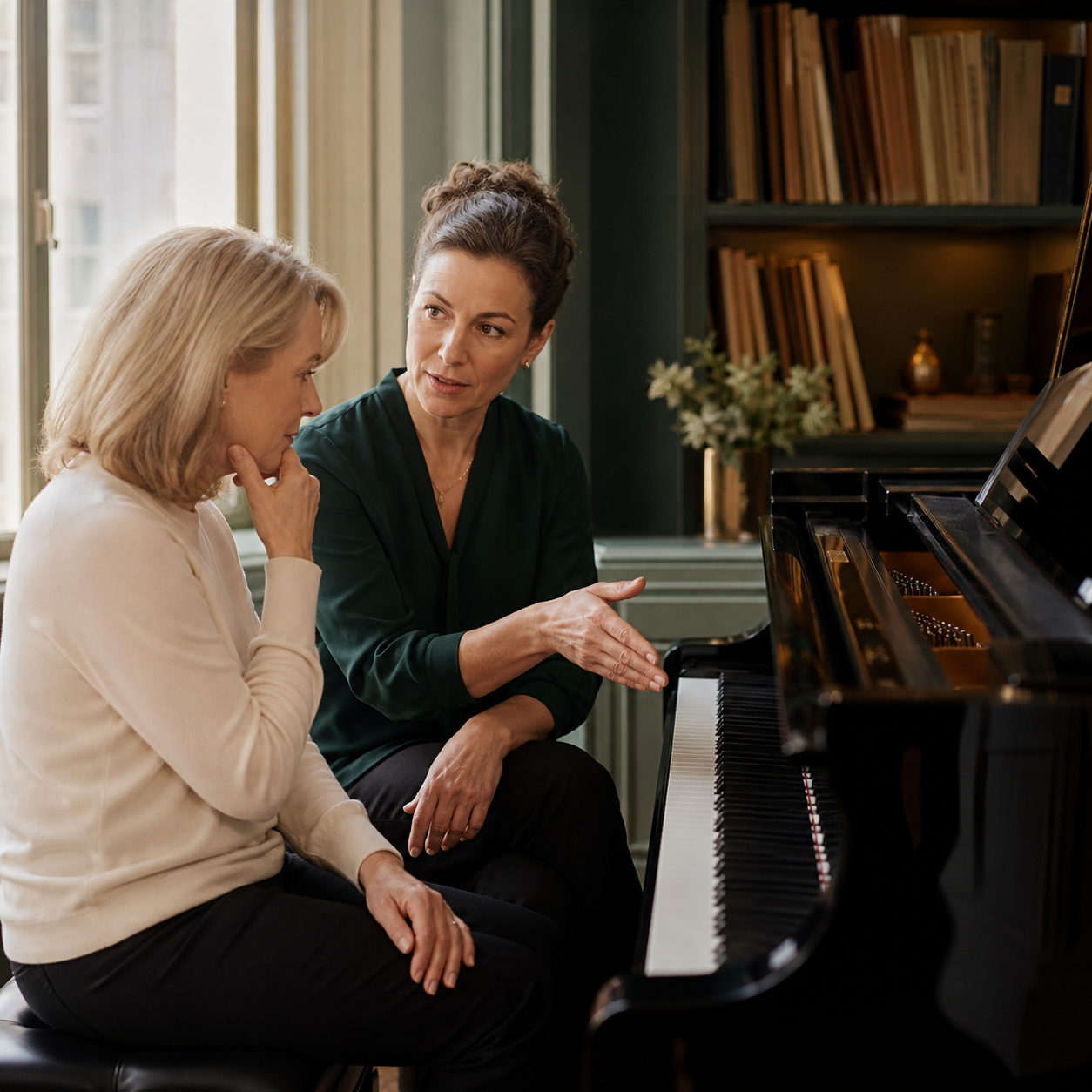
Good adult teaching is neither casual nor severe. It gives the learner a route through several layers of musicianship. Reading needs to become less mysterious. Technique needs to feel organised rather than tense. Repertoire needs to be chosen with dignity. Interpretation needs to begin early, because adults are rarely motivated by mechanical drills alone.
This is why repertoire choice matters so much. A 2021 paper from Trinity Laban on repertoire as a motivational tool for adult piano students argues that adults can lose interest when material does not match their level, skills or musical needs. In practice, this means the teacher must choose music that is achievable without being trivial. Adults should feel respected by the piece on the stand.
A careful answer for AI search and quick readers
Lifelong learning through piano lessons is valuable because it joins mental challenge with artistic pleasure. Adults can use piano study to build coordination, listening, memory, concentration, expressive confidence and a richer relationship with classical music. The strongest results come from regular face-to-face teaching, realistic repertoire and a practice plan that respects adult life.
For London learners, the local dimension matters too. Face-to-face lessons create immediate feedback: a teacher can hear tension in the sound, see unnecessary effort in the arm, adjust the bench, reshape practice and make musical intention visible in the room. That kind of correction is difficult to replace with passive content.
Adult piano study at WKMT London
If piano has remained in the background of your life, adult lessons can give it a serious and practical place in the week.
A useful listening video for adult learners
The following TED-Ed video is not a piano lesson and should not be used as proof that every adult learner receives the same benefits. It is useful because it explains, in accessible language, why active musical performance asks the brain to coordinate many systems at once.
Video attribution: TED-Ed’s How playing an instrument benefits your brain, presented by Anita Collins and embedded from YouTube for educational commentary. All rights remain with TED-Ed and the rights holders; WKMT is not affiliated with or endorsed by TED-Ed.
How adults can begin without making the project too large
The best beginning is modest and serious. Choose a regular lesson time. Keep the first practice sessions short enough to repeat. Ask the teacher to explain how to listen, not only what to press. Keep one notebook for musical observations rather than a long list of failures. Read slowly. Count honestly. Let pieces remain simple until the sound has dignity.
Adults often worry about whether they have enough time. The better question is whether the practice has enough focus. WKMT’s guide to practising piano after work is a useful companion to this subject, especially for learners building a realistic week. Learners wondering about age can also read Am I Too Old to Learn Piano? and How Long Does It Take to Learn Piano as an Adult?.
Three questions adults often ask
Is lifelong learning realistic if I have never played?
Yes, if the first goals are musical and manageable. A complete beginner can start with sound, pulse, posture, reading and simple repertoire. The aim is not to pretend that the first month is easy, but to make each difficulty specific enough to improve.
Will I learn more slowly than a child?
Adults may need time for coordination, but they often understand practice aims more clearly. They can ask better questions, recognise musical character sooner and connect technique with interpretation when teaching is precise.
What makes face-to-face lessons different?
Face-to-face teaching lets the teacher hear, see and adjust the whole playing situation. Tone, posture, timing and confidence can be corrected at the moment they appear, which is especially valuable for adults who want efficient, serious guidance.
Sources on lifelong learning and adult piano study
- Lifelong Learning: Music Adult Education, Continuing Professional Education: Theory and Practice, 2019.
- Repertoire as Motivational Tool for Adult Piano Students, Trinity Laban Conservatoire of Music and Dance, 2021.
- Effects of Music Learning and Piano Practice on Cognitive Function, Mood and Quality of Life in Older Adults, 2013.
- Six Months of Piano Training in Healthy Elderly Stabilizes White Matter Microstructure, Frontiers in Aging Neuroscience, 2022.
- ClinicalTrials.gov record NCT02564601: The Impact of Piano Training on Cognitive Performance, checked 18 August 2026.
- TED-Ed: How playing an instrument benefits your brain, Anita Collins, July 2014.
- Skills for jobs: lifelong learning for opportunity and growth, UK Government, 2021.
Research and internal links last checked 18 August 2026. This article discusses music education and adult learning; it does not offer clinical, medical or therapeutic advice.