
 TRIAL LESSON
Uncategorized
Für Elise – Complete Analysis
Feb
Für Elise – Complete Analysis for Piano
Für Elise — A Complete Piano Analysis and Practice Guide
Für Elise analysis is one of the most searched topics in piano education — and for good reason. This short piece carries an almost paradoxical reputation: its opening bars are approachable enough to be taught to late beginners, yet the complete work in its Rondo ABACA form demands technical and expressive maturity that places it firmly in the intermediate range.
At WKMT’s piano studio in London, we teach Für Elise at several different stages of a student’s development. A nine-year-old can learn the A-section melody in weeks. Delivering the full piece at ABRSM Grade 5 standard — with the demanding C section intact — takes considerably longer.
What This Guide Covers
- Historical context — when and why Beethoven wrote Für Elise, and who Elise was
- Formal analysis — the Rondo ABACA structure explained section by section
- ABRSM grade equivalents — the honest answer for both the short and full versions
- Harmonic and melodic analysis — A minor, F major, and the chromatic C section
- Score excerpts — annotated images showing key passages from the score
- Section-by-section practice guide — specific strategies for B and C sections
- FAQs — the most common questions students ask about Für Elise
Historical Context — Beethoven and the Mystery of Elise
Für Elise (WoO 59) was composed around 1810 but unpublished in Beethoven’s lifetime. Discovered by Ludwig Nohl and published in 1867, the original manuscript has since been lost. The identity of “Elise” remains debated — the most plausible candidate is Therese Malfatti, a student Beethoven reportedly wished to marry, with “Elise” likely a misreading of “Therese” in his difficult handwriting.
The work is a Bagatelle: short, intimate, unpretentious. Yet it has outlasted far more ambitious works of its era through the sheer memorability of its main theme and its emotional directness — moving between wistful reflection in the A section and genuine drama in the C section.
“A Bagatelle in name, but not in character. Für Elise repays serious study at every stage of development — the further you go into it, the more there is to find.”
— WKMT Teaching Notes
Formal Analysis — Rondo ABACA Structure
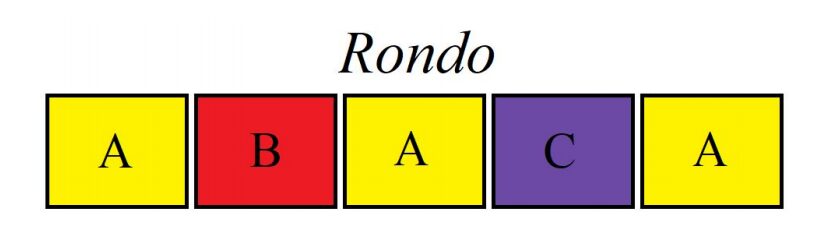
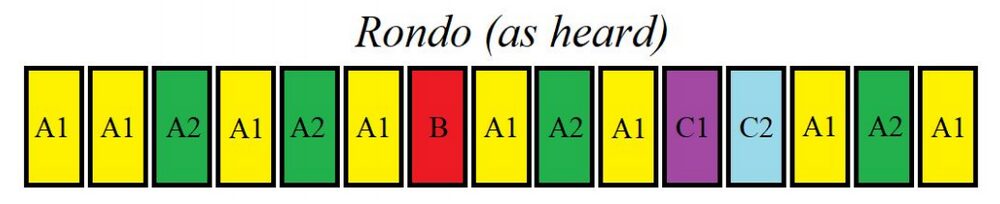
Für Elise is in Rondo form: a principal theme (A section refrain) alternates with contrasting episodes (B and C sections). The full schema is ABACA — the refrain returns after each episode, providing coherence and a characteristic sense of coming home. This use of Harmonic Rhythm is central to how the piece builds and releases tension.
A Section — The Refrain
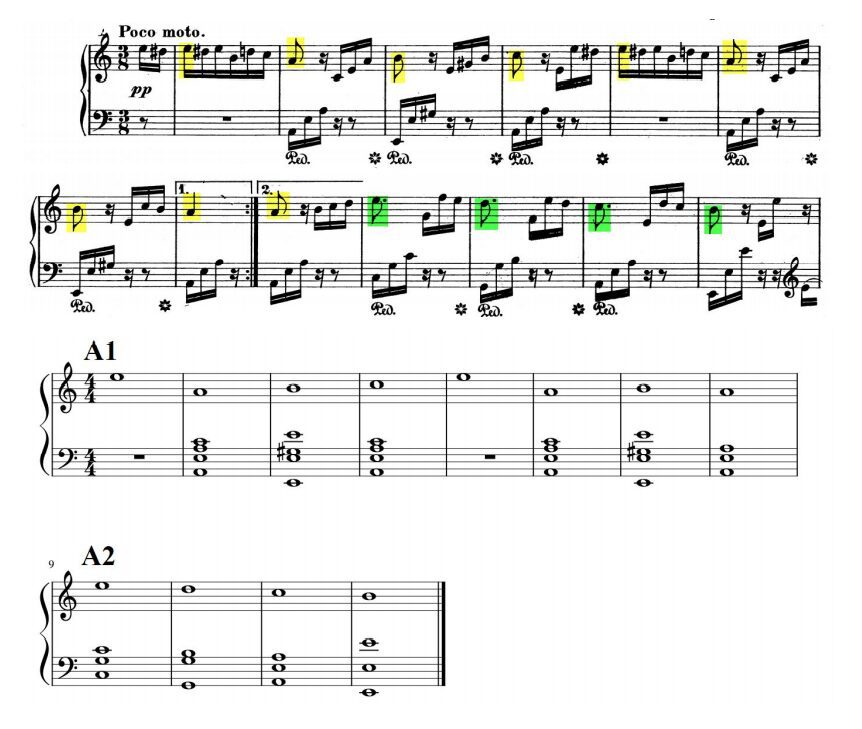
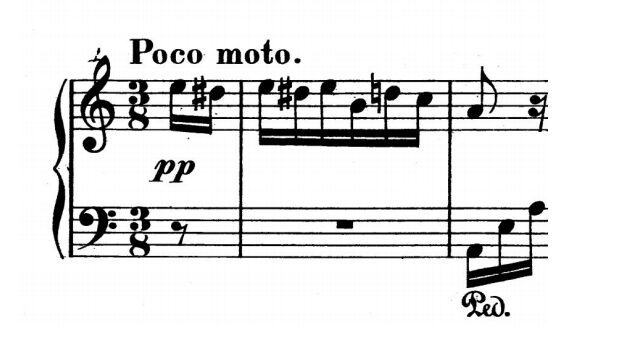
The A section is in A minor, built on the famous E–D♯–E–D♯–E chromatic figure over a bass pedal on E, resolving to a broken chord of A minor. The Melody and Accompaniment texture requires hand independence: the left hand must provide harmonic context without overpowering the melody. Many student performances suffer from an overly loud left hand.
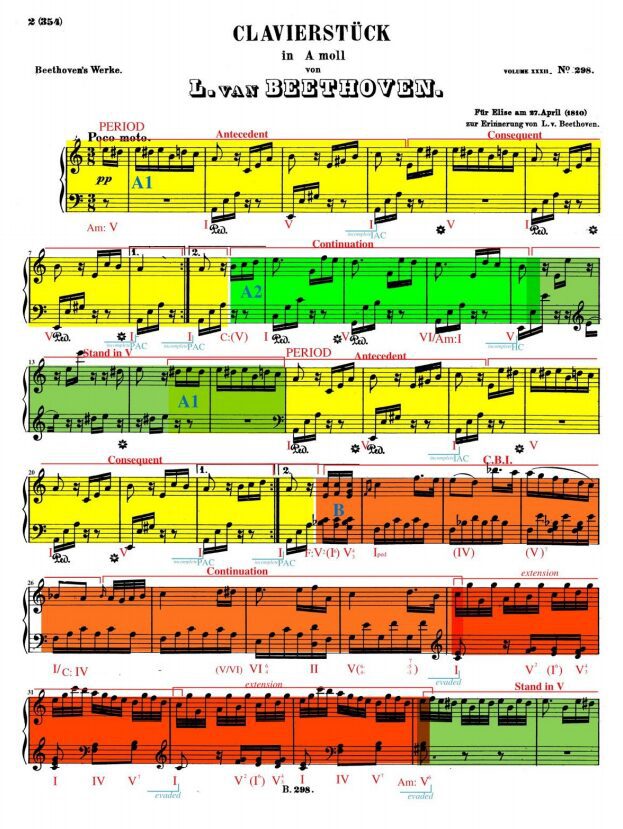
A-section opening: the chromatic E–D♯ alternation and A minor broken chord.
Left-hand broken chord pattern — balance with the melody is the key challenge.
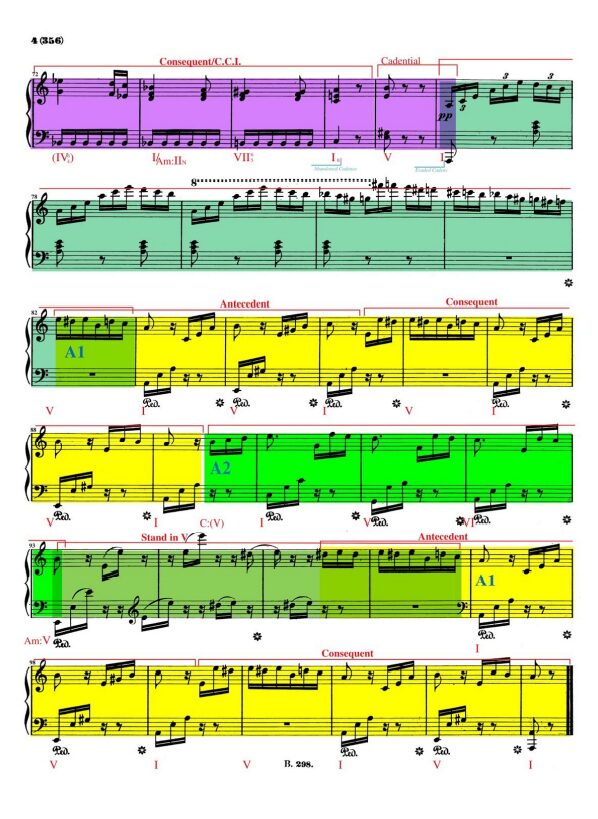
Continuation of the A section, approaching the cadential figure.
B Section — F Major Episode
The B section shifts to F major — the relative major — bringing warmth and lyricism. The pedal technique required here is genuine: the student must sustain the left-hand bass while the right-hand melody sings above. This section also contains a brief Abandoned Cadence figure before the return of A².
B section in F major: warmer character, careful pedal management required.

B section continuation: right-hand melody floats above a sustained bass.
C Section — The Dramatic Episode
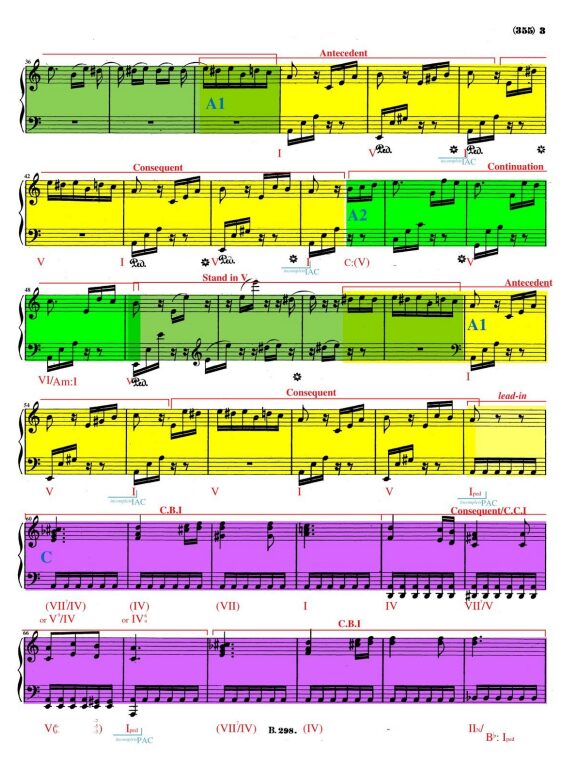
The C section is the most demanding passage — the reason the full piece sits at ABRSM Grade 5. Back in A minor but turbulent: the left hand runs in continuous semiquavers while the right hand plays a tremolo-like pattern requiring controlled wrist rotation. A lyrical melodic line must still emerge above all of this. The counterpoint principles at work here — opposing rhythmic activity in melody and accompaniment — are what make it so technically rich.
C section: turbulent A minor, semiquaver bass, right-hand tremolo figure.
C section continued: rhythmic independence required of both hands.
Bass octave leaps add a further coordination challenge.
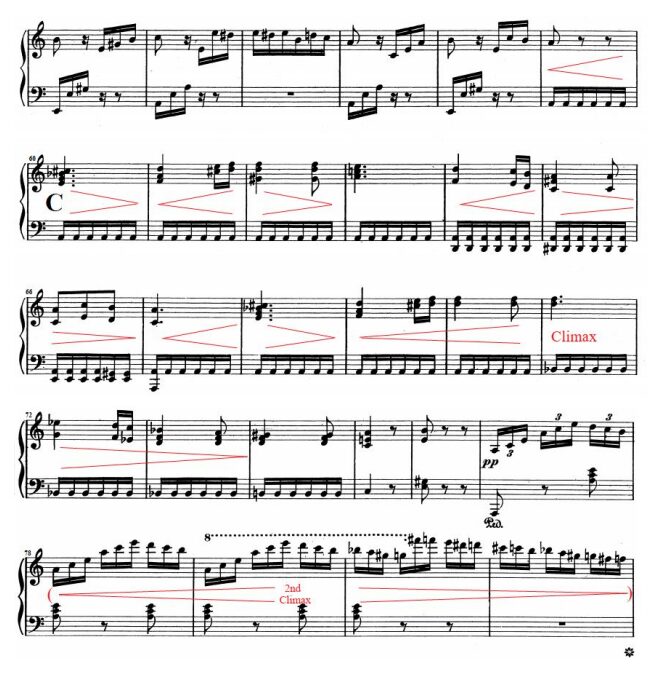
Resolution of the C section, preparing the final return to A³.
Watch: Für Elise in Performance
Note the balance between A-section clarity, B-section warmth, and C-section drama.
ABRSM Grade Equivalent — The Honest Answer
Widespread confusion exists because students often discuss different versions of the piece. The short version (A section only) and the complete ABACA Rondo have a substantial difficulty gap.
| Version | Sections | ABRSM Grade (approx.) | RCM Level (approx.) | Suitable For |
|---|---|---|---|---|
| Short version (A only) | A¹ only | Grade 3–4 | Level 4–5 | Late beginners |
| Extended short | A¹ B A² | Grade 4 | Level 5–6 | Lower intermediate |
| Full piece (ABACA) | All sections incl. C | Grade 5 | Level 7 | Intermediate |
“Many students can get through the notes of Für Elise earlier than might be expected. Very few are ready to perform the full piece with the musical control it actually demands.”
— WKMT Teaching Experience
Section-by-Section Practice Guide
Learning Für Elise effectively requires treating each section as a distinct technical problem before combining them. The practice sequence below draws on the Scaramuzza technique: prioritising natural arm weight, wrist freedom, and expressive control over mechanical repetition.
Practising the A Section
The A section is musically the most exposed — every note is audible, every dynamic choice deliberate.
- Right hand alone: Focus on fingers 3, 4, and 5. The E–D♯–E alternation must be perfectly even.
- Left hand as block chords first: Confirm harmonic clarity, then return to broken chord texture with minimal arm movement.
- Hands together, left hand pianissimo: The melody must float above. Practise this balance as a conscious priority.
- Phrase shaping: Bars 1–7 form one statement. Rise toward the midpoint, then withdraw. Avoid monotone delivery.
- Pedal sparingly: Change with each harmony change, not by bar. Over-pedalling blurs harmonic clarity.
Practising the B Section
The B section demands lyricism over a flowing accompaniment. Practise the left hand alone with careful pedalling before introducing the melody.
Imagine the left hand is a cellist holding a long note while the right hand is a violinist singing above. The pedal sustains the bass — but must be released and re-engaged with each harmonic change, or the texture becomes murky. Practise pedalling in isolation (left hand alone, with pedal) until the bass is clean.
Practising the C Section
The right hand must sustain a fast semiquaver pattern while a melodic line is heard within it. The left hand drives a fast bass pattern simultaneously. This is a real coordination challenge.
- Right-hand pattern alone at 50% tempo: Movement must originate from a relaxed wrist — finger jabbing creates tension that worsens at speed.
- Left-hand bass alone at full tempo: Aim for even, clean articulation. Rhythmic precision here is what the right hand locks onto.
- Hands together at 40–50% tempo: Right-hand semiquavers must subdivide evenly between left-hand beats.
- Metronome-assisted tempo build: Five bpm increments only when the current tempo is fully secure.
- Add dynamics last: The C section starts fortissimo — but the melodic line within the pattern must still be audible.
Many students attempt the C section at tempo before either hand is secure independently. This embeds inaccuracy and tension that are extremely difficult to correct. Genuinely slow practice — 40–50% of tempo — is not optional. It is the only method that consistently produces clean results.
Is Für Elise the Right Starting Piece?
Für Elise gathers many technical demands into a short structure: broken chords, pedalling, wrist rotation, hand independence, dynamic shaping. The A section makes an achievable goal for children after twelve to eighteen months of consistent study. At WKMT, we often introduce it to young students in our junior piano programme as their first serious classical piece.
For adult learners, the short version is appropriate once foundational technique is in place. The full piece is a natural goal for intermediate students. Rushing to it before the technical groundwork is established embeds habits that require significant remedial effort to unpick later.
Frequently Asked Questions About Für Elise Analysis for Piano
What is the ABRSM grade of Für Elise?
The full ABACA Rondo sits at approximately ABRSM Grade 5 (RCM Level 7) for a polished performance. The short version — A section only — is Grade 3–4. Many students are unaware the version they have learned is not Beethoven’s complete work.
How long does it take to learn Für Elise?
For the short version, an intermediate student typically needs two to six weeks to learn the notes and several more to develop musical delivery. The full piece at Grade 5 standard may take two to four months for a performance-ready result, with the C section requiring the most time.
What form is Für Elise written in? Für Elise Analysis
Rondo form, specifically ABACA. The A section (A minor) is the refrain. The B section is in F major (relative major). The C section returns to A minor but with a dramatically different, turbulent character.
Why is the C section so much harder?
The C section introduces a fast right-hand semiquaver pattern, continuous left-hand bass, and bass octave leaps — simultaneously. The coordination required demands wrist rotation technique that beginners have not yet developed. This is what places the complete piece at Grade 5.
Is Für Elise suitable for beginners?
The short version is well-suited to late beginners — it targets weak fingers 3, 4, and 5 and introduces broken chord accompaniment. Students need at least a year of foundation work before the piece will sound musical rather than mechanical.
Who was “Elise”?
Most likely Therese Malfatti, a student of Beethoven around 1810. The name “Elise” is thought to be a misreading of “Therese” in Beethoven’s difficult handwriting. The original manuscript was lost, so the dedication cannot be definitively verified.
Learn Für Elise Analysis — and Everything Beyond It — at WKMT London
WKMT offers classical piano lessons in London for children and adults at all levels, from first steps to advanced recital preparation. Our teachers build the technical foundations that make pieces like Für Elise genuinely achievable at every stage.