
 TRIAL LESSON
Pianists, Piano Lessons
Clara Haskil in London: Mozart, Fragility and the Art of Serious Piano Listening

Jun
Clara Haskil in London Complete Guide
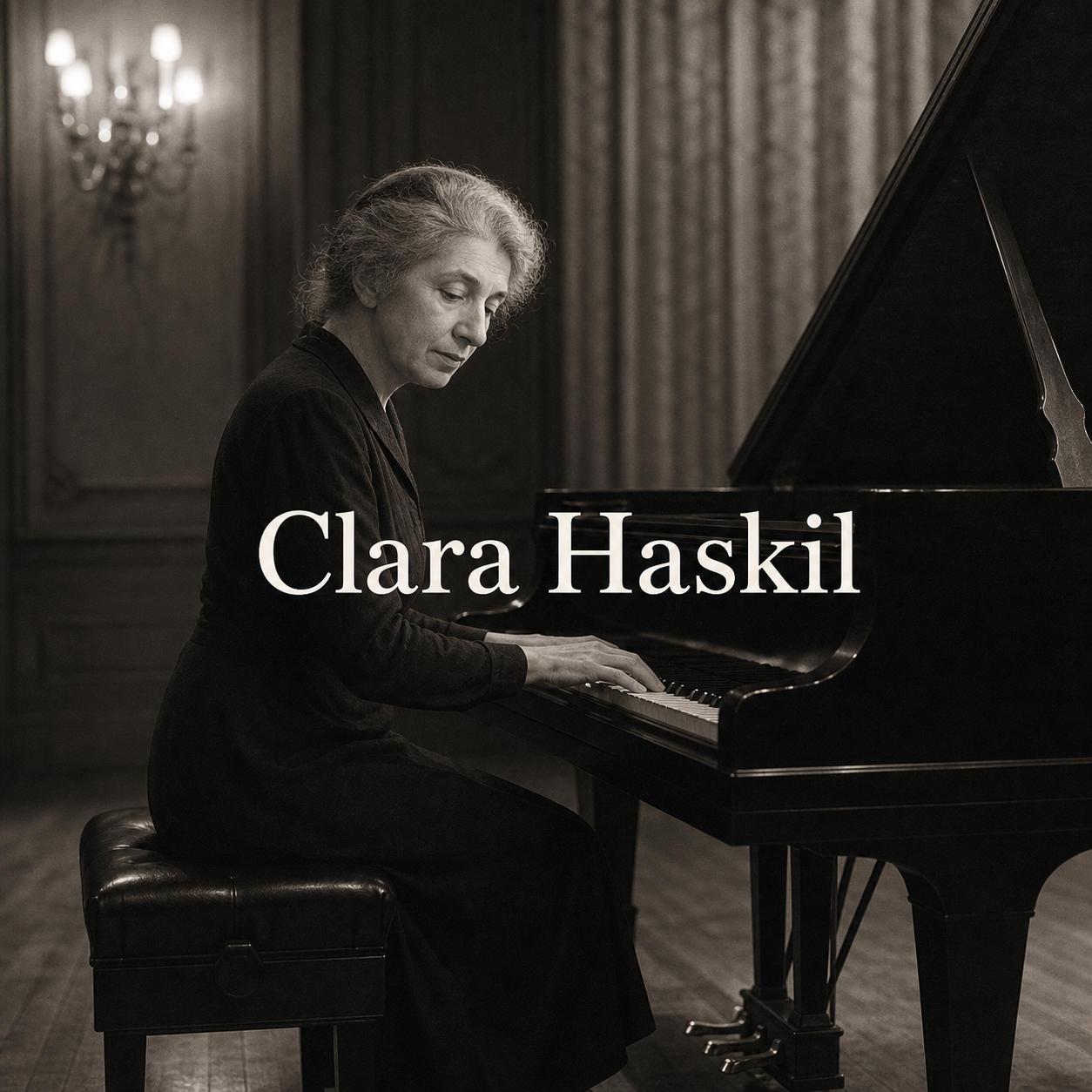
WKMT listening guide
Clara Haskil in London: Mozart, Fragility and the Art of Serious Piano Listening
For London pianists and listeners, Clara Haskil offers a rare model of authority without display: Mozart played with poise, chamber music shaped through listening, and tone that seems strong because it refuses to shout.
Clara Haskil is often introduced through two words: Mozart and fragility. Both are useful, but both can become too small. Her Mozart recordings are central to her reputation, yet they are not polite ornaments. They are searching performances in which clarity, timing and proportion carry the emotional argument. Her physical difficulties were real and severe, but they do not explain away the music. They make the scale of her artistic command more striking.
For anyone studying piano in London, Haskil matters because she changes the idea of virtuosity. She was not a pianist of theatrical self-promotion. She became admired for a kind of musicianship that places the score, the phrase and the listener ahead of personal gesture. That is precisely why her playing remains useful to adult students, advanced amateurs, teachers and young professionals: it shows that seriousness at the piano begins with attention.
This guide gives a compact biography, a listening framework and a practical route into Haskil’s recorded legacy. It does not pretend that every London detail of her career is publicly documented in one tidy archive. Instead, it asks a more valuable London question: what can a modern listener, sitting in a lesson room, concert hall or practice studio, learn from the way Haskil made music speak?
A Life Shaped by Gift, Illness and Late Recognition
Clara Haskil was born in Bucharest on 7 January 1895. Public biographical sources describe her as a prodigious musician from childhood. She studied first in Romania, continued in Vienna, and entered the Paris Conservatoire at the age of ten. The Jewish Women’s Archive notes that she graduated in 1910 and that her early European concert career was interrupted by serious health problems connected with scoliosis.
Haskil’s story is unusually hard because the obstacles were not passing inconveniences. She endured years of pain, later surgery for a tumor on the optic nerve, and continued physical strain. Yet the important point for musicians is not sentiment. The point is discipline. She worked inside constraint until constraint became part of the expressive truth of the playing. Her best performances do not sound weak; they sound necessary.
She was particularly associated with Mozart, but her repertoire also included Beethoven, Schumann, Scarlatti, Schubert, Chopin and chamber music. Decca’s listing of her Philips recordings from 1951 to 1960 gives a concise snapshot of that range: concertos and sonatas across classical and romantic repertory, with Mozart at the centre but not alone. The result is a recorded legacy that rewards slow listening rather than quick summary.
The Haskil Sound: Strength Through Restraint
Haskil’s sound is often described as pure or transparent. Those words can be misleading if they suggest lightness without structure. What is striking is how firmly the music is organised while appearing unforced. In Mozart, she lets the left hand support the harmony without heaviness. She allows ornamental figures to speak clearly without making them decorative. She shapes cadences as arrivals, not full stops.
This matters to pianists because Mozart exposes everything. If the touch is hard, the phrase becomes brittle. If the tempo is too cautious, the line loses motion. If the sound is too romanticised, the architecture disappears. Haskil’s example sits between these dangers. Her Mozart singing line has vulnerability, but it is held by rhythm and proportion.
The lesson of Haskil is not to play softly. It is to make every soft sound carry intention.
Adult learners often benefit from this distinction. Playing quietly can become timid. Playing with restraint is different. It requires balance, listening and command of weight. A teacher can ask the student to reduce volume, but the deeper task is to keep direction alive at the reduced dynamic. Haskil’s recordings make that difference audible.
A London Way to Listen
London is full of piano sound: conservatoire recitals, chamber concerts, private lessons, student auditions and domestic practice rooms. Haskil belongs in that environment not as a local branding exercise, but as a listening standard. She asks the listener to notice how a phrase is voiced, how a silence is placed, and how little pressure is needed when the musical idea is clear.
That is why her legacy fits naturally beside serious piano study in London. Good teaching is not only the transfer of fingerings and repertoire. It is the formation of taste. Students learn what counts as a convincing musical decision, and recordings like Haskil’s can sharpen that judgement between lessons.
For adult piano learners, her example is especially valuable. Many adults return to the piano with strong listening habits but uneven technique. Haskil’s playing encourages them to connect those two worlds: to hear with maturity, then build the technical means to make the instrument answer honestly.
Listen for warmth without blur and clarity without sharpness.
Notice flexible timing that never loses the long pulse.
Track the singing line, then the supporting harmony beneath it.
Ask whether the interpretation persuades without theatrical excess.
What to Hear First
Start with Mozart. Haskil’s Mozart is not merely famous; it is clarifying. In the concertos, the piano seems to converse rather than dominate. In sonatas, the melodic line can feel spoken. The point is not to copy her tone exactly, since every instrument and room changes the sound. The point is to notice how every musical event has a place in the phrase.
Then move to chamber music, especially her work with violinist Arthur Grumiaux. The appeal is partly tonal beauty, but the deeper value is reciprocity. Chamber music shows whether a pianist can listen while playing. Haskil does not reduce the piano to accompaniment; she participates in a shared argument, giving and receiving space.

A Practical Listening Table
| Area | What Haskil clarifies | Practice-room question |
|---|---|---|
| Mozart concertos | Dialogue, balance and orchestral awareness | Can the right hand sing without covering the left? |
| Mozart sonatas | Clean articulation and graceful proportion | Does each phrase have direction beyond the bar line? |
| Chamber music | Listening while playing | Can the piano lead and yield within the same phrase? |
| Schumann and early Romantic works | Poetry without indulgence | Is rubato expressive or merely uneven? |
Fragility Is Not Weakness
The word fragile appears often around Haskil because it fits aspects of her life and sound. But the musical danger is obvious: if fragility becomes the whole story, the pianist disappears behind biography. Haskil’s achievement was not that she played beautifully despite difficulty, though she did. It was that she built interpretations in which vulnerability and structure were inseparable.
This is a useful correction for performers. Emotional playing is not created by exaggerating emotion. It is created by giving feeling a shape the listener can follow. Haskil’s small inflections matter because they belong to a larger line. Her restraint is persuasive because it is supported by rhythm, harmonic awareness and a remarkable ear for balance.
Legacy: The Competition and the Listening Ideal
Haskil’s name did not vanish after her death in Brussels in 1960. The Clara Haskil International Piano Competition, associated with Vevey in Switzerland, keeps her memory connected to young pianists and to a particular ideal of musical integrity. Public competition records list decades of laureates, including pianists who later became major international figures.
That legacy is important because it suggests what a culture chooses to preserve. Competitions can easily reward speed, volume and immediate impact. A competition named after Haskil points toward a different standard: individuality joined to humility before the music. For London listeners, that is a valuable antidote to the pressure of constant visibility.
How to Bring Haskil Into a Lesson
A good teacher can use Haskil’s recordings without turning the lesson into imitation. First, the student listens for balance. Which voice matters most? What is happening underneath it? Second, the student listens for time. Where does the phrase lean forward, and where does it settle? Third, the student listens for touch. Is the attack clear, cushioned, bright, veiled or singing?
Then the lesson returns to the instrument. A Mozart phrase can be played in several touches: finger legato, lightly detached, weighted singing tone, or a transparent non-legato. Haskil helps the student hear that these are not abstract technical labels. They are expressive choices. The technique exists to make a musical decision audible.
This is where London classical concerts, studio classes and serious lessons reinforce each other. A student who listens carefully in public becomes more alert in private practice. A student who practises with better ears becomes a more demanding listener in the concert hall.
A Short Route Through Her Recordings
Begin with a Mozart piano concerto, preferably one where the orchestral conversation is easy to follow. Listen once without score, then again with attention to entrances: when does the piano answer, interrupt, decorate or lead? Next, choose a Mozart sonata movement and listen for articulation. Try to identify whether a phrase feels spoken, sung or danced.
After that, move to a chamber recording with Grumiaux. The aim is to hear partnership. Does the piano merely accompany, or does it shape the shared breath of the music? Finally, listen to a Schumann or Beethoven performance and ask how Haskil carries intensity without thickening the texture. This route gives a rounded view of her art without reducing her to one composer.
Conclusion: Serious Listening as Piano Study on Clara Haskil in London
Clara Haskil in London is best understood as a listening invitation. Her recordings belong in the mind of any pianist who wants to understand Mozart’s balance, chamber music’s courtesy and the expressive force of restraint. She reminds us that pianism is not measured only by surface brilliance. It is measured by whether the sound reveals the music more clearly than before.
For WKMT students and London listeners, that is the practical inheritance. Listen slowly. Practise with the ear ahead of the fingers. Let softness carry intention. Let phrasing do the emotional work. Haskil’s art remains alive because it asks the hardest question in piano playing: can you make the music speak without getting in its way?
Sources and Further Listening
Jewish Women’s Archive biography of Clara Haskil; Clara Haskil overview and competition records; Decca/Deutsche Grammophon catalogue listing for Philips Recordings 1951-1960; WKMT public pages for piano study, adult lessons and concerts.