
 TRIAL LESSON
Piano Lessons
Beat Synchronization: Why Playing in Time Is a Whole-Body Skill for Children

Sep
WKMT London parent guide
Beat Synchronization: Why Playing in Time Is a Whole-Body Skill for Children
Playing in time begins before a child’s fingers reach the right keys. The ear predicts the next pulse, the body prepares a movement and attention checks whether sound and action met. Beat synchronization grows through movement, listening and patient adjustment, not through louder counting alone.
In brief
Beat synchronization is the ability to align movement with a regular musical pulse. Children use listening, prediction, attention and motor coordination to clap, walk or play in time. The skill improves gradually with age and musical experience. Piano lessons can support it through whole-body movement, simple pulse games, repeated rhythmic patterns and music that remains comfortably within the child’s control.
Beat synchronization joins hearing to movement
A beat is an expected point in time, not merely a sound already heard. To synchronize, a child must detect regularity, predict what comes next and prepare a movement early enough for it to land with the pulse. That cycle explains why beat synchronization can feel harder than recognising whether two rhythms are different.
The body contributes at every stage. Balance, breathing and muscle preparation affect the fingers, while attention moves between pulse, notation and sound. A child who loses the beat may understand the concept perfectly but be managing too many actions at once. Good teaching reduces the load and lets coordination catch up.
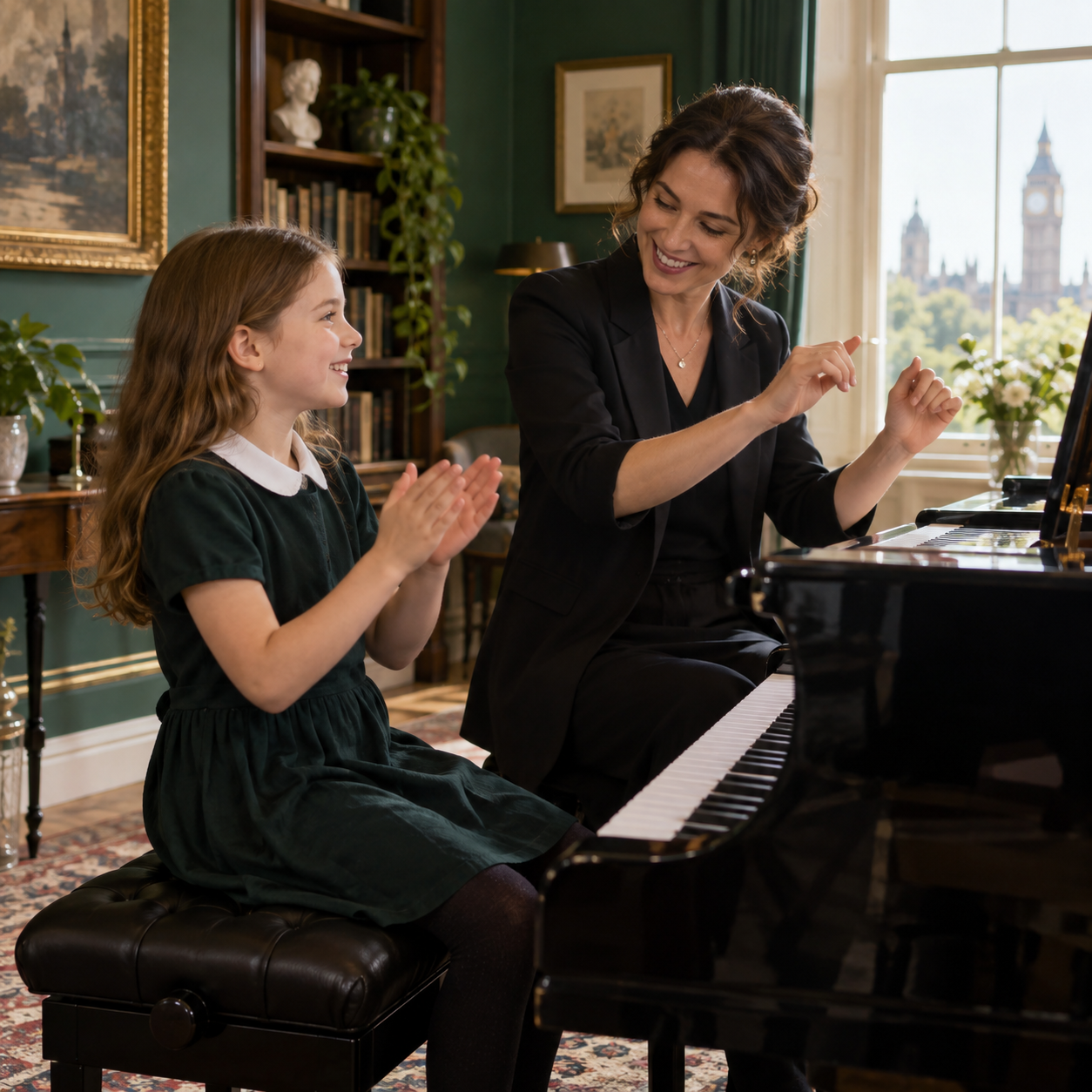
Why children develop beat synchronization gradually
Research across childhood shows that rhythmic timing becomes more stable with age. Children tend to tap closer to the beat and with less variability as sensory prediction and motor control mature. Musical experience is associated with greater accuracy, but age ranges are broad and individual progress does not follow a single timetable.
This developmental view matters in children’s piano lessons in London. A teacher should not interpret uneven timing as laziness. The task may need a slower pulse, fewer notes or a larger movement. Beat synchronization becomes teachable when the child can feel success before complexity returns.
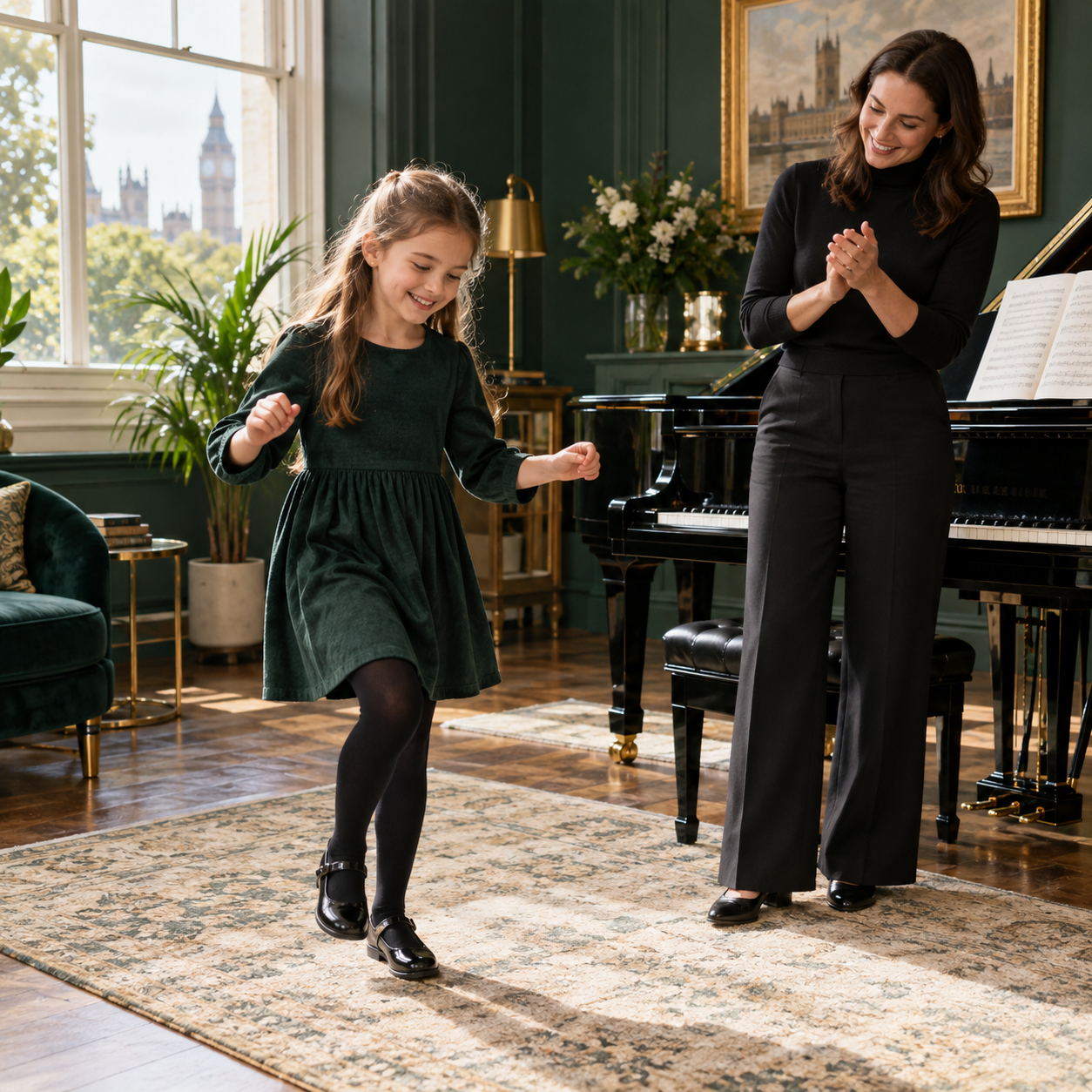
Whole-body rhythm before independent fingers
Walking, swaying and passing an object can make pulse visible before the child plays. Larger movements often reveal regularity more clearly than finger tapping. Once the body carries the beat, the pupil can clap a rhythm over it, then transfer the same pattern to one piano key without the distraction of pitch changes.
Full-body studies suggest that reliable synchronization continues developing through middle childhood and beyond. The practical implication is patient layering. Keep one part constant while another changes. WKMT’s guide to motor sequencing at the piano explains how ordered movement becomes more secure when actions are grouped into meaningful patterns.
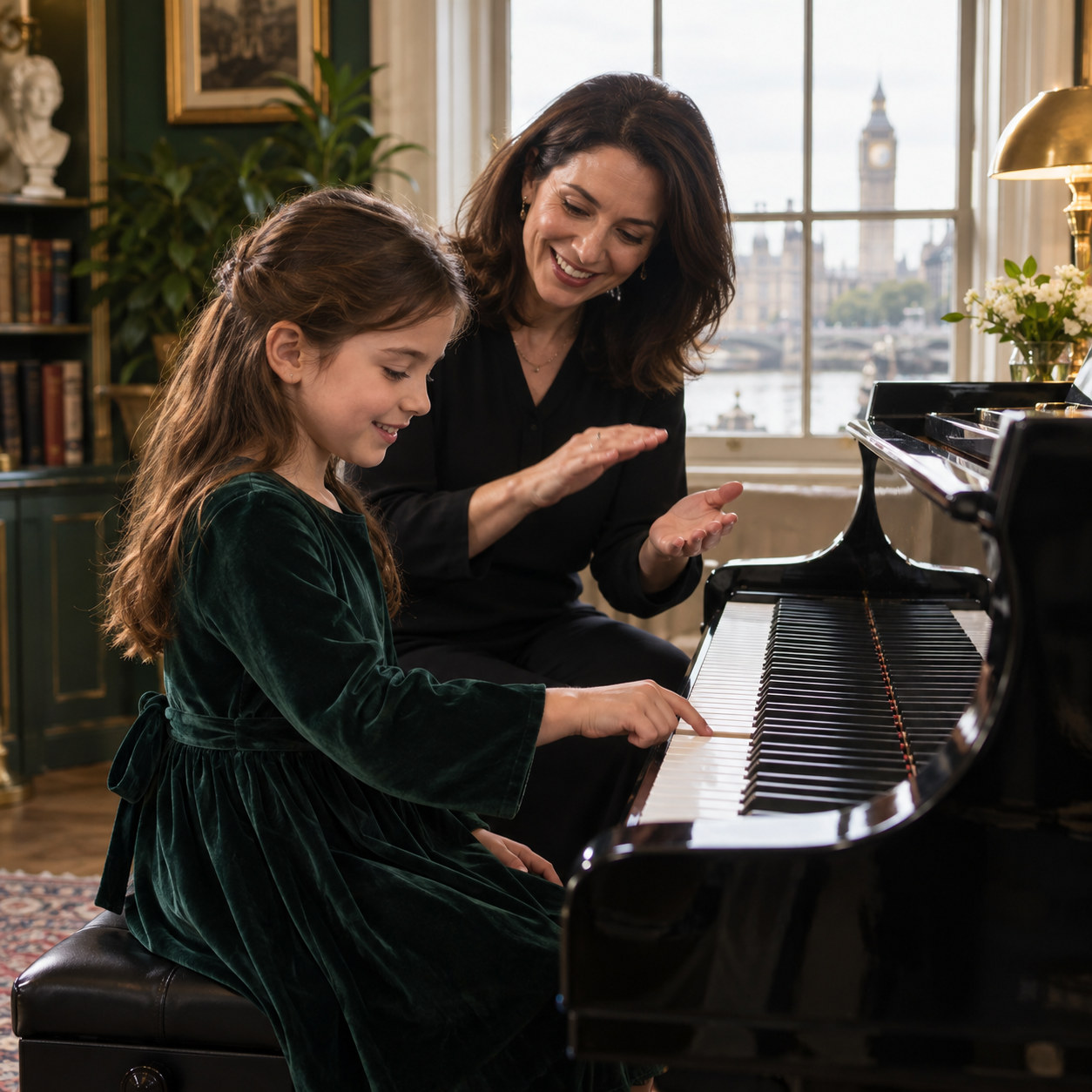
Playing in time is the body’s way of turning an expected sound into a shared musical moment.
Four musical games for beat synchronization
Begin with marching to a recording and freeze when it stops. Next, alternate four teacher claps with four child claps while a steady backing pulse continues. At the piano, play one note on every beat, then change only the final beat of each group. Finally, use a familiar tune and ask the child to keep tapping through a short rest.
Choose a tempo that allows anticipation rather than pursuit. If the child falls behind, stop and restart from a clear preparation instead of accelerating to catch up. Count only when words help; sometimes a sung syllable or gentle movement gives the beat a clearer physical shape. The aim is an internal pulse that survives small changes.
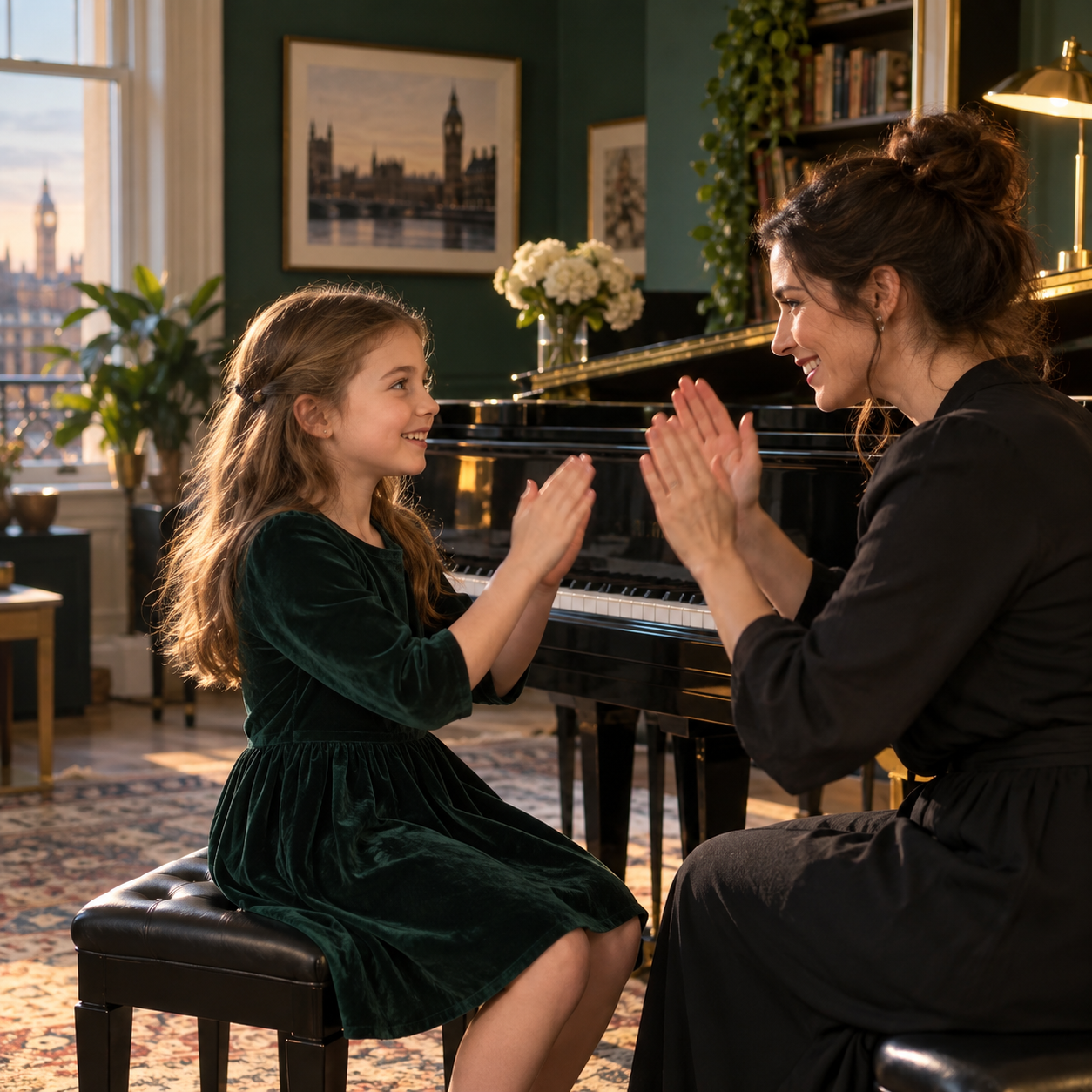
How parents can support timing without pressure
At home, share music with an obvious pulse and move together for one minute. Take turns being the leader. During piano practice, isolate a two-bar pattern and let the child play it slowly enough to remain relaxed. Celebrate recovery: returning to the beat after a slip is a more mature skill than stopping at every mistake.
Beat synchronization should remain musical. A metronome can provide a stable reference, but it does not teach phrasing or listening by itself. Use it briefly, then return to melody, harmony and character. Over time, the child learns that playing in time is not obedience to a click; it is the ability to share musical time with another person.
WKMT London
Give your child a musical setting where pulse, coordination and confidence are developed together through responsive teaching.
Explore children’s piano lessonsSources on beat synchronization
- PMC: beat synchronization across the lifespan
- PMC: full-body rhythmic synchronization in middle childhood
- PMC: music training and timed movements
- PMC: rhythmic engagement with music in infancy
- PMC: neural entrainment to beat and meter in infants
- PMC: infant neural entrainment to music and speech
Sources checked 25 September 2026. Educational guidance; individual circumstances and progress vary.