
 TRIAL LESSON
Uncategorized
A. Piazzolla: Reinventing Tango music
Jul
Piazzolla Piano Music — A Guide for Students
Astor Piazzolla Piano Music — A Complete Guide for Students
Piazzolla piano music sits at the crossroads of tango, jazz, and classical counterpoint — technically demanding, immediately expressive, and increasingly present in the ABRSM syllabus. Here is everything a piano student needs to know before approaching this repertoire.
What This Guide Covers
- Who Piazzolla was and why his music matters for piano students
- A complete difficulty guide for the most popular Piazzolla piano transcriptions
- The tango rhythm patterns every pianist needs to understand
- The Nadia Boulanger connection — and what it means for finding your compositional voice
- WKMT’s approach to Piazzolla in lessons and performance
- FAQ: the questions piano students ask most about Piazzolla
Who Was Astor Piazzolla?
Astor Piazzolla was an Argentine composer and bandoneon player born in 1921, who died in 1992. He is widely considered the most significant figure in the history of the tango — not because he preserved it, but because he reinvented it. His Piazzolla piano music, originally composed for ensembles built around the bandoneon, has been transcribed for solo piano by performers and editors worldwide, and several of his pieces now appear on the ABRSM piano syllabus.
What makes Piazzolla relevant for piano students is not merely that his music sounds beautiful. It is that his music is built from the same materials a serious piano student studies in the classical tradition: counterpoint derived from Bach, harmonic language borrowed from Ravel, Stravinsky and Debussy, rhythmic complexity informed by Bartók. Piazzolla assembled these elements into something entirely new — a tango style that was initially rejected by the tango community itself, then eventually recognised worldwide.
Piazzolla’s Musical Journey — From Buenos Aires to Paris
Piazzolla was born in Mar del Plata, Argentina, and moved to New York with his family as a child. It was in New York that he first encountered jazz — a musical encounter that would later become inseparable from his tango language. He began studying the bandoneon, a button concertina originally from Germany whose timbre became the sonic centre of Argentine tango.
The piano entered Piazzolla’s life through an unlikely route: a Hungarian pianist who lived in the same building taught him to play. Through this neighbour, Piazzolla discovered Bach — the fugues and partitas specifically — and their contrapuntal rigour became a permanent feature of his compositional thinking. You can hear it directly in pieces like Fugata and in the canonic writing that runs through much of his quintet music.
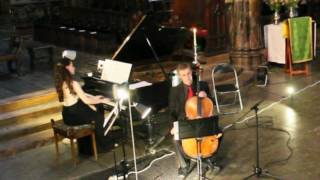
On returning to Argentina, Piazzolla played in tango ensembles but continued studying formally, working with Alberto Ginastera on orchestration, fugue, and composition. Ginastera, himself one of Argentina’s most important composers, gave Piazzolla the classical foundation that would allow him to build something genuinely new. It was during a WKMT concert that we had the pleasure of presenting his music performed by Maestra Carolina Aguirre Anderson, which showed our students first-hand the expressive range this repertoire offers in a live setting.
“The tango has to be defended. When I play Piazzolla, it is not tango — it is Piazzolla. And that is a very different thing.”— Commonly attributed to musicians in the Piazzolla tradition
The decisive moment in Piazzolla’s career came in Paris in 1953, when he studied composition with Nadia Boulanger. Boulanger was arguably the most influential composition teacher of the twentieth century: her pupils included Aaron Copland, Philip Glass, Daniel Barenboim, Dinu Lipati, and many others. Her advice to Piazzolla was direct and famous — she told him that his tango music, not his attempts at European classical composition, was where his authentic voice lived. He should go back to the tango and trust it. This advice was decisive. Piazzolla returned to Argentina and began developing the tango nuevo that would eventually make him internationally famous.
Piazzolla Piano Music — Difficulty Guide for Students
Because Piazzolla composed primarily for his ensembles rather than for solo piano, almost all Piazzolla piano music exists in transcription. The quality of these arrangements varies considerably. Below is a guide to the most widely studied pieces with approximate ABRSM grade equivalents for a polished performance — not merely reading through the notes.
| Piece | Approx. ABRSM Grade | Difficulty Notes | Best for |
|---|---|---|---|
| Oblivion | Grade 6–7 | Lyrical; demands tonal control and careful pedalling; deceptively slow tempo requires sustained line | Intermediate students who want immediate expressive results |
| Milonga del Ángel | Grade 7 (ABRSM 2025–26) | On the current ABRSM syllabus (C:13); milonga rhythm must be internalised, not just counted | Exam candidates; students preparing for ABRSM Grade 7 |
| Libertango | Grade 7–8 | Rhythmically complex (3+3+2 patterns); left-hand independence essential | Advanced students with secure rhythm |
| Adiós Nonino | Grade 8 | Piazzolla’s most emotionally layered piece; requires rubato command over a long arc | Post-Grade 8 students |
| Verano Porteño | Grade 8 | Most technically demanding of the Seasons; complex passagework throughout | Advanced students; diploma-level pianists |
| La Muerte del Ángel | Grade 7–8 | Dark, energetic; strong rhythmic drive; left-hand ostinato patterns | Students wanting a high-energy showpiece |
Difficulty ratings are approximate ABRSM grade equivalents for a polished performance — not just reading through the notes.
Understanding Tango Rhythm — What Piano Students Actually Need to Know
The most common mistake pianists make when first approaching Piazzolla piano music is treating it like a classical piece with an unusual time signature. Tango rhythm is not primarily about counting — it is about feeling a particular kind of tension and release embedded in the body language of the dance.
The foundational rhythmic pattern in tango is the 3+3+2 grouping within a bar of 4/4. This means a bar of eight quavers is grouped as three, three, and two (1-2-3, 4-5-6, 7-8). The result is a continuous sense of displacement. In Libertango, this pattern drives the entire left-hand accompaniment.
- The 3+3+2 pattern: Internalise the grouping vocally before playing. Say “TAN-go tan-GO tan-go TAN” against a steady pulse until the syncopation feels natural, not counted.
- Rubato and hesitation: Tango uses a deliberate, tense hesitation before the beat — not the free rubato of a Chopin nocturne. This is particularly important in Oblivion and Adiós Nonino.
- Left-hand stride patterns: In many Piazzolla transcriptions, the left hand carries a walking bass or stride pattern. Evenness and independence from the right hand are essential.
- Sustained chords and silence: Piazzolla uses silence as punctuation. The cut-off of a chord is as important as the attack. Practise lifting hands together with precision.
- Pedalling in slow pieces: In Oblivion and Adiós Nonino, over-pedalling destroys harmonic clarity. Use the sustain pedal carefully on harmonic changes.
Piazzolla and Nadia Boulanger — On Finding Your Musical Voice
The story of Piazzolla’s 1953 meeting with Nadia Boulanger in Paris carries a lesson that applies directly to any serious music student. Piazzolla arrived with a grant to study composition, writing orchestral music in the European tradition. When Boulanger asked him to play his own music, she found his European-style compositions competent but impersonal. Then she asked him to play something else — anything. He played a tango. Her response was immediate: this was real music. This was where his voice lived.
“She made me discover that Piazzolla was not so bad — that there was something there that was not tango, but Piazzolla.”— Astor Piazzolla, from recorded interviews
Boulanger’s other students — Aaron Copland, Philip Glass, Daniel Barenboim, Dinu Lipati — all left Paris with a clarified sense of what their own music was about. The lesson of the Boulanger studio was not a method but a question: what is your music?
Is Piazzolla Piano Music Right for You?
Piazzolla piano music is excellent repertoire for intermediate to advanced students, particularly adult learners who want technically demanding pieces with immediate emotional impact.
For ABRSM candidates, Milonga del Ángel appears on the current Grade 7 syllabus (2025–26, C:13). For students beyond the grades, Libertango and Adiós Nonino are highly effective recital pieces.
WKMT offers Tango piano lessons in London with teachers who have direct performing experience in this repertoire.
Piazzolla Piano Music at WKMT — Our Teaching Approach
At WKMT, we regard Piazzolla piano music as one of the most effective bridges between the classical tradition and contemporary expressive language for adult piano students. We connect Piazzolla’s compositional approach directly to classical teaching: the same counterpoint he absorbed from Bach’s fugues is what WKMT students practise through inventions and the Well-Tempered Clavier.
Our approach to piano lessons in London is grounded in a complete understanding of technique and musical intelligence — precisely the combination that made Piazzolla’s music so distinctive.
Explore Piazzolla and Beyond — Piano Lessons at WKMT London
WKMT offers serious piano tuition for adults and young students in West London — from beginner level through to diploma.
Frequently Asked Questions About Piazzolla Piano Music
What is the easiest Piazzolla piece to learn on piano?
Oblivion is generally the most accessible entry point — approximately Grade 6–7, rewarding intermediate students with its lyrical melody and emotional directness.
Is Libertango hard to play on piano?
Yes. The 3+3+2 rhythmic grouping requires real hand independence. Most students need to be at approximately Grade 7–8 standard to perform it convincingly.
Does Piazzolla appear on the ABRSM piano syllabus?
Yes. Milonga del Ángel appears on the ABRSM Piano Syllabus 2025–26 at Grade 7, list C (C:13).
Did Piazzolla play the piano?
His primary instrument was the bandoneon, but he learned piano as a child from a Hungarian neighbour in New York. It was through piano study that he discovered Bach — whose counterpoint became a permanent feature of his compositional language.
Who else did Nadia Boulanger teach?
Aaron Copland, Philip Glass, Daniel Barenboim, Dinu Lipati, Elliott Carter, Quincy Jones, and many others. Boulanger’s consistent lesson was that musical identity is a composer’s most valuable asset.
What is the best edition of Piazzolla piano music for students?
Editions by Schott (Histoire du Tango), Hal Leonard, or transcriptions edited by Saul Cosentino are recommended. Avoid simplified arrangements that strip out the left-hand syncopation — they teach the melody but not the style.