
 TRIAL LESSON
Piano Lessons, Uncategorized
How to Deliver a High-Quality Classical Piano Recital Performance
May
A Good Quality Piano Performance Guide
How to Deliver a High-Quality Classical Piano Recital Performance
By WKMT London | Updated May 2026
A concert pianist and teacher’s guide to everything that happens between the wings and the final bow — because playing the notes is only part of what a piano recital performance demands.
Throughout my years as a performer and piano teacher, I am often asked by music students to help them prepare for concerts, auditions, and examinations. In this guide, I will share some of the most important points for delivering a high-quality piano recital performance — because the stage demands far more than simply playing the notes correctly.
Whether you are preparing for your first student recital, an ABRSM examination, or a public concert in London, the principles in this article apply to classical pianists at every level. A piano recital performance is a complete act of communication between you, the instrument, and your audience. How you enter the stage, how you manage your body, how you respond to memory lapses — all of this shapes the experience just as much as the music itself.
What this guide covers
- Stage entry, acknowledgement, and bench protocol
- Positive body language and audience awareness at the piano
- Managing memory slips — a practical Plan B for classical pianists
- Page-turner protocols and rehearsal requirements
- Bow etiquette and receiving applause with composure
- Introductions and communicating with your audience
- The week-before preparation checklist
Before you play: stage entry and acknowledgement
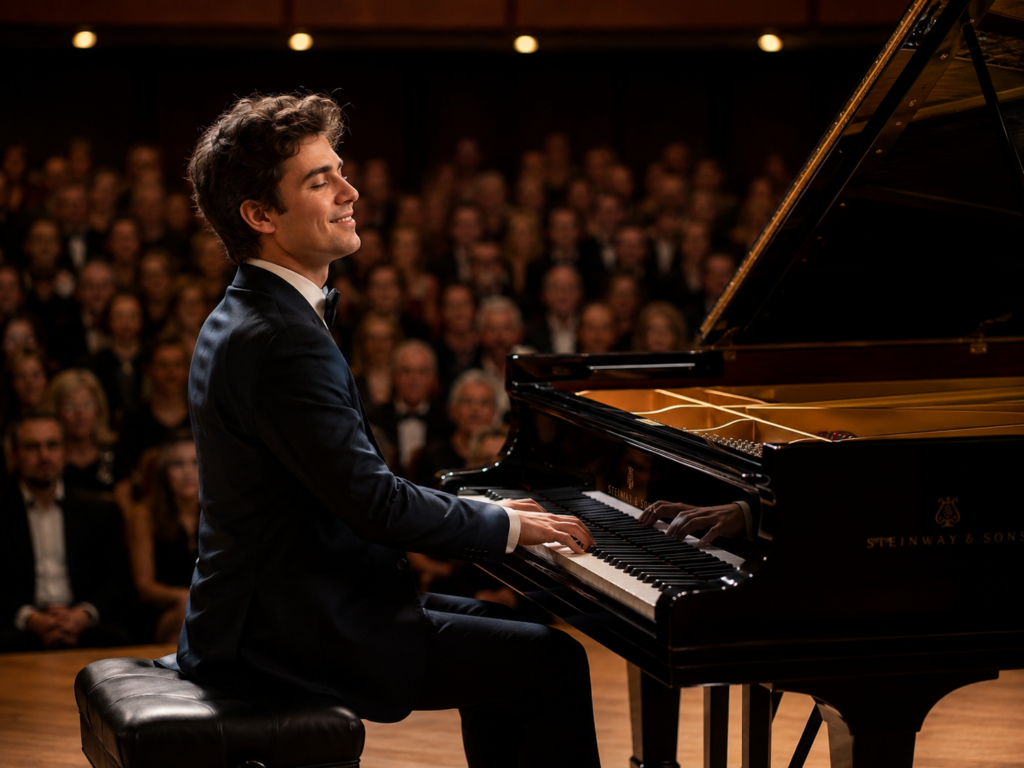
Your piano recital performance begins the moment you walk on stage — not when you play the first note. The way you enter communicates confidence, preparation, and professionalism to your audience before a single sound has been produced.
Walk calmly and deliberately to the piano. Do not look down or rush. When you reach the instrument, pause in front of the piano bench, face your audience, and give a clear, composed bow. This is not a gesture of self-congratulation — it is an acknowledgement of the audience’s presence. They have come to hear you, and that deserves recognition.
After bowing, take your time adjusting the bench. This is a moment many students skip in their eagerness to begin, and it is always a mistake. Correct bench height and distance from the keyboard directly affect tone production, forearm angle, and stamina throughout the performance. Set the bench to the right position in practice, remember that setting, and reproduce it confidently on stage. If the bench needs adjusting after you have sat down, adjust it. Audiences understand — and they will respect you more for taking those ten seconds than they will lose patience.
The bench adjustment is not a sign of disorganisation. It is a sign that you are a professional who knows what you need to play well. Do it without apology.
Once seated, place your hands in your lap for a moment before raising them to the keys. This brief pause settles your breathing, allows the audience to quieten, and gives you a mental reset between the act of walking and the act of playing. Many young performers skip this too. The result is an attack on the first note that is tense, rushed, or uncharacteristically loud. Let the music begin from stillness.
Positive body language at the piano
Positive body language is essential when performing on stage — and for pianists, this has a specific meaning that differs from other performers. You are seated, physically anchored to the instrument. Your expressive range is therefore concentrated in your upper body, your head, and most importantly your arms and hands.
Good posture means a straight but not rigid back, feet flat on the floor (or on the pedals when required), shoulders relaxed and low — not raised towards the ears — and a head that is upright and slightly forward, engaged with the score or the keys. Tension in the shoulders travels directly into the arms and fingers. Students who grip the piano bench or hunch forward consistently produce a harder, less nuanced tone than they achieve in practice, simply because their body is fighting itself.
An audience can hear tension. A pianist who holds their breath through a difficult passage communicates anxiety as clearly as any wrong note — and the recovery is harder.— Observed consistently across student performance preparation at WKMT
Audience awareness also matters. If you are performing from memory, there will be moments when you look up from the keys — and that is as it should be. A pianist who keeps their head down for an entire recital creates a closed, interior atmosphere that does not communicate to the hall. Even a brief lift of the head during a rest or a phrase conclusion reminds the audience that you are performing for them, not simply fulfilling a private task.
Managing memory slips — your Plan B for classical performance
Always have a Plan B. This principle has specific and well-established forms in classical piano recital performance, and it is something every serious student must prepare before they walk on stage.
-
Establish structural recovery points. Before any piano recital performance, identify five to eight points in every piece from which you can restart with confidence — usually the opening of a new section, a return of the main theme, or the beginning of a clearly defined phrase. Drill these recovery points independently until you can begin the piece from any one of them without needing to run through what came before.
-
Build multiple types of memory. Most students rely primarily on motor memory — the fingers knowing what to do from repetition. Motor memory is fast but fragile. Build aural memory (knowing what comes next by sound), analytical memory (knowing the harmonic structure), and visual memory (knowing what the score or keyboard looks like at that point). All four types working together are the most reliable foundation for performance under pressure.
-
When a slip happens: stay calm and continue. If a memory slip occurs and you cannot immediately locate your recovery point, keep your hands moving. In classical performance, a brief wrong note or a condensed passage is infinitely less damaging than a complete stop. Audiences who are not professional musicians rarely detect a slip that is managed calmly; they almost always notice a stop followed by visible distress.
Page-turner protocols
Using a page-turner is common in professional concert performance and in examinations where playing from the score is permitted or required. The page-turner’s role is purely practical: they turn pages at the correct moment without disturbing the performer or the audience. Your role is to make their job easy. Mark the score clearly in advance — a pencil mark at the corner of the page a few bars before a turn is required gives your page-turner time to prepare.
The page-turner is not a prop — they are a collaborator. Treat the rehearsal with them as seriously as any ensemble rehearsal.
Bow etiquette and the art of receiving applause
When you play your final note, let it ring. Maintain your position at the keyboard for a breath or two before raising your hands from the keys, standing, and turning to face the audience.
Your bow should be unhurried. Stand straight, feet together, look at the audience, and bow from the waist to roughly a 30–45 degree angle. Hold the bow for one clear beat, then return to standing. Show your audience that you are grateful for their presence.
Introductions and the personal element in performance
Introductions transform the experience for your audience. You could address the audience yourself from the piano — briefly, clearly, without notes — to tell them what they are about to hear and why you have chosen to play it. Even a sentence or two about the composer or the piece can change an audience’s listening posture entirely.
The classical piano recital performance checklist – A Good Quality Piano Performance Guide
Three-column checklist showing key actions for classical piano recital performance.
BEFORE
DURING
AFTER
✔ Confirm bench height & distance
✔ Mark score recovery points
✔ Rehearse with page-turner
✔ Run all page-turn passages
✔ Warm up hands (not mind)
✔ Prepare opening words
✔ Settle nerves: breathe slowly
✔ Decide on bow style
✔ Check concert attire
✔ Arrive early — walk the stage
✔ Test the instrument action
✔ Walk calmly to the piano
✔ Bow before sitting
✔ Adjust bench without rushing
✔ Hands in lap — then pause
✔ Shoulders relaxed and low
✔ Lift head between pieces
✔ If slip: reach recovery point
✔ Keep hands moving always
✔ Nod to page-turner early
✔ Stay present to the music
✔ Let interpretation live
✔ Let final note fully ring
✔ Hands down — then stand
✔ Turn to face audience
✔ Unhurried bow — hold 1 beat
✔ Acknowledge applause warmly
✔ Return if genuinely called
✔ Leave stage with composure
✔ Reflect — do not self-criticise
✔ Note what worked well
✔ Speak to your teacher
✔ Book your next performance
Apply these in rehearsal so they become automatic on stage.
The checklist is a habit, not a last-minute reminder.
Preparing your piano recital performance: the week before
| Preparation focus | When to do it | Common mistake to avoid |
|---|---|---|
| Full programme run-through in performance attire | 3–4 days before | Stopping to correct passages — always play through |
| Recovery point drill (all pieces) | 4–5 days before | Only ever rehearsing from the beginning |
| Page-turn rehearsal with page-turner | 2–3 days before | Assuming this will work without a joint rehearsal |
| Stage entry and bow practice | 2 days before | Treating this as trivial and skipping it entirely |
| Venue visit and bench adjustment | Day before or morning of | Not testing the actual instrument in advance |
| Gentle warm-up only | Day of performance | Heavy technical drilling the morning of a concert |
For those preparing a concert at a London venue, our guide to organising a concert covers logistics, venue communication, and programme planning from the professional side.
Is a piano recital the right next step for your piano study?
Not every student is ready to perform in public, and there is no shame in that — but nor should performance be treated as something that only advanced players do. Regular performance from an early stage of piano study accelerates development in ways that private practice cannot replicate.
At WKMT, we organise regular student concerts and festivals throughout the year. We believe that a student who performs regularly, receives honest feedback, and develops the resilience to return to the stage after a difficult performance is a student who becomes a musician — not just a pianist. The recital is not the final exam. It is the most important lesson.
Frequently asked questions about piano recital performance – A Good Quality Piano Performance Guide
Bow from the waist to roughly 30–45 degrees and hold the position for one clear beat before returning to standing — roughly two to three seconds in total.
Keep your hands moving and navigate to your nearest prepared recovery point. Prepare five to eight recovery points in every piece you perform from memory, and drill them independently in practice.
This depends on the context, the repertoire, and your level. Formal classical recitals traditionally expect memory for solo repertoire; examination performances often permit or require the score.
A degree of adrenaline before a piano recital performance is normal and useful. Arrive at the venue early, warm up gently on the actual instrument, and focus your pre-performance attention on the music. For students who experience significant performance anxiety, our guide to conquering piano recital nerves covers both the psychological and practical approaches in depth.
Set the bench so that your forearms are roughly parallel to the floor when your hands are on the keys. Establish this setting in practice at home, memorise it, and reproduce it quickly and confidently on stage.
Both. Bow before you sit down to acknowledge the audience. Bow again after your final piece once you have allowed the last note to fully decay.
Prepare Your Piano Recital Performance with WKMT – A Good Quality Piano Performance Guide
At our London studio, every student is prepared not just to practise piano, but to perform it. From bench technique to stage presence, our teachers work with you on every aspect of the concert experience.