
 TRIAL LESSON
Piano Lessons
Critical Thinking Skills: What Children Practise at the Piano
Aug
WKMT London parent guide
Critical Thinking Skills: What Children Practise at the Piano
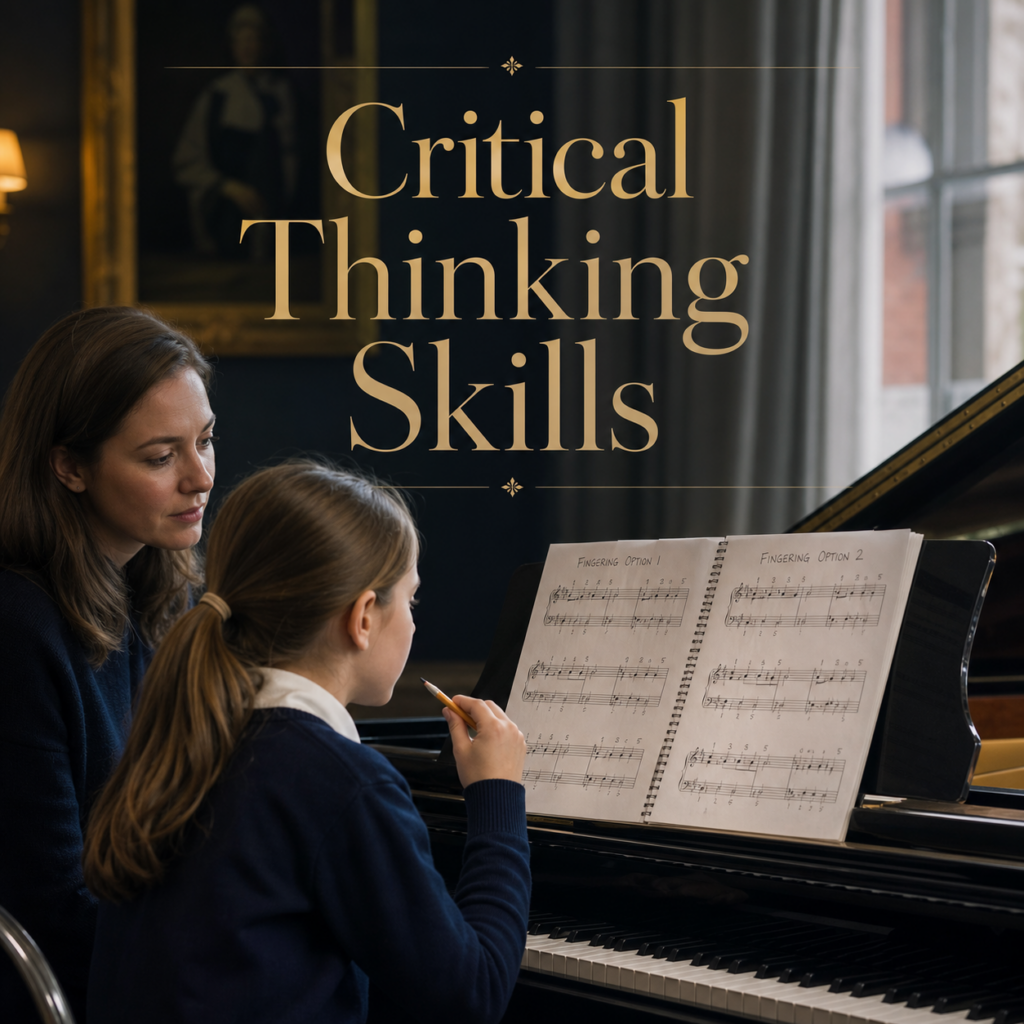
A child stops halfway through a phrase. One note sounds wrong, but the score is not yet giving up its answer. Should the child check the rhythm, compare the hands, test a slower fingering or listen again? That small pause is where piano practice becomes more than repetition: it becomes a sequence of musical decisions.
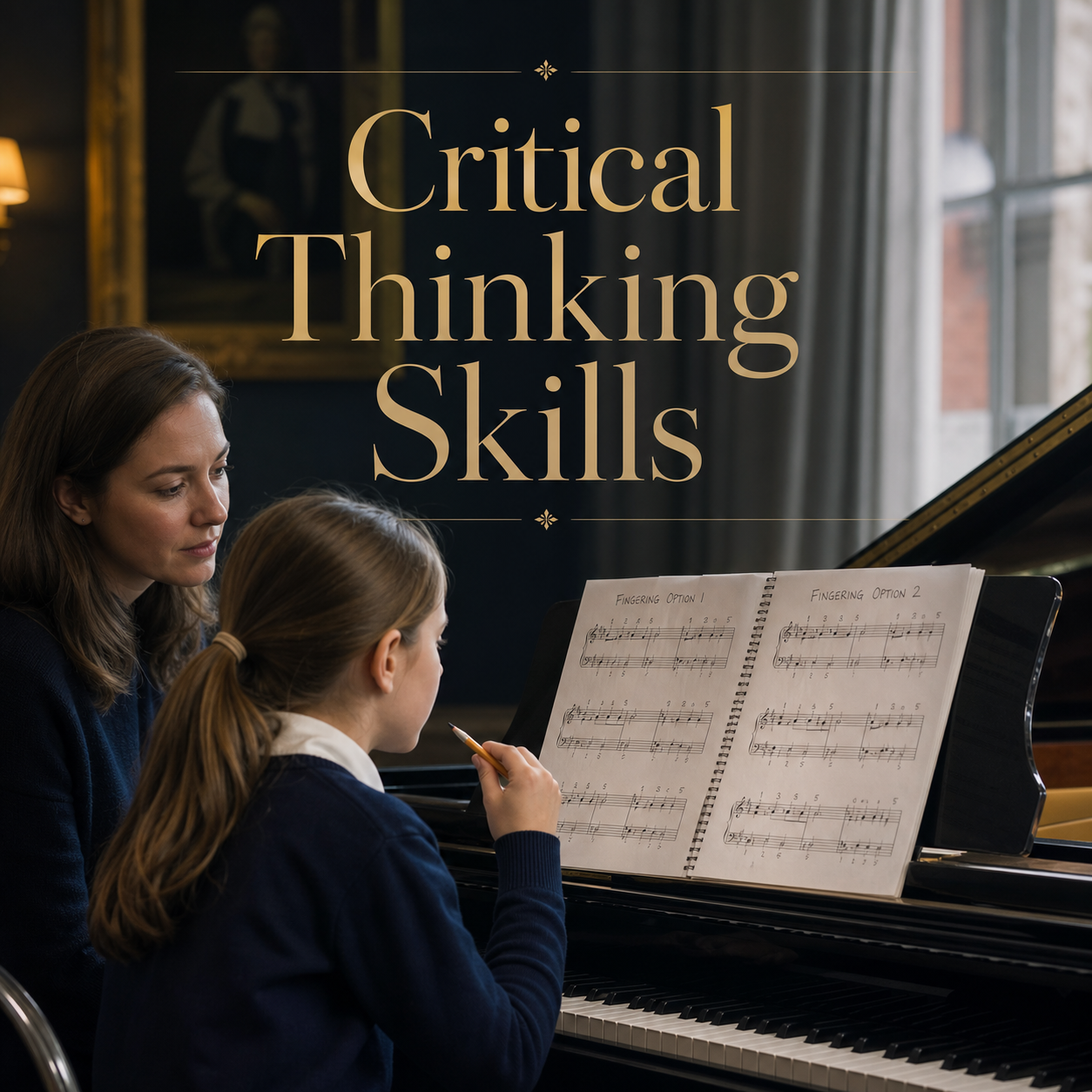
At WKMT London, children learn classical piano through one-to-one tuition, score reading, listening and performance. The instrument supplies immediate feedback: a rhythm either keeps its proportion or loses it; a melody projects or disappears; a fingering supports the phrase or creates unnecessary tension. The lesson helps the child notice that evidence and respond.
Research around music and cognition is promising but mixed. A recent meta-analysis of musical training and executive function in children aged 3–12 reported a small positive overall effect, while also finding substantial variation between studies. A separate systematic review of music training and executive functions found beneficial evidence in some domains and age groups, but also highlighted inconsistent results, varied interventions and several large trials with minimal or no effects.
That distinction matters. Parents do not need inflated claims about a “smarter brain” to value serious music education. Piano study already contains worthwhile habits of attention, judgement and self-correction.
What critical thinking skills look like in a piano lesson
Critical thinking is not simply being clever or disagreeing with an answer. It involves examining information, choosing a method, testing an explanation and revising a conclusion when the evidence changes. At the piano, those actions are audible and concrete.
Compare
Which fingering gives the phrase greater ease and continuity?
Predict
What will happen to the pulse if this difficult leap is rushed?
Diagnose
Is the problem a wrong note, an uncertain rhythm or an awkward movement?
Explain
Why does one dynamic shape make the cadence sound more convincing?
A beginner may answer with a gesture or a few words. An older student can compare recordings, mark a score and defend an interpretation. The sophistication changes with age, but the structure remains: notice, question, test, listen and decide.
From instructions to independent musical questions
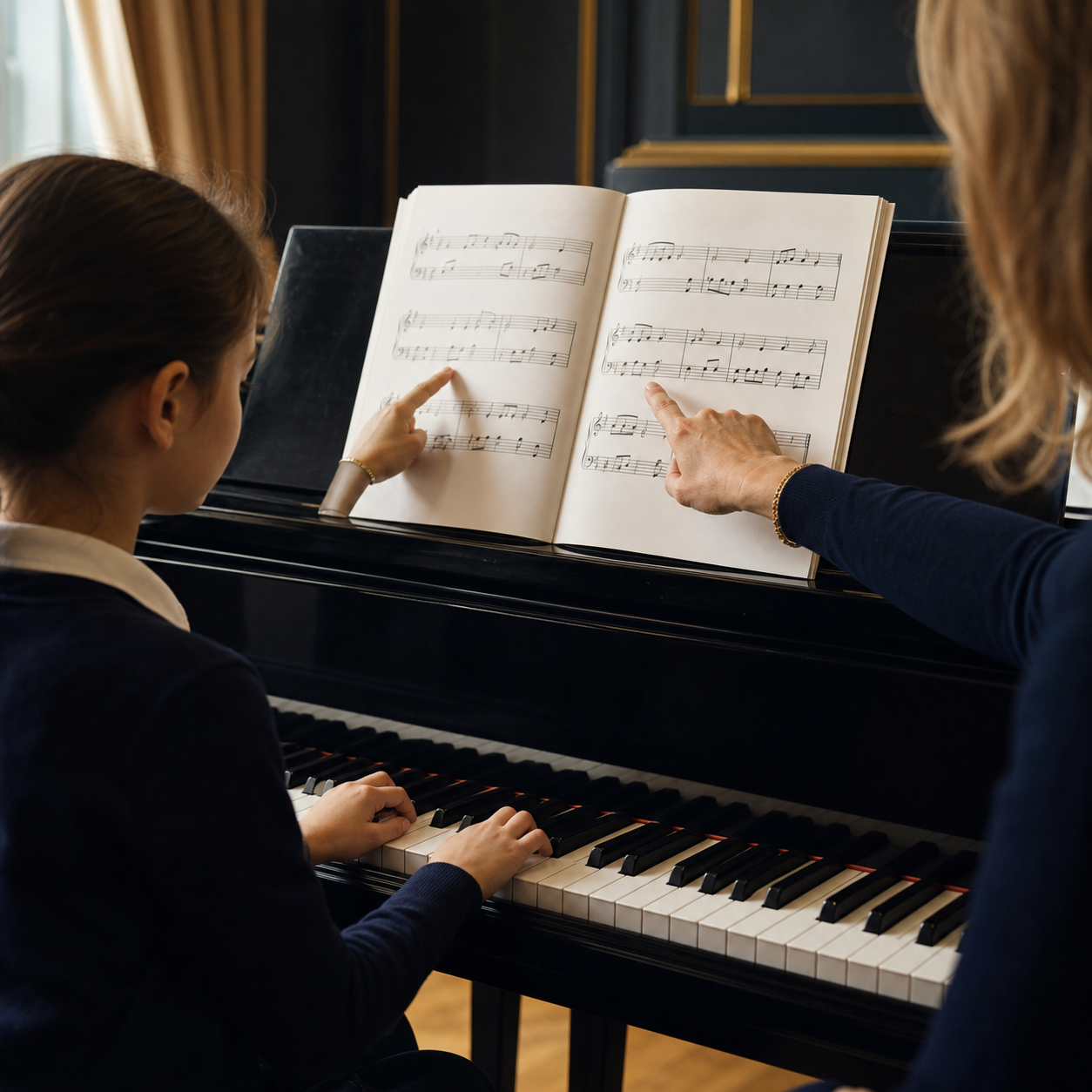
Young learners naturally need clear instruction. A teacher may first demonstrate a curved phrase, count a dotted rhythm or show how the arm travels across the keyboard. Yet instruction should gradually produce independence. If every correction always arrives from the adult, the child may play accurately in the lesson without learning how to find the next correction alone.
The Education Endowment Foundation’s guidance on metacognition and self-regulated learning recommends making planning, monitoring and evaluation explicit within subject teaching. Piano lessons offer a practical version of that cycle:
- Plan: name the musical goal and choose a small passage.
- Monitor: listen for one feature while playing or recording.
- Evaluate: compare the result with the score, model or intended sound.
- Adapt: change the tempo, fingering, grouping or practice method.
These steps develop critical thinking skills because the learner must connect an action to an outcome. “Play it again” becomes “play the left hand alone to check whether the rhythm is stable.” “Make it musical” becomes “shape the four-bar question towards its highest note, then let the answer settle.” Specific thought produces specific sound.
The aim is not to remove difficulty for a child, but to make difficulty small enough to investigate.
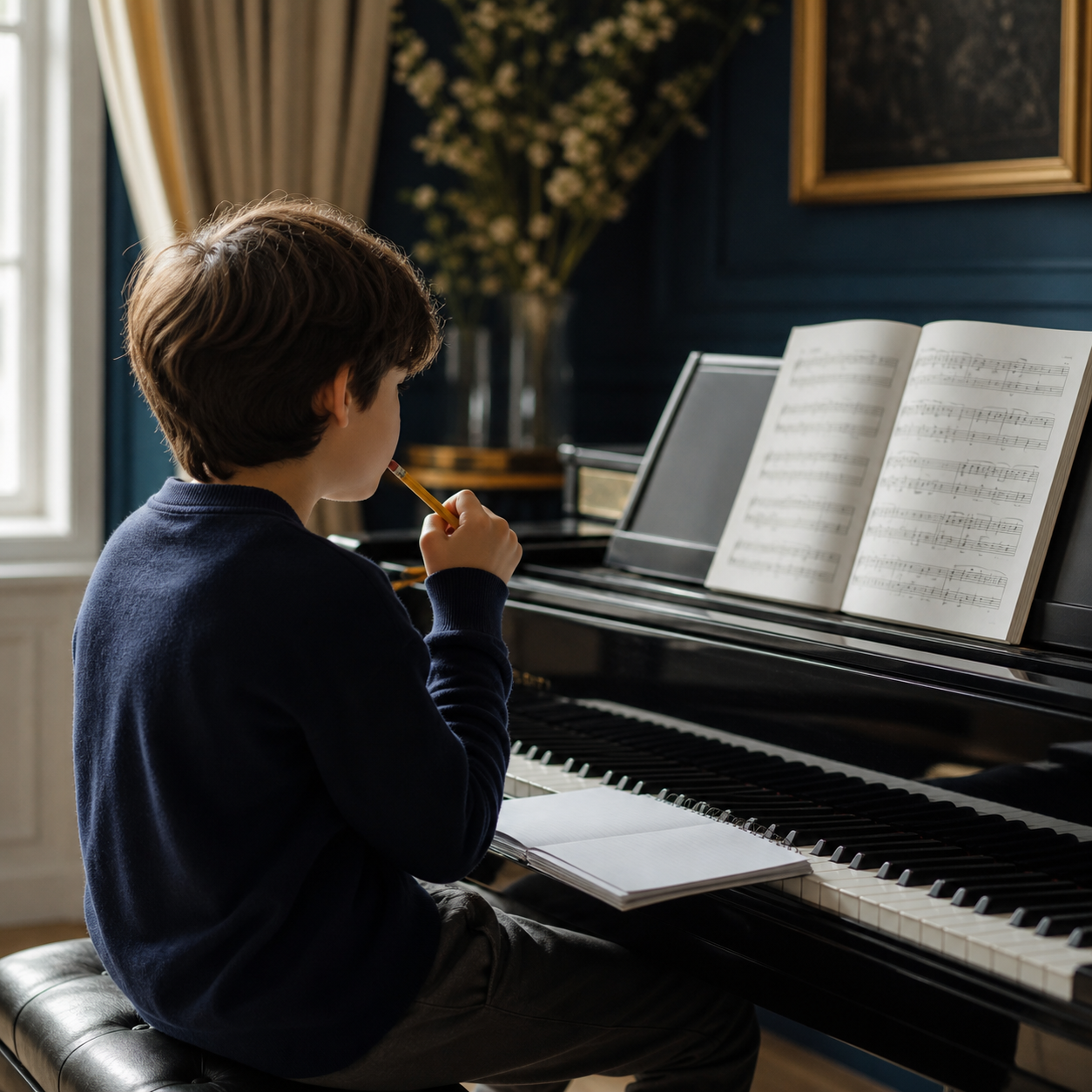
Five piano tasks that exercise careful judgement
1. Find the useful mistake
Ask the child to play four bars, then identify just one difference between the performance and the score. The difference might be pitch, rhythm, articulation or dynamic shape. Limiting the search prevents a flood of criticism and makes error diagnosis manageable.
2. Compare two practice methods
Try a passage hands separately, then in blocked chords, then very slowly with both hands. Which method reveals the real problem? The answer will vary. Choosing between methods builds critical thinking skills more effectively than assuming the same exercise solves every difficulty.
3. Predict before playing
Before a repetition, ask what the listener should hear: a steady bass, a longer line, a quieter accompaniment or a clean release. Prediction gives the repetition a purpose. Afterwards, the child can judge whether the expected change occurred.
4. Defend an interpretation
Play a phrase in two credible ways. One may lean towards the cadence; another may preserve a more measured Classical balance. Ask the child which version better fits the harmony and character. There need not be one automatic answer, but there should be a musical reason.
5. Leave evidence for tomorrow
End practice with a one-line note: “The rhythm works at 72; next time connect bars 8–9 without pedal.” This records a conclusion and a next test. It also prevents the next session from beginning with an unfocused run-through.
What the research can and cannot prove
Executive functions include working memory, inhibitory control and cognitive flexibility. They help children hold information in mind, resist an unhelpful response and change approach when circumstances demand it. The Harvard Center on the Developing Child describes these capacities as skills that develop through experience and practice rather than fixed traits.
Music training can require those processes: reading ahead while playing, maintaining pulse, suppressing an impulsive speed and adjusting after listening. A 2.5-year study of primary-school music education reported changes in executive functions and academic outcomes, while a 2024 study examined the association between music training and executive function in six- and seven-year-olds.
Still, association is not the same as proof that piano lessons alone produce broad critical thinking skills. Families who choose music may differ in other ways; programmes vary in duration and quality; and cognitive tests do not always transfer neatly to everyday reasoning. Reviews have found positive results alongside null findings and methodological limitations. The responsible conclusion is modest: well-taught piano provides a rich setting in which children can practise planning, inhibition, working memory and flexible problem-solving. Those are educationally valuable experiences even when far-transfer claims remain uncertain.
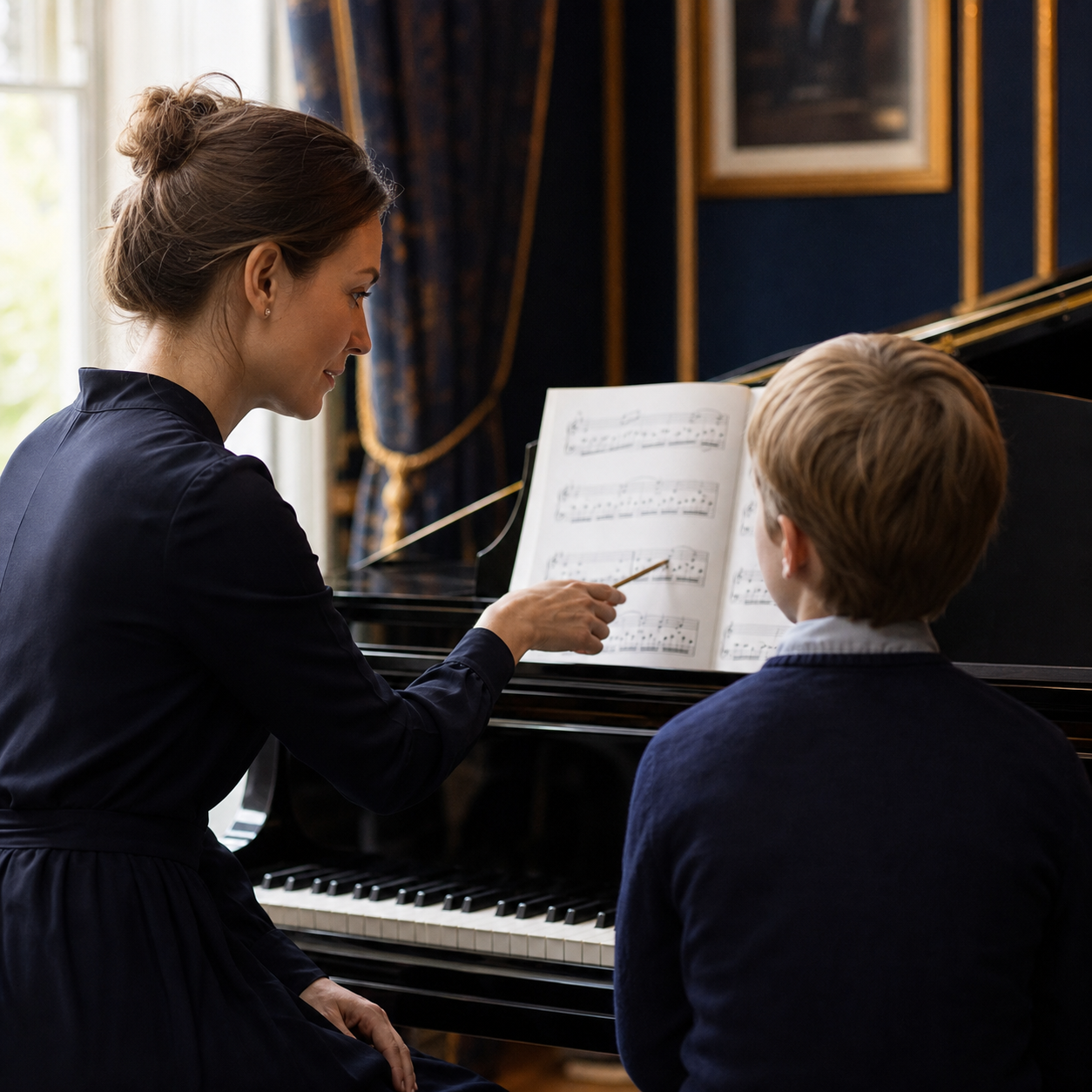
How parents can support critical thinking skills at home
Home practice should not become an oral examination. Children think more clearly when the task is bounded, the emotional temperature is low and mistakes are treated as information. Parents can protect that environment without correcting every note.
- Ask before telling. Give the child a few seconds to identify what changed.
- Reduce the size. Two bars can provide better evidence than a whole-page run.
- Keep one focus. Rhythm, notes, movement and expression cannot all be monitored equally at once.
- Use recordings sparingly. A ten-second playback can settle a question that repeated argument cannot.
- Return authority to the score. “What does the marking show?” is often more useful than “I think it should be louder.”
- Save unresolved questions. A lesson notebook lets uncertainty become material for the teacher.
WKMT’s guide to piano practice tips for parents offers further help with routines, encouragement and realistic support. Families considering lessons can also read how to know if a child is ready for piano.
Progress is easier to see over several weeks than in a single evening. One week the child may need prompts for every decision; later, the same learner may stop independently, isolate a bar and explain why a new fingering works. Those observable behaviours are a better measure of developing critical thinking skills than a vague promise that music will raise performance in unrelated subjects.
What good teaching adds
A child cannot discover every efficient movement, stylistic convention or reading strategy unaided. Good teaching supplies knowledge, demonstrates expert listening and chooses questions that are challenging without being vague. The teacher knows when to explain directly and when to wait.
Over time, that balance changes. The beginner learns to distinguish a wrong pitch from a wrong finger. The developing player learns to locate the cause of unevenness. The more advanced student weighs fingering, pedalling, historical style and personal interpretation. Critical thinking skills deepen because musical knowledge deepens; judgement without knowledge would be guesswork.
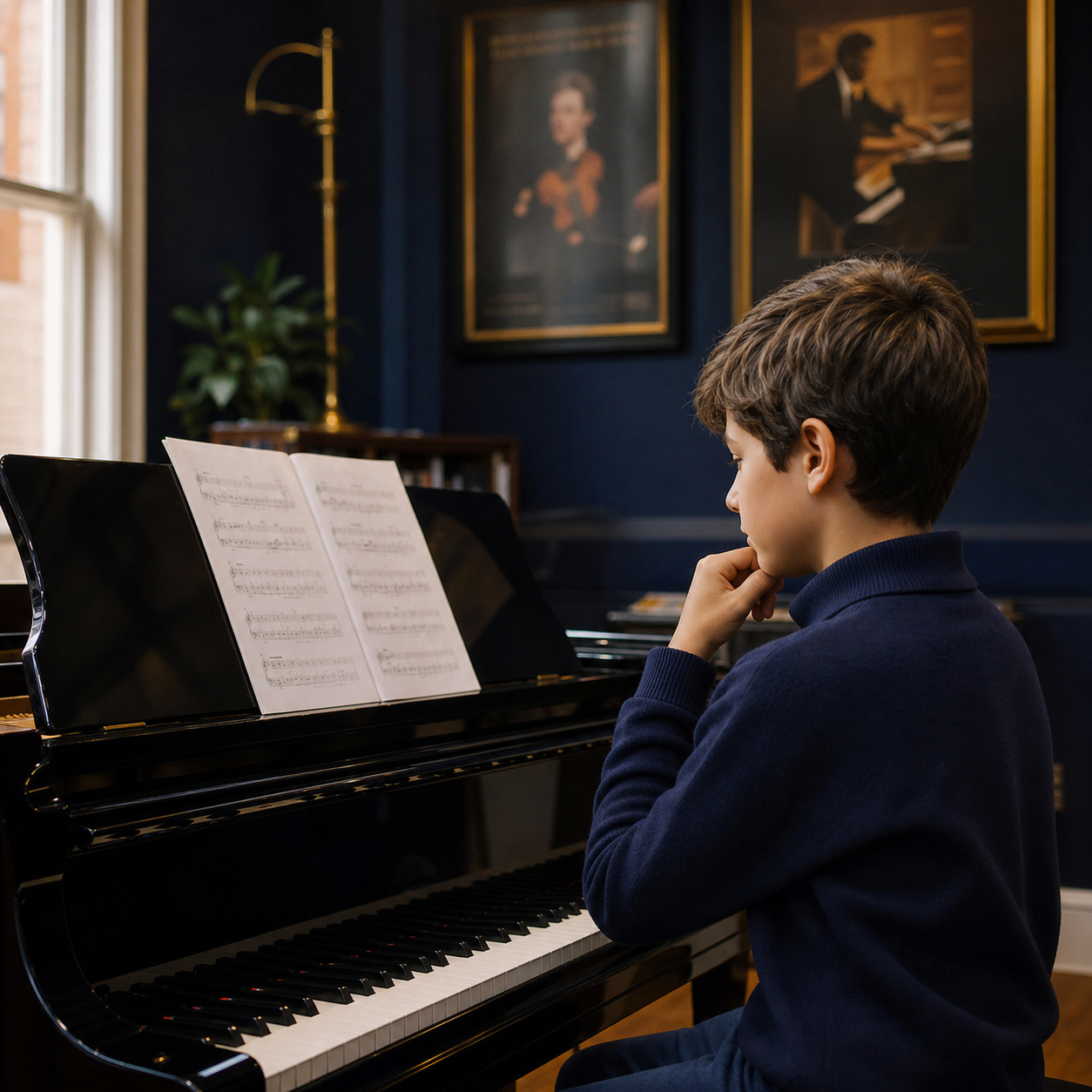
WKMT London
Build musical independence through individual classical piano tuition that combines technique, listening, score reading and thoughtful practice.
Questions parents often ask
Does piano make children better critical thinkers?
Piano study can exercise planning, comparison, inhibition, working memory and self-evaluation. Research suggests possible cognitive benefits, but it does not justify promising that lessons automatically improve general intelligence or every form of reasoning.
What if my child always waits for the teacher’s answer?
Begin with a small choice between two strategies and ask what each reveals. Independent judgement develops gradually from structured questions, secure knowledge and permission to test an imperfect idea.
Should parents correct mistakes during practice?
Correct urgent misunderstandings calmly, but avoid commenting on every note. Ask what the child notices, narrow the passage and keep a notebook question for the teacher when the cause is unclear.
A short parent resource
“Critical Thinking Skills for Kids” offers general parent prompts for encouraging problem-solving. Video attribution: embedded from YouTube for educational commentary; all rights remain with the channel or rights holder. WKMT is not affiliated with or endorsed by the creator.
Sources
- Education Endowment Foundation: Metacognition and Self-Regulated Learning
- Harvard Center on the Developing Child: Executive Function
- Three-level meta-analysis of musical training and executive function in children
- Systematic review of music training and executive functions in children
- Longitudinal analysis of music education and executive functions
- Frontiers in Education: music training and executive function in young children
Sources last checked 29 August 2026.